

|
시장보고서
상품코드
2099810
AI 메모리 시장 : 시장 점유율 분석, 업계 동향 및 통계, 성장 예측(2026-2031년)AI Memory - Market Share Analysis, Industry Trends & Statistics, Growth Forecasts (2026 - 2031) |
||||||
 Mordor Intelligence
Mordor Intelligence에 의하면, AI 메모리 시장 규모는 2025년 217억 2,000만 달러로 평가되었고, 2026년에는 279억 3,000만 달러로 확대될 것으로 추정되고, 2026-2031년 CAGR 28.61%로 성장을 지속할 전망이며, 2031년에는 982억 8,000만 달러에 이를 것으로 예측됩니다.
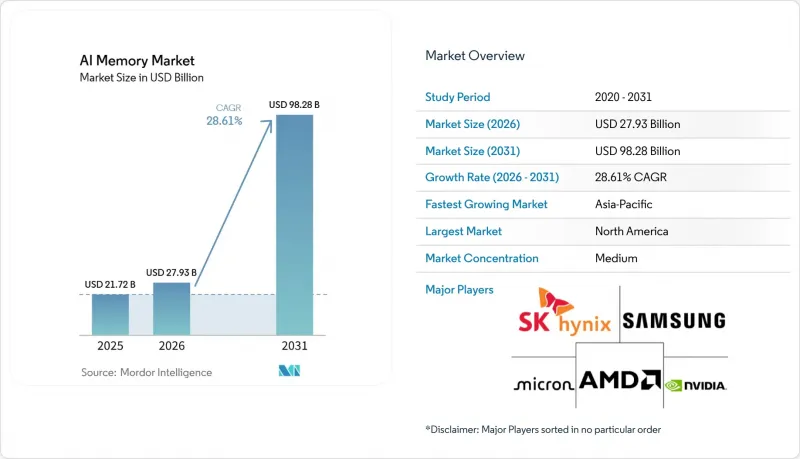
본 보고서는 메모리 기술별(HBM, AI 서버용 DRAM, GDDR, AI 엣지 메모리용 LPDDR 등), AI 용도별(AI 훈련 및 모델 개발, AI 추론, HPC 및 과학 분야용 AI), 컴퓨팅 플랫폼별(AI 서버, AI 연산 가속기, AI 네트워크 인프라, 엣지 AI 시스템 등), 그리고 지역별로 분류되어 있습니다. 시장 전망은 금액(달러) 기준으로 제시되어 있습니다.
세계의 AI 메모리 시장 동향 및 인사이트
AI 가속기에서 HBM3E 및 HBM4 채택 확대
각 가속기 벤더들이 차세대 플랫폼마다 더 큰 대역폭과 전력 효율 향상을 추구하는 가운데, HBM3E에서 HBM4로의 전환이 빠르게 진행되고 있습니다. NVIDIA는 2026년 5월, Vera Rubin 플랫폼이 본격적인 양산 단계에 접어들었다고 발표했습니다. 이는 차세대 메모리 수요가 초기 샘플 제공 단계가 아닌, 실제 생산 도입으로 직접 이어지고 있음을 뒷받침하는 것입니다. 이는 중요한 점입니다. 왜냐하면 HBM은 더 이상 최첨단 AI 시스템에서의 프리미엄 선택지가 아니라, 컴퓨팅 스택의 필수 요소가 되었기 때문입니다. 구매자들이 하드웨어 로드맵을 더 고성능의 가속기에 맞추어 나가면서, 메모리 계획은 더 일찍 시작되고 더 오랜 기간에 걸쳐 확정되게 될 것입니다. 이에 따라 조달은 단기 주기의 부품 구매에서 플랫폼 수준의 확약으로 전환될 것입니다. AI 메모리 시장에서 이러한 추세는 HBM을 매출 성장과 전략적 공급업체로서의 지위 중심에 계속 두게 될 것입니다.
하이퍼스케일 AI 서버 군의 확대
대규모 AI 서버 프로그램은 단계적인 시범 운영에서 클라우드 인프라 전반에 걸친 본격적인 도입 주기로 전환되고 있습니다. AMD와 Meta Platforms는 2026년 2월, 6기가와트 규모의 AMD GPU 인프라를 구축하기 위한 협력 확대를 발표했으며, 첫 1기가와트 분량의 출하가 2026년 하반기에 시작될 예정입니다. 이러한 규모의 확장이 이루어질 때마다 HBM, 서버용 DRAM, 스토리지 메모리, 네트워크용 메모리가 동시에 도입됩니다. 즉, 성장은 단일 메모리 유형에 국한되지 않고 AI 클러스터를 뒷받침하는 전체 스택으로 확대될 것입니다. 또한, 신뢰성 높은 인증, 안정적인 생산량, 로드맵의 지속성을 제공할 수 있는 공급업체가 유리해집니다. 따라서 AI 메모리 시장은 서버 군의 대수 증가와 도입되는 각 시스템 내 메모리 탑재량 증가라는 두 가지 혜택을 모두 누리고 있습니다.
패키지 수준에서의 엄격한 열 설계 및 수율 제약
첨단 적층형 메모리는 더 좁은 열 설계 범위 내에서 더 많은 층이 연동하여 작동해야 하므로, 기존 메모리보다 스케일링이 어렵습니다. 이는 특히 HBM에서 중요하며, 완제품의 품질은 웨이퍼 공급과 마찬가지로 패키징 품질에 크게 좌우됩니다. 패키징 성능이 저하되면 최종 수요가 견조하더라도 가속기의 납품이 지연될 가능성이 있습니다. 또한, 각 세대는 양산 출하 전에 열 설계, 신뢰성 및 플랫폼 수준의 요구 사항을 충족해야 하므로 검증에도 시간이 소요됩니다. 이로 인해 신제품 세대의 양산 개시를 위한 유효 기간(램프업 기간)이 좁아질 가능성이 있습니다. 따라서 AI 메모리 시장은 수요 환경이 견조하더라도 패키지 수준의 실행 위험에 지속적으로 노출될 수밖에 없습니다.
부문 분석
2025년, HBM은 AI 메모리 시장 점유율의 55.60%를 차지했으며, 이는 하이퍼스케일 훈련 인프라가 해당 연도의 수익에 얼마나 큰 영향을 미쳤는지를 보여줍니다. 이러한 우위는 주요 AI 가속기가 매우 높은 대역폭을 가진 메모리에 의존하고 있으며, 없이는 기대되는 처리량을 유지할 수 없습니다는 사실에서 기인합니다. NVIDIA는 2026년 5월, Vera Rubin이 본격적인 양산 단계로 접어들고 있다고 발표했으며, 이는 차세대 시스템이 본격적으로 도입됨에 따라 HBM에 대한 수요가 지속될 것임을 뒷받침합니다. AI 서버용 DRAM은 대규모 AI 시스템에서 여전히 가속기 콤플렉스 주변에 충분한 메인 메모리가 필요하기 때문에 2위 기술 계층으로서의 지위를 유지했습니다.
GDDR은 GDDR7의 상용화에 힘입어 2031년까지 연평균 성장률(CAGR) 29.44%를 기록하며 AI 메모리 시장에서 가장 빠른 규모 확장을 보일 것으로 예측됩니다. Rambus는 GDDR7이 2024년 3월 JEDEC에 의해 표준화되어 그래픽 및 가속기 용도를 위한 더 높은 성능의 로드맵을 제시했다고 지적했습니다. 이에 따라 AI 메모리 업계에서 GDDR은 더 높은 대역폭을 필요로 하지만 반드시 HBM급 패키징이 필요하지는 않은 GPU 및 엣지 가속기 분야에서 더욱 확고한 입지를 다지게 될 것입니다. 또한, 추론 시스템과 엣지 디바이스는 엄격한 열 제한 하에서 와트당 대역폭 향상이 필요하기 때문에 AI 엣지 메모리인 LPDDR도 확대될 것으로 전망됩니다. 기타 메모리 기술, 특히 CXL 기반의 확장에 대해서는 Penguin Solutions가 2026년 3월, 엔터프라이즈용 추론을 위해 최대 11TB의 메모리를 탑재한 양산 가능한 CXL 기반 KV 캐시 서버를 발표함에 따라, 추가적인 성장 여지가 확대되고 있습니다.
지역별 분석
2025년, 북미는 AI 메모리 시장 점유율의 38.41%를 차지하며 최대 지역 수요 거점이 되었습니다. 이러한 우위는 하이퍼스케일러들의 AI 인프라 확충에 기인하며, 이로 인해 메모리는 단순한 일상적인 서버 구성 요소가 아닌 전략적 조달 품목으로 자리매김했습니다. 또한, 이 지역에는 주요 클라우드 및 가속기 플랫폼 구매자들이 집중되어 있어, 인증된 공급처에 대한 강력한 견인력을 발휘하고 있습니다. 이에 따라 AI 메모리 시장에서 북미는 단기적인 할당 결정과 장기적인 플랫폼 계획 모두에서 중심적인 위치를 계속 차지하고 있습니다.
아시아태평양은 2031년까지 연평균 성장률(CAGR) 29.48%를 나타낼 것으로 예측되며, AI 메모리 시장에서 가장 빠르게 성장하는 지역이 될 전망입니다. 이 지역은 주요 HBM 제조 거점 및 지원적인 패키징 생태계의 상당 부분을 보유하고 있어, 수요 측면과 생산 측면 모두에서 중요한 역할을 수행하고 있습니다. 한국은 계속해서 첨단 AI 메모리의 핵심 생산 거점이며, 한편 일본은 HBM 생산 능력에 대한 신규 투자를 통해 추가적인 제조 거점으로서의 역할을 강화하고 있습니다. 중국에서는 기술적 제약으로 인해 도입 가능한 메모리 인프라의 유형가 제한적인 반면, 국내 AI 모델 개발 증가를 통해 새로운 수요층이 형성되고 있습니다. 인도는 클라우드 확대와 AI 스타트업 증가에 힘입어 예측 기간 동안 소비 시장으로서 더욱 부상하고 있습니다.
유럽 및 기타 지역은 2025년 AI 메모리 시장에서 점유율은 작았지만, 그 수요 패턴은 전략적으로 특징적이었습니다. 유럽에서는 수요가 산업용 AI, 금융 서비스, 생명과학, 그리고 추적 가능성과 에너지 효율을 중시하는 국가 주도 컴퓨팅 프로그램에 집중되어 있습니다. 남미, 중동 및 아프리카는 여전히 초기 단계 시장이지만, 주정부 주도 클라우드 프로그램과 지역 전반에 걸친 데이터센터 투자 확대를 통해 AI 추론에 대한 수요가 더욱 증가하고 있습니다. 이는 매출 집중도가 북미에서 가장 높고, 생산 집중도가 아시아태평양에서 가장 강한 상태가 지속되고 있음에도 불구하고, AI 메모리 시장의 세계 전개 범위가 확대되고 있음을 의미합니다.
기타 혜택 :
- 엑셀 형식 시장 예측(ME) 시트
- 3개월간의 애널리스트 지원
자주 묻는 질문
목차
제1장 서론
제2장 조사 방법
제3장 주요 요약
제4장 시장 구도
제5장 시장 규모 및 성장 예측
제6장 경쟁 구도
제7장 시장 기회 및 향후 전망
AJY 26.08.11According to Mordor Intelligence, the AI memory market size is expected to grow from USD 21.72 billion in 2025 to USD 27.93 billion in 2026 and is forecast to reach USD 98.28 billion by 2031 at 28.61% CAGR over 2026-2031.
This report is Segmented by Memory Technology (HBM, AI Server DRAM, GDDR, AI Edge Memory LPDDR, and More), AI Application (AI Training and Model Development, AI Inference, and AI Inference, and HPC and Scientific AI), Computing Platform (AI Servers, AI Compute Accelerators, AI Networking Infrastructure, Edge AI Systems, and More), and Geography. The Market Forecasts are Provided in Terms of Value (USD).
Global AI Memory Market Trends and Insights
Growing Adoption of HBM3E And HBM4 in AI Accelerators
The move from HBM3E to HBM4 is progressing quickly as accelerator vendors push for more bandwidth and better power efficiency in each new platform generation. NVIDIA stated in May 2026 that the Vera Rubin platform was ramping into full production, which confirms that next-generation memory demand is now tied directly to production deployments rather than early sampling activity. This matters because HBM is no longer a premium option inside leading AI systems and has become a required part of the compute stack. As buyers align hardware roadmaps with more capable accelerators, memory planning starts earlier and stays locked in for longer periods. That shifts procurement from short-cycle component buying toward platform-level commitment. For the AI memory market, this keeps HBM at the center of revenue growth and strategic supplier positioning.
Expansion of Hyperscale AI Server Fleets
Large AI server programs are moving from staged pilots to committed deployment cycles across cloud infrastructure. AMD and Meta Platforms announced in February 2026 an expanded partnership to deploy 6 gigawatts of AMD GPU infrastructure, with shipments for the first-gigawatt phase beginning in the second half of 2026. Each rollout of that scale pulls in HBM, server DRAM, storage memory, and networking memory at the same time. That means growth is not confined to a single memory type and instead spreads across the full stack that supports AI clusters. It also favors suppliers that can offer dependable qualification, stable output, and roadmap continuity. The AI memory market is therefore benefiting from both larger fleet counts and higher memory content inside each deployed system.
High Package-Level Thermal and Yield Constraints
Advanced stacked memory is harder to scale than conventional memory because more layers have to perform together inside a tighter thermal envelope. This is especially important in HBM, where finished output depends on packaging quality as much as wafer supply. If packaging performance slips, accelerator deliveries can slow even when end demand stays firm. Validation also takes time because each generation has to clear thermal, reliability, and platform-level requirements before volume shipment. That can narrow the usable ramp window for a new product generation. The AI memory market therefore stays exposed to package-level execution risk even when demand conditions remain strong.
Other drivers and restraints analyzed in the detailed report include:
- Rising AI Training and Inference Compute Density
- Memory Content Inflation in AI Servers and Racks
- Limited Qualified Supply Base for Advanced HBM
For complete list of drivers and restraints, kindly check the Table Of Contents.
Segment Analysis
HBM held 55.60% of AI memory market share in 2025, which shows how strongly hyperscale training infrastructure shaped revenue during the year. Its lead came from the fact that leading AI accelerators depend on very high bandwidth memory and cannot sustain expected throughput without it. NVIDIA said in May 2026 that Vera Rubin was ramping into full production, which supports continued HBM demand as next-generation systems move into active deployment. AI Server DRAM remained the second-largest technology layer because large AI systems still need substantial main memory around the accelerator complex.
GDDR is projected to record the fastest AI memory market size growth at 29.44% CAGR through 2031, supported by the commercial rollout of GDDR7. Rambus noted that GDDR7 was standardized by JEDEC in March 2024 and brought a higher-performance path for graphics and accelerator applications. Within the AI memory industry, that gives GDDR a stronger position in GPUs and edge accelerators that need higher bandwidth but do not always require HBM-class packaging. AI Edge Memory LPDDR is also set to expand as inference systems and edge devices need better bandwidth per watt under tight thermal limits. Other memory technology, including CXL-based expansion, adds a longer runway because Penguin Solutions introduced a production-ready CXL-based KV cache server with up to 11TB of memory for enterprise inference in March 2026.
Complete Report Scope:
- By Memory Technology
- HBM
- AI Server DRAM
- GDDR
- AI Edge Memory LPDDR
- Other Memory Technologies (CXL Memory and Other Emerging Memory Types)
- By AI Application
- AI Training and Model Development
- AI Inference
- HPC and Scientific AI
- By Computing Platform
- AI Servers
- AI Compute Accelerators
- AI Networking Infrastructure
- Edge AI Systems
- Other Computing Platforms (Specialized AI Computing Platforms and AI Workstations)
- By Geography
- North America
- United States
- Canada
- Mexico
- Europe
- United Kingdom
- Germany
- France
- Italy
- Rest of Europe
- Asia-Pacific
- China
- Japan
- South Korea
- India
- Rest of Asia-Pacific
- South America
- Middle East and Africa
- North America
Geography Analysis
North America held 38.41% of AI memory market share in 2025, which made it the largest regional demand center. Its lead came from hyperscaler AI infrastructure buildouts that turned memory into a strategic procurement item instead of a routine server component. The region also benefits from the concentration of major cloud and accelerator platform buyers, which gives it strong pull on qualified supply. This keeps North America central to both near-term allocation decisions and longer-term platform planning in the AI memory market.
Asia-Pacific is projected to grow at a 29.48% CAGR through 2031, making it the fastest-growing region in the AI memory market. The region matters on both the demand side and the production side because it houses the main HBM manufacturing base and much of the supporting packaging ecosystem. South Korea remains the core production center for advanced AI memory, while Japan is strengthening its role as an additional manufacturing node through new investment in HBM capacity. China adds another layer of demand through rising domestic AI model development, even as technology restrictions shape the type of memory infrastructure that can be deployed. India is emerging more as a consumption market during the forecast period, supported by cloud expansion and a growing AI startup base.
Europe and the remaining regions represented a smaller share of the AI memory market in 2025, but their demand pattern is strategically distinct. In Europe, demand is centered on industrial AI, financial services, life sciences, and sovereign computing programs that place a premium on traceability and energy efficiency. South America, the Middle East, and Africa remain earlier-stage markets, yet they are developing additional AI inference demand through sovereign cloud programs and wider regional data center investment. This means the global footprint of the AI memory market is broadening even though revenue concentration remains highest in North America and production concentration remains strongest in Asia-Pacific.
- SK hynix Inc.
- Samsung Electronics Co., Ltd.
- Micron Technology, Inc.
- NVIDIA Corporation
- Advanced Micro Devices, Inc.
- Intel Corporation
- Broadcom Inc.
- Marvell Technology, Inc.
- Taiwan Semiconductor Manufacturing Company Limited
- ASML Holding N.V.
- Applied Materials, Inc.
- Lam Research Corporation
- KLA Corporation
- Tokyo Electron Limited
- Amkor Technology, Inc.
- ASE Technology Holding Co., Ltd.
- JCET Group Co., Ltd.
- Powertech Technology Inc.
- Google LLC
- Amazon.com, Inc.
- Meta Platforms, Inc.
Additional Benefits:
- The market estimate (ME) sheet in Excel format
- 3 months of analyst support
TABLE OF CONTENTS
1 INTRODUCTION
- 1.1 Study Assumptions and Market Definition
- 1.2 Scope of the Study
2 RESEARCH METHODOLOGY
3 EXECUTIVE SUMMARY
4 MARKET LANDSCAPE
- 4.1 Market Overview
- 4.2 Market Drivers
- 4.2.1 Growing Adoption of HBM3E and HBM4 in AI Accelerators
- 4.2.2 Rising AI Training and Inference Compute Density
- 4.2.3 Expansion of Hyperscale AI Server Fleets
- 4.2.4 Higher Bandwidth Demand Per Watt in Advanced GPUs and ASICs
- 4.2.5 Persistent KV Cache Growth in Long-Context Agentic AI Workloads
- 4.2.6 Memory Content Inflation in AI Servers and Racks
- 4.3 Market Restraints
- 4.3.1 High Package-Level Thermal and Yield Constraints
- 4.3.2 Limited Qualified Supply Base for Advanced HBM
- 4.3.3 Heavy Dependence on Advanced Packaging Capacity
- 4.3.4 Rapid Obsolescence Risk Across HBM Generations
- 4.4 Industry Value Chain Analysis
- 4.5 Industry Supply Chain Analysis
- 4.6 Impact of Macroeconomic Factors on the Market
- 4.7 Regulatory Landscape
- 4.8 Technological Outlook
- 4.9 Porter's Five Forces Analysis
- 4.9.1 Bargaining Power of Suppliers
- 4.9.2 Bargaining Power of Buyers
- 4.9.3 Threat of New Entrants
- 4.9.4 Threat of Substitutes
- 4.9.5 Competitive Rivalry
5 MARKET SIZE AND GROWTH FORECASTS (VALUE)
- 5.1 By Memory Technology
- 5.1.1 HBM
- 5.1.2 AI Server DRAM
- 5.1.3 GDDR
- 5.1.4 AI Edge Memory LPDDR
- 5.1.5 Other Memory Technologies (CXL Memory and Other Emerging Memory Types)
- 5.2 By AI Application
- 5.2.1 AI Training and Model Development
- 5.2.2 AI Inference
- 5.2.3 HPC and Scientific AI
- 5.3 By Computing Platform
- 5.3.1 AI Servers
- 5.3.2 AI Compute Accelerators
- 5.3.3 AI Networking Infrastructure
- 5.3.4 Edge AI Systems
- 5.3.5 Other Computing Platforms (Specialized AI Computing Platforms and AI Workstations)
- 5.4 By Geography
- 5.4.1 North America
- 5.4.1.1 United States
- 5.4.1.2 Canada
- 5.4.1.3 Mexico
- 5.4.2 Europe
- 5.4.2.1 United Kingdom
- 5.4.2.2 Germany
- 5.4.2.3 France
- 5.4.2.4 Italy
- 5.4.2.5 Rest of Europe
- 5.4.3 Asia-Pacific
- 5.4.3.1 China
- 5.4.3.2 Japan
- 5.4.3.3 South Korea
- 5.4.3.4 India
- 5.4.3.5 Rest of Asia-Pacific
- 5.4.4 South America
- 5.4.5 Middle East and Africa
- 5.4.1 North America
6 COMPETITIVE LANDSCAPE
- 6.1 Market Concentration
- 6.2 Strategic Moves
- 6.3 Market Share Analysis
- 6.4 Company Profiles (includes Global Level Overview, Market Level Overview, Core Segments, Financials as available, Strategic Information, Market Rank/Share, Products and Services, Recent Developments)
- 6.4.1 SK hynix Inc.
- 6.4.2 Samsung Electronics Co., Ltd.
- 6.4.3 Micron Technology, Inc.
- 6.4.4 NVIDIA Corporation
- 6.4.5 Advanced Micro Devices, Inc.
- 6.4.6 Intel Corporation
- 6.4.7 Broadcom Inc.
- 6.4.8 Marvell Technology, Inc.
- 6.4.9 Taiwan Semiconductor Manufacturing Company Limited
- 6.4.10 ASML Holding N.V.
- 6.4.11 Applied Materials, Inc.
- 6.4.12 Lam Research Corporation
- 6.4.13 KLA Corporation
- 6.4.14 Tokyo Electron Limited
- 6.4.15 Amkor Technology, Inc.
- 6.4.16 ASE Technology Holding Co., Ltd.
- 6.4.17 JCET Group Co., Ltd.
- 6.4.18 Powertech Technology Inc.
- 6.4.19 Google LLC
- 6.4.20 Amazon.com, Inc.
- 6.4.21 Meta Platforms, Inc.
7 MARKET OPPORTUNITIES AND FUTURE OUTLOOK
- 7.1 White-Space and Unmet-Need Assessment


