
|
시장보고서
상품코드
2099398
아시아태평양의 현장 근로자 기술 : 시장 점유율 분석, 업계 동향 및 통계, 성장 예측(2026-2031년)Asia-Pacific Frontline Worker Technology - Market Share Analysis, Industry Trends & Statistics, Growth Forecasts (2026 - 2031) |
||||||
 Mordor Intelligence
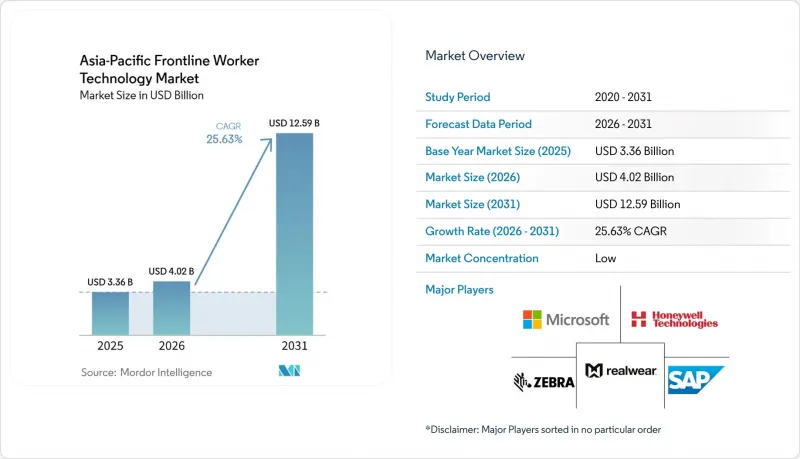
Mordor Intelligence에 의하면, 아시아태평양의 현장 근로자 기술 시장 규모는 2025년 33억 6,000만 달러로 평가되었습니다. 2026년에는 40억 2,000만 달러로 확대되어 2026년부터 2031년에 걸쳐 CAGR 25.63%로 성장을 지속하여, 2031년에는 125억 9,000만 달러에 이를 것으로 예측됩니다.
본 보고서는 구성 요소(소프트웨어 및 서비스), 배포 방식(클라우드 기반, 하이브리드형, On-Premise형), 조직 규모(대기업 및 중소기업), 용도(인력 분석 및 성과 관리 등), 최종 사용자 산업(소매 및 전자상거래 등), 지역별로 분류되어 있습니다. 시장 전망은 금액(달러) 기준으로 제시되어 있습니다.
아시아태평양의 현장 근로자 기술 시장 동향 및 인사이트
규제 대상 작업 현장에서의 안전 문서화 요건 강화
안전 관련 문서화는 아시아태평양 전체의 규제 대상 작업 현장에서 핵심적인 운영 요건으로 자리 잡고 있으며, 이에 따라 아시아태평양의 현장 근로자 기술 시장은 더욱 광범위한 디지털화 도입으로 나아가고 있습니다. 규정 준수 기록에 적시성, 검색 가능성 및 검증 용이성이 요구됨에 따라, 종이 기반의 현장 업무 프로세스를 유지하는 것은 점점 더 어려워지고 있습니다. 안전 점검에 사용되는 것과 동일한 모바일 인터페이스는 업무 인계, 체크리스트 및 사고 기록에도 대응할 수 있으므로, 기술 활용 범위는 단순한 규정 준수 기능에 그치지 않습니다. 이러한 추세에 따라, 분산된 작업자 그룹이나 여러 교대조에 걸쳐 쉽게 도입할 수 있는 플랫폼에 대한 수요가 증가하고 있습니다. 또한, 시스템 간 연동이 불충분하면 보고 및 설명 책임 측면에서 피할 수 있는 공백이 발생하므로, 통합된 커뮤니케이션 및 워크플로우 도구의 도입 필요성도 더욱 커지고 있습니다. 싱가포르의 작업장 안전 프레임워크는 이러한 규제 방향을 반영하고 있으며, 보다 체계화된 현장 위험 관리 워크플로우로의 전환을 뒷받침하고 있습니다.
노동력 부족이 워크플로우 자동화에 대한 의존도를 높이고 있습니다.
지속적인 인력 부족은 아시아태평양의 현장 근로자 기술 시장, 특히 교대 근무나 현장 작업에 의존하는 산업 분야에서 견고한 성장 기반을 마련하고 있습니다. 기업들은 결원을 줄이는 것뿐만 아니라, 각 교대 근무에 배치된 직원 한 명 한 명의 생산성을 높이려고 노력하고 있습니다. 그 결과, 수요는 단순한 스케줄링 도구를 넘어 가이드가 포함된 워크플로우, 디지털화된 표준 작업 절차서, AI를 활용한 코칭으로 이동하고 있습니다. 경험이 풍부한 직원이 은퇴함에 따라 이러한 시스템의 가치는 더욱 높아집니다. 고용주는 신입 사원에게 지식을 신속하게 전달할 방법을 필요로 하기 때문입니다. 히타치가 2025년 7월에 ‘Frontline Coordinator, Naivy’를 출시한 것은 벤더가 업무 워크플로우에 전문가의 지침을 통합함으로써 이러한 요구에 어떻게 대응하고 있는지를 보여줍니다. 이러한 추세가 확산됨에 따라 구매자들은 단순한 근태 관리나 메시징 기능만을 갖춘 도구보다 조직의 노하우를 보호하는 데 도움이 되는 플랫폼을 더욱 중시하게 될 것입니다.
직원 모니터링을 둘러싼 데이터 개인정보 보호 우려
많은 현장용 시스템이 직원의 위치 정보, 업무 행동, 커뮤니케이션 활동 또는 기기 사용 패턴을 수집하고 있기 때문에 데이터 개인정보 보호는 여전히 아시아태평양의 현장 근로자 기술 시장에 큰 걸림돌이 되고 있습니다. 이러한 도구는 협업을 향상시킬 수 있지만, 동의, 저장, 공개 및 국경을 넘는 전송과 관련된 의문도 제기합니다. 여러 APAC 관할 구역에서 사업을 운영하는 고용주에게는 국가마다 다른 데이터 처리 관행이 필요한 경우가 많기 때문에 이 과제는 더욱 어려워집니다. 따라서 대규모 규정 준수 팀이나 성숙한 거버넌스 프로세스를 갖추지 못한 구매자에게는 도입 비용이 높아집니다. 내장된 개인정보 보호 제어 기능, 명확한 관리 설정, 유연한 데이터 정책을 제공하는 공급업체는 기능 면에서만 경쟁하는 공급업체보다 유리한 입장에 있습니다. 이러한 제약이 도입을 막는 것은 아니지만, 검토 기간을 길게 만들며, 법적 및 운영상의 불확실성을 완화할 수 있는 벤더를 구매자가 선택하도록 이끌게 됩니다.
부문 분석
2025년에도 소프트웨어는 매출의 77.21%를 차지하며 여전히 가장 큰 구성 요소로 남아 있었습니다. 한편, 서비스는 2031년까지 연평균 성장률(CAGR) 28.41%로 확대될 것으로 예측됩니다. 이러한 구성 비율은 아시아태평양의 현장 근로자 기술 시장이 여전히 커뮤니케이션, 일정 관리, 분석 및 대규모 가이드형 업무를 관리하는 플랫폼에 크게 의존하고 있음을 보여줍니다. 소프트웨어는 구매자 그룹 간에 높은 재현성을 갖는다는 장점이 있으며, 특히 벤더가 제조, 물류, 의료, 서비스와 같은 다양한 환경에서 동일한 핵심 제품을 제공할 수 있을 때 그 강점이 발휘됩니다. 또한, 클라우드를 통한 제공 역시 소프트웨어 도입을 가속화하는 요인 중 하나로, 구매자는 더 조기에 도입을 시작할 수 있으며 현지 IT 팀의 부담도 경감되고 있습니다. 더 많은 기업이 핵심 현장 워크플로우를 디지털 플랫폼으로 전환함에 따라, 소프트웨어는 사용자 참여, 데이터 수집 및 프로세스 표준화의 기반으로서 계속해서 중요한 역할을 하고 있습니다.
서비스 분야의 성장이 가속화되고 있는 이유는 시장이 성숙해짐에 따라 도입이 쉬워지기는커녕 오히려 어려워지고 있기 때문입니다. 구매자들은 현지화, 워크플로우 재설계, 직원 교육, 통합 지원, 그리고 도입 후에도 지속적인 활용을 지원하는 매니지드 서비스를 점점 더 기대하고 있습니다. 아시아태평양의 현장 근로자 기술 업계에서는 언어의 다양성, 규제 차이, 거점별 디지털 성숙도의 편차로 인해 이러한 요구가 더욱 강해지고 있습니다. 플랫폼은 도입 첫날부터 기술적으로는 사용 가능할지라도, 성능 향상은 공급업체가 도구를 각 거점의 업무 루틴에 얼마나 적절하게 적용할 수 있는지에 따라 좌우되는 경우가 많습니다. 그 결과, 총 계약액에서 자문 및 운영 지원이 차지하는 비중이 커지고 있습니다. 장기적으로는 소프트웨어가 여전히 최대 수익원이 될지라도, 서비스가 더욱 중요한 차별화 요소가 될 것입니다.
2025년에는 클라우드 기반 도입이 매출의 70.23%를 차지했으며, 이는 이 지역 전체에서 구매자들이 마찰이 적은 제공 모델을 명확히 선호하고 있음을 보여줍니다. 이러한 추세는 더 신속한 설정, 초기 비용 절감, 그리고 여러 거점의 관리 용이성을 추구하는 고용주들의 실용적인 판단을 반영합니다. 또한, 클라우드 기반 제공은 현장 이용 사례의 요구 사항에도 부합합니다. 새로운 거점, 계약업체, 혹은 계절 근로자라도 대규모 인프라 구축 없이 도입할 수 있는 경우가 많기 때문입니다. 아시아태평양의 현장 근로자 기술 시장에서 이러한 이점은 기업이 광범위한 지역과 다양한 인력 풀에 걸쳐 사업을 전개할 때 특히 중요합니다. 그 결과, 모바일 사용 편의성이 뛰어나고 관리가 간편한 플랫폼이 높이 평가되는 구매 패턴이 형성되고 있습니다.
하이브리드형이나 On-Premise형 모델도 여전히 시장에서 입지를 유지하고 있습니다. 이는 모든 구매자가 완전히 클라우드로 전환할 수 있는 것은 아니기 때문입니다. 산업 분야의 사업자는 데이터 관리에 관한 요구 사항, 거점 간 연결성의 제한, 혹은 레거시 아키텍처를 안고 있는 경우가 많아, 단기적으로는 완전한 전환이 현실적이지 않은 경우가 있습니다. 정부 관련 기관, 유틸리티, 중공업 분야의 사용자들도 운영 정보에 대한 보다 엄격한 관리를 선호하는 경향이 있습니다. 그렇긴 하지만, 클라우드 기반 서비스가 차지하는 점유율은 시장의 중심이 이미 이동했음을 보여줍니다. 또한, 클라우드 도입은 구현 기간을 단축시킵니다. 이는 장기간에 걸친 기업 규모의 확장에 대응할 수 없는 중규모 구매자에게 중요한 요소입니다. 이러한 균형을 고려할 때, 클라우드가 계속해서 주류를 이루는 한편, 규제가 엄격하거나 기술적 제약이 있는 환경에서는 하이브리드 및 On-Premise 옵션도 여전히 중요하게 여겨질 것임을 시사합니다.
기타 혜택 :
- 엑셀 형식 시장 예측(ME) 시트
- 3개월간의 애널리스트 지원
자주 묻는 질문
목차
제1장 서론
제2장 조사 방법
제3장 주요 요약
제4장 시장 구도
제5장 시장 규모 및 성장 예측
제6장 경쟁 구도
제7장 시장 기회 및 향후 전망
KTH 26.08.10According to Mordor Intelligence, the Asia-Pacific frontline worker technology market size is expected to grow from USD 3.36 billion in 2025 to USD 4.02 billion in 2026 and is forecast to reach USD 12.59 billion by 2031 at 25.63% CAGR over 2026-2031.
This report is Segmented by Component (Software, and Services), Deployment (Cloud-Based, Hybrid, and On-Premises), Organization Size (Large Enterprises, and Small and Medium Enterprises), Application (Workforce Analytics and Performance Management, and More), End-User Industry (Retail and E-Commerce, and More), and Geography. The Market Forecasts are Provided in Terms of Value (USD).
Asia-Pacific Frontline Worker Technology Market Trends and Insights
Rising Safety Documentation Requirements in Regulated Worksites
Safety documentation is becoming a core operating requirement on regulated worksites across the region, driving the Asia-Pacific frontline worker technology market toward broader digital adoption. When compliance records must be timely, searchable, and easy to verify, paper-based frontline processes become harder to sustain. The same mobile interface used for safety checks can also support task handovers, checklists, and incident logging, extending technology use beyond a single compliance function. This dynamic raises demand for platforms that are easy to deploy across dispersed worker groups and multiple shifts. It also strengthens the case for integrated communication and workflow tools, because disconnected systems create avoidable gaps in reporting and accountability. Singapore's workplace safety framework reflects this regulatory direction and reinforces the shift toward more structured frontline risk management workflows.
Labor Shortages Increasing Reliance on Workflow Automation
Persistent labor pressure is creating a durable growth base for the Asia-Pacific frontline worker technology market, especially in sectors that depend on shift-based and field-based labor. Companies are not only trying to reduce vacancies but also to make each available worker more productive during every shift. That is why demand is moving beyond simple scheduling tools and toward guided workflows, digital standard operating procedures, and AI-supported coaching. The value of these systems increases when experienced workers retire, because employers then need faster ways to transfer knowledge to newer staff. Hitachi's July 2025 launch of its Frontline Coordinator, Naivy, shows how vendors are addressing this need by embedding expert guidance into operational workflows. As this pattern spreads, buyers are likely to place more value on platforms that help protect institutional knowledge than on tools that only manage attendance or messaging.
Data Privacy Concerns around Worker Monitoring
Data privacy remains a meaningful brake on the Asia-Pacific frontline worker technology market because many frontline systems collect worker location, task behavior, communication activity, or device usage patterns. These tools can improve coordination, but they also raise questions around consent, retention, disclosure, and cross-border transfer. The challenge becomes harder for employers that operate across multiple APAC jurisdictions, as they often need different data-handling practices in different countries. That makes implementation more expensive for buyers without large compliance teams or mature governance processes. Vendors that offer built-in privacy controls, clear administrative settings, and flexible data policies are in a stronger position than those that compete solely on functionality. This restraint does not stop adoption, but it does lengthen review cycles and pushes buyers toward vendors that can reduce legal and operational uncertainty.
Other drivers and restraints analyzed in the detailed report include:
- Expansion of Private 5G and Industrial Connectivity at the Edge
- Faster Adoption of AI-Enabled Task Routing and Coaching
- Integration Complexity with Legacy OT and ERP Systems
For complete list of drivers and restraints, kindly check the Table Of Contents.
Segment Analysis
Software remained the largest component in 2025, with 77.21% of revenue, while services are projected to expand at a 28.41% CAGR through 2031. This mix shows that the Asia-Pacific frontline worker technology market still leans heavily toward platforms that manage communication, scheduling, analytics, and guided work at scale. Software benefits from strong repeatability across buyer groups, especially when vendors can deliver the same core product across manufacturing, logistics, healthcare, and service environments. Cloud delivery has also helped accelerate software adoption, enabling buyers to get started sooner and reducing the burden on local IT teams. As more companies move core frontline workflows onto digital platforms, software remains the anchor for user engagement, data capture, and process standardization.
Services are growing faster because implementation is becoming harder, not easier, as the market matures. Buyers increasingly expect localization, workflow redesign, worker training, integration support, and managed services that can help adoption continue after launch. In the Asia-Pacific frontline worker technology industry, those needs are intensified by language diversity, regulatory variation, and uneven digital maturity across sites. A platform may be technically ready on day 1, but performance gains often depend on how well the vendor aligns the tool with site-specific work routines. That creates a larger role for advisory and operational support inside total contract value. Over time, this should make services a more meaningful differentiator even when software remains the largest revenue pool.
Cloud-based deployment accounted for 70.23% of revenue in 2025, indicating that buyers have clearly favored lower-friction delivery models across the region. This lead reflects a practical decision by employers who want faster setup, lower upfront spending, and easier multi-site management. Cloud delivery also matches the needs of frontline use cases, because new locations, contractors, or seasonal labor can often be onboarded without major infrastructure work. In the Asia-Pacific frontline worker technology market, that advantage is especially relevant where companies operate across wide geographies and varied labor pools. The result is a buying pattern that rewards platforms with strong mobile usability and straightforward administration.
Hybrid and on-premises models still hold a place in the market because not every buyer can shift fully to the cloud. Industrial operators often have data control requirements, site connectivity limits, or legacy architectures that make a full migration less practical in the near term. Government-linked, utility, and heavy-industry users may also prefer tighter control over operational information. Even so, the share held by cloud-based delivery shows that the center of gravity has already shifted. Cloud deployments also shorten implementation timelines, which matters for mid-sized buyers that cannot support long enterprise rollouts. This balance suggests that cloud will remain dominant, while hybrid and on-premises options will remain relevant in more regulated or technically constrained environments.
Complete Report Scope:
- By Component
- Software
- Services
- By Deployment
- Cloud-Based
- Hybrid
- On-Premises
- By Organization Size
- Large Enterprises
- Small and Medium Enterprises
- By Application
- Employee Communication and Engagement
- Workforce Execution and Task Management
- Workforce Scheduling and Coordination
- Learning and Knowledge Enablement
- Workforce Analytics and Performance Management
- Safety and Compliance Management
- Other Applications
- By End-User Industry
- Retail and E-Commerce
- Industrial Manufacturing
- Healthcare and Life Sciences
- Transportation and Logistics
- Hospitality
- Construction
- Government and Public Administration
- Other End-User Industries
- By Geography
- China
- Japan
- India
- South Korea
- Southeast Asia
- Rest of Asia-Pacific
List of Companies Covered in this Report:
- Microsoft Corporation
- Honeywell International Inc.
- Zebra Technologies Corporation
- PTC Inc.
- Siemens AG
- Schneider Electric SE
- Oracle Corporation
- SAP SE
- ServiceNow, Inc.
- Fujitsu Limited
- Accenture plc
- Tata Consultancy Services Limited
- RealWear, Inc.
- Vuzix Corporation
- WorkJam, Inc.
- Beekeeper AG
- Crew AI, Inc.
- Quinyx AB
- UKG Inc.
- IFS AB
- Poka Inc.
- SymphonyAI
Additional Benefits:
- The market estimate (ME) sheet in Excel format
- 3 months of analyst support
TABLE OF CONTENTS
1 INTRODUCTION
- 1.1 Study Assumptions and Market Definition
- 1.2 Scope of the Study
2 RESEARCH METHODOLOGY
3 EXECUTIVE SUMMARY
4 MARKET LANDSCAPE
- 4.1 Market Overview
- 4.2 Market Drivers
- 4.2.1 Rising Safety Documentation Requirements in Regulated Worksites
- 4.2.2 Labor Shortages Increasing Reliance on Workflow Automation
- 4.2.3 Expansion of Private 5G and Industrial Connectivity at the Edge
- 4.2.4 Faster Adoption of AI-Enabled Task Routing and Coaching
- 4.2.5 Digital Traceability Demands Across Frontline Operations
- 4.2.6 Workforce Retention Pressure in High-Turnover Service Industries
- 4.3 Market Restraints
- 4.3.1 Data Privacy Concerns Around Worker Monitoring
- 4.3.2 Integration Complexity With Legacy OT and ERP Systems
- 4.3.3 Uneven Device Durability in Harsh Industrial Environments
- 4.3.4 Budget Sensitivity Among Small and Medium Enterprises
- 4.4 Industry Value Chain Analysis
- 4.5 Regulatory Landscape
- 4.6 Technological Outlook
- 4.7 Impact of Macroeconomic Factors on the Market
- 4.8 Porter's Five Forces Analysis
- 4.8.1 Threat of New Entrants
- 4.8.2 Bargaining Power of Suppliers
- 4.8.3 Bargaining Power of Buyers
- 4.8.4 Threat of Substitutes
- 4.8.5 Competitive Rivalry
5 MARKET SIZE AND GROWTH FORECASTS (VALUE)
- 5.1 By Component
- 5.1.1 Software
- 5.1.2 Services
- 5.2 By Deployment
- 5.2.1 Cloud-Based
- 5.2.2 Hybrid
- 5.2.3 On-Premises
- 5.3 By Organization Size
- 5.3.1 Large Enterprises
- 5.3.2 Small and Medium Enterprises
- 5.4 By Application
- 5.4.1 Employee Communication and Engagement
- 5.4.2 Workforce Execution and Task Management
- 5.4.3 Workforce Scheduling and Coordination
- 5.4.4 Learning and Knowledge Enablement
- 5.4.5 Workforce Analytics and Performance Management
- 5.4.6 Safety and Compliance Management
- 5.4.7 Other Applications
- 5.5 By End-User Industry
- 5.5.1 Retail and E-Commerce
- 5.5.2 Industrial Manufacturing
- 5.5.3 Healthcare and Life Sciences
- 5.5.4 Transportation and Logistics
- 5.5.5 Hospitality
- 5.5.6 Construction
- 5.5.7 Government and Public Administration
- 5.5.8 Other End-User Industries
- 5.6 By Geography
- 5.6.1 China
- 5.6.2 Japan
- 5.6.3 India
- 5.6.4 South Korea
- 5.6.5 Southeast Asia
- 5.6.6 Rest of Asia-Pacific
6 COMPETITIVE LANDSCAPE
- 6.1 Market Concentration
- 6.2 Strategic Moves
- 6.3 Market Share Analysis
- 6.4 Company Profiles (includes Global Level Overview, Market Level Overview, Core Segments, Financials as available, Strategic Information, Market Rank/Share, Products and Services, Recent Developments)
- 6.4.1 Microsoft Corporation
- 6.4.2 Honeywell International Inc.
- 6.4.3 Zebra Technologies Corporation
- 6.4.4 PTC Inc.
- 6.4.5 Siemens AG
- 6.4.6 Schneider Electric SE
- 6.4.7 Oracle Corporation
- 6.4.8 SAP SE
- 6.4.9 ServiceNow, Inc.
- 6.4.10 Fujitsu Limited
- 6.4.11 Accenture plc
- 6.4.12 Tata Consultancy Services Limited
- 6.4.13 RealWear, Inc.
- 6.4.14 Vuzix Corporation
- 6.4.15 WorkJam, Inc.
- 6.4.16 Beekeeper AG
- 6.4.17 Crew AI, Inc.
- 6.4.18 Quinyx AB
- 6.4.19 UKG Inc.
- 6.4.20 IFS AB
- 6.4.21 Poka Inc.
- 6.4.22 SymphonyAI
7 MARKET OPPORTUNITIES AND FUTURE OUTLOOK
- 7.1 White-Space and Unmet-Need Assessment