

|
시장보고서
상품코드
2099414
GPU 네트워킹 : 시장 점유율 분석, 업계 동향 및 통계, 성장 예측(2026-2031년)GPU Networking - Market Share Analysis, Industry Trends & Statistics, Growth Forecasts (2026 - 2031) |
||||||
 Mordor Intelligence
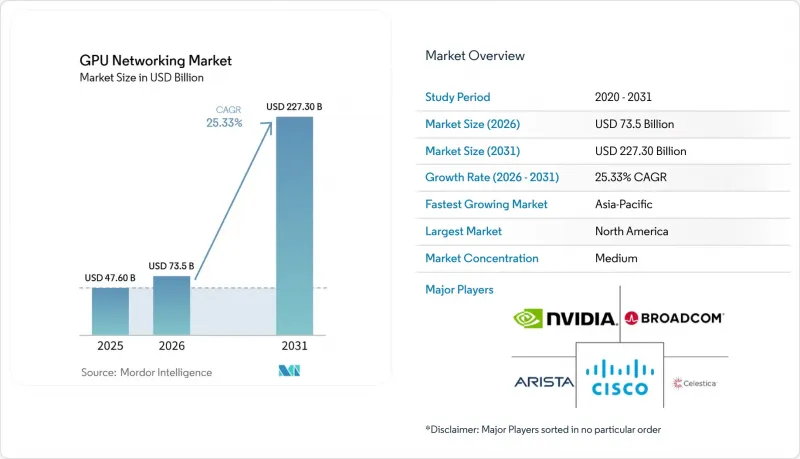
Mordor Intelligence에 의하면, GPU 네트워킹 시장 규모는 2025년 476억 달러로 평가되었습니다. 2026년에는 735억 달러로 확대되어 2031년까지 2,273억 달러에 이를 것으로 예상되고 2026년부터 2031년에 걸쳐 CAGR 25.33%로 성장할 전망입니다.
본 보고서는 제공 형태(하드웨어, 소프트웨어, 서비스), 네트워크 유형(이더넷, 인피니밴드, 스케일업형 GPU 상호 연결), 도입 모델(On-Premise AI 클러스터, 클라우드 및 하이퍼스케일 GPU 패브릭 등), 최종 사용자(클라우드 서비스 제공업체, 기업, 정부·국방 기관, 연구 기관·학술 기관 등) 및 지역별로 분류되어 있습니다. 시장 예측은 금액(달러) 기준으로 제시되어 있습니다.
세계의 GPU 네트워킹 시장 동향과 인사이트
AI 클러스터 밀도 증가가 백엔드 네트워크를 주역으로 부상시키고 있습니다.
AI 클러스터의 밀도가 이전 웹 인프라 사이클보다 빠르게 증가하고 있기 때문에 GPU 네트워킹 시장은 하이퍼스케일 데이터센터로부터 더 많은 자본을 유치하고 있습니다. AI 가속기 랙의 전력 소비량은 웹 서비스 시대의 20kW 미만에서 150kW 이상으로 증가했으며, 현재 공개된 로드맵에는 1MW에 육박하는 포드 규모의 시스템이 제시되어 있습니다. 이러한 밀도 증가로 인해 사업자들은 더 좁은 설치 공간에 더 많은 GPU를 배치할 수밖에 없게 되었고, 그 결과 백엔드 패브릭 전체에서 동서 방향 대역폭에 대한 수요가 증가하고 있습니다. 그 결과, GPU 네트워킹 시장은 현재 AI 인프라 계획의 중심에 자리 잡고 있습니다. 패브릭 용량이 부족하면 고가의 연산 리소스가 데이터 마이그레이션을 기다려야 하는 상황이 발생하기 때문입니다. 조달 우선순위는 대규모 훈련 클러스터의 부하 분산을 유지할 수 있는 고속 스위칭, 광통신, 고밀도 상호 연결 설계로 이동하고 있습니다. 이는 또한 구매자가 이미 가속기나 스토리지에 막대한 예산을 투자하고 있는 경우에도 GPU 네트워킹 시장이 지속적인 투자를 유치하고 있는 이유를 설명해 줍니다.
400G 및 800G로의 급속한 전환이 이더넷 스위치 매출을 견인
GPU 네트워킹 시장은 다른 대부분의 엔터프라이즈 인프라 분야보다 더 빠른 이더넷 속도 전환의 혜택을 받고 있습니다. 400G는 2024년에 주류가 되었고, 800G는 2025년에 양산이 시작되었으며, 1.6 Tbps 플랫폼은 2026년에 신제품 출시를 통해 시장에 등장하기 시작했습니다. 알리스타는 2026년 6월, 224G SerDes 및 브로드컴의 Tomahawk 6 실리콘을 채택하고, 플랫폼당 100 Tbps의 총 스위칭 용량을 갖춘 7060XE7 시리즈를 발표했습니다. 이어 셀레스티카는 2026년 4월 DS6000 시리즈 1.6 TbE 스위치의 수주를 시작했으며, 이를 통해 동 속도 등급의 제품이 ODM 채널에도 도입되었습니다. 각 속도 세대마다 업그레이드 주기가 단축되고 있기 때문에 현재 800G를 도입하고 있는 구매자들은 이미 1.6T로의 전환 계획을 세우고 있습니다. 또한, GPU 네트워킹 시장에서 OCP ESUN 및 UEC 사양 지원이 점점 더 중요해지고 있는 만큼, 표준 규격 준수도 구매 결정에 영향을 미치고 있습니다.
자본 집약도가 높기 때문에 하이퍼스케일 사업자들 시장 진입이 집중되고 있습니다.
GPU 네트워킹 시장에는 여전히 막대한 초기 비용 부담이 따르며, 이러한 부담이 누가 실제 운영 수준의 패브릭을 대규모로 구축할 수 있는지를 좌우하고 있습니다. AI 네트워킹 환경을 완벽하게 구축하려면 스위치, NIC, DPU, 트랜시버, 케이블, 소프트웨어 및 통합 작업이 필요하기 때문에 그 지출 장벽은 기존 데이터센터 업그레이드보다 훨씬 높습니다. 따라서 대량 구매를 통한 협상이 가능하고, 고정 엔지니어링 비용을 매우 대규모 도입에 분산할 수 있는 하이퍼스케일 사업자가 유리합니다. 반면, 엔터프라이즈 고객이나 소규모 클라우드 사업자는 조달 규모가 작고 통합 팀도 소규모이기 때문에 GPU 1대당 네트워크 비용이 훨씬 더 높아지는 경향이 있습니다. 그 결과, 사설 구축이나 지역 인프라 프로그램에 의존하는 GPU 네트워킹 시장의 일부에서는 도입 속도가 더뎌지고 있습니다. 이러한 비용 장벽으로 인해 소규모 구매자들은 실행 위험을 완화해 주는 검증된 아키텍처나 서비스 주도형 도입 모델에 대한 관심도 높아지고 있습니다.
부문 분석
하드웨어는 2025년 매출의 92.11%를 차지하며, GPU 네트워킹 시장에서 여전히 가장 큰 구성 요소였습니다. 이러한 집중도는 물리적 인프라, 특히 스위치, NIC, DPU, 케이블, 광트랜시버의 높은 비용을 반영합니다. 스위칭 플랫폼이 가장 큰 하드웨어 블록을 형성한 것은 800G 이더넷 및 InfiniBand 시스템이 AI 클러스터 설계의 핵심을 이루고 있기 때문입니다. 또한 구매자들이 네트워크 오프로드, 텔레메트리, 트래픽 관리를 서버 스택 내의 전용 실리콘으로 이전함에 따라 NIC 및 DPU의 중요성도 높아졌습니다. 이러한 번들링 추세로 인해 GPU 네트워킹 시장 전체에서 컴퓨팅과 네트워킹 조달이 더욱 상호 의존적으로 변하고 있습니다.
케이블과 트랜시버는 여전히 세 번째로 중요한 하드웨어 축이며, 그 공급 상황은 GPU 네트워킹 시장의 도입 일정에 계속해서 영향을 미치고 있습니다. 구매자가 가속기나 스위치 플랫폼을 확보하더라도, 클러스터 가동 개시는 여전히 광통신 구축 현황과 인증된 상호 연결 장비의 재고 상황에 좌우됩니다. 소프트웨어는 2031년까지 연평균 성장률(CAGR) 26.21%로 확대될 것으로 예측되며, GPU 네트워킹 시장에서 가장 빠르게 성장하는 분야가 되고 있습니다. 클러스터 규모가 확대됨에 따라 네트워크 오케스트레이션, 적응형 라우팅, 텔레메트리 및 혼잡 제어는 선택적 도구에서 운영상의 필수 요건으로 전환되고 있습니다. 또한 기업 및 정부 기관은 GPU 패브릭을 대규모로 운영하기 위해 도입 지원, 통합 지원 및 지속적인 운영에 관한 전문 지식이 필요한 경우가 많아 서비스의 중요성도 높아지고 있습니다.
2025년 매출에서 이더넷이 차지하는 비중은 47.33%로, 네트워크 유형별로는 GPU 네트워킹 시장을 주도했습니다. 이러한 우위는 스케일아웃형 AI 백엔드 네트워크, 프런트엔드 관리 계층 및 스토리지 트래픽에서 이더넷이 수행하는 역할을 반영합니다. RoCE를 지원하는 이더넷은 개방형 표준과 폭넓은 공급처를 추구하는 많은 AI 훈련 환경에서 사실상 기본 표준으로 자리 잡았습니다. 2025년 6월 Ultra Ethernet Consortium이 발표한 UEC 1.0은 AI 클러스터의 요구 사항에 맞추어 이더넷의 동작을 확장함으로써 그 입지를 더욱 공고히 했습니다. 지원 트래픽에서는 표준 이더넷이 여전히 중요했지만, GPU 네트워킹 시장 내에서는 더 높은 성능의 RoCE 도입이 훈련 워크로드의 대부분을 담당하게 되었습니다.
인피니밴드는 결정론적 성능과 극히 낮은 지연 시간이 광범위한 상호 운용성의 이점을 능가하는 상황에서 여전히 필수적인 존재였습니다. 한편, 스케일업형 GPU 상호 연결은 2031년까지 연평균 성장률(CAGR) 26.62%를 나타낼 것으로 예측되며, GPU 네트워킹 시장에서 가장 빠르게 성장하는 네트워크 유형이 되었습니다. 그 주된 이유는 아키텍처에 있습니다. 현재 AI 시스템은 노드 간뿐만 아니라 컴퓨트 포드 내부에서도 더 많은 트래픽을 처리하고 있기 때문입니다. NVIDIA의 Vera Rubin NVL144와 AMD의 Infinity Fabric은 테라비트급 클러스터 내 대역폭의 중요성이 높아지고 있음을 반영하고 있습니다. 또한, UALink 1.0은 오픈 스케일업 패브릭의 설계 범위를 넓혀, GPU 네트워킹 시장에서 이 분야의 전략적 중요성을 유지하고 있습니다.
지역별 분석
북미는 2025년 매출의 38.44%를 차지하며, GPU 네트워킹 시장에서 가장 규모가 큰 지역 블록으로 자리매김했습니다. 이 지역은 미국의 주요 하이퍼스케일러들의 자본 투자 프로그램에 힘입어, 이들이 스위치, 트랜시버 및 상호 연결용 실리콘에 대한 전 세계적 수요를 계속해서 주도하고 있습니다. NVIDIA가 Spectrum-X를 통해 이더넷 스위칭 분야의 리더십을 확립한 움직임은 이 지역에서 컴퓨팅과 네트워킹에 대한 의사결정이 얼마나 밀접하게 연결되어 있는지를 보여줍니다. Google, Amazon, Microsoft, Meta 등의 클라우드 제공업체들은 2025년과 2026년에 걸쳐 다년간의 AI 인프라 확장을 발표했으며, 이로 인해 800G 및 1.6T 공급망에 지속적인 압박이 가해졌습니다. 또한, 미국은 여전히 많은 화이트박스 및 ODM 프로그램의 주요 설계·조달 거점 역할을 하고 있으므로, 그곳에서 내려진 결정은 아시아의 제조 생태계에 신속하게 파급됩니다. 캐나다와 멕시코에서는 전력 확보 및 미국 클라우드 인프라와의 근접성 덕분에 지역 내 확장이 현실화될 수 있는 분야에서 지원 체계를 확충했습니다.
유럽은 GPU 네트워킹 시장에서 여전히 2위 규모를 유지하며, 국가 주도의 AI 정책, 하이퍼스케일러의 확장, 그리고 디지털 인프라 프로그램을 배경으로 지속적인 성장을 이룩했습니다. 도이치 텔레콤과 NVIDIA는 2026년 2월 뮌헨에 ‘독일 산업용 AI 클라우드’를 개설하고, 1만 대의 NVIDIA Blackwell GPU와 10억 유로(10억 9,000만 달러)를 투자했습니다. 또한 영국도 2026년 초 NVIDIA, 마이크로소프트, 구글로부터 400억 파운드(500억 달러)가 넘는 투자 확약을 확보했습니다. 여기에는 2026년 말까지 영국 데이터센터에 12만 대의 Blackwell GPU를 도입하겠다는 NVIDIA의 계획도 포함되어 있습니다. 유럽연합 집행위원회의 ‘AI 기가팩토리’ 프로그램에서는 최대 200억 유로의 공적 자금을 투입해 5개 시설이 신설될 전망이며, 이를 통해 럭스케일 네트워킹의 향후 프로젝트 파이프라인이 확대될 것입니다.
아시아태평양은 2031년까지 연평균 성장률(CAGR) 26.42%를 나타낼 것으로 예측되며, GPU 네트워킹 시장에서 가장 빠르게 성장하는 지역이 될 전망입니다. 중국, 일본, 한국, 인도는 퍼블릭 클라우드, 주권 AI, 통신, 산업 분야에서의 도입에 있어 각각 다른 수요 패턴을 주도하고 있습니다. 중국의 주요 인터넷 기업들은 데이터센터용량 확장에 계속해서 막대한 투자를 하고 있으며, 국내 조달을 우선시하는 방침이 현지 GPU 네트워킹 확충을 뒷받침하고 있습니다. 또한 일본에서도 분산형 포토닉 네트워킹 분야에서 초기 성장세가 나타나고 있습니다. NTT 동일본은 2026년 3월, IOWN 올포토닉스 네트워크를 이용하여 도쿄와 후쿠오카 간 개념 증명(PoC)을 완료하고, 1,000km 거리에서 평균 왕복 지연 시간 13.26ms를 기록했습니다. NTT는 2026년 4월, AI 네트워크를 핵심 주제로 삼아 2033년까지 데이터센터의 IT 전력 용량을 300 MW에서 1 GW로 확대할 계획이라고 발표했습니다. 동남아시아, 남미, 중동 및 아프리카는 정부계 펀드와 디지털 경제 프로그램이 지역 내 GPU 클라우드 및 코로케이션 시설 구축을 뒷받침하고 있어, GPU 네트워킹 시장에서 새로운 수요원으로 부상하고 있습니다.
기타 혜택 :
- 엑셀 형식 시장 예측(ME) 시트
- 3개월간의 애널리스트 지원
자주 묻는 질문
목차
제1장 서론
제2장 조사 방법
제3장 주요 요약
제4장 시장 구도
제5장 시장 규모 및 성장 예측
제6장 경쟁 구도
제7장 시장 기회 및 향후 전망
KTH 26.08.10According to Mordor Intelligence, the GPU networking market size is expected to increase from USD 47.6 billion in 2025 to USD 73.5 billion in 2026 and reach USD 227.3 billion by 2031, growing at a CAGR of 25.33% over 2026-2031.
This report is Segmented by Offering (Hardware, Software, and Services), Network Type (Ethernet, Infiniband, Scale-Up GPU Interconnects), Deployment Model (On-Premises AI Clusters, Cloud and Hyperscale GPU Fabrics, and More), End User (Cloud Service Providers, Enterprises, Government and Defense, Research and Academia, and More), and Geography. The Market Forecasts are Provided in Terms of Value (USD).
Global GPU Networking Market Trends and Insights
Rising AI Cluster Density Pushes Back-End Network to Center Stage
The GPU networking market is drawing more capital from hyperscale data centers because AI cluster density is rising faster than earlier web infrastructure cycles. AI accelerator rack power moved from below 20 kW in the web-services era to above 150 kW, and public roadmaps now point to pod-scale systems nearing 1 MW. That density forces operators to place more GPUs into tighter footprints, which raises east-west bandwidth demand across the back-end fabric. As a result, the GPU networking market now sits closer to the center of AI infrastructure planning, because underbuilt fabrics can leave expensive compute capacity waiting on data movement. Procurement priorities have shifted toward high-speed switching, optics, and dense interconnect designs that can keep large training clusters balanced. This also explains why the GPU networking market is attracting sustained spending even when buyers are already committing very large budgets to accelerators and storage.
Rapid Shift to 400G and 800G Fuels Ethernet Switch Revenue
The GPU networking market is benefiting from a faster Ethernet speed transition than most enterprise infrastructure categories have seen. 400G became mainstream in 2024, 800G entered production in 2025, and 1.6 Tbps platforms began reaching the market in 2026 through new product launches. Arista introduced the 7060XE7 Series in June 2026 with 100 Tbps aggregate switching capacity per platform using 224G SerDes and Broadcom Tomahawk 6 silicon. Celestica then made its DS6000-series 1.6 TbE switches available to order in April 2026, which brought the same speed class into the ODM channel. Each speed generation is shortening the upgrade cycle, so buyers that are deploying 800G today are already planning migration paths to 1.6T. Standards alignment is also shaping purchase decisions, since support for OCP ESUN and UEC specifications is becoming more important in the GPU networking market.
High Capital Intensity Concentrates Market Access Among Hyperscale Operators
The GPU networking market still carries a large upfront cost burden, and that burden shapes who can deploy production-grade fabrics at scale. A full AI networking build requires switches, NICs, DPUs, transceivers, cabling, software, and integration work, so the spending threshold is far higher than in conventional data center upgrades. This favors hyperscale buyers that can negotiate at volume and spread fixed engineering costs across very large deployments. Enterprise buyers and smaller cloud operators often face a much steeper per-GPU networking cost because their procurement scale is lower and their integration teams are smaller. The result is slower adoption in parts of the GPU networking market that depend on private builds or regional infrastructure programs. This cost barrier is also increasing interest in validated architectures and service-led deployment models that reduce execution risk for smaller buyers.
Other drivers and restraints analyzed in the detailed report include:
- Lossless Ethernet for GPU Fabrics Displaces InfiniBand as the Scale-Out Default
- InfiniBand Maintains Dominance for Frontier-Scale Model Training
- Interoperability Fragmentation Introduces Strategic Risk Across Fabric Stacks
For complete list of drivers and restraints, kindly check the Table Of Contents.
Segment Analysis
Hardware accounted for 92.11% of 2025 revenue and remained the largest component of the GPU networking market. That concentration reflects the high cost of physical infrastructure, especially switches, NICs, DPUs, cables, and optical transceivers. Switching platforms formed the largest hardware block because 800G Ethernet and InfiniBand systems are central to AI cluster design. NICs and DPUs also gained weight as buyers moved network offload, telemetry, and traffic management onto dedicated silicon inside the server stack. This bundling trend is making compute and networking procurement more interdependent across the GPU networking market.
Cables and transceivers remained the third major hardware pillar, and their availability still affected deployment schedules in the GPU networking market. Buyers could secure accelerators and switch platforms, but cluster turn-up still depended on optical readiness and qualified interconnect inventory. Software is projected to expand at a 26.21% CAGR through 2031, which makes it the fastest-growing offering in the GPU networking market. Network orchestration, adaptive routing, telemetry, and congestion control are moving from optional tools to operating requirements as cluster sizes increase. Services are also becoming more important because enterprise and sovereign operators often need deployment support, integration help, and ongoing operations expertise to run GPU fabrics at scale.
Ethernet held 47.33% of 2025 revenue and led the GPU networking market by network type. That lead reflects Ethernet's role in scale-out AI back-end networks, front-end management layers, and storage traffic. RoCE-enabled Ethernet has become the practical default for many AI training environments where buyers want open standards and broader sourcing. The Ultra Ethernet Consortium's UEC 1.0 release in June 2025 strengthened that position by extending Ethernet behavior for AI cluster requirements. Standard Ethernet still mattered for support traffic, while higher-performance RoCE deployments carried more of the training workload inside the GPU networking market.
InfiniBand remained critical where deterministic performance and very low latency outweighed the benefits of broader interoperability. At the same time, Scale-Up GPU Interconnects are forecast to grow at a 26.62% CAGR through 2031, making them the fastest-growing network type in the GPU networking market. The main reason is architectural, because AI systems are now pushing more traffic inside the compute pod rather than only between nodes. NVIDIA's Vera Rubin NVL144 direction and AMD's Infinity Fabric reflect the rising importance of terabit-class intra-cluster bandwidth. UALink 1.0 also widened the design path for open scale-up fabrics, which keeps this part of the GPU networking market strategically important.
Complete Report Scope:
- By Offering
- Hardware
- Switches
- Network Interface Cards and DPUs
- Cables and Transceivers
- Software
- Network Orchestration and Management Software
- Monitoring and Telemetry Software
- Services
- Integration and Deployment Services
- Support and Maintenance Services
- Hardware
- By Network Type
- Ethernet
- Standard Ethernet
- RoCE-enabled Ethernet
- InfiniBand
- Scale-Up GPU Interconnects
- NVLink/NVSwitch
- Infinity Fabric
- UALink and Other Emerging Interconnects
- Ethernet
- By Deployment Model
- On-Premises AI Clusters
- Cloud and Hyperscale GPU Fabrics
- GPU Cloud and Colocation Deployments
- By End User
- Cloud Service Providers
- Enterprises
- Government and Defense
- Research and Academia
- Telecommunications Service Providers
- By Geography
- North America
- United States
- Canada
- Mexico
- Europe
- Germany
- United Kingdom
- France
- Italy
- Rest of Europe
- Asia-Pacific
- China
- Japan
- South Korea
- India
- Southeast Asia
- Rest of Asia-Pacific
- South America
- Middle East and Africa
- North America
Geography Analysis
North America held 38.44% of 2025 revenue and remained the largest regional block in the GPU networking market. The region is anchored by the capital programs of major U.S. hyperscalers, which continue to shape global demand for switches, transceivers, and interconnect silicon. NVIDIA's move into Ethernet switching leadership through Spectrum-X showed how tightly compute and networking decisions are now linked in this region. Cloud providers such as Google, Amazon, Microsoft, and Meta announced multiyear AI infrastructure expansions in 2025 and 2026, which kept pressure on 800G and 1.6T supply chains. The United States also remains the main design and procurement center for many white-box and ODM programs, so decisions made there flow quickly through Asian manufacturing ecosystems. Canada and Mexico added supporting capacity where power availability and proximity to U.S. cloud infrastructure made regional deployments practical.
Europe remained the second-largest region in the GPU networking market and continued to advance on the back of sovereign AI policy, hyperscaler expansion, and digital infrastructure programs. Deutsche Telekom and NVIDIA opened Germany's Industrial AI Cloud in Munich in February 2026 with 10,000 NVIDIA Blackwell GPUs and EUR 1 billion (USD 1.09 billion) in investment. The UK also attracted commitments from NVIDIA, Microsoft, and Google that exceeded GBP 40 billion (USD 50 billion) in early 2026, including NVIDIA's plan to install 120,000 Blackwell GPUs in British data centers by end-2026. The European Commission's AI Gigafactory program is expected to add 5 facilities with up to EUR 20 billion in public funding, which extends the future project pipeline for rack-scale networking.
Asia-Pacific is projected to grow at a 26.42% CAGR through 2031, making it the fastest-growing region in the GPU networking market. China, Japan, South Korea, and India are driving different demand patterns across public cloud, sovereign AI, telecom, and industrial deployments. China's large internet companies continue to invest heavily in data center capacity, and domestic procurement priorities are supporting local GPU networking build-outs. Japan is also showing early momentum in distributed photonic networking. NTT East completed a proof of concept between Tokyo and Fukuoka in March 2026 using the IOWN All-Photonics Network and recorded average round-trip latency of 13.26 ms over 1,000 km. NTT said in April 2026 that it plans to increase data center IT power capacity from 300 MW to 1 GW by 2033, with AI networking as a central theme. Southeast Asia, South America, and the Middle East and Africa are emerging demand pools in the GPU networking market as sovereign funds and digital economy programs back regional GPU cloud and colocation builds.
- NVIDIA Corporation
- Broadcom Inc.
- Arista Networks, Inc.
- Cisco Systems, Inc.
- Celestica Inc.
- HPE
- Juniper Networks, Inc.
- Dell Technologies Inc.
- Intel Corporation
- Marvell Technology, Inc.
- Astera Labs, Inc.
- Credo Technology Group Holding Ltd
- Coherent Corp.
- Lumentum Holdings Inc.
- Ciena Corporation
- Nokia Corporation
- Huawei Technologies Co., Ltd.
- Ericsson AB
- Hewlett Packard Enterprise Development LP
- Super Micro Computer, Inc.
Additional Benefits:
- The market estimate (ME) sheet in Excel format
- 3 months of analyst support
TABLE OF CONTENTS
1 INTRODUCTION
- 1.1 Study Assumptions and Market Definition
- 1.2 Scope of the Study
2 RESEARCH METHODOLOGY
3 EXECUTIVE SUMMARY
4 MARKET LANDSCAPE
- 4.1 Market Overview
- 4.2 Impact of Macroeconomic Factors on the Market
- 4.3 Market Drivers
- 4.3.1 Rising AI Cluster Density in Hyperscale Data Centers
- 4.3.2 Rapid Shift to 400G and 800G Network Upgrades
- 4.3.3 Growing Adoption of Lossless Ethernet for GPU Fabrics
- 4.3.4 Accelerating Use of InfiniBand for Large Model Training
- 4.3.5 Co-Packaged Optics Adoption in High-Speed GPU Fabrics
- 4.3.6 Increased Demand for White-Box and ODM-Based AI Network Builds
- 4.4 Market Restraints
- 4.4.1 High Capital Intensity of GPU Networking Infrastructure
- 4.4.2 Interoperability and Vendor Lock-In Risk Across Fabric Stacks
- 4.4.3 Power, Cooling, and Rack Density Constraints in AI Facilities
- 4.4.4 Limited Supply of High-Speed Switch Silicon and Optical Components
- 4.5 Industry Value Chain Analysis
- 4.6 Supply Chain Analysis
- 4.7 Regulatory Landscape
- 4.8 Technological Outlook
- 4.9 Porter's Five Forces Analysis
- 4.9.1 Threat of New Entrants
- 4.9.2 Bargaining Power of Suppliers
- 4.9.3 Bargaining Power of Buyers
- 4.9.4 Threat of Substitutes
- 4.9.5 Competitive Rivalry
5 MARKET SIZE AND GROWTH FORECASTS (VALUE)
- 5.1 By Offering
- 5.1.1 Hardware
- 5.1.1.1 Switches
- 5.1.1.2 Network Interface Cards and DPUs
- 5.1.1.3 Cables and Transceivers
- 5.1.2 Software
- 5.1.2.1 Network Orchestration and Management Software
- 5.1.2.2 Monitoring and Telemetry Software
- 5.1.3 Services
- 5.1.3.1 Integration and Deployment Services
- 5.1.3.2 Support and Maintenance Services
- 5.1.1 Hardware
- 5.2 By Network Type
- 5.2.1 Ethernet
- 5.2.1.1 Standard Ethernet
- 5.2.1.2 RoCE-enabled Ethernet
- 5.2.2 InfiniBand
- 5.2.3 Scale-Up GPU Interconnects
- 5.2.3.1 NVLink/NVSwitch
- 5.2.3.2 Infinity Fabric
- 5.2.3.3 UALink and Other Emerging Interconnects
- 5.2.1 Ethernet
- 5.3 By Deployment Model
- 5.3.1 On-Premises AI Clusters
- 5.3.2 Cloud and Hyperscale GPU Fabrics
- 5.3.3 GPU Cloud and Colocation Deployments
- 5.4 By End User
- 5.4.1 Cloud Service Providers
- 5.4.2 Enterprises
- 5.4.3 Government and Defense
- 5.4.4 Research and Academia
- 5.4.5 Telecommunications Service Providers
- 5.5 By Geography
- 5.5.1 North America
- 5.5.1.1 United States
- 5.5.1.2 Canada
- 5.5.1.3 Mexico
- 5.5.2 Europe
- 5.5.2.1 Germany
- 5.5.2.2 United Kingdom
- 5.5.2.3 France
- 5.5.2.4 Italy
- 5.5.2.5 Rest of Europe
- 5.5.3 Asia-Pacific
- 5.5.3.1 China
- 5.5.3.2 Japan
- 5.5.3.3 South Korea
- 5.5.3.4 India
- 5.5.3.5 Southeast Asia
- 5.5.3.6 Rest of Asia-Pacific
- 5.5.4 South America
- 5.5.5 Middle East and Africa
- 5.5.1 North America
6 COMPETITIVE LANDSCAPE
- 6.1 Market Concentration
- 6.2 Strategic Moves
- 6.3 Market Share Analysis
- 6.4 Company Profiles (includes Global Level Overview, Market Level Overview, Core Segments, Financials as available, Strategic Information, Market Rank/Share, Products and Services, Recent Developments)
- 6.4.1 NVIDIA Corporation
- 6.4.2 Broadcom Inc.
- 6.4.3 Arista Networks, Inc.
- 6.4.4 Cisco Systems, Inc.
- 6.4.5 Celestica Inc.
- 6.4.6 HPE
- 6.4.7 Juniper Networks, Inc.
- 6.4.8 Dell Technologies Inc.
- 6.4.9 Intel Corporation
- 6.4.10 Marvell Technology, Inc.
- 6.4.11 Astera Labs, Inc.
- 6.4.12 Credo Technology Group Holding Ltd
- 6.4.13 Coherent Corp.
- 6.4.14 Lumentum Holdings Inc.
- 6.4.15 Ciena Corporation
- 6.4.16 Nokia Corporation
- 6.4.17 Huawei Technologies Co., Ltd.
- 6.4.18 Ericsson AB
- 6.4.19 Hewlett Packard Enterprise Development LP
- 6.4.20 Super Micro Computer, Inc.
7 MARKET OPPORTUNITIES AND FUTURE OUTLOOK
- 7.1 White-Space and Unmet-Need Assessment


