

|
시장보고서
상품코드
2099416
GPU 소프트웨어 시장 : 점유율 분석, 업계 동향 및 통계, 성장 예측(2026-2031년)GPU Software - Market Share Analysis, Industry Trends & Statistics, Growth Forecasts (2026 - 2031) |
||||||
 Mordor Intelligence
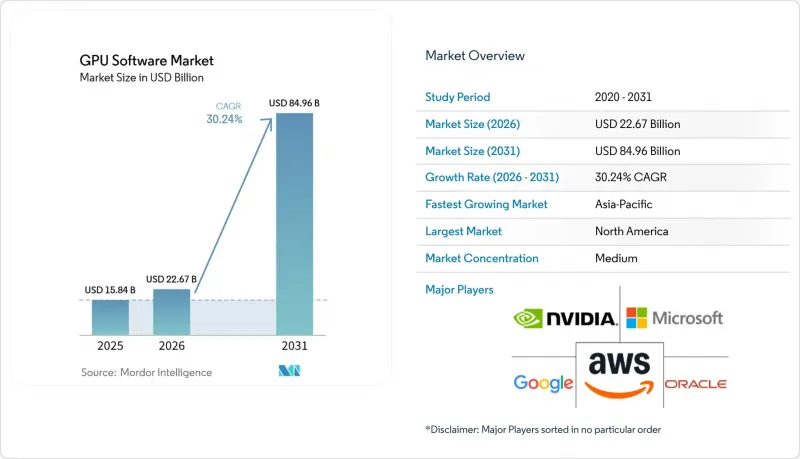
Mordor Intelligence에 의하면, GPU 소프트웨어 시장 규모는 2025년 158억 4,000만 달러에서 2026년에는 226억 7,000만 달러로 확대되어 2031년까지 849억 6,000만 달러에 이를 것으로 예상되고 있어 2026년부터 2031년까지 CAGR 30.24%로 성장할 전망입니다.
본 보고서는 구성 요소(소프트웨어 및 서비스), 도입 형태(클라우드 기반, On-Premise 등), 기업 규모(대기업 및 중소기업), 용도(인공지능 및 머신러닝 등), 최종 사용자(클라우드 서비스 제공업체 및 하이퍼스케일러, 자동차 산업, BFSI 등) 및 지역별로 분류되어 있습니다. 시장 전망은 금액(달러) 기준으로 제시되어 있습니다.
세계 GPU 소프트웨어 시장 동향 및 인사이트
생성형 AI 및 대규모 언어 모델 워크로드의 채택 확대
대규모 모델의 훈련 및 추론은 스케줄링, 메모리 사용량, 실행 효율에 지속적인 부하를 주기 때문에 생성형 AI에 대한 투자는 여전히 GPU 소프트웨어 시장의 최대 성장 요인으로 작용하고 있습니다. 요청당 소프트웨어 오버헤드가 엔터프라이즈 AI 도입의 운영 비용에 직접적인 영향을 미치기 때문에 추론 서빙은 특히 중요해지고 있습니다. NVIDIA는 2026 회계연도 실적 발표에서 SemiAnalysis의 InferenceX 벤치마크에 따르면 Blackwell Ultra가 Hopper에 비해 에이전트형 AI를 대상으로 최대 50배의 성능 향상과 35분의 1 수준의 비용 절감을 실현한다고 발표했습니다. 이를 통해 플랫폼 전환 가속화와 리프레시 주기 단축이 촉진될 것입니다. 또한 NVIDIA는 CUDA-X 생태계가 현재 6,000개에 가까운 가속 지원 용도를 포괄하고 있다고 밝혔으며, 이는 GPU 소프트웨어 시장이 하드웨어 단독이 아닌 확립된 소프트웨어 기반과 얼마나 깊이 연결되어 있는지를 보여줍니다. 이번 제품 사이클에서는 물리적 AI 및 로봇 공학을 위한 오픈 모델 ‘Cosmos’와 ‘Isaac GR00T’도 도입되어, 이를 통해 GPU 소프트웨어 시장은 공장 자동화 및 자율 시스템 시뮬레이션 분야로 확대되고 있습니다.
하이브리드 및 멀티 클라우드 환경에서의 GPU 오케스트레이션 수요 증가
GPU 소프트웨어 시장은 퍼블릭 클라우드, 프라이빗 클라우드 및 소버린 환경에 걸친 오케스트레이션 수요 증가의 혜택도 누리고 있습니다. 기업에서는 기밀성이 높은 모델의 훈련을 자사가 소유하거나 관리하는 인프라에서 유지하면서, 처리 능력이 부족할 때 추론 처리를 외부 클라우드 리소스로 이전하는 영구적인 하이브리드 구성을 활용하는 사례가 점점 늘어나고 있습니다. Mirantis는 2026년 4월, 자사의 k0rdent AI 플랫폼과 NVIDIA Run:ai의 통합을 발표했습니다. 이 회사에 따르면, 이를 통해 네오클라우드 및 기업은 몇 주가 아닌 몇 분 만에 프로덕션급 AI 환경을 구축할 수 있게 됩니다. 또한, Mirantis와 Supermicro는 2026년 3월, 검증된 소버린 AI 및 하이브리드 클라우드 스택을 발표했습니다. 이는 각 공급업체들이 하이브리드 오케스트레이션을 보다 표준화된 상용 서비스로 전환하고 있음을 보여줍니다. 이러한 추세는 소프트웨어 계층이 서로 다른 인프라 환경에 걸친 워크로드 배치, 데이터 지역성 및 활용률을 관리함으로써 하이브리드 클라우드 및 프라이빗 클라우드의 더 빠른 확장을 뒷받침하고 있습니다.
서로 다른 GPU 및 클라우드 스택에 걸친 고도의 통합 복잡성
프로덕션 환경에서는 서로 다른 칩, 드라이버, 서버 유형, 배포 모델이 조합되는 경우가 많기 때문에 통합의 복잡성은 여전히 GPU 소프트웨어 시장의 큰 걸림돌로 남아 있습니다. 하드웨어 세대가 바뀔 때마다 새로운 상호 연결 동작, 메모리 계층 구조, 소프트웨어 종속성이 발생하며, 이로 인해 기업 팀의 테스트 및 최적화 작업 부담이 증가하고 있습니다. AMD는 Instinct MI350 시리즈용 ROCm 7.0 소프트웨어에서 FP4 및 FP6 지원 범위를 확대하고, 데이터센터용 새로운 확장성 기능을 추가했다고 발표했습니다. 이는 대체 소프트웨어 스택이 진화하는 한편, 사용자에게는 호환성을 확보하기 위한 작업이 더욱 늘어날 것임을 시사합니다. NVIDIA의 2026년도 실적도 CUDA-X와 수천 개에 달하는 가속화 지원 용도를 통해 해당 기업의 생태계가 얼마나 깊이 침투해 있는지를 여실히 보여주고 있으며, 이로 인해 기존 스택에서 전환하는 데 더 많은 시간이 소요되고 비용도 높아집니다. 그 결과, GPU 소프트웨어 시장에서 다중 벤더를 통한 도입의 경우 검증 주기가 장기화되고, 인프라 투자 회수가 지연되는 경우가 많습니다.
부문 분석
2025년 GPU 소프트웨어 시장에서 소프트웨어가 76.11%를 차지하고 있으며, 이는 고객이 단순한 연산 리소스 접근보다 오케스트레이션, 가시성, 추론 최적화를 더 중요하게 여기고 있음을 보여줍니다. NVIDIA에 따르면, CUDA-X 생태계는 약 6,000개의 가속 지원 용도를 지원하며, 그 규모가 AI, 과학, 시각화 등 각 워크로드를 아우르는 소프트웨어 계층의 광범위한 도입 기반을 지속적으로 뒷받침하고 있습니다. 이러한 상황은 기업들이 고립된 클러스터에서 보다 지속 가능한 워크로드 관리 프레임워크로 전환하고 있다는 점을 고려할 때, 소프트웨어가 2031년까지 연평균 성장률(CAGR) 31.21%로 시장에서 가장 빠르게 성장하는 구성 요소인 이유를 설명하는 요인 중 하나가 됩니다. 2025년 GPU 소프트웨어 시장의 나머지 점유율은 서비스 부문이 차지했으며, 해당 부문의 매출 대부분은 관리형 GPU 클라우드 및 도입 지원에서 비롯되었습니다.
GPU 소프트웨어 업계에서는 공급업체들이 오케스트레이션, 모니터링, 최적화 기능을 관리형 인프라 제공에 통합하는 경향이 강해지고 있어, 소프트웨어 및 서비스 간의 상업적 경계가 모호해지고 있습니다. Mirantis는 NVIDIA Run:ai와의 k0rdent AI 통합을 AI 플랫폼 도입 및 라이프사이클 관리를 자동화하는 수단으로 포지셔닝했습니다. 이는 소프트웨어 기능이 보다 광범위한 서비스 제공에 통합되고 있음을 보여줍니다. CoreWeave 역시 2025 회계연도에 견실한 성장과 엔터프라이즈 분야로의 집중 확대를 보고했는데, 이는 GPU 네이티브 제공업체들이 소프트웨어 제어 계층을 독립된 제품으로 취급하기보다는 클라우드 용량과 함께 수익화하고 있음을 시사합니다. 이러한 번들화는 더 높은 지속적 수익을 뒷받침하는 한편, GPU 소프트웨어 시장 전체에서 개별 구성 요소 간의 비교를 어렵게 만들고 있습니다.
2025년에는 GPU 소프트웨어 시장의 45.33%를 클라우드 기반 도입이 차지하고, 하이브리드 클라우드 및 프라이빗 클라우드는 2031년까지 연평균 성장률(CAGR) 31.62%로 성장할 것으로 전망됩니다. 도입 기반이 가장 큰 것은 여전히 클라우드 환경이며, 이는 기업이 GPU 용량에 신속하게 접근할 수 있고 모든 하드웨어를 소유하지 않고도 훈련 및 추론을 확장할 수 있기 때문입니다. 동시에 가장 빠른 성장이 예상되는 분야는 하이브리드 설계로 점차 전환되고 있습니다. 이는 이러한 구성이 버스트 용량을 유지하면서도 사용자가 데이터 배치 및 보안을 보다 세밀하게 제어할 수 있기 때문입니다. Mirantis와 Supermicro는 2026년 3월, 검증된 소버린 AI 및 하이브리드 클라우드 도입 스택을 발표했는데, 이는 기존 하이브리드 GPU 환경에 대한 상업적 수요가 증가하고 있음을 반영한 것입니다.
On-Premise 배포는 데이터의 소재지나 시스템 제어에 있어 타협할 수 없는 규제 대상 산업 및 연구 환경에서 여전히 중요한 위치를 차지하고 있습니다. 엣지 및 임베디드 배포는 GPU 소프트웨어 시장에서 아직 규모는 작지만, 자동차 검증, 산업용 디지털 트윈 및 기타 자산 수준의 추론 워크로드에서 그 중요성이 점차 커지고 있습니다. 소프트뱅크는 2026년 1월, AI 데이터센터 사업자가 GPU 인프라 상에서 멀티테넌트형 Kubernetes-as-a-Service 및 Inference-as-a-Service를 제공할 수 있도록 하는 'Infrinia AI Cloud OS'를 출시했습니다. 이번 출시는 분산형 도입 모델에 대한 소프트웨어 지원 강화를 시사합니다. 따라서 도입 형태의 다양화가 진행되고 있지만, 이러한 환경을 통합하기 위한 주요 도구로서 소프트웨어 계층은 여전히 중요한 역할을 수행하고 있습니다.
지역별 분석
2025년, 북미는 GPU 소프트웨어 시장 점유율의 48.44%를 차지하며 지역별로는 가장 큰 기여도를 보였습니다. 이 지역이 주도적인 위치를 차지하는 이유는 하이퍼스케일러의 설비 투자, 기업 내 AI의 광범위한 도입, 그리고 확립된 GPU 생태계 내에서 활동하는 소프트웨어 개발자들의 견고한 기반이 결합되어 있기 때문입니다. CoreWeave에 따르면, 2026년 3월 31일 기준 수주 잔고는 2025 회계연도 말의 668억 달러에서 994억 달러로 증가했으며, 이는 북미의 클라우드 및 기업 활동을 중심으로 확고한 수요 기반이 존재함을 보여줍니다. NVIDIA의 2026 회계연도 실적에서도 CUDA-X 생태계의 지속적인 확대와 북미 고객의 지속적인 업그레이드 주기를 뒷받침하는 Blackwell 플랫폼으로의 전환이 드러났습니다. 이에 따라 다른 지역의 성장률이 상승하는 가운데서도, 예측 기간 동안 북미는 견고한 입지를 유지하게 될 것입니다.
아시아태평양은 2031년까지 연평균 성장률(CAGR) 31.42%로 확대될 것으로 예측되며, GPU 소프트웨어 시장에서 가장 빠르게 성장하는 지역이 될 전망입니다. 소프트뱅크는 2026년 1월, GPU 인프라 상에서 멀티테넌트형 Kubernetes-as-a-Service 및 Inference-as-a-Service 제공을 목표로 하는 AI 데이터센터 사업자를 위해 ‘Infrinia AI Cloud OS’를 출시했습니다. NTT 데이터 역시 일본에서 대규모 머신러닝 워크로드를 위한 ‘GPU as a Service’를 시작했으며, LLM(대규모 언어 모델) 개발, 자율주행, 신약 개발 등의 이용 사례를 타겟으로 하고 있습니다. 이러한 움직임은 아시아태평양의 GPU 소프트웨어 시장이 현지 플랫폼 개발은 물론, 클라우드 우선 기업 도입 및 국가 주도의 AI 투자 프로그램에 따른 수요에 의해 뒷받침되고 있음을 보여줍니다.
한편, 유럽 및 기타 지역에서는 데이터 관리와 주권적 인프라에 대한 요구에 의해 보다 직접적으로 형성되는 GPU 소프트웨어 시장의 다른 성장 패턴을 확인할 수 있습니다. 유럽 의회가 2025년에 실시한 소프트웨어 및 사이버 의존성에 관한 조사에서는 유럽이 EU 역외 공급자에 의존하고 있는 실태가 부각되었으며, AI 및 클라우드 인프라에 대한 지역적 관리의 중요성이 한층 더 높아지고 있습니다. 도이치 텔레콤과 NVIDIA는 2026년 2월 뮌헨에서 독일 최초의 ‘산업용 AI 클라우드’를 가동했습니다. 약 1만 대의 NVIDIA Blackwell GPU와 0.5 엑사플롭스의 처리 능력을 갖춘 이 인프라는 이러한 정책적 압력이 실제 인프라 구축으로 이어지고 있음을 보여줍니다. 또한, 비트콤(Bitkom)에 따르면 2025년에는 AI 및 HPC 워크로드가 독일 데이터센터용량의 15%를 차지하고 있으며, 2030년까지 40%를 나타낼 것으로 예측됩니다. 이는 지역 내 인프라 구축을 지속해야 한다는 주장을 뒷받침하는 것입니다.
기타 혜택:
- 엑셀 형식 시장 예측(ME) 시트
- 3개월간의 애널리스트 지원
자주 묻는 질문
목차
제1장 서론
제2장 조사 방법
제3장 주요 요약
제4장 시장 구도
제5장 시장 규모와 성장 예측
제6장 경쟁 구도
제7장 시장 기회와 향후 전망
JHS 26.08.05According to Mordor Intelligence, the GPU software market size is expected to increase from USD 15.84 billion in 2025 to USD 22.67 billion in 2026 and reach USD 84.96 billion by 2031, growing at a CAGR of 30.24% over 2026-2031.
This report is Segmented by Component (Software, and Services), Deployment Mode (Cloud-Based, On-Premises, and More), Enterprise Size (Large Enterprises, and Small and Medium Enterprises), Application (Artificial Intelligence and Machine Learning, and More), End User (Cloud Service Providers and Hyperscalers, Automotive, BFSI, and More), and Geography. The Market Forecasts are Provided in Terms of Value (USD).
Global GPU Software Market Trends and Insights
Increasing Adoption of Generative AI and Large Language Model Workloads
Generative AI spending remains the strongest growth driver for the GPU software market because large model training and inference place sustained pressure on scheduling, memory use, and runtime efficiency. Inference serving has become especially important because software overhead per request directly affects the operating cost of enterprise AI deployments. NVIDIA stated in its fiscal 2026 results that Blackwell Ultra delivers up to 50x better performance and 35x lower cost for agentic AI than Hopper on the SemiAnalysis InferenceX benchmark, which supports faster platform migration and shorter refresh cycles. NVIDIA also said that the CUDA-X ecosystem now spans nearly 6,000 accelerated applications, which shows how deeply the GPU software market is tied to an established software base rather than hardware alone. The same product cycle also introduced Cosmos and Isaac GR00T open models for physical AI and robotics, which extends the GPU software market into factory automation and autonomous system simulation.
Rising Demand for GPU Orchestration in Hybrid and Multi-Cloud Environments
The GPU software market is also benefiting from rising demand for orchestration across public cloud, private cloud, and sovereign environments. Enterprises are increasingly using permanent hybrid setups where sensitive model training stays on owned or controlled infrastructure and overflow inference runs move to external cloud capacity. Mirantis launched integration between its k0rdent AI platform and NVIDIA Run:ai in April 2026, and the company said this allows neoclouds and enterprises to deploy production-ready AI environments in minutes rather than weeks. Mirantis and Supermicro also announced a validated sovereign AI and hybrid cloud stack in March 2026, which shows that suppliers are turning hybrid orchestration into a more standardized commercial offer. This pattern supports faster expansion in hybrid cloud and private cloud because the software layer manages workload placement, data locality, and utilization across different infrastructure environments.
High Integration Complexity Across Heterogeneous GPU and Cloud Stacks
Integration complexity remains a real brake on the GPU software market because production environments often combine different chips, drivers, server types, and deployment models. Each hardware generation brings new interconnect behavior, memory hierarchies, and software dependencies, which raises testing and optimization work for enterprise teams. AMD said its ROCm 7.0 software for the Instinct MI350 series added broader FP4 and FP6 support and new data center scalability features, which shows that alternative software stacks are advancing but still add another layer of compatibility work for users. NVIDIA's fiscal 2026 results also underline how deeply its ecosystem is embedded through CUDA-X and thousands of accelerated applications, which makes migration away from an established stack slower and more expensive. As a result, multi-vendor deployments often face longer validation cycles and slower returns on infrastructure spending in the GPU software market.
Other drivers and restraints analyzed in the detailed report include:
- Growing Use of GPU Software for High-Performance Computing Workloads
- Expansion of Cloud Gaming and Real-Time Rendering Use Cases
- Security, Privacy, and Data Sovereignty Concerns in Shared GPU Environments
For complete list of drivers and restraints, kindly check the Table Of Contents.
Segment Analysis
Software held 76.11% of the GPU software market in 2025, which shows that customers place more value on orchestration, observability, and inference optimization than on access to compute alone. NVIDIA said the CUDA-X ecosystem supports nearly 6,000 accelerated applications, and that scale continues to support a deep installed base for the software layer across AI, science, and visualization workloads. This position also helps explain why software is the fastest-growing component at 31.21% CAGR through 2031, because enterprises are moving from isolated clusters to more persistent workload management frameworks. The services segment accounted for the remaining share of the GPU software market in 2025, and much of that revenue came from managed GPU cloud and deployment support.
The commercial line between software and services is becoming less clear in the GPU software industry because suppliers increasingly bundle orchestration, monitoring, and optimization into managed infrastructure offers. Mirantis positioned its k0rdent AI integration with NVIDIA Run:ai as a way to automate AI platform deployment and lifecycle management, which shows how software functionality is being wrapped into broader service delivery. CoreWeave also reported strong fiscal 2025 growth and a larger enterprise focus, which indicates that GPU-native providers are monetizing software control layers alongside cloud capacity rather than treating them as separate products. This bundling supports higher recurring revenue and makes stand-alone component comparisons less straightforward across the GPU software market.
Cloud-based deployment accounted for 45.33% of the GPU software market in 2025, while hybrid cloud and private cloud is projected to grow at 31.62% CAGR through 2031. The largest installed base still sits in cloud environments because they give enterprises faster access to GPU capacity and let them scale training and inference without owning all hardware. At the same time, the fastest growth is shifting toward hybrid designs because those setups give users more control over data placement and security while preserving burst capacity. Mirantis and Supermicro announced a validated sovereign AI and hybrid cloud deployment stack in March 2026, which reflects rising commercial demand for ready-built hybrid GPU environments.
On-premises deployment remains relevant in regulated sectors and research settings where data residency and system control cannot be compromised. Edge and embedded deployment is still a smaller base in the GPU software market, but it is becoming more relevant in automotive validation, industrial digital twins, and other asset-level inference workloads. SoftBank launched Infrinia AI Cloud OS in January 2026 to let AI data center operators provide multi-tenant Kubernetes-as-a-Service and inference-as-a-Service on GPU infrastructure, and that release points to stronger software support for distributed deployment models. The deployment mix is therefore widening, but the software layer remains the main tool for tying these environments together.
Complete Report Scope:
- By Component
- Software
- Services
- By Deployment Mode
- Cloud-Based
- On-Premises
- Hybrid Cloud / Private Cloud
- Edge / Embedded
- By Enterprise Size
- Large Enterprises
- Small and Medium Enterprises
- By Application
- Artificial Intelligence and Machine Learning
- High-Performance Computing
- Data Analytics
- Graphics Rendering and Visualization
- Simulation and Digital Twins
- Video Processing and Streaming
- Gaming and Cloud Gaming Infrastructure
- Other Applications
- By End User
- Cloud Service Providers and Hyperscalers
- IT and Telecommunications
- Healthcare and Life Sciences
- BFSI
- Media and Entertainment
- Automotive
- Manufacturing
- Other End Users (Government and Defense, Retail and E-Commerce)
- Geography
- North America
- United States
- Canada
- Mexico
- Europe
- Germany
- United Kingdom
- France
- Italy
- Rest of Europe
- Asia-Pacific
- China
- Japan
- South Korea
- India
- Southeast Asia
- Rest of Asia-Pacific
- South America
- Middle East and Africa
- North America
Geography Analysis
North America accounted for 48.44% of the GPU software market share in 2025, which made it the largest regional contributor. The region leads because it combines hyperscaler capital spending, deep enterprise AI adoption, and a strong installed base of software developers working within established GPU ecosystems. CoreWeave said its revenue backlog rose to USD 99.4 billion as of March 31, 2026, up from USD 66.8 billion at year-end 2025, which points to a large committed demand base centered heavily in North American cloud and enterprise activity. NVIDIA's fiscal 2026 results also showed the continued expansion of the CUDA-X ecosystem and Blackwell platform transition, which supports ongoing upgrade cycles across North American customers. This keeps North America in a strong position through the forecast period even as regional growth rates elsewhere move higher.
Asia-Pacific is projected to expand at 31.42% CAGR through 2031, making it the fastest-growing region in the GPU software market. SoftBank launched Infrinia AI Cloud OS in January 2026 for AI data center operators that want to offer multi-tenant Kubernetes-as-a-Service and inference-as-a-Service on GPU infrastructure. NTT DATA also launched GPU as a Service for large-scale machine learning workloads in Japan, targeting use cases such as LLM development, autonomous driving, and drug discovery. These moves show that the GPU software market in Asia-Pacific is being supported by local platform development as well as demand from cloud-first enterprise adoption and sovereign AI investment programs.
Europe and the rest of the world contribute a different growth profile to the GPU software market, one shaped more directly by data control and sovereign infrastructure needs. The European Parliament's 2025 study on software and cyber dependencies highlighted the extent of Europe's reliance on non-EU providers, which adds urgency to regional control over AI and cloud infrastructure. Deutsche Telekom and NVIDIA brought Germany's first Industrial AI Cloud online in Munich in February 2026 with around 10,000 NVIDIA Blackwell GPUs and 0.5 ExaFLOPS of capacity, which shows how that policy pressure is translating into real infrastructure. Bitkom also said AI and HPC workloads accounted for 15% of German data center capacity in 2025 and are projected to reach 40% by 2030, which supports the case for continued regional build-out.
- Amazon Web Services, Inc.
- Microsoft Corporation
- Google LLC
- NVIDIA Corporation
- IBM Corporation
- Oracle Corporation
- Alibaba Cloud Computing Co. Ltd.
- CoreWeave, Inc.
- Akamai Technologies, Inc.
- Lambda, Inc.
- DigitalOcean Holdings, Inc.
- OVH Groupe SA
- Scaleway SAS
- Runpod, Inc.
- Vast.ai, Inc.
- Gcore Holding Ltd.
- Nebius Group N.V.
- Tencent Cloud Computing (Beijing) Co., Ltd.
- Hewlett Packard Enterprise Company
- Red Hat, Inc.
Additional Benefits:
- The market estimate (ME) sheet in Excel format
- 3 months of analyst support
TABLE OF CONTENTS
1 INTRODUCTION
- 1.1 Study Assumptions and Market Definition
- 1.2 Scope of the Study
2 RESEARCH METHODOLOGY
3 EXECUTIVE SUMMARY
4 MARKET LANDSCAPE
- 4.1 Market Overview
- 4.2 Impact of Macroeconomic Factors on the Market
- 4.3 Market Drivers
- 4.3.1 Increasing Adoption of Generative AI and Large Language Model Workloads
- 4.3.2 Rising Demand for GPU Orchestration in Hybrid and Multi-Cloud Environments
- 4.3.3 Growing Use of GPU Software for High-Performance Computing Workloads
- 4.3.4 Expansion of Cloud Gaming and Real-Time Rendering Use Cases
- 4.3.5 Shift Toward Fractional GPU Provisioning and Pay-Per-Use Access Models
- 4.3.6 Rising Enterprise Focus on GPU Utilization, Monitoring, and Cost Optimization
- 4.4 Market Restraints
- 4.4.1 High Integration Complexity Across Heterogeneous GPU and Cloud Stacks
- 4.4.2 Security, Privacy, and Data Sovereignty Concerns in Shared GPU Environments
- 4.4.3 Limited Availability of Advanced GPU Infrastructure and Related Talent
- 4.4.4 High Ongoing Cost of Enterprise-Grade GPU Software and Managed Services
- 4.5 Industry Value Chain Analysis
- 4.6 Regulatory Landscape
- 4.7 Technological Outlook
- 4.8 Porter's Five Forces Analysis
- 4.8.1 Threat of New Entrants
- 4.8.2 Bargaining Power of Suppliers
- 4.8.3 Bargaining Power of Buyers
- 4.8.4 Threat of Substitutes
- 4.8.5 Competitive Rivalry
5 MARKET SIZE AND GROWTH FORECASTS (VALUE)
- 5.1 By Component
- 5.1.1 Software
- 5.1.2 Services
- 5.2 By Deployment Mode
- 5.2.1 Cloud-Based
- 5.2.2 On-Premises
- 5.2.3 Hybrid Cloud / Private Cloud
- 5.2.4 Edge / Embedded
- 5.3 By Enterprise Size
- 5.3.1 Large Enterprises
- 5.3.2 Small and Medium Enterprises
- 5.4 By Application
- 5.4.1 Artificial Intelligence and Machine Learning
- 5.4.2 High-Performance Computing
- 5.4.3 Data Analytics
- 5.4.4 Graphics Rendering and Visualization
- 5.4.5 Simulation and Digital Twins
- 5.4.6 Video Processing and Streaming
- 5.4.7 Gaming and Cloud Gaming Infrastructure
- 5.4.8 Other Applications
- 5.5 By End User
- 5.5.1 Cloud Service Providers and Hyperscalers
- 5.5.2 IT and Telecommunications
- 5.5.3 Healthcare and Life Sciences
- 5.5.4 BFSI
- 5.5.5 Media and Entertainment
- 5.5.6 Automotive
- 5.5.7 Manufacturing
- 5.5.8 Other End Users (Government and Defense, Retail and E-Commerce)
- 5.6 Geography
- 5.6.1 North America
- 5.6.1.1 United States
- 5.6.1.2 Canada
- 5.6.1.3 Mexico
- 5.6.2 Europe
- 5.6.2.1 Germany
- 5.6.2.2 United Kingdom
- 5.6.2.3 France
- 5.6.2.4 Italy
- 5.6.2.5 Rest of Europe
- 5.6.3 Asia-Pacific
- 5.6.3.1 China
- 5.6.3.2 Japan
- 5.6.3.3 South Korea
- 5.6.3.4 India
- 5.6.3.5 Southeast Asia
- 5.6.3.6 Rest of Asia-Pacific
- 5.6.4 South America
- 5.6.5 Middle East and Africa
- 5.6.1 North America
6 COMPETITIVE LANDSCAPE
- 6.1 Market Concentration
- 6.2 Strategic Moves
- 6.3 Market Share Analysis
- 6.4 Company Profiles (includes Global Level Overview, Market Level Overview, Core Segments, Financials as available, Strategic Information, Market Rank/Share, Products and Services, Recent Developments)
- 6.4.1 Amazon Web Services, Inc.
- 6.4.2 Microsoft Corporation
- 6.4.3 Google LLC
- 6.4.4 NVIDIA Corporation
- 6.4.5 IBM Corporation
- 6.4.6 Oracle Corporation
- 6.4.7 Alibaba Cloud Computing Co. Ltd.
- 6.4.8 CoreWeave, Inc.
- 6.4.9 Akamai Technologies, Inc.
- 6.4.10 Lambda, Inc.
- 6.4.11 DigitalOcean Holdings, Inc.
- 6.4.12 OVH Groupe SA
- 6.4.13 Scaleway SAS
- 6.4.14 Runpod, Inc.
- 6.4.15 Vast.ai, Inc.
- 6.4.16 Gcore Holding Ltd.
- 6.4.17 Nebius Group N.V.
- 6.4.18 Tencent Cloud Computing (Beijing) Co., Ltd.
- 6.4.19 Hewlett Packard Enterprise Company
- 6.4.20 Red Hat, Inc.
7 MARKET OPPORTUNITIES AND FUTURE OUTLOOK
- 7.1 White-Space and Unmet-Need Assessment


