

|
시장보고서
상품코드
2099175
랙 스케일 GPU 시장 : 점유율 분석, 업계 동향 및 통계, 성장 예측(2026-2031년)Rack-Scale GPU - Market Share Analysis, Industry Trends & Statistics, Growth Forecasts (2026 - 2031) |
||||||
 Mordor Intelligence
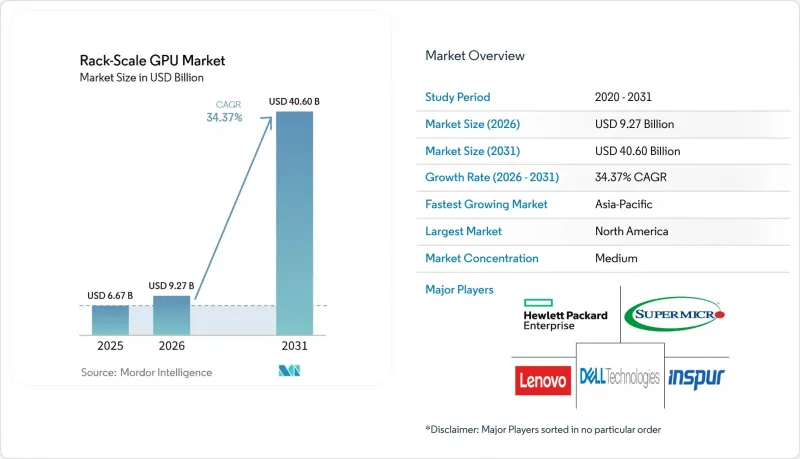
Mordor Intelligence에 의하면, 랙 스케일 GPU 시장 규모는 2025년 66억 7,000만 달러, 2026년 92억 7,000만 달러에서 2031년까지 406억 달러로 확대한다고 예측되고 있어 2026년부터 2031년까지 연평균 복합 성장률(CAGR)은 34.37%를 나타낼 전망입니다.
본 보고서는 제공 형태(하드웨어, 소프트웨어, 서비스), 랙 밀도(최대 16GPU, 17-64GPU, 65-128 GPU, 128 GPU 이상), 냉각 기술(공랭식, 수랭식, 하이브리드 냉각), 최종 사용자(클라우드 서비스 제공업체, 기업, 정부·연구기관, 통신·엣지 사업자) 및 지역별로 분류되어 있습니다. 시장 예측은 금액(달러) 기준으로 제시되어 있습니다.
전 세계 랙 스케일 GPU 시장 동향과 인사이트
하이퍼스케일 AI 클러스터의 밀도 요구 사항 증가
랙스케일 GPU 시장은 새로운 도입 주기마다 더 높은 밀도의 인프라를 필요로 하는 대규모 AI 클러스터를 구축하는 하이퍼스케일 클라우드 사업자에 의해 주도되고 있습니다. NVIDIA는 Vera Rubin NVL72 플랫폼이 단일 랙 스케일 시스템 내에 72개의 Rubin GPU와 36개의 Vera CPU를 통합하고 있다고 밝히며, 성능 목표가 이미 독립된 노드에서 통합 패브릭으로 전환되고 있음을 강조했습니다. 또한 NVIDIA는 GB200 NVL72급 시스템이 2025년에는 랙당 132kW에 달할 것이며, Vera Rubin급 플랫폼은 훨씬 더 높은 랙 밀도로 전환되고 있음을 보여주었습니다. 이에 따라 각 확장 단계에서 전용으로 설계된 전력 및 냉각 설계에 대한 의존도가 높아지고 있습니다. 그 결과, 랙 스케일 GPU 시장에서는 가속기뿐만 아니라 랙 납품, 액체 냉각 루프, 광섬유를 통한 스케일업, 나아가 시스템 도입 전 공장 수준에서의 검증에도 더 많은 투자가 집중되고 있습니다. Dell은 NVIDIA Vera Rubin 플랫폼을 기반으로 한 시스템의 CoreWeave에 대한 첫 출하를 2026년 6월에 실시했음을 확인했으며, 이는 하이퍼스케일 수요에서 기존의 부품 단위 도입 주기보다 통합된 랙 단위의 납품이 현재 중시되고 있음을 반영합니다. 이와 유사한 변화는 NVIDIA가 설명하는 ‘100만 GPU 규모의 AI 팩토리’에서도 분명하게 나타나며, 그곳에서는 랙 스케일 GPU 시장이 기존의 서버 교체 주기가 아닌 플랫폼 규모의 구축을 통해 형성되고 있습니다.
GPU 노드에서 랙 스케일 패브릭으로의 전환
또한, AI 도입 기업들이 개별 GPU 서버의 집합체가 아닌, 단일한 논리적 컴퓨팅 시스템처럼 작동하는 랙을 점점 더 요구함에 따라 랙 스케일 GPU 시장도 진화하고 있습니다. NVIDIA는 Vera Rubin NVL72를 260 TB/s의 NVLink 6 패브릭으로 통합된 통합 랙 플랫폼으로 설명하고 있으며, 이 아키텍처는 까다로운 AI 워크로드를 위한 대규모 공유 메모리 도메인으로의 전환을 직접 지원합니다. AI용 오픈 클러스터 설계에 관한 Open Compute Project의 노력은 인프라 표준이 기존의 노드 중심에서 고출력 클러스터 레이아웃, 더 넓은 랙 형식, 그리고 랙 네이티브 전력 분배를 중심으로 구축되고 있음을 더욱 잘 보여줍니다. 이는 랙 스케일 GPU 시장에 중요한 의미를 지닙니다. 조달 활동이 점점 더 시스템 지향적으로 변하고 있으며, 구매자들이 인클로저, 네트워크, 액체 냉각 및 서비스 지원성을 하나의 패키지로 평가하게 되었기 때문입니다. 또한 AMD는 자사의 ‘Helios AI’ 랙 설계를 Meta의 Open Compute 프로젝트 이니셔티브와 연계하고 있으며, 이는 패브릭 주도적 방향성이 단일 공급업체 생태계에 국한되지 않음을 시사합니다. 따라서 랙 스케일 GPU 시장은 전환 비용, 검증 주기, 운영 숙련도가 가속기의 순수한 성능과 거의 동등하게 중요시되는 플랫폼 경쟁으로 전환되고 있습니다.
초기 투자 부담이 큽니다.
랙 스케일 GPU 시장은 여전히 큰 제약에 직면해 있습니다. 풀 랙 AI 시스템에는 하드웨어, 랙 통합, 냉각 장치, 네트워크, 시설 구축 등 다방면에 걸친 초기 투자가 필요하기 때문입니다. 각 벤더의 발표 내용만 보더라도 가치가 얼마나 시스템 전체에 집중되어 있는지 알 수 있습니다. 구매자들은 더 이상 GPU 보드만 주문하는 것이 아니라, 지원 인프라를 갖춘 완전한 랙 스케일 환경을 조달하고 있기 때문입니다. 이러한 비용 구조로 인해 랙 스케일 GPU 시장은 하이퍼스케일러, 국가 주도 프로그램, 그리고 자금력이 풍부한 소수의 클라우드 전문 기업에 편중된 상태가 지속되고 있습니다. 관리형 배포(Managed Deployment)나 호스팅형 AI 컴퓨팅은 기업의 소유 부담을 경감시킬 수 있으며, AMD와 Rackspace 간에 체결된 30MW 계약은 서비스 주도형 접근 모델이 해결책의 일부가 되어가고 있음을 보여줍니다. 하지만 각 도입 사례마다 컴퓨팅 능력과 시설 능력 모두에 상당한 투자가 필요하기 때문에 랙스케일 GPU 시장 진입은 기존 서버 시장보다 여전히 어렵습니다. 이러한 자본 구조는 장기적인 성장을 뒷받침하는 한편, 당분간 고객층을 좁히고 있습니다.
부문 분석
2025년에는 하드웨어가 매출의 62.98%를 차지하며 랙스케일 GPU 시장에서 가장 큰 공급 분야가 되었습니다. 이는 가속기, NVLink 스위치, 랙 인클로저, 전원 시스템, 냉각 하드웨어에 막대한 지출이 필요함을 반영합니다. 이러한 상황은 많은 고객이 여전히 새로운 AI 용량을 구축하고 있으며, 최적화 계층이 지출의 주요 초점이 되기 전에 물리적 스택 전체를 구매해야 했던 초기 구축 주기와 일치했습니다. Dell, HPE, Supermicro, Lenovo 및 기타 시스템 구축 업체들은 풀 랙 AI 플랫폼을 상용화하고 있으며, 현재의 확장 국면에서 하드웨어는 여전히 구매자의 예산에서 중심을 차지하고 있습니다. 소프트웨어 매출 비중은 여전히 작지만, 패브릭, 냉각 제어, 워크로드 오케스트레이션이 기존 HPC 도구로는 관리하기 어려워짐에 따라 운영 측면에서의 중요성은 높아지고 있습니다. 즉, 하드웨어가 여전히 지출의 기반을 이루고 있기는 하지만, 랙 스케일 GPU 시장은 더 이상 서버 하드웨어만으로 정의될 수 없는 상황이 되었습니다.
서비스 분야는 2031년까지 연평균 성장률(CAGR) 34.96%로 확대될 것으로 예측되며, 가장 빠르게 성장하는 분야가 될 전망입니다. 이는 운영상의 복잡성이 많은 구매자에게 있어 허용 범위를 넘어 급속히 증가하고 있음을 보여줍니다. CoreWeave사가 2026년 6월에 실시한 NVIDIA Vera Rubin NVL72 출시에는 수냉식 스토리지, 맞춤형 소프트웨어 기반 냉각 제어, 통합 랙 관리가 포함되어 있어, 랙이 실제 운영에 들어가기 전에 필요한 조정 작업의 깊이를 보여줍니다. Dell사의 'Integrated Rack Scalable Systems' 모델도 유사한 방향성을 보여주며, 검증, 현장 구축, 라이프사이클 지원을 하드웨어와 함께 제공하여, 선택적 추가 작업으로 판매하는 것이 아니라 일체화된 형태로 제공합니다. 랙 스케일 GPU 업계에서 이로 인해 시운전, 열 설계 최적화, 펌웨어 검증, 광 인터커넥트 설정 및 보안 설정의 역할이 더욱 광범위해집니다. 따라서 기업, Tier 2 클라우드, 공공 기관이 사내에 완전한 운영 팀을 구축하지 않고도 랙 네이티브 AI 기능을 필요로 하는 곳에서는 랙 스케일 GPU 시장에서 서비스 수익이 더욱 빠르게 증가할 가능성이 높다고 볼 수 있습니다.
2025년에는 17-64개의 GPU로 구성된 티어가 매출의 39.83%를 차지하며 랙 스케일 GPU 시장의 주요 밀도 등급이 되었습니다. 이는 광범위한 엔터프라이즈 AI, 리저널 클라우드 및 중규모 주권 요구 사항을 충족하기 때문입니다. 이 티어는 구매자가 즉시 최대 규모이자 가장 까다로운 랙 실적로 전환하지 않고도 실용적인 컴퓨팅 밀도를 실현할 수 있는 현실적인 중간 지점을 제공했습니다. 또한, 이 부문은 고급 훈련 및 추론 능력을 요구하면서도 관리하기 쉬운 전력 할당량과 도입 일정 범위 내에서 운영하고자 하는 조직의 요구에도 부합했습니다. 그 결과, 2025년에는 17-64개의 GPU를 갖춘 부문이 랙 스케일 GPU 시장 점유율의 39.83%를 차지하며, 최고 밀도 포맷이 수반하는 복잡성 없이 확장성을 추구하는 구매자들에게 계속해서 주력 부문으로 자리매김했습니다. 이 부문은 기업의 초기 도입과 완전한 하이퍼스케일 구성 사이의 가교 역할을 수행함으로써 랙 스케일 GPU 시장 전체에 혜택을 가져다주었습니다.
128개 이상의 GPU를 갖춘 부문은 2031년까지 연평균 성장률(CAGR) 35.17%로 확대될 것으로 예측되며, 이는 더 대규모의 AI 모델이 랙 내에서 더 빠른 통신과 낮은 지연 시간을 요구함에 따라 다음 규모의 확장 물결이 어디로 향하고 있는지를 보여줍니다. Supermicro는 자사의 'Vera Rubin NVL4 DCBBS' 블루프린트가 3.2 MW 유닛 내에서 최대 1,152개의 NVIDIA Rubin GPU까지 확장 가능하다고 발표했습니다. 이는 공급업체들이 이미 극도로 고밀도인 AI 도입 블록을 염두에 두고 설계를 진행하고 있음을 보여줍니다. 또한, Dell도 ORv3 규격의 랙 1대당 최대 144개의 GPU를 지원하는 ‘PowerEdge XE8812’를 발표했으며, 이는 랙 스케일 GPU 시장이 더욱 고밀도인 랙 클래스로 전환되고 있음을 다시 한번 뒷받침합니다. 개방형 클러스터 설계를 추진하는 Open Compute Project는 미래의 고밀도 AI 클러스터를 위한 섀시 및 전원 규격을 제정함으로써, 이러한 흐름에 표준화의 차원을 더하고 있습니다. 랙 스케일 GPU 업계에서는 최대 16개 및 65-128개의 GPU를 탑재하는 구성도 여전히 중요하지만, 최첨단 워크로드에서 통신 오버헤드를 줄일 수 있는 더 대규모의 랙 도메인으로 추세가 분명히 이동하고 있습니다.
지역별 분석
2025년, 북미는 랙 스케일 GPU 시장의 53.34%를 차지하며 지역별 시장에서 1위를 기록했습니다. 이는 하이퍼스케일 클라우드 구매자, AI 인프라 전문가, 그리고 초기 수냉식 구축이 집중되어 있음을 반영합니다. 미국은 최대 규모의 플랫폼 출시, 첫 시스템 출하, 그리고 주목받는 AI 팩토리 프로젝트의 상당수가 이 나라를 중심으로 전개되고 있기 때문에 여전히 주요 거점으로 자리 잡고 있습니다. 델은 2026년 6월, CoreWeave사에 Vera Rubin 기반 시스템을 출하했습니다. 이는 북미 랙스케일 GPU 시장이 여전히 공급업체와 고객 간의 긴밀한 협력 및 신속한 상용화 주기의 혜택을 받고 있음을 보여줍니다. 또한 엔비디아(NVIDIA)는 코어위브(CoreWeave)사에 20억 달러를 투자하고, 2030년까지 5GW 이상의 AI 팩토리 구축을 지원하기 위해 제휴를 확대했습니다. 이는 해당 지역에서 이미 진행 중인 인프라 투자 규모를 뒷받침하는 것입니다. 따라서 이 지역이 주도적인 입지를 차지하고 있는 것은 현재의 생산 능력뿐만 아니라, 전력 공급, 랙 통합, 생태계 지원 각 분야에서의 신속한 실행력 덕분입니다.
유럽은 비교적 작은 기반에서 성장하고 있지만, 이 지역의 랙 스케일 GPU 시장은 연구용 컴퓨팅, 국가 주도의 AI 전략, 그리고 효율적인 고밀도 인프라에 대한 관심 증가를 통해 탄력을 받고 있습니다. NVIDIA가 2026년에 발표한 과학 시스템에는 라이프니츠 슈퍼컴퓨팅 센터가 포함되어 있으며, 이는 해당 지역이 첨단 랙 네이티브 AI 및 HPC 플랫폼 도입에 있어 여전히 활발함을 보여줍니다. HPE와 Lenovo 역시 멀티테넌트 및 대규모 도입을 목표로 2026년 ‘AI 팩토리’ 및 ‘Vera Rubin’ 프로그램을 선보였습니다. 이는 유럽의 구매자들이 노드를 단계적으로 추가하는 방식이 아닌 풀 랙 플랫폼으로 전환하고 있다는 관점을 뒷받침합니다. 이 지역의 동향을 보면, 컴퓨팅 주권, 연구 워크로드, 그리고 효율성을 중시하는 시설 설계가 결합되어 꾸준한 성장이 예상됩니다.
아시아태평양은 2031년까지 연평균 성장률(CAGR) 35.31%로 확대될 것으로 예측되며, 랙 스케일 GPU 시장에서 가장 빠르게 성장하는 지역 부문이 될 전망입니다. 일본에서는 고밀도 수냉식 운영 및 IDC Frontier, Vertiv, Equinix 등의 사업자가 제공하는 상용 수냉식 서비스를 통해 이미 도입 준비가 완료된 것으로 나타났습니다. 중국은 독자적인 국내 전략을 추진하고 있으며, 화웨이의 'CloudMatrix384' 논문에서는 16개의 랙에 걸친 통합 메모리 풀을 갖춘 384개의 NPU로 구성된 랙 스케일 슈퍼노드 아키텍처가 설명되어 있습니다. 또한 화웨이는 자사의 ‘Atlas 950 SuperPoD’가 최대 8,192개의 NPU까지 확장 가능하다고 밝혔으며, 이는 현지 대체 솔루션이 시스템 수준의 AI 인프라로 얼마나 빠르게 진화하고 있는지를 보여줍니다. 아시아태평양 이외에서는 남미가 여전히 소규모 시장에 머물러 있으며, 제한적인 하이퍼스케일 코로케이션 수요가 주를 이루고 있습니다. 한편, 중동 및 아프리카에서는 정부 주도의 AI 인프라 구축과 대규모 AI 팩토리 구상을 통해 존재감이 높아지고 있지만, 도입 기반은 북미에 비해 여전히 집중된 상황입니다.
기타 혜택:
- 엑셀 형식 시장 예측(ME) 시트
- 3개월간의 애널리스트 지원
자주 묻는 질문
목차
제1장 서론
제2장 조사 방법
제3장 주요 요약
제4장 시장 구도
제5장 시장 규모와 성장 예측
제6장 경쟁 구도
제7장 시장 기회와 향후 전망
JHS 26.08.05According to Mordor Intelligence, the rack-scale GPU market size is projected to expand from USD 6.67 billion in 2025 and USD 9.27 billion in 2026 to USD 40.60 billion by 2031, registering a CAGR of 34.37% between 2026 and 2031.
This report is Segmented by Offering (Hardware, Software, and Services), Rack Density (Up To 16 GPUs, 17-64 GPUs, 65-128 GPUs, and Above 128 GPUs), Cooling Technology (Air Cooled, Liquid Cooled, and Hybrid Cooled), End-User (Cloud Service Providers, Enterprises, Government and Research Institutions, and Telecom and Edge Operators), and Geography. The Market Forecasts are Provided in Terms of Value (USD).
Global Rack-Scale GPU Market Trends and Insights
Rising Hyperscale AI Cluster Density Requirements
The rack-scale GPU market is being driven by hyperscale cloud operators building larger AI clusters that require denser infrastructure in every new deployment cycle. NVIDIA stated that the Vera Rubin NVL72 platform combines 72 Rubin GPUs and 36 Vera CPUs in a single rack-scale system, underscoring how the performance target has already shifted from isolated nodes to integrated fabrics. NVIDIA also showed that GB200 NVL72-class systems reached 132 kW per rack in 2025, and that Vera Rubin-class platforms are moving toward far higher rack densities, making each expansion phase increasingly dependent on purpose-built power and cooling design. As a result, the rack-scale GPU market is drawing higher spending not only for accelerators, but also for rack delivery, liquid loops, optical scale-up, and factory-level validation before systems are installed. Dell confirmed the first shipment of systems built on the NVIDIA Vera Rubin platform to CoreWeave in June 2026, reflecting how hyperscale demand now favors integrated rack delivery over slower component-led installation cycles. The same shift is evident in NVIDIA's description of million-GPU AI factories, where the rack-scale GPU market is being shaped by platform-scale buildouts rather than typical server refresh cycles.
Shift From GPU Nodes To Rack-Scale Fabrics
The rack-scale GPU market is also advancing as AI buyers increasingly want racks that behave like a single logical compute system rather than a collection of separate GPU servers. NVIDIA described Vera Rubin NVL72 as a unified rack platform tied together by a 260 TB/s NVLink 6 fabric, and that architecture directly supports the move toward large shared memory domains for demanding AI workloads. Open Compute Project's work on open cluster designs for AI further shows that infrastructure standards are now being built around high-power cluster layouts, wider rack formats, and rack-native power distribution, rather than legacy node assumptions. That matters for the rack-scale GPU market because procurement is becoming more system-oriented, with buyers evaluating enclosures, networking, liquid cooling, and service readiness as one package. AMD also tied its Helios AI rack design to Meta's Open Compute work, suggesting that this fabric-led direction is not confined to a single supplier ecosystem. The rack-scale GPU market is therefore moving toward platform competition where switching costs, validation cycles, and operational familiarity matter almost as much as raw accelerator performance.
High Upfront Capital Intensity
The rack-scale GPU market still faces a meaningful restraint because full-rack AI systems require a large upfront commitment across hardware, rack integration, cooling equipment, networking, and facility preparation. Vendor announcements themselves show how much value is concentrated in the full system, since buyers are no longer ordering only GPU boards and are instead procuring complete rack-scale environments with supporting infrastructure. That cost profile keeps the rack-scale GPU market tilted toward hyperscalers, sovereign programs, and a small group of well-capitalized cloud specialists. Managed deployment and hosted AI compute can reduce the ownership burden for enterprises, and AMD's 30 MW agreement with Rackspace shows that service-led access models are becoming part of the response. Even so, the rack-scale GPU market remains harder to enter than conventional server markets because each deployment requires a matched investment in both compute and facility capability. This capital profile supports long-term growth but narrows the immediate customer pool.
Other drivers and restraints analyzed in the detailed report include:
- Liquid-Cooling Readiness in New AI Data Centers
- Sovereign AI Infrastructure Buildouts
- Power And Cooling Retrofit Complexity
For complete list of drivers and restraints, kindly check the Table Of Contents.
Segment Analysis
Hardware accounted for 62.98% of revenue in 2025, making it the largest offering in the rack-scale GPU market and reflecting the heavy spending required for accelerators, NVLink switches, rack enclosures, power systems, and cooling hardware. That position was consistent with an early build cycle, when many customers were still building new AI capacity and had to purchase the full physical stack before optimization layers became the primary focus of spending. Dell, HPE, Supermicro, Lenovo, and other system builders are commercializing full-rack AI platforms, keeping hardware at the center of buyers' budgets during the current expansion phase. Software remains smaller in revenue share, yet it has become operationally more important as fabrics, cooling controls, and workload orchestration become harder to manage with traditional HPC tools. That means the rack-scale GPU market is no longer defined solely by server hardware, even if hardware still anchors spending.
Services are projected to expand at a 34.96% CAGR through 2031, making it the fastest-growing offering and showing how quickly operating complexity is moving beyond the comfort level of many buyers. CoreWeave's June 2026 bring-up of NVIDIA Vera Rubin NVL72 involved liquid-cooled storage, custom software-defined cooling control, and unified rack management, which illustrates the depth of coordination required before a rack enters production use. Dell's Integrated Rack Scalable Systems model also points in the same direction, packaging validation, on-site deployment, and lifecycle support alongside the hardware rather than selling them as optional follow-on work. In the rack-scale GPU industry, this creates a wider role for commissioning, thermal tuning, firmware validation, optical interconnect setup, and security configuration. The rack-scale GPU market is therefore likely to see service revenue rise faster wherever enterprises, second-tier clouds, and public institutions want the capability of rack-native AI without building a full operations team internally.
The 17-64 GPU tier accounted for 39.83% of revenue in 2025, making it the leading density class in the rack-scale GPU market, as it meets a broad set of enterprise AI, regional cloud, and mid-scale sovereign requirements. This tier offered a practical middle ground where buyers could deploy meaningful compute density without immediately moving into the largest and most demanding rack footprints. The segment also matched the needs of organizations that wanted advanced training and inference capacity while still working within more manageable power envelopes and deployment schedules. For that reason, 17-64 GPUs held 39.83% of the rack-scale GPU market share in 2025, and it remained the workhorse bracket for buyers seeking scale without the full complexity of the highest-density formats. The rack-scale GPU market benefited from this segment, as it bridged early enterprise adoption and full hyperscale configurations.
The above-128 GPU tier is projected to expand at a 35.17% CAGR through 2031, which shows where the next wave of scale is heading as larger AI models demand tighter intra-rack communication and lower latency. Supermicro said its Vera Rubin NVL4 DCBBS blueprint can scale to 1,152 NVIDIA Rubin GPUs within a 3.2 MW unit, which demonstrates how suppliers are already designing around extremely dense AI deployment blocks. Dell also introduced the PowerEdge XE8812, which supports up to 144 GPUs per ORv3-standard rack, further confirming that the rack-scale GPU market is moving toward much denser rack classes. The Open Compute Project, which works on open cluster designs, adds a standards layer to this movement by preparing enclosures and power formats for future high-density AI clusters. In the rack-scale GPU industry, the up-to-16 and 65-128 GPU brackets still matter, but the strongest momentum is clearly shifting toward larger rack domains that can reduce communication overhead for frontier workloads.
Complete Report Scope:
- By Offering
- Hardware
- Software
- Services
- By Rack Density
- Up to 16 GPUs
- 17-64 GPUs
- 65-128 GPUs
- Above 128 GPUs
- By Cooling Technology
- Air Cooled
- Liquid Cooled
- Hybrid Cooled
- By End User
- Cloud Service Providers
- Enterprises
- Government and Research Institutions
- Telecom and Edge Operators
- By Geography
- North America
- United States
- Canada
- Mexico
- Europe
- Germany
- United Kingdom
- France
- Italy
- Rest of Europe
- Asia-Pacific
- China
- Japan
- South Korea
- India
- Southeast Asia
- Rest of Asia-Pacific
- South America
- Middle East and Africa
- North America
Geography Analysis
North America accounted for 53.34% of the rack-scale GPU market in 2025, making it the leading regional market and reflecting the concentration of hyperscale cloud buyers, AI infrastructure specialists, and early liquid-cooled buildouts. The United States remains the main anchor because the largest platform launches, first system shipments, and many of the most visible AI factory projects are centered there. Dell shipped Vera Rubin-based systems to CoreWeave in June 2026, showing that the rack-scale GPU market in North America still benefits from close vendor-customer coordination and fast commercialization cycles. NVIDIA also invested USD 2 billion in CoreWeave and expanded the partnership to support a 5+ GW AI factory buildout by 2030, underscoring the scale of the infrastructure commitment already underway in the region. The regional lead is therefore not only a matter of current capacity, but also of faster execution across power, rack integration, and ecosystem support.
Europe is growing from a smaller base, but the rack-scale GPU market there is gaining traction through research computing, sovereign AI priorities, and rising interest in efficient high-density infrastructure. NVIDIA's 2026 science systems announcement included the Leibniz Supercomputing Center, demonstrating that the region remains active in deploying advanced rack-native AI and HPC platforms. HPE and Lenovo also positioned their 2026 AI factory and Vera Rubin programs for multi-tenant and large-scale deployments, which supports the view that European buyers are moving toward full-rack platforms rather than incremental node additions. The regional profile suggests steady growth where compute sovereignty, research workloads, and efficiency-oriented facility design come together.
Asia-Pacific is projected to expand at a 35.31% CAGR through 2031, making it the fastest-growing regional segment in the rack-scale GPU market. Japan is already demonstrating stronger deployment readiness through high-density liquid-cooled operations and commercial liquid-cooling services from operators such as IDC Frontier, Vertiv, and Equinix. China is advancing along a distinct domestic path, and Huawei's CloudMatrix384 paper described a 384 NPU rack-scale supernode architecture with unified memory pooling across 16 racks. Huawei also said its Atlas 950 SuperPoD would scale to 8,192 NPUs, which shows how quickly local alternatives are moving toward system-level AI infrastructure. Outside Asia-Pacific, South America remains a smaller market, centered on selective hyperscale colocation demand, while the Middle East and Africa are becoming more visible through sovereign AI buildouts and large AI factory ambitions, even though the installed base remains more concentrated than in North America.
- Dell Technologies Inc.
- Hewlett Packard Enterprise Company
- Super Micro Computer, Inc.
- Lenovo Group Limited
- Inspur Group Co., Ltd.
- NVIDIA Corporation
- Advanced Micro Devices, Inc.
- Cisco Systems, Inc.
- Huawei Technologies Co., Ltd.
- GIGABYTE Technology Co., Ltd.
- ASUSTeK Computer Inc.
- Fujitsu Limited
- International Business Machines Corporation
- Intel Corporation
- Oracle Corporation
- CoreWeave, Inc.
- Quanta Computer Inc.
- Wistron Corporation
- Wiwynn Corporation
- Hon Hai Precision Industry Co., Ltd.
Additional Benefits:
- The market estimate (ME) sheet in Excel format
- 3 months of analyst support
TABLE OF CONTENTS
1 INTRODUCTION
- 1.1 Study Assumptions and Market Definition
- 1.2 Scope of the Study
2 RESEARCH METHODOLOGY
3 EXECUTIVE SUMMARY
4 MARKET LANDSCAPE
- 4.1 Market Overview
- 4.2 Market Drivers
- 4.2.1 Rising Hyperscale AI Cluster Density Requirements
- 4.2.2 Shift From GPU Nodes to Rack-Scale Fabrics
- 4.2.3 Liquid-Cooling Readiness in New AI Data Centers
- 4.2.4 Sovereign AI Infrastructure Buildouts
- 4.2.5 Power-Availability Constraints Favoring High-Density Rack Design
- 4.2.6 Multi-Tenant AI Service Monetization Pressure
- 4.3 Market Restraints
- 4.3.1 High Upfront Capital Intensity
- 4.3.2 Power and Cooling Retrofit Complexity
- 4.3.3 Limited Supply of Advanced Packaging and High-Bandwidth Memory
- 4.3.4 Rack-Level Standardization Gaps Across OEMs
- 4.4 Impact of Macroeconomic Factors on the Market
- 4.5 Industry Value Chain Analysis
- 4.6 Regulatory Landscape
- 4.7 Technological Outlook
- 4.8 Porter's Five Forces Analysis
- 4.8.1 Bargaining Power of Buyers
- 4.8.2 Bargaining Power of Suppliers
- 4.8.3 Threat of New Entrants
- 4.8.4 Threat of Substitutes
- 4.8.5 Intensity of Competitive Rivalry
5 MARKET SIZE AND GROWTH FORECASTS (VALUE)
- 5.1 By Offering
- 5.1.1 Hardware
- 5.1.2 Software
- 5.1.3 Services
- 5.2 By Rack Density
- 5.2.1 Up to 16 GPUs
- 5.2.2 17-64 GPUs
- 5.2.3 65-128 GPUs
- 5.2.4 Above 128 GPUs
- 5.3 By Cooling Technology
- 5.3.1 Air Cooled
- 5.3.2 Liquid Cooled
- 5.3.3 Hybrid Cooled
- 5.4 By End User
- 5.4.1 Cloud Service Providers
- 5.4.2 Enterprises
- 5.4.3 Government and Research Institutions
- 5.4.4 Telecom and Edge Operators
- 5.5 By Geography
- 5.5.1 North America
- 5.5.1.1 United States
- 5.5.1.2 Canada
- 5.5.1.3 Mexico
- 5.5.2 Europe
- 5.5.2.1 Germany
- 5.5.2.2 United Kingdom
- 5.5.2.3 France
- 5.5.2.4 Italy
- 5.5.2.5 Rest of Europe
- 5.5.3 Asia-Pacific
- 5.5.3.1 China
- 5.5.3.2 Japan
- 5.5.3.3 South Korea
- 5.5.3.4 India
- 5.5.3.5 Southeast Asia
- 5.5.3.6 Rest of Asia-Pacific
- 5.5.4 South America
- 5.5.5 Middle East and Africa
- 5.5.1 North America
6 COMPETITIVE LANDSCAPE
- 6.1 Market Concentration
- 6.2 Strategic Moves
- 6.3 Market Positioning Analysis
- 6.4 Company Profiles (includes Global Level Overview, Market Level Overview, Core Segments, Financials as available, Strategic Information, Market Rank/Share, Products and Services, Recent Developments)
- 6.4.1 Dell Technologies Inc.
- 6.4.2 Hewlett Packard Enterprise Company
- 6.4.3 Super Micro Computer, Inc.
- 6.4.4 Lenovo Group Limited
- 6.4.5 Inspur Group Co., Ltd.
- 6.4.6 NVIDIA Corporation
- 6.4.7 Advanced Micro Devices, Inc.
- 6.4.8 Cisco Systems, Inc.
- 6.4.9 Huawei Technologies Co., Ltd.
- 6.4.10 GIGABYTE Technology Co., Ltd.
- 6.4.11 ASUSTeK Computer Inc.
- 6.4.12 Fujitsu Limited
- 6.4.13 International Business Machines Corporation
- 6.4.14 Intel Corporation
- 6.4.15 Oracle Corporation
- 6.4.16 CoreWeave, Inc.
- 6.4.17 Quanta Computer Inc.
- 6.4.18 Wistron Corporation
- 6.4.19 Wiwynn Corporation
- 6.4.20 Hon Hai Precision Industry Co., Ltd.
7 MARKET OPPORTUNITIES AND FUTURE OUTLOOK
- 7.1 White-Space and Unmet-Need Assessment


