
|
시장보고서
상품코드
2114386
인도의 자동차용 윤활유 : 시장 점유율 분석, 업계 동향 및 통계, 성장 예측(2026-2031년)India Automotive Lubricants - Market Share Analysis, Industry Trends & Statistics, Growth Forecasts (2026 - 2031) |
||||||
 Mordor Intelligence
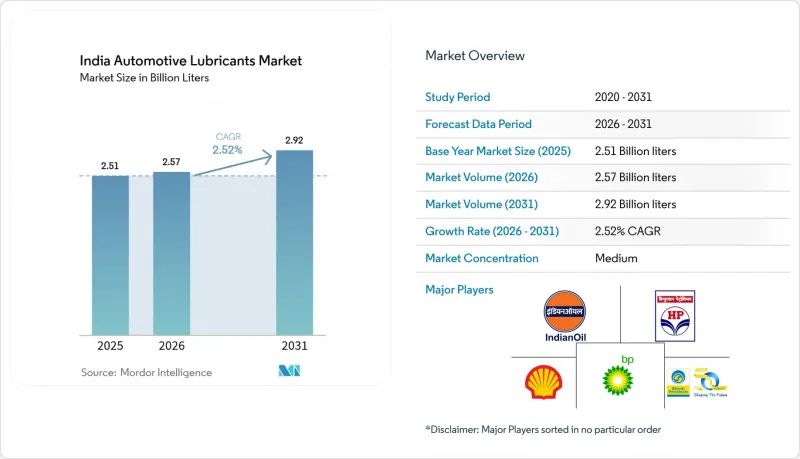
Mordor Intelligence에 의하면, 인도의 자동차용 윤활유 시장 규모는 2025년에 25억 1,000만 리터로 평가되었고, 2026년 25억 7,000만 리터에서 2031년까지 29억 2,000만 리터에 이를 것으로 예측되며, 예측 기간(2026-2031년) CAGR은 2.52%를 기록할 전망입니다.
본 보고서는 제품 유형(자동차 엔진 오일, 수동 변속기 오일, 자동 변속기 오일, 브레이크 오일, 자동차 그리스, 기타 제품 유형) 및 차량 유형(승용차, 상용차, 이륜차)별로 분류되어 있습니다. 시장 전망은 수량(리터) 기준으로 제시되어 있습니다.
인도 자동차 윤활유 시장 동향 및 인사이트
자동차 보유 대수 및 승용차 판매 대수 증가
2024 회계연도, GDP가 8.2% 성장하고 소비자 심리가 회복됨에 따라 승용차 생산 대수는 9.9% 회복되었습니다. 신차, 특히 소형 SUV의 등장으로 API SP 규격의 합성유에 대한 초기 충전 수요가 자극받고 있으며, 또한 출력 대 중량 비율의 향상에 따라 열 안정성이 뛰어난 프리미엄 윤활유가 필요시되고 있습니다. 인도의 경차의 연간 평균 주행 거리는 1만 2,000km이므로, 오일 교환 주기가 연장되었음에도 불구하고 여전히 연간 2-3회의 오일 교환이 필요하며, 그 결과 애프터마켓에서 지속적인 수요가 발생하고 있습니다. 대리점의 서비스 프로그램에서는 브랜드 윤활유가 세트로 판매되고 있으며, OEM이 권장하는 등급을 준수하도록 장려되고 있습니다. 그 결과, 인도의 자동차용 윤활유 시장은 출고 시 최초 주입과 정비소에서 발생하는 지속적인 수요 사이클 양쪽 모두로부터 혜택을 받고 있습니다.
인도 농촌 지역의 이륜차 보급률 급증
‘프라단 만트리 그람 사다크 요자나(Pradhan Mantri Gram Sadak Yojana)’를 통해 촉진된 농촌 지역의 소득 증가와 도로망 확충으로 인해 이륜차 보유 대수는 지속적으로 증가하고 있으며, 이륜차와 스쿠터가 주요 이동 수단이 되고 있습니다. 3,000-4,000km라는 빈번한 오일 교환 주기가 윤활유의 지속적인 수요를 창출하고 있습니다. 보급률은 여전히 100-125cc 모델이 가장 높으며, 이들 중 상당수가 여전히 광물유나 반합성유를 사용하고 있기 때문에 도시 지역 소비자들이 전기 모델로 전환하고 있음에도 불구하고 판매량은 유지되고 있습니다. 시장을 선도하는 Hero Motocorp와 Honda는 마을 단위의 정비사를 통한 보급 활동을 지속하고 있으며, 이를 통해 브랜드 윤활유 제조업체들은 농촌 지역의 유통망을 확대할 수 있게 되었습니다. 따라서 이륜차 부문은 저소득 지역 인도 자동차 윤활유 시장의 견조한 판매량을 지탱하는 기반이 되고 있습니다.
이륜차·삼륜차의 급속한 전기화
FAME-II 인센티브와 주 차원의 보조금에 힘입어 라스트 마일 배송용 전기 스쿠터 및 삼륜차의 도입이 가속화되고 있습니다. 전기 파워트레인은 엔진 오일이 필요 없고 변속기 오일 사용량을 줄이기 때문에 기존 윤활유의 소비량은 감소합니다. 그럼에도 불구하고 전기차의 등장으로 인해 배터리 열 관리용 유전체 냉각액이나 단단 감속기용 저점도 기어 오일과 같은 새로운 틈새 시장이 생겨나고 있습니다. 사비타 오일 테크놀로지스는 최근 이러한 용도를 겨냥한 합성 에스테르계 유체를 상품화했습니다. 2030년까지 전체 물량에 미치는 영향은 여전히 미미한 수준이지만, 이러한 제약 요인이 인도 자동차 윤활유 시장에서 기존 부문의 성장을 둔화시키고 있습니다.
부문 분석
2025년 인도 자동차 윤활유 시장에서 엔진 오일 시장 규모는 총 판매량의 58.12%를 차지했습니다. BS-VI 규격 엔진에서는 내산화성과 피스톤 청정성이 요구되기 때문에 API SP 및 ILSAC GF-6 규격 제품이 보급되고 있습니다. 완전 합성 유형은 가격이 30% 더 비싸기 때문에 판매량은 정체되어 있음에도 불구하고 부문 시장 규모를 끌어올리고 있습니다. 차량 함대 실증 시험에서는 저점도 0W-20 오일을 사용함으로써 2%의 연비 개선이 확인되어, 대도시권의 카셰어링 차량 함대에서의 도입을 촉진하고 있습니다. 과거 데이터와 비교하면 특수 윤활유의 확대에 따라 엔진 오일의 점유율은 소폭 하락하고 있지만, 이 부문은 여전히 인도의 자동차용 윤활유 시장의 주축을 이루고 있습니다.
자동변속기 오일(ATF)은 규모는 작지만 가장 빠르게 성장하는 부문으로, 2031년까지 연평균 성장률(CAGR)이 2.63%를 나타낼 것으로 예측됩니다. 이러한 성장은 소형차 및 SUV에서 CVT와 AMT 변속기의 보급률 상승에 기인합니다. 또한, 각 OEM 업체들은 시내버스를 6단 자동변속기로 전환하고 있으며, 이로 인해 12만 km의 교환 주기를 충족할 수 있는 TES-295 규격의 오일에 대한 수요가 촉진되고 있습니다. 혼합 오일 제조업체들은 토크 컨버터의 산화 시험 기준을 충족하기 위해 고품질의 그룹 III 및 PAO 기반 ATF에 대한 투자를 확대되고 있습니다. 그 결과, ATF 제품 포트폴리오는 점점 더 다양해지고 있으며, 이는 인도 자동차 윤활유 시장 규모 산정 시 평균 판매 단가 상승에 기여하고 있습니다.
기타 혜택
- 엑셀 형식 시장 예측(ME) 시트
- 3개월간의 애널리스트 지원
자주 묻는 질문
목차
제1장 서론
제2장 조사 방법
제3장 주요 요약
제4장 시장 구도
제5장 시장 규모와 성장 예측
제6장 경쟁 구도
제7장 시장 기회와 향후 전망
제8장 CEO가 직면하는 중요 전략적 과제
LSH 26.08.26According to Mordor Intelligence, the India automotive lubricants market size was valued at 2.51 billion liters in 2025 and estimated to grow from 2.57 billion liters in 2026 to reach 2.92 billion liters by 2031, at a CAGR of 2.52% during the forecast period (2026-2031).
This report is Segmented by Product Type (Automotive Engine Oil, Manual Transmission Fluids, Automatic Transmission Fluids, Brake Fluids, Automotive Greases, and Other Product Types) and Vehicle Type (Passenger Vehicles, Commercial Vehicles, and Two-Wheelers). The Market Forecasts are Provided in Terms of Volume (liters).
India Automotive Lubricants Market Trends and Insights
Rising Vehicle Parc and Passenger-Car Sales
Passenger-car production rebounded 9.9% in FY 2024 as GDP grew 8.2% and consumer sentiment recovered. New models, especially compact SUVs, stimulate first-fill demand for API SP synthetics, and higher power-to-weight ratios necessitate premium lubricants for thermal stability. Recurring aftermarket volumes follow because the average Indian light vehicle clocks 12,000 km annually, still requiring two to three oil changes a year despite extended drain intervals. Dealer service programs bundle branded lubricants, improving compliance with OEM-recommended grades. Consequently, India automotive lubricants market benefits from both initial factory fills and sustained workshop demand cycles.
Two-Wheeler Penetration Surge in Rural India
Rising rural incomes and improved road connectivity, facilitated by the Pradhan Mantri Gram Sadak Yojana, continue to boost two-wheeler ownership, with motorcycles and scooters serving as the primary means of mobility. Frequent oil-change intervals of 3,000-4,000 km generate recurring lubricant demand. Penetration remains highest for 100-125 cc models, many of which still use mineral or semi-synthetic oils, preserving volume even as urban consumers shift to electric variants. Market leaders Hero MotoCorp and Honda sustain outreach programs through village-level mechanics, enabling branded lubricant companies to deepen rural distribution. The two-wheeler segment, therefore, anchors volume resilience for the India automotive lubricants market in lower-income geographies.
Rapid Electrification of 2- & 3-Wheelers
FAME-II incentives and state-level subsidies have accelerated the adoption of electric scooters and three-wheelers for last-mile deliveries. Electric powertrains eliminate engine oil requirements and reduce transmission fluid volumes, thereby reducing traditional lubricant consumption. Still, EVs introduce new niches-dielectric coolants for battery thermal management and low-viscosity gear oils for single-speed reducers. Savita Oil Technologies recently commercialized synthetic ester fluids targeting these applications. While overall volume impact remains modest to 2030, the restraint trims growth of conventional segments within India automotive lubricants market.
Other drivers and restraints analyzed in the detailed report include:
- Shift to High-Performance Synthetics Post-BS-VI
- OEM Factory-Fill Tie-Ups Expanding Lubricant Volume
- Base-Oil Price Volatility
For complete list of drivers and restraints, kindly check the Table Of Contents.
Segment Analysis
India automotive lubricants market size for engine oils totaled 58.12% share of total volumes in 2025. API SP and ILSAC GF-6 formulations are gaining traction because BS-VI engines require improved oxidation resistance and piston cleanliness. Fully synthetic variants fetch 30% higher prices, lifting segment value despite flat volumes. Fleet trials show a 2 % fuel-economy gain using low-viscosity 0W-20 oils, encouraging adoption across ride-hailing fleets in metropolitan areas. Historical comparisons reveal that the share of engine oil is declining marginally as specialty fluids expand, yet the segment remains the anchor of India's automotive lubricants market.
Automatic transmission fluids constitute a smaller but fastest-growing pocket, with projected volumes rising at a 2.63% CAGR through 2031. Growth stems from the rising penetration of CVT and AMT gearboxes in compact cars and SUVs. OEMs also shift city-bus fleets to six-speed automatics, spurring demand for TES-295-grade fluids capable of 120,000 km service intervals. Blenders invest in premium Group III and PAO-based ATFs to meet torque-converter oxidation tests. As a result, ATFs increasingly diversify product portfolios and improve average realizations within India automotive lubricants market size calculations.
Complete Report Scope:
- By Product Type
- Automotive Engine Oil
- 0W-XX
- 5W-XX
- 10W-XX
- 15W-XX
- Monogrades
- Other Grades
- Manual Transmission Fluids (MTF)
- Automatic Transmission Fluids (ATF)
- Brake Fluids
- Automotive Greases
- Other Product Types (Power Steering Fluid etc.)
- Automotive Engine Oil
- By Vehicle Type
- Passenger Vehicles
- Commercial Vehicles
- Two-Wheelers
List of Companies Covered in this Report:
- Bharat Petroleum Corporation Limited
- BP p.l.c.
- Chevron Alkhalij
- ENEOS Corporation
- Exxon Mobil Corporation
- FUCHS
- GP Petroleums
- Gulf Oil International
- Hindustan Petroleum Corporation Limited
- Idemitsu Lubricants India Pvt Ltd
- Indian Oil Corporation Limited
- KLUBER LUBRICATION INDIA Pvt. Ltd.
- Morris Lubricants India
- Motul
- Saudi Arabian Oil Co.
- Savita Oil Technologies Limited
- Shell Plc
- TotalEnergies
- Veedol Corporation Limited
Additional Benefits:
- The market estimate (ME) sheet in Excel format
- 3 months of analyst support
TABLE OF CONTENTS
1 Introduction
- 1.1 Study Assumptions and Market Definition
- 1.2 Scope of the Study
2 Research Methodology
3 Executive Summary
4 Market Landscape
- 4.1 Market Overview
- 4.2 Market Drivers
- 4.2.1 Rising vehicle parc and passenger-car sales
- 4.2.2 Two-wheeler penetration surge in rural India
- 4.2.3 Shift to high-performance synthetics post-BS-VI
- 4.2.4 OEM factory-fill tie-ups expanding lubricant volume
- 4.2.5 Growth of shared-mobility fleets driving higher churn
- 4.3 Market Restraints
- 4.3.1 Rapid electrification of 2- & 3-wheelers
- 4.3.2 Base-oil price volatility
- 4.3.3 Push toward re-refined base oils reducing virgin demand
- 4.4 Value Chain and Distribution Channel Analysis
- 4.5 Porter's Five Forces
- 4.5.1 Threat of New Entrants
- 4.5.2 Bargaining Power of Suppliers
- 4.5.3 Bargaining Power of Buyers
- 4.5.4 Threat of Substitutes
- 4.5.5 Industry Rivalry
- 4.6 Regulatory Framework
- 4.7 Automotive Industry Trends
5 Market Size and Growth Forecasts (Volume)
- 5.1 By Product Type
- 5.1.1 Automotive Engine Oil
- 5.1.1.1 0W-XX
- 5.1.1.2 5W-XX
- 5.1.1.3 10W-XX
- 5.1.1.4 15W-XX
- 5.1.1.5 Monogrades
- 5.1.1.6 Other Grades
- 5.1.2 Manual Transmission Fluids (MTF)
- 5.1.3 Automatic Transmission Fluids (ATF)
- 5.1.4 Brake Fluids
- 5.1.5 Automotive Greases
- 5.1.6 Other Product Types (Power Steering Fluid etc.)
- 5.1.1 Automotive Engine Oil
- 5.2 By Vehicle Type
- 5.2.1 Passenger Vehicles
- 5.2.2 Commercial Vehicles
- 5.2.3 Two-Wheelers
6 Competitive Landscape
- 6.1 Market Concentration
- 6.2 Strategic Moves
- 6.3 Market Share (%)**/Ranking Analysis
- 6.4 Company Profiles (includes Global level Overview, Market level overview, Core Segments, Financials as available, Production Capacity, Strategic Information, Market Rank/Share for key companies, Products and Services, and Recent Developments)
- 6.4.1 Bharat Petroleum Corporation Limited
- 6.4.2 BP p.l.c.
- 6.4.3 Chevron Alkhalij
- 6.4.4 ENEOS Corporation
- 6.4.5 Exxon Mobil Corporation
- 6.4.6 FUCHS
- 6.4.7 GP Petroleums
- 6.4.8 Gulf Oil International
- 6.4.9 Hindustan Petroleum Corporation Limited
- 6.4.10 Idemitsu Lubricants India Pvt Ltd
- 6.4.11 Indian Oil Corporation Limited
- 6.4.12 KLUBER LUBRICATION INDIA Pvt. Ltd.
- 6.4.13 Morris Lubricants India
- 6.4.14 Motul
- 6.4.15 Saudi Arabian Oil Co.
- 6.4.16 Savita Oil Technologies Limited
- 6.4.17 Shell Plc
- 6.4.18 TotalEnergies
- 6.4.19 Veedol Corporation Limited
7 Market Opportunities and Future Outlook
- 7.1 White-space and Unmet-need Assessment