

|
시장보고서
상품코드
2115854
유럽의 화학제품 물류 : 시장 점유율 분석, 업계 동향과 통계, 성장 예측(2026-2031년)Europe Chemical Logistics - Market Share Analysis, Industry Trends & Statistics, Growth Forecasts (2026 - 2031) |
||||||
 Mordor Intelligence
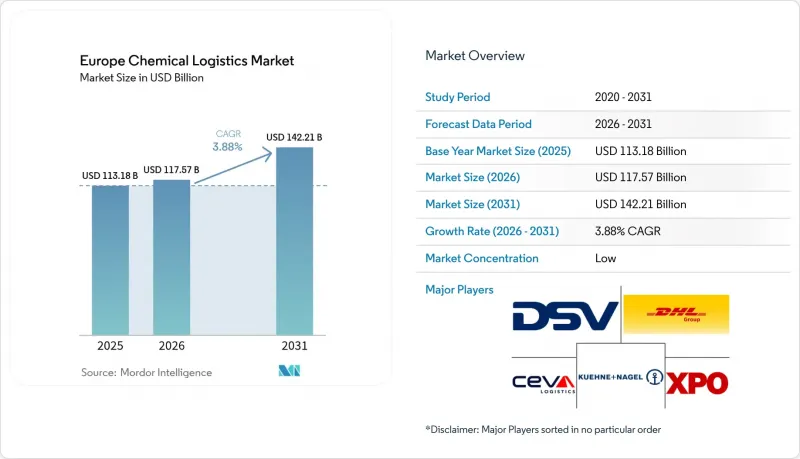
Mordor Intelligence에 따르면 유럽의 화학제품 물류 시장 규모는 2025년에 1,131억 8,000만 달러로 평가되며, 2026년 1,175억 7,000만 달러에서 2031년까지 1,422억 1,000만 달러에 달할 것으로 예측되며, 예측 기간(2026-2031년) 동안 CAGR은 3.88%가 될 전망입니다.
본 보고서는 서비스별(운송, 창고·유통·재고 관리, 기타), 최종사용자 산업(제약, 화장품, 석유·가스, 특수 화학제품 등), 위험물 분류(위험물, 비위험물), 온도 관리(온도 관리 있음, 온도 관리 없음), 및 지역(영국 등)별로 분류되어 있습니다. 시장 전망은 금액(달러) 기준으로 제시되어 있습니다.
유럽 화학제품 물류 시장의 동향 및 인사이트
그린 케미컬 수요로 인해 특수 허브 인근 지역으로의 집하가 집중되고 있습니다
지속가능한 화학에 주력하는 제조업체들은 기존 클러스터 인근으로 생산 거점을 이전하고 있으며, 이로 인해 배송 거리는 단축되는 반면, 온도 관리 및 ADR 준수 인프라에 대한 요구 사항은 높아지고 있습니다. ICIG가 Valtris Advanced Organics의 거점을 자사의 Vynova 플랫폼에 통합한 사례는, 케미컬 파크 내의 수직 통합이 적재 밀도를 높이고, 지속적인 환경 모니터링 기능을 갖춘 전문 창고가 필요함을 보여줍니다. 검증된 콜드체인 역량과 누출 방지 대책이 마련된 ISO 탱크 차량을 보유한 물류 제공업체는 의약품 및 화장품 중간체에 엄격한 취급 프로토콜이 요구되기 때문에 높은 단가의 운임을 확보하고 있습니다.
REPowerEU가 유럽 내 벌크 화학제품 운송 경로 변경을 가속화
러시아산 원료에 대한 의존도를 낮추려는 EU의 정책에 따라, 벌크 화학제품의 유통 경로는 서부 항만 및 내륙의 복합 운송 허브로 전환되고 있습니다. 독일이 2억 2,900만 유로(2억 5,273만 달러) 규모의 철도 접근 보조금을 2028년까지 연장함에 따라 철도의 수익성이 강화되어, 장거리 트럭 운송에 비해 종단간 비용을 최대 20% 절감하고 있습니다. 여러 회원국에 걸쳐 통관, 안전, 지속가능성 관련 규정 준수를 조화시킬 수 있는 유연성을 갖춘 3PL 기업들은 제조업체들이 공급망을 재협상하는 가운데 새로운 계약을 수주하고 있습니다.
ADR 인증 트럭 운전사 부족
600-1,700파운드에 달하는 교육 비용이 진입 장벽이 되고 있는 반면, 은퇴자 수가 신규 면허 취득자 수를 초과하고 있습니다. 그 결과, 유럽의 화학제품 물류 시장에서는 노선 간 불균형과 갑작스러운 현물 운임 급등 현상이 나타나고 있습니다. 사업자 측은 사내 교육 기관 설립, 급여 인상, 노선 계획 최적화 등으로 대응하고 있지만, 특히 중대한 위험을 수반하는 위험물의 경우 운송 능력 부족이 여전히 지속되고 있습니다.
부문 분석
2025년, 운송 부문은 매출의 64.40%를 차지하며, 특수 탱크로리, 철도 탱크차, ISO 컨테이너를 통한 운송이 유럽 화학제품 물류 시장의 중추 역할을 계속하고 있습니다. 이 부문은 DSV의 DB 쉔커 인수 계획 등 네트워크 밀집화 프로젝트를 통해 규모의 경제를 확보하고 있습니다. 한편, 부가가치 서비스 부문에서 유럽 화학제품 물류 시장 규모는 연평균 성장률(CAGR) 3.56%로 확대될 것으로 예측됩니다. 이는 멀티 클라이언트형 화학제품 유통 센터에 통합된 라벨 부착, 재포장, 품질 검사 업무의 증가를 반영한 것입니다.
운송 수단으로는 도로 운송이 시간 엄수와 위험물 취급을 담당하는 반면, 철도는 정부의 인센티브에 힘입어 장거리 노선에서 점유율을 확대하고 있습니다. ADR(위험물 운송 규정)을 준수하는 운송 능력과 귀로 화물을 매칭시키는 디지털 플랫폼을 통해 빈차 운행을 억제함으로써, 통행료 할증률이 상승하는 상황에서도 이익률이 향상되고 있습니다. 항공 화물 및 근해 운송 솔루션은 운송 시간이나 대량 운송에 따른 할인이 비용 프리미엄을 상회하는 틈새 시장이자 고부가가치 화물을 처리하고 있습니다.
부가가치 서비스에는 규제 관련 서류 작성, 안전 데이터 관리, 지속가능성 보고 등이 점점 더 많이 포함되고 있어, 화주들은 규정 준수와 관련된 복잡한 업무를 외부에 위탁할 수 있게 되었습니다. 환경·사회·지배구조(ESG) 공시가 의무화됨에 따라, 3PL 각사는 포털 사이트에 CO2 대시보드를 통합하여 물류 성과를 실질적인 배출량 데이터로 시각화하고 있습니다. 현장 물류, 블렌딩, 샘플 테스트에 대한 수요가 증가함에 따라 수탁 제조와 제3자 물류의 경계가 더욱 모호해지고 있으며, 이는 유럽 화학제품 물류 업계 전반에 걸쳐 서비스의 고도화를 촉진하고 있습니다.
석유·가스 부문은 확립된 석유화학 원료의 흐름에 힘입어 2025년 매출의 25.60%를 차지했습니다. 그러나 의약품 및 화장품 분야의 특수 화학제품에 대한 수요는 연평균 성장률(CAGR) 3.73%로 성장할 것으로 예측되며, 이는 벌크 부문을 상회하는 속도입니다. 의약품 유통 분야의 유럽 화학제품 물류 시장 규모는 UPS 헬스케어의 확장된 더블린 캠퍼스 등, GDP 인증을 받은 콜드체인 솔루션을 의무화하는 새로운 바이오의약품 거점의 혜택을 받고 있습니다.
화장품 물류는 현재 의약품 등급 기준을 준수하고 있으며, 일정한 온도 유지, 알레르기 유발 물질 격리, 로트 추적 가능성이 중시되고 있습니다. 그린 케미스트리(Green Chemistry) 이니셔티브로 인해 통제된 환경에 대한 수요가 더욱 높아지고 있습니다. 대조적으로, 석유화학제품 화주들은 가격 변동과 에너지 전환으로 인한 역풍에 직면해 있으며, 정유소 복합 시설 내 철도 부선 개보수 및 바지선(하케)과의 연결과 같은 효율화 프로젝트가 추진되고 있습니다. 농약과 산업용 가스는 여전히 안정적인 수익원으로 작용하고 있지만, IBC에서 실린더 묶음에 이르기까지 다양한 포장이 요구됨에 따라 유럽 화학제품 물류 시장에서 3PL의 역량 범위를 확대할 필요가 대두되고 있습니다.
기타 혜택:
- 엑셀 형식의 시장 예측(ME) 시트
- 3개월간의 애널리스트 지원
자주 묻는 질문
목차
제1장 소개
제2장 조사 방법
제3장 주요 요약
제4장 시장 구도
제5장 시장 규모와 성장 예측
제6장 경쟁 구도
제7장 시장 기회와 향후 전망
KSM 26.08.26According to Mordor Intelligence, the Europe chemical logistics market size was valued at USD 113.18 billion in 2025 and estimated to grow from USD 117.57 billion in 2026 to reach USD 142.21 billion by 2031, at a CAGR of 3.88% during the forecast period (2026-2031).
This report is Segmented by Service (Transportation, Warehousing/Distribution/Inventory Management, and More), End-User Industry (Pharmaceutical, Cosmetic, Oil & Gas, Specialty Chemicals, and More), Hazard Class (Hazardous, Non-Hazardous), Temperature Control (Temperature-Controlled, Non-Temperature-Controlled), and Geography (UK, and More). Market Forecasts are Provided in Terms of Value (USD).
Europe Chemical Logistics Market Trends and Insights
Green-chemicals demand concentrating loads closer to specialty hubs
Manufacturers dedicated to sustainable chemistry are relocating production near established clusters, shortening delivery distances yet heightening requirements for temperature-controlled and ADR-compliant infrastructure. ICIG's integration of Valtris Advanced Organics sites into its Vynova platform illustrates how vertical integration inside chemical parks boosts load density and necessitates specialized warehouses with continuous environmental monitoring. Logistics providers offering validated cold-chain capability and leak-proof ISO-tank fleets capture premium rates because pharmaceutical and cosmetic intermediates demand strict handling protocols.
REPowerEU accelerating intra-Europe bulk chemicals re-routing
The EU policy to reduce dependence on Russian feedstocks has redirected bulk chemical flows toward western ports and inland multimodal hubs. Germany's extension of EUR 229 million (USD 252.73 million) in track-access subsidies until 2028 strengthens rail viability, cutting end-to-end costs up to 20% compared with long-haul trucking. Agile 3PLs able to harmonize customs, safety, and sustainability compliance across several member states secure new contracts as manufacturers renegotiate supply lines.
Shortage of ADR-certified truck drivers
Training fees ranging from GBP 600-1,700 pose an entry barrier, while retirements outpace new license issuances. The Europe chemical logistics market therefore experiences lane imbalances and spot-rate surges on short notice. Providers counteract with in-house academies, pay premiums, and tighter route planning, yet capacity gaps persist, particularly for high consequence dangerous goods.
Other drivers and restraints analyzed in the detailed report include:
- On-site rail siding subsidies in Germany and Netherlands
- Expansion of ADR-compliant ISO-tank leasing pools
- Stricter CO2 corridor tolls on German Autobahn
For complete list of drivers and restraints, kindly check the Table Of Contents.
Segment Analysis
Transportation retained 64.40% revenue in 2025 as specialized tank-truck, rail-tank-wagon, and ISO-container moves remain the backbone of the Europe chemical logistics market. The segment secures economies of scale via network densification projects such as DSV's pending takeover of DB Schenker. Meanwhile, the Europe chemical logistics market size for value-added services is forecast to expand at 3.56% CAGR, reflecting an uptick in labeling, repacking, and quality inspection tasks embedded into multi-client chemical distribution centers.
Within transportation, road carries time-critical or hazardous parcels, whereas rail gains share on long corridors backed by government incentives. Digital platforms matching ADR-compliant capacity with backhaul loads curb empty runs, improving margins even as toll surcharges escalate. Airfreight and short-sea solutions address niche, high-value payloads where transit time or bulk discounts outweigh cost premiums.
Value-added offerings increasingly include regulatory documentation, safety data management, and sustainability reporting, enabling shippers to outsource compliance complexity. As environmental, social, and governance (ESG) disclosure becomes mandatory, 3PLs embed CO2 dashboards into portals, translating logistics performance into actionable emissions data. Growing demand for site logistics, blending, and sample testing further blurs the line between contract manufacturing and third-party logistics, elevating service sophistication across the Europe chemical logistics industry.
Oil & gas accounted for 25.60% of 2025 revenue, underpinned by established petrochemical feedstock flows. However, specialty chemical demand from pharmaceuticals and cosmetics is projected to grow at 3.73% CAGR, outpacing bulk segments. The Europe chemical logistics market size for pharmaceutical distribution benefits from new biologics sites that mandate GDP-certified cold-chain solutions, like UPS Healthcare's enlarged Dublin campus.
Cosmetics logistics now mirrors drug-grade conditions, emphasizing temperature consistency, allergen segregation, and batch traceability. Green-chemistry initiatives intensify urgency for controlled environments. Petrochemical shippers, in contrast, confront price volatility and energy transition headwinds, prompting efficiency projects such as rail-siding retrofits and barge connectivity at refinery complexes. Agricultural chemicals and industrial gases remain steady contributors, though they require diverse packaging from IBCs to cylinder bundles stretching 3PL capability sets in the Europe chemical logistics market.
Complete Report Scope:
- By Service (Value, USD Million)
- Transportation
- Road
- Rail
- Air
- Sea
- Warehousing, Distribution and Inventory Management
- Other Services
- Transportation
- By End-User Industry (Value, USD Million)
- Pharmaceutical
- Cosmetic
- Oil and Gas
- Specialty Chemicals
- Other End-Users
- By Hazard Class (Value, USD Million)
- Hazardous Chemicals
- Non-hazardous Chemicals
- By Temperature Control (Value, USD Million)
- Temperature-Controlled (Refrigerated/Heated)
- Non-Temperature-Controlled
- By Geography (Value, USD Million)
- Germany
- United Kingdom
- Netherlands
- France
- Italy
- Spain
- Poland
- BENELUX (Belgium, Netherlands, and Luxembourg)
- NORDICS (Denmark, Finland, Iceland, Norway, and Sweden)
- Rest of Europe
List of Companies Covered in this Report:
- DHL
- DSV A/S
- CEVA Logistics
- XPO Logistics
- Kuehne + Nagel
- BDP International
- Bertschi AG
- Suttons International
- Den Hartogh Logistics
- Broekman Logistics
- Rhenus Logistics
- H. Essers
- Log4Chem
- Chemical Express
- JCL Logistics
- MOL Logistics
- DACHSER
- De Rijke Group
- Noatum Logistics
- Pfenning Logistics GmbH
Additional Benefits:
- The market estimate (ME) sheet in Excel format
- 3 months of analyst support
TABLE OF CONTENTS
1 Introduction
- 1.1 Study Assumptions and Market Definition
- 1.2 Scope of the Study
2 Research Methodology
3 Executive Summary
4 Market Landscape
- 4.1 Market Overview
- 4.2 Market Drivers
- 4.2.1 Green-chemicals demand concentrating loads closer to specialty hubs
- 4.2.2 REPowerEU accelerating intra-Europe bulk chemicals re-routing
- 4.2.3 On-site rail siding subsidies in Germany and Netherlands
- 4.2.4 Expansion of ADR-compliant ISO-tank leasing pools
- 4.2.5 MandA-driven 3PL network densification
- 4.2.6 Digital freight-matching platforms for hazardous cargo
- 4.3 Market Restraints
- 4.3.1 Shortage of ADR-certified truck drivers
- 4.3.2 Stricter CO2 corridor tolls on German Autobahn
- 4.3.3 Limited rail path capacity post-European Green Deal modal shift
- 4.3.4 Inflation-led surge in specialty packaging costs
- 4.4 Value / Supply-Chain Analysis
- 4.5 Regulatory Landscape
- 4.6 Technological Outlook
- 4.7 Industry Attractiveness
- 4.7.1 Porter's Five Forces
- 4.7.2 Bargaining Power of Suppliers
- 4.7.3 Bargaining Power of Buyers
- 4.7.4 Threat of New Entrants
- 4.7.5 Threat of Substitutes
- 4.7.6 Competitive Rivalry
- 4.8 Impact of Geo-Political Events on Supply Chain Shifts
5 Market Size and Growth Forecasts (Value, USD Billion)
- 5.1 By Service (Value, USD Million)
- 5.1.1 Transportation
- 5.1.1.1 Road
- 5.1.1.2 Rail
- 5.1.1.3 Air
- 5.1.1.4 Sea
- 5.1.2 Warehousing, Distribution and Inventory Management
- 5.1.3 Other Services
- 5.1.1 Transportation
- 5.2 By End-User Industry (Value, USD Million)
- 5.2.1 Pharmaceutical
- 5.2.2 Cosmetic
- 5.2.3 Oil and Gas
- 5.2.4 Specialty Chemicals
- 5.2.5 Other End-Users
- 5.3 By Hazard Class (Value, USD Million)
- 5.3.1 Hazardous Chemicals
- 5.3.2 Non-hazardous Chemicals
- 5.4 By Temperature Control (Value, USD Million)
- 5.4.1 Temperature-Controlled (Refrigerated/Heated)
- 5.4.2 Non-Temperature-Controlled
- 5.5 By Geography (Value, USD Million)
- 5.5.1 Germany
- 5.5.2 United Kingdom
- 5.5.3 Netherlands
- 5.5.4 France
- 5.5.5 Italy
- 5.5.6 Spain
- 5.5.7 Poland
- 5.5.8 BENELUX (Belgium, Netherlands, and Luxembourg)
- 5.5.9 NORDICS (Denmark, Finland, Iceland, Norway, and Sweden)
- 5.5.10 Rest of Europe
6 Competitive Landscape
- 6.1 Market Concentration
- 6.2 Strategic Moves
- 6.3 Market Share Analysis
- 6.4 Company Profiles {(includes Global level Overview, Market level overview, Core Segments, Financials as available, Strategic Information, Market Rank/Share for key companies, Products and Services, and Recent Developments)}
- 6.4.1 DHL
- 6.4.2 DSV A/S
- 6.4.3 CEVA Logistics
- 6.4.4 XPO Logistics
- 6.4.5 Kuehne + Nagel
- 6.4.6 BDP International
- 6.4.7 Bertschi AG
- 6.4.8 Suttons International
- 6.4.9 Den Hartogh Logistics
- 6.4.10 Broekman Logistics
- 6.4.11 Rhenus Logistics
- 6.4.12 H. Essers
- 6.4.13 Log4Chem
- 6.4.14 Chemical Express
- 6.4.15 JCL Logistics
- 6.4.16 MOL Logistics
- 6.4.17 DACHSER
- 6.4.18 De Rijke Group
- 6.4.19 Noatum Logistics
- 6.4.20 Pfenning Logistics GmbH
7 Market Opportunities and Future Outlook
- 7.1 White-space and Unmet-need Assessment


