

|
시장보고서
상품코드
2116116
바이오의약품 물류 : 시장 점유율 분석, 업계 동향과 통계, 성장 예측(2026-2031년)Bio-Pharma Logistics - Market Share Analysis, Industry Trends & Statistics, Growth Forecasts (2026 - 2031) |
||||||
 Mordor Intelligence
Mordor Intelligence에 따르면 바이오의약품 물류 시장 규모는 2025년에 1,394억 1,000만 달러로 평가되며, 2026년 1,520억 4,000만 달러에서 2031년까지 2,345억 8,000만 달러에 달할 것으로 예측되며, 예측 기간(2026-2031년) 동안 CAGR은 9.06%가 될 전망입니다.
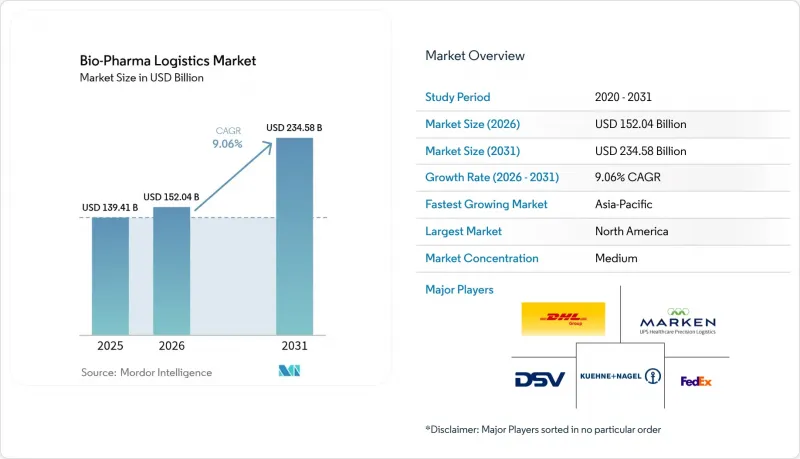
본 보고서는 서비스별(운송, 창고·보관, 유통 등), 온도대별(콜드체인, 비콜드체인), 제품 유형별(백신·면역요법, 세포·유전자 치료 등), 및 지역별(북미, 유럽, 아시아태평양, 남미, 중동 및 아프리카)로 분류되어 있습니다. 시장 예측은 금액(달러) 기준으로 제시되어 있습니다.
세계 바이오의약품 물류 시장의 동향 및 인사이트
고부가가치 생물학적 제제 및 전문 의약품의 급증으로 콜드체인 수요가 증가하고 있습니다
콜드체인 문제로 인해 이 업계는 연간 350억 달러의 손실을 입고 있으며, 견고한 온도 관리가 재무적 측면에서도 필수적이라는 점이 부각되고 있습니다. 물류 사업자들은 온도 이탈 위험을 예측하기 위해 AI를 활용한 예측 분석을 도입하는 한편, 대체품의 위협 증가에 대응하기 위해 보안 대책을 강화하고 있습니다. 프론티어 사이언티픽 솔루션즈(Frontier Scientific Solutions)는 운송 시간을 단축하고 고부가가치 생물학적 제제를 보호하기 위해 윌밍턴 및 섀넌 공항 주변의 대외무역지구(FTZ) 인프라에 15억 달러를 투자했습니다.
첨단 치료법(mRNA, 세포·유전자 치료)의 성장으로 초저온 물류가 필수화
mRNA 및 바이러스 벡터 제품은 최소 -150℃에서 보관해야 합니다. 크라이오포트(CryoPort)와 SK 팜테크는 이러한 치료법에 특화된, 제조부터 유통까지 아우르는 통합 플랫폼을 출범시켰습니다. 표준 냉장 환경에서 mRNA를 보관할 수 있는 내열성 지질에 대한 연구로 인해 초저온 냉동 네트워크에 대한 의존도가 완화될 가능성은 있지만, 현재의 파이프라인은 여전히 극저온 인프라에 크게 의존하고 있습니다. DHL이 연간 60만 건 이상의 초저온 화물을 취급하는 CRYOPDP를 인수한 것은 전문적인 운송 능력을 둘러싼 업계 재편 추세를 보여줍니다.
온도 관리된 항공 화물 및 액체 질소/드라이아이스 공급의 용량 제약이 비용 변동을 초래하고 있습니다
COVID-19 백신 배포 과정에서 발생한 드라이아이스 부족은 공급 기반의 취약성을 여실히 드러냈습니다. 공기 분리 장치는 치솟는 에너지 가격으로 어려움을 겪고 있으며, 항공 화물의 화물실 용량은 E-Commerce와의 경쟁에 직면해 있습니다. 비엔나 공항의 의약품 취급 센터는 콜드체인 전용 공간을 2배로 확대했으나, 여전히 사전 예약이 이용 가능한 슬롯 수를 초과하여 운임 급등과 운송 수단 전환을 강요받고 있습니다.
부문별 분석
2025년, 바이오의약품 물류 시장 매출 중 운송이 70.12%를 차지했습니다. 이는 라스트 마일(last mile)을 위한 도로망과 시간적 제약이 엄격한 생물학적 제제를 위한 항공 노선이 기반이 되고 있습니다. 그럼에도 불구하고, 고객이 핵심 운송 서비스 외에도 라벨링, 키팅, 그리고 자격을 갖춘 담당자의 출하 승인을 요구함에 따라 부가가치 서비스는 2031년까지 연평균 10.77%로 성장할 것으로 예측됩니다. 각 공급업체는 창고 내에서 AI를 활용하여 용량 피크를 예측하고, 온도 편차를 방지하고 있습니다. 카탈렌트(Catalent)사의 ‘FastChain’ 플랫폼은 실시간 재고 정보와 지역별 창고를 연계함으로써, 수요 주도형 주문 처리로의 전환을 보여주고 있습니다. 부가가치 서비스 분야의 바이오의약품 물류 시장 규모는 규제 복잡화 및 환자 중심의 포장 수요를 반영하여 꾸준히 확대될 것으로 예상됩니다. 운송 부문은 규모를 유지할 것으로 보이지만, 온도 관리 트럭 운송 및 항공 화물 분야의 공급 부족에 따라 가격 측면에서 압박을 받게 될 것입니다.
운송 분야에서 대륙 횡단 네트워크를 통한 영하 배송의 경우 육상 물류가 여전히 주류를 이루고 있지만, 항공 운송은 지속적인 운송 능력 제약이 있음에도 불구하고 초저온 유전자 치료제 운송에서 중요한 역할을 수행하고 있습니다. 지속가능성 목표가 안정성이 높은 바이오의약품의 운송 수단 전환을 뒷받침하는 가운데, 해상 운송의 점유율은 완만하게 확대되고 있습니다. 창고 사업의 성장은 고객의 오프사이트 보관 선호와 연동되어 있으며, 특히 유럽에서는 GMP 기준을 준수하는 새로운 냉장실이 국경을 넘는 유통을 가능하게 하고 있습니다.
2025년, 콜드체인 서비스는 바이오의약품 물류 시장의 68.40%를 차지하며, 연평균 성장률(CAGR) 10.49%로 가장 빠르게 성장할 전망입니다. 냉장(2-8°C) 루트는 백신 및 인슐린 유통을 뒷받침하고 있지만, mRNA 및 세포·유전자 치료제를 위한 초저온(-20°C--150°C) 부문이 주목받는 하위 부문으로 부상하고 있습니다. 초저온 운송과 관련된 바이오의약품 물류 시장 규모는 2031년까지 거의 2배로 증가할 것으로 예측됩니다. 각 사업자들은 진공 단열 패널, 상변화 물질, 실시간 온도 정보를 제공하는 IoT 비콘을 갖춘 질소 기반 드라이 쉬퍼에 대한 투자를 추진하고 있습니다.
상온(15-25°C) 물류 네트워크는 여전히 기존의 경구용 고형 제제 운송을 담당하고 있지만, 처방 목록이 바이오의약품으로 이동함에 따라 성장 속도는 둔화되고 있습니다. 냉동(0°C--20°C)은 특정 원료의약품이나 장기 비축품용 틈새 시장에 머물러 있습니다. 지속가능성에 대한 요구로 인해 재사용 가능한 운송 용기 및 전동 냉장 컨테이너로의 전환이 가속화되고 있으며, 친환경 전력과 높은 열용량을 결합한 하이브리드 모델이 등장하고 있습니다. 블록체인을 활용한 시범 프로젝트에서는 규정 준수를 보장하기 위해 보관 이력을 추적하고 있습니다.
지역별 분석
북미는 확립된 의약품 제조 기반, GDP 인증을 받은 고밀도 네트워크, 그리고 IoT를 활용한 모니터링의 조기 도입을 배경으로 2025년 바이오의약품 물류 시장에서 41.20%의 점유율을 유지했습니다. UPS의 Andlauer Healthcare Group 16억 달러 인수와 같은 대규모 설비 투자 프로그램은 지역 인프라를 강화하고, 표준 설정에서 주도적인 입지를 공고히 하고 있습니다.
아시아태평양은 연평균 성장률(CAGR) 11.06%로 성장할 것으로 예측되며, 2031년까지 시장 가치 증가분의 대부분을 차지할 전망입니다. 중국의 혁신적인 기업들은 리스크 분산을 위해 벡터 생산을 싱가포르와 태국으로 이전하고 있는 반면, 인도는 개정된 GMP 규정에 따라 주사제 생산을 확대하고 있습니다. 싱가포르의 새로운 멀티테넌트형 제약 허브는 이 지역 내 높은 수준의 냉장 보관 및 국경을 넘는 신속한 통관에 대한 노력을 구현하고 있습니다. 그 결과, 아시아 지역 내 무역 경로와 관련된 바이오의약품 물류 시장의 규모는 앞으로 더욱 확대될 전망입니다.
유럽은 엄격한 규제 준수와 광범위한 도로 및 철도를 활용한 저온 운송 회랑을 바탕으로 여전히 강력한 입지를 유지하고 있습니다. 프랑크푸르트 근교에서 DHL이 추진 중인 30,000 m² 규모의 탄소 중립 확장 프로젝트는 -70°C까지의 초저온 창고를 지원하며, 세포 및 유전자 치료 파이프라인을 관리하는 유럽 대륙의 역량을 강화하고 있습니다. 지속적인 업계 재편으로 서비스 품질은 향상되고 있지만, 스키폴이나 브뤼셀과 같은 주요 화물 관문에서는 여전히 용량 제약이 남아 있습니다.
남미, 중동 및 아프리카에서는 새로운 비즈니스 기회가 대두되고 있습니다. 정부 주도의 백신 접종 캠페인과 만성 질환 치료의 보급 확대로 인해, 인증된 냉장 시설 및 육로에서 항공로로 이어지는 연계 서비스에 대한 수요가 증가하고 있습니다. 그러나 전력망의 불안정성과 GDP 모니터링 체계의 미비점이 서비스 품질상의 과제로 대두되어, 인프라 구축 속도를 저해하고 있습니다.
기타 혜택:
- 엑셀 형식의 시장 예측(ME) 시트
- 3개월간의 애널리스트 지원
자주 묻는 질문
목차
제1장 소개
제2장 조사 방법
제3장 주요 요약
제4장 시장 구도
제5장 시장 규모와 성장 예측
제6장 경쟁 구도
제7장 시장 기회와 향후 전망
KSM 26.08.26According to Mordor Intelligence, the bio-Pharma logistics market size was valued at USD 139.41 billion in 2025 and estimated to grow from USD 152.04 billion in 2026 to reach USD 234.58 billion by 2031, at a CAGR of 9.06% during the forecast period (2026-2031).
This report is Segmented by Service (Transportation, Warehousing, and Distribution, and More), by Temperature Range (Cold Chain, and Non-Cold Chain), by Product Type (Vaccines & Immunotherapies, Cell & Gene Therapies, and More), and Geography (North America, Europe, Asia-Pacific, South America, and Middle-East and Africa). The Market Forecasts are Provided in Terms of Value (USD).
Global Bio-Pharma Logistics Market Trends and Insights
Surge in High-Value Biologicals & Specialty Pharma Elevating Cold-Chain Demand
Cold-chain failures cost the sector USD 35 billion annually, underscoring the financial imperative for resilient temperature management. Logistics providers deploy AI-driven predictive analytics to foresee excursion risks, while security upgrades counter rising counterfeit threats. Frontier Scientific Solutions invested USD 1.5 billion in Foreign Trade Zone infrastructure around Wilmington and Shannon airports to cut transit times and safeguard high-value biologics .
Advanced Therapies Growth (mRNA, Cell & Gene) Necessitating Ultra-Low-Temperature Logistics
mRNA and viral-vector products require storage as low as -150 °C. Cryoport and SK Pharmteco launched an integrated platform spanning manufacturing and distribution tailored to such therapies. Research into thermostable lipids that preserve mRNA at standard refrigeration may ease dependence on deep-freeze networks, yet current pipelines still rely heavily on cryogenic infrastructure. DHL's acquisition of CRYOPDP, handling more than 600,000 ultra-cold consignments annually, illustrates consolidation around specialized capacity.
Capacity Constraints in Temperature-Controlled Airfreight & LN2/Dry-Ice Supply Driving Cost Volatility
Dry-ice shortages during the COVID-19 vaccine rollout revealed a fragile supply base. Air separation units wrestle with high energy prices, while airfreight belly-hold capacity competes with e-commerce. Vienna Airport's Pharma Handling Center doubled cold-chain space, yet forward bookings still exceed slot availability, causing rate spikes and forcing mode shifts.
Other drivers and restraints analyzed in the detailed report include:
- Globalization & Decentralization of Clinical Trials Accelerating Direct-to-Patient Shipments
- Stringent Worldwide GDP/GxP Compliance Mandating Outsourcing to Certified 3PLs
- Divergent Global Regulatory & Customs Requirements Causing Delays and Excursion Risk
For complete list of drivers and restraints, kindly check the Table Of Contents.
Segment Analysis
Transportation accounted for 70.12% of bio pharma logistics market revenue in 2025, anchored by road networks for last-mile and air corridors for time-critical biologics. Nonetheless, value-added services are forecast to grow 10.77% annually to 2031 as clients demand labeling, kitting, and qualified-person release alongside core transport. Providers leverage AI in warehouses to anticipate capacity peaks and prevent temperature deviations. Catalent's FastChain platform illustrates the shift toward demand-led fulfilment, pairing real-time inventory with regional depots. The bio pharma logistics market size for value-added services is projected to widen steadily, reflecting regulatory complexity and patient-centric packaging needs. Transportation will retain scale but face pricing pressure as supply tightens in temperature-controlled trucking and airfreight.
Within transport, road logistics remains dominant for sub-zero deliveries across continental networks, while air plays a critical role in ultra-cold gene-therapy consignments despite ongoing capacity constraints. Sea freight gains modest share as sustainability targets drive modal shifts for stable biologics. Warehousing growth tracks with clients' off-site storage preferences, particularly in Europe where new GMP-compliant cold rooms unlock cross-border distribution.
Cold chain services captured 68.40% of the bio pharma logistics market in 2025 and will expand fastest at 10.49% CAGR. Refrigerated (2-8 °C) lanes underpin vaccines and insulin flows, yet ultra-cold (-20 °C to -150 °C) emerges as the star sub-segment for mRNA and cell & gene therapies. The bio pharma logistics market size tied to ultra-cold shipments is forecast to nearly double by 2031. Providers invest in vacuum-insulated panels, phase-change materials, and nitrogen-based dry shippers with IoT beacons for live temperature feeds.
Ambient (15-25 °C) networks continue to serve traditional oral solids but grow slower as formularies tilt toward biologics. Frozen (0 °C to -20 °C) remains niche for specific APIs and long-term stockpiles. Sustainability imperatives accelerate a pivot to reusable shippers and electrified reefers, creating hybrid models pairing green power with dense thermal mass. Blockchain pilots track chain-of-custody events to assure compliance.
Complete Report Scope:
- By Service
- Transportation
- Road
- Rail
- Sea/Ocean
- Air
- Warehousing & Distribution
- Value-Added Services (Labelling, Kitting, QP Release)
- Transportation
- By Temperature Range
- Cold Chain
- Ambient (15-25 °C)
- Refrigerated (2-8 °C)
- Frozen (0 °C to -20 °C)
- Ultra-Cold / Cryogenic (-20 °C to -150 °C)
- Non Cold Chain
- Cold Chain
- By Product Type
- Vaccines & Immunotherapies
- Cell & Gene Therapies
- APIs & Bulk Biologics
- Finished Dose Biologics
- Others
- By End-user
- Bio-Pharma Manufacturers
- CROs (Contract Research Organizations) & CMOs (Contract Manufacturing Organizations)
- Hospitals & Clinical-Trial Sites
- Other End Users
- By Geography
- North America
- United States
- Canada
- Mexico
- South America
- Brazil
- Peru
- Chile
- Argentina
- Rest of South America
- Asia-Pacific
- India
- China
- Japan
- Australia
- South Korea
- South East Asia (Singapore, Malaysia, Thailand, Indonesia, Vietnam, and Philippines)
- Rest of Asia-Pacific
- Europe
- United Kingdom
- Germany
- France
- Spain
- Italy
- BENELUX (Belgium, Netherlands, and Luxembourg)
- NORDICS (Denmark, Finland, Iceland, Norway, and Sweden)
- Rest of Europe
- Middle East And Africa
- United Arab Emirates
- Saudi Arabia
- South Africa
- Nigeria
- Rest of Middle East And Africa
- North America
Geography Analysis
North America retained 41.20% share of the bio pharma logistics market in 2025 on the back of entrenched pharmaceutical manufacturing, dense GDP-certified networks, and the early adoption of IoT-enabled monitoring. Major capex programs, such as UPS's USD 1.6 billion acquisition of Andlauer Healthcare Group, deepen regional infrastructure and reinforce standards leadership.
Asia-Pacific is projected to grow at 11.06% CAGR and will account for the majority of the incremental market value through 2031. Chinese innovators are relocating vector production to Singapore and Thailand to diversify risk, while India expands injectables output under revised GMP rules. Singapore's new multi-tenant pharma hub embodies the region's push for high-grade cold storage and cross-border rapid clearance. As a result, the bio-pharma logistics market size related to intra-Asia trade lanes is set to accelerate.
Europe remains a powerhouse, leveraging tight regulatory compliance and extensive road-rail cold corridors. DHL's 30,000 m2 climate-neutral expansion near Frankfurt supports sub-zero warehousing down to -70 °C, reinforcing the continent's capability to manage cell & gene therapy pipelines. Ongoing consolidation raises service quality, though capacity constraints persist at key cargo gateways like Schiphol and Brussels.
South America and the Middle East & Africa exhibit emerging opportunity profiles. Government vaccine campaigns and growing chronic-disease treatment uptake catalyze the need for certified cold rooms and road-to-air interfaces. However, patchy power grids and limited GDP oversight pose service-quality challenges, slowing the pace of infrastructure upgrades.
- Deutsche Post DHL Group (DHL Global Forwarding, DHL Life Sciences & Healthcare)
- UPS Healthcare / Marken
- Kuehne + Nagel PharmaChain
- FedEx Healthcare Solutions
- Nippon Express (NX Pharma)
- DSV Panthera Life Sciences
- CEVA Logistics FORPATIENTS
- SF Express Cold-Chain
- Kerry Logistics Pharma & Healthcare
- Americold Logistics
- Lineage Logistics
- Cryoport Systems
- Yusen Logistics Healthcare
- GEODIS PharmaHealthcare
- Biocair
- Maersk Pharma Ocean & Air Services
- World Courier
- Aramex Healthcare
- Hellmann Worldwide Logistics - Healthcare
- Rhenus Logistics Pharma
- LATAM Cargo Pharma
- AIT Worldwide Logistics - Life Sciences
Additional Benefits:
- The market estimate (ME) sheet in Excel format
- 3 months of analyst support
TABLE OF CONTENTS
1 Introduction
- 1.1 Study Assumptions & Market Definition
- 1.2 Scope of the Study
2 Research Methodology
3 Executive Summary
4 Market Landscape
- 4.1 Market Overview
- 4.2 Market Drivers
- 4.2.1 Surge in High-Value Biologicals & Specialty Pharma Share Elevating Cold-Chain Demand
- 4.2.2 Advanced Therapies Growth (mRNA, Cell & Gene) Necessitating Ultra-Low-Temperature Logistics
- 4.2.3 Globalization & Decentralization of Clinical Trials Accelerating Direct-to-Patient Shipments
- 4.2.4 Stringent Worldwide GDP/GxP Compliance Mandating Outsourcing to Certified 3PLs
- 4.2.5 E-commerce & D2C Distribution of Specialty Medicines Boosting Last-Mile Temperature-Controlled Delivery
- 4.2.6 Emerging-Market Biologics Manufacturing Expansion Increasing Cross-Border Cold-Chain Flows
- 4.3 Market Restraints
- 4.3.1 Capacity Constraints in Temperature-Controlled Airfreight & LN?/Dry-Ice Supply Driving Cost Volatility
- 4.3.2 Divergent Global Regulatory & Customs Requirements Causing Delays and Excursion Risk
- 4.3.3 High Carbon Footprint of Cold-Chain Operations Prompting Costly Sustainability Investments
- 4.3.4 Scarcity of Skilled Workforce & GDP-Certified Infrastructure in Emerging Regions Limiting Reliability
- 4.4 Value / Supply-Chain Analysis
- 4.5 Technological Innovations in the Industry
- 4.6 Government Regulations and Policies
- 4.7 Porter's Five Forces
- 4.7.1 Bargaining Power of Suppliers
- 4.7.2 Bargaining Power of Buyers
- 4.7.3 Threat of New Entrants
- 4.7.4 Threat of Substitutes
- 4.7.5 Competitive Rivalry
- 4.8 Spotlight on the Bio-Pharmaceutical Industry
- 4.9 Logistics & Distribution Cost Analysis
- 4.10 Refrigerated Warehouse Infrastructure Insights
- 4.11 Cold-Chain Packaging Market Brief
- 4.12 Impact of Geopolitical Events on the Market
5 Market Size & Growth Forecasts (Value & Volume)
- 5.1 By Service
- 5.1.1 Transportation
- 5.1.1.1 Road
- 5.1.1.2 Rail
- 5.1.1.3 Sea/Ocean
- 5.1.1.4 Air
- 5.1.2 Warehousing & Distribution
- 5.1.3 Value-Added Services (Labelling, Kitting, QP Release)
- 5.1.1 Transportation
- 5.2 By Temperature Range
- 5.2.1 Cold Chain
- 5.2.1.1 Ambient (15-25 °C)
- 5.2.1.2 Refrigerated (2-8 °C)
- 5.2.1.3 Frozen (0 °C to -20 °C)
- 5.2.1.4 Ultra-Cold / Cryogenic (-20 °C to -150 °C)
- 5.2.2 Non Cold Chain
- 5.2.1 Cold Chain
- 5.3 By Product Type
- 5.3.1 Vaccines & Immunotherapies
- 5.3.2 Cell & Gene Therapies
- 5.3.3 APIs & Bulk Biologics
- 5.3.4 Finished Dose Biologics
- 5.3.5 Others
- 5.4 By End-user
- 5.4.1 Bio-Pharma Manufacturers
- 5.4.2 CROs (Contract Research Organizations) & CMOs (Contract Manufacturing Organizations)
- 5.4.3 Hospitals & Clinical-Trial Sites
- 5.4.4 Other End Users
- 5.5 By Geography
- 5.5.1 North America
- 5.5.1.1 United States
- 5.5.1.2 Canada
- 5.5.1.3 Mexico
- 5.5.2 South America
- 5.5.2.1 Brazil
- 5.5.2.2 Peru
- 5.5.2.3 Chile
- 5.5.2.4 Argentina
- 5.5.2.5 Rest of South America
- 5.5.3 Asia-Pacific
- 5.5.3.1 India
- 5.5.3.2 China
- 5.5.3.3 Japan
- 5.5.3.4 Australia
- 5.5.3.5 South Korea
- 5.5.3.6 South East Asia (Singapore, Malaysia, Thailand, Indonesia, Vietnam, and Philippines)
- 5.5.3.7 Rest of Asia-Pacific
- 5.5.4 Europe
- 5.5.4.1 United Kingdom
- 5.5.4.2 Germany
- 5.5.4.3 France
- 5.5.4.4 Spain
- 5.5.4.5 Italy
- 5.5.4.6 BENELUX (Belgium, Netherlands, and Luxembourg)
- 5.5.4.7 NORDICS (Denmark, Finland, Iceland, Norway, and Sweden)
- 5.5.4.8 Rest of Europe
- 5.5.5 Middle East And Africa
- 5.5.5.1 United Arab Emirates
- 5.5.5.2 Saudi Arabia
- 5.5.5.3 South Africa
- 5.5.5.4 Nigeria
- 5.5.5.5 Rest of Middle East And Africa
- 5.5.1 North America
6 Competitive Landscape
- 6.1 Market Concentration
- 6.2 Strategic Moves
- 6.3 Market Share Analysis
- 6.4 Company Profiles (includes Global-level Overview, Market-level Overview, Core Segments, Financials as available, Strategic Information, Market Rank/Share, Products & Services, Recent Developments)
- 6.4.1 Deutsche Post DHL Group (DHL Global Forwarding, DHL Life Sciences & Healthcare)
- 6.4.2 UPS Healthcare / Marken
- 6.4.3 Kuehne + Nagel PharmaChain
- 6.4.4 FedEx Healthcare Solutions
- 6.4.5 Nippon Express (NX Pharma)
- 6.4.6 DSV Panthera Life Sciences
- 6.4.7 CEVA Logistics FORPATIENTS
- 6.4.8 SF Express Cold-Chain
- 6.4.9 Kerry Logistics Pharma & Healthcare
- 6.4.10 Americold Logistics
- 6.4.11 Lineage Logistics
- 6.4.12 Cryoport Systems
- 6.4.13 Yusen Logistics Healthcare
- 6.4.14 GEODIS PharmaHealthcare
- 6.4.15 Biocair
- 6.4.16 Maersk Pharma Ocean & Air Services
- 6.4.17 World Courier
- 6.4.18 Aramex Healthcare
- 6.4.19 Hellmann Worldwide Logistics - Healthcare
- 6.4.20 Rhenus Logistics Pharma
- 6.4.21 LATAM Cargo Pharma
- 6.4.22 AIT Worldwide Logistics - Life Sciences
7 Market Opportunities & Future Outlook
- 7.1 White-space & Unmet-Need Assessment


