|
시장보고서
상품코드
2123066
인도의 세라믹 타일 시장 : 점유율 분석, 업계 동향과 통계, 성장 예측(2026-2031년)India Ceramic Tiles - Market Share Analysis, Industry Trends & Statistics, Growth Forecasts (2026 - 2031) |
||||||
 Mordor Intelligence
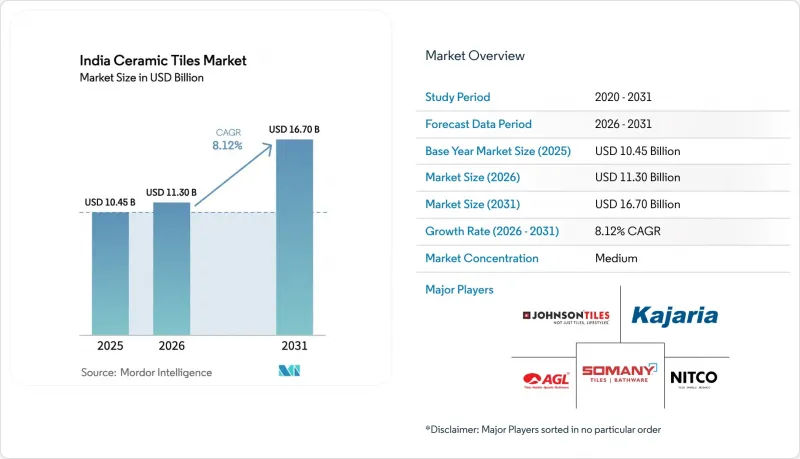
Mordor Intelligence에 의하면, 인도 세라믹 타일 시장 규모는 2025년 104억 5,000만 달러에서 2026년에는 113억 달러로 확대되어 2031년까지 167억 달러에 이를 것으로 예상되고 있어 2026년부터 2031년까지 CAGR 8.12%로 성장할 전망입니다.
본 보고서는 제품 유형(도자기 타일, 유약 세라믹 타일, 기타), 용도(바닥, 벽, 지붕),최종 사용자(주택, 상업시설), 건설 유형(신축, 개보수·교체), 유통 채널(타일·석재 전문점, 홈센터·DIY 매장, 기타), 지역(인도 북부, 남부, 서부, 동부)별로 분류되어 있습니다. 시장 전망은 금액(달러) 기준으로 제시되어 있습니다.
인도 세라믹 타일 시장 동향 및 인사이트
저가형 주택 및 스마트 시티 프로젝트의 확대
2024년 6월 현재,‘프라단 만트리 아와스 요자나 어반(PMAY-U)’은 합리적인 가격의 주택을 제공한다는 목표를 향해 현저한 진전을 이루고 있으며, 전국적으로 수백만 호의 주택이 승인 및 인도됨으로써 도시 지역의 주택 공급이 착실히 진행되고 있음을 반영하고 있습니다. 이러한 납기 준수가 중요한 프로젝트에 참여하는 건설업체들은 적시 납품이 가능한 공급업체를 선호하기 때문에 규모가 크고 체계적으로 조직된 사업자가 우위를 점하고 있습니다. 스마트 시티의 공공 공간에서는 R10-R13의 미끄럼 방지 성능을 갖춘 도자기질 타일이 인도 표준국(BIS)의 기준을 준수하고 있습니다. 그 결과, 안전성과 내구성이 초기 비용을 상회함에 따라 제품 구성은 고급 슬래브로 전환되고 있습니다. 저가 주택 및 스마트 시티 인프라에 대한 정부의 지속적인 투자로 인해 대규모 고부가가치 프로젝트가 안정적으로 공급되고 있으며, 세라믹 타일에 대한 수요도 견조한 추세를 보이고 있습니다. 도시화의 진전과 품질·안전 기준에 대한 소비자 인식의 제고까지 더해져, 각 제조업체는 주택 및 상업 부문 모두에서 지속적인 성장의 혜택을 누릴 수 있는 위치에 있습니다.
도시 중산층의 리모델링 붐
인도 건축가 및 프로젝트 사양 수립자들 수요는 기존의 600mm×600mm 타일에서 최대 1,600mm×3,200mm의 대형 슬래브 타일로 점점 더 이동하고 있습니다. 이는 고급 주택 개발이나 호텔 로비 등 프리미엄 상업 공간에서 이음매 없는 아름다운 외관이 선호되는 데 그 배경이 있습니다. 이러한 수요에 부응하기 위해 국내 제조업체들은 뒤틀림을 최소화하고 대형 사이즈에서도 일관된 품질을 실현하는 이탈리아산 첨단 프레스 기술에 투자해 왔습니다. 이러한 기술적 업그레이드를 통해 제조업체들은 표준 타일에 비해 약 15%-25%의 가격 프리미엄을 책정할 수 있는 한편, 인건비 증가는 비교적 억제되고 있습니다. 대형 슬래브는 프리미엄 수익원으로서 중요한 역할을 수행하고 있으며, 시장의 고부가가치 부문에서 전략적 중요성을 높이고 있습니다. 또한, 대형 타일은 이음매 사용량을 줄임으로써 친환경 건축 목표를 지원하고, 그 결과 휘발성 유기 화합물(VOC) 배출을 저감하여 인도의 ‘에너지 절약 건축 기준법’도 준수하고 있습니다. 생산 능력 향상에 뒤처지는 제조업체는 인도 세라믹 타일 시장의 프리미엄 부문에서 점유율을 잃을 위험에 직면하게 될 것입니다.
천연가스 가격의 급격한 변동
천연가스 가격 변동은 인도의 세라믹 타일 제조업체, 특히 구자라트주 모르비와 같은 에너지 집약적 지역의 제조업체들에게 큰 과제가 되고 있습니다. 연료비 예측의 어려움으로 인해 제조업체들은 건설업체에 고정 가격 계약을 제시하기 어려워졌으며, 계약에 분기별 가격 조정 조항을 포함시킬 수밖에 없는 실정입니다. 이는 합리적인 가격대의 주택 부문에서 가격에 민감한 고객들을 멀어지게 하는 요인이 될 수 있습니다. 예를 들어, 2024년 7월, Gujarat Gas는 산업용 가스 가격을 1 SCM당 2-2.48 루피(0.023-0.029 달러) 인상했으며, 이로 인해 현지 제조업체의 에너지 비용은 가마의 효율에 따라 8%에서 12%까지 증가했습니다. 가스는 변동비의 30%-35%를 차지하기 때문에 가격이 10% 변동하는 것만으로도 매출총이익률의 3%-3.5%가 잠식될 가능성이 있으며, 2025년에 만료되는 기존 계약의 경우 즉시 이익률에 압박이 가해질 것입니다. 또한, 가격 변동성은 대출 기관이 더 높은 부채 상환 배수를 요구하고 투자 회수 전망이 불투명해지기 때문에 새로운 가마에 대한 설비 투자를 저해하는 요인이 되고 있습니다. 일부 생산자는 석탄 연소 가마로의 다각화나 태양열 예열 장치 도입을 통해 위험을 완화하고, 비용 변동을 5%-8% 낮추고 있지만, 이러한 개조에는 라인당 15-25 크롤(180-300만 달러)의 비용이 소요되며,가동 개시까지 18-24개월이 소요되므로 단기적인 실현 가능성은 제한적입니다.
부문 분석
2025년, 유약 마감 세라믹 타일은 인도 세라믹 타일 시장에서 39.75%의 점유율을 차지하며, 건설사가 미관보다 비용을 우선시하는 중저가 주택 프로젝트에서 그 우위를 확고히 했습니다. 그러나 포셀린 타일은 2031년까지 연평균 성장률(CAGR) 11.33%로 성장할 전망입니다. 이러한 급속한 성장은 고급 아파트, 호텔 로비, 공항 터미널에서 건축가들이 낮은 기공률과 높은 강도를 지닌 소재를 선호하는 경향에 힘입은 것입니다. 수분 흡수율이 0.5% 미만인 포세린은 건물 외벽이나 물이 자주 사용되는 공간에 최적입니다. Somany Ceramics나 H&R Johnson과 같은 제조업체들은 이탈리아의 드라이 프레스 기술을 채택하여, 최대 1,600mm × 3,200mm 크기의 포세린 슬래브를 뒤틀림을 최소화하며 제조할 수 있게 되었습니다. 무유 세라믹 타일은 미관보다 미끄럼 방지 성능을 중시하는 산업용 및 실외 환경에서 독자적인 틈새 시장을 개척하고 있습니다. 대조적으로, 모자이크 타일은 부티크 스타일의 인테리어 디자이너나 역사적 건축물 복원 분야에서 선호되고 있습니다.
포셀린 타일은 매력적인 이익률을 자랑하며, 유약을 입힌 세라믹 타일보다 평균 판매 가격이 20%에서 30% 더 높습니다. 한편, 장석, 카올린, 석영 등의 원자재 비용 상승률은 12%에서 15% 사이를 오가고 있습니다. 이러한 추세로 인해 매출 총이익률은 500-700 베이시스 포인트라는 눈부신 성장세를 보이고 있습니다. 이러한 경제적 요인이 Kajaria Ceramics가 2024 회계연도에 200 카롤 루피(2,400만 달러)를 투자하여 가일푸르 및 마루트 공장의 포셀린 생산 능력 확대를 목표로 하는 결정의 배경이 되었습니다. 이 회사는 2027 회계연도까지 총 생산량에서 포셀린이 차지하는 비율을 25%로 높이는 것을 목표로 하고 있습니다. 저가 주택이나 2선 도시 수요에서는 유약 도자기 타일이 여전히 주류를 차지하고 있지만, 그 시장 점유율은 감소할 전망입니다. 이러한 변화는 소셜 미디어와 주택 리모델링 프로그램으로 형성된 구매자의 기대에 영향을 받아 건설업체들이 사양을 향상시키고 있기 때문입니다.
2025년, 바닥 타일은 인도 세라믹 타일 시장 전체의 62.26%를 차지했습니다. 이는 주로 내구성과 청소가 용이한 점이 최우선으로 고려되는 주택의 거실, 주방, 욕실에서의 사용이 주도한 결과입니다. 한편, 벽용 타일은 2031년까지 연평균 성장률(CAGR) 9.37%라는 견조한 성장이 예상됩니다. 이러한 급속한 성장은 도시 지역의 주택 소유자와 상업용 부동산 개발업자들이 디지털 잉크젯 인쇄를 통한 무늬를 점점 더 많이 선택하고 있기 때문입니다. 이러한 무늬는 대리석, 목재, 직물의 질감을 재현하며, 천연 소재 비용의 불과 몇 분의 일 수준에서 구현되고 있습니다. 벽 타일로 향하는 이러한 변화는 시장 내 프리미엄화라는 더 광범위한 추세를 여실히 보여주고 있습니다. 구매자들은 현재, 특히 주 침실이나 응접 공간에서 악센트 벽에 그 어느 때보다 많은 예산을 할당하는 경향을 보이고 있습니다. 산악 리조트나 해안 지역의 정부 규제는 사이클론에 대한 내성과 단열성을 중시하여, 점토나 콘크리트로 만든 지붕 기와 사용을 의무화하고 있습니다.
벽 타일 시장의 성장은 주택 인테리어에 대한 1인당 지출 증가와 밀접한 관련이 있습니다. ICRA 보고서에 따르면, 이 지출액은 2020 회계연도의 18,000 루피(216 달러)에서 2024 회계연도에는 26,000 루피(312 달러)로 증가했으며,특히 연소득 10카롤 루피(1만 2,000 달러)를 초과하는 도시 지역 가구에서 두드러집니다. 밀레니얼 세대의 취향에 민감하게 대응하는 건설업체들은 현재 오픈 키친이나 홈 오피스 등의 공간에 벽 타일을 채택하고 있습니다. 과거에는 페인트나 벽지가 주를 이루던 이 영역에서 이러한 용도의 확대로 인해 프로젝트당 벽 타일 사용량이 8%에서 10% 증가했습니다. 바닥 타일은 리모델링 수요의 물결을 타고 있지만, 주택 소유주들은 10-15년 사용한 유리질 타일을 미끄럼 방지 처리가 된 도자기질 타일로 교체하고 있어 바닥 교체 주기가 현저히 길어지고 있습니다. 한편, 지붕 기와(기와)는 특히 산업용 창고에서 금속판이나 폴리카보네이트 패널과의 경쟁에 직면해 있습니다.
기타 혜택:
- 엑셀 형식 시장 예측(ME) 시트
- 3개월간의 애널리스트 지원
자주 묻는 질문
목차
제1장 서론
제2장 조사 방법
제3장 주요 요약
제4장 시장 구도
제5장 시장 규모와 성장 예측
제6장 경쟁 구도
제7장 시장 기회와 향후 전망
JHS 26.09.09According to Mordor Intelligence, the India ceramic tiles market size is expected to increase from USD 10.45 billion in 2025 to USD 11.30 billion in 2026 and reach USD 16.70 billion by 2031, growing at a CAGR of 8.12% over 2026-2031.
This report is Segmented by Product Type (Porcelain, Glazed Ceramic, Others), Application (Floor, Wall, Roofing), End-User (Residential, Commercial), Construction Type (New, Renovation and Replacement), Distribution Channel (Specialty Tile & Stone Stores, Home Improvement & DIY Stores, Others), and Geography (North, South, West, East India). The Market Forecasts are Provided in Terms of Value (USD).
India Ceramic Tiles Market Trends and Insights
Growth in Affordable Housing and Smart City Projects
As of June 2024, the Pradhan Mantri Awas Yojana-Urban (PMAY-U) has made substantial progress toward its objective of delivering affordable housing, with several million homes sanctioned and delivered nationwide, reflecting steady advancement in urban housing supply. Builders working on these time-sensitive projects prefer suppliers that can deliver just-in-time, giving larger, organized players an edge. In smart-city public spaces, slip-resistant porcelain tiles rated R10-R13 comply with Bureau of Indian Standards norms. Product mixes are therefore tilting to premium slabs because safety and longevity outweigh upfront cost. Ongoing government investment in affordable housing and smart-city infrastructure ensures a steady pipeline of large-scale, high-value projects, supporting consistent demand for ceramic tiles. Coupled with increasing urbanization and rising consumer awareness of quality and safety standards, manufacturers are positioned to benefit from sustained growth in both residential and commercial segments.
Renovation Boom Among Urban Middle-Class
Demand from architects and project specifiers in India is increasingly moving away from conventional 600 mm X 600 mm tiles toward large-format slab tiles measuring up to 1,600 mm X 3,200 mm, driven by preferences for seamless aesthetics in luxury residential developments and premium commercial spaces such as hotel lobbies. To meet this demand, domestic manufacturers have invested in advanced Italian pressing technology that minimizes warpage and enables consistent quality at larger sizes. These technological upgrades allow producers to command price premiums of approximately 15%-25% over standard tiles, while incremental labor costs remain relatively contained. Large slabs are becoming a meaningful contributor to premium revenue streams, reinforcing their strategic importance within the higher-value segment of the market. Additionally, large-format tiles support green-building objectives by reducing grout usage, which in turn lowers volatile organic compound emissions and aligns with India's Energy Conservation Building Code. Manufacturers that fail to upgrade production capabilities risk losing share in the premium segment of the Indian ceramic tiles market.
Natural Gas Prices Experience Significant Fluctuations
Volatility in natural-gas prices poses a significant challenge for ceramic tile manufacturers in India, particularly those in energy-intensive regions like Morbi, Gujarat. Unpredictable fuel costs make it difficult for producers to offer fixed-price contracts to builders, forcing the inclusion of quarterly price-revision clauses that can alienate cost-sensitive customers in the affordable-housing segment. For instance, in July 2024, Gujarat Gas raised industrial gas prices by INR2-INR2.48 (USD 0.023-USD 0.029) per SCM, increasing energy bills for local manufacturers by 8% to 12% depending on kiln efficiency. Since gas accounts for 30%-35% of variable costs, a 10% price change can erode 3%-3.5% of gross margins, while legacy contracts expiring in 2025 face immediate margin pressure. Price volatility also discourages investment in new kiln capacity, as lenders require higher debt-service coverage and payback assumptions become uncertain. While some producers have mitigated risk by diversifying into coal-fired kilns or installing solar thermal pre-heaters, achieving 5%-8% lower cost variability, these retrofits demand INR15-25 crore (USD 1.8-3 million) per line and take 18-24 months to commission, limiting their short-term feasibility.
Other drivers and restraints analyzed in the detailed report include:
- Small Builders Embrace Digital-Inkjet Mass Customization
- Thin-Set Overlay Systems See Rising Adoption
- Commercial Shift Towards LVT/SPC Flooring
For complete list of drivers and restraints, kindly check the Table Of Contents.
Segment Analysis
In 2025, glazed ceramic tiles held a 39.75% India ceramic tiles market share, solidifying their dominance in mid-range residential projects where builders prioritize cost over aesthetics. However, porcelain tiles are set to grow at 11.33% CAGR through 2031. This surge is fueled by architects' preference for low-porosity, high-strength materials in luxury apartments, hotel lobbies, and airport terminals. With a water absorption rate below 0.5%, porcelain is ideal for exterior facades and wet areas. Manufacturers like Somany Ceramics and H&R Johnson have adopted Italian dry-pressing technology, enabling them to produce porcelain slabs measuring up to 1,600 mm X 3,200 mm with minimal warpage. Unglazed ceramic tiles find their niche in industrial and outdoor settings, prioritizing slip resistance over aesthetics. In contrast, mosaic tiles are favored by boutique interior designers and for heritage restoration.
Porcelain tiles boast an attractive margin profile: they achieve average selling prices 20% to 30% higher than glazed ceramics. Meanwhile, the rise in raw material costs for feldspar, kaolin, and quartz hovers between 12% to 15%. This dynamic results in an impressive 500 to 700 basis points of incremental gross margin. Such economics shed light on Kajaria Ceramics' decision to invest INR200 crore (USD 24 million) in fiscal 2024, aiming to boost porcelain capacity at its Gailpur and Maloot plants. The company targets a 25% contribution from porcelain to its total volumes by fiscal 2027. While glazed ceramics continue to dominate affordable housing and demand in tier-2 cities, their market share is poised to decline. This shift is attributed to builders elevating specifications, influenced by buyer expectations shaped by social media and home-improvement shows.
In 2025, floor tiles accounted for 62.26% of the total India ceramic tiles market size, primarily driven by their use in residential living rooms, kitchens, and bathrooms, where durability and ease of cleaning are paramount. Wall tiles, however, are set to experience a robust growth rate of 9.37% CAGR through 2031. This surge is attributed to urban homeowners and commercial developers increasingly opting for digital-inkjet patterns. These patterns mimic the aesthetics of marble, wood, and fabric textures, all at a fraction of the cost of their natural counterparts. This shift towards wall tiles underscores a broader trend of premiumization in the market. Buyers are now willing to allocate larger budgets for feature walls, especially in master bedrooms and reception areas. Government mandates in hill stations and coastal zones specify clay or concrete roofing tiles, emphasizing their cyclone resistance and thermal insulation properties.
The growth of wall tiles is closely linked to an uptick in per-capita spending on home interiors. This spending rose from INR18,000 (USD 216) in fiscal 2020 to INR26,000 (USD 312) in fiscal 2024, as reported by ICRA, and is particularly notable among urban households earning above INR10 lakh (USD 12,000) annually. Builders, keenly attuned to millennial preferences, are now installing wall tiles in spaces like open kitchens and home offices. These areas, once dominated by paint or wallpaper, have seen an 8% to 10% increase in wall-tile volumes per project due to this expanded usage. While floor tiles are riding the wave of renovations, homeowners are swapping 10- to 15-year-old vitrified tiles for anti-skid porcelain; the replacement cycle for floors is notably longer. On the other hand, roofing tiles are facing competition from metal sheets and polycarbonate panels, especially in industrial sheds.
Complete Report Scope:
- By Product Type
- Porcelain Tiles
- Glazed Ceramic Tiles
- Unglazed Ceramic Tiles
- Mosaic Tiles
- Others (Decorative, Patterned, Handmade)
- By Application
- Floor
- Wall
- Roofing
- By End-User
- Residential
- Commercial
- Hospitality (Hotels, Resorts)
- Retail Spaces
- Offices & Institutions
- Healthcare
- Educational Facilities
- Transport Hubs (Airports, Metro, Bus Terminals)
- Other Commercial Users
- By Construction Type
- New Construction
- Renovation and Replacement
- By Distribution Channel
- Specialty Tile & Stone Stores
- Home Improvement & DIY Stores
- Online Retail
- Direct Sales to Contractors
- By Geography
- North India
- South India
- West India
- East India
List of Companies Covered in this Report:
- Kajaria Ceramics Ltd
- Somany Ceramics Ltd
- H&R Johnson (India)
- Asian Granito India Ltd
- Nitco Ltd
- Orient Bell Ltd
- RAK Ceramics India
- Exxaro Tiles Ltd
- Varmora Granito
- Simpolo Ceramics
- Johnson Pedder
- Murudeshwar Ceramics (Naveen)
- Pavit Ceramics
- Grindwell Norton (Saint-Gobain India)
- Astral Tiles
- Cera Sanitaryware Ltd
- Capron Granito
- Metro City Tiles
- Itaca Ceramics
- Regent Granito
Additional Benefits:
- The market estimate (ME) sheet in Excel format
- 3 months of analyst support
TABLE OF CONTENTS
1 Introduction
- 1.1 Study Assumptions & Market Definition
- 1.2 Scope of the Study
2 Research Methodology
3 Executive Summary
4 Market Landscape
- 4.1 Market Overview
- 4.2 Market Drivers
- 4.2.1 Growth in Affordable Housing and Smart City Projects
- 4.2.2 Renovation Boom Among Urban Middle-Class
- 4.2.3 Large-Format Slab Tiles Gain Popularity
- 4.2.4 Morbi Clusters' Hydrogen-Ready Kilns Slash Energy Costs
- 4.2.5 Small Builders Embrace Digital-Inkjet Mass Customization
- 4.2.6 Thin-Set Overlay Systems See Rising Adoption
- 4.3 Market Restraints
- 4.3.1 Natural Gas Prices Experience Significant Fluctuations
- 4.3.2 Key Export Destinations Impose Anti-Dumping Duties
- 4.3.3 Mundra Port Faces Logistics Bottlenecks
- 4.3.4 Commercial Shift Towards LVT/SPC Flooring
- 4.4 Industry Value Chain Analysis
- 4.5 Porter's Five Forces Analysis
- 4.5.1 Threat of New Entrants
- 4.5.2 Bargaining Power of Suppliers
- 4.5.3 Bargaining Power of Buyers
- 4.5.4 Threat of Substitutes
- 4.5.5 Competitive Rivalry
- 4.6 Insights into the Latest Trends and Innovations in the Market
- 4.7 Insights on Recent Developments (New Product Launches, Strategic Initiatives, Investments, Partnerships, JVs, Expansion, M&As, etc.) in the Industry
5 Market Size & Growth Forecasts (Value in USD)
- 5.1 By Product Type
- 5.1.1 Porcelain Tiles
- 5.1.2 Glazed Ceramic Tiles
- 5.1.3 Unglazed Ceramic Tiles
- 5.1.4 Mosaic Tiles
- 5.1.5 Others (Decorative, Patterned, Handmade)
- 5.2 By Application
- 5.2.1 Floor
- 5.2.2 Wall
- 5.2.3 Roofing
- 5.3 By End-User
- 5.3.1 Residential
- 5.3.2 Commercial
- 5.3.2.1 Hospitality (Hotels, Resorts)
- 5.3.2.2 Retail Spaces
- 5.3.2.3 Offices & Institutions
- 5.3.2.4 Healthcare
- 5.3.2.5 Educational Facilities
- 5.3.2.6 Transport Hubs (Airports, Metro, Bus Terminals)
- 5.3.2.7 Other Commercial Users
- 5.4 By Construction Type
- 5.4.1 New Construction
- 5.4.2 Renovation and Replacement
- 5.5 By Distribution Channel
- 5.5.1 Specialty Tile & Stone Stores
- 5.5.2 Home Improvement & DIY Stores
- 5.5.3 Online Retail
- 5.5.4 Direct Sales to Contractors
- 5.6 By Geography
- 5.6.1 North India
- 5.6.2 South India
- 5.6.3 West India
- 5.6.4 East India
6 Competitive Landscape
- 6.1 Market Concentration
- 6.2 Strategic Moves
- 6.3 Market Share Analysis
- 6.4 Company Profiles (includes Global level Overview, Market level overview, Core Segments, Financials as available, Strategic Information, Market Rank/Share for key companies, Products & Services, and Recent Developments)
- 6.4.1 Kajaria Ceramics Ltd
- 6.4.2 Somany Ceramics Ltd
- 6.4.3 H&R Johnson (India)
- 6.4.4 Asian Granito India Ltd
- 6.4.5 Nitco Ltd
- 6.4.6 Orient Bell Ltd
- 6.4.7 RAK Ceramics India
- 6.4.8 Exxaro Tiles Ltd
- 6.4.9 Varmora Granito
- 6.4.10 Simpolo Ceramics
- 6.4.11 Johnson Pedder
- 6.4.12 Murudeshwar Ceramics (Naveen)
- 6.4.13 Pavit Ceramics
- 6.4.14 Grindwell Norton (Saint-Gobain India)
- 6.4.15 Astral Tiles
- 6.4.16 Cera Sanitaryware Ltd
- 6.4.17 Capron Granito
- 6.4.18 Metro City Tiles
- 6.4.19 Itaca Ceramics
- 6.4.20 Regent Granito
7 Market Opportunities & Future Outlook
- 7.1 Rapid Adoption of Large-Format and Premium Aesthetic Tiles
- 7.2 Expansion of Digital Sales Channels and Customized Tile Solutions