|
시장보고서
상품코드
2124264
독일의 세라믹 타일 시장 : 시장 점유율 분석, 업계 동향 및 통계, 성장 예측(2026-2031년)Germany Ceramic Tiles - Market Share Analysis, Industry Trends & Statistics, Growth Forecasts (2026 - 2031) |
||||||
 Mordor Intelligence
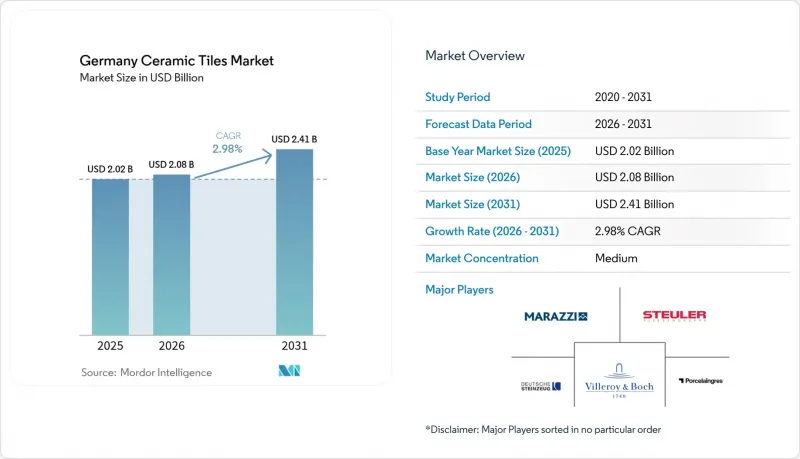
Mordor Intelligence에 의하면, 2026년 독일의 세라믹 타일 시장 규모는 20억 8,000만 달러로 추정되며, 2025년 20억 2,000만 달러에서 2031년에는 24억 1,000만 달러에 달할 것으로 예측됩니다.
2026-2031년 연평균 성장률(CAGR)은 2.98%를 기록할 것으로 전망됩니다.
본 보고서는 제품 유형별(도자기 타일, 기타), 용도별(바닥, 기타), 최종 사용자별(주택, 상업시설), 건설 유형별(신축, 기타), 유통 채널별(타일·석재 전문점, 기타), 지역별(남부 독일, 기타)로 분류되어 있습니다. 시장 전망은 금액(달러) 기준으로 제시되어 있습니다.
독일의 세라믹 타일 시장 동향 및 인사이트
포스트 코로나 시대의 주택 리모델링 수요 증가
장기간에 걸쳐 집에서 지내는 생활이 이어짐에 따라, 각 가정이 저축한 자금을 쾌적성 및 에너지 효율 향상을 위한 대책에 투자하게 되면서 독일 내 리모델링 열기는 가속화되고 있습니다. BEG 제도 하에서는 타일 시공 서비스가 건물당 최대 4만 유로(4만 2,800달러)의 세액 공제 대상이 되며, 욕실, 주방, 단열 외벽 시공이 촉진되고 있습니다. 2024년 건축 허가 건수가 급감한 데 따라, 현재 건설 활동의 61.99%를 리노베이션이 차지하고 있으며, 이는 신축을 크게 상회하고 있습니다. 학술적 모델 분석에 따르면, 2045년 기후 목표를 달성하기 위해서는 주택 재고에 대해 매년 연면적의 2.5%를 전면적으로 개조해야 합니다. 이러한 규제의 명확화로 인해 독일 세라믹 타일 시장 수요 전망은 더욱 확고해집니다. 특히 세라믹이 내구성, 위생성, 그리고 미적 범용성을 발휘하는 실내 공간에서 이러한 경향은 두드러집니다. 자재 가격 상승세가 완화됨에 따라 연기되었던 프로젝트가 재개될 것으로 예상되며, 이는 판매량 증가를 더욱 뒷받침할 것입니다.
대형 포셀린 슬래브로의 전환
소매업체에 따르면, 150×300 cm를 초과하는 XXL 사이즈의 구매가 급증하고 있으며, 이음매 없는 외관과 불과 3 mm에 불과한 줄눈 폭이 높이 평가받고 있습니다. 디지털 잉크젯 시스템은 현재 목재, 석재, 콘크리트를 사진 수준의 정밀도로 재현할 수 있게 되어, 고급 주택 및 플래그십 상업시설의 디자인에 대한 기대감을 높이고 있습니다. 독일 최초의 3×1.5m 대형 슬래브를 사용한 통기성 파사드가 Fliesen Thomas의 쇼룸에 설치되어, 이러한 제품이 외장 용도에 적합하다는 것이 입증되었습니다. 슬래브 두께가 6mm 미만으로 얇아짐에 따라 시공자를 위한 교육과 전용 취급 공구가 확대되고 있습니다. 이로 인해 구조적 하중은 경감되는 반면, 운송 중 파손 위험은 높아지고 있습니다. 대형 도자기 타일의 높은 가격 책정이 평균 판매 가격을 끌어올리며, 독일 세라믹 타일 시장의 가치 성장을 뒷받침하고 있습니다.
천연가스 가격 변동이 타일 가마의 소성 비용을 끌어올리고
타일 가마의 에너지 수요 중 약 85%를 천연가스가 차지하고 있으며, 최근의 가격 변동으로 인해 생산 비용이 전 분기 대비 최대 40%나 급등했습니다. 현재 독일의 여러 공장에서는 가격 안정화가 예상되는 LPG로의 전환을 시범적으로 도입하고 있으나, 이를 위해서는 대용량 저장 시설과 기화 장치가 필요합니다. 폐열 회수도 보급이 확대되고 있으며, 새로 도입된 열 배터리는 잉여 배열을 저장하여 건조 라인에서 재사용하고 있습니다. 이러한 개조는 비용 변동을 완화해 주지만, 소규모 생산자에게는 자금 조달이 어려운 설비 투자가 필요합니다. 가격 불안정이 지속되는 것은 독일 세라믹 타일 시장 전체의 이익률에 계속해서 큰 부담으로 작용하고 있습니다.
부문 분석
2025년, 독일 세라믹 타일 시장 규모의 45.12%를 포셀린 타일이 차지했습니다. 이는 내동결성과 낮은 흡수성 덕분에 고급 프로젝트에서 천연석을 대체할 수 있었기 때문입니다. 얇은 대형 포셀린 패널은 파사드 적용 증가와 미니멀리즘 인테리어 트렌드의 부양에 힘입어 연평균 성장률(CAGR) 9.18%로 확대될 것으로 예측됩니다. 유약 도장 세라믹은 38.35%의 점유율을 차지하며, 비용을 중시하는 리노베이션 시장에서 지속적인 수요를 보이고 있습니다. 한편, 무유약 타일은 높은 내마모성이 요구되는 산업용 바닥재 시장에서 주류를 이루고 있습니다. 모자이크 타일은 여전히 틈새 시장이지만, 호텔 및 레스토랑 업계의 리노베이션에서 평방미터당 높은 가격을 유지하고 있습니다. 항균성 포셀린 타일의 보급이 확대됨에 따라 포셀린 타일의 평균 판매 가격이 더욱 상승하고 있으며, 판매 수량 증가에 앞서 매출 성장을 견인하고 있습니다.
독일 공장에서는 최대 12가지 색상의 컬러 바와 텍스처 매핑을 지원하는 3세대 디지털 프린터에 대한 투자가 진행되고 있어 디자인의 자유도가 확대되고 있습니다. 미끄럼 방지를 위한 미세 구조와 광촉매 코팅을 통해 습한 환경에서의 성능이 향상되고 있습니다. 생산 자동화를 통해 6mm 패널과 기존의 10mm 포맷을 동일한 라인에서 전환할 수 있게 되어 유연성이 한층 더 높아졌습니다. 이러한 기술적 진보는 포세린 타일의 프리미엄 위상을 확고히 하고, 독일 세라믹 타일 시장에서의 주도적 지위를 강화하고 있습니다.
2025년 수요 중 바닥재가 70.05%를 차지했습니다. 이는 독일 기후대에 전형적인 기계적 하중과 동결·융해 주기를 반영한 결과입니다. 가장자리를 수정 가공한 대형 포세린 타일은 이음매가 거의 눈에 띄지 않는 시공을 가능하게 하여, 오픈 플랜 인테리어에서 피팅 유지보수 부담을 줄여줍니다. 벽 타일은 21.15%의 점유율을 기록했습니다. 이는 항균성과 관리가 용이한 유약을 활용한 욕실 및 주방 리모델링이 뒷받침한 결과입니다. 파사드는 단열층과 레인스크린 설계를 통합한 얇은 타일 클래딩 시스템에 힘입어 7.86%라는 가장 높은 연평균 성장률(CAGR)을 기록했습니다. 지붕 자재는 여전히 전통을 중시하는 경향이 있으며, 랜드마크 복원이나 고급 전원 주택에서는 세라믹 지붕판이 지정되고 있습니다.
에너지 규제로 인해 단열 패널과 경량 세라믹을 결합한 외장 리모델링이 촉진되고 있으며, 이에 따라 파사드 전문 업체들은 DIBt의 승인을 받은 앵커 장치 및 접착 모르타르의 인증 취득을 추진하고 있습니다. 이러한 기술적 진보에 힘입어 파사드는 독일 세라믹 타일 시장에서 구조적 성장의 핵심 축으로서의 입지를 확고히 하고 있습니다.
기타 혜택 :
- 엑셀 형식 시장 예측(ME) 시트
- 3개월간의 애널리스트 지원
자주 묻는 질문
목차
제1장 서론
제2장 조사 범위
제3장 조사 방법
제4장 주요 요약
제5장 시장 구도
제6장 시장 규모 및 성장 예측
제7장 경쟁 구도
제8장 시장 기회 및 향후 전망
AJY 26.09.09According to Mordor Intelligence, the Germany ceramic tiles market size in 2026 is estimated at USD 2.08 billion, growing from 2025 value of USD 2.02 billion with 2031 projections showing USD 2.41 billion, growing at 2.98% CAGR over 2026-2031.
This report is Segmented by Product Type (Porcelain Tiles, and Others), Application (Floor, and Others), End-User (Residential, Commercial), Construction Type (New Construction, and Others), Distribution Channel (Specialty Tile and Stone Stores, and Others), and Geography (South Germany, and Others). The Market Forecasts are Provided in Terms of Value (USD). .
Germany Ceramic Tiles Market Trends and Insights
Rising Renovation Demand in Post-COVID Housing Upgrades
Germany's retrofit momentum is accelerating as households channel savings into comfort and energy-efficiency measures after an extended time at home. Under the BEG scheme, tile-laying services qualify for a tax reduction of up to EUR 40,000 (USD 42,800) per property, bolstering installations in bathrooms, kitchens, and insulated facades. Renovation now accounts for 61.99% of construction activity, dwarfing new builds as approvals declined sharply in 2024. Academic modeling shows the housing stock must undergo full-scale renovation of 2.5% of floor area annually to align with 2045 climate targets. This regulatory clarity locks in demand visibility for the Germany ceramic tiles market, especially in interior spaces where ceramics deliver durability, hygiene, and aesthetic versatility. As material inflation eases, postponed projects are expected to resume, further underpinning volume growth.
Shift Toward Large-Format Porcelain Slabs
Retailers report surging purchases of XXL formats exceeding 150 X 300 cm, valued for seamless looks and minimal 3 mm joints . Digital inkjet systems now replicate wood, stone, and concrete with near-photographic detail, raising design expectations in premium homes and flagship commercial venues. Germany's first ventilated facade using 3 X 1.5 m maxi-slabs was installed at the Fliesen Thomas showroom, validating exterior suitability of these products. Installer training and specialist handling tools are expanding as slab thickness drops below 6 mm, reducing structural loads yet increasing breakage risk during transport. The premium pricing of large-format porcelain lifts average selling prices, strengthening value growth within the Germany ceramic tiles market.
Volatile Natural-Gas Prices Inflating Kiln Firing Costs
Gas supplies cover roughly 85% of energy demand in tile kilns, and recent price swings have driven production-cost spikes of up to 40% quarter-on-quarter. Several German plants now trial LPG conversions that promise steadier pricing but require bulk-storage yards and vaporizer systems. Waste-heat recovery is gaining traction; new thermal-battery installations store surplus exhaust heat for use in drying lines. While these retrofits temper cost volatility, they necessitate capital outlays that smaller producers find difficult to finance. Persistent price instability continues to weigh on margins across the Germany ceramic tiles market.
Other drivers and restraints analyzed in the detailed report include:
- Accelerated Adoption of Thin Tiles for Facades
- Government Subsidies for Energy-Efficient Refurbishments
- Tightening EU Carbon Regulations on Heavy Ceramics Manufacturing
For complete list of drivers and restraints, kindly check the Table Of Contents.
Segment Analysis
Porcelain tiles captured 45.12% of the Germany ceramic tiles market size in 2025 as frost resistance and low water absorption allowed them to displace natural stone in upscale projects. Thin large-format porcelain panels are forecast to expand at a 9.18% CAGR, propelled by rising facade applications and minimalist interior trends. Glazed ceramic holds a 38.35% share and continues to serve budget-conscious renovations, while unglazed bodies dominate industrial floors requiring high abrasion resistance. Mosaic tiles remain niche but command elevated prices per square meter in hospitality refurbishments. Growing acceptance of antibacterial porcelain further elevates porcelain's average selling price, boosting revenue growth ahead of volume gains.
German plants are investing in third-generation digital printers that support up to 12 color bars and texture-mapping, broadening design latitude. Slip-resistant micro-structures and photocatalytic coatings amplify performance in wet environments. Production automation now allows same-line switching between 6 mm panels and classic 10 mm formats, sharpening flexibility. These technical gains anchor porcelain's premium positioning and reinforce its leadership in the Germany ceramic tiles market.
Flooring represented 70.05% of demand in 2025, reflecting the mechanical loads and frost cycles typical of German climate zones. Large-format porcelain with rectified edges supports near-seamless installations that reduce grout maintenance in open-plan interiors. Wall tiles secured a 21.15% share, fueled by bathroom and kitchen upgrades that leverage antibacterial and easy-clean glazes. Facades recorded the fastest CAGR at 7.86%, driven by thin-tile cladding systems that integrate insulation layers and rain-screen designs. Roofing remains heritage-focused, with ceramic shingles specified on landmark restorations and premium countryside homes.
Energy codes encourage exterior retrofits that combine thermal panels with lightweight ceramics, prompting facade specialists to certify anchor devices and adhesive mortars with DIBt approvals. This engineering progress positions facades as a structural growth pillar for the Germany ceramic tiles market.
Complete Report Scope:
- Glazed Ceramic Tiles
- Unglazed Ceramic Tiles
- Mosaic Tiles
- Others (Decorative, Patterned, Handmade)
- By Application
- Floor
- Wall
- Roofing
- By End-User
- Residential
- Commercial
- Hospitality (Hotels, Resorts)
- Retail Spaces
- Offices and Institutions
- Healthcare
- Educational Facilities
- Transport Hubs (Airports, Metro, Bus Terminals)
- Other Commercial Users
- By Construction Type
- New Construction
- Renovation and Replacement
- By Distribution Channel
- Specialty Tile and Stone Stores
- Home Improvement and DIY Stores
- Online Retail
- Direct Sales to Contractors
List of Companies Covered in this Report:
- ABC-Fliesen GmbH
- Agrob Buchtal GmbH
- Villeroy and Boch AG
- Deutsche Steinzeug Cremer and Breuer AG
- Porcelaingres GmbH
- Marazzi Group (Germany)
- Ragno Deutschland
- Ceramiche Piemme (Germany)
- Florim Deutschland
- Emilgroup Deutschland
- Iris Ceramica Group (Germany)
- FAP Ceramiche (Germany)
- Leonardo Ceramica (Germany)
- Steuler Fliesen GmbH
- Jasba Mosaik GmbH
- Kerateam GmbH and Co. KG
- NordCeram GmbH
- Interbau-Blink Fliesen GmbH
- Equipe Ceramicas (Germany)
- Design Industry Tiles (Germany)
Additional Benefits:
- The market estimate (ME) sheet in Excel format
- 3 months of analyst support
TABLE OF CONTENTS
1 Introduction
2 Scope of the Study
3 Research Methodology
4 Executive Summary
5 Market Landscape
- 5.1 Market Drivers
- 5.1.1 Rising renovation demand in post-COVID housing upgrades
- 5.1.2 Shift toward large-format porcelain slabs
- 5.1.3 Accelerated adoption of thin tiles for facades
- 5.1.4 Government subsidies for energy-efficient refurbishments
- 5.1.5 Growing preference for antibacterial glazed surfaces (hospitality and healthcare)
- 5.2 Market Restraints
- 5.2.1 Volatile natural-gas prices inflating kiln firing costs
- 5.2.2 Tightening EU carbon regulations on heavy ceramics manufacturing
- 5.2.3 Labor shortages in German construction sector
- 5.3 Value / Supply-Chain Analysis
- 5.4 Regulatory Landscape
- 5.5 Technological Outlook
- 5.6 Porter's Five Forces
- 5.6.1 Bargaining Power of Suppliers
- 5.6.2 Bargaining Power of Buyers
- 5.6.3 Threat of New Entrants
- 5.6.4 Threat of Substitutes
- 5.6.5 Competitive Rivalry
6 Market Size and Growth Forecasts
- 6.1 Glazed Ceramic Tiles
- 6.1.1 Unglazed Ceramic Tiles
- 6.1.2 Mosaic Tiles
- 6.1.3 Others (Decorative, Patterned, Handmade)
- 6.2 By Application
- 6.2.1 Floor
- 6.2.2 Wall
- 6.2.3 Roofing
- 6.3 By End-User
- 6.3.1 Residential
- 6.3.2 Commercial
- 6.3.2.1 Hospitality (Hotels, Resorts)
- 6.3.2.2 Retail Spaces
- 6.3.2.3 Offices and Institutions
- 6.3.2.4 Healthcare
- 6.3.2.5 Educational Facilities
- 6.3.2.6 Transport Hubs (Airports, Metro, Bus Terminals)
- 6.3.2.7 Other Commercial Users
- 6.4 By Construction Type
- 6.4.1 New Construction
- 6.4.2 Renovation and Replacement
- 6.5 By Distribution Channel
- 6.5.1 Specialty Tile and Stone Stores
- 6.5.2 Home Improvement and DIY Stores
- 6.5.3 Online Retail
- 6.5.4 Direct Sales to Contractors
7 Competitive Landscape
- 7.1 Strategic Moves
- 7.2 Market Share Analysis
- 7.3 Company Profiles (includes Global level Overview, Market level overview, Core Segments, Financials as available, Strategic Information, Market Rank/Share for key companies, Products and Services, and Recent Developments)
- 7.3.1 ABC-Fliesen GmbH
- 7.3.2 Agrob Buchtal GmbH
- 7.3.3 Villeroy and Boch AG
- 7.3.4 Deutsche Steinzeug Cremer and Breuer AG
- 7.3.5 Porcelaingres GmbH
- 7.3.6 Marazzi Group (Germany)
- 7.3.7 Ragno Deutschland
- 7.3.8 Ceramiche Piemme (Germany)
- 7.3.9 Florim Deutschland
- 7.3.10 Emilgroup Deutschland
- 7.3.11 Iris Ceramica Group (Germany)
- 7.3.12 FAP Ceramiche (Germany)
- 7.3.13 Leonardo Ceramica (Germany)
- 7.3.14 Steuler Fliesen GmbH
- 7.3.15 Jasba Mosaik GmbH
- 7.3.16 Kerateam GmbH and Co. KG
- 7.3.17 NordCeram GmbH
- 7.3.18 Interbau-Blink Fliesen GmbH
- 7.3.19 Equipe Ceramicas (Germany)
- 7.3.20 Design Industry Tiles (Germany)
8 Market Opportunities and Future Outlook
- 8.1 Rapid growth in prefabricated modular housing driving demand for lightweight large-format porcelain panels
- 8.2 Smart sensor-embedded tiles for indoor environmental monitoring in premium commercial spaces