

|
시장보고서
상품코드
2124229
중동 및 북아프리카의 모바일 가상 네트워크 사업자 시장 : 시장 점유율 분석, 업계 동향 및 통계, 성장 예측(2026-2031년)MENA Mobile Virtual Network Operator - Market Share Analysis, Industry Trends & Statistics, Growth Forecasts (2026 - 2031) |
||||||
 Mordor Intelligence
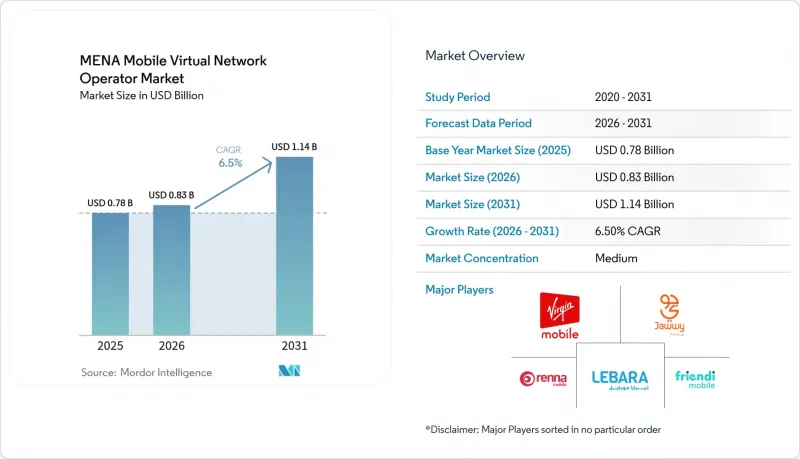
Mordor Intelligence에 의하면, 2026년 중동 및 북아프리카의 모바일 가상 네트워크 사업자(MVNO) 시장 규모는 8억 3,000만 달러로 추정되고, 2025년 7억 8,000만 달러에서 확대될 전망입니다.
또한, 2031년 예측치는 11억 4,000만 달러로 예상되며, 2026-2031년 연평균 성장률(CAGR) 6.5%로 성장할 것으로 전망됩니다.
본 보고서는 도입 모델별(클라우드, 온프레미스), 운영 모드별(서비스 사업자, 기타), 가입자 유형별(일반 소비자, 기업, 기타), 용도별(할인, 기타), 네트워크 기술별(2G/3G, 기타), 유통 채널별(온라인/디지털 전용, 기타), 국가별로 분류되어 있습니다. 시장 전망은 금액(달러)과 규모(가입자 수)로 제시되어 있습니다.
중동 및 북아프리카의 모바일 가상 네트워크 사업자(MVNO) 시장 동향 및 인사이트
가격에 민감한 주재원 및 젊은 층의 MVNO 선불 요금제 전환 촉진
사우디아라비아에 거주하는 약 1,000만 명의 외국인 거주자와 GCC 전역에 걸쳐 있는 대규모 젊은 층은 계약 구속력이 적은 선불 요금제를 원하고 있으며, 이에 따라 저렴한 국제 통화 분과 유연한 데이터 할당량을 결합한 MVNO 서비스로 가입자들이 꾸준히 이동하고 있습니다. 번호 이동성 개혁과 완전히 디지털화된 가입 절차로 인해 전환 장벽이 제거되면서 기존 사업자에 대한 해지 속도가 가속화되고 있습니다. 버진 모바일의 지역 사용자 수가 350만 명으로 급증한 것은 간소화된 요금 체계와 앱 내 서비스를 통해 얼마나 신속하게 규모를 확대할 수 있는지를 보여줍니다. 그 결과 발생한 압박으로 인해 호스트 사업자들은 해외 트래픽을 유지하기 위해 도매 조건 재협상을 할 수밖에 없게 되었으며, 이는 간접적으로 MVNO의 수익성을 향상시키고 있습니다. 따라서 외국인 거주자와 젊은 층이 주도하는 성장은 막대한 마케팅 비용을 들이지 않고도 중동 및 북아프리카 MVNO 시장에 안정적인 수요 기반을 확보하고 있습니다.
5G 지원 디지털 브랜드를 통한 eSIM 및 앱 전용 서비스 활용
중동 및 북아프리카의 eSIM 연결 건수는 연평균 20%의 성장률을 기록하고 있으며, 2028년까지 활성 프로파일 수가 1억 3,500만 건에 달할 것으로 예측됩니다. 이를 통해 MVNO는 물리적 유통 과정을 생략하고, 단 몇 분 만에 사용자를 활성화할 수 있게 됩니다. stc의 ‘Jawwy’와 같은 플랫폼은 클라우드 네이티브 과금 스택을 활용하여 실시간 제안 및 정책 제어를 고객 앱에 전달함으로써, 고객 확보 비용을 절감하고 세분화된 세분화을 실현하고 있습니다. 5G 네트워크 슬라이싱과 eSIM 프로비저닝의 융합을 통해 마이크로 번들, 일일 기가바이트 패스, 혹은 지연 시간이 최적화된 스트리밍이 가능해지면서, SIM 카드 채널에는 존재하지 않았던 수익화 가능한 이용 사례가 창출되고 있습니다. 그 결과, 디지털 전문 브랜드는 기본 요금이 낮은 수준에 머물러 있는 경우에도 사용자 유지율을 높이고 ARPU를 향상시킬 수 있어, 중동 및 북아프리카 MVNO 시장의 성장 전망을 뒷받침하고 있습니다.
걸프 국가들의 높은 모바일 데이터 통신 최저가로 인한 MVNO ARPU 압박
도매 데이터 최저 가격 규제로 인해 아랍에미리트와 쿠웨이트의 MVNO는 유럽의 동종 서비스와 비교하여 1기가바이트당 요금이 15-20% 더 비싼 경우가 많으며, 이로 인해 표면상의 할인 폭이 제한되고, 대상이 되는 대중 시장 부문도 한정되고 있습니다. 부가가치 기능을 통해 이익률 하락을 어느 정도 상쇄하는 것은 가능하지만, 통신 사업자들은 데이터 소비량이 많은 소비자용 요금제에서 기존 사업자보다 저렴한 가격으로 서비스를 제공하는 데 어려움을 겪고 있습니다. 따라서 경쟁적 차별화는 적극적인 가격 전략이 아닌 라이프스타일 브랜딩, 로열티 혜택, 핀테크 부가 서비스로 전환되고 있으며, 이는 중동 및 북아프리카 MVNO 시장의 단기적인 성장 여력을 억제하고 있습니다.
부문 분석
2025년에는 클라우드 도입이 매출의 62.30%를 차지했으며, 연평균 성장률(CAGR) 11.45%로 중동 및 북아프리카 MVNO 시장 규모를 견인했습니다. 이 운영 모델에서는 모바일 스위칭 노드 등 막대한 설비 투자(CAPEX) 항목이 필요하지 않고, ‘성장에 따라 지불(pay-as-you-grow)’ 형태의 확장이 가능하기 때문에 신규 진입 브랜드도 18개월 이내에 손익분기점에 도달할 가능성이 있습니다. AI를 활용한 부정 감지 기능과 실시간 정책 엔진은 대부분의 하이퍼스케일형 서비스에 표준으로 탑재되어 있어 서비스 품질 향상에 기여하고 있습니다.
데이터 주권 조항에 따라 현지 처리가 요구되는 경우, 특히 국가의 에너지 및 국방 부문에서는 여전히 온프레미스 환경이 남아 있습니다. 이러한 도입의 경우 도입 주기가 길어지지만, 서비스 수준 보증에 활용되는 긴밀한 네트워크 통합이 실현됩니다. 각 벤더사는 미션 크리티컬 기능을 프라이빗 클라우드에 유지하면서 중개 처리, 분석, 과금 기능을 멀티테넌트 환경으로 이전함으로써 솔루션의 하이브리드화를 추진하고 있으며, 이를 통해 레거시 MVNO의 이전 프로세스가 원활해지고 있습니다.
2025년에는 신속한 서비스 출시가 가능한 브랜드가 기존 호스트 자산을 활용함에 따라, 중동 및 북아프리카 MVNO 시장 점유율의 62.85%를 리셀러/라이트/브랜드 형태가 차지했습니다. 그러나 코어 네트워크 요소 및 SIM 프로파일을 관리하는 완전한 MVNO 프레임워크는 연평균 성장률(CAGR) 23.6%를 기록할 전망이며, 이는 시장이 서비스의 자율성을 향해 나아가고 있음을 나타냅니다.
‘레드불 모바일’과 같은 브랜드형 모델에서는 기간 제한이 없는 ‘기가코인’ 데이터 지갑 실험이 진행되고 있는데, 이는 제한이 많은 리셀러 계약 하에서는 실현 불가능한 구조입니다. 완전한 제어를 통해 독립형 로밍 계약이나 5G 네트워크 슬라이스를 기반으로 한 온디맨드 품질 계층 구축이 가능해집니다. 시간이 지남에 따라 더 높은 이익률과 차별화된 기능 세트가 Full MVNO의 매력을 높여, 중동 및 북아프리카 MVNO 시장에서 장기적인 경쟁력을 공고히할 것으로 보입니다.
기타 혜택
- 엑셀 형식 시장 예측(ME) 시트
- 3개월간의 애널리스트 지원
자주 묻는 질문
목차
제1장 서론
제2장 조사 방법
제3장 주요 요약
제4장 시장 구도
제5장 시장 규모 및 성장 예측
제6장 경쟁 구도
제7장 시장 기회 및 향후 전망
AJY 26.09.11According to Mordor Intelligence, MENA mobile virtual network operator market size in 2026 is estimated at USD 0.83 billion, growing from 2025 value of USD 0.78 billion with 2031 projections showing USD 1.14 billion, growing at 6.5% CAGR over 2026-2031.
This report is Segmented by Deployment Model (Cloud, and On-Premise), Operational Mode (Service Operator, and More), Subscriber Type (Consumer, Enterprise, and More), Application (Discount, and More), Network Technology (2G/3G, and More), Distribution Channel (Online/Digital-only, and More), and Country. The Market Forecasts are Provided in Terms of Value (USD) and Volume (Subscribers).
MENA Mobile Virtual Network Operator Market Trends and Insights
Price-Sensitive Expatriate and Youth Segments Fuel Prepaid Churn
Roughly 10 million expatriates in Saudi Arabia and large youth cohorts across the GCC seek low-commitment prepaid plans, prompting steady subscriber migration toward MVNO offers that combine cheaper international minutes with flexible data allocations. Number-portability reforms and fully digital onboarding remove switching friction, accelerating churn away from incumbents. Virgin Mobile's jump to 3.5 million regional users illustrates how simplified tariffs plus in-app servicing capture scale quickly. The resulting pressure forces host operators to renegotiate wholesale terms to retain outbound traffic, indirectly improving MVNO economics. Expat and youth-led growth, therefore, secures a stable demand base for the MENA MVNO market without heavy marketing spend.
5G-Enabled Digital Brands Leverage eSIM and App-Only Onboarding
Regional eSIM connections are tracking 20% annual growth, with projections of 135 million active profiles by 2028, allowing MVNOs to forgo physical distribution and activate users in minutes. Platforms such as Jawwy by stc rely on cloud-native charging stacks that push real-time offers and policy controls to customer apps, lowering acquisition costs and supporting granular segmentation. The convergence of 5G network slicing with eSIM provisioning enables micro-bundles, daily gigabyte passes, or latency-optimized streams, creating monetizable use cases absent from SIM card channels. As a result, digital-only brands enhance stickiness and lift ARPU even when headline tariffs remain low, reinforcing growth prospects for the MENA MVNO market.
High Mobile-Data Floor Prices in Gulf States Squeeze ARPU
Wholesale data-floor regulations mean MVNOs in the UAE and Kuwait often pay per-gigabyte rates that are 15-20% above European comparables, constraining headline discounts and limiting addressable mass-market segments. While value-added features can offset some margin loss, operators struggle to undercut incumbents on data-hungry consumer plans. Competitive differentiation, therefore, shifts to lifestyle branding, loyalty perks, and fintech add-ons rather than aggressive price moves, tempering near-term upside for the MENA MVNO market.
Other drivers and restraints analyzed in the detailed report include:
- Regulator-Mandated Network-Sharing and Wholesale Price Caps Improve Economics
- Satellite-NTN Connectivity for Remote Oil and Gas Sites
- Limited Number-Portability in North Africa Curbs Switching
For complete list of drivers and restraints, kindly check the Table Of Contents.
Segment Analysis
Cloud implementations held 62.30% revenue in 2025 and pushed the MENA MVNO market size forward with an 11.45% CAGR. The operating model removes hefty capex items such as mobile switching nodes and allows pay-as-you-grow scaling, creating a breakeven horizon under 18 months for greenfield brands. AI-assisted fraud checks and real-time policy engines come bundled with most hyperscale offerings, reinforcing service quality.
On-premise environments persist where data-sovereignty clauses require local processing, notably in sovereign energy and defense verticals. These deployments impose longer deployment cycles yet deliver tight network integration for service-level commitments. Vendors are increasingly hybridizing solutions by anchoring mission-critical functions on private clouds while shifting mediation, analytics, and billing to multitenant regions, smoothing migration paths for legacy MVNOs.
Reseller/light/brand formats accounted for 62.85% of the MENA MVNO market share in 2025 as quick-launch brands leveraged existing host assets. Yet full MVNO frameworks, controlling core network elements and SIM profiles, are set to record 23.6% CAGR, signaling the market's march toward service autonomy.
Branded concepts like Red Bull Mobile experiment with perpetual Gigacoin data wallets, a structure unviable under restrictive reseller contracts. Full control allows independent roaming deals and on-demand quality tiers built atop 5G network slices. Over time, richer margins and differentiated feature sets propel full MVNO appeal, anchoring long-term competitiveness inside the MENA MVNO market.
Complete Report Scope:
- By Deployment Model
- Cloud
- On-premise
- By Operational Mode
- Reseller / Light / Brand MVNO
- Service Operator
- Full MVNO
- By Subscriber Type
- Consumer
- Enterprise
- IoT-specific
- By Application
- Discount
- Business
- Cellular M2M
- Others
- By Network Technology
- 2G/3G
- 4G/LTE
- 5G
- Satellite/NTN
- By Distribution Channel
- Online / Digital-only
- Traditional Retail Stores
- Carrier Sub-brand Stores
- Third-Party / Wholesale
- By Geography
- Middle East
- Saudi Arabia
- United Arab Emirates
- Turkey
- Rest of Middle East
- North Africa
- Egypt
- Morocco
- Tunisia
- Algeria
- Rest of North Africa
- Middle East
List of Companies Covered in this Report:
- Virgin Mobile Middle East and Africa (Beyond ONE)
- Lebara Mobile KSA
- FRiENDi Mobile Oman (Beyond ONE)
- Renna Mobile Oman
- Jawwy (Saudi Telecom Company)
- Salam Mobile
- Red Bull MOBILE Bahrain
- Swyp (Etisalat UAE)
- Lyca Mobile Tunisia
Additional Benefits:
- The market estimate (ME) sheet in Excel format
- 3 months of analyst support
TABLE OF CONTENTS
1 INTRODUCTION
- 1.1 Study Assumptions and Market Definition
- 1.2 Scope of the Study
2 RESEARCH METHODOLOGY
3 EXECUTIVE SUMMARY
4 MARKET LANDSCAPE
- 4.1 Market Overview
- 4.2 Market Drivers
- 4.2.1 Price-sensitive expatriate and youth segments fuel prepaid churn towards MVNOs
- 4.2.2 5G-enabled digital brands leverage eSIM and app-only onboarding
- 4.2.3 Regulator-mandated network-sharing/wholesale price caps improve MVNO economics
- 4.2.4 Cross-border remittance bundling (e.g., airtime-to-cash corridors)
- 4.2.5 Satellite-NTN connectivity for remote oil and gas sites
- 4.2.6 Green fintech-MVNO hybrids monetize carbon-credit micro-transactions
- 4.3 Market Restraints
- 4.3.1 High mobile-data floor prices in Gulf states squeeze MVNO ARPU
- 4.3.2 Limited number-portability in North Africa curbs subscriber switching
- 4.3.3 Rising wholesale 5G slicing fees vs. legacy 4G rates
- 4.3.4 Geopolitical spectrum-allocation delays (e.g., Libya, Yemen)
- 4.4 Value Chain Analysis
- 4.5 Regulatory Landscape
- 4.6 Porter's Five Forces Analysis
- 4.6.1 Threat of New Entrants
- 4.6.2 Bargaining Power of Buyers
- 4.6.3 Bargaining Power of Suppliers
- 4.6.4 Threat of Substitutes
- 4.6.5 Intensity of Competitive Rivalry
- 4.7 Assessment of Macroeconomic Factors on the Market
5 MARKET SIZE AND GROWTH FORECASTS (VALUE)
- 5.1 By Deployment Model
- 5.1.1 Cloud
- 5.1.2 On-premise
- 5.2 By Operational Mode
- 5.2.1 Reseller / Light / Brand MVNO
- 5.2.2 Service Operator
- 5.2.3 Full MVNO
- 5.3 By Subscriber Type
- 5.3.1 Consumer
- 5.3.2 Enterprise
- 5.3.3 IoT-specific
- 5.4 By Application
- 5.4.1 Discount
- 5.4.2 Business
- 5.4.3 Cellular M2M
- 5.4.4 Others
- 5.5 By Network Technology
- 5.5.1 2G/3G
- 5.5.2 4G/LTE
- 5.5.3 5G
- 5.5.4 Satellite/NTN
- 5.6 By Distribution Channel
- 5.6.1 Online / Digital-only
- 5.6.2 Traditional Retail Stores
- 5.6.3 Carrier Sub-brand Stores
- 5.6.4 Third-Party / Wholesale
- 5.7 By Geography
- 5.7.1 Middle East
- 5.7.1.1 Saudi Arabia
- 5.7.1.2 United Arab Emirates
- 5.7.1.3 Turkey
- 5.7.1.4 Rest of Middle East
- 5.7.2 North Africa
- 5.7.2.1 Egypt
- 5.7.2.2 Morocco
- 5.7.2.3 Tunisia
- 5.7.2.4 Algeria
- 5.7.2.5 Rest of North Africa
- 5.7.1 Middle East
6 COMPETITIVE LANDSCAPE
- 6.1 Market Concentration
- 6.2 Strategic Moves
- 6.3 Market Share Analysis
- 6.4 Company Profiles (includes Global level Overview, Market level overview, Core Segments, Financials as available, Strategic Information, Market Rank/Share for key companies, Products and Services, and Recent Developments)
- 6.4.1 Virgin Mobile Middle East and Africa (Beyond ONE)
- 6.4.2 Lebara Mobile KSA
- 6.4.3 FRiENDi Mobile Oman (Beyond ONE)
- 6.4.4 Renna Mobile Oman
- 6.4.5 Jawwy (Saudi Telecom Company)
- 6.4.6 Salam Mobile
- 6.4.7 Red Bull MOBILE Bahrain
- 6.4.8 Swyp (Etisalat UAE)
- 6.4.9 Lyca Mobile Tunisia
7 MARKET OPPORTUNITIES AND FUTURE OUTLOOK
- 7.1 White-Space and Unmet-Need Assessment


