
|
시장보고서
상품코드
2125585
스페인의 통신 MNO 시장 : 시장 점유율 분석, 산업 동향 및 통계 데이터, 성장 예측(2026-2031년)Spain Telecom MNO - Market Share Analysis, Industry Trends & Statistics, Growth Forecasts (2026 - 2031) |
||||||
 Mordor Intelligence
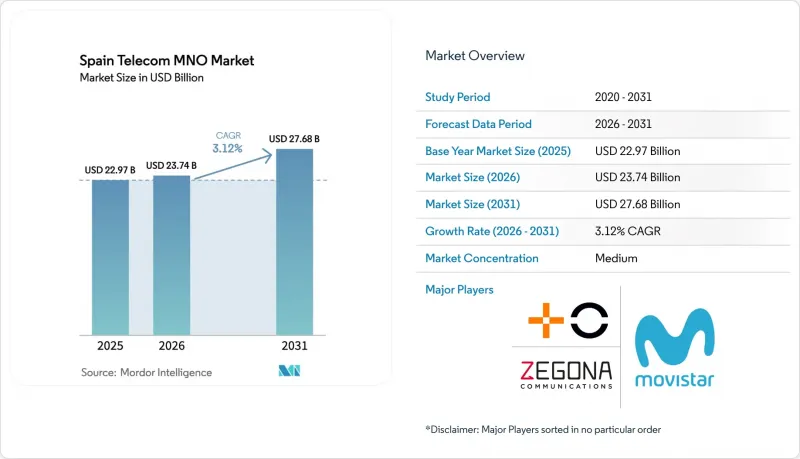
Mordor Intelligence에 의하면, 스페인의 통신 MNO 시장 규모는 2025년에 229억 7,000만 달러로 평가되었고, 2026년 237억 4,000만 달러에서 2031년까지 276억 8,000만 달러에 이를 것으로 예측되며, 예측 기간(2026-2031년) CAGR은 3.12%를 나타낼 전망입니다.

본 보고서는 서비스 유형별(음성 서비스, 데이터·인터넷 서비스, 메시징 서비스, IoT·M2M 서비스, OTT·유료 TV 서비스 등), 최종 사용자별(기업, 소비자) 및 지역별로 분류되어 있습니다. 시장 예측은 금액(달러) 기준으로 제시되어 있습니다.
스페인의 통신 MNO 시장 동향 및 인사이트
5G 독립형(SA) 방식의 커버리지 확대 및 주파수 재할당
스페인의 통신 사업자들은 이미 국내 5G 기지국의 8.3%를 독립형(stand-alone) 모드로 운영하고 있으며, 이는 유럽 평균인 3%를 크게 상회하는 수준입니다. 텔레포니카는 기존에 3G 트래픽을 전송하던 2.1GHz 대역의 주파수 재할당을 통해 마드리드와 바르셀로나의 용량을 향상시켰으며, 2025년까지 주파수 이용 효율을 22% 향상시켰습니다. MasOrange는 700 MHz, 3.5GHz, 26GHz 대역을 통합하는 ‘5G-Advanced’ 레이어를 가동하여 3 Gbps를 넘는 시험 속도를 달성했습니다. 기업들은 이 아키텍처를 높이 평가했습니다. 네트워크 슬라이싱과 엣지 노드를 통해 로봇 공학 및 AR 유지보수 도구를 위해 10밀리초 미만의 지연 시간이 보장되기 때문입니다. CNMC가 추가 비용 없이 3.5GHz 라이선스를 2040년까지 연장하기로 결정함에 따라, 산업 회랑 내 기지국 밀도를 더욱 높일 수 있는 자금이 확보되었습니다.
무제한 요금제에 힘입은 모바일 데이터 소비량 증가
현재 스페인 후불 회선의 68%가 무제한 요금제 대상이며, 2025년에는 월평균 데이터 사용량이 18.4GB에 달한 것으로 평가되었습니다. DIGI사의 10유로 요금제로 인해 기존 사업자들은 가격 경쟁을 피할 수 없게 되었으며, 트래픽이 급증했음에도 불구하고 ARPU는 6.95유로(8.20달러)까지 하락했습니다. 보더폰의 네트워크 데이터에 따르면, 동영상 스트리밍은 모바일 트래픽의 62%를 차지하고 있지만, 정액 요금제 하에서는 추가 수익을 창출하지 못하고 있습니다. 텔레포니카의 보고서에 따르면, 상위 10%의 이용자는 매월 47GB를 소비하는 반면, 수익 기여도는 고작 6.95유로(8.20달러)에 그쳐, 매출 총이익률은 38%까지 축소되었습니다. 이에 대응해 통신사들은 수익성을 회복하기 위해 광대역과 모바일의 결합 요금제나월50유로(59달러) 전후의 프리미엄 5G 요금제로의 업셀링에 주력하고 있습니다.
포화 상태에 이른 모바일 가입자 기반이 유기적 성장을 제한
2025년에는 모바일 보급률이 122%에 달했고, 4,700만 명의 거주자에 대해 5,730만 장의 활성 SIM이 사용되고 있어, 추가적인 회선 수 증가 여지는 거의 없습니다. 2025년 모바일 계약 순 증가는 고작 0.3%에 그쳐, 팬데믹 이전 연간 2%를 상회하던 성장률과는 대조적입니다. 현재 가입자 수 증가는 신규 개인 사용자에 의한 것이 아니라, 주로 멀티 SIM 단말기 및 IoT 연결에 기인합니다. 텔레포니카의 개인용 ARPU는 통합형 패키지로의 전환을 추진했음에도 불구하고 전년 대비 4.2% 감소했습니다. 이러한 성장 정체로 인해 통신 사업자들은 개인 가입자 수의 정체 추세를 상쇄하기 위해 고부가가치 기업 계약 확보에 박차를 가하고 있습니다.
부문별 분석
2025년, 데이터 및 인터넷 서비스는 스페인 통신 MNO 시장 매출의 51.17%를 차지했으며, 음성 및 메시징을 합친 매출을 크게 상회했습니다. 이 부문은 동영상 스트리밍의 대량 이용과 5G에 따른 통신 용량 향상이라는 혜택을 누리고 있지만, 정액제 무제한 요금제로 인해 수익의 추가 확대는 제한되고 있습니다. IoT 및 M2M 서비스는 스페인 통신 MNO 시장 규모에서 차지하는 비중은 작지만, 규제에 따라 계량기, 차량, 농업용 센서 연결이 의무화되어 있어 전체 카테고리 중 가장 높은 연평균 성장률(CAGR) 3.27%로 확대될 것으로 예측됩니다.
OTT 앱이 회선 교환형 트래픽을 대체함에 따라 음성 및 메시징 수익은 계속 축소되고 있지만, 한편 OTT와 유료 TV는 고객 이탈을 억제하는 번들 서비스를 통해 시장 전체 구성비에서 약 8%를 차지하고 있습니다. 로밍은 2025년에 팬데믹 이전 수준으로 거의 회복되어, 관광지에서 여전히 스페인 통신 MNO 시장 점유율에 의미 있는 기여를 하고 있는 ‘기타 서비스’의 수익원을 뒷받침하고 있습니다. 장기적인 성장 여지는 대규모 기기 군을 관리할 수 있는 플랫폼에 있으며, 이러한 역량은 이미 텔레포니카 테크(Telefonica Tech)의 고수익 IoT 매출에 반영되고 있습니다.
기타 혜택 :
- Excel 형식 시장 예측(ME) 시트
- 3개월간의 애널리스트 지원
자주 묻는 질문
목차
제1장 서론
제2장 분석 방법
제3장 주요 요약
제4장 시장 구도
제5장 시장 규모 및 성장률 예측
제6장 경쟁 구도
제7장 시장 기회 및 향후 전망
AJY 26.09.15According to Mordor Intelligence, the Spain telecom MNO market size was valued at USD 22.97 billion in 2025 and is estimated to grow from USD 23.74 billion in 2026 to reach USD 27.68 billion by 2031, at a CAGR of 3.12% during the forecast period (2026-2031).
This report is Segmented by Service Type (Voice Services, Data and Internet Services, Messaging Services, Iot and M2M Services, OTT and PayTV Services, and More), End-User (Enterprises, and Consumer), and Geography. The Market Forecasts are Provided in Terms of Value (USD).
Spain Telecom MNO Market Trends and Insights
5G Standalone Coverage Expansion and Spectrum Refarming
Spain's operators already run 8.3% of national 5G sites in standalone mode, far above the sub-3% European average. Telefonica improved capacity in Madrid and Barcelona by refarming 2.1 GHz spectrum that previously carried 3G traffic, raising spectral efficiency by 22% during 2025. MasOrange switched on a 5G-Advanced layer that aggregates 700 MHz, 3.5 GHz, and 26 GHz bands, delivering trial speeds above 3 Gbps. Enterprises value the architecture because network slicing and edge nodes guarantee sub-10 millisecond latency for robotics and AR maintenance tools. The CNMC decision to extend 3.5 GHz licences to 2040 at no extra cost freed capital for further densification in industrial corridors.
Rising Mobile-Data Consumption Driven by Unlimited Plans
Unlimited tariffs now cover 68% of Spanish post-paid lines, lifting average monthly data use to 18.4 GB in 2025. DIGI's EUR 10 offer forced incumbents to match prices, so ARPU slid to EUR 6.95 (USD 8.20) even as traffic soared. Vodafone's network shows that video streaming represents 62% of mobile load yet adds no incremental revenue under flat-fee plans. Telefonica reported that top-decile users consumed 47 GB each month while contributing barely EUR 6.95 (USD 8.20) in revenue, compressing gross margins to 38%. Operators respond by upselling fiber-mobile bundles and premium 5G tiers priced near EUR 50 (USD 59) per month to restore profitability.
Saturated Mobile Subscriber Base Limiting Organic Growth
Mobile penetration climbed to 122% in 2025 with 57.3 million active SIMs serving 47 million residents, leaving scant room for further line additions. Net new mobile subscriptions rose only 0.3% in 2025 compared with more than 2% annual growth before the pandemic. Incremental gains now stem mainly from multi-SIM devices and IoT links rather than new human users. Telefonica's consumer ARPU fell 4.2% year-over-year despite migration efforts toward converged packages. The growth ceiling forces carriers to chase higher-value enterprise contracts to offset flat consumer volumes.
Other drivers and restraints analyzed in the detailed report include:
- Fiber-to-the-Home Diffusion Enabling Converged Bundles
- Enterprise IoT Uptake in Energy, Transport, and Agriculture
- ARPU Compression Due to Price Wars and Low-Cost Brands
For complete list of drivers and restraints, kindly check the Table Of Contents.
Segment Analysis
Data and Internet Services held 51.17% of Spain Telecom MNO market revenue in 2025, far surpassing voice and messaging combined. The segment benefits from heavy video-streaming consumption and from 5G's capacity uplift, yet flat-fee unlimited plans mute incremental monetization. IoT and M2M Services accounted for a smaller slice of Spain Telecom MNO market size but are projected to expand at a 3.27% CAGR, the fastest across all categories, as regulatory mandates embed connectivity into meters, vehicles, and agricultural sensors.
Voice and Messaging revenues continue to contract as over-the-top apps displace circuit-switched traffic, while OTT and PayTV add roughly 8% to the overall mix through churn-reducing bundles. Roaming almost returned to pre-pandemic levels in 2025, aiding the "other services" pool that still contributes meaningfully to Spain Telecom MNO market share in tourist districts. Long-term upside resides in platforms capable of managing device fleets at scale, a capability already reflected in Telefonica Tech's high-margin IoT earnings.
Complete Report Scope:
- Overall Telecom Revenue and ARPU
- Service Type
- Voice Services
- Data and Internet Services
- Messaging Services
- IoT and M2M Services
- OTT and PayTV Services
- Other Services (VAS, Roaming and International Services, Enterprise and Wholesale Services)
- End-User
- Enterprises
- Consumer
List of Companies Covered in this Report:
- Telefonica Spain (Movistar)
- MASORANGE, S.L.
- Zegona Communications (Vodafone Spain)
Additional Benefits:
- The market estimate (ME) sheet in Excel format
- 3 months of analyst support
TABLE OF CONTENTS
1 INTRODUCTION
- 1.1 Study Assumptions and Market Definition
- 1.2 Scope of the Study
2 RESEARCH METHODOLOGY
3 EXECUTIVE SUMMARY
4 MARKET LANDSCAPE
- 4.1 Market Overview
- 4.2 Regulatory and Policy Framework
- 4.3 Spectrum Landscape and Competitive Holdings
- 4.4 Telecom Industry Ecosystem
- 4.5 Macroeconomic and External Drivers
- 4.6 Porter's Five Forces Analysis
- 4.6.1 Competitive Rivalry
- 4.6.2 Threat of New Entrants
- 4.6.3 Bargaining Power of Suppliers
- 4.6.4 Bargaining Power of Buyers
- 4.6.5 Threat of Substitutes
- 4.7 Key MNO KPIs (2020-2025)
- 4.7.1 Unique Mobile Subscribers and Penetration Rate
- 4.7.2 Mobile Internet Users and Penetration Rate
- 4.7.3 SIM Connections by Access Technology and Penetration
- 4.7.4 Cellular IoT and M2M Connections
- 4.7.5 Broadband Connections (Mobile and Fixed)
- 4.7.6 ARPU (Average Revenue Per User)
- 4.7.7 Average Data Usage per Subscription (GB/month)
- 4.8 Market Drivers
- 4.8.1 5G Standalone Coverage Expansion and Spectrum Refarming
- 4.8.2 Rising Mobile-Data Consumption Driven by Unlimited Plans
- 4.8.3 Fiber-to-the-Home Diffusion Enabling Converged Bundles
- 4.8.4 Enterprise IoT Uptake in Energy, Transport, and Agriculture
- 4.8.5 Industrial Private 5G Campus Network Demand from Automotive and Ports
- 4.8.6 Spectrum Lease Revenue from Neutral-Host Indoor DAS Deployments
- 4.9 Market Restraints
- 4.9.1 Saturated Mobile Subscriber Base Limiting Organic Growth
- 4.9.2 ARPU Compression Due to Price Wars and Low-Cost Brands
- 4.9.3 Uncertain Litigation Over Historical Spectrum Fees Delaying Investment
- 4.9.4 Volatile Electricity Prices Increasing Network OPEX
- 4.10 Technological Outlook
- 4.11 Analysis of Key Business Models in Telecom Sector
- 4.12 Analysis of Pricing Models and Pricing
5 MARKET SIZE AND GROWTH FORECASTS (VALUE)
- 5.1 Overall Telecom Revenue and ARPU
- 5.2 Service Type
- 5.2.1 Voice Services
- 5.2.2 Data and Internet Services
- 5.2.3 Messaging Services
- 5.2.4 IoT and M2M Services
- 5.2.5 OTT and PayTV Services
- 5.2.6 Other Services (VAS, Roaming and International Services, Enterprise and Wholesale Services)
- 5.3 End-User
- 5.3.1 Enterprises
- 5.3.2 Consumer
6 COMPETITIVE LANDSCAPE
- 6.1 Market Concentration
- 6.2 Strategic Moves and Investments by Key Vendors, 2023-2025
- 6.3 Market Share Analysis for MNOs, 2025
- 6.4 Product Benchmarking Analysis for Mobile Network Services
- 6.5 MNO Snapshot (Subscribers, Churn Rate, ARPU)
- 6.6 Company Profiles of MNOs (Includes Business Overview, Service Portfolio, Financials, Business Strategy and Recent Development, SWOT Analysis)
- 6.6.1 Telefonica Spain (Movistar)
- 6.6.2 MASORANGE, S.L.
- 6.6.3 Zegona Communications (Vodafone Spain)
7 MARKET OPPORTUNITIES AND FUTURE OUTLOOK
- 7.1 White-Space and Unmet-Need Assessment