

|
시장보고서
상품코드
2125395
영국의 중고차 : 시장 점유율 분석, 업계 동향 및 통계, 성장 예측(2026-2031년)United Kingdom Used Car - Market Share Analysis, Industry Trends & Statistics, Growth Forecasts (2026 - 2031) |
||||||
 Mordor Intelligence
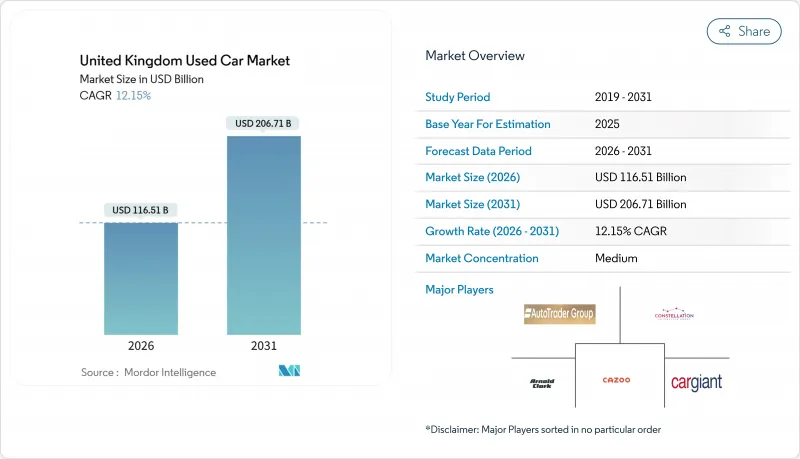
Mordor Intelligence에 의하면, 영국의 중고차 시장 규모는 2026년에 1,165억 1,000만 달러에 달하고, 2031년까지 2,067억 1,000만 달러에 이를 것으로 예상되며, 예측 기간 중 CAGR은 12.15%를 나타낼 것으로 전망됩니다..
본 보고서는 공급업체 유형(조직화·비조직화), 차량 연식(0-2년, 3-5년, 그 이상), 연료 유형(가솔린, 디젤, 기타), 차체 유형(해치백, 세단, 기타), 판매 채널(온라인, 기타),소유 형태(초기 소유자, 기타), 가격대(7,000달러 미만, 기타), 지역별로 분류되어 있습니다. 시장 규모 및 전망은 금액(달러) 및 수량(대)으로 제시되어 있습니다.
영국의 중고차 시장 동향 및 인사이트
온라인 전문 마켓플레이스 및 ‘클릭 앤 딜리버’ 모델의 급속한 확산
Auto Trader는 즉시 제안 도구와 트레이드-인 보장 옵션을 활용하여 개인 판매자의 판매 과정을 효율화함으로써, 마켓플레이스 내 체류 시간을 독점하고 있습니다. Carwow는 딜러 입찰 엔진을 도입하여 소매 재고에 대해 투명성이 높은 경매 형식의 가격 책정을 시행하고 있습니다. 이 전략은 불만 건수가 적어 ‘탑 레이트(Top Rate)’ 배지 인증을 획득할 뿐만 아니라, 디지털 상의 신뢰도 강화로 이어지고 있습니다. Vertu Insights와 같은 실시간 가격 책정 엔진은 재고 회전율을 높이고 이익률을 향상시킵니다. 모바일 중심의 구매자들은 단기간 내 집까지 배송을 기대하게 되었으며, 이로 인해 기존 그룹조차도 옴니채널 접근 방식을 도입하고 있습니다.
ULEZ, ZEZ, 청정 공기 구역이 더 새로운 중고차로의 차량 교체를 가속화
런던의 초저배출구역(ULEZ)은 현재 모든 자치구를 포괄하고 있으며, 2024년 중반까지 규제 준수율을 96%로 높여 구형 엔진을 탑재한 차량 소유주들이 유로 6 기준을 준수하는 중고차로 교체하도록 유도했습니다. 버밍엄, 맨체스터, 그리고 스코틀랜드의 4개 저배출 구역(LEZ)에서 도입된 유사한 청정 공기 과금 제도에서는 일일 요금이 부과되어, 차령 8년 이상의 차량을 운행하는 경제성이 저하되고 있습니다. 그 결과 발생한 수요 변화로 인해 영국의 중고차 시장은 양극화되고 있으며, 규제를 준수하는 가솔린차와 디젤차는 도시 지역에서 프리미엄 가격이 형성되고 있습니다. 반면, 규제를 준수하지 않는 차량은 지방으로 옮겨지거나 폐차되고 있습니다. 이러한 정책의 파급 효과로 인해 거래 회전율이 높아져 비교적 새로운 차량의 잔존 가치가 유지되고 있습니다. 2026년 카디프에 도입될 예정인 구역을 포함한 지역별 확대에 따라, 예측 기간 동안 규제로 인한 호재가 지속될 것으로 전망됩니다.
높은 금리 환경이 구매자의 자금 조달 비용을 상승시키고 있다.
영란은행은 2025년 5월까지 정책 금리를 4.25%로 인하했으나, 신용도가 높은 차주를 대상으로 한 중고차 대출 연이율(APR)은 중간 수준에 머무르는 반면, 서브프라임 계층의 금리는 상당히 높은 수준에 도달할 가능성이 있습니다. 그 결과, 표준 대출의월상환액이 증가하고 있습니다. 금융 및 리스 협회(FLA)는 초보 구매자들이 시장에서 물러나고 있다는 점을 이유로 중고차 대출 취급액이 감소하고 있다고 보고했습니다. 판매를 유지하기 위해 딜러들은 금리 인하분을 부담하고 있으며, 이는 매출 총이익률에 압박 요인이 되고 있습니다. 게다가 구형 내연기관 차량의 네거티브 에퀴티(부정적 자산 가치)로 인해 트레이드인 거래가 더욱 어려워지고 있습니다.
부문별 분석
기존에 지방 상권이나 저가대에서 지배적인 위치를 차지해 온 독립적이고 비조직화된 판매업체들은 2025년 영국의 중고차 시장 규모의 58.23%를 차지했습니다. 그러나 규정 준수 압박이 커짐에 따라 그 시장 점유율은 꾸준히 감소하고 있습니다. Constellation사의 Aston Berkeley사 인수와 관련된 CMA의 2단계 조사는 경매 업계 통합에 대한 규제 당국의 감시가 강화되고 있음을 여실히 보여줍니다. 대형 사업자들은 데이터 분석, 자사 계열 금융, 물류 분야의 규모의 경제를 활용하는 반면, 소규모로 분산된 업체들은 시장 점유율을 잃을 위험이 점점 더 커지고 있습니다.
조직화된 딜러들은 2025년 영국의 중고차 시장 점유율의 41.77%를 차지했으나, 인증 중고차 프로그램과 전국 규모의 디지털 스토어프론트가 신뢰성과 편의성을 높여감에 따라 2031년까지 연평균 성장률(CAGR) 12.82%로 취급 대수를 확대할 것으로 예측됩니다. 이러한 구조적인 호재 덕분에 조직화된 사업자들은 거의 신차와 다름없는 재고를 바탕으로 소규모 경쟁사보다 낮은 가격을 책정하면서도, 금융 및 서비스 관련 부가가치를 수익화할 수 있게 되었습니다.
2025년 영국의 중고차 시장에서 차령 3-5년 차량이 시장 점유율의 34.28%를 차지했으며, 이는 기존의 감가상각에 따른 ‘최적의 시기’를 반영한 것입니다. 그러나 영국의 중고차 시장에서는 차령 0-2년 모델에 대한 수요가 2031년까지 연평균 성장률(CAGR) 12.43%로 가장 빠르게 증가하고 있으며, 이는 단기 주기의 플릿 반납 및 시승차 공급 과잉이 원인으로 작용하고 있습니다.
연식이 새로운 재고는 OEM의 완전 보증 및 인증 프로그램의 대상이 된다는 이점이 있어, 높은 가격 책정과 신속한 회전을 뒷받침하고 있습니다. 대조적으로, 8년 이상 된 차량은 도심 진입료 인상 및 보험료 급등에 직면해 있어, 도심 외곽의 현금 구매자에게는 매력적임에도 불구하고 재판매 가치를 떨어뜨리고 있습니다. 딜러들은 주행 거리가 많은 차량이나 규정을 충족하지 못하는 재고를 수출 시장으로 보내는 경향이 강해지고 있으며, 이를 통해 국내의 잔존 가치를 보호하고 있습니다.
2025년 시점에서도 가솔린 차량은 여전히 영국의 중고차 시장 점유율의 53.34%를 차지했습니다. 그러나 인프라 개선과 보증된 배터리 상태 보고서를 통해 구매자의 불안이 완화됨에 따라 BEV(배터리 전기자동차)는 연평균 성장률(CAGR) 19.23%로 급성장하고 있습니다. 전동 파워트레인을 탑재한 영국의 중고차 시장 규모는 2031년까지 3배 이상으로 늘어날 것으로 예측됩니다.
청정 공기 구역(CAZ)의 과금 제도로 인해 디젤차의 쇠퇴는 가속화되고 있지만, 하이브리드차는 주행 거리나 주유 제약에 대한 대안으로 인기를 얻고 있습니다. 규제가 완화된 지역으로의 디젤차 수출 수요가 국내 가격 하락을 일부 완화하고는 있지만, 장기적인 추세로는 여전히 하락세를 보이고 있습니다.
기타 혜택 :
- 엑셀 형식 시장 예측(ME) 시트
- 3개월간의 애널리스트 지원
자주 묻는 질문
목차
제1장 서론
제2장 조사 방법
제3장 주요 요약
제4장 시장 구도
제5장 시장 규모 및 성장 예측
제6장 경쟁 구도
제7장 시장 기회 및 향후 전망
KTH 26.09.14According to Mordor Intelligence, the United Kingdom used car market size stands at USD 116.51 billion in 2026 and is projected to reach USD 206.71 billion by 2031, translating into a 12.15% CAGR over the forecast period.
This report is Segmented by Vendor Type (Organized and Unorganized), Vehicle Age (0-2 Years, 3-5 Years, and More), Fuel Type (Petrol, Diesel, and More), Body Type (Hatchback, Sedan, and More), and Sales Channel (Online, and More), Ownership (First-Owner, and More), Price Band (Less Than USD 7, 000, and More) and Geography. The Market Sizes and Forecasts are Provided in Terms of Value (USD) and Volume (Units).
United Kingdom Used Car Market Trends and Insights
Rapid Uptake of Online-Only Marketplaces and Click-and-Deliver Models
Auto Trader dominates marketplace browsing time, leveraging instant-offer tools and guaranteed part-exchange options to streamline sales for private sellers. Carwow uses a dealer-bidding engine, introducing transparent auction-style pricing to its retail inventory. This strategy not only earns recognition through Top-Rated badges for low complaint rates but also strengthens digital trust. Real-time pricing engines, such as Vertu Insights, enhance stock turnover and increase profit margins. Mobile-centric buyers now expect home delivery within a short timeframe, prompting even traditional groups to embrace an omnichannel approach.
ULEZ, ZEZ and Clean-Air Zones Accelerating Fleet Turnover Toward Newer Used Cars
London's Ultra-Low Emission Zone now covers every borough, raising compliance to 96% by mid-2024 and pushing owners of older engines to trade into Euro 6-compliant used stock. Similar clean-air charging schemes in Birmingham, Manchester, and Scotland's four Low Emission Zones levy daily fees that erode the economics of running vehicles aged eight years or more. The resulting demand shifts split the United Kingdom's used car market, with compliant petrol and diesel cars attracting urban premiums. At the same time, non-compliant stock is either relocated to rural areas or scrapped. The policy cascade lifts transaction velocity and underpins residual values for younger vehicles. Regional rollouts, including Cardiff's planned 2026 zone, are expected to maintain the regulatory tailwind through the forecast horizon.
High Interest-Rate Environment Raising Finance Costs for Buyers
Although the Bank of England eased the base rate to 4.25% by May 2025, for prime borrowers, used-car APRs hover at moderate levels, while subprime rates can reach significantly higher percentages . This results in an increase in monthly costs on standard loans. The Finance & Leasing Association has reported a decline in used-car finance volumes, citing the exit of entry-level buyers from the market. To sustain sales, dealers are absorbing rate buy-downs, which in turn pressures their gross margins. Additionally, negative equity on older ICE vehicles is making trade-ins more challenging.
Other drivers and restraints analyzed in the detailed report include:
- OEM-Backed Certified Pre-Owned Programs Boost Buyer Trust and Prices
- Attractive Residual-Value Guarantees on Used BEVs and Hybrids
- Used-Car Prices Surge as New-Car Output Faces Crunch
For complete list of drivers and restraints, kindly check the Table Of Contents.
Segment Analysis
Independent, unorganized vendors, traditionally dominant in rural catchments and lower price bands, accounted for 58.23% of the United Kingdom's used car market size in 2025. However, their market share is steadily declining due to increasing compliance pressures. The CMA's Phase 2 investigation into Constellation's acquisition of Aston Barclay underscores the increasing regulatory scrutiny of auction consolidations. Larger players leverage scale advantages in data analytics, captive finance, and logistics, leaving smaller, fragmented traders increasingly at risk of losing market share.
Organized dealers captured 41.77% of the United Kingdom's used car market share in 2025; yet, the group is expected to add volume at a 12.82% CAGR through 2031, as certified-pre-owned schemes and nationwide digital storefronts build trust and convenience. This structural tailwind positions organized operators to undercut smaller rivals on nearly-new stock while monetizing finance and service add-ons.
Vehicles aged 3-5 years accounted for 34.28% of the United Kingdom used car market share in 2025, reflecting the traditional depreciation "sweet spot." However, the United Kingdom used car market demand for 0-2 year models is rising fastest at a 12.43% CAGR through 2031, driven by short-cycle fleet returns and demonstrator oversupply.
Younger inventory benefits from full OEM warranty and eligibility for certified programs, supporting premium pricing and faster turns. In contrast, cars older than eight years face mounting urban access fees and higher insurance costs, which suppress their resale values despite their appeal to cash buyers outside city centers. Dealers are increasingly channeling high-mileage or non-compliant stock to export markets, thereby protecting domestic residuals.
Petrol cars still led the United Kingdom's used car market share in 2025, with 53.34%. Yet, BEVs are sprinting ahead with a 19.23% CAGR as infrastructure improves and warranty-supported battery health reports reduce buyer anxiety. The United Kingdom used car market size tied to electrified powertrains is expected to more than triple by 2031.
Diesel's retreat quickens under Clean-Air Zone charges, while hybrids enjoy a hedge against range and refueling constraints. Export demand for diesel units to less-regulated regions partly cushions domestic price falls, but the long-term trajectory remains downward.
Complete Report Scope:
- By Vendor Type
- Organized
- Unorganized
- By Vehicle Age
- 0 - 2 Years
- 3 - 5 Years
- 6 - 8 Years
- More than 8 Years
- By Fuel Type
- Petrol
- Diesel
- Hybrid
- Battery Electric
- Plug-in Hybrid
- Other Alt-Fuels (CNG/LPG)
- By Body Type
- Hatchback
- Sedan
- Sport Utility Vehicle (SUV)
- Multi-Purpose Vehicle (MPV)
- By Sales Channel
- Online
- Offline - Franchised Dealers
- Offline - Independent Dealers
- Private-to-Private
- By Ownership Type
- First-Owner
- Second-Owner
- Third-or-More Owners
- By Price Band
- Less than USD 7,000
- USD 7,001 - USD 15,000
- USD 15,000 - USD 30,000
- More than 30,000
- By Region
- England
- Scotland
- Wales
- Northern Ireland
List of Companies Covered in this Report:
- Auto Trader Group plc
- Constellation Automotive Group Ltd
- Arnold Clark Automobiles Ltd
- Cazoo Group Ltd
- Car Giant Ltd
- Lookers plc
- Pendragon plc (CarStore)
- Vertu Motors plc
- Motorpoint Group plc
- Manheim (Cox Automotive U.K.)
- Sytner Group Ltd
- Inchcape plc
- TrustFord (Ford Retail Ltd)
- Jardine Motors Group U.K. Ltd
- AvailableCar Ltd
- Carwow Ltd
- Motors.co.uk Ltd
- Aramis Group
- Peter Vardy Ltd
Additional Benefits:
- The market estimate (ME) sheet in Excel format
- 3 months of analyst support
TABLE OF CONTENTS
1 Introduction
- 1.1 Study Assumptions & Market Definition
- 1.2 Scope of the Study
2 Research Methodology
3 Executive Summary
4 Market Landscape
- 4.1 Market Overview
- 4.2 Market Drivers
- 4.2.1 ULEZ, ZEZ and Clean-Air Zones Accelerating Fleet Turnover Toward Newer Used Cars
- 4.2.2 OEM-Backed Certified-Pre-Owned Programs Boosting Buyer Trust and Prices
- 4.2.3 Rapid Uptake of Online-Only Marketplaces and Click-and-Deliver Models in the U.K.
- 4.2.4 Subscription-Based Used-Car Schemes Increasing Repeat Demand Cycles
- 4.2.5 Attractive Residual-Value Guarantees on Used BEVs and Hybrids
- 4.2.6 Insurance Telematics Making Older Vehicles Less Cost-Competitive
- 4.3 Market Restraints
- 4.3.1 High Interest-Rate Environment Raising Finance Costs for Used-Car Buyers
- 4.3.2 Used-Car Prices Surge as New-Car Output Faces Crunch
- 4.3.3 ICE Faces Residual-Value Uncertainty Ahead of Upcoming Petrol/Diesel Ban
- 4.3.4 Data-Privacy Concerns Around Connected-Car Ownership Transfers
- 4.4 Value / Supply-Chain Analysis
- 4.5 Regulatory Outlook
- 4.6 Technological Outlook
- 4.7 Porter's Five Forces
- 4.7.1 Threat of New Entrants
- 4.7.2 Bargaining Power of Buyers
- 4.7.3 Bargaining Power of Suppliers
- 4.7.4 Threat of Substitutes
- 4.7.5 Competitive Rivalry
5 Market Size and Growth Forecasts (Value (USD), Volume (Units))
- 5.1 By Vendor Type
- 5.1.1 Organized
- 5.1.2 Unorganized
- 5.2 By Vehicle Age
- 5.2.1 0 - 2 Years
- 5.2.2 3 - 5 Years
- 5.2.3 6 - 8 Years
- 5.2.4 More than 8 Years
- 5.3 By Fuel Type
- 5.3.1 Petrol
- 5.3.2 Diesel
- 5.3.3 Hybrid
- 5.3.4 Battery Electric
- 5.3.5 Plug-in Hybrid
- 5.3.6 Other Alt-Fuels (CNG/LPG)
- 5.4 By Body Type
- 5.4.1 Hatchback
- 5.4.2 Sedan
- 5.4.3 Sport Utility Vehicle (SUV)
- 5.4.4 Multi-Purpose Vehicle (MPV)
- 5.5 By Sales Channel
- 5.5.1 Online
- 5.5.2 Offline - Franchised Dealers
- 5.5.3 Offline - Independent Dealers
- 5.5.4 Private-to-Private
- 5.6 By Ownership Type
- 5.6.1 First-Owner
- 5.6.2 Second-Owner
- 5.6.3 Third-or-More Owners
- 5.7 By Price Band
- 5.7.1 Less than USD 7,000
- 5.7.2 USD 7,001 - USD 15,000
- 5.7.3 USD 15,000 - USD 30,000
- 5.7.4 More than 30,000
- 5.8 By Region
- 5.8.1 England
- 5.8.2 Scotland
- 5.8.3 Wales
- 5.8.4 Northern Ireland
6 Competitive Landscape
- 6.1 Market Concentration
- 6.2 Strategic Moves
- 6.3 Market Share Analysis
- 6.4 Company Profiles (Includes Global-level Overview, Market-level Overview, Core Segments, Financials as available, Strategic Information, Market Rank/Share, Products & Services, Recent Developments)
- 6.4.1 Auto Trader Group plc
- 6.4.2 Constellation Automotive Group Ltd
- 6.4.3 Arnold Clark Automobiles Ltd
- 6.4.4 Cazoo Group Ltd
- 6.4.5 Car Giant Ltd
- 6.4.6 Lookers plc
- 6.4.7 Pendragon plc (CarStore)
- 6.4.8 Vertu Motors plc
- 6.4.9 Motorpoint Group plc
- 6.4.10 Manheim (Cox Automotive U.K.)
- 6.4.11 Sytner Group Ltd
- 6.4.12 Inchcape plc
- 6.4.13 TrustFord (Ford Retail Ltd)
- 6.4.14 Jardine Motors Group U.K. Ltd
- 6.4.15 AvailableCar Ltd
- 6.4.16 Carwow Ltd
- 6.4.17 Motors.co.uk Ltd
- 6.4.18 Aramis Group
- 6.4.19 Peter Vardy Ltd


