

|
시장보고서
상품코드
2154391
대체연료 및 원료(AFR)용 폐기물 전처리 : 시장 점유율 분석, 업계 동향과 통계, 성장 예측(2026-2031년)Waste Pre-processing For Alternate Fuel and Raw Materials (AFR) - Market Share Analysis, Industry Trends & Statistics, Growth Forecasts (2026 - 2031) |
||||||
 Mordor Intelligence
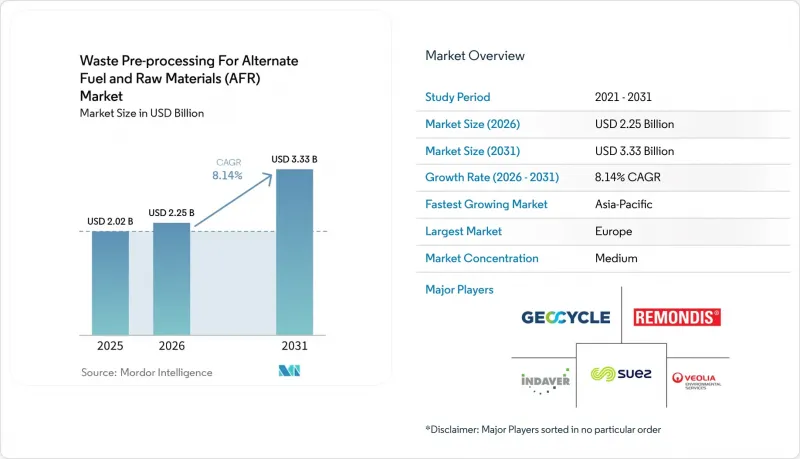
에 따르면 대체연료 및 원재료용 폐기물 전처리 시장 규모는 2025년 20억 2,000만 달러에서 2026년에는 22억 5,000만 달러로 확대하며, 2031년까지 33억 3,000만 달러에 달할 것으로 전망되고 있으며, 2026-2031년에 걸친 CAGR은 8.14%에 달할 전망입니다.
대체 연료 및 원자재(AFR)용 폐기물 전처리 시장의 글로벌 동향 및 인사이트
화석 연료 대체 및 시멘트의 탈탄소화
시멘트 생산시 발생하는 배출량의 30%는 연료 연소에서 비롯되며, 연료 대체는 시멘트 공장에 있으며, 직접적인 운영상의 최우선 과제입니다. 공장이 불규칙한 폐기물 반입 대신 설계된 연료를 필요로 하는 경우, 대체 연료 및 원료용 폐기물 전처리 시장은 그 혜택을 받게 됩니다. GCCA에 따르면 연료의 품질 요건에는 현재 발열량, 알칼리분, 염화물 함량 제한 및 수분 관리가 포함됩니다. 하이델베르크 매트리얼즈는 대체 연료 사용률을 50% 이상으로 높이는 목표를 설정하고, 클링커 공장의 30% 이상에서 AFR 사용률을 최소 45%로 끌어올릴 계획입니다. 이러한 목표에 따라 일관된 사양의 고발열량 고형 회수 연료를 공급할 수 있는 공급업체에 대한 수요가 발생하고 있습니다. 또한 공급 및 계량 설비에 대한 투자는 일회성 폐기물 거래가 아닌, 수년에 걸친 계약 관계를 촉진하고 있습니다.
매립 폐기물 감축 및 순환형 경제 의무화
유럽의 매립 규제로 인해 더 많은 잔여물이 회수 및 공동 처리 경로로 유도되고 있습니다. ‘폐기물 기본 지침’은 예방, 재사용, 재활용, 회수, 처분의 순서로 지원하고 있습니다. 매립 처분이 더욱 제한됨에 따라 대체 연료 및 원자재 시장을 위한 폐기물 전처리는 지역 차원에서 더 많은 처리량을 확보하게 될 것입니다. 규정 2026/1703은 회수를 목적으로 한 혼합 도시 폐기물의 수출을 제한하고 있으며, 이로 인해 잔여물의 해외 배출처가 줄어들고 있습니다. 또한 프랑스에서는 2025년까지 고형 재생 연료(SRF) 생산에 관한 요건이 개정되었습니다. 이러한 규제는 처리가 어려운 도시 쓰레기와 산업 폐기물을 기준을 충족하는 연료로 전환할 수 있는 시설을 장려하는 것입니다. 경쟁적인 처분 경로의 비용 상승으로 인해 저발열량의 슬러지나 건설 잔재물을 처리하는 경제성이 향상될 가능성이 있습니다. 이에 따라 기술적인 관리 체제가 갖춰져 있다면, 대체 연료나 원자재 시장을 위한 폐기물 전처리에 투입할 수 있는 재료의 범위가 넓어집니다.
원료의 편차와 소성로 안정성 위험
수분, 발열량 및 회분 성분이 변동하면 잔여 폐기물이 메인 버너의 연료 요건을 충족하지 못할 가능성이 있습니다. 가마 버너 기술에 관한 조사에 따르면 메인 버너에서 안정적인 연소를 위해서는 수분 함량이 10% 미만이어야 한다고 합니다. 수분 함량이 높은 연료는 칼시네이터의 안정성을 저해하고 클링커의 불균일한 연소를 유발할 수 있습니다. 이 때문에 많은 도시 고형 폐기물 및 농업 잔여물 처리 공정에서 건조 및 수분 조절이 필요합니다. 바이오 건조나 열 건조 설비를 갖추지 않은 사업자는 대체 연료 및 원자재 시장을 겨냥한 폐기물 전처리 과정에서 고품질 연료 공급 계약을 확보하는 데 있으며, 경쟁력이 떨어집니다. 품질관리가 더욱 엄격해져야 하므로, 반입되는 재료의 성분이 변화할 경우 이익률이 압박받을 가능성이 있습니다.
부문 분석
2025년 시점에 도시 고형 폐기물은 대체 연료 및 원자재용 폐기물 전처리 시장 점유율의 33.4%를 차지했습니다. 그 방대한 처리량과 도시 수거 시스템과의 근접성 덕분에, 처리 시설을 도시 폐기물 흐름 근처에 설치할 수 있게 되었습니다. 산업 폐기물 및 상업 폐기물은 그 성분이 더 균일하고 오염이 적은 경우가 많기 때문에 여전히 유용한 원료로 활용되고 있습니다. 이러한 균일성 덕분에 고발열량의 고형 회수 연료를 제조하는 데 필요한 처리 공정을 줄일 수 있습니다. 건설·해체 목재는 시멘트 가마용 펠릿 원료로 부상하고 있습니다. 건설·해체 재활용 협회(CDRA)는 2025-2026년에 미국 시멘트 협회(ACA) 및 미국 환경보호청(EPA)과 협력하여, 청정 셀룰로오스계 바이오매스를 무해한 2차 자재로 분류하는 방안을 검토했습니다. 폐타이어는 파쇄 및 철분 제거 과정을 거친 후에도 석탄에 가까운 발열량을 유지합니다. 하수 슬러지는 혼소에 적합한 에너지 밀도에 도달하기 위해 바이오 건조가 필요합니다. 이러한 원료는 안정적인 수요를 가져오지만, 바이오매스 잔여물에 비해 성장 전망은 낮은 편입니다.
바이오매스 및 농업 폐기물을 대상으로 한 대체 연료·원료용 폐기물 전처리 시장 규모는 2031년까지 연평균 성장률(CAGR) 9.3%로 확대될 것으로 예측됩니다. 농업 잔여물은 아시아태평양 및 라틴아메리카의 시멘트 제조업체에게 원료 기반을 확대할 가능성을 제공합니다. 2025년 연구에 따르면 바이오매스 및 농업 유래 연료는 석탄 에너지 함량의 최대 70%를 공급할 수 있으며, 시험 조건 하에서는 HCl 및 다이옥신 배출량이 적은 것으로 나타났습니다. 홀심 멕시코는 2026년 8월 콜리마주에서 바이오매스 시설 가동을 시작했습니다. 이 시설에서는 하루 220톤의 사탕수수 바가스(바가스)를 가마에서 회수한 열로 건조한 후, 분쇄하여 혼소에 사용하고 있습니다. 중국의 T/CIECCPA 129-2026 규격은 시멘트 가마에서 사용되는 바이오매스 연료의 열량, 수분, 회분 조성 및 입자 직경에 관한 요건을 규정하고 있습니다. 이러한 요건은 농업 원료의 계절적 변동에 대응할 수 있는 시설을 우대하는 것입니다. 또한 미처리 잔여물의 공급이 아닌, 가공된 연료의 사양에 부합하는 바이오매스 공급으로 전환하는 효과도 있습니다.
지역별 분석
2025년, 대체 연료 및 원료용 폐기물 전처리 시장 점유율 중 유럽이 37.4%를 차지했습니다. 이 지역에서는 폐기물 공동 처리에 관한 규정과 상업적 합의가 확립되어 있습니다. 규정 2026/1703은 회수를 목적으로 한 혼합 도시 폐기물의 수출을 제한하고, 잔여물을 국내 판매 채널로 전환하도록 규정하고 있습니다. 오스트리아, 벨기에, 독일은 시멘트 대체율이 가장 높은 국가들 중 일부입니다. 폴란드, 스페인, 이탈리아는 유럽의 대체 연료 이용률 평균인 58%에 미치지 못해, 새로운 처리 능력을 도입할 여지가 남아 있습니다. Paprec사와 Vicat사는 2026년 7월 프랑스에서 1,540만 유로를 투자해 ‘ALTereNATIVE’ 공장을 개장했습니다. 이 시설은 처리 능력과 지역내 시멘트 구매자를 연결하는 지역적 공급망 모델을 구현하고 있습니다.
아시아태평양은 2031년까지 연평균 성장률(CAGR) 9.5%로 성장할 것으로 예측됩니다. 대체 연료 및 원료용 폐기물 전처리 시장은 중국, 인도, 인도네시아, 베트남의 폐기물량 증가와 시멘트 생산 능력 확대에 힘입고 있으나, 공급 품질은 여전히 현지 수거·분리 시스템에 의존하고 있습니다. KHD사는 2025년 12월 콘치 그룹의 바오산 공장에서 두 번째 ‘Pyrorotor’ 시스템의 가동을 시작했습니다. 이 설비는 높은 수분 조건에서 바이오매스 및 도시 고형 폐기물을 시간당 18톤 처리합니다. 인도네시아의 폐기물 에너지화 프로젝트 추진 계획은 전처리된 연료에 필요한 공식적인 인프라 확충으로 이어질 수 있습니다. 인도에서는 매일 15만 톤의 도시 고형 폐기물이 발생하고 있지만, 분리 수거 체계의 미비나 원료 품질의 편차로 인해 단기적인 시멘트 활용은 제한되고 있습니다. 이 지역의 비즈니스 기회는 원료가 시멘트 공장으로 반입되기 전의 수거, 선별, 품질관리 개선에 달려 있습니다.
남미, 중동 및 아프리카는 규모는 작지만 의미 있는 잠재력을 지닌 지역입니다. 지오사이클(GeoCycle)사는 2030년까지 라틴아메리카에 1억 2,500만 달러를 투자할 계획이며, 2025년에는 14개 시설이 총 약 100만 톤의 폐기물을 처리할 전망입니다. 이 모델은 시멘트 사업과 폐기물 처리를 단일 공급망 내에 통합한 것입니다. 사우디아라비아와 아랍에미리트(UAE)는 ‘시멘트·콘크리트 혁신 구상(Cement Concrete Breakthrough Initiative)’를 통해 대체 연료로서의 폐기물을 지원하는 정책 체계를 추진하고 있습니다. 모로코 역시 시멘트 생산량과 도시 고형 폐기물 발생량이 증가하고 있으며, 잠재적인 가능성을 지니고 있습니다. 조사에 따르면 현지에서 조달한 농업 폐기물 재를 활용함으로써 아프리카 시멘트의 탄소발자국을 최대 40%까지 줄일 수 있는 것으로 밝혀졌습니다. 이를 통해 향후 프로젝트에서 연료 준비와 대체 원료 활용을 연계하는 것이 가능해집니다.
기타 혜택:
- 엑셀 형식의 시장 예측(ME) 시트
- 3개월간의 애널리스트 지원
자주 묻는 질문
목차
제1장 서론
- 조사 전제조건과 시장 정의
- 조사 범위
제2장 조사 방법
제3장 개요
제4장 시장 구도
- 시장 개요
- 시장 성장 촉진요인
- 시장 성장 억제요인
- 공급망 분석
- Porter's Five Forces 분석
- 기술 동향
- 규제 상황
- 투자 분석
제5장 시장 규모와 성장 예측
- 폐기물 유형별
- 전처리 기술별
- 지역별
- 북미
- 미국
- 캐나다
- 멕시코
- 유럽
- 독일
- 프랑스
- 이탈리아
- 스페인
- 영국
- 폴란드
- 러시아
- 기타 유럽 국가
- 아시아태평양
- 중국
- 인도
- 일본
- 한국
- 호주
- 인도네시아
- 베트남
- 태국
- 기타 아시아태평양 국가
- 남미
- 브라질
- 아르헨티나
- 칠레
- 기타 남미 국가
- 중동 및 아프리카
- 사우디아라비아
- 아랍에미리트
- 이집트
- 남아프리카공화국
- 모로코
- 기타 중동 및 아프리카 국가
- 북미
제6장 경쟁 구도
- 시장 집중도
- 전략적 동향
- 시장 점유율 분석
- 기업 개요
- Andusia Holdings Limited
- Beauparc Utilities Holdings Limited
- Biffa plc
- CEMEX, S.A.B. de C.V.
- EEW Energy from Waste GmbH
- Enva Group Limited
- FCC Environment(UK) Limited
- Geminor AS
- Geocycle(Deutschland) GmbH
- Heidelberg Materials AG
- Holcim Ltd.
- Indaver NV
- Paprec Group S.A.S.(Paprec)
- PreZero International GmbH
- Ragn-Sells AB
- REMONDIS SE & Co. KG
- Renewi plc(Renewi)
- SUEZ S.A.
- Veolia Environnement SA
- Vicat SA
제7장 시장 기회와 향후 전망
KSAAccording to Mordor Intelligence, the waste pre-processing for alternate fuel and raw materials market size is expected to increase from USD 2.02 billion in 2025 to USD 2.25 billion in 2026 and reach USD 3.33 billion by 2031, at a CAGR of 8.14% over 2026-2031.
Global Waste Pre-processing For Alternate Fuel and Raw Materials (AFR) Market Trends and Insights
Fossil-Fuel Substitution and Cement Decarbonization
Fuel combustion accounted for 30% of cement production emissions, making fuel replacement a direct operating priority for cement plants. The waste pre-processing for alternative fuels and raw materials market benefits when plants require engineered fuels instead of irregular waste deliveries. The GCCA states that fuel quality requirements now address calorific value, alkali content, chloride limits, and moisture control. Heidelberg Materials set a target above 50% for alternative fuel use and plans for more than 30% of its clinker plants to achieve at least 45% AFR use. These targets create demand for suppliers that can provide high-calorific solid recovered fuel at consistent specifications. Investment in feeding and dosing equipment also supports multi-year arrangements rather than one-time waste transactions.
Landfill Diversion and Circular-Economy Mandates
Europe's landfill rules are directing more residual material toward recovery and co-processing routes. The Waste Framework Directive supports prevention, reuse, recycling, recovery, and disposal in that order. The waste pre-processing for alternative fuels and raw materials market gains access to larger local volumes when landfilling becomes more restricted. Regulation 2026/1703 restricts exports of mixed municipal waste for recovery, which reduces overseas outlets for residual waste. France also updated requirements related to solid recovered fuel production during 2025. These rules encourage facilities that can turn difficult municipal and industrial streams into compliant fuels. Higher costs for competing disposal routes can improve the economics of processing lower-calorific sludge and construction residues. This increases the range of materials that can enter the waste pre-processing for alternative fuels and raw materials market when technical controls are in place.
Feedstock Variability and Kiln-Stability Risk
Variable moisture, calorific value, and ash composition can prevent residual waste from meeting main-burner fuel requirements. Research on kiln burner technology identifies moisture below 10% as necessary for stable main-burner combustion. High-moisture fuel can destabilize the calciner and cause uneven clinker burning. This makes drying and moisture conditioning necessary for many municipal solid waste and agricultural residue streams. Operators without biodrying or thermal drying equipment are less able to compete for premium fuel contracts in the waste pre-processing for alternative fuels and raw materials market. The need for tighter quality control can narrow margins when incoming materials change in composition.
Other drivers and restraints analyzed in the detailed report include:
- Demand for Consistent High-Calorific Fuels and Energy Recovery Capacity
- AI-Enabled Sorting, Traceability, and Alternative Raw Materials Integration
- High Pre-Processing Capital, Logistics, and Compliance Costs
For complete list of drivers and restraints, kindly check the Table Of Contents.
Segment Analysis
Municipal solid waste held 33.4% of the waste pre-processing for alternative fuels and raw materials market share in 2025. Its large volume and proximity to urban collection systems support the location of processing facilities near municipal waste flows. Industrial and commercial waste remains a useful input because its composition is often more uniform and less contaminated. That uniformity can reduce the processing steps needed to produce higher-calorific solid recovered fuel. Construction and demolition wood is emerging as a pellet feedstock for cement kilns. The Construction and Demolition Recycling Association worked with the American Cement Association and the EPA during 2025 and 2026 on non-hazardous secondary material classification for clean cellulosic biomass. Waste tires retain a heat value near that of coal after shredding and steel separation. Sewage sludge requires biodrying to reach an energy density suitable for co-firing. These inputs provide stable demand but have lower projected growth than biomass residues.
The waste pre-processing for alternative fuels and raw materials market size for biomass and agricultural waste is projected to grow at a 9.3% CAGR through 2031. Agricultural residues can broaden the feedstock base for cement producers in Asia-Pacific and Latin America. A 2025 study found that biomass and agricultural fuels could provide up to 70% of coal's energy content and showed low HCl and dioxin emissions under the tested conditions. Holcim Mexico commissioned a biomass facility in Colima during August 2026. The facility dries 220 tonnes per day of sugar bagasse with recovered kiln heat before grinding it for co-firing. China's T/CIECCPA 129-2026 standard sets requirements for calorific value, moisture, ash composition, and particle size for biomass fuels used in cement kilns. Such requirements favor facilities that can manage seasonal variation in agricultural inputs. They also shift biomass supply toward engineered fuel specifications rather than untreated residue delivery.
Complete Report Scope:
- By Waste Type
- Municipal Solid Waste (MSW)
- Industrial Waste
- Commercial Waste
- Construction and Demolition Waste
- Sewage Sludge
- Waste Tires
- Biomass and Agricultural Waste
- Other Waste Types
- By Pre-processing Technology
- Mechanical Sorting and Segregation
- Shredding and Size Reduction
- Screening and Classification
- Magnetic and Eddy-Current Separation
- Air and Ballistic Separation
- Optical and Sensor-Based Sorting
- Mechanical-Biological Treatment and Biodrying
- Drying and Moisture Conditioning
- Others
- By Geography
- North America
- United States
- Canada
- Mexico
- Europe
- Germany
- France
- Italy
- Spain
- United Kingdom
- Poland
- Russia
- Rest of Europe
- Asia-Pacific
- China
- India
- Japan
- South Korea
- Australia
- Indonesia
- Vietnam
- Thailand
- Rest of Asia-Pacific
- South America
- Brazil
- Argentina
- Chile
- Rest of South America
- Middle East and Africa
- Saudi Arabia
- United Arab Emirates
- Egypt
- South Africa
- Morocco
- Rest of Middle East and Africa
- North America
Geography Analysis
Europe accounted for 37.4% of the waste pre-processing for alternative fuels and raw materials market share in 2025. The region has established rules and commercial arrangements for waste co-processing. Regulation 2026/1703 restricts mixed municipal waste exports for recovery and redirects residual material to domestic outlets. Austria, Belgium, and Germany have some of the highest cement substitution rates. Poland, Spain, and Italy remain below Europe's 58% average alternative fuel rate, leaving room for new processing capacity. Paprec and Vicat opened the EUR 15.4 million ALTereNATIVE plant in France during July 2026. The facility illustrates the regional supply-chain model that links processing capacity with a local cement offtaker.
Asia-Pacific is projected to grow at a 9.5% CAGR through 2031. The waste pre-processing for alternative fuels and raw materials market is supported by increasing waste volumes and cement capacity across China, India, Indonesia, and Vietnam, although supply quality still depends on local collection and segregation systems. KHD commissioned a second Pyrorotor system at Conch Group's Baoshan plant during December 2025. The installation processes shredded biomass and municipal solid waste at 18 tonnes per hour under high-moisture conditions. Indonesia's program for waste-to-energy projects can expand the formal infrastructure needed for prepared fuels. India generates 150,000 tonnes of municipal solid waste each day, but segregation gaps and variable feedstock quality limit near-term cement use. The region's opportunity depends on improving collection, sorting, and quality control before material reaches cement plants.
South America and the Middle East and Africa are smaller regions with meaningful potential. Geocycle planned USD 125 million of Latin American investment through 2030, supported by 14 facilities that processed nearly 1 million tonnes of waste during 2025. This model combines cement operations and waste processing within one supply chain. Saudi Arabia and the UAE support policy frameworks for waste as an alternative fuel through the Cement and Concrete Breakthrough initiative. Morocco also offers potential as cement production and municipal solid waste volumes grow. Research found that locally sourced agricultural waste ashes could reduce the carbon footprint of African cement by up to 40%. This can link fuel preparation with alternative raw material use in future projects.
- Andusia Holdings Limited
- Beauparc Utilities Holdings Limited
- Biffa plc
- CEMEX, S.A.B. de C.V.
- EEW Energy from Waste GmbH
- Enva Group Limited
- FCC Environment (UK) Limited
- Geminor AS
- Geocycle (Deutschland) GmbH
- Heidelberg Materials AG
- Holcim Ltd.
- Indaver NV
- Paprec Group S.A.S. (Paprec)
- PreZero International GmbH
- Ragn-Sells AB
- REMONDIS SE & Co. KG
- Renewi plc (Renewi)
- SUEZ S.A.
- Veolia Environnement SA
- Vicat SA
Additional Benefits:
- The market estimate (ME) sheet in Excel format
- 3 months of analyst support
TABLE OF CONTENTS
1 INTRODUCTION
- 1.1 Study Assumptions and Market Definition
- 1.2 Scope of the Study
2 RESEARCH METHODOLOGY
3 EXECUTIVE SUMMARY
4 MARKET LANDSCAPE
- 4.1 Market Overview
- 4.2 Market Drivers
- 4.2.1 Fossil-Fuel Substitution and Cement Decarbonization
- 4.2.2 Landfill Diversion and Circular-Economy Mandates
- 4.2.3 Demand for Consistent High-Calorific Fuels
- 4.2.4 Expansion of Waste-to-Energy and CHP Capacity
- 4.2.5 AI-Enabled Sorting and Digital Fuel Traceability
- 4.2.6 Integration of Alternative Raw Materials With Fuel Pre-Processing
- 4.3 Market Restraints
- 4.3.1 Feedstock Variability and Kiln-Stability Risk
- 4.3.2 High Pre-Processing Capital and Logistics Costs
- 4.3.3 Competition for High-Calorific Residual Waste
- 4.3.4 Fragmented Permitting and Cross-Border Waste Rules
- 4.4 Supply-Chain Analysis
- 4.5 Porter's Five Forces Analysis
- 4.5.1 Bargaining Power of Suppliers
- 4.5.2 Bargaining Power of Buyers
- 4.5.3 Threat of New Entrants
- 4.5.4 Threat of Substitutes
- 4.5.5 Competitive Rivalry
- 4.6 Technology Outlook
- 4.7 Regulatory Landscape
- 4.8 Investment Analysis
5 MARKET SIZE AND GROWTH FORECASTS
- 5.1 By Waste Type
- 5.1.1 Municipal Solid Waste (MSW)
- 5.1.2 Industrial Waste
- 5.1.3 Commercial Waste
- 5.1.4 Construction and Demolition Waste
- 5.1.5 Sewage Sludge
- 5.1.6 Waste Tires
- 5.1.7 Biomass and Agricultural Waste
- 5.1.8 Other Waste Types
- 5.2 By Pre-processing Technology
- 5.2.1 Mechanical Sorting and Segregation
- 5.2.2 Shredding and Size Reduction
- 5.2.3 Screening and Classification
- 5.2.4 Magnetic and Eddy-Current Separation
- 5.2.5 Air and Ballistic Separation
- 5.2.6 Optical and Sensor-Based Sorting
- 5.2.7 Mechanical-Biological Treatment and Biodrying
- 5.2.8 Drying and Moisture Conditioning
- 5.2.9 Others
- 5.3 By Geography
- 5.3.1 North America
- 5.3.1.1 United States
- 5.3.1.2 Canada
- 5.3.1.3 Mexico
- 5.3.2 Europe
- 5.3.2.1 Germany
- 5.3.2.2 France
- 5.3.2.3 Italy
- 5.3.2.4 Spain
- 5.3.2.5 United Kingdom
- 5.3.2.6 Poland
- 5.3.2.7 Russia
- 5.3.2.8 Rest of Europe
- 5.3.3 Asia-Pacific
- 5.3.3.1 China
- 5.3.3.2 India
- 5.3.3.3 Japan
- 5.3.3.4 South Korea
- 5.3.3.5 Australia
- 5.3.3.6 Indonesia
- 5.3.3.7 Vietnam
- 5.3.3.8 Thailand
- 5.3.3.9 Rest of Asia-Pacific
- 5.3.4 South America
- 5.3.4.1 Brazil
- 5.3.4.2 Argentina
- 5.3.4.3 Chile
- 5.3.4.4 Rest of South America
- 5.3.5 Middle East and Africa
- 5.3.5.1 Saudi Arabia
- 5.3.5.2 United Arab Emirates
- 5.3.5.3 Egypt
- 5.3.5.4 South Africa
- 5.3.5.5 Morocco
- 5.3.5.6 Rest of Middle East and Africa
- 5.3.1 North America
6 COMPETITIVE LANDSCAPE
- 6.1 Market Concentration
- 6.2 Strategic Moves
- 6.3 Market Share Analysis
- 6.4 Company Profiles (includes Global Level Overview, Market Level Overview, Core Segments, Financials as available, Strategic Information, Products and Services, Recent Developments)
- 6.4.1 Andusia Holdings Limited
- 6.4.2 Beauparc Utilities Holdings Limited
- 6.4.3 Biffa plc
- 6.4.4 CEMEX, S.A.B. de C.V.
- 6.4.5 EEW Energy from Waste GmbH
- 6.4.6 Enva Group Limited
- 6.4.7 FCC Environment (UK) Limited
- 6.4.8 Geminor AS
- 6.4.9 Geocycle (Deutschland) GmbH
- 6.4.10 Heidelberg Materials AG
- 6.4.11 Holcim Ltd.
- 6.4.12 Indaver NV
- 6.4.13 Paprec Group S.A.S. (Paprec)
- 6.4.14 PreZero International GmbH
- 6.4.15 Ragn-Sells AB
- 6.4.16 REMONDIS SE & Co. KG
- 6.4.17 Renewi plc (Renewi)
- 6.4.18 SUEZ S.A.
- 6.4.19 Veolia Environnement SA
- 6.4.20 Vicat SA
7 MARKET OPPORTUNITIES AND FUTURE OUTLOOK
- 7.1 White-Space and Unmet-Need Assessment


