

|
시장보고서
상품코드
2154392
WtE(Waste-to-Energy) 플랜트 원료 : 시장 점유율 분석, 업계 동향과 통계, 성장 예측(2026-2031년)Waste-to-Energy (WtE) Plant Feedstock - Market Share Analysis, Industry Trends & Statistics, Growth Forecasts (2026 - 2031) |
||||||
 Mordor Intelligence
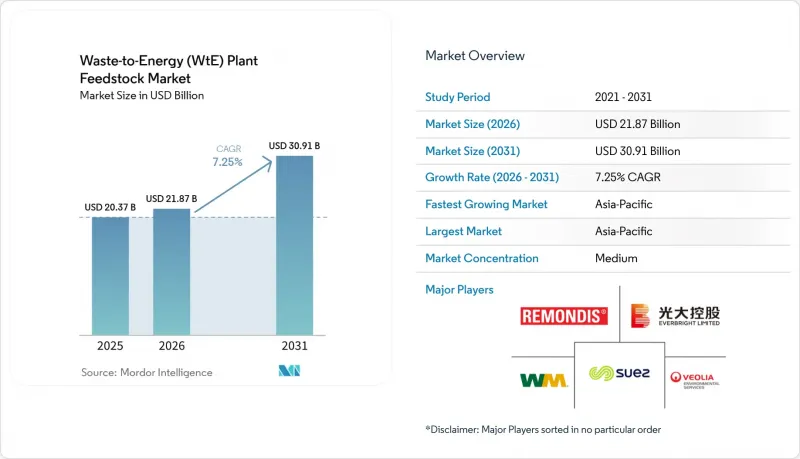
에 따르면 폐기물 에너지화 플랜트 원료 시장 규모는 2025년 203억 7,000만 달러에서 2026년에는 218억 7,000만 달러로 확대하며, 2026-2031년에 CAGR 7.25%로 추이하며, 2031년에는 309억 1,000만 달러에 달할 것으로 예측됩니다.
전 세계 폐기물 에너지화(WtE) 플랜트용 원료 시장의 동향 및 인사이트
매립 폐기물 감축 의무와 지자체의 처리 능력 부족
매립 규제로 인해 원료 확보는 지자체 당국에게 규정 준수상 과제가 되고 있습니다. 지자체가 유기물을 분리 수거하거나 잔여 폐기물을 전용해야 하는 경우, 폐기물 에너지화 플랜트의 원료 시장은 보다 예측 가능한 공급량을 확보할 수 있게 됩니다. 캘리포니아주의 AB-70 법안은 2025-2026년 회기 중에 심의가 진행되고 있으며, 2027년 1월까지 재활용된 유기 폐기물 유래의 파이프라인용 바이오메탄을 규제 대상에 포함시키는 것이 의무화될 전망입니다. 플로리다주의 2025년 제정법에서는 폐기물 집적을 지원하는 인프라를 포함하여, 도시 고형 폐기물 에너지화 프로젝트에 대한 보조금 및 재정 지원이 허용되고 있습니다. 뉴저지주는 2025년 8월, 지정 발생자에 의한 발생원별 분리 수거를 의무화하고, 적격 물질을 허가를 받은 시설로 유도하는 식품 폐기물 재활용 규정을 채택했습니다. 따라서 장기적인 게이트피 계약은 전력 가격에만 좌우되는 프로젝트에 비해 사업자에게 더 안정적인 수익을 가져다줄 수 있습니다.
AI 선별 및 디지털 연소 제어를 통한 원료 품질 안정화
발열량이 안정화되면 발전량이 증가하고 설비에 가해지는 부하가 경감되어, 더욱 신뢰성 높은 플랜트 운영이 가능해집니다. 경기도에서 실시된 지능형 연소 제어 상용화 시험에서는 6개월 동안 발전량이 3.09% 증가하고, 일산화탄소 배출량이 60.72% 감소하며, 질소산화물 농도가 7.33% 낮아졌습니다. 에바라 환경 플랜트는 부적격 폐기물, 유해 폐기물 및 크기가 너무 큰 폐기물을 식별하는 이미지 인식 시스템을 개발하여 크레인 조작의 90%를 무인화할 수 있었다고 보고했습니다. 자이푸르 로보틱스는 2024년, 스위스의 폐기물 저장소에 컴퓨터 비전을 도입하여 발열량 매핑을 수행하고, 운영자가 연소 전에 재료를 혼합할 수 있도록 지원했습니다. 카나데비아사는 2025년, 센서 데이터를 활용하여 연소 후 화격자 위의 연소 면적을 60% 줄이는 플랜트 시험 기법을 발표했습니다. 폐기물 에너지화 플랜트의 원료 시장에서는 품질을 문서화하고 원료의 특성을 추적할 수 있는 계약이 앞으로 더욱 중요해질 전망입니다.
막대한 초기 투자, 규정 준수 비용 및 인허가 리스크
대규모 플랜트는 수익을 창출하기까지 막대한 자본이 필요합니다. 현재 북미 및 유럽의 비용 여건 하에서는 연간 100만 톤을 처리하는 유틸리티 규모의 시설에 12억 달러의 설비 투자가 필요할 수 있습니다. 대출 기관은 일반적으로 장기 프로젝트 파이낸싱을 제공하기 전에 계약에 기반한 수익, 검증된 기술, 독립적인 엔지니어링 검토, 그리고 1.50배 이상의 부채 상환 배율을 요구합니다. MVV사는 2025년 12월, 메드워스 시설에 대한 자금 조달을 확보했습니다. 이 시설은 완공 후 연간 최대 62만 5,000톤의 잔여 폐기물을 처리할 예정입니다. 민간 사업자 역시 기존 계약으로는 회수하기 어려울 수 있는 탄소 비용 및 배출 비용에 직면해 있습니다. 지역 사회의 우려나 허가 취득 지연으로 인해 추가적인 시간과 비용이 소요될 가능성이 있으므로, 폐기물 에너지화 플랜트의 원료 시장에서는 확립된 지자체와의 협약이나 공공 지원이 중요합니다.
부문별 분석
2025년 기준, 도시 고형 폐기물은 폐기물 에너지화 플랜트 원료 시장 점유율의 68.3%를 차지했습니다. 이러한 위상은 유럽, 북미, 동아시아 전역에 확립된 수거 시스템과 지자체와의 양도 계약을 반영한 것입니다. 이러한 시스템을 통해 사업자는 처리량 및 게이트 수수료 수입에 대해 보다 명확한 전망을 얻을 수 있습니다. 농업 및 바이오매스 잔여물은 2031년까지 연평균 성장률(CAGR) 9.8%로 성장할 것으로 예측됩니다. 이 부문은 작물 잔여물, 가축 분뇨 및 기타 농업 유래 물질로부터 가치를 창출하려는 노력에 힘입어 성장하고 있습니다. 과학 문헌에서는 잔여물의 전환이 바이오연료 및 바이오제품으로 이어지는 길로 계속해서 지적되고 있지만, 계절적 공급량 변동은 여전히 실용적인 제약 요인으로 남아 있습니다.
산업 폐기물은 제조업 클러스터에서 2차 공급원으로 작용하고 있으며, 특히 생산자가 자재 회수나 현장 에너지 활용을 추구하는 지역에서 두드러집니다. 하수 처리 시설이 혐기성 소화 공정을 확대함에 따라 하수 슬러지의 중요성이 높아지고 있습니다. 플라스틱이나 재활용이 불가능한 폐기물은 열처리용 혼합물의 에너지 함량을 높일 수 있지만, 그 이용은 재활용 및 배출 규제 요건을 준수해야 합니다. 의료·생체의료 폐기물은 전문적인 취급과 규제 준수가 요구되므로 처리 비용이 고액입니다. 건설·철거 폐기물은 토양, 콘크리트, 금속이 포함될 가능성이 있으며, 여전히 활용이 어렵습니다. 2025년 체계적 문헌 인사이트에 따르면 바이오매스 잔여물 조사에서 인공지능(AI) 및 기계학습의 활용이 확대되고 있으며, 이는 선별 및 공정 모델링의 정확도 향상에 기여하고 있습니다. 따라서 폐기물 에너지화 플랜트의 원료 산업은 미처리 혼합 폐기물에만 의존하는 것이 아니라, 보다 체계적으로 관리된 혼합 및 전처리로 전환되고 있습니다.
지역별 분석
2025년 기준, 아시아태평양은 폐기물 에너지화 플랜트 원료 시장 규모의 39.7%를 차지하고 있으며, 2031년까지 연평균 성장률(CAGR) 8.1%로 성장할 것으로 예측됩니다. 중국은 설비 도입 규모가 크지만, 정책의 초점은 운영 품질 향상과 비산재 관리로 전환되고 있습니다. 국무원(국무원)의 2026년 계획에 따르면 신규 프로젝트의 경우 건설 허가 취득 외에도 플라이애시 처리 대책을 마련해야 할 의무가 부과됩니다. 인도에서는 도시 쓰레기와 농업 잔여물을 통해 성장 가능성이 전망되고 있습니다. 정부는 2026-2027 회계연도에 농작물 잔여물 관리에 54억 인도 루피를 배정했습니다. JFE 엔지니어링은 2026년 4월, 안드라프라데시주의 2개 프로젝트에 7억 5,000만 엔(520만 달러 상당)을 투자하여 25%의 지분을 취득했습니다.
2025년 시점에 유럽은 지역별 규모에서 2위를 차지했습니다. 유럽의 폐기물 에너지화 플랜트 원료 시장은 광범위한 처리 능력 확충에서 자산 최적화 및 동유럽에서의 선택적 개발로 전환되고 있습니다. 또한 유럽의 사업자들은 탄소 회계 기준의 강화와 원료 특성 평가에 대한 기대감 고조에도 대응하고 있습니다. 폴란드, 루마니아, 체코는 매립 규제가 새로운 폐기물 처리 능력 확장을 지원하고 있으며, 여전히 중요한 시장으로 남아 있습니다. 에버셰즈-서덜랜드(Eversheds Sutherland)의 보고서에 따르면 폴란드의 폐기물 에너지화 자산은 장기적인 인프라 자산으로서 주목받고 있습니다. 유럽의 폐기물 에너지화 플랜트용 원료 시장은 화석 유래 비율이 낮고 생물 유래 비율이 높은 원료를 확보하며, 그 탄소 함량을 모니터링할 수 있는 능력에 따라 점차 형성되고 있습니다.
북미, 남미, 중동 및 아프리카가 기타 지역 수요를 차지하고 있습니다. 북미의 폐기물 에너지화 플랜트 원료 시장은 폐기물 전환 대책과 재생 가능 가스 개발에 의해 지원되고 있으며, 각 주의 프로그램이 유기물 처리 경로를 더욱 명확하게 규정하고 있습니다. 모비우스 리뉴어블스는 2026년 5월, 에어 리퀴드의 미국, 프랑스, 노르웨이, 스웨덴내 바이오가스 사업(매립가스를 재생 천연가스로 전환하는 시설 및 농업 폐기물 처리 시설 포함)을 인수했습니다. 남미에서는 사탕수수 바가스 등의 농업 잔여물에 잠재적인 가능성이 있습니다. 중동 및 아프리카는 도시 폐기물 관리 프로그램과 프로젝트 파이프라인에 의해 지원되고 있습니다. 인도네시아의 2025년 대통령령 제109호에서는 30년 동안 1kWh당 0.20달러의 고정 요금이 설정되어 있으며, 이에 따라 수익 전망은 개선되지만 사업자는 장기적인 인플레이션 위험에 노출될 것입니다.
기타 혜택:
- 엑셀 형식의 시장 예측(ME) 시트
- 3개월간의 애널리스트 지원
자주 묻는 질문
목차
제1장 서론
- 조사 전제조건과 시장 정의
- 조사 범위
제2장 조사 방법
제3장 개요
제4장 시장 구도
- 시장 개요
- 시장 성장 촉진요인
- 시장 성장 억제요인
- 공급망 분석
- Porter's Five Forces 분석
- 기술 동향
- 규제 상황
- 투자 분석
제5장 시장 규모와 성장 예측
- 원료 유형별
- 용도별
- 최종사용자별
- 지역별
- 북미
- 미국
- 캐나다
- 멕시코
- 유럽
- 독일
- 프랑스
- 이탈리아
- 스페인
- 영국
- 폴란드
- 러시아
- 기타 유럽 국가
- 아시아태평양
- 중국
- 인도
- 일본
- 한국
- 호주
- 인도네시아
- 베트남
- 태국
- 기타 아시아태평양 국가
- 남미
- 브라질
- 아르헨티나
- 칠레
- 기타 남미 국가
- 중동 및 아프리카
- 사우디아라비아
- 아랍에미리트
- 이집트
- 남아프리카공화국
- 모로코
- 기타 중동 및 아프리카 국가
- 북미
제6장 경쟁 구도
- 시장 집중도
- 전략적 동향
- 시장 점유율 분석
- 기업 개요
- Waste Management, Inc.
- Republic Services, Inc.
- Veolia Environnement S.A.
- SUEZ Group
- Urbaser S.A.
- China Everbright Environment Group Limited
- Reworld
- FCC Environment
- Biffa plc
- Renewi plc
- Remondis SE & Co. KG
- Stericycle, Inc.
- Ramky Enviro Engineers Limited
- China Green Environmental Protection Group
- Cleanaway Waste Management Limited
- Sembcorp Industries Ltd
- PreZero
- Shanghai Environment Group Co., Ltd.
- Indaver NV
- GFL Environmental Inc.
제7장 시장 기회와 향후 전망
KSAAccording to Mordor Intelligence, the Waste-to-Energy plant feedstock market size is expected to grow from USD 20.37 billion in 2025 to USD 21.87 billion in 2026 and is forecast to reach USD 30.91 billion by 2031 at 7.25% CAGR over 2026-2031.
Global Waste-to-Energy (WtE) Plant Feedstock Market Trends and Insights
Landfill-Diversion Mandates and Municipal Capacity Gaps
Landfill restrictions are making feedstock access a compliance matter for municipal authorities. The waste-to-energy plant feedstock market gains more predictable volumes when municipalities must separate organics or divert residual waste. California's AB-70 is advancing through the 2025-2026 session and would require regulations to include pipeline biomethane derived from diverted organic waste by January 2027. Florida's 2025 statute permits grants and financial assistance for municipal solid-waste-to-energy projects, including infrastructure that supports waste aggregation. New Jersey adopted food-waste recycling rules in August 2025 that require source separation from designated generators and channel eligible material to permitted facilities. Long-term gate-fee agreements can therefore provide operators with steadier revenue than projects exposed only to electricity prices.
Feedstock-Quality Stabilization Through AI Sorting and Digital Combustion Control
Stable calorific value improves power output, reduces equipment stress, and supports more reliable plant operation. A commercial trial of intelligent combustion control in Gyeonggi Province increased power generation by 3.09%, reduced carbon monoxide emissions by 60.72%, and lowered nitrogen oxide concentrations by 7.33% over 6 months. EBARA Environmental Plant has developed an image-recognition system that identifies unsuitable, hazardous, and oversized waste, and it reported 90% operatorless crane control. Jaipur Robotics deployed computer vision at a Swiss waste bunker in 2024 to map calorific values and help operators blend materials before combustion. Kanadevia presented a plant-trial method in 2025 that used sensor data to reduce the combustion area on the post-combustion grate by 60%. The waste-to-energy plant feedstock market is likely to place greater value on contracts that document quality and provide traceable feedstock characteristics.
High Upfront Capital, Compliance Costs, and Permitting Risk
Large plants require substantial capital before they can generate revenue. A utility-scale facility processing 1 million tonnes annually can require capital expenditure of USD 1.2 billion under current North American and European cost conditions. Lenders commonly seek contracted revenues, proven technology, independent engineering review, and debt-service coverage above 1.50x before they provide long-tenor project finance. MVV secured financing for its Medworth facility in December 2025, which is intended to process up to 625,000 tonnes of residual waste annually once complete. Private operators also face carbon and emissions costs that may not be recoverable through existing contracts. Community concerns and slow permitting can add further time and cost, making established municipal agreements and public support important for the waste-to-energy plant feedstock market.
Other drivers and restraints analyzed in the detailed report include:
- Carbon-Credit and Circular-Economy Revenue Stacking
- Public-Private Pipelines and Renewable Gas Offtake
- Feedstock Contamination and Calorific-Value Volatility
For complete list of drivers and restraints, kindly check the Table Of Contents.
Segment Analysis
Municipal Solid Waste held 68.3% of the waste-to-energy plant feedstock market share in 2025. Its position reflects established collection systems and municipal concession agreements across Europe, North America, and East Asia. Those systems give operators better visibility on volume and gate-fee income. Agricultural & Biomass Residue is forecast to grow at a 9.8% CAGR through 2031. The segment is supported by efforts to capture value from crop residues, manure, and other farm-based materials. Scientific literature continues to identify residue conversion as a route to biofuels and bioproducts, although seasonal availability remains a practical constraint.
Industrial Waste supplies a secondary stream in manufacturing clusters, especially where producers seek material recovery and on-site energy use. Sewage sludge has become more relevant as wastewater facilities are expanding anaerobic digestion. Plastic and non-recyclable waste can improve energy content in thermal mixes, although its use must remain consistent with recycling and emissions requirements. Medical and biomedical waste commands higher processing fees because it requires specialized handling and compliance. Construction and demolition waste remains difficult to use because it can contain soil, concrete, and metals. A 2025 systematic review found growing use of artificial intelligence and machine learning in biomass-residue research, supporting better sorting and process modeling. The waste-to-energy plant feedstock industry is therefore moving toward more controlled blending and pretreatment rather than relying only on unprocessed mixed waste.
Complete Report Scope:
- By Feedstock Type
- Municipal Solid Waste (MSW)
- Industrial Waste
- Agricultural & Biomass Residue
- Medical/Biomedical Waste
- Plastic & Non-Recyclable Waste
- Sewage Sludge
- Others (Construction & Demolition Waste, etc.)
- By Application
- Electricity Generation
- Heat/Steam Generation
- Combined Heat & Power (CHP)
- Fuel Production (RDF, Biogas, Syngas)
- By End User
- Municipal Corporations
- Industrial Captive Plants
- Commercial Establishments
- Independent Power Producers (IPPs)
- By Geography
- North America
- United States
- Canada
- Mexico
- Europe
- Germany
- France
- Italy
- Spain
- United Kingdom
- Poland
- Russia
- Rest of Europe
- Asia-Pacific
- China
- India
- Japan
- South Korea
- Australia
- Indonesia
- Vietnam
- Thailand
- Rest of Asia-Pacific
- South America
- Brazil
- Argentina
- Chile
- Rest of South America
- Middle East and Africa
- Saudi Arabia
- United Arab Emirates
- Egypt
- South Africa
- Morocco
- Rest of Middle East and Africa
- North America
Geography Analysis
Asia-Pacific accounted for 39.7% of the waste-to-energy plant feedstock market size in 2025 and is forecast to grow at an 8.1% CAGR through 2031. China has a large installed base, but policy is shifting attention toward better operating quality and fly-ash management. The State Council's 2026 plan requires new projects to address fly-ash disposal along with construction approval. India offers growth potential through municipal waste and agricultural residue. The government allocated INR 5.4 billion for crop-residue management in 2026-2027. JFE Engineering invested JPY 750 million, equal to USD 5.2 million, for a 25% interest in 2 Andhra Pradesh projects in April 2026.
Europe held the second-largest regional position in 2025. The waste-to-energy plant feedstock market in Europe is shifting from broad capacity additions to asset optimization and selective development in Eastern Europe. European operators are also adapting to tighter carbon accounting and higher expectations for feedstock characterization. Poland, Romania, and the Czech Republic remain relevant because landfill rules support new waste-treatment capacity. Eversheds Sutherland reported that Polish waste-to-energy assets are attracting interest as long-term infrastructure assets. The waste-to-energy plant feedstock market in Europe is increasingly shaped by the ability to secure lower-fossil, higher-biogenic material and monitor its carbon content.
North America, South America, and the Middle East & Africa make up the remaining regional demand. The waste-to-energy plant feedstock market in North America is supported by diversion measures and renewable-gas development, with state programs providing more defined pathways for organics. Mobius Renewables acquired Air Liquide biogas activities in the United States, France, Norway, and Sweden in May 2026, including landfill-gas-to-renewable-natural-gas and farm-waste sites. South America has potential in agricultural residues, including sugarcane bagasse. The Middle East & Africa is supported by urban waste-management programs and project pipelines. Indonesia's Presidential Regulation No. 109 of 2025 set a fixed USD 0.20/kWh tariff for 30 years, which improves revenue visibility but leaves operators exposed to long-term inflation risk.
- Waste Management, Inc.
- Republic Services, Inc.
- Veolia Environnement S.A.
- SUEZ Group
- Urbaser S.A.
- China Everbright Environment Group Limited
- Reworld
- FCC Environment
- Biffa plc
- Renewi plc
- Remondis SE & Co. KG
- Stericycle, Inc.
- Ramky Enviro Engineers Limited
- China Green Environmental Protection Group
- Cleanaway Waste Management Limited
- Sembcorp Industries Ltd
- PreZero
- Shanghai Environment Group Co., Ltd.
- Indaver NV
- GFL Environmental Inc.
Additional Benefits:
- The market estimate (ME) sheet in Excel format
- 3 months of analyst support
TABLE OF CONTENTS
1 INTRODUCTION
- 1.1 Study Assumptions and Market Definition
- 1.2 Scope of the Study
2 RESEARCH METHODOLOGY
3 EXECUTIVE SUMMARY
4 MARKET LANDSCAPE
- 4.1 Market Overview
- 4.2 Market Drivers
- 4.2.1 Landfill-Diversion Mandates and Municipal Capacity Gaps
- 4.2.2 Public-Private Partnership Pipelines for Urban Residual Waste
- 4.2.3 Renewable Gas and Bio-LNG Offtake Commitments
- 4.2.4 Carbon-Credit and Circular-Economy Revenue Stacking
- 4.2.5 Feedstock-Quality Stabilization Through AI Sorting and Digital Combustion Control
- 4.2.6 Heat-Offtake and District-Energy Integration
- 4.3 Market Restraints
- 4.3.1 High Upfront Capital and Financing Risk
- 4.3.2 Feedstock Contamination and Calorific-Value Volatility
- 4.3.3 Emissions Compliance and Retrofit Cost Escalation
- 4.3.4 Community Opposition and Permitting Delays
- 4.4 Supply-Chain Analysis
- 4.5 Porter's Five Forces Analysis
- 4.5.1 Bargaining Power of Suppliers
- 4.5.2 Bargaining Power of Buyers
- 4.5.3 Threat of New Entrants
- 4.5.4 Threat of Substitutes
- 4.5.5 Competitive Rivalry
- 4.6 Technology Outlook
- 4.7 Regulatory Landscape
- 4.8 Investment Analysis
5 MARKET SIZE AND GROWTH FORECASTS
- 5.1 By Feedstock Type
- 5.1.1 Municipal Solid Waste (MSW)
- 5.1.2 Industrial Waste
- 5.1.3 Agricultural & Biomass Residue
- 5.1.4 Medical/Biomedical Waste
- 5.1.5 Plastic & Non-Recyclable Waste
- 5.1.6 Sewage Sludge
- 5.1.7 Others (Construction & Demolition Waste, etc.)
- 5.2 By Application
- 5.2.1 Electricity Generation
- 5.2.2 Heat/Steam Generation
- 5.2.3 Combined Heat & Power (CHP)
- 5.2.4 Fuel Production (RDF, Biogas, Syngas)
- 5.3 By End User
- 5.3.1 Municipal Corporations
- 5.3.2 Industrial Captive Plants
- 5.3.3 Commercial Establishments
- 5.3.4 Independent Power Producers (IPPs)
- 5.4 By Geography
- 5.4.1 North America
- 5.4.1.1 United States
- 5.4.1.2 Canada
- 5.4.1.3 Mexico
- 5.4.2 Europe
- 5.4.2.1 Germany
- 5.4.2.2 France
- 5.4.2.3 Italy
- 5.4.2.4 Spain
- 5.4.2.5 United Kingdom
- 5.4.2.6 Poland
- 5.4.2.7 Russia
- 5.4.2.8 Rest of Europe
- 5.4.3 Asia-Pacific
- 5.4.3.1 China
- 5.4.3.2 India
- 5.4.3.3 Japan
- 5.4.3.4 South Korea
- 5.4.3.5 Australia
- 5.4.3.6 Indonesia
- 5.4.3.7 Vietnam
- 5.4.3.8 Thailand
- 5.4.3.9 Rest of Asia-Pacific
- 5.4.4 South America
- 5.4.4.1 Brazil
- 5.4.4.2 Argentina
- 5.4.4.3 Chile
- 5.4.4.4 Rest of South America
- 5.4.5 Middle East and Africa
- 5.4.5.1 Saudi Arabia
- 5.4.5.2 United Arab Emirates
- 5.4.5.3 Egypt
- 5.4.5.4 South Africa
- 5.4.5.5 Morocco
- 5.4.5.6 Rest of Middle East and Africa
- 5.4.1 North America
6 COMPETITIVE LANDSCAPE
- 6.1 Market Concentration
- 6.2 Strategic Moves
- 6.3 Market Share Analysis
- 6.4 Company Profiles (includes Global Level Overview, Market Level Overview, Core Segments, Financials as available, Strategic Information, Products and Services, Recent Developments)
- 6.4.1 Waste Management, Inc.
- 6.4.2 Republic Services, Inc.
- 6.4.3 Veolia Environnement S.A.
- 6.4.4 SUEZ Group
- 6.4.5 Urbaser S.A.
- 6.4.6 China Everbright Environment Group Limited
- 6.4.7 Reworld
- 6.4.8 FCC Environment
- 6.4.9 Biffa plc
- 6.4.10 Renewi plc
- 6.4.11 Remondis SE & Co. KG
- 6.4.12 Stericycle, Inc.
- 6.4.13 Ramky Enviro Engineers Limited
- 6.4.14 China Green Environmental Protection Group
- 6.4.15 Cleanaway Waste Management Limited
- 6.4.16 Sembcorp Industries Ltd
- 6.4.17 PreZero
- 6.4.18 Shanghai Environment Group Co., Ltd.
- 6.4.19 Indaver NV
- 6.4.20 GFL Environmental Inc.
7 MARKET OPPORTUNITIES AND FUTURE OUTLOOK
- 7.1 White-Space and Unmet-Need Assessment


