
|
시장보고서
상품코드
2038649
컨테이너보드 시장 : 시장 비즈니스 기회, 성장요인, 업계 동향 분석 및 예측(2026-2035년)Containerboard Market Opportunity, Growth Drivers, Industry Trend Analysis, and Forecast 2026 - 2035 |
||||||

세계의 컨테이너 보드 시장은 2025년에 1,546억 달러로 평가되었고, CAGR 3%로 성장할 전망이며, 2035년까지 2,077억 달러에 이를 것으로 추정되고 있습니다.
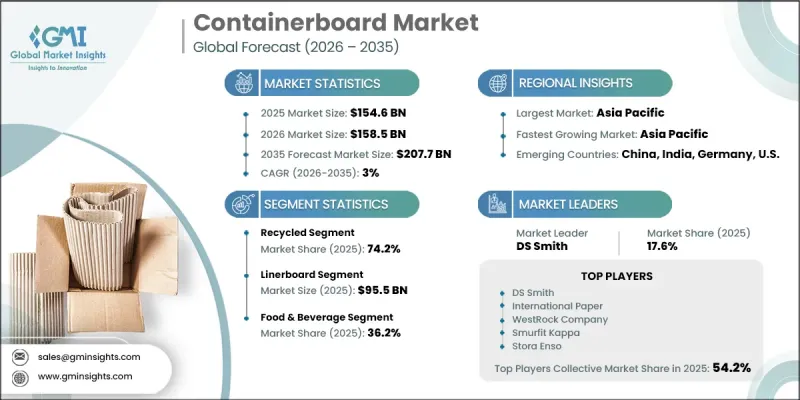
이 시장의 성장은 친환경 포장 솔루션으로의 전환, 전 세계 포장된 소비재 유통 증가, 디지털 소매 생태계의 급속한 확장에 의해 주도되고 있습니다. 물류 및 운송 활동의 강화와 더불어 제조 및 공급망에서 컨테이너보드 소재에 대한 의존도가 높아짐에 따라 시장 확대가 더욱 가속화되고 있습니다. 동시에, 가볍고 내구성이 뛰어나며 비용 효율적인 종이 포장으로의 전환은 여러 최종 사용 산업에서 업무 효율성을 향상시키고 포장 성능을 향상시키고 있습니다.
| 시장 범위 | |
|---|---|
| 개시 연도 | 2025년 |
| 예측 기간 | 2026-2035년 |
| 개시 시점 시장 규모 | 1,546억 달러 |
| 예측 시장 규모 | 2,077억 달러 |
| CAGR | 3% |
수요 동향은 산업 및 소비재 분야에서 재활용 가능하고 지속 가능한 포장에 대한 선호도가 높아지는 추세에 크게 영향을 받고 있습니다. 2025년 10월 미국 환경보호청(EPA)이 발표한 지속가능성에 초점을 맞춘 보고서에서 지속가능한 재료 관리 이니셔티브에 따라 매립 폐기물을 줄이고 재활용 성과를 향상시키기 위해 섬유 기반 포장재 채택이 확대되고 있다고 강조했습니다. 이러한 규제 및 환경적 요인으로 인해 제조업체와 브랜드는 플라스틱 포장을 종이로 대체할 수 있는 대안으로 플라스틱 포장을 대체할 것을 촉구하고 있습니다. 강화된 환경 규정 준수 요건과 기업의 지속가능성에 대한 노력과 함께 이러한 전환은 더욱 가속화되고 있습니다. 그 결과, 컨테이너보드는 재활용성, 비용 효율성 및 보호 포장 응용 분야에서 우수한 성능으로 인해 선호되는 소재가 되고 있습니다.
버진(미사용) 부문은 2035년까지 연평균 복합 성장률(CAGR) 2.1%를 나타낼 것으로 예측됩니다. 산업 및 고부가가치 용도 분야에서 고강도, 내구성, 고품질 포장 솔루션에 대한 수요가 증가함에 따라 그 확대가 뒷받침되고 있습니다. 구조적 무결성, 안정된 성능, 우수한 인쇄 품질이 요구되는 경우, 버진 컨테이너 보드는 널리 선호됩니다. 이러한 특성으로 인해 고도의 보호 기능과 세련된 시각적 표현이 요구되는 포장 형태에 적합하며, 품질에 민감한 용도에 꾸준히 채택되고 있습니다.
소비재 부문은 2026-2035년 연평균 복합 성장률(CAGR) 3.3%를 나타낼 것으로 예측됩니다. 이 부문의 성장은 퍼스널케어, 가정용품, 전자제품 등의 카테고리에서 매력적이고 보호력이 높은 포장 솔루션에 대한 수요가 증가함에 따라 성장세를 보이고 있습니다. 제품 다양화, 강력한 브랜딩 및 마케팅 요구 사항과 결합하여 제조업체는 맞춤형 컨테이너 보드 포장 솔루션의 채택을 촉진하고 있습니다. 디스플레이 효과, 제품 안전성, 차별화된 패키지 디자인에 대한 관심이 높아짐에 따라 이 부문 전체에 대한 수요가 더욱 증가하고 있습니다.
북미의 컨테이너 보드 시장은 2025년 25.9%의 점유율을 차지했습니다. 이 지역에서는 기존 소매, 물류 및 제조 공급망 전반에 걸친 컨테이너 보드의 강력한 통합으로 인해 꾸준한 성장세를 보이고 있습니다. 창고, 팔레타이징, 유통 과정에서 컨테이너보드 포장의 광범위한 표준화는 산업 및 소비자 부문 모두에서 안정적인 수요를 지속적으로 지원하고 있습니다. 또한, 제조 자동화의 발전과 지역 생산자들의 지속적인 생산 능력 최적화를 위한 노력은 지역 전체의 효율성 향상과 지속적인 시장 발전에 기여하고 있습니다.
자주 묻는 질문
목차
제1장 조사 방법 및 범위
제2장 주요 요약
제3장 업계 인사이트
제4장 경쟁 구도
제5장 시장 추산 및 예측 : 유형별(2022-2035년)
제6장 시장 추산 및 예측 : 제품 유형별(2022-2035년)
제7장 시장 추산 및 예측 : 최종 이용 산업별(2022-2035년)
제8장 시장 추산 및 예측 : 지역별(2022-2035년)
제9장 기업 개요
AJY 26.06.11The Global Containerboard Market was valued at USD 154.6 billion in 2025 and is estimated to grow at a CAGR of 3% to reach USD 207.7 billion by 2035.
The market growth is shaped by the rising transition toward environmentally responsible packaging solutions, increasing global distribution of packaged consumer products, and the rapid expansion of digital retail ecosystems. Strengthening logistics and transportation activities, along with the growing dependence on corrugated materials in manufacturing and supply chains, are further supporting market expansion. At the same time, the shift toward lightweight, durable, and cost-efficient paper-based packaging formats is improving operational efficiency and enhancing packaging performance across multiple end-use industries.
| Market Scope | |
|---|---|
| Start Year | 2025 |
| Forecast Year | 2026-2035 |
| Start Value | $154.6 Billion |
| Forecast Value | $207.7 Billion |
| CAGR | 3% |
The demand landscape is strongly influenced by the rising preference for recyclable and sustainable packaging across both industrial and consumer applications. A sustainability-focused report released in October 2025 by the U.S. Environmental Protection Agency emphasized the growing adoption of fiber-based packaging materials to reduce landfill waste and improve recycling outcomes under sustainable materials management initiatives. This regulatory and environmental push is encouraging manufacturers and brands to replace plastic-based packaging with paper-based alternatives. Increasing environmental compliance requirements, combined with corporate sustainability commitments, are further accelerating this transition. As a result, containerboard is becoming a preferred material choice due to its recyclability, cost efficiency, and strong performance in protective packaging applications.
The virgin segment is projected to grow at a CAGR of 2.1% through 2035. Its expansion is supported by increasing demand for high-strength, durable, and premium-grade packaging solutions across industrial and high-value applications. Virgin containerboard is widely preferred where structural integrity, consistent performance, and superior print quality are required. These characteristics make it suitable for packaging formats that demand enhanced protection and refined visual presentation, thereby supporting steady adoption across quality-sensitive applications.
The consumer goods segment is expected to register a CAGR of 3.3% during 2026 to 2035. Growth in this segment is driven by rising demand for attractive and protective packaging solutions across categories such as personal care, household essentials, and electronic products. Expanding product diversity, coupled with strong branding and marketing requirements, is encouraging manufacturers to adopt customized containerboard packaging solutions. The increasing emphasis on shelf appeal, product safety, and differentiated packaging design continues to reinforce demand across this segment.
North America Containerboard Market accounted for a 25.9% share in 2025. The region is witnessing steady growth due to the strong integration of containerboard across well-established retail, logistics, and manufacturing supply chains. Widespread standardization of corrugated packaging in warehousing, palletization, and distribution processes continues to support consistent demand from both industrial and consumer sectors. In addition, advancements in manufacturing automation and ongoing capacity optimization efforts by regional producers are contributing to improved efficiency and sustained market development across the region.
Prominent players operating in the Containerboard Industry include Cascades Inc., Mondi, Smurfit Kappa, International Paper, Stora Enso, DS Smith, Greif, Georgia-Pacific LLC, Oji Holdings Corporation, WestRock Company, Sappi, Kruger Inc., Daio Paper Corporation, Atlantic Packaging Products Ltd., Rengo Co., Ltd., Progroup AG, Burgo Group S.p.A., CellMark AB, Firn Overseas Packaging, and W. Hamburger GmbH. Key strategies adopted by companies in the Containerboard Market include expanding production capacity to meet rising demand for sustainable packaging, strengthening recycling and fiber recovery capabilities to improve raw material efficiency, and investing in advanced manufacturing automation to optimize cost and productivity. Market players are increasingly focusing on product innovation, particularly in lightweight and high-strength grades, to enhance performance and reduce material usage. Strategic mergers, acquisitions, and long-term supply agreements are being used to consolidate market position and secure raw material access. Companies are also prioritizing sustainability initiatives, including carbon reduction programs and circular economy integration. Additionally, digital transformation in production and supply chain operations is helping improve operational visibility, reduce waste, and enhance customer responsiveness.
Table of Contents
Chapter 1 Methodology and Scope
- 1.1 Market scope and definition
- 1.2 Research design
- 1.2.1 Research approach
- 1.2.2 Data collection methods
- 1.3 Data mining sources
- 1.3.1 Global
- 1.3.2 Regional/Country
- 1.4 Base estimates and calculations
- 1.4.1 Base year calculation
- 1.4.2 Key trends for market estimation
- 1.5 Primary research and validation
- 1.5.1 Primary sources
- 1.6 Forecast model
- 1.7 Research assumptions and limitations
Chapter 2 Executive Summary
- 2.1 Industry 360° synopsis, 2022 - 2035
- 2.2 Key market trends
- 2.2.1 Type trends
- 2.2.2 Product type trends
- 2.2.3 End-use industry trends
- 2.2.4 Regional trends
- 2.3 TAM Analysis, 2026-2035
- 2.4 CXO perspectives: Strategic imperatives
Chapter 3 Industry Insights
- 3.1 Industry ecosystem analysis
- 3.1.1 Supplier Landscape
- 3.1.2 Profit Margin
- 3.1.3 Cost structure
- 3.1.4 Value addition at each stage
- 3.1.5 Factor affecting the value chain
- 3.1.6 Disruptions
- 3.2 Industry impact forces
- 3.2.1 Growth drivers
- 3.2.1.1 Increasing demand for sustainable and recyclable packaging
- 3.2.1.2 Growth of packaged food and beverage distribution
- 3.2.1.3 Rapid expansion of e-commerce and omnichannel retail
- 3.2.1.4 Rising industrial production and goods transportation
- 3.2.1.5 Shift toward lightweight and cost-efficient packaging materials
- 3.2.2 Industry pitfalls and challenges
- 3.2.2.1 Volatility in recovered paper and raw material prices
- 3.2.2.2 High capital investment and long payback cycles
- 3.2.3 Market opportunities
- 3.2.3.1 Expansion of recyclable packaging solutions for emerging consumer goods categories
- 3.2.3.2 Rising adoption of customized and high-performance corrugated packaging designs
- 3.2.1 Growth drivers
- 3.3 Growth potential analysis
- 3.4 Regulatory landscape
- 3.4.1 North America
- 3.4.2 Europe
- 3.4.3 Asia Pacific
- 3.4.4 Latin America
- 3.4.5 Middle East & Africa
- 3.5 Porter's analysis
- 3.6 PESTEL analysis
- 3.7 Technology and Innovation landscape
- 3.7.1 Current technological trends
- 3.7.2 Emerging technologies
- 3.8 Price trends
- 3.8.1 By region
- 3.8.2 By product
- 3.9 Pricing Strategies
- 3.10 Emerging Business Models
- 3.11 Compliance Requirements
- 3.12 Patent and IP analysis
Chapter 4 Competitive Landscape, 2025
- 4.1 Introduction
- 4.2 Company market share analysis
- 4.2.1 By region
- 4.2.1.1 North America
- 4.2.1.2 Europe
- 4.2.1.3 Asia Pacific
- 4.2.1.4 Latin America
- 4.2.1.5 Middle East & Africa
- 4.2.2 Market concentration analysis
- 4.2.1 By region
- 4.3 Competitive benchmarking of key players
- 4.3.1 Financial performance comparison
- 4.3.1.1 Revenue
- 4.3.1.2 Profit margin
- 4.3.1.3 R&D
- 4.3.2 Product portfolio comparison
- 4.3.2.1 Product range breadth
- 4.3.2.2 Technology
- 4.3.2.3 Innovation
- 4.3.3 Geographic presence comparison
- 4.3.3.1 Global footprint analysis
- 4.3.3.2 Service network coverage
- 4.3.3.3 Market penetration by region
- 4.3.4 Competitive positioning matrix
- 4.3.4.1 Leaders
- 4.3.4.2 Challengers
- 4.3.4.3 Followers
- 4.3.4.4 Niche players
- 4.3.5 Strategic outlook matrix
- 4.3.1 Financial performance comparison
- 4.4 Key developments
- 4.4.1 Mergers and acquisitions
- 4.4.2 Partnerships and collaborations
- 4.4.3 Technological advancements
- 4.4.4 Expansion and investment strategies
- 4.4.5 Digital transformation initiatives
- 4.5 Emerging/ startup competitors landscape
Chapter 5 Market Estimates and Forecast, By Type, 2022 - 2035 (USD Million)
- 5.1 Key trends
- 5.2 Virgin
- 5.3 Recycled
Chapter 6 Market Estimates and Forecast, By Product Type, 2022 - 2035 (USD Million)
- 6.1 Key trends
- 6.2 Linerboard
- 6.2.1 Kraftliner
- 6.2.2 Testliner
- 6.3 Corrugating medium
- 6.4 White tops
Chapter 7 Market Estimates and Forecast, By End-use Industry, 2022 - 2035 (USD Million)
- 7.1 Key trends
- 7.2 Food & beverage
- 7.3 Pharmaceuticals
- 7.4 Electronics
- 7.5 Industrial
- 7.6 Consumer goods
- 7.7 Others
Chapter 8 Market Estimates and Forecast, By Region, 2022 - 2035 (USD Million)
- 8.1 Key trends
- 8.2 North America
- 8.2.1 U.S.
- 8.2.2 Canada
- 8.3 Europe
- 8.3.1 Germany
- 8.3.2 UK
- 8.3.3 France
- 8.3.4 Spain
- 8.3.5 Italy
- 8.3.6 Russia
- 8.4 Asia Pacific
- 8.4.1 China
- 8.4.2 India
- 8.4.3 Japan
- 8.4.4 Australia
- 8.4.5 South Korea
- 8.5 Latin America
- 8.5.1 Brazil
- 8.5.2 Mexico
- 8.5.3 Argentina
- 8.6 Middle East and Africa
- 8.6.1 South Africa
- 8.6.2 Saudi Arabia
- 8.6.3 UAE
Chapter 9 Company Profiles
- 9.1 Global Key Players
- 9.1.1 DS Smith
- 9.1.2 International Paper
- 9.1.3 WestRock Company
- 9.1.4 Smurfit Kappa
- 9.1.5 Stora Enso
- 9.2 Regional key players
- 9.2.1 North America
- 9.2.1.1 Atlantic Packaging Products Ltd.
- 9.2.1.2 Cascades Inc.
- 9.2.1.3 Georgia-Pacific LLC
- 9.2.1.4 Greif
- 9.2.1.5 Kruger Inc.
- 9.2.2 Asia Pacific
- 9.2.2.1 Daio Paper Corporation
- 9.2.2.2 Oji Holdings Corporation
- 9.2.2.3 Rengo Co., Ltd.
- 9.2.3 Europe
- 9.2.3.1 Burgo Group S.p.A.
- 9.2.3.2 CellMark AB
- 9.2.3.3 Mondi
- 9.2.3.4 Progroup AG
- 9.2.3.5 W. Hamburger GmbH
- 9.2.4 Middle East & Africa
- 9.2.4.1 Sappi
- 9.2.1 North America
- 9.3 Niche Players/Disruptors
- 9.3.1 Firn Overseas Packaging