
|
시장보고서
상품코드
2061786
이탈리아의 NOR 플래시 시장 : 시장 점유율 분석, 업계 동향 및 통계, 성장 예측(2026-2031년)Italy NOR Flash - Market Share Analysis, Industry Trends & Statistics, Growth Forecasts (2026 - 2031) |
||||||
 Mordor Intelligence
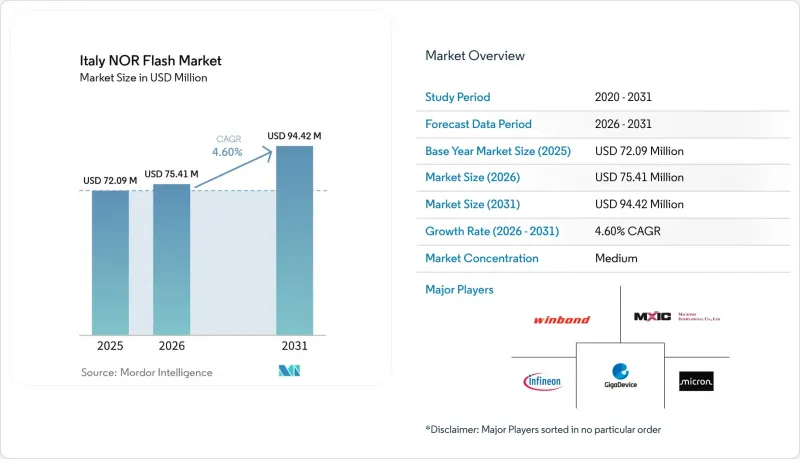
Mordor Intelligence에 의하면, 이탈리아의 NOR 플래시 시장 규모는 2025년 7,209만 달러로 평가되었고, 2026년에는 7,541만 달러로 추정되고, 2031년까지 9,442만 달러에 이를 것으로 예측되며, 2026-2031년 CAGR 4.60%로 성장할 전망입니다.
본 보고서는 유형별(직렬 NOR 플래시, 병렬 NOR 플래시), 인터페이스별(SPI 싱글/듀얼 등), 밀도별(2메가비트 이하 등), 전압(3V급 등), 최종 사용자 용도별(통신, 기타), 공정 노드별(90nm 및 그 이전, 기타), 패키지 유형별(WLCSP/CSP, 기타), 지역별(이탈리아)로 분류되어 있습니다. 시장 전망은 금액(달러) 및 수량(단위)으로 제공됩니다.
이탈리아의 NOR 플래시 시장 동향 및 인사이트
이탈리아 자동차 OEM 업체들의 ADAS 및 자율주행 플랫폼 확대
스텔란티스는 2026년에 AI4I 컨소시엄에 참여하여, 차세대 존 컨트롤러에 NOR 플래시를 탑재하는 공동 개발 계획을 확정했습니다. 이 그룹은 2025년 말에 이미 레벨 3 기능을 실증했으며, 2030년까지 반도체 조달에 100억 달러를 배정하고 있는데, 여기에는 결정론적 부팅을 위한 256메가비트 이상의 디바이스도 포함됩니다. 페라리와 람보르기니도 유사한 로드맵을 따르고 있으며, 안전하고 즉시 가동 가능한 스토리지가 필요한 예측 유지보수 스택을 통합하고 있습니다. 따라서 고정 지연 시간을 갖는 읽기 경로가 ISO 26262 ASIL-D의 최악의 경우 실행 목표를 충족하는 병렬 NOR 플래시가 주목받고 있습니다. 200MHz 8비트 버스로의 전환을 통해 400MB/s의 처리량이 실현되며, OTA(Over-the-Air) 업데이트로 인한 다운타임이 수 시간에서 수 분으로 단축되어 딜러의 서비스 수익성이 향상됩니다.
이탈리아 전력회사의 스마트 에너지 계량기 도입 확대
유럽 투자은행으로부터 5억 유로(5억 4,000만 달러)의 자금을 조달받은 Enel사의 ‘Open Meter II’ 프로그램은 각 계량기 내에 자동차 등급의 시리얼 NOR를 탑재하여 4,100만 대의 엔드포인트를 대상으로 하고 있습니다. A2A사가 밀라노와 브레시아에서 운영 중인 130만 대의 시스템 역시 동일한 아키텍처를 채택하고 있습니다. 2세대 계기판은 -25°C에서 +70°C의 온도 범위에서 작동하며, 10만 회의 프로그램 및 삭제 사이클과 20년간의 데이터 보존이 요구되며, 해당 사양은 AEC-Q100 등급 1 플래시 규격을 준수합니다. 규제 당국인 ARERA가 나머지 계량기에 대해 2027년을 기한으로 도입을 추진하고 있기 때문에 수요는 롬바르디아주, 라치오주, 에밀리아-로마냐주에 집중되어 있습니다. 넓은 온도 범위와 적은 핀 수를 갖춘 디바이스를 인증할 수 있는 공급업체는 지속적인 경쟁 우위를 확보하게 됩니다.
높은 프런트엔드 팹 비용과 제한된 국내 웨이퍼 생산 능력
이탈리아는 아시아의 파운드리 업체에 의존하고 있지만, 해당 업체들의 배정 규칙은 대량 발주 고객을 우선시하는 경향이 있습니다. 유럽의 파브는 비용 면에서 20-30% 불리한 입장에 있으며, EU의 NanoIC 파일럿 라인은 5nm 노드에 초점을 맞추고 있어 NOR 플래시에는 사용되지 않고 있습니다. 인텔의 마그데부르크 메가팹 건설 중단은 이 지역의 취약성을 더욱 부각시키고 있습니다. 한편, ST마이크로일렉트로닉스의 50억 유로(54억 달러) 규모 SiC 캠퍼스는 메모리가 아닌 파워 디바이스에 중점을 두고 있습니다. 그 결과, 현지 시스템 통합사업자들은 리드타임의 장기화와 조달 비용 상승에 직면해 있으며, 수출 지향적인 기계 분야의 경쟁력이 약화되고 있습니다.
부문별 분석
2025년 시점에서 패러렐 NOR은 이탈리아 NOR 플래시 시장에서 점유율이 낮았으나, 연평균 성장률(CAGR) 7.40%는 첨단 운전자 보조 시스템(ADAS)에 대한 수요 증가를 뒷받침하고 있습니다. 자동차용 도메인 컨트롤러는 100밀리초를 초과하는 시작 지연을 허용할 수 없기 때문에 핀 수를 줄이는 것보다 결정적인 읽기 성능이 우선시됩니다. 인피니온과 윈본드는 모두 150°C의 접합부 온도에서도 인스턴트 온 동작을 유지하는 AEC-Q100 등급 1의 병렬 소자를 출시했습니다. 시리얼 NOR는 소형 텔레매틱스 및 웨어러블 기기에 여전히 필수적이지만, 안전상 중요한 모듈들이 더 폭이 넓은 버스로 전환되고 있어 시장 성장률은 둔화되고 있습니다.
병렬 NOR는 인플레이스 실행을 통한 펌웨어 실행의 이점도 누리고 있으며, 세이프티 아일랜드 내의 외부 DRAM을 제거함으로써 비용을 절감합니다. 스텔란티스가 30개 이상의 제어 유닛을 구역형 아키텍처로 통합함에 따라, 각 노드에는 A/B 펌웨어 이미지용 이중 중복화된 병렬 NOR 뱅크가 필요합니다. 한편, 시리얼 NOR의 다양한 SKU 덕분에 핀당 비용이 저렴하고 PCB 배선이 간소화된 산업용 센서 및 스마트 미터 시장을 아우르며, 총 출하 대수의 적어도 절반을 유지할 것으로 확실시되고 있습니다.
쿼드 SPI는 이탈리아 NOR 플래시 시장에서 가장 큰 점유율을 차지하고 있지만, 옥탈 및 xSPI가 연평균 성장률(CAGR) 9.60%로 성장함에 따라 40.90%에 달하는 이 점유율은 축소될 전망입니다. GigaDevice의 GD25NX 시리즈는 200 MHz에서 400 MB/s의 읽기 속도를 구현하여, 기존의 듀얼 SPI에 비해 5배 빠른 속도를 자랑합니다. 이탈리아의 각 OEM 업체들은 OTA(무선) 업데이트에 소요되는 시간과 휴대전화 데이터 통신 요금제의 비용을 절감하기 위해 이러한 부품을 채택하고 있습니다. 스텔란티스의 벤치마크에 따르면, xSPI 플래시에 호스팅된 경우 2GB 펌웨어 패키지를 다운로드하는 데 6분도 채 걸리지 않는 반면, 쿼드 SPI에서는 30분이 소요됩니다.
연간 코드 개정이 이루어지는 셋톱박스나 산업용 컨트롤러에서는 표준 SPI 및 듀얼 SPI가 계속해서 채택되고 있습니다. 그러나 UN R155가 보안 업데이트 파이프라인을 의무화하고 있는 가운데, xSPI 프로토콜의 8비트 DDR 신호 전송에 더해 인증용 사이드밴드 핀이 주목할 만한 기능으로 부각되고 있습니다. 르네사스(Renesas) 등 마이크로컨트롤러 공급업체들은 현재, 보안 부트 로더가 사전 탑재된 온보드 옥탈 플래시와 자동차용 MCU를 결합한 레퍼런스 설계를 출하하고 있으며, 이를 통해 Tier 1 공급업체 전반에 걸친 도입을 원활하게 하고 있습니다.
이탈리아 NOR 플래시 시장 규모 데이터에 따르면, 특히 스마트 미터 및 산업용 게이트웨이 분야에서 32메가비트 이하 기기가 출하량의 대부분을 차지하고 있습니다. 그럼에도 불구하고, ADAS 스택의 확대에 따라 256메가비트급 시장은 연간 7.20%의 성장률을 보이고 있습니다. 인피니온의 Semper 제품군은 동일한 다이에서 25년의 데이터 보존 기간 또는 100만 사이클의 내구성을 제공하여, 장기간의 현장 사용 기간 동안 발생할 수 있는 위험을 줄여줍니다. Tier 1 공급업체는 현재 인포테인먼트 및 세이프티 아일랜드용 256메가비트 xSPI 플래시에 대해 이중 공급처를 확보함으로써 인증에 따른 부담을 줄이고 있습니다.
데이터 전송 속도가 512메가비트에서 1기가비트로 향상됨에 따라, NOR와 NAND의 비트당 단가에 대한 논의가 활발해지고 있습니다. NOR 기술은 ASIL-D 환경에서 매우 중요한 무작위 읽기 안정성 및 인플레이스 실행 기능과 같은 엄격한 요구 사항을 충족하는 능력 덕분에 여전히 그 위상을 유지하고 있습니다. 이러한 기능 덕분에, 안전성과 성능을 타협할 수 없는 용도 분야에서 NOR는 신뢰할 수 있는 선택지가 되고 있습니다. 이탈리아의 각 OEM 업체들은 전략적으로 듀얼 스토리지 방식을 채택하고 있습니다. 기본 부팅 프로세스를 NOR에 할당함으로써, 결정론적이고 신뢰성이 높은 부팅을 보장합니다. 한편, 대용량 지도 데이터 저장을 위해서는 NAND를 활용하여 그 높은 저장 용량을 극대화하고 있습니다. 이러한 조합을 통해 제조업체는 성능, 비용, 스토리지 효율성 간의 균형을 효과적으로 맞출 수 있습니다.
기타 혜택 :
- 엑셀 형식 시장 예측(ME) 시트
- 3개월간의 애널리스트 지원
자주 묻는 질문
목차
제1장 서론
제2장 조사 방법
제3장 주요 요약
제4장 시장 구도
제5장 시장 규모 및 성장 예측
제6장 경쟁 구도
제7장 시장 기회 및 향후 전망
AJY 26.06.26According to Mordor Intelligence, the italy nOR flash market size is expected to increase from USD 72.09 million in 2025 to USD 75.41 million in 2026 and reach USD 94.42 million by 2031, growing at a CAGR of 4.60% over 2026-2031.
This report is Segmented by Type (Serial NOR Flash, Parallel NOR Flash), Interface (SPI Single/Dual, and More), Density (2 Megabit and Less, and More), Voltage (3V Class, and More), End-User Application (Communication, and More), Process Node (90nm and Older, and More), Packaging Type (WLCSP/CSP, and More), and Geography (Italy). Market Forecasts are Provided in Terms of Value (USD) and Volume (Units).
Italy NOR Flash Market Trends and Insights
Expansion of ADAS and Autonomous Platforms in Italian Automotive OEMs
Stellantis joined the AI4I consortium in 2026, locking in co-development paths that embed NOR Flash into next-generation zonal controllers. The group already demonstrated Level 3 capabilities in late 2025 and earmarked USD 10 billion in semiconductor sourcing to 2030, including 256 Megabit-plus devices for deterministic boot. Ferrari and Lamborghini follow similar roadmaps, integrating predictive maintenance stacks that also demand secure, instant-on storage. Parallel NOR Flash thus gains favor because its fixed-latency read path satisfies ISO 26262 ASIL-D worst-case execution targets. The shift to octal 200 MHz buses delivers 400 MB/s throughput, reducing OTA downtime from hours to minutes and enhancing dealer service economics.
Growing Deployment of Smart Energy Meters by Italian Utilities
Enel's Open Meter II program, backed by a EUR 500 million (USD 540 million) European Investment Bank loan, targets 41 million endpoints with automotive-grade Serial NOR inside each meter. A2A's 1.3 million-unit rollout in Milan and Brescia follows the same architecture. Second-generation meters operate from -25 °C to +70 °C and require 100,000 program-erase cycles plus 20-year retention, specifications aligned with AEC-Q100 Grade 1 Flash. As the regulator ARERA pushes the remaining meters toward a 2027 deadline, demand concentrates in Lombardy, Lazio, and Emilia-Romagna. Suppliers able to certify wide-temperature, low-pin-count devices gain a durable advantage.
High Front-End Fab Costs Versus Limited Domestic Wafer Capacity
Italy depends on Asian foundries whose allocation rules favor higher-volume customers. European fabs sit at a 20-30% cost disadvantage, and the EU NanoIC pilot line remains focused on 5 nm nodes, not used for NOR Flash. The cancellation of Intel's Magdeburg megafab further underscores regional fragility, while STMicroelectronics' EUR 5 billion (USD 5.40 billion) SiC campus focuses on power devices rather than memory. Consequently, local integrators face longer lead times and higher purchasing costs, eroding competitiveness in export-oriented machinery.
Other drivers and restraints analyzed in the detailed report include:
- Government Incentives for Industrial IoT Under Transizione 4.0
- Rising Demand for Secure OTA Updates in Connected Two-Wheelers
- Stringent EU REACH and RoHS Compliance Raising Qualification Costs
For complete list of drivers and restraints, kindly check the Table Of Contents.
Segment Analysis
Parallel NOR accounted for a smaller share of the Italian NOR Flash market in 2025, yet its 7.40% CAGR underscores rising demand for advanced driver assistance systems. Automotive domain controllers cannot tolerate boot latency above 100 ms, so deterministic read performance takes precedence over pin-count savings. Infineon and Winbond both released AEC-Q100 Grade 1 Parallel devices that sustain instant-on operation at 150 °C junction temperatures. Serial NOR remains indispensable for compact telematics and wearables, but its market growth rate lags because safety-critical modules are moving to wider buses.
Parallel NOR also benefits from execute-in-place firmware execution, reducing cost by eliminating external DRAM in safety islands. As Stellantis consolidates 30-plus control units into zonal architectures, each node requires dual-redundant Parallel NOR banks for A/B firmware images. Conversely, the SKU diversity of Serial NOR ensures it will keep at least half of total unit shipments, covering industrial sensors and smart meters that value low cost per pin and streamlined PCB routing.
Quad SPI owns the largest slice of the Italian NOR Flash market share, yet its 40.90% position is set to erode as Octal and xSPI climb at 9.60% CAGR. GigaDevice's GD25NX line pushes 400 MB/s read speeds at 200 MHz, a fivefold leap over legacy Dual SPI. Italian OEMs adopt these parts to slash OTA update time and cellular data-plan costs. Stellantis benchmarks show a 2 GB firmware package downloading in under six minutes when hosted on xSPI Flash compared with 30 minutes on Quad SPI.
Standard and Dual SPI continue in set-top boxes and industrial controllers with annual code revisions. However, as UN R155 mandates secure update pipelines, the xSPI protocol's 8-bit DDR signaling plus side-band pins for authentication become persuasive features. Microcontroller vendors such as Renesas now ship reference designs pairing automotive MCUs with on-board Octal Flash pre-loaded with secure-boot loaders, smoothing adoption across Tier 1 suppliers.
Italy NOR Flash market size data show 32 Megabit-and-smaller devices dominate volume, especially in smart meters and industrial gateways. Still, the 256 Megabit bracket advances 7.20% per year as ADAS stacks swell. Infineon's Semper family offers 25-year data retention or 1 million cycle endurance on the same die, de-risking long field life. Tier 1 suppliers now dual-source 256 Megabit xSPI Flash for both infotainment and safety islands, reducing qualification overhead.
As data rates rise from 512 Megabits to 1 Gigabit, discussions intensify over the cost-per-bit between NOR and NAND. NOR technology continues to hold its ground due to its ability to meet the stringent requirements of random-read stability and execute-in-place functionalities, which are critical in ASIL-D environments. These features make NOR a reliable choice for applications where safety and performance cannot be compromised. Italian OEMs have strategically adopted a dual-storage approach, securing the primary boot process in NOR to ensure deterministic and reliable start-up. Meanwhile, they utilize NAND for storing bulk map data, capitalizing on its high-capacity storage capabilities. This combination allows manufacturers to balance performance, cost, and storage efficiency effectively.
List of Companies Covered in this Report:
- Infineon Technologies AG
- Micron Technology Inc.
- GigaDevice Semiconductor Inc.
- Macronix International Co. Ltd
- Winbond Electronics Corp.
- Integrated Silicon Solution Inc.
- Microchip Technology Inc.
- Renesas Electronics Corporation
- Elite Semiconductor Microelectronics Technology Inc.
- Wuhan XMC
- Puya Semiconductor Co. Ltd.
- STMicroelectronics N.V.
- ISSI Italia S.r.l.
- SK hynix Inc.
- Powerchip Semiconductor Manufacturing Corporation
- AMIC Technology Corporation
- EON Silicon Solution Inc.
- Espressif Systems Shanghai Co. Ltd.
- Elite Memory Systems S.r.l.
- PUFsecurity Corporation
Additional Benefits:
- The market estimate (ME) sheet in Excel format
- 3 months of analyst support
TABLE OF CONTENTS
1 INTRODUCTION
- 1.1 Study Assumptions and Market Definition
- 1.2 Scope of the Study
2 RESEARCH METHODOLOGY
3 EXECUTIVE SUMMARY
4 MARKET LANDSCAPE
- 4.1 Market Overview
- 4.2 Market Drivers
- 4.2.1 Expansion of ADAS and Autonomous Platforms in Italian Automotive OEMs
- 4.2.2 Growing Deployment of Smart Energy Meters by Italian Utilities
- 4.2.3 Transition of Italian Broadcasting Infrastructure to DVB-T2 Firmware Upgrades
- 4.2.4 Government Incentives for Industrial IoT under Transizione 4.0
- 4.2.5 Rising Demand for Secure OTA Updates in Connected Two-Wheelers
- 4.2.6 Miniaturization Push in Italian Medical Device Start-Ups Wearables
- 4.3 Market Restraints
- 4.3.1 High Front-End Fab Costs vs Limited Domestic Wafer Capacity
- 4.3.2 Stringent EU REACH/RoHS Compliance Raising Qualification Costs
- 4.3.3 Skill Shortages in Embedded NOR Flash Design in Italian SMEs
- 4.3.4 Euro Depreciation Volatility Affecting Memory Component Pricing
- 4.4 Industry Value and Supply-Chain Analysis
- 4.5 Impact of Macroeconomic Factors on the Market
- 4.6 Regulatory and Technological Outlook
- 4.7 Porter's Five Forces Analysis
- 4.7.1 Bargaining Power of Suppliers
- 4.7.2 Bargaining Power of Buyers
- 4.7.3 Threat of New Entrants
- 4.7.4 Threat of Substitute Products
- 4.7.5 Intensity of Competitive Rivalry
- 4.8 Pricing Analysis
- 4.9 Investment Analysis
5 MARKET SIZE AND GROWTH FORECASTS (VALUE, VOLUME)
- 5.1 By Type (Value, Volume)
- 5.1.1 Serial NOR Flash
- 5.1.2 Parallel NOR Flash
- 5.2 By Interface (Value)
- 5.2.1 SPI Single / Dual
- 5.2.2 Quad SPI
- 5.2.3 Octal and xSPI
- 5.3 By Density (Value)
- 5.3.1 2 Megabit and Less NOR
- 5.3.2 4 Megabit and Less NOR greater than 2 Mb
- 5.3.3 8 Megabit and Less NOR greater than 4 Mb
- 5.3.4 16 Megabit and Less NOR greater than 8 Mb
- 5.3.5 32 Megabit and Less NOR greater than 16 Mb
- 5.3.6 64 Megabit and Less NOR greater than 32 Mb
- 5.3.7 128 Megabit and Less NOR greater than 64 Mb
- 5.3.8 256 Megabit and Less NOR greater than 128 Mb
- 5.3.9 Greater than 256 Megabit
- 5.4 By Voltage (Value)
- 5.4.1 3 V Class
- 5.4.2 1.8 V Class
- 5.4.3 Wide-Voltage 1.65 V - 3.6 V
- 5.4.4 Other Voltage Classes 1.2 V 2.5 V 5 V
- 5.5 By End-User Application (Value, Volume)
- 5.5.1 Consumer Electronics
- 5.5.2 Communication
- 5.5.3 Automotive
- 5.5.4 Industrial
- 5.5.5 Other Applications
- 5.6 By Process Technology Node (Value)
- 5.6.1 90 nm and Older
- 5.6.2 65 nm
- 5.6.3 55 nm including 58 nm
- 5.6.4 45 nm
- 5.6.5 28 nm and Below
- 5.7 By Packaging Type (Value)
- 5.7.1 WLCSP / CSP
- 5.7.2 QFN / SOIC
- 5.7.3 BGA / FBGA
- 5.7.4 Other Packaging Types
6 COMPETITIVE LANDSCAPE
- 6.1 Market Concentration
- 6.2 Strategic Moves
- 6.3 Vendor Positioning Analysis
- 6.4 Company Profiles
- 6.4.1 Infineon Technologies AG
- 6.4.2 Micron Technology Inc.
- 6.4.3 GigaDevice Semiconductor Inc.
- 6.4.4 Macronix International Co. Ltd
- 6.4.5 Winbond Electronics Corp.
- 6.4.6 Integrated Silicon Solution Inc.
- 6.4.7 Microchip Technology Inc.
- 6.4.8 Renesas Electronics Corporation
- 6.4.9 Elite Semiconductor Microelectronics Technology Inc.
- 6.4.10 Wuhan XMC
- 6.4.11 Puya Semiconductor Co. Ltd.
- 6.4.12 STMicroelectronics N.V.
- 6.4.13 ISSI Italia S.r.l.
- 6.4.14 SK hynix Inc.
- 6.4.15 Powerchip Semiconductor Manufacturing Corporation
- 6.4.16 AMIC Technology Corporation
- 6.4.17 EON Silicon Solution Inc.
- 6.4.18 Espressif Systems Shanghai Co. Ltd.
- 6.4.19 Elite Memory Systems S.r.l.
- 6.4.20 PUFsecurity Corporation
7 MARKET OPPORTUNITIES AND FUTURE OUTLOOK
- 7.1 White-Space and Unmet-Need Assessment