

|
시장보고서
상품코드
2063322
북미의 화학제품 창고 시장 : 시장 점유율 분석, 업계 동향 및 통계, 성장 예측(2026-2031년)North America Chemical Warehousing - Market Share Analysis, Industry Trends & Statistics, Growth Forecasts (2026 - 2031) |
||||||
 Mordor Intelligence
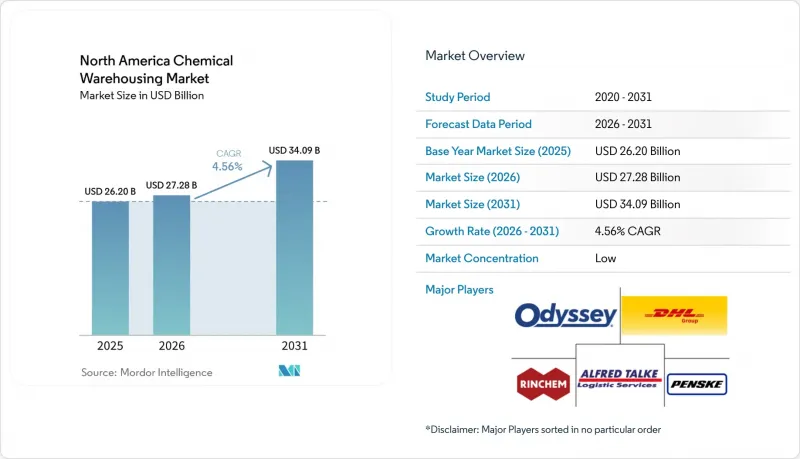
Mordor Intelligence에 의하면, 북미의 화학제품 창고 시장 규모는 2025년 262억 달러로 평가되었습니다. 2026년 272억 8,000만 달러에서 2031년까지 340억 9,000만 달러로 확대되어 2026-2031년에 걸쳐 CAGR은 4.56%를 나타낼 것으로 예측됩니다.
지속가능성 인증을 받은 보관 시설에 대한 수요 증가, 배터리 등급 리튬 화합물의 성장, 멕시코 북부로의 니어쇼어링 확대에 따라 북미의 화학제품 창고 시장 전반에서 서비스 요건과 시설 입지가 재편되고 있습니다. 본 보고서는 창고 유형(일반 창고, 특수 화학물질 창고, 위험물 창고, 기타), 화학물질 유형(인화성 액체, 부식성 물질, 기타), 최종 사용자 산업(기초 화학물질 제조, 특수 화학물질 제조, 기타), 국가(미국, 캐나다, 멕시코)별로 분류되어 있습니다. 시장 전망은 금액(달러) 기준으로 제시되어 있습니다.
북미의 화학제품 창고 시장 동향 및 인사이트
탄소 중립을 위한 노력이 급증하면서, LEED 및 ISO 14001 인증을 획득한 화학제품 창고에 대한 수요가 증가하고 있습니다.
현재 기업의 지속가능성 목표에는 스코프 3 물류 배출량이 포함되어 있으며, 화주들은 제3자 시설에 대해 LEED 및 ISO 14001 기준을 충족할 것을 강력히 요구하고 있습니다. 태양광 지붕, 고효율 HVAC, 부지 내 물 재활용 시스템을 도입한 운영 사업자는 그린론의 대상이 되며, 북미의 화학제품 창고 시장에서 프리미엄 임대료를 확보하고 있습니다. 멕시코만 연안 지역의 평균 에너지 비용이 1kWh당 6.6센트인 점을 고려할 때, 재생에너지로 전환하기 위한 투자 회수 기간은 더욱 단축되고 있습니다. 이러한 인증은 자본력이 있는 기존 사업자에게 수요를 유도하는 구체적인 진입 장벽이 되고 있습니다. 주 규제 당국이 건축 기준을 기후 정책과 조화시켜 나감에 따라, 북미 화학물질 창고 시장에서 지속가능성 인증은 더 이상 차별화 요소가 아니라 기본적인 요건이 될 것으로 예측됩니다.
온도 관리가 필요한 격리 보관이 필수적인 배터리 등급 및 에너지 저장용 화학물질의 급속한 확대
전해액용 용매와 수산화리튬은 습기나 미량의 금속에 매우 민감하기 때문에 창고 측에서는 이슬점 모니터링, 불활성 가스 주입, 격리실 설치가 필수적입니다. 린켐사의 애리조나주에 위치한 12만 3,000제곱피트 규모의 시설은 이 업계에서 현재 표준으로 자리 잡은 첨단 환기 시스템과 센서 어레이의 대표적인 사례입니다. 이러한 정밀한 관리를 통해 로트 불량 위험을 줄일 수 있으며, 가동률을 안정적으로 유지할 수 있는 다년 계약이 가능해집니다. 각 자동차 OEM 업체들이 2027년까지 15곳의 신규 배터리 공장을 건설하겠다고 발표한 만큼, 이러한 전용 보관 공간에 대한 수요는 북미의 화학제품 창고 시장 전체의 동향보다 더 빠르게 증가할 것으로 전망됩니다.
주요 최종 시장의 경기 순환에 따른 침체 위험이 창고 가동률의 변동을 초래합니다.
도료, 플라스틱, 건설용 첨가제는 주택 착공 건수나 자동차 생산량과 연동되어 있으며, 경기 침체기에는 재고가 감소합니다. 뉴저지주에서는 임차인 확보가 불확실한 상태에서 4,000만 제곱피트 규모의 투기적 건설이 완료된 결과, 2024년 창고 공실률이 9%까지 상승했습니다. 북미의 화학제품 창고 시장에서도 유사한 변동이 나타나고 있으며, 고정자산의 이익률이 압박받고 있습니다. 이로 인해 사업자들은 포트폴리오의 위험을 분산시키기 위해 제약 산업 등 경기 변동의 영향을 덜 받는 분야로 진출할 수밖에 없게 되었습니다.
부문별 분석
북미의 화학제품 창고 시장은 눈부신 성장을 보이고 있으며, 온도 관리형 화학제품 창고는 2031년까지 연평균 성장률(CAGR) 5.59%로 확대될 것으로 예상되어 시장 전체의 성장률을 상회할 전망입니다. 이는 전문적인 보관 솔루션에 대한 수요가 증가하고 있음을 여실히 보여주고 있습니다. 2025년에 34.25%의 시장 점유율을 차지한 특수 화학제품 창고는 산업계가 품질과 규정 준수를 중시하고 있음을 반영하고 있습니다. 고객들은 안전성과 규정 준수를 보장하기 위해 인증되고, 문서화되며, 검증된 모니터링 시스템에 대한 투자에 적극적인 의지를 보이고 있습니다. 이러한 요인들이 복합적으로 작용하여 해당 지역의 화학제품 창고 시장의 발전을 주도하고 있습니다.
이슬점 제어, 불활성 가스 퍼지, 비연속 전원 공급에 대한 수요로 인해 자본 집약도는 높아지고 있지만, 한편으로는 전자 기업 및 생명과학 기업과의 다년 계약을 확보하는 결과로 이어지고 있습니다. 한센 스토리지사는 더욱 엄격한 기후 민감도 기준을 충족하기 위해 냉동고 용량을 60만 제곱피트로 두 배로 늘렸습니다. 북미의 화학제품 창고 시장에서 화주들이 프리미엄 제품을 전용 구역으로 이전함에 따라, 일반 창고는 상품화 현상에 직면하고 있으며, 비전문 업체들은 가격 경쟁에 뛰어들거나 시장에서 철수할 수밖에 없는 상황에 처해 있습니다.
기타 혜택
- 엑셀 형식 시장 예측(ME) 시트
- 3개월간의 애널리스트 지원
자주 묻는 질문
목차
제1장 서론
제2장 조사 방법
제3장 주요 요약
제4장 시장 구도
제5장 시장 규모 및 성장 예측
제6장 경쟁 구도
제7장 시장 기회 및 향후 전망
KTH 26.06.24According to Mordor Intelligence, the north america chemical warehousing market size is projected to expand from USD 26.2 billion in 2025 and USD 27.28 billion in 2026 to USD 34.09 billion by 2031, registering a 4.56% CAGR between 2026 and 2031.
Rising demand for sustainability-certified storage, growth in battery-grade lithium compounds, and ongoing nearshoring into Northern Mexico are reshaping service requirements and facility locations across the North America chemical warehousing market. This report is Segmented by Warehouse Type (General Warehousing, Specialty Chemical Warehouse, HAZMAT Warehouses, and More), by Chemical Type (Flammable Liquids, Corrosives, and More), by End-User Industry (Basic Chemicals Manufacturing, Specialty Chemicals Manufacturing, and More), and by Country (United States, Canada, Mexico). The Market Forecasts are Provided in Terms of Value (USD).
North America Chemical Warehousing Market Trends and Insights
Surge in Carbon-Neutral Pledges Driving Demand for LEED and ISO 14001-Certified Chemical Warehouses
Corporate sustainability targets now include Scope 3 logistics emissions, prompting shippers to insist that third-party facilities meet LEED and ISO 14001 benchmarks. Operators adopting solar roofs, high-efficiency HVAC and on-site water recycling qualify for green loans and command premium rent in the North America chemical warehousing market. Energy costs averaging 6.6 cents /kWh along the Gulf Coast further improve payback periods for renewable retrofits. These certifications create tangible barriers to entry that channel volume toward well-capitalized incumbents. As state regulators align building codes with climate policy, sustainability credentials are expected to become a baseline requirement rather than a differentiator across the North America chemical warehousing market.
Rapid Expansion of Battery-Grade and Energy-Storage Chemicals Requiring Segregated Temperature-Controlled Storage
Electrolyte solvents and lithium hydroxide are hypersensitive to moisture and trace metals, forcing warehouses to add dew-point monitoring, inert gas blanketing, and isolated rooms. Rinchem's 123,000 ft2 Arizona site illustrates the upgraded ventilation and sensor arrays now standard for this trade. Precision helps reduce batch-failure risk, enabling multi-year contracts that lock in utilization. With automotive OEMs announcing 15 new battery plants by 2027, demand for such dedicated capacity is set to rise more quickly than overall activity in the North America chemical warehousing market.
Cyclical Downturn Risk in Key End-Markets Causing Volatile Warehouse Utilization
Paints, plastics and construction additives cycle with housing starts and auto output, shrinking inventories during recessions. New Jersey's warehouse vacancy climbed to 9% in 2024 after 40 million ft2 of speculative builds came online without committed tenants. Similar swings in the North America chemical warehousing market squeeze margin on fixed-cost assets, compelling operators to court counter-cyclical sectors such as pharmaceuticals to balance portfolio risk.
Other drivers and restraints analyzed in the detailed report include:
- United States-Canada Inland-Port Build-Outs Integrating Rail, Barge and Pipeline Links with Dedicated Hazmat Terminals
- AI-Powered Safety Analytics Lowering Incident Rates and Insurance Prerequisites
- Emerging PFAS Bans Adding Uncertainty to Long-Tail Inventories and Liability Management
For complete list of drivers and restraints, kindly check the Table Of Contents.
Segment Analysis
The North America chemical warehousing market is witnessing notable growth, with Temperature-Controlled Chemical Warehouses projected to expand at a CAGR of 5.59% through 2031, surpassing the market's overall growth rate. This highlights the increasing demand for specialized storage solutions. Specialty Chemical Warehouses, holding a 34.25% market share in 2025, reflect the industry's emphasis on quality and compliance. Customers are demonstrating a willingness to invest in certifications, documentation, and validated monitoring systems to ensure safety and regulatory adherence. These factors collectively drive the evolution of the chemical warehousing market in the region.
Demand for dew-point control, inert gas purging, and backup power makes capital intensity high, yet also locks in multi-year contracts from electronics and life-science firms. Hansen Storage doubled freezer capacity to 600,000 ft2 to meet stricter climate-sensitivity standards. General Warehousing faces commoditization as shippers shift premium products into purpose-built zones across the North America chemical warehousing market, forcing non-specialists to compete on price or exit.
List of Companies Covered in this Report:
- DHL Group
- Rinchem Company, Inc.
- Odyssey Logistics and Technology
- ALFRED TALKE
- Penske Logistics
- Quantix Quantix Supply Chain Solutions (Formerly AandR Logistics)
- Porter Logistics
- Weber Logistics
- North American Warehousing Co.
- Metrix Logistics Group
- Buske Logistics
- Evans Distribution Systems
- FW Warehousing
- Rhenus Logistics
- ADLI Logistics
- GXO Logistics
- XPO, Inc.
- C.H. Robinson
- DSV A/S
- Kuehne+Nagel
Additional Benefits:
- The market estimate (ME) sheet in Excel format
- 3 months of analyst support
TABLE OF CONTENTS
1 Introduction
- 1.1 Study Assumptions and Market Definition
- 1.2 Scope of the Study
2 Research Methodology
3 Executive Summary
4 Market Landscape
- 4.1 Market Overview
- 4.2 Market Drivers
- 4.2.1 Surge in Carbon-Neutral Pledges Driving Demand for LEED- and ISO 14001-Certified Chemical Warehouses
- 4.2.2 Rapid Expansion of Battery-Grade and Energy-Storage Chemicals Requiring Segregated Temperature-Controlled Storage
- 4.2.3 US-Canada Inland-Port Build-Outs Integrating Rail, Barge and Pipeline Links with Dedicated Hazmat Terminals
- 4.2.4 AI-Powered Safety Analytics Lowering Incident Rates and Insurance Prerequisites, Accelerating Facility Approvals
- 4.2.5 Growth of Bio-Based and Fermentation-Derived Chemicals Creating Allergen-Free, Contamination-Controlled Warehousing Niches
- 4.2.6 Post-CUSMA Near-Shoring Boom Shifting Specialty-Chemical Inventory South to Northern Mexico Logistics Corridors
- 4.3 Market Restraints
- 4.3.1 Cyclical Downturn Risk in Key End-Markets (Construction, Plastics) Causing Volatile Warehouse Utilization
- 4.3.2 Emerging PFAs Bans Adding Uncertainty to Long-Tail Chemical Inventories and Liability Management
- 4.3.3 Scarcity of Rail-Connected Hazmat-Zoned Land Parcels within Tier-1 Chemical Clusters
- 4.3.4 Rising Cyber-Security Threats to IoT-Integrated Hazmat Facilities Increasing Compliance and Mitigation Costs
- 4.4 Value / Supply-Chain Analysis
- 4.5 Regulatory Landscape
- 4.6 Technological Outlook
- 4.7 Porter's Five Forces Analysis
- 4.7.1 Threat of New Entrants
- 4.7.2 Bargaining Power of Suppliers
- 4.7.3 Bargaining Power of Buyers
- 4.7.4 Threat of Substitutes
- 4.7.5 Competitive Rivalry
5 Market Size and Growth Forecasts (Value)
- 5.1 By Warehouse Type
- 5.1.1 General Warehousing
- 5.1.2 Specialty Chemical Warehouse
- 5.1.3 Hazardous Materials (HAZMAT) Warehouses
- 5.1.4 Temperature-Controlled Chemical Warehouses
- 5.2 By Chemical Type
- 5.2.1 Flammable Liquids
- 5.2.2 Corrosives
- 5.2.3 Toxic Substances
- 5.2.4 Oxidizers
- 5.2.5 Others
- 5.3 By End-user Industry
- 5.3.1 Basic Chemicals Manufacturing
- 5.3.2 Specialty Chemicals Manufacturing
- 5.3.3 Pharmaceuticals and Life Sciences
- 5.3.4 Agrochemicals
- 5.3.5 Paints, Coatings and Adhesives
- 5.3.6 Food and Feed Additives
- 5.3.7 Oil and Gas / Petrochemicals
- 5.3.8 Others
- 5.4 By Country
- 5.4.1 United States
- 5.4.2 Canada
- 5.4.3 Mexico
6 Competitive Landscape
- 6.1 Market Concentration
- 6.2 Strategic Moves
- 6.3 Market Share Analysis
- 6.4 Company Profiles (includes Global Level Overview, Market Level Overview, Core Segments, Financials as available, Strategic Information, Market Rank/Share for key companies, Products and Services, and Recent Developments)
- 6.4.1 DHL Group
- 6.4.2 Rinchem Company, Inc.
- 6.4.3 Odyssey Logistics and Technology
- 6.4.4 ALFRED TALKE
- 6.4.5 Penske Logistics
- 6.4.6 Quantix Quantix Supply Chain Solutions (Formerly AandR Logistics)
- 6.4.7 Porter Logistics
- 6.4.8 Weber Logistics
- 6.4.9 North American Warehousing Co.
- 6.4.10 Metrix Logistics Group
- 6.4.11 Buske Logistics
- 6.4.12 Evans Distribution Systems
- 6.4.13 FW Warehousing
- 6.4.14 Rhenus Logistics
- 6.4.15 ADLI Logistics
- 6.4.16 GXO Logistics
- 6.4.17 XPO, Inc.
- 6.4.18 C.H. Robinson
- 6.4.19 DSV A/S
- 6.4.20 Kuehne+Nagel
7 Market Opportunities and Future Outlook
- 7.1 White-space and Unmet-Need Assessment


