

|
시장보고서
상품코드
2063331
프랑스의 화학제품 창고 : 시장 점유율 분석, 업계 동향 및 통계, 성장 예측(2026-2031년)France Chemical Warehousing - Market Share Analysis, Industry Trends & Statistics, Growth Forecasts (2026 - 2031) |
||||||
 Mordor Intelligence
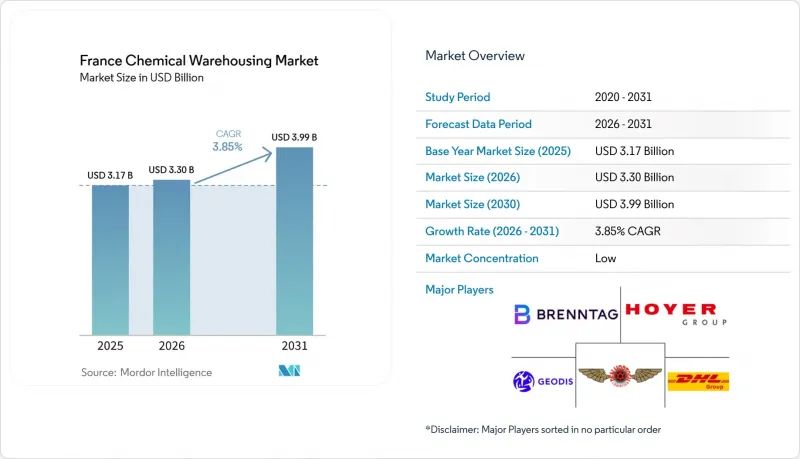
Mordor Intelligence에 의하면, 프랑스의 화학제품 창고 시장 규모는 2025년 31억 7,000만 달러로 평가되었습니다. 2026년에는 33억 달러로 확대되어 2030년까지 39억 9,000만 달러에 이를 것으로 예측되며, 2026-2030년에 걸쳐 CAGR 3.85%를 나타낼 전망입니다.
본 보고서는 창고 유형별(일반, 특수, 위험물, 온도 관리), 화학물질 유형별(인화성 액체, 부식성 물질, 독성 물질, 산화제, 기타), 최종 사용자 산업별(기초 화학물질, 특수 화학물질, 의약품, 농약, 페인트 및 코팅, 식품 첨가물, 석유 및 가스, 기타), 지역별로 분류되어 있습니다. 시장 전망은 금액 기준(미국)으로 제시되어 있습니다.
프랑스의 화학제품 창고 시장 동향 및 인사이트
유럽의 전략적 물류 허브로서의 위상
프랑스는 대서양과 지중해 양쪽 해안에 위치해 있으며, 6개의 EU 회원국과 국경을 접하고 있어 해상 관문과 내륙 거점을 통해 물류가 집중되고 있으며, 현재는 새로운 산업용지 확보와 복합운송 연결 프로그램의 혜택을 누리고 있습니다. 2024년 3월에 발표된 정부 계획에 따르면, 2030년까지 3대 항만 지역에 15억 유로를 투자하고 1,500헥타르의 부지를 확보할 방침을 밝혔으며, 이를 통해 친환경 연료, 배터리, 석유화학 프로젝트와 더불어, 화학제품의 창고 보관, 혼합, 유통을 위한 공동 입지 옵션이 확대될 것입니다. 국가 물류 전략의 정책 이니셔티브에서는 지속 가능한 공급망과 보다 우수한 공간 계획도 중시되고 있으며, 이는 토지 이용 및 ZFE(무공해 지역)의 제약과 조화를 이루며, 철도 및 하천 접근성을 갖춘 복합 운송 거점으로의 신규 물동량 유도를 촉진하고 있습니다. 론-손 축과 내륙 터미널의 강화는 벌크 액체 및 탱크 컨테이너를 바지선에서 창고로 환적하는 과정을 지원함으로써, 트럭 운송에 대한 의존도를 낮추는 동시에 ADR 화물의 규정 준수 수준을 높여줍니다. 프랑스의 화학제품 창고 시장은 이러한 협력적 확장의 혜택을 누리고 있습니다. 사업자는 항만 시설, 철도 지선, 공동 안전 인프라를 통합함으로써, 집적된 클러스터 내에서 단위당 운영 비용을 절감할 수 있습니다. 그 결과, 신규 건설 결정이 점차 이러한 회랑으로 이동하고 있으며, 연안 항만과 리옹을 중심으로 한 국내 유통용 허브 앤 스포크 모델이 강화되고 있습니다.
제약·화장품 산업의 강점
프랑스의 의약품 및 화장품 복합 시설은 콜드체인, 클린 존, GDP 및 ISO 품질 요건을 충족하는 검증 완료된 공정 등, 고도의 사양이 요구되는 보관 시설에 대한 대규모의 지속적인 수요를 뒷받침하고 있습니다. 271곳에 달하는 의약품 생산 시설은 국가의 의료 주권 관련 노력을 뒷받침하고 있으며, 사노피(Sanofi)와 EUROAPI가 추진하는 새로운 API(원료의약품) 및 바이오의약품 프로그램은 HEPA 필터, HVAC 구역화, 검증된 배치 추적 기능을 갖춘 인근 창고에 대한 수요를 견인하고 있습니다. 사노피의 바이오의약품 제조에 대한 투자(비트리-쉬르-센과 르 트레에서의 생산 능력 확대를 포함)는 엄격한 보관 관리와 명확하게 문서화된 취급 절차에 기반한 전문적인 물류 흐름을 창출하고 있습니다. EUROAPI의 Med4Cure 프로그램은 코르티코스테로이드, 마크로라이드, 첨단 입자 공학용 제품의 국내 생산을 더욱 확대하고 있으며, 이를 위해서는 SEVESO 규제의 적용을 받는 주요 시설에서 안전한 격리 및 통제된 환경이 요구됩니다. CEVA의 스트라스부르 신규 거점과 Cryoport의 파리 지역 센터와 같은 전용 물류 시설은 프랑스 생명과학 부문에서 처리 기준이 된 품질 관리 및 온도 관리 수준을 구현하고 있습니다. 프랑스의 화학제품 창고 시장에서는 이러한 헬스케어 부문의 프로젝트가 성숙기에 접어들면서, 규정 준수가 요구되는 화학제품 및 포장 자재의 재고를 주도함에 따라 고급 시장이 확대되고 있습니다.
냉장 창고의 치솟는 에너지 비용
프랑스의 고용주 부담은 여전히 크며, 최근 사회보험료 기준액 변경으로 인해 저율 적용 범위의 적용 조건이 엄격해짐에 따라, 많은 창고 업무에서 실질적인 고용 비용이 상승하고 있습니다. 2025년에 발효된 개정안에 따라 일부 사회보험료가 적용되는 임금 기준액이 인상됨에 따라, 새로 설정된 기준 범위 내에 보수가 포함되는 ADR 인증 직원에 의존하고 있는 사업자에게는 추가적인 부담이 가중되고 있습니다. 사회보장의 연간 상한액은 2025년에 인상되었으며, 2026년에도 다시 인상될 예정이므로, 이에 따라 해당 기준에 따라 산정되는 부담금이 증가하게 되어 사업자의 인건비 총액이 증가하게 됩니다. 에너지 비용도 여전히 큰 변동을 보이고 있으며, 2024년 산업용 에너지 요금은 2019년 수준을 상회한 채로 유지되어, 이로 인해 이익률이 압박받았으며, 동시에 진행되는 임금 인상을 감당할 사업자의 여력이 줄어들었습니다. 시장 전반에 걸친 임금 협상에 따른 임금 인상과 생산성 정체 현상이 겹치면서, 계약 가격에 상응하는 단위 원가를 유지해야 하는 과제는 더욱 심각해지고 있습니다. 따라서 프랑스의 화학제품 창고 시장, 특히 콜드체인 부문에서는 인건비 상승을 상쇄하고 서비스 수준을 유지하기 위해 자동화 및 에너지 절약 기술에 대한 투자를 지속해야 합니다.
부문별 분석
2025년에는 특수 화학제품 창고가 시장 점유율의 43.74%를 차지했습니다. 이는 고부가가치 중간체와 비활성화 처리, 온도 관리, 엄격한 추적 관리가 필요한 로트별 보관 재고에 힘입은 것으로, 이러한 요소들이 프랑스의 화학제품 창고 시장에서 프리미엄 가격의 기반이 되고 있습니다. 온도 관리형 화학물질 창고는 2031년까지 연평균 성장률(CAGR) 4.65%를 기록하며 가장 높은 성장세를 보일 것으로 전망됩니다. 이는 새로운 바이오의약품 및 API(원료의약품) 프로그램으로 인해 생산 거점 인근에서 GDP(의약품 적정 보관 기준)를 준수하는 보관의 범위와 엄격성이 강화되면서, 최고 수준의 사양을 요구하는 프랑스의 화학제품 창고 시장 규모가 확대되고 있기 때문입니다. CEVA의 스트라스부르 거점과 Cryoport의 파리 지역 센터와 같은 새로운 시설들은 온도 구역별 관리와 청결한 취급이 헬스케어 관련 물류 분야에서 어떻게 운영 기준으로 자리 잡았는지를 보여주고 있습니다. 이러한 기능 세트를 통해, 시간적 제약이 있는 제품의 단거리 운송이 필요한 일드프랑스, 노르망디, 오베르뉴-론-알프 각 지역의 제약 제조 거점 주변에 창고 배치가 최적화되었습니다. 한편, 범용 화학제품용 일반 창고의 가동률은 하락하고 있습니다. 기초 화학제품의 생산량이 2021년 중반 수준보다 낮아짐에 따라, 하류 수요가 정상화될 때까지 대량 저장 수요는 억제될 전망입니다.
위험물 창고 분야에서는 안전 시스템, 디지털 모니터링, 규정 준수 관련 전문 지식에 투자하는 사업자들과의 통합이 진행되고 있으며, 이는 국가의 감독 강화 및 상한치에 대한 SEVESO 기준과 부합합니다. 내륙 수로와 철도가 잘 갖춰진 물류센터는 도로 운송에 대한 의존도를 낮추고, 안전 기준 범위 내에서 게이트 간 운송을 가능하게 함으로써 위험물 물류 분야에서 제안력을 강화하고 있습니다. 따라서 프랑스의 화학제품 창고 산업은 양극화되어 있으며, 일반 화학제품을 취급하는 시설은 취급량이 정체된 반면, 의약품 및 특수 화학제품의 성장에 따라 온도 관리가 이루어지는 고급 자산은 확대되고 있습니다. 항만이나 플랫폼 구역 내에 공동으로 입지한 창고 운영사는 공유 유틸리티 및 비상 시스템을 활용함으로써, 규정 준수에 부합하는 보관에 드는 단위 비용과 팔레트당 설비 투자 비용을 절감할 수 있습니다. 이에 따라 예측 기간 동안 멀티모달 클러스터가 신규 건설 및 확장 프로젝트의 우선 입지처로 자리매김하고 있습니다.
기타 혜택
- 엑셀 형식 시장 예측(ME) 시트
- 3개월간의 애널리스트 지원
자주 묻는 질문
목차
제1장 서론
제2장 조사 방법
제3장 주요 요약
제4장 시장 구도
제5장 시장 규모 및 성장 예측
제6장 경쟁 구도
제7장 시장 기회 및 향후 전망
KTH 26.06.24According to Mordor Intelligence, the france chemical warehousing market size is expected to increase from USD 3.17 billion in 2025 to USD 3.30 billion in 2026 and reach USD 3.99 billion by 2030, growing at a CAGR of 3.85% over 2026-2030.
This report is Segmented by Warehouse Type (General, Specialty, HAZMAT, and Temperature-Controlled), by Chemical Type (Flammable Liquids, Corrosives, Toxic Substances, Oxidizers, and Others), by End-User Industry (Basic Chemicals, Specialty Chemicals, Pharmaceuticals, Agrochemicals, Paints/Coatings, Food Additives, Oil & Gas, and Others), and by Geography. Market Forecasts are in Value Terms, USD.
France Chemical Warehousing Market Trends and Insights
Strategic European Logistics Hub Position
France's location on both Atlantic and Mediterranean seaboards and its borders with six EU member states concentrate flows through maritime gateways and inland nodes that now benefit from new industrial land commitments and multimodal connectivity programs. The state's March 2024 plan to bring early EUR 1 billion to 1,500 hectares across the three largest port zones by 2030 expands co-location options for chemical warehousing, blending, and distribution alongside green-fuel, battery, and petrochemical projects. Policy initiatives within the national logistics strategy also stress sustainable supply chains and better spatial planning, which align with land-use and ZFE constraints and steer new capacity toward multimodal sites with rail and river access. Strengthening of the Rhone-Saone axis and inland terminals supports barge-to-warehouse transshipment of bulk liquids and tank containers, which reduces trucking dependencies and improves compliance for ADR cargo. The France chemical warehousing market benefits from this synchronized expansion. Operators can integrate port utilities, rail spurs, and shared safety infrastructure, lowering unit operating costs in concentrated clusters. The result is a gradual shift of new build decisions toward these corridors, which reinforces a hub-and-spoke model for national distribution centered on coastal ports and Lyon.
Pharmaceutical and Cosmetics Industry Strength
France's medicine and cosmetics complexes underpin a large and persistent need for high-specification storage, including cold chain, clean zones, and validated processes that meet GDP and ISO quality requirements. Pharmaceutical production spans 271 sites and supports national health sovereignty initiatives, while new API and biologics programs by Sanofi and EUROAPI drive adjacent demand for proximity warehousing with HEPA filtration, HVAC zoning, and validated batch traceability. Sanofi's investments in biologics manufacturing, including capacity expansions at Vitry-sur-Seine and Le Trait, add specialized flows that rely on tight storage controls and clearly documented handling. EUROAPI's Med4Cure programs further extend onshore production for corticosteroids, macrolides, and advanced particle engineering, which call for safe segregation and controlled environments in upper-tier SEVESO facilities. Purpose-built logistics assets, such as CEVA's new Strasbourg site and Cryoport's Paris-region center, illustrate the quality and temperature layers that have become standard in life sciences handling in France. The France chemical warehousing market sees the premium end of the spectrum expand as these health-sector projects mature and pull through ancillary chemical and packaging inventories that need compliant storage.
High Energy Costs for Cold Warehouses
Employer contributions in France remain significant, and recent threshold changes for social charges have tightened eligibility for lower-rate brackets, which raises effective employment costs for many warehouse roles. Adjustments that took effect in 2025 increase the wage bases to which some contributions apply, which adds pressure to operators that rely on ADR-certified staff whose compensation bands fall into the newly constrained thresholds. The annual ceiling for social security rose in 2025 and is set to rise again in 2026, which lifts contributions calculated on those bases and increases payroll outlays in absolute terms for operators. Energy costs remain volatile as well, and the 2024 industrial energy bill stayed above its 2019 level, which narrows margins and reduces operators' ability to absorb parallel wage growth. Negotiated wage increases and limited productivity gains across the market sector add to the challenge of maintaining unit costs in line with contract pricing. The France chemical warehousing market, particularly the cold-chain segment, must therefore continue to invest in automation and energy-saving technologies to offset payroll drift and protect service levels.
Other drivers and restraints analyzed in the detailed report include:
- Lyon Chemical Valley Expansion
- Port Infrastructure Development
- Complex ICPE Authorization Process
For complete list of drivers and restraints, kindly check the Table Of Contents.
Segment Analysis
Specialty Chemical Warehouses captured 43.74% in 2025, supported by higher-value intermediates and batch-segregated inventories that require inerting, controlled climates, and rigorous traceability, which anchor premium pricing within the France chemical warehousing market. Temperature-Controlled Chemical Warehouses are projected to post the fastest 4.65% CAGR through 2031 as new biologics and API programs expand the scope and stringency of GDP-compliant storage near production hubs, adding to the France chemical warehousing market size at the top end of specifications. New facilities such as CEVA's Strasbourg site and Cryoport's Paris-region center illustrate how temperature layering and clean handling have become operational baselines in health-related flows. This capability set tailors warehousing footprints around pharma manufacturing arcs in Ile-de-France, Normandy, and Auvergne-Rhone-Alpes, where time-sensitive product requires short transfer distances. At the same time, commodity-oriented General Warehousing faces softer utilization where basic chemical output fell below mid-2021 levels, which trims bulk storage needs until downstream demand normalizes.
Hazardous Materials Warehouses continue to consolidate toward operators that invest in safety systems, digital monitoring, and compliance expertise, which aligns with national oversight intensity and SEVESO criteria at upper thresholds. Inland waterway and rail-served depots strengthen the proposition for hazardous flows by reducing road exposure and enabling gate-to-gate movements within safety perimeters. The France chemical warehousing industry therefore bifurcates, with ambient commodity sites adjusting to flatter volumes and premium temperature-controlled assets expanding in line with pharmaceutical and specialty chemical growth. Warehouse operators that co-locate within port and platform zones can leverage shared utilities and emergency systems that reduce unit costs and capex per pallet for compliant storage. This positions multimodal clusters as preferred destinations for new builds and expansion projects through the forecast period.
List of Companies Covered in this Report:
- DHL Group
- Geodis
- Hoyer Group
- Brenntag
- Den Hartogh Logistics
- Ziegler Group
- Bertschi AG France
- De Rijke Group
- H.Essers
- Kuehne + Nagel
- Rhenus Logistics
- Groupe Charles Andre (GCA)
- DSV
- CEVA Logistics
- DACHSER
- Ectra group
- JAS Worldwide
- Logwin
- Manuport Logistics
- ADR Logistics (TLA Group)
Additional Benefits:
- The market estimate (ME) sheet in Excel format
- 3 months of analyst support
TABLE OF CONTENTS
1 Introduction
- 1.1 Study Assumptions and Market Definition
- 1.2 Scope of the Study
2 Research Methodology
3 Executive Summary
4 Market Landscape
- 4.1 Market Overview
- 4.2 Market Drivers
- 4.2.1 Strategic European Logistics Hub Position
- 4.2.2 Pharmaceutical and Cosmetics Industry Strength
- 4.2.3 Lyon Chemical Valley Expansion
- 4.2.4 Port Infrastructure Development
- 4.2.5 Industrial Chemicals for Manufacturing
- 4.2.6 Energy Transition Chemical Storage
- 4.3 Market Restraints
- 4.3.1 High Labor Costs and Social Charges
- 4.3.2 Complex ICPE Authorization Process
- 4.3.3 Frequent Industrial Action and Strikes
- 4.3.4 Stringent Environmental Liability Regime
- 4.4 Value / Supply-Chain Analysis
- 4.5 Regulatory Landscape
- 4.6 Technological Outlook
- 4.7 Porter's Five Forces
- 4.7.1 Threat of New Entrants
- 4.7.2 Bargaining Power of Suppliers
- 4.7.3 Bargaining Power of Buyers
- 4.7.4 Threat of Substitutes
- 4.7.5 Competitive Rivalry
- 4.8 Post-Lubrizol Regulatory Landscape
- 4.9 Grand Port Maritime System
5 Market Size and Growth Forecasts (Value, USD Billion)
- 5.1 By Warehouse Type
- 5.1.1 General Warehousing
- 5.1.2 Speciality Chemical Warehouse
- 5.1.3 Hazardous Materials (HAZMAT) Warehouses
- 5.1.4 Temperature-Controlled Chemical Warehouses
- 5.2 By Chemical Type
- 5.2.1 Flammable Liquids
- 5.2.2 Corrosives
- 5.2.3 Toxic Substances
- 5.2.4 Oxidizers
- 5.2.5 Others
- 5.3 By End-user Industry
- 5.3.1 Basic Chemicals Manufacturing
- 5.3.2 Specialty Chemicals Manufacturing
- 5.3.3 Pharmaceuticals & Life Sciences
- 5.3.4 Agrochemicals
- 5.3.5 Paints, Coatings & Adhesives
- 5.3.6 Food & Feed Additives
- 5.3.7 Oil & Gas / Petrochemicals
- 5.3.8 Others
- 5.4 Impact of Geopolitical Events on the Market
- 5.5 Circular Economy Chemical Recycling
6 Competitive Landscape
- 6.1 Market Concentration
- 6.2 Strategic Moves
- 6.3 Market Share Analysis
- 6.4 Company Profiles (includes Global level Overview, Market level overview, Core Segments, Financials as available, Strategic Information, Market Rank/Share for key companies, Products and Services, and Recent Developments)
- 6.4.1 DHL Group
- 6.4.2 Geodis
- 6.4.3 Hoyer Group
- 6.4.4 Brenntag
- 6.4.5 Den Hartogh Logistics
- 6.4.6 Ziegler Group
- 6.4.7 Bertschi AG France
- 6.4.8 De Rijke Group
- 6.4.9 H.Essers
- 6.4.10 Kuehne + Nagel
- 6.4.11 Rhenus Logistics
- 6.4.12 Groupe Charles Andre (GCA)
- 6.4.13 DSV
- 6.4.14 CEVA Logistics
- 6.4.15 DACHSER
- 6.4.16 Ectra group
- 6.4.17 JAS Worldwide
- 6.4.18 Logwin
- 6.4.19 Manuport Logistics
- 6.4.20 ADR Logistics (TLA Group)
7 Market Opportunities and Future Outlook
- 7.1 White-space and Unmet-need Assessment


