
|
시장보고서
상품코드
2072559
인도의 NOR 플래시 : 시장 점유율 분석, 업계 동향 및 통계, 성장 예측(2026-2031년)India NOR Flash - Market Share Analysis, Industry Trends & Statistics, Growth Forecasts (2026 - 2031) |
||||||
 Mordor Intelligence
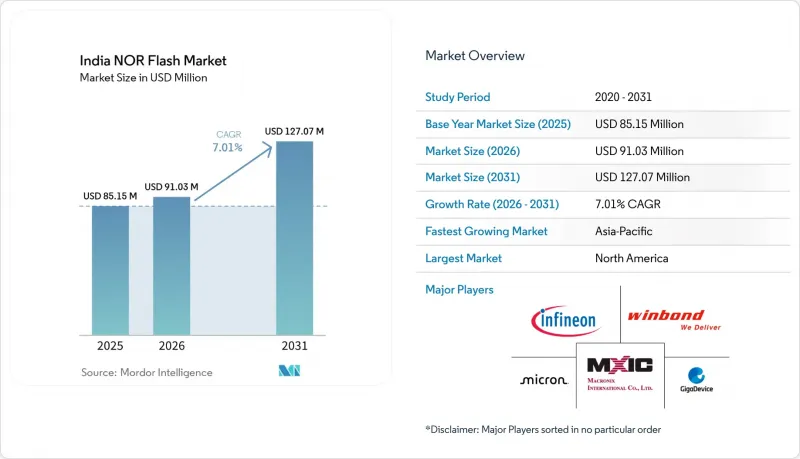
Mordor Intelligence에 의하면, 인도의 NOR 플래시 시장 규모는 2025년 8,515만 달러로 평가되었습니다. 2026년에는 9,103만 달러로 확대되어 2031년까지 1억 2,707만 달러에 이를 것으로 예상되고 2026-2031년에 걸쳐 CAGR 6.9%로 성장할 전망입니다.
본 보고서는 유형(직렬 NOR 플래시, 기타), 인터페이스(SPI 싱글/듀얼, 기타), 밀도(2Mbit 이하, 기타), 전압(3V급, 기타), 최종 사용자용도(가전, 자동차, 기타), 공정 기술 노드(65nm, 45nm, 기타), 패키징 유형(WLCSP/CSP, 기타)별로 분류되어 있습니다. 시장 전망은 금액(달러)과 수량(개) 두 가지 측면으로 제시되어 있습니다.
인도의 NOR 플래시 시장 동향 및 분석
정부의 PLI 및 반도체 보조금으로 인해 자본 진입 장벽이 낮아졌습니다.
“'인도 반도체 미션 2.0'이에 따라 새로운 조립·검사·마킹·포장(ATMP) 거점에 100억 루피(1억 2,000만 달러)를 배정했습니다. 또한, “"전자 부품 제조 방식" 이에 따라 2026년 1월, 4,186억 3,000만 루피(50억 2,000만 달러) 상당의 22개 프로젝트가 승인되어 민간 부문의 공동 투자를 유치함으로써, 현지 EMS 기업들의 투자 회수 장벽이 낮아졌습니다. 샌앤드에 건설될 마이크론사의 27억 5,000만 달러 규모의 ATMP 공장은 외국인 직접 투자에 대한 신뢰를 보여주는 것이며, 구자라트 주 일대 생태계 형성을 뒷받침하고 있습니다.
보안 부팅 의무화로 시리얼 NOR 수요 증가
인도 표준청(BIS)은 현재 소비자용 IoT 펌웨어에 대해 암호 서명 검증을 의무화하고 있으며, 각 OEM 업체들은 즉시 실행 가능한 전용 비휘발성 코드 저장 장치를 탑재해야 하는 상황에 놓여 있습니다. 마크로닉스는 이에 대응하여, 시큐어 부트 기능을 지원하는 스마트 미터 설계용으로 3.0V와 1.8V의 듀얼 레일을 지원하는 최대 1GB 용량의 “"ArmorBoot MX76"'패밀리'를 발표했습니다. 스마트 미터 및 결제 단말기 도입에 있어 조기에 규정 준수 조치를 취함으로써, 2027년까지 해당 설계가 지속적으로 채택될 것으로 확실시되고 있습니다.
국내 첨단 반도체 공장 부족이 공급 안정성을 저해하고 있습니다.
ISM의 각 단계에서 인가를 받은 10개 반도체 벤처 기업은 임베디드 비휘발성 메모리가 아닌, 주로 28nm 로직 및 화합물 반도체에 주력하고 있습니다. 그 결과, 55nm 이하의 NOR 웨이퍼는 현재 모두 대만과 중국에서 조달되고 있어, 이들 지역에 대한 의존도가 높아지고 있습니다. 이러한 의존은 특히 공급망 차질이나 지정학적 긴장이 발생할 때 위험 요인이 됩니다. 또한, 2026년 1분기에 DRAM 현물 가격이 70% 급등한 것은 시장 침체기에 파운드리 업체들이 우선순위를 변경하는 경우가 많다는 점을 여실히 보여주었습니다. 이러한 우선순위 변경은 NOR 생산의 문제를 더욱 심각하게 만들어 리드타임이 길어지고 공급난을 초래합니다. 이러한 동향은 현재 반도체 산업 내 NOR 공급망의 취약성을 여실히 드러내고 있습니다.
부문별 분석
시리얼 디바이스는 2025년에 62.7%의 점유율을 차지하며, 인도의 NOR 플래시 시장 전체를 능가하는 성장률을 보일 것으로 전망됩니다. 이러한 장치는 병렬 방식의 제품과 비교했을 때 기판 면적과 핀 수를 줄일 수 있다는 큰 장점이 있습니다. 이러한 효율성은 소비자용 IoT, 자동차용 제어 장치, 산업용 PLC 등의 응용 분야에서 특히 높이 평가받고 있습니다. 시리얼 제품의 컴팩트한 설계와 기능 향상 덕분에, 이는 현대 용도에서 선호되는 선택지가 되어 다양한 산업 분야에서 채택이 확대되고 있습니다.
한편, 병렬 NOR는 16비트 버스가 필요한 구형 통신 기기나 항공 전자 기기의 백플레인에서 여전히 사용되고 있습니다. 그러나 각 벤더들은 이러한 시스템을 위한 드롭인 업그레이드로 옥탈 직렬 제품을 포지셔닝하려는 움직임을 강화하고 있습니다. 옥탈 시리얼 제품은 병렬 NOR과 동등한 400 MB/s의 처리량을 실현하면서도 실적를 대폭 줄여줍니다. Winbond, Macronix, GigaDevice 등의 기업들은 2025년부터 2026년에 걸쳐 옥탈 제품 라인업을 확충함으로써, 대역폭을 희생하지 않으면서 설계자들에게 시리얼 기술로의 원활한 전환 경로를 제공했습니다.
2025년에는 쿼드 SPI가 인터페이스 매출의 47.6%를 차지했습니다. 그러나 JEDEC xSPI 2.0 인증 획득과 자동차 분야에서 300-400 MB/s의 고속 읽기 수요가 증가하는 것을 배경으로, 옥탈 및 xSPI 인터페이스가 가장 빠른 성장세를 보이고 있습니다. 이러한 발전 덕분에 제조업체들은 더욱 빠르고 효율적인 메모리 솔루션에 대한 증가하는 수요에 부응할 수 있게 되었습니다. 옥탈과 xSPI의 도입은 기존 시스템과의 호환성을 유지하면서 성능을 향상시킬 수 있다는 점에서도 더욱 힘을 얻고 있습니다.
인피니언의 “"Semper" 시리즈 및 기가디바이스사의 ““GD25LX256E”이러한 주요 벤더들은 기능 안전 및 저전력 소비와 같은 기능을 갖춘 xSPI 인터페이스를 통합하고 있습니다. 이러한 혁신은 자동차 및 산업용 자동화와 같은 산업의 진화하는 요구 사항에 부응하는 것입니다. 한편, 싱글 및 듀얼 SPI 인터페이스는 펌웨어 크기를 최소화하고 비용 효율성을 최우선으로 하는 웨어러블 기기나 센서 등, 비용에 매우 민감한 용도 분야에서 여전히 중요한 역할을 수행하고 있습니다.
2025년에도 중용량 32-64Mbit 디바이스가 시장 점유율의 28.7%를 차지하며, 계속해서 주류 위치를 유지했습니다. 이러한 기기들은 비용과 성능의 균형이 뛰어나고 폭넓은 용도에 대응할 수 있기 때문에 여전히 선호되는 선택지로 남아 있습니다. 그러나 기술의 발전과 효율적인 데이터 저장 솔루션에 대한 수요가 증가함에 따라, 대용량 장치에 대한 수요는 꾸준히 늘어나고 있습니다. Mindgrove의 V2600과 같은 AI 코프로세서는 효과적으로 작동하기 위해 더 큰 모델 가중치가 필요하기 때문에 이러한 추세의 주요 원동력이 되고 있습니다.
방위 부문에서는 항공전자 시스템 분야에서 256Mbit 이상의 용량을 가진 내방사선 부품의 조달이 증가하고 있습니다. 이 부품들은 Bharat Electronics와의 계약을 통해 조달되고 있으며, 높은 신뢰성이 요구되는 용도의 특정 요구 사항을 충족하고 있습니다. 이 부문은 소량 생산이 이루어지는 틈새 시장이지만, 특수 부품의 높은 가격 책정 덕분에 여전히 높은 수익성을 유지하고 있습니다. 방위 시스템의 발전에 따라 더욱 고도화된 메모리 솔루션에 대한 수요가 증가함에 따라, 이러한 디바이스에 대한 수요도 확대될 것으로 예측됩니다.
기타 혜택
- 엑셀 형식 시장 예측(ME) 시트
- 3개월간의 애널리스트 지원
자주 묻는 질문
목차
제1장 서론
제2장 조사 방법
제3장 주요 요약
제4장 시장 구도
제5장 시장 규모 및 성장 예측
제6장 경쟁 구도
제7장 시장 기회 및 향후 전망
KTH 26.07.03According to Mordor Intelligence, the india NOR flash market size is expected to increase from USD 85.15 million in 2025 to USD 91.03 million in 2026 and reach USD 127.07 million by 2031, growing at a CAGR of 6.9% over 2026-2031.
This report is Segmented by Type (Serial NOR Flash, and More), Interface (SPI Single/Dual, and More), Density (2 Mbit and Less, and More), Voltage (3 V Class, and More), End-User Application (Consumer Electronics, Automotive and More), Process Technology Node (65 Nm, 45 Nm, and More), and Packaging Type (WLCSP/CSP, and More). The Market Forecasts are Provided in Terms of Both Value (USD) and Volume (Units).
India NOR Flash Market Trends and Insights
Government PLI and Semiconductor Subsidies Lower Capital Barriers
India Semiconductor Mission 2.0 earmarked INR 1,000 crore (USD 120 million) for new assembly-test-mark-pack sites, while the Electronics Component Manufacturing Scheme approved 22 projects worth INR 41,863 crore (USD 5.02 billion) in January 2026, unlocking private coinvestment and reducing payback hurdles for local EMS companies. Micron's USD 2.75 billion ATMP plant in Sanand signals confidence in foreign direct investment and encourages the formation of an ecosystem around Gujarat.
Secure-Boot Mandates Accelerate Serial NOR Demand
The Bureau of Indian Standards now requires cryptographic signature checks for consumer IoT firmware, pushing OEMs to add dedicated non-volatile code storage that can execute in place.Macronix answered with its ArmorBoot MX76 family up to 1 GB that supports dual 3.0 V and 1.8 V rails for secure-boot smart-meter designs. Early compliance efforts in smart-meter and payment-terminal rollouts ensure sustained design-in activity through 2027.
Lack of Advanced Domestic Fabs Constrains Supply Security
Ten semiconductor ventures cleared under ISM phases are primarily focused on 28 nm logic or compound semiconductors, rather than embedded non-volatile memory. As a result, all sub-55 nm NOR wafers are currently sourced from Taiwan and China, creating a dependency on these regions. This reliance poses a risk, especially during periods of supply chain disruptions or geopolitical tensions. Additionally, a 70% spike in DRAM spot prices during the first quarter of 2026 highlighted how foundry lines often shift priorities during market crunches. Such shifts further exacerbate the challenges for NOR production, leading to extended lead times and constrained supply. This dynamic underscores the vulnerability of the NOR supply chain in the current semiconductor landscape.
Other drivers and restraints analyzed in the detailed report include:
- Automotive ADAS Electronics Need Functional-Safety NOR Flash
- Make in India Smartphone Output Sustains High-Volume Consumption
- Import Tariffs Inflate Memory Costs
For complete list of drivers and restraints, kindly check the Table Of Contents.
Segment Analysis
Serial devices held 62.7% share in 2025 and are projected to outgrow the overall India NOR Flash market. These devices offer significant advantages by reducing board area and pin counts compared to parallel parts. This efficiency is particularly valued in applications such as consumer IoT, automotive control units, and industrial PLCs. The compact design and enhanced functionality of serial products make them a preferred choice for modern applications, driving their adoption across various industries.
Parallel NOR, on the other hand, continues to find use in legacy telecom and avionics backplanes that require 16-bit buses. However, vendors are increasingly positioning Octal serial parts as drop-in upgrades for these systems. Octal serial parts match the 400 MB/s throughput of parallel NOR while significantly reducing the footprint. Companies like Winbond, Macronix, and GigaDevice expanded their Octal portfolios during 2025-2026, providing designers with a seamless migration path to serial technology without compromising on bandwidth.
Quad SPI generated 47.6% of interface revenue in 2025. However, Octal and xSPI interfaces are witnessing the fastest growth, driven by JEDEC xSPI 2.0 certification and the increasing demand for high-speed reads of 300-400 MB/s in automotive applications. These advancements are enabling manufacturers to meet the growing need for faster and more efficient memory solutions. The adoption of Octal and xSPI is further supported by their ability to deliver enhanced performance while maintaining compatibility with existing systems.
Leading vendors, such as Infineon with its Semper series and GigaDevice with the GD25LX256E, are integrating xSPI interfaces with features like functional safety and low power consumption. These innovations cater to the evolving requirements of industries like automotive and industrial automation. Meanwhile, Single and Dual SPI interfaces continue to hold relevance in ultra-cost-sensitive applications, such as wearables and sensors, where firmware size remains minimal, and cost efficiency is a priority.
Mid-range 32-64 Mbit devices continued to dominate in 2025, accounting for 28.7% of the market share. These devices remain a preferred choice due to their balance of cost and performance, catering to a wide range of applications. However, the demand for higher-capacity devices is steadily increasing, driven by advancements in technology and the growing need for efficient data storage solutions. AI co-processors, such as Mindgrove's V2600, are a key driver of this trend as they require larger model weights to function effectively.
In the defense sector, avionics systems are increasingly procuring radiation-tolerant parts with capacities of 256 Mbit or more. These components are sourced through contracts with Bharat Electronics, addressing the specific needs of high-reliability applications. While this segment represents a low-volume niche, it remains highly profitable due to the premium pricing of specialized components. The demand for such devices is expected to grow as defense systems continue to evolve and require more advanced memory solutions.
Complete Report Scope:
- By Type (Value, Volume)
- Serial NOR Flash
- Parallel NOR Flash
- By Interface (Value)
- SPI Single / Dual
- Quad SPI
- Octal and xSPI
- By Density (Value)
- 2 Mbit and Less NOR
- More than 2-4 Mbit NOR
- More than 4-8 Mbit NOR
- More than 8-16 Mbit NOR
- More than16-32 Mbit NOR
- More than 32-64 Mbit NOR
- More than 64-128 Mbit NOR
- More than 128-256 Mbit NOR
- Greater than 256 Mbit NOR
- By Voltage (Value)
- 3 V Class
- 1.8 V Class
- Wide-Voltage (1.65 V-3.6 V)
- Others -1.2 V Class and Similar
- By End-user Application (Value, Volume)
- Consumer Electronics
- Communication
- Automotive
- Industrial
- Other End-user Applications
- By Process Technology Node (Value)
- 90 nm and More
- 65 nm
- 55 nm (incl. 58 nm)
- 45 nm
- 28 nm and Below
- By Packaging Type (Value)
- WLCSP / CSP
- QFN / SOIC
- BGA / FBGA
- Other Packaging Types
List of Companies Covered in this Report:
- Winbond Electronics Corporation
- Macronix International Co. Ltd.
- GigaDevice Semiconductor Inc.
- Infineon Technologies AG
- Micron Technology Inc.
- Integrated Silicon Solution Inc.
- Microchip Technology Inc.
- Renesas Electronics Corporation
- Wuhan XMC
- Puya Semiconductor (Shanghai) Co. Ltd.
- Samsung Semiconductor
- Alliance Memory
- Zbit Semiconductor
- XTX Technology (Shenzhen) Limited
- Shenzhen Longsys Electronics Co. Ltd.
- Cypress Semiconductor Corporation
- Eon Silicon Solution Inc.
- AMIC Technology Corporation
- Elite Semiconductor Memory Technology Inc.
- Jiangsu Fudan Microelectronics Group Co., Ltd.
Additional Benefits:
- The market estimate (ME) sheet in Excel format
- 3 months of analyst support
TABLE OF CONTENTS
1 INTRODUCTION
- 1.1 Study Assumptions and Market Definition
- 1.2 Scope of the Study
2 RESEARCH METHODOLOGY
3 EXECUTIVE SUMMARY
4 MARKET LANDSCAPE
- 4.1 Market Overview
- 4.2 Market Drivers
- 4.2.1 Impact of Government-Led PLI and Semiconductor India Subsidies on Capital Expenditures
- 4.2.2 Implementation of Secure-Boot Standards by the Bureau of Indian Standards to Strengthen IoT Device Security
- 4.2.3 Growth in Domestic Automotive ADAS ECU Market
- 4.2.4 Expansion of Smartphone Production under the Make in India Initiative
- 4.2.5 Rising Demand for Octal NOR Flash in Domestic Aerospace and Defense Avionics Modules
- 4.2.6 Adoption of IoT Edge AI Chips Requiring On-Device Code Storage
- 4.3 Market Restraints
- 4.3.1 Limited Indigenous Wafer Fabrication Capabilities for Advanced Sub-55 nm NOR Flash Technology in India
- 4.3.2 Impact of High Import Duties on Landed Costs of NOR Flash versus Southeast Asian Manufacturing Hubs
- 4.3.3 Declining Demand for Discrete NOR Flash Components Due to OEMs' Transition to Multi-Chip Packages
- 4.3.4 Supply Uncertainty from China-Taiwan Geopolitical Risks Affecting Contract Foundry Allocation for Indian Buyers
- 4.4 Industry Value Chain Analysis
- 4.5 Impact of Macroeconomic Factors on the Market
- 4.6 Regulatory Landscape
- 4.7 Technological Outlook
- 4.8 Porter's Five Forces Analysis
- 4.8.1 Bargaining Power of Suppliers
- 4.8.2 Bargaining Power of Buyers
- 4.8.3 Threat of New Entrants
- 4.8.4 Threat of Substitute Products
- 4.8.5 Intensity of Competitive Rivalry
- 4.9 Pricing Analysis
- 4.10 Investment Analysis
5 MARKET SIZE AND GROWTH FORECASTS (VALUE, VOLUME)
- 5.1 By Type (Value, Volume)
- 5.1.1 Serial NOR Flash
- 5.1.2 Parallel NOR Flash
- 5.2 By Interface (Value)
- 5.2.1 SPI Single / Dual
- 5.2.2 Quad SPI
- 5.2.3 Octal and xSPI
- 5.3 By Density (Value)
- 5.3.1 2 Mbit and Less NOR
- 5.3.2 More than 2-4 Mbit NOR
- 5.3.3 More than 4-8 Mbit NOR
- 5.3.4 More than 8-16 Mbit NOR
- 5.3.5 More than16-32 Mbit NOR
- 5.3.6 More than 32-64 Mbit NOR
- 5.3.7 More than 64-128 Mbit NOR
- 5.3.8 More than 128-256 Mbit NOR
- 5.3.9 Greater than 256 Mbit NOR
- 5.4 By Voltage (Value)
- 5.4.1 3 V Class
- 5.4.2 1.8 V Class
- 5.4.3 Wide-Voltage (1.65 V-3.6 V)
- 5.4.4 Others -1.2 V Class and Similar
- 5.5 By End-user Application (Value, Volume)
- 5.5.1 Consumer Electronics
- 5.5.2 Communication
- 5.5.3 Automotive
- 5.5.4 Industrial
- 5.5.5 Other End-user Applications
- 5.6 By Process Technology Node (Value)
- 5.6.1 90 nm and More
- 5.6.2 65 nm
- 5.6.3 55 nm (incl. 58 nm)
- 5.6.4 45 nm
- 5.6.5 28 nm and Below
- 5.7 By Packaging Type (Value)
- 5.7.1 WLCSP / CSP
- 5.7.2 QFN / SOIC
- 5.7.3 BGA / FBGA
- 5.7.4 Other Packaging Types
6 COMPETITIVE LANDSCAPE
- 6.1 Market Concentration
- 6.2 Strategic Moves
- 6.3 Vendor Positioning Analysis
- 6.4 Company Profiles
- 6.4.1 Winbond Electronics Corporation
- 6.4.2 Macronix International Co. Ltd.
- 6.4.3 GigaDevice Semiconductor Inc.
- 6.4.4 Infineon Technologies AG
- 6.4.5 Micron Technology Inc.
- 6.4.6 Integrated Silicon Solution Inc.
- 6.4.7 Microchip Technology Inc.
- 6.4.8 Renesas Electronics Corporation
- 6.4.9 Wuhan XMC
- 6.4.10 Puya Semiconductor (Shanghai) Co. Ltd.
- 6.4.11 Samsung Semiconductor
- 6.4.12 Alliance Memory
- 6.4.13 Zbit Semiconductor
- 6.4.14 XTX Technology (Shenzhen) Limited
- 6.4.15 Shenzhen Longsys Electronics Co. Ltd.
- 6.4.16 Cypress Semiconductor Corporation
- 6.4.17 Eon Silicon Solution Inc.
- 6.4.18 AMIC Technology Corporation
- 6.4.19 Elite Semiconductor Memory Technology Inc.
- 6.4.20 Jiangsu Fudan Microelectronics Group Co., Ltd.
7 MARKET OPPORTUNITIES AND FUTURE OUTLOOK
- 7.1 White-space and Unmet-Need Assessment