

|
시장보고서
상품코드
2073611
아시아태평양의 미량영양소 비료 : 시장 점유율 분석, 업계 동향 및 통계, 성장 예측(2026-2031년)Asia-Pacific Micronutrient Fertilizer - Market Share Analysis, Industry Trends & Statistics, Growth Forecasts (2026 - 2031) |
||||||
 Mordor Intelligence
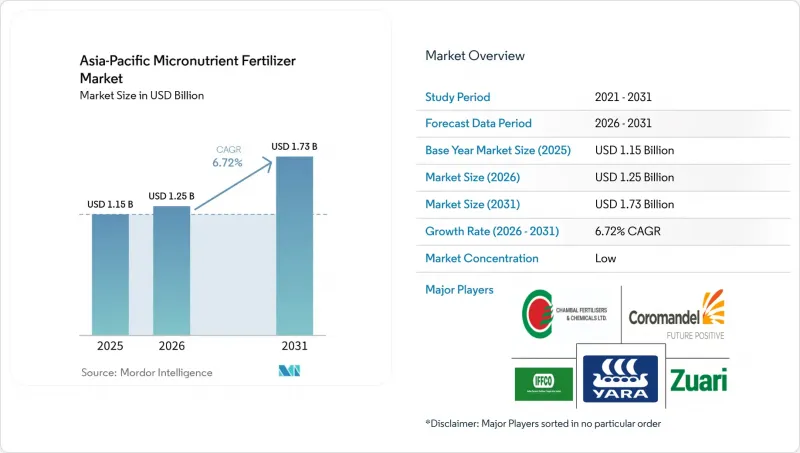
Mordor Intelligence에 의하면, 아시아태평양의 미량영양소 비료 시장 규모는 2025년에 11억 5,000만 달러로 평가되었습니다. 2026년 12억 5,000만 달러에서 2031년까지 17억 3,000만 달러에 이를 것으로 예상되며, 예측 기간(2026-2031년) CAGR은 6.72%를 나타낼 전망입니다.
본 보고서는 제품별(붕소, 구리, 철, 망간, 몰리브덴 등), 시용 방법별(비료 관개, 엽면 시비 등), 작물 유형별(밭작물, 원예작물 등), 지역별(호주, 방글라데시, 중국, 인도 등)로 분류되어 있습니다. 시장 전망은 금액(달러) 및 수량(미터톤) 단위로 제시되어 있습니다.
아시아태평양의 미량영양소 비료 시장 동향 및 인사이트
중국의 아연 보조금 제도가 '숨겨진 기아'의 위기에 대처
중국의 영양 중심 보조금 제도에서는 단순히 수확량을 늘리는 데 그치지 않고, 곡물의 미량영양소 농도를 높이는 아연 강화 비료에 성(省) 차원의 자금을 재분배하고 있습니다. 이 이니셔티브는 제품의 성공 지표를 곡물 내 아연 함량을 기준으로 재정의하고, 공중보건 목표와 농장 차원의 실천을 조화시킴으로써 아시아태평양의 미량영양소 비료 시장을 고부가가치 제제로 이끌고 있습니다. 현장 실증 결과에 따르면, 엽면 시비를 통한 아연의 생물학적 강화 효과는 토양 시비에 비해 55.2% 더 높은 것으로 나타났으며, 이에 따라 차세대 엽면 시비제의 연구 개발이 활발히 진행되고 있습니다. 인접국들이 중국의 프로그램을 주시하며, 그 공중보건상의 성과를 재현하려는 움직임이 파급 효과를 낳고 있어, 전문 공급업체들에게 더 큰 잠재 수요가 창출되고 있습니다.
보호 재배 분야에서 호주에서 일어난 비료 및 관개 혁명
수자원이 부족한 호주에서는 고밀도 재배되는 블루베리 및 기타 온실 과수 작물의 경우, 낭비를 최소화하고 시비 시기를 미세하게 조정하기 위해 시비 관개가 우선적으로 시행되고 있습니다. 이러한 변화로 인해, 프리미엄 가격임에도 불구하고 수확량과 품질의 측정 가능한 향상을 가져다주는 완전 수용성 킬레이트화 미량영양소가 선호되고 있습니다. 초기 도입자들로부터 철분 결핍성 황화증 발생 감소와 수출용 베리류의 경도 향상 등이 보고되고 있으며, 이로 인해 뉴질랜드와 동남아시아의 온실에서 후속 투자가 촉진되고 있습니다. 따라서, 비료 및 관개용지의 재배 면적 확대는 아시아태평양의 미량영양소 비료 시장에서 가장 빠르게 성장하고 있는 용도 분야를 뒷받침하는 요인이 되고 있습니다.
원자재 가격 변동이 시장 접근을 제약
엄격한 환경 규제에 따른 중국의 광산 폐쇄로 인해 고품위 황산아연 광석공급이 제한되고, 원료 비용이 상승하면서, 이는 미량영양소 가격 변동으로 이어지고 있습니다. 유통업체들은 재고 관리에 어려움을 겪고 있어, 정기적인 가격 인상을 피할 수 없는 실정입니다. 이로 인해 소규모 농가의 현금 흐름에 부담이 가중되어 제품의 보급이 저해되고 있습니다. 순도가 더 높은 원료에 의존하는 킬레이트제나 나노 제제는 불균형한 비용 압박에 시달리고 있어, 아시아태평양의 미량영양소 비료 시장에서 이러한 고효능 제품의 채택이 제한되고 있습니다.
부문별 분석
아연은 농업용 토양에서 광범위하게 나타나는 아연 결핍과 작물의 성장, 영양분 흡수, 수확량 증대에 있어 아연이 수행하는 중요한 역할에 힘입어, 2025년에는 아시아태평양의 미량영양소 비료 시장에서 가장 큰 점유율(34.2%)을 차지했습니다. 이 부문은 곡물, 유지종자, 원예 작물 분야에서 폭넓게 채택되고 있는 혜택을 누리고 있을 뿐만 아니라, 킬레이트제, 코팅제, 수용성 제제 분야의 지속적인 제품 혁신을 통해 영양소 이용 효율이 향상되고 있습니다. 주요 농업 경제권에서 정부 주도의 토양 검사 활동과 균형 잡힌 비료 시비 프로그램이 확대되고 있는 것이 아연 수요를 더욱 부추기고 있으며, 아시아태평양의 미량영양소 비료 시장에서 아연의 주도적 지위를 공고히 하고 있습니다.
붕소는 2026년부터 2031년까지 연평균 성장률(CAGR) 9.2%를 나타낼 것으로 예측되며, 가장 빠르게 성장하는 제품 부문이 될 것으로 전망됩니다. 이러한 성장은 개화, 수분, 결실, 품질 향상을 위해 붕소가 필요한 과일, 채소, 유지종자, 플랜테이션 작물의 재배 확대에 힘입어 이루어지고 있습니다. 비료 시비 및 관개, 엽면 시비와 같은 영양 관리 기법의 보급이 확대됨에 따라, 다양한 작물 재배 체계에서 수용성 및 특수 붕소 제제에 대한 수요가 증가하고 있습니다. 한편, 철, 구리, 망간 등의 미량영양소는 작물별 영양 결핍 문제를 지속적으로 해결해 나가고 있으며, 아시아태평양의 미량영양소 비료 시장에서 대량 판매 제품과 부가가치 제품을 모두 아우르는 균형 잡힌 제품 포트폴리오를 확보하고 있습니다.
기타 혜택 :
- 엑셀 형식 시장 예측(ME) 시트
- 3개월간의 애널리스트 지원
자주 묻는 질문
목차
제1장 서론
제2장 보고서의 내용
제3장 주요 요약 및 주요 조사 결과
제4장 주요 업계 동향
제5장 시장 규모 및 성장 예측
제6장 경쟁 구도
제7장 비료 업계 CEO가 직면하는 중요 전략적 과제
KTH 26.07.07According to Mordor Intelligence, the asia-Pacific micronutrient fertilizer market size was valued at USD 1.15 billion in 2025 and estimated to grow from USD 1.25 billion in 2026 to reach USD 1.73 billion by 2031, at a CAGR of 6.72% during the forecast period (2026-2031).
This report is Segmented by Product (Boron, Copper, Iron, Manganese, Molybdenum, and More), Application Mode (Fertigation, Foliar, and More), Crop Type (Field Crops, Horticultural Crops, and More), and Geography (Australia, Bangladesh, China, India, and More). The Market Forecasts are Provided in Terms of Value (USD) and Volume (Metric Tons).
Asia-Pacific Micronutrient Fertilizer Market Trends and Insights
China's Zinc Subsidies Target Hidden Hunger Crisis
China's nutrition-centric subsidy scheme reallocates provincial funds toward zinc-enriched fertilizers that lift grain micronutrient density instead of merely boosting yields. The initiative reframes product success metrics around grain zinc content and aligns public health goals with farm-level practices, pushing the Asia-Pacific micronutrient fertilizer market toward value-added formulations. Field evidence shows foliar zinc delivers 55.2% higher biofortification efficacy than soil application, spurring R&D into next-generation foliar sprays. Multiplier effects arise as neighboring countries monitor China's program to replicate its public health gains, unlocking additional addressable demand for specialized suppliers.
Australia's Fertigation Revolution in Protected Horticulture
Water-scarce Australia prioritizes fertigation to minimize waste and fine-tune nutrient timing for high-density blueberries and other greenhouse fruit crops. This shift favors fully water-soluble chelated micronutrients that command premium pricing yet deliver measurable yield-and-quality gains. Early adopters report reductions in iron chlorosis episodes and improved firmness in export berries, catalyzing copy-cat investments in New Zealand and Southeast Asian greenhouses. Rising fertigation acreage, therefore, underwrites the fastest-growing application segment of the Asia-Pacific micronutrient fertilizer market.
Raw-Material Price Volatility Constrains Market Accessibility
China's mine closures under stringent environmental mandates curtail the supply of high-grade zinc sulfate ores, lifting feedstock costs and cascading into micronutrient price swings. Distributors struggle to hedge inventories, forcing periodic price hikes that strain smallholders' cash flow and hinder uptake. Chelated and nano formulations, which rely on purer inputs, bear disproportionate cost pressure, narrowing the adoption of these high-efficacy options within the Asia-Pacific micronutrient fertilizer market.
Other drivers and restraints analyzed in the detailed report include:
- Digital Platforms Accelerate Precision Micronutrient Applications
- Specialty-Crop Expansion Drives Customized Demand
- Credit Constraints Limit Premium Product Adoption
For complete list of drivers and restraints, kindly check the Table Of Contents.
Segment Analysis
Zinc accounted for the largest Asia-Pacific micronutrient fertilizer market share, 34.2% in 2025, supported by widespread zinc deficiencies across agricultural soils and its critical role in crop growth, nutrient uptake, and yield improvement. The segment benefits from strong adoption across cereals, oilseeds, and horticultural crops, while continued product innovation in chelated, coated, and water-soluble formulations is enhancing nutrient-use efficiency. Growing government-led soil testing initiatives and balanced fertilization programs across major agricultural economies are further supporting zinc demand and reinforcing its leadership position in the Asia-Pacific micronutrient fertilizer market.
Boron is anticipated to be the fastest-growing product segment, with a projected CAGR of 9.2% during 2026 to 2031. This growth is fueled by the increasing cultivation of fruits, vegetables, oilseeds, and plantation crops, which require boron for flowering, pollination, fruit set, and quality improvement. The rising adoption of fertigation and foliar nutrient management practices is boosting demand for soluble and specialty boron formulations across various cropping systems. Meanwhile, micronutrients such as iron, copper, and manganese continue to address crop-specific nutrient deficiencies, ensuring a balanced portfolio of high-volume and value-added products in the Asia-Pacific micronutrient fertilizer market.
Complete Report Scope:
- Product
- Boron
- Copper
- Iron
- Manganese
- Molybdenum
- Zinc
- Others
- Application Mode
- Fertigation
- Foliar
- Soil
- Crop Type
- Field Crops
- Horticultural Crops
- Turf & Ornamental
- Geography
- Australia
- Bangladesh
- China
- India
- Indonesia
- Japan
- Pakistan
- Philippines
- Thailand
- Vietnam
- Rest of Asia-Pacific
List of Companies Covered in this Report:
- Yara International ASA
- Chambal Fertilisers and Chemicals Limited
- Zuari Agro Chemicals Limited
- Coromandel International Limited
- Indian Farmers Fertiliser Cooperative Limited
- Compo Expert GmbH (Grupa Azoty S.A.)
- Haifa Negev Technologies Ltd. (Haifa Group)
- ICL Fertilizers (ICL Group Ltd.)
- Kingenta Ecological Engineering Group Co., Ltd.
- Nutrien Ltd.
- Deepak Fertilisers and Petrochemicals Corporation Limited
- Gujarat State Fertilizers and Chemicals Limited
- OMEX Agriculture Ltd. (OMEX Group)
- Valagro S.p.A. (Syngenta Group)
- Balchem Plant Nutrition (Balchem Corporation)
Additional Benefits:
- The market estimate (ME) sheet in Excel format
- 3 months of analyst support
TABLE OF CONTENTS
1 INTRODUCTION
- 1.1 Study Assumptions & Market Definition
- 1.2 Scope of the Study
- 1.3 Research Methodology
2 REPORT OFFERS
3 EXECUTIVE SUMMARY & KEY FINDINGS
4 KEY INDUSTRY TRENDS
- 4.1 Acreage Of Major Crop Types
- 4.1.1 Field Crops
- 4.1.2 Horticultural Crops
- 4.2 Average Nutrient Application Rates
- 4.2.1 Micronutrients
- 4.2.1.1 Field Crops
- 4.2.1.2 Horticultural Crops
- 4.2.1 Micronutrients
- 4.3 Agricultural Land Equipped For Irrigation
- 4.4 Regulatory Framework
- 4.5 Value Chain & Distribution Channel Analysis
- 4.6 Market Drivers
- 4.6.1 China's Zinc Subsidies Target Hidden Hunger Crisis
- 4.6.2 Australia's Fertigation Revolution in Protected Horticulture
- 4.6.3 India's Soil Health Cards Drive Systematic Micronutrient Testing
- 4.6.4 Digital Platforms Accelerate Precision Micronutrient Applications
- 4.6.5 Specialty-Crop Expansion Drives Customized Demand
- 4.6.6 Consumer Demand for Fortified Foods Spurs Farm-Level Biofortification
- 4.7 Market Restraints
- 4.7.1 Raw-Material Price Volatility Constrains Market Accessibility
- 4.7.2 Credit Constraints Limit Premium Product Adoption
- 4.7.3 Counterfeit Products Erode Farmer Confidence
- 4.7.4 Port Bottlenecks Delay Chelated Micronutrient Exports
5 MARKET SIZE AND GROWTH FORECASTS (VALUE AND VOLUME)
- 5.1 Product
- 5.1.1 Boron
- 5.1.2 Copper
- 5.1.3 Iron
- 5.1.4 Manganese
- 5.1.5 Molybdenum
- 5.1.6 Zinc
- 5.1.7 Others
- 5.2 Application Mode
- 5.2.1 Fertigation
- 5.2.2 Foliar
- 5.2.3 Soil
- 5.3 Crop Type
- 5.3.1 Field Crops
- 5.3.2 Horticultural Crops
- 5.3.3 Turf & Ornamental
- 5.4 Geography
- 5.4.1 Australia
- 5.4.2 Bangladesh
- 5.4.3 China
- 5.4.4 India
- 5.4.5 Indonesia
- 5.4.6 Japan
- 5.4.7 Pakistan
- 5.4.8 Philippines
- 5.4.9 Thailand
- 5.4.10 Vietnam
- 5.4.11 Rest of Asia-Pacific
6 COMPETITIVE LANDSCAPE
- 6.1 Key Strategic Moves
- 6.2 Market Share Analysis
- 6.3 Company Landscape
- 6.4 Company Profiles (Includes Global Level Overview, Market Level Overview, Core Business Segments, Financials, Key Information, Market Rank, Market Share, Products and Services, and Analysis of Recent Developments)
- 6.4.1 Yara International ASA
- 6.4.2 Chambal Fertilisers and Chemicals Limited
- 6.4.3 Zuari Agro Chemicals Limited
- 6.4.4 Coromandel International Limited
- 6.4.5 Indian Farmers Fertiliser Cooperative Limited
- 6.4.6 Compo Expert GmbH (Grupa Azoty S.A.)
- 6.4.7 Haifa Negev Technologies Ltd. (Haifa Group)
- 6.4.8 ICL Fertilizers (ICL Group Ltd.)
- 6.4.9 Kingenta Ecological Engineering Group Co., Ltd.
- 6.4.10 Nutrien Ltd.
- 6.4.11 Deepak Fertilisers and Petrochemicals Corporation Limited
- 6.4.12 Gujarat State Fertilizers and Chemicals Limited
- 6.4.13 OMEX Agriculture Ltd. (OMEX Group)
- 6.4.14 Valagro S.p.A. (Syngenta Group)
- 6.4.15 Balchem Plant Nutrition (Balchem Corporation)


