|
시장보고서
상품코드
2118195
킬레이트화 미량영양소 비료 시장 : 시장 점유율 분석, 업계 동향 및 통계, 성장 예측(2026-2031년)Chelated Micronutrient Fertilizers - Market Share Analysis, Industry Trends & Statistics, Growth Forecasts (2026 - 2031) |
||||||
 Mordor Intelligence
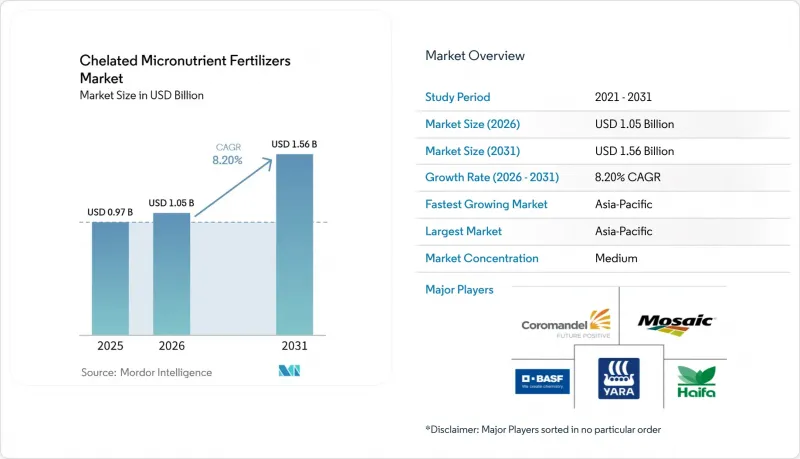
Mordor Intelligence에 의하면, 킬레이트화 미량영양소 비료 시장 규모는 2025년 9억 7,000만 달러로 평가되었고, 2026년 10억 5,000만 달러에서 2031년까지 15억 6,000만 달러로 확대될 것으로 예측되며, 2026-2031년 연평균 성장률(CAGR)은 8.20%를 나타낼 전망입니다.
본 보고서는 미량영양소 유형별(아연, 철, 망간 등), 형태별(건조·액체), 킬레이트제별(EDTA, EDDHA 등), 작물 유형별(과일 및 채소 등), 시비 방법별(비료 관개, 엽면 시비 등), 지역별(북미, 유럽 등)로 분류되어 있습니다. 시장 전망은 금액(달러) 및 수량(메트릭 톤)으로 제시되어 있습니다.
세계의 킬레이트화 미량영양소 비료 시장 동향 및 인사이트
집약적 농업이 이루어지는 토양에서 미량영양소의 고갈이 진행되고 있음
킬레이트화 미량영양소 비료 시장은 미량영양소의 보충 속도를 능가하는 속도로 그 저장량을 고갈시키고 있는 연작 시스템으로부터 강력한 추진력을 얻고 있습니다. 2024년 『Frontiers in Soil Science』 저널에 게재된 연구에 따르면, 인도 28개 주에서 채취한 토양 샘플의 38%에서 아연 결핍이 확인되었으며, 이는 대규모 상업 농업 기반에서 이 농학적 과제의 규모를 뒷받침합니다. 이러한 상업적 영향은 생산성이 높은 관개 지역에서 더욱 두드러지는데, 이곳의 생산자들은 고품질 영양소 보정 프로그램으로 전환하기 위한 경제적 인센티브와 농업적 역량을 모두 갖추고 있습니다. 2024년 『Journal of Soil Science and Plant Nutrition』지에 게재된 연구에 따르면, 아연 제품은 노화, 침출 및 이동을 통해 토양 내 식물 이용 가능분을 잃을 가능성이 있는 것으로 나타났으며, 이는 반복적으로 사용하더라도 안정적인 킬레이트화된 공급이 효과적이라는 실적을 뒷받침합니다. 생산자가 이러한 토양 조건에서 더 신뢰할 수 있는 작물 반응을 확인하게 되면, 저비용 염류로부터의 전환을 되돌리기 어려워지므로, 킬레이트화 미량영양소 비료 시장은 그 수요를 유지할 것으로 보입니다.
정밀 농업으로 인해 처방 기반의 미량영양소 사용이 증가하고 있습니다.
가변 시비 시스템, 원격 감지, 토양 매핑의 보급으로 미량영양소 관리가 더욱 정밀해지고, 사후 대응적인 접근 방식이 줄어들면서 시장은 그 혜택을 보고 있습니다. 2026년 『Research in Applied Water Science』지에서는 정밀 시비 시스템이 센서, 컨트롤러, 주입 장치를 결합하여 광범위 살포 방식으로는 실현할 수 없는 시기와 장소에서 작물별로 최적의 영양소를 공급하는 방법이 설명되었습니다. 이로 인해 농가와 서비스 제공업체가 일관된 안정성, 알려진 흡수 특성, 정밀 기기와의 호환성을 갖춘 제품을 점점 더 요구하게 되면서 조달 행태에 변화가 생기고 있습니다. BASF SE는 2025년 10월, 일본에서 ‘xarvio HEALTHY FIELDS for RiTA’를 출시하며 이러한 개념을 한층 더 발전시켰습니다. 이 서비스는 인공지능(AI)을 활용한 토양 개량 서비스 및 영양 처방 지원과 벼 농가용 수확량 보장 모델을 결합한 것입니다. 이러한 데이터 주도형 프로그램이 보급됨에 따라, 킬레이트화 미량영양소 비료 시장은 범용 혼합형에서 영양 처방 전략에 부합하는 특정 배합으로 전환되는 추세의 혜택을 받고 있습니다.
기존 미량영양소 비료에 비해 높은 비용
킬레이트화 미량영양소 비료 시장에서 가격 책정은 여전히 가장 중요한 구조적 제약 요소로 남아 있습니다. 이는 킬레이트화 제품이 일반적으로 동등한 황산염계 대체품보다 비싸기 때문입니다. 이 가격 차이는 기존 제품의 1.5배에서 2.5배에 달할 수 있어, 투입 예산이 제한된 소규모 농가와 작물에게는 장벽이 되고 있습니다. 시비량을 줄임으로써 그 차이를 어느 정도 상쇄할 수는 있지만, 즉각적인 비용이 여전히 의사결정의 주요 요인이 되는 주곡 작물 프로그램의 경우, 그 절감액만으로는 생산자의 행동을 바꾸기에는 불충분한 경우가 적지 않습니다. 이러한 영향은 곡물 및 기타 범용 작물에서 가장 두드러지며, 이러한 작물의 경우 양호한 농학적 반응이 반드시 설득력 있는 단기적 경제적 이익으로 이어지는 것은 아닙니다. 따라서 킬레이트화 미량영양소 비료 시장은 품질 유지와 수확량 안정성이 더 높은 상업적 가치를 지닌 원예, 수출용 농업, 제어 환경 및 기타 농업 시스템에 집중된 상태가 지속되고 있습니다.
부문 분석
아연은 여전히 가장 큰 영양소 범주로, 2025년에는 킬레이트화 미량영양소 비료 시장의 26.2%를 차지했습니다. 이러한 위상은 아연 결핍이 지리적으로 광범위하게 나타나며, 곡물, 채소 및 원예 시스템 전반에 걸쳐 신뢰할 수 있는 결핍 시정이 실질적으로 필요하다는 점을 반영합니다. MDPI의 학술지 『Plants』에 게재된 2024년 총설에서는 아연이 열대 토양에서 가장 결핍되기 쉬운 미량영양소라고 지적되었으며, 브라질의 세라두 지역 전체에서 아연 상태가 불충분하다고 보고되어 열대 농업에서 아연의 상업적 중요성이 강조되고 있습니다. 철분은 철분의 이용 가능성이 급격히 떨어지는 석회질 토양에서 황화 현상을 시정하는 데 필수적이기 때문에 주요 부문 중 하나가 되었습니다. 또한 망간, 구리, 몰리브덴도 특정 효소 기능, 질소 고정 지원 및 작물별 영양 계획과 관련하여 사용되기 때문에 킬레이트화 미량영양소 비료 시장에서 중요한 역할을 유지하고 있습니다.
붕소는 미량영양소 부문에서 가장 빠른 성장률을 나타낼 것으로 예상되며, 2031년까지 연평균 성장률(CAGR) 9.1%로 확대될 것으로 전망됩니다. 이러한 성장은 과일, 채소, 유지종자의 재배 면적 증가와 관련이 있습니다. 이러한 작물의 경우, 붕소 결핍이 개화, 착과, 종자 형성 및 품질에 직접적인 영향을 미칠 수 있기 때문입니다. 그 상업적 논리는 간단명료합니다. 이러한 작물 체계의 생산자들은 일반적으로 눈에 띄는 돌이킬 수 없는 생산 손실을 방지하기 위한 영양 관리 프로그램에 더 적극적으로 비용을 지출하는 경향이 있기 때문입니다. 철분의 경우, 기술적으로 어려운 토양 조건에서도 계속해서 중요한 역할을 할 것으로 전망됩니다. 이는 더 단순한 제제의 효과가 저하되는 상황에서도 EDDHA 기반공급 방식이 여전히 우수한 성능을 발휘하고 있기 때문입니다. 따라서 영양소의 전반적인 구성은 대규모 결핍 시정과, 규모는 작지만 성장 속도가 빠르고 고부가가치 작물의 생산을 뒷받침하는 특수 용도 사이에서 균형을 유지하고 있습니다.
킬레이트화 미량영양소 비료 시장에서 건조 제제가 가장 큰 점유율을 차지하여 2025년에는 58.4%에 달했습니다. 건조 제품이 이러한 우위를 유지할 수 있었던 이유는 보관이 용이하고, 기존 유통 경로를 통한 이동도 쉬우며, 여전히 표준 취급 시스템에 의존하는 광대한 농지의 재배 프로그램에 적합하기 때문입니다. 또한, 곡물 작물의 대량 조달 관행과 더 긴 저장 기간 및 익숙한 시비 형태를 선호하는 생산자의 요구에도 부합합니다. 이러한 실용적인 장점이 시비 방법이 지속적으로 진화하는 가운데서도 건조 제품이 여전히 판매량의 핵심 카테고리로 남아 있는 이유를 설명해 줍니다.
액체 제제는 가장 빠른 성장세를 기록할 것으로 예상되며, 2031년까지 연평균 성장률(CAGR) 8.8%로 확대될 것으로 전망됩니다. 이러한 변화는 비료 관개, 보호 재배, 수경 재배 및 정확한 용해와 안정적인 영양분 공급이 필요한 기타 시스템의 보급과 밀접한 관련이 있습니다. 또한, 액체 제품은 상업 원예 분야에서 점점 더 선호되는 저용량·고빈도 시비 일정에도 적합합니다. 아울러, 새로운 생분해성 킬레이트제 역시 액체 제품 개발에 자연스럽게 부합합니다. 이는 이러한 제형이 영양소 공급과 취급 편의성, 그리고 시스템과의 호환성을 쉽게 양립시킬 수 있기 때문입니다. 그 결과, 급격한 대체가 아닌 제형의 점진적인 전환이 진행되고 있으며, 기술적으로 진보된 작물 재배 시스템에서는 액체 제품의 점유율이 확대되는 반면, 기존의 시비 모델에서는 건조 제품이 여전히 주류를 차지하고 있습니다.
지역별 분석
아시아태평양은 2025년 킬레이트화 미량영양소 비료 시장 점유율의 25.3%를 차지했으며, 2031년까지 연평균 성장률(CAGR) 8.9%를 기록해 지역별 가장 높은 성장률을 보일 것으로 예측됩니다. 이러한 이중 우위는 중국과 인도의 작물 생산 규모와, 해당 지역의 집약적으로 경작되는 토양 전반에 걸쳐 미해결된 미량영양소 결핍이 심각하다는 점을 반영합니다. 2024년 『Frontiers in Soil Science』 저널이 발표한 인도에 관한 연구에 따르면, 28개 주에서 채취한 토양 샘플의 38%에서 아연 결핍이 확인되어, 이 지역 최대 규모의 농업 시스템 중 하나에서 보다 목표가 명확한 개선책이 필요하다는 점이 부각되었습니다. 또한, 상업 농업에서 점적 관개, 엽면 시비, 작물별 자문 프로그램이 보급됨에 따라 해당 지역에서는 수용성 제품의 채택이 더욱 확대되고 있습니다. BASF SE가 2025년 10월 일본에서 RiTA를 대상으로 ‘xarvio HEALTHY FIELDS’를 출시한 것은 디지털 농업학과 미량영양소 처방전을 서비스 주도형 모델에 통합할 수 있음을 보여주며, 이는 킬레이트화 미량영양소 비료 시장의 향후 방향성에 있어 중요합니다.
유럽은 킬레이트화 미량영양소 비료 시장에서 중요한 위치를 차지해 왔습니다. 이는 해당 지역의 생산자들이 더욱 엄격한 식품 품질 요건 하에서 농사를 짓고, 보다 충실한 농업 지원 체계를 갖추고 있으며, 정밀 시비 기술에 대한 접근성도 광범위하기 때문입니다. 스페인, 이탈리아, 독일, 프랑스는 여전히 중심적인 위치를 차지하고 있습니다. 이는 지중해식 원예 및 다년생 작물 생산 시스템에서 집약적인 생산 조건 하에서 신뢰할 수 있는 미량영양소의 성능이 요구되기 때문입니다. 규제 환경도 더욱 엄격하며, 특히 유럽연합(EU)의 비료 규제와 지속가능성에 대한 기대에 부합해야 하는 제품 포트폴리오의 경우 더욱 그렇습니다. 그 결과, 생분해성 킬레이트제는 다른 많은 지역보다 유럽에서 그 중요성이 더욱 커지고 있습니다. 따라서 이 지역은 현지 수요뿐만 아니라 여러 시장에 서비스를 제공하는 공급업체의 세계 배합 전략에도 영향을 미치고 있습니다.
북미와 남미는 모두 장기적인 성장에 중요한 지역이지만, 킬레이트화 미량영양소 비료 시장 수요 구조에는 차이가 나타났습니다. 북미에서는 정밀 농업이 더욱 성숙해져 있으며, 비료 시비 및 관개, 가변 시비율 시스템, 상세한 토양 관리가 특산 작물 및 첨단 줄뿌림 작물 재배에 도입되는 데 박차를 가하고 있습니다. 반면, 남미는 열대 및 아열대 지역의 농업 현실과 밀접하게 연결되어 있으며, 특히 브라질에서는 대규모 경작 시스템에서 아연과 붕소의 결핍이 여전히 중요한 과제로 남아 있습니다. 중동 및 아프리카는 판매량이 아직 소규모이긴 하지만, 온실 재배, 수출용 원예, 그리고 물 사용에 대한 엄격한 관리가 깨끗하고 효율적인 미량영양소 공급을 뒷받침하고 있어 전략적으로 중요한 지역이 되고 있습니다. 이 지역 전반에 걸쳐 생산자들이 관개 관리, 상업 작물의 집약화, 그리고 보다 안정적인 영양분 흡수에 대한 명확한 요구를 결합함에 따라, 킬레이트 처리된 미량영양소 비료 시장은 확대되고 있습니다.
기타 혜택 :
- 엑셀 형식 시장 예측(ME) 시트
- 3개월간의 애널리스트 지원
자주 묻는 질문
목차
제1장 서론
제2장 본 보고서의 내용
제3장 개요 및 주요 조사 결과
제4장 주요 업계 동향
제5장 시장 규모 및 성장 예측
제6장 경쟁 구도
제7장 비료 업계의 CEO가 직면하는 중요한 전략적 과제
AJY 26.09.01According to Mordor Intelligence, the chelated micronutrient fertilizers market size is projected to expand from USD 0.97 billion in 2025 and USD 1.05 billion in 2026 to USD 1.56 billion by 2031, registering a CAGR of 8.20% between 2026 and 2031.
This report is Segmented by Micronutrient Type (Zinc, Iron, Manganese, and More), by Form (Dry and Liquid), by Chelating Agent (EDTA, EDDHA, and More), by Crop Type (Fruits and Vegetables, and More), by Application Mode (Fertigation, Foliar, and More), and by Geography (North America, Europe, and More). The Market Forecasts are Provided in Terms of Value (USD) and Volume (Metric Tons).
Global Chelated Micronutrient Fertilizers Market Trends and Insights
Rising Micronutrient Depletion in Intensively Farmed Soils
The chelated micronutrient fertilizers market is seeing strong support from continuous cropping systems that are depleting micronutrient reserves faster than they are replenished. A 2024 study in Frontiers in Soil Science reported that zinc deficiency in India was documented in 38% of soil samples collected across 28 states, confirming the scale of the agronomic problem in a large commercial farming base . The commercial effect is stronger in productive irrigation belts, where growers have both the economic incentive and the agronomic capability to shift toward premium nutrient correction programs. Research published in the Journal of Soil Science and Plant Nutrition in 2024 showed that zinc products can lose plant-available fractions in soil through aging, leaching, and migration, supporting the performance case for stable chelated delivery under repeated use. Once growers see more reliable crop response under these soil conditions, the chelated micronutrient fertilizers market tends to retain that demand because the move away from low-cost salts becomes harder to reverse.
Precision Agriculture is Increasing Prescription-Based Micronutrient Use
The market is benefiting from the spread of variable-rate systems, remote sensing, and soil mapping, which make micronutrient management more targeted and less reactive. Research in Applied Water Science in 2026 described how precision fertigation systems combine sensors, controllers, and injection units to deliver crop-specific nutrients with timing and placement that broadcast methods cannot match. This changes procurement behavior because growers and service providers increasingly want products with consistent stability, known uptake behavior, and compatibility with precision equipment. BASF SE expanded this logic in October 2025 when it launched xarvio HEALTHY FIELDS for RiTA in Japan, combining artificial intelligence-based soil improvement services and nutrient prescription support with a yield guarantee model for rice farmers. As these data-led programs become more common, the chelated micronutrient fertilizers market gains from the shift away from generic blends and toward defined formulations that fit prescription nutrition strategies.
Higher Cost Versus Conventional Micronutrient Inputs
Pricing remains the most significant structural constraint in the chelated micronutrient fertilizers market, as chelated products typically cost more than comparable sulfate-based alternatives. This premium can range from 1.5 to 2.5 times the cost of conventional options, creating a barrier for smallholder farming systems and crops with limited input budgets. Lower application rates help offset that difference, but the saving is often not enough to change grower behavior in staple crop programs where immediate cost still drives decisions. The effect is strongest in cereals and other commodity crops, where a favorable agronomic response does not always translate into a convincing short-term economic return. That keeps the chelated micronutrient fertilizers market more concentrated in horticulture, export agriculture, controlled environments, and other farm systems where quality protection and yield stability carry higher commercial value.
Other drivers and restraints analyzed in the detailed report include:
- Yield Protection in High-Value Crops is Supporting Chelated Formulations
- Water-Soluble Chelates are Expanding Fertigation Compatibility
- Regulatory Scrutiny Around Chelating Agent Persistence and Environmental Fate
For complete list of drivers and restraints, kindly check the Table Of Contents.
Segment Analysis
Zinc remained the largest nutrient category, accounting for 26.2% of the chelated micronutrient fertilizers market in 2025. This position reflects the broad geographic spread of zinc deficiency and the practical need for dependable correction across grain, vegetable, and horticultural systems. A 2024 review in Plants from MDPI noted that zinc is the most deficient micronutrient in tropical soils and reported weak zinc status across Brazil's Cerrado region, underscoring its commercial relevance in tropical agriculture. Iron is one of the major segments because it remains essential for correcting chlorosis in calcareous soils, where iron availability breaks down quickly. Manganese, copper, and molybdenum also retained a role in the chelated micronutrient fertilizers market because their use is tied to specific enzyme functions, nitrogen fixation support, and crop-specific nutrition plans.
Boron is projected to register the fastest growth among micronutrient categories, expanding at a 9.1% CAGR through 2031. That growth is tied to rising acreage for fruit, vegetables, and oilseeds, where boron deficiency can directly affect flowering, fruit set, seed development, and quality. The commercial logic is straightforward: growers in these crop systems are usually more willing to pay for nutrient programs that prevent visible, irreversible production losses. Iron is likely to remain important in technically difficult soils because EDDHA-based delivery continues to offer strong performance, even as simpler formulations lose effectiveness. The broader nutrient mix, therefore, remains balanced between large-volume deficiency correction and smaller, but faster-growing, specialty uses that support higher-value crop production.
Dry formulations accounted for the largest share of the chelated micronutrient fertilizers market, representing 58.4% in 2025. Dry products kept this lead because they are easier to store, easier to move through conventional distribution channels, and better suited to broad-acre programs that still depend on standard handling systems. They also align well with bulk procurement practices for grain crops and with growers who prefer longer shelf life and familiar application formats. These practical advantages help explain why dry products remain the base volume category even as application methods continue to evolve.
Liquid formulations are projected to register the fastest growth, expanding at a CAGR of 8.8% through 2031. This shift is closely linked to the wider use of fertigation, protected cultivation, hydroponics, and other systems that require accurate dissolution and stable nutrient delivery. Liquid products are also better aligned with low-dose, high-frequency feeding schedules that commercial horticulture increasingly prefers. Newer biodegradable chelates also fit naturally into liquid product development because these formats make it easier to combine nutrient delivery with handling convenience and system compatibility. The result is a gradual form transition, not a sudden replacement, with liquids gaining share in technically advanced crop systems while dry products continue to dominate older application models.
Complete Report Scope:
- By Micronutrient Type
- Zinc
- Iron
- Manganese
- Boron
- Copper
- Molybdenum
- Other Micronutrient Types
- By Form
- Dry
- Liquid
- By Chelating Agent
- EDTA
- EDDHA
- DTPA
- IDHA
- Other Chelating Agents
- By Crop Type
- Fruits and Vegetables
- Cereals and Grains
- Oilseeds and Pulses
- Other Crop Types
- By Application
- Foliar
- Soil
- Fertigation
- Seed Treatment
- By Geography
- North America
- United States
- Canada
- Rest of North America
- South America
- Brazil
- Argentina
- Rest of South America
- Europe
- Germany
- France
- United Kingdom
- Italy
- Spain
- Russia
- Rest of Europe
- Asia-Pacific
- China
- India
- Japan
- South Korea
- Australia
- Rest of Asia-Pacific
- Middle East
- Saudi Arabia
- United Arab Emirates
- Turkey
- Rest of Middle East
- Africa
- South Africa
- Egypt
- Nigeria
- Rest of Africa
- North America
Geography Analysis
Asia-Pacific accounted for 25.3% of the chelated micronutrient fertilizers market share in 2025 and is also projected to post the fastest regional CAGR of 8.9% through 2031. This dual lead reflects the scale of crop production in China and India and the depth of unresolved micronutrient deficiency across intensively farmed soils in the region. The 2024 Frontiers in Soil Science study on India confirmed zinc deficiency in 38% of sampled soils from 28 states, underscoring the need for more targeted correction in one of the region's largest agricultural systems. The region is also seeing stronger adoption of water-soluble products as drip irrigation, foliar feeding, and crop-specific advisory programs become more common in commercial farming. BASF SE's October 2025 launch of xarvio HEALTHY FIELDS for RiTA in Japan showed how digital agronomy and micronutrient prescription can be bundled into service-led models, which is important for the future direction of the chelated micronutrient fertilizers market.
Europe held a significant position in the chelated micronutrient fertilizers market because growers there operate with tighter food quality requirements, stronger agronomic support systems, and broader access to precision application technology. Spain, Italy, Germany, and France remain central because Mediterranean horticulture and permanent crop systems need reliable micronutrient performance under intensive production conditions. The regulatory setting is also more demanding, especially for product portfolios that must align with European Union fertilizer rules and sustainability expectations. That is why biodegradable chelates are becoming more relevant in Europe than in many other regions. The region, therefore, influences not only local demand but also global formulation strategies for suppliers serving multiple markets.
North America and South America showed different demand structures within the chelated micronutrient fertilizers market, even though both regions are important to long-term growth. North America reflects greater maturity in precision farming, where fertigation, variable-rate systems, and detailed soil management support adoption in specialty crops and advanced row-crop operations. South America is more strongly tied to the agronomic realities of tropical and subtropical production, especially in Brazil, where zinc and boron deficiencies remain important in large-scale cropping systems. The Middle East and Africa remain smaller in volume, but they are strategically relevant because greenhouse production, export horticulture, and water-use discipline favor clean and efficient micronutrient delivery. Across these regions, the chelated micronutrient fertilizers market is strengthening as growers combine irrigation control, commercial crop intensity, and a clear need for more stable nutrient uptake.
- BASF SE
- The Mosaic Company
- Haifa Group
- Yara International ASA
- Coromandel International Limited
- Nouryon Chemicals Holding B.V.
- Valagro S.p.A.
- ADOB Sp. z o.o. Sp.j.
- ATP Nutrition, LLC
- BMS Micro-Nutrients B.V.
- Van Iperen International B.V.
- Wilbur-Ellis Company LLC
- ICL Group Ltd.
- The Andersons, Inc.
- Nufarm Limited
Additional Benefits:
- The market estimate (ME) sheet in Excel format
- 3 months of analyst support
TABLE OF CONTENTS
1 INTRODUCTION
- 1.1 Study Assumptions and Market Definition
- 1.2 Scope of the Study
- 1.3 Research Methodology
2 REPORT OFFERS
3 EXECUTIVE SUMMARY AND KEY FINDINGS
4 KEY INDUSTRY TRENDS
- 4.1 Acreage of Major Crop Types
- 4.1.1 Field Crops
- 4.1.2 Horticultural Crops
- 4.1.3 Turf and Ornamental
- 4.2 Average Nutrient Application Rates
- 4.2.1 Primary Nutrients
- 4.2.1.1 Field Crops
- 4.2.1.2 Horticultural Crops
- 4.2.1.3 Turf and Ornamental
- 4.2.1 Primary Nutrients
- 4.3 Regulatory Framework
- 4.4 Value Chain and Distribution Channel Analysis
- 4.5 Market Drivers
- 4.5.1 Rising micronutrient depletion in intensively farmed soils
- 4.5.2 Precision agriculture is increasing prescription-based micronutrient use
- 4.5.3 Yield protection in high-value crops is supporting chelated formulations
- 4.5.4 Water-soluble chelates are expanding fertigation compatibility
- 4.5.5 Sustainability pressure is accelerating low-dose nutrient efficiency adoption
- 4.5.6 Bioavailability advantage over conventional micronutrient salts is driving conversion
- 4.6 Market Restraints
- 4.6.1 Higher cost versus conventional micronutrient inputs
- 4.6.2 Farmer misapplication risk from incompatible tank mixes
- 4.6.3 Variable performance across soil pH and water hardness conditions
- 4.6.4 Regulatory scrutiny around chelating agent persistence and environmental fate
5 MARKET SIZE AND GROWTH FORECASTS (VALUE AND VOLUME)
- 5.1 By Micronutrient Type
- 5.1.1 Zinc
- 5.1.2 Iron
- 5.1.3 Manganese
- 5.1.4 Boron
- 5.1.5 Copper
- 5.1.6 Molybdenum
- 5.1.7 Other Micronutrient Types
- 5.2 By Form
- 5.2.1 Dry
- 5.2.2 Liquid
- 5.3 By Chelating Agent
- 5.3.1 EDTA
- 5.3.2 EDDHA
- 5.3.3 DTPA
- 5.3.4 IDHA
- 5.3.5 Other Chelating Agents
- 5.4 By Crop Type
- 5.4.1 Fruits and Vegetables
- 5.4.2 Cereals and Grains
- 5.4.3 Oilseeds and Pulses
- 5.4.4 Other Crop Types
- 5.5 By Application
- 5.5.1 Foliar
- 5.5.2 Soil
- 5.5.3 Fertigation
- 5.5.4 Seed Treatment
- 5.6 By Geography
- 5.6.1 North America
- 5.6.1.1 United States
- 5.6.1.2 Canada
- 5.6.1.3 Rest of North America
- 5.6.2 South America
- 5.6.2.1 Brazil
- 5.6.2.2 Argentina
- 5.6.2.3 Rest of South America
- 5.6.3 Europe
- 5.6.3.1 Germany
- 5.6.3.2 France
- 5.6.3.3 United Kingdom
- 5.6.3.4 Italy
- 5.6.3.5 Spain
- 5.6.3.6 Russia
- 5.6.3.7 Rest of Europe
- 5.6.4 Asia-Pacific
- 5.6.4.1 China
- 5.6.4.2 India
- 5.6.4.3 Japan
- 5.6.4.4 South Korea
- 5.6.4.5 Australia
- 5.6.4.6 Rest of Asia-Pacific
- 5.6.5 Middle East
- 5.6.5.1 Saudi Arabia
- 5.6.5.2 United Arab Emirates
- 5.6.5.3 Turkey
- 5.6.5.4 Rest of Middle East
- 5.6.6 Africa
- 5.6.6.1 South Africa
- 5.6.6.2 Egypt
- 5.6.6.3 Nigeria
- 5.6.6.4 Rest of Africa
- 5.6.1 North America
6 COMPETITIVE LANDSCAPE
- 6.1 Market Concentration
- 6.2 Strategic Moves
- 6.3 Market Share Analysis
- 6.4 Company Profiles (Includes Global Level Overview, Market Level Overview, Core Business Segments, Financials, Key Information, Market Rank, Market Share, Products and Services, and Analysis of Recent Developments)
- 6.4.1 BASF SE
- 6.4.2 The Mosaic Company
- 6.4.3 Haifa Group
- 6.4.4 Yara International ASA
- 6.4.5 Coromandel International Limited
- 6.4.6 Nouryon Chemicals Holding B.V.
- 6.4.7 Valagro S.p.A.
- 6.4.8 ADOB Sp. z o.o. Sp.j.
- 6.4.9 ATP Nutrition, LLC
- 6.4.10 BMS Micro-Nutrients B.V.
- 6.4.11 Van Iperen International B.V.
- 6.4.12 Wilbur-Ellis Company LLC
- 6.4.13 ICL Group Ltd.
- 6.4.14 The Andersons, Inc.
- 6.4.15 Nufarm Limited