

|
시장보고서
상품코드
2099327
유럽의 미량영양소 비료 : 시장 점유율 분석, 업계 동향 및 통계, 성장 예측(2026-2031년)Europe Micronutrient Fertilizers - Market Share Analysis, Industry Trends & Statistics, Growth Forecasts (2026 - 2031) |
||||||
 Mordor Intelligence
Mordor Intelligence에 의하면, 유럽의 미량영양소 비료 시장 규모는 2025년에 7억 3,000만 달러로 평가되었습니다. 2026년 7억 9,000만 달러에서 2031년까지 11억 6,000만 달러에 이를 것으로 예상되며, 예측 기간(2026-2031년) CAGR은 6.95%를 나타낼 전망입니다.
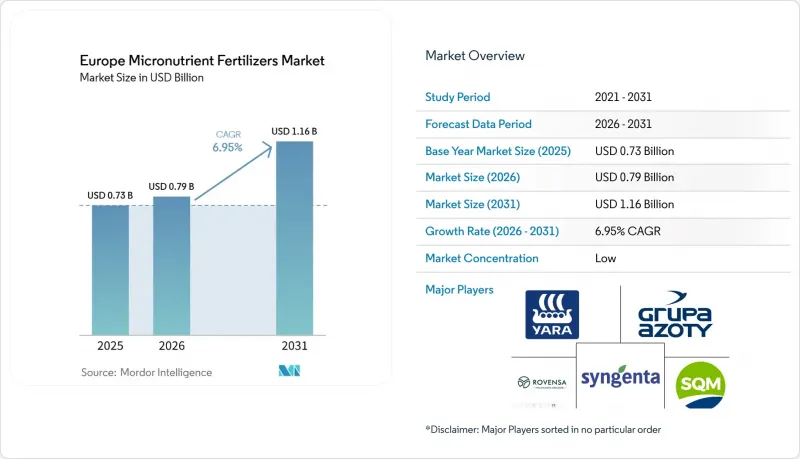
본 보고서는 제품별(붕소, 구리, 철 등), 시비 방법별(시비 관개, 엽면 시비 등), 작물 유형별(밭작물, 원예작물 등), 지역별(프랑스, 독일, 이탈리아 등)로 분류되어 있습니다. 시장 전망은 금액(달러) 및 수량(메트릭 톤)으로 제시되어 있습니다.
유럽의 미량영양소 비료 시장 동향과 인사이트
정밀 농업이 주도하는 토양 미량영양소 매핑
가변률 토양 분석은 유럽의 미량영양소 비료 시장에서 농가가 미량영양소를 구매하는 방식을 변화시키고 있으며, 일률적인 시비 계획에서 포장별 개별 구매로 전환되고 있습니다. GPS 및 GIS와 연동된 고밀도 그리드 샘플링을 통해, 기존의 광범위한 분석 기법으로는 파악할 수 없었던 미량영양소 결핍을 농가가 특정할 수 있게 되었습니다. 2024년 2월부터 시작되어 EU로부터 359만 유로(387만 달러)의 자금을 지원받고 있는 ‘토양 품질 평가·매핑 도구(SQAT)’ 프로젝트에서는 현장에서 토양 분석을 수행하기 위한 로봇 탑재형 센서 개발이 진행되고 있습니다. 이 프로젝트는 2027년 7월까지 유럽의 7개 중소기업을 통해 상용화를 목표로 하고 있으며, 기술 적용에 있어서는 단순한 실험실 작업에 그치지 않고 실용적인 농장 활용에 중점을 두고 있습니다. 또한 매핑 기술의 향상으로 인해 남유럽 및 동유럽의 석회질 토양에서 아연과 망간의 결핍 현상도 점차 밝혀지고 있습니다. 이러한 지역에서는 눈에 보이는 수요가 여전히 현장 데이터를 통해 밝혀지고 있는 농학적 필요량을 따라가지 못하고 있습니다. 이는 유럽의 미량영양소 비료 시장에 있어 중요한 의미를 지닙니다. 왜냐하면 미래 수요의 상당 부분은 단순한 경작 면적 확대가 아니라 진단 기술의 향상에 의해 주도될 가능성이 있기 때문입니다.
공통농업정책(CAP)의 에코 스킴에 따른 인센티브
CAP(공통농업정책) 2023-2027년 프레임워크에 따라, 유럽의 미량영양소 비료 시장 전반에서 영양 계획이 농장 의사결정 과정에서 더욱 공식적인 위치를 차지하고 있습니다. 미량영양소 구매는 단순한 비정기적 시정 조치로 취급되는 것이 아니라, 문서화된 토양 검사, 재배 계획 및 농업 자문가의 검토와 연계되는 사례가 늘고 있습니다. 2026년 5월에 채택된 유럽위원회의 ‘비료 행동 계획’에서는 CAP 전략 계획 내 농업 자문 서비스 강화와 영양소 이용 효율 및 바이오 투입물에 대한 명확한 지원이 요구되고 있습니다. 이러한 정책 방향은 보다 정기적인 미량영양소 감사를 촉진하여, 눈에 띄는 작물 스트레스가 발생하기 전에 결핍을 파악할 가능성을 높입니다. 또한, 농장 차원의 규정 준수 및 기록 관리를 더욱 중시하고 있어, 이를 통해 특수 영양제를 보다 일관되게 시비하는 체계적인 생산자에게 유리하게 작용하는 경향이 있습니다. 이러한 상황에서 영양 관리가 비정기적인 구매 결정이 아닌 일상적인 농장 운영의 일부가 됨에 따라, 유럽의 미량영양소 비료 시장은 보다 안정적인 수요 기반을 확보하게 될 것입니다.
금속계 원자재 가격 변동
아연, 구리, 황산망간의 가격은 여전히 원자재 가격 변동의 영향을 받기 쉬우며, 이는 유럽의 미량영양소 비료 시장에서 제조업체의 이익률을 압박할 가능성이 있습니다. 투입 비용이 급등할 경우, 공급업체는 종종 그 상승분의 일부를 농가에 전가하게 되며, 그 결과 당장 필요하다고 간주되지 않는 특수 제품의 구매가 지연될 가능성이 있습니다. 망간이 유럽의 미량영양소 비료 시장에서 가장 빠르게 성장하고 있는 제품 부문이라는 점을 고려할 때, 이 위험은 심각합니다. 공급 차질이나 원가 상승은 공급업체들이 가장 적극적으로 확장을 모색하고 있는 이 부문의 성장을 둔화시킬 가능성이 있습니다. 이로 인해 성장 잠재력은 여전히 매력적이지만, 수익 전망과 실현 시기는 원자재 시세에 크게 좌우되는 어려운 상황이 발생하고 있습니다.
부문 분석
아연은 2025년 시점에서 유럽 미량영양소 비료 시장 점유율의 29.2%를 차지했습니다. 이는 식물의 흡수가 구조적으로 제한되는 석회질 토양이나 고pH 토양에서 밀, 옥수수, 해바라기 재배 체계 전반에 걸쳐 아연이 폭넓은 역할을 수행하고 있음을 반영합니다. 이러한 폭넓은 농업학적 의의로 인해 아연은 유럽의 미량영양소 비료 시장에서 계속해서 중심적인 위치를 차지하고 있습니다. 이는 이 문제가 농업 관행과 마찬가지로 토양 화학에도 뿌리를 두고 있기 때문입니다. 망간은 2026년부터 2031년에 걸쳐 연평균 성장률(CAGR) 7.90%로 확대될 것으로 예측됩니다. 이는 반복되는 재배 주기로 인해 지속적인 보충이 필요한 온실 원예 및 무토양 재배 시스템에 힘입은 결과입니다. 구리와 철분 또한 뚜렷한 역할을 유지하고 있으며, 구리는 결핍이 발생하기 쉬운 지역의 곡물 및 유채와 관련이 있고, 철 킬레이트제는 알칼리성 과수원, 포도원, 채소 재배 시스템에서 널리 사용되고 있습니다.
붕소는 이 지역의 몇몇 대규모 농업 국가에서 유채, 해바라기, 사탕무 등 수분에 민감한 작물에서 여전히 중요한 역할을 하고 있습니다. 몰리브덴의 절대적인 수요는 여전히 소규모이지만, 콩과 작물 재배에서 안정적인 위치를 차지하고 있습니다. 또한, 망간 분야에는 특유의 조달 리스크가 있어, 다른 몇몇 제품군에 비해 원자재 계획의 리스크가 높습니다. 아울러 ‘토양 품질 분석 도구(SQAT)’를 활용한 정밀 매핑 노력으로 인해 모든 작물 체계에서 미량영양소가 부족한 구획을 식별하는 정확도가 향상되어, 유럽의 미량영양소 비료 산업 전반에 걸쳐 보다 타겟이 명확한 수요 창출이 촉진될 전망입니다.
기타 혜택 :
- 엑셀 형식 시장 예측(ME) 시트
- 3개월간의 애널리스트 지원
자주 묻는 질문
목차
제1장 서론
제2장 개 보고서의 내용
제3장 주요 요약 및 주요 조사 결과
제4장 주요 산업 동향
제5장 시장 규모 및 성장 예측
제6장 경쟁 구도
제7장 이해관계자에게 향한 주요 전략적 과제
KTH 26.08.10According to Mordor Intelligence, the Europe micronutrient fertilizers market size was valued at USD 0.73 billion in 2025 and is estimated to grow from USD 0.79 billion in 2026 to reach USD 1.16 billion by 2031, at a CAGR of 6.95% during the forecast period (2026-2031).
This report is Segmented by Product (Boron, Copper, Iron, and More), by Application Mode (Fertigation, Foliar, and More), by Crop Type (Field Crops, Horticultural Crops, and More), and by Geography (France, Germany, Italy, and More). The Market Forecasts are Provided in Terms of Value (USD) and Volume (Metric Tons).
Europe Micronutrient Fertilizers Market Trends and Insights
Precision Agriculture Led Soil Micronutrient Mapping
Variable-rate soil testing is changing how farmers purchase micronutrients in the Europe micronutrient fertilizer market, replacing blanket programs with field-specific purchases. GPS and GIS-linked sampling at fine grid density is helping farms identify micronutrient deficiencies that were not visible under broader testing practices. The Soil Quality Assessment and mapping Tool (SQAT) project, active since February 2024 with EUR 3.59 million (USD 3.87 million) in EU funding, is developing robot-mounted sensors for in situ soil analysis. The project is targeting commercialization through 7 European SMEs by July 2027, keeping the technology application focused on practical farm use rather than laboratory work alone. Improved mapping is also revealing zinc and manganese deficiencies in calcareous soils across Southern and Eastern Europe, where visible demand still trails the agronomic need that field data is beginning to expose. For the Europe micronutrient fertilizer market, this is significant because a larger share of future demand may be driven by improved diagnosis rather than simple acreage expansion.
Common Agricultural Policy Eco-Scheme Incentives
The CAP 2023-2027 framework is making nutrient planning a more formal part of farm decision-making across the European micronutrient fertilizer market. Micronutrient purchases are increasingly tied to documented soil testing, crop planning, and advisory review, rather than being treated as occasional corrective inputs. The European Commission's Fertilizer Action Plan, adopted in May 2026, calls for stronger Farm Advisory Services within CAP Strategic Plans and explicit support for nutrient use efficiency and bio-based inputs. This policy direction supports more regular micronutrient audits and increases the likelihood that deficiencies are identified before visible crop stress occurs. It also places greater emphasis on compliance and recordkeeping at the farm level, which tends to favor better-organized growers that apply specialty nutrition more consistently. In this context, the European micronutrient fertilizer market gains a more stable demand base, as nutrient management becomes part of routine farm administration rather than an irregular purchase decision.
Metal-Based Raw Material Price Volatility
Prices for zinc, copper, and manganese sulfate remain exposed to commodity fluctuations, which can narrow manufacturer margins in the Europe micronutrient fertilizer market. When input costs rise sharply, suppliers often pass part of the increase to farmers, which can delay purchases of specialty products not viewed as immediately necessary. This exposure is significant given that manganese is also the fastest-growing product segment in the Europe micronutrient fertilizer market. Any supply disruption or cost increase can slow the segment that suppliers are most actively trying to scale. This creates a challenging dynamic where growth remains attractive, but earnings visibility and timing are heavily dependent on raw material conditions.
Other drivers and restraints analyzed in the detailed report include:
- Rising Demand for High-Value Horticultural Crops
- Shift Toward Chelated Liquid and Water-Soluble Formulations
- Competition from Biological Inoculants and Biofertilizers
For complete list of drivers and restraints, kindly check the Table Of Contents.
Segment Analysis
Zinc held 29.2% of the Europe micronutrient fertilizer market share in 2025, reflecting its broad role across wheat, maize, and sunflower systems in calcareous and high-pH soils where plant availability is structurally constrained. This wide agronomic relevance keeps zinc central to the Europe micronutrient fertilizer market, as the issue is rooted in soil chemistry as much as in farm practice. Manganese is anticipated to expand at a 7.90% CAGR from 2026 to 2031, supported by greenhouse horticulture and soilless systems where repeated crop cycles require constant replenishment. Copper and iron also retain clear roles, with copper linked to cereals and oilseed rape in deficiency-prone areas and iron chelates used widely in alkaline orchards, vineyards, and vegetable systems.
Boron remains important in pollination-sensitive crops such as oilseed rape, sunflower, and sugar beet across several large farming countries in the region. Molybdenum remains smaller in absolute demand but holds a stable place in legume cultivation. The manganese segment also carries a distinct procurement risk, making raw material planning more exposed than in several other product lines. The Soil Quality Analysis Tool (SQAT) precision mapping effort is also likely to improve the identification of micronutrient-deficient parcels across crop systems, supporting more targeted demand across the Europe micronutrient fertilizer industry.
Complete Report Scope:
- Product
- Boron
- Copper
- Iron
- Manganese
- Molybdenum
- Zinc
- Others
- Application Mode
- Fertigation
- Foliar
- Soil
- Crop Type
- Field Crops
- Horticultural Crops
- Turf and Ornamental
- By Geography
- France
- Germany
- Italy
- Netherlands
- Russia
- Spain
- Ukraine
- United Kingdom
- Rest Of Europe
List of Companies Covered in this Report:
- Yara International ASA
- Compo Expert GmbH (Grupa Azoty S.A.)
- Sociedad Quimica y Minera de Chile S.A.
- Trade Corporation International (Rovensa Group)
- Valagro S.p.A. (Syngenta Group)
- BASF SE
- Triton Partners (Fertiberia)
- Haifa Group
- ICL Group Ltd.
- K+S Aktiengesellschaft
- Nutrien Ltd.
- Timac Agro SAS (Groupe Roullier)
- Verdesian Life Sciences LLC (AEA Investors)
- EuroChem Group AG
- AGLUKON Spezialduenger GmbH and Co. KG
Additional Benefits:
- The market estimate (ME) sheet in Excel format
- 3 months of analyst support
TABLE OF CONTENTS
1 INTRODUCTION
- 1.1 Study Assumptions and Market Definition
- 1.2 Scope of the Study
- 1.3 Research Methodology
2 REPORT OFFERS
3 EXECUTIVE SUMMARY AND KEY FINDINGS
4 KEY INDUSTRIES TRENDS
- 4.1 Acreage of Major Crop Types
- 4.1.1 Field Crops
- 4.1.2 Horticultural Crops
- 4.2 Average Nutrient Application Rates
- 4.2.1 Micronutrients
- 4.2.1.1 Field Crops
- 4.2.1.2 Horticultural Crops
- 4.2.1 Micronutrients
- 4.3 Agricultural Land Equipped for Irrigation
- 4.4 Regulatory Framework
- 4.5 Pricing Analysis
- 4.6 Market Drivers
- 4.6.1 Precision agriculture led soil micronutrient mapping
- 4.6.2 CAP eco schemes initiative
- 4.6.3 Rising demand for high-value horticultural crops
- 4.6.4 Shift toward chelated liquid and water-soluble formulations
- 4.6.5 Digital agronomic advisory platforms boosting adoption
- 4.6.6 Post-brexit fast-track micronutrient registrations in the United Kingdom
- 4.7 Market Restraints
- 4.7.1 Metal-based raw material price volatility
- 4.7.2 European union heavy metal contaminant limit
- 4.7.3 Bio-fortification policies reducing external application
- 4.7.4 Competition from biological inoculants and biofertilizers
5 MARKET SIZE AND GROWTH FORECASTS (VALUE AND VOLUME)
- 5.1 Product
- 5.1.1 Boron
- 5.1.2 Copper
- 5.1.3 Iron
- 5.1.4 Manganese
- 5.1.5 Molybdenum
- 5.1.6 Zinc
- 5.1.7 Others
- 5.2 Application Mode
- 5.2.1 Fertigation
- 5.2.2 Foliar
- 5.2.3 Soil
- 5.3 Crop Type
- 5.3.1 Field Crops
- 5.3.2 Horticultural Crops
- 5.3.3 Turf and Ornamental
- 5.4 By Geography
- 5.4.1 France
- 5.4.2 Germany
- 5.4.3 Italy
- 5.4.4 Netherlands
- 5.4.5 Russia
- 5.4.6 Spain
- 5.4.7 Ukraine
- 5.4.8 United Kingdom
- 5.4.9 Rest Of Europe
6 COMPETITIVE LANDSCAPE
- 6.1 Market Concentration
- 6.2 Strategic Moves
- 6.3 Market Share Analysis
- 6.4 Company Profiles (Includes Global Overview, Market Overview, Core Segments, Financials, Strategic Information, Market Rank/Share, Products and Services, and Recent Developments)
- 6.4.1 Yara International ASA
- 6.4.2 Compo Expert GmbH (Grupa Azoty S.A.)
- 6.4.3 Sociedad Quimica y Minera de Chile S.A.
- 6.4.4 Trade Corporation International (Rovensa Group)
- 6.4.5 Valagro S.p.A. (Syngenta Group)
- 6.4.6 BASF SE
- 6.4.7 Triton Partners (Fertiberia)
- 6.4.8 Haifa Group
- 6.4.9 ICL Group Ltd.
- 6.4.10 K+S Aktiengesellschaft
- 6.4.11 Nutrien Ltd.
- 6.4.12 Timac Agro SAS (Groupe Roullier)
- 6.4.13 Verdesian Life Sciences LLC (AEA Investors)
- 6.4.14 EuroChem Group AG
- 6.4.15 AGLUKON Spezialduenger GmbH and Co. KG


