

|
시장보고서
상품코드
2097413
동남아시아의 데이터센터 GPU : 시장 점유율 분석, 업계 동향과 통계, 성장 예측(2026-2031년)Southeast Asia Data Center GPU - Market Share Analysis, Industry Trends & Statistics, Growth Forecasts (2026 - 2031) |
||||||
 Mordor Intelligence
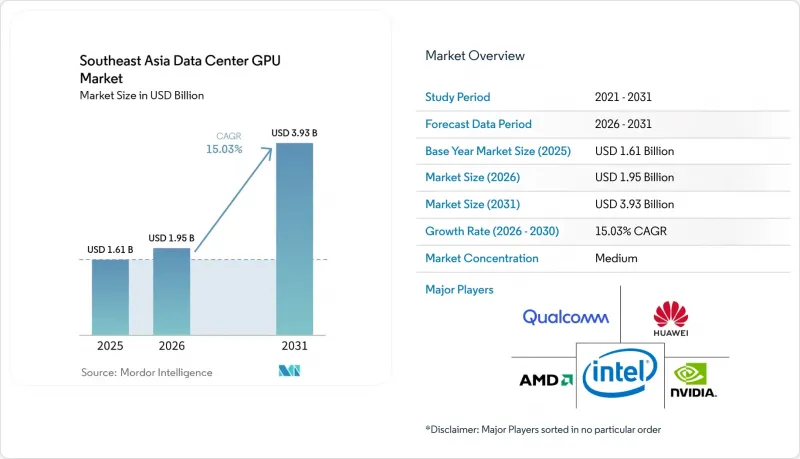
Mordor Intelligence에 의하면, 동남아시아의 데이터센터 GPU 시장 규모는 2025년에 16억 1,000만 달러, 2026년에 19억 5,000만 달러에서 2031년까지 39억 3,000만 달러에 이를 것으로 예측되며, 2026-2031년 CAGR 15.03%를 기록할 전망입니다.
본 보고서는 구축 유형(클라우드 데이터센터, 기업/프라이빗 데이터센터 등), GPU 유형(훈련용 GPU, 추론용 GPU), 상호 연결(PCIe 기반 GPU, 고대역폭 상호 연결 GPU), 워크로드 유형(AI 및 ML, HPC 등), 최종 사용자(하이퍼스케일러/CSP, 기업 등)별로 분류되어 있습니다. 시장 전망은 금액(달러) 기준으로 제시되어 있습니다.
동남아시아의 데이터센터 GPU 시장 동향 및 인사이트
AI에 최적화된 하이퍼스케일 시설의 급속한 확충
2025년 1월부터 2026년 3월까지 하이퍼스케일러의 자본 투자액은 130억 달러 이상에 달할 것으로 예상되며, 그중에서도 마이크로소프트의 싱가포르 55억 달러, 태국 11억 달러 투자 계획이 두드러집니다. 바탐 및 조호르에 건설될 새로운 캠퍼스는 80kW를 초과하는 GPU 고밀도 랙을 핵심으로 설계되었으며, 이러한 구성은 액체 냉각의 채택을 촉진함과 동시에 벤더의 로드맵을 섀시 수준의 열 재활용으로 이끌고 있습니다. 해저 케이블 상륙 지점과의 근접성은 아시아 주요 대도시권의 지연 시간을 개선하고, 대규모 언어 모델 서비스와 같은 워크로드를 동일한 가용성 영역에 정착시킬 수 있게 합니다. 그러나 몇몇 회랑 내에 메가와트 규모의 프로젝트가 집중됨에 따라 사업자들은 전력망의 용량 제한에 직면하게 되며, 이로 인해 추가 확장이 지연될 가능성이 있습니다. 전반적으로, 수년에 걸쳐 지속될 자본 투자 파이프라인은 GPU 대량 발주의 다음 물결을 뒷받침할 명확한 수요 신호로 작용하고 있습니다.
저지연 AI 추론을 위한 5G 지원 엣지 노드의 보급
2025년에 설치된 15,000개 이상의 5G 기지국에는 영상 분석, 자율주행차 텔레메트리, 산업용 IoT 워크로드를 위해 4-8개의 GPU를 탑재한 어플라이언스를 호스팅하는 마이크로 데이터센터가 통합되었습니다. Singtel의 Paragon 플랫폼은 10밀리초 미만의 성능을 보여주며, 서비스 품질(QoS) 목표를 달성하는 동시에 추론 처리를 중앙 집중형 클라우드에서 이전할 수 있음을 입증했습니다. 통신 사업자들은 현재 GPU에 대한 자본 투자를 수년에 걸친 리스 계약으로 분산시키는 ‘인프라스트럭처 애즈 어 서비스(IaaS)’ 계약을 묶어 제공하고 있으며, 이로 인해 엔트리 레벨 가속기의 판매 주기가 단축되고 있습니다. 그러나 설치 장소가 분산되어 있어 운영상의 복잡성이 발생하고 있습니다. 각 엣지 거점에는 현장 유지보수 기술, 내환경성 있는 케이스, 그리고 원격 오케스트레이션 스택이 필요하기 때문입니다.
만성적인 전력망 불안정성과 전력 공급 제약
조호르주 규제 당국은 변전소가 메가와트 규모의 부하를 감당하지 못했기 때문에 2025년에 데이터센터 신청 건의 3분의 1 가량을 기각했습니다. 이로 인해 사업자들은 용량 확장을 위해 수년을 기다려야 하는 상황에 내몰렸습니다. 인도네시아의 석탄에 의존하는 전력망 가동률은 99.7%에 그쳐, Tier III 인증에 필요한 99.995%를 밑돌고 있습니다. 그 결과 전압 변동이 발생하여 GPU의 열 스로틀링 보호 기능이 작동하게 됩니다. 이 지역 전체의 전력 수요는 2024년 9테라와트시에서 2030년까지 68테라와트시로 급증할 전망이며, 이는 확정된 발전 프로젝트공급 능력을 훨씬 초과합니다. 기업들은 디젤 발전기 임대를 강요받고 있으며, 이로 인해 운영비가 최대 20% 증가하고 넷제로 공약을 훼손하게 되어, 지속가능성에 대한 슬로건과 일상적인 회복탄력성 계획 사이에 괴리가 생기고 있습니다.
부문 분석
2025년, 클라우드 시설은 전체 지역 출하량의 58.76%를 차지했습니다. 이는 싱가포르와 조호르의 캠퍼스가 핵심을 이루고 있으며, 이러한 시설에서는 NVLink 및 InfiniBand 패브릭을 통해 수만 대의 GPU를 연결하여 1조 파라미터 규모의 모델 훈련 및 서비스를 제공합니다. 각 하이퍼스케일러 기업은 전력 사용 효율(PUE)을 1.3 미만으로 억제하는 재생에너지 계약과 수출 수익에 연동된 세제 혜택의 혜택을 받고 있습니다. 엣지 시설은 개별 규모는 작지만, 5G의 밀집화에 따라 무선 액세스 네트워크(RAN)에서의 추론 처리가 요구됨에 따라 급속히 증가하고 있습니다. 각 마이크로 사이트에는 동영상 분석 시 10밀리초 미만의 응답 시간을 보장하기 위해 4-8장의 NVIDIA T4 또는 A2 카드가 탑재되어 있습니다. 엣지 노드와 관련된 데이터센터 GPU 시장 규모는 자본 지출(CAPEX)을 월간 구독료로 분산시키는 통신 사업자와의 제휴에 힘입어 연평균 성장률(CAGR) 22% 이상으로 급성장할 것으로 예측됩니다. 기업 및 프라이빗 데이터센터도 이러한 전반적인 추세를 보완하고 있으며, 주로 특정 기록을 On-Premise에서 보관해야 하고, 계절적 피크 시간대에는 잉여 부하를 퍼블릭 클라우드로 버스트 처리해야 하는 규제 산업에 서비스를 제공합니다.
엣지 환경에서의 설치 면적 축소로 인해, 인프라 설계는 단상 침지 냉각 및 원격 오케스트레이션 기능을 갖춘 모듈형 블레이드 형태로 전환되고 있습니다. 이는 120kW 클라우드 랙에 도입된 모놀리식 칠러와는 대조적입니다. 통신 사업자들은 현재 공동 조달 풀을 협상하여 대량 구매 할인을 확보하고 있지만, 이종 혼용 도입 기준이 여전히 통합에 따른 오버헤드를 증가시키고 있습니다. 한편, 자카르타와 방콕의 코로케이션 사업자들은 임대 계약에 전용 다크 파이버를 포함시켜, 기밀 데이터를 On-Premise에 보관하면서도 피크 시간대의 분석 처리에는 하이퍼스케일러의 GPU 버스트를 활용하는 하이브리드 워크로드를 도입하고 있습니다. 이러한 분산형 토폴로지는 데이터센터 GPU 시장의 수익원을 다각화하고 입지 리스크를 헤지하지만, 그와 동시에 벤더와의 관계가 세분화되어 대규모 펌웨어 관리를 복잡하게 만들고 있습니다.
2025년에는 기업들이 순수한 연구용 훈련보다 챗봇, 추천 엔진, 부정 감지 등 수익 창출이 가능한 서비스를 우선시한 결과, 추론 가속기 시장 점유율은 57.52%에 달했습니다. 트랜스포머의 양자화를 통해 메모리 요구 사항이 완화되어, 기존에는 8기가 필요했던 워크로드를 4기의 추론용 GPU로 처리할 수 있게 됨에 따라, 추론과 관련된 데이터센터 GPU 시장 점유율은 더욱 확대될 것으로 예측됩니다. 하이퍼스케일러의 추론 팜 도입을 주도하고 있는 것은 NVIDIA의 H100 NVL 및 L40S 보드이지만, AMD의 MI300X는 특히 중소기업을 대상으로 설계된 구독 플랜에서 처리 토큰당 비용 측면에서 경쟁력을 발휘하고 있습니다. H200이나 MI325X와 같은 훈련용 GPU는 새로운 기반 모델 개발에 여전히 필수적이지만, 메모리 가격 급등과 리드타임 장기화로 인해 그 시장 점유율은 제한되고 있습니다.
싱가포르와 태국의 국립 슈퍼컴퓨팅 센터는 대부분의 훈련 클러스터의 핵심을 담당하고 있으며, 현재 유휴 상태인 처리 사이클을 대학이나 스타트업에 대여하는 ‘파티션화된 스케줄링’ 도입을 검토하고 있습니다. 대조적으로, 추론용 보드는 사실적인 장면을 렌더링하는 미디어 스튜디오부터 밀리초 단위로 리스크 점수를 갱신하는 핀테크 스타트업에 이르기까지 모든 곳에서 활용되고 있습니다. 추론으로의 전환에 따라 카드 1장당 평균 전력 소비량은 700와트에서 300와트로 감소하여 랙 통합이 용이해질 뿐만 아니라, 기계적인 전면 개조 대신 수냉 시스템을 단계적으로 도입할 수 있게 됩니다. FP16, FP8, 그리고 향후 등장할 FP4와 같은 정밀도 간 소프트웨어 이식성을 확보할 수 있는 벤더는 모델 압축 기술이 보급됨에 따라 압도적인 시장 점유율을 확보할 수 있을 것입니다.
기타 혜택:
- 엑셀 형식 시장 예측(ME) 시트
- 3개월간의 애널리스트 지원
자주 묻는 질문
목차
제1장 서론
제2장 조사 방법
제3장 주요 요약
제4장 시장 구도
제5장 시장 규모와 성장 예측
제6장 경쟁 구도
제7장 시장 기회와 향후 전망
KTH 26.08.06According to Mordor Intelligence, the Southeast Asia data center GPU market size is projected to be USD 1.61 billion in 2025, USD 1.95 billion in 2026, and reach USD 3.93 billion by 2031, growing at a CAGR of 15.03% from 2026 to 2031.
This report is Segmented by Deployment Type (Cloud Data Centers, Enterprise/Private Data Centers, and More), GPU Type (Training GPUs, Inference GPUs), Interconnect (PCIe-Based GPUs, High-Bandwidth Interconnect GPUs), Workload Type (AI and ML, HPC, and More), and End-User (Hyperscalers/CSPs, Enterprises, and More). The Market Forecasts are Provided in Terms of Value (USD).
Southeast Asia Data Center GPU Market Trends and Insights
Rapid Build-Out of AI-Optimized Hyperscale Facilities
Hyperscaler capital commitments topped USD 13 billion between January 2025 and March 2026, highlighted by Microsoft's USD 5.5 billion plan for Singapore and USD 1.1 billion for Thailand. New campuses in Batam and Johor are designed around GPU-dense racks that exceed 80 kilowatts, a configuration that pushes liquid-cooling adoption and shapes vendor roadmaps toward chassis-level heat reuse.Proximity to subsea cable landings improves latency to major Asian metros, which keeps workloads such as large language model serving anchored in the same availability zones. However, clustering of megawatt-scale projects inside a few corridors exposes operators to grid caps that can slow additional build-outs. Overall, sustained multiyear capex pipelines provide a clear demand signal that underpins the next wave of GPU volume orders.
Proliferation of 5G-Enabled Edge Nodes for Low-Latency AI Inference
More than 15,000 5G base stations installed during 2025 embedded micro data centers that host 4- to 8-GPU appliances for video analytics, autonomous vehicle telemetry, and industrial IoT workloads. Singtel's Paragon platform showed sub-10-millisecond performance, proving that inference can shift away from centralized cloud while meeting quality-of-service targets.Telecommunications operators are now bundling infrastructure-as-a-service contracts that spread GPU capex across multiyear leases, which shortens sales cycles for entry-level accelerators. Yet fragmented site footprints create operational complexity because each edge location demands on-site maintenance skills, hardened enclosures, and remote orchestration stacks.
Chronic Grid Instability and Power-Supply Constraints
Johor regulators rejected nearly one-third of data center applications in 2025 because substations could not meet megawatt-scale loads, placing operators in multiyear queues for capacity upgrades. Indonesia's coal-dependent grid delivers only 99.7% uptime, short of the 99.995% needed for Tier III certification, leading to voltage swings that trip GPU thermal throttling safeguards. Power demand across the region is set to jump from 9 terawatt-hours in 2024 to 68 terawatt-hours by 2030, far outpacing confirmed generation projects. Enterprises are forced to lease diesel generators, which lift operating expenditure by up to 20% and undermine net-zero pledges, creating a wedge between sustainability rhetoric and day-to-day resiliency planning.
Other drivers and restraints analyzed in the detailed report include:
- Rising Adoption of GPU-Accelerated Databases for Fintech
- Government Incentives for Green Data Centers and Carbon Credits
- Escalating Geopolitical Risk to Global GPU Supply Chains
For complete list of drivers and restraints, kindly check the Table Of Contents.
Segment Analysis
Cloud installations delivered 58.76% of regional shipments in 2025, anchored in Singapore and Johor campuses that string tens of thousands of GPUs behind NVLink and InfiniBand fabrics to train and serve trillion-parameter models. Hyperscalers benefit from renewable power contracts that assure sub-1.3 power usage effectiveness as well as tax abatements linked to export revenue. Edge facilities, though smaller individually, are multiplying quickly because 5G densification demands inference at the radio access network; each micro site carries 4-8 NVIDIA T4 or A2 cards to guarantee sub-10-millisecond response for video analytics. The data center GPU market size tied to edge nodes is projected to surge at more than 22% CAGR, driven by telecom partnerships that spread capex across monthly subscriptions. Enterprise and private data centers round out the picture, mainly serving regulated industries that must retain certain records on-premises and burst excess loads to the public cloud when seasonal peaks hit.
Smaller footprints at the edge shift infrastructure design toward modular blades with single-phase immersion cooling and remote orchestration, a contrast to the monolithic chillers deployed in 120-kilowatt cloud racks. Telecommunication operators now negotiate joint procurement pools to unlock volume discounts, but heterogeneous deployment standards still inflate integration overhead. Meanwhile, colocation landlords in Jakarta and Bangkok bundle dedicated dark fiber into leases to capture hybrid workloads that pin sensitive data on premises while leaning on hyperscaler GPU bursts for peak analytics. This distributed topology diversifies revenue for the data center GPU market and hedges location risk, yet also fragments vendor relationships, complicating firmware management at scale.
Inference accelerators captured 57.52% share in 2025 as enterprises prioritized monetizable services like chatbots, recommendation engines, and fraud screening over pure research training. The data center GPU market share tied to inference is expected to widen as transformer quantization reduces memory requirements and allows four inference GPUs to serve workloads previously needing eight. NVIDIA H100 NVL and L40S boards headline deployments in hyperscaler inference farms, while AMD MI300X competes on cost per token processed, especially in subscription tiers engineered for small-to-mid-size enterprises. Training GPUs such as H200 and MI325X remain vital for new foundation model development, but their share is bound by high memory premiums and longer lead times.
National supercomputing centers in Singapore and Thailand anchor most training clusters, which are now exploring partitioned scheduling that leases idle cycles to universities and startups. Inference boards, by contrast, surface everywhere from media studios rendering photorealistic scenes to fintech start-ups that refresh risk scores in milliseconds. The pivot toward inference shrinks average card power from 700 watts to 300 watts, easing rack integration and enabling incremental adoption of liquid-cooling retrofits rather than wholesale mechanical overhauls. Vendors that bridge software portability across FP16, FP8, and upcoming FP4 precisions can capture outsized share as model compression techniques proliferate.
Complete Report Scope:
- By Deployment Type
- Cloud Data Centers
- Enterprise / Private Data Centers
- Edge Data Centers
- By GPU Type
- Training GPUs
- Inference GPUs
- By Interconnect
- PCIe-Based GPUs
- High-Bandwidth Interconnect GPUs
- By Workload Type
- Artificial Intelligence (AI) and Machine Learning (ML)
- High-Performance Computing (HPC) (non-AI scientific computing)
- Data Analytics (database acceleration, query processing)
- Graphics and Visualization (VDI, rendering, digital twins)
- By End-User
- Hyperscalers / Cloud Service Providers
- Enterprises
- Government and Research Institutions
- By Geography
- Indonesia
- Malaysia
- Philippines
- Singapore
- Thailand
- Vietnam
- Rest of Southeast Asia
List of Companies Covered in this Report:
- NVIDIA Corporation
- Advanced Micro Devices, Inc.
- Intel Corporation
- Huawei Technologies Co., Ltd.
- Qualcomm Technologies, Inc.
- Graphcore Limited
- Baidu, Inc.
- Tencent Holdings Ltd.
- Alibaba Group Holding Limited
- Giga Computing Technology Co., Ltd. (Gigabyte)
- AsusTek Computer Inc.
- Lenovo Group Limited
- ASRock Rack Inc.
- Super Micro Computer, Inc.
- Dell Technologies Inc.
- Hewlett Packard Enterprise Company
- Inspur Group
- Acer Inc.
- Fujitsu Limited
- Amazon Web Services, Inc. (Annapurna Labs)
- Google LLC
- Samsung Electronics Co., Ltd.
- EVGA Corporation
- Xilinx, Inc. (AMD)
- Arm Ltd.
- Tyan Computer Corporation
- Synopsys, Inc.
Additional Benefits:
- The market estimate (ME) sheet in Excel format
- 3 months of analyst support
TABLE OF CONTENTS
1 INTRODUCTION
- 1.1 Study Assumptions and Market Definition
- 1.2 Scope of the Study
2 RESEARCH METHODOLOGY
3 EXECUTIVE SUMMARY
4 MARKET LANDSCAPE
- 4.1 Market Overview
- 4.2 Market Drivers
- 4.2.1 Rapid Build-Out of AI-Optimized Hyperscale Facilities
- 4.2.2 Rising Adoption of GPU-Accelerated Databases for Fintech
- 4.2.3 Government Incentives for Green Data Centers and Carbon Credits
- 4.2.4 Growing Demand for Real-Time Digital Twin Platforms in Smart Cities
- 4.2.5 Proliferation of 5G-Enabled Edge Nodes for Low-Latency AI Inference
- 4.2.6 Expansion of Cloud Gaming Services Across Southeast Asia
- 4.3 Market Restraints
- 4.3.1 Chronic Grid Instability and Power-Supply Constraints
- 4.3.2 Limited Availability of Tier IV Data-Center Real Estate in Metro Hubs
- 4.3.3 High Import Tariffs on Advanced Semiconductor Components
- 4.3.4 Escalating Geopolitical Risk to Global GPU Supply Chains
- 4.4 Impact of Macroeconomic Factors on the Market
- 4.5 Industry Value Chain Analysis
- 4.6 Regulatory Landscape
- 4.7 Technological Outlook
- 4.8 Porter's Five Forces Analysis
- 4.8.1 Threat of New Entrants
- 4.8.2 Bargaining Power of Buyers
- 4.8.3 Bargaining Power of Suppliers
- 4.8.4 Threat of Substitute Products or Services
- 4.8.5 Competitive Rivalry
5 MARKET SIZE AND GROWTH FORECASTS (VALUE)
- 5.1 By Deployment Type
- 5.1.1 Cloud Data Centers
- 5.1.2 Enterprise / Private Data Centers
- 5.1.3 Edge Data Centers
- 5.2 By GPU Type
- 5.2.1 Training GPUs
- 5.2.2 Inference GPUs
- 5.3 By Interconnect
- 5.3.1 PCIe-Based GPUs
- 5.3.2 High-Bandwidth Interconnect GPUs
- 5.4 By Workload Type
- 5.4.1 Artificial Intelligence (AI) and Machine Learning (ML)
- 5.4.2 High-Performance Computing (HPC) (non-AI scientific computing)
- 5.4.3 Data Analytics (database acceleration, query processing)
- 5.4.4 Graphics and Visualization (VDI, rendering, digital twins)
- 5.5 By End-User
- 5.5.1 Hyperscalers / Cloud Service Providers
- 5.5.2 Enterprises
- 5.5.3 Government and Research Institutions
- 5.6 By Geography
- 5.6.1 Indonesia
- 5.6.2 Malaysia
- 5.6.3 Philippines
- 5.6.4 Singapore
- 5.6.5 Thailand
- 5.6.6 Vietnam
- 5.6.7 Rest of Southeast Asia
6 COMPETITIVE LANDSCAPE
- 6.1 Market Concentration
- 6.2 Strategic Moves
- 6.3 Market Share Analysis
- 6.4 Company Profiles (includes Global Level Overview, Market Level Overview, Core Segments, Financials as available, Strategic Information, Market Rank/Share, Products and Services, Recent Developments)
- 6.4.1 NVIDIA Corporation
- 6.4.2 Advanced Micro Devices, Inc.
- 6.4.3 Intel Corporation
- 6.4.4 Huawei Technologies Co., Ltd.
- 6.4.5 Qualcomm Technologies, Inc.
- 6.4.6 Graphcore Limited
- 6.4.7 Baidu, Inc.
- 6.4.8 Tencent Holdings Ltd.
- 6.4.9 Alibaba Group Holding Limited
- 6.4.10 Giga Computing Technology Co., Ltd. (Gigabyte)
- 6.4.11 AsusTek Computer Inc.
- 6.4.12 Lenovo Group Limited
- 6.4.13 ASRock Rack Inc.
- 6.4.14 Super Micro Computer, Inc.
- 6.4.15 Dell Technologies Inc.
- 6.4.16 Hewlett Packard Enterprise Company
- 6.4.17 Inspur Group
- 6.4.18 Acer Inc.
- 6.4.19 Fujitsu Limited
- 6.4.20 Amazon Web Services, Inc. (Annapurna Labs)
- 6.4.21 Google LLC
- 6.4.22 Samsung Electronics Co., Ltd.
- 6.4.23 EVGA Corporation
- 6.4.24 Xilinx, Inc. (AMD)
- 6.4.25 Arm Ltd.
- 6.4.26 Tyan Computer Corporation
- 6.4.27 Synopsys, Inc.
7 MARKET OPPORTUNITIES AND FUTURE OUTLOOK
- 7.1 White-Space and Unmet-Need Assessment


