

|
시장보고서
상품코드
2097414
중동 및 아프리카의 데이터센터 GPU : 시장 점유율 분석, 업계 동향과 통계, 성장 예측(2026-2031년)Middle East and Africa Data Center GPU - Market Share Analysis, Industry Trends & Statistics, Growth Forecasts (2026 - 2031) |
||||||
 Mordor Intelligence
Mordor Intelligence에 의하면, 중동 및 아프리카의 데이터센터 GPU 시장 규모는 2025년 9억 2,000만 달러, 2026년 11억 달러에서 2031년까지 20억 2,000만 달러에 달할 것으로 예측되며, 2026-2031년 연평균 복합 성장률(CAGR)은 12.99%를 나타낼 전망입니다.
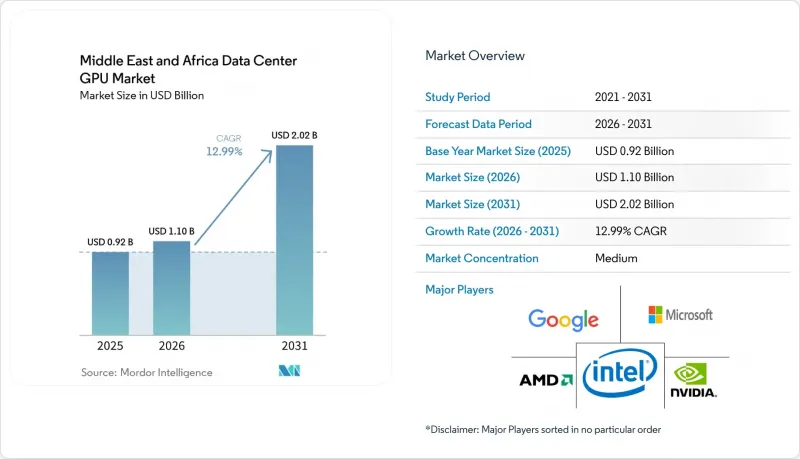
본 보고서는 배포 유형(클라우드 데이터센터, 기업 등), GPU 유형(훈련용 GPU, 추론용 GPU), 상호 연결(PCIe 기반 GPU, 고대역폭 상호 연결 GPU), 워크로드 유형(AI 및 ML, HPC 등), 최종 사용자(하이퍼스케일러/CSP, 기업, 정부 및 연구 기관)별로 분류되어 있습니다. 시장 전망은 금액(달러) 기준으로 제시되어 있습니다.
중동 및 아프리카의 데이터센터 GPU 시장 동향 및 인사이트
걸프 국가 정부의 주도적 이니셔티브를 통한 생성형 AI 및 대규모 언어 모델 도입 가속화
중동 및 아프리카의 데이터센터 GPU 시장은 도입 기간을 기존의 수년 주기에서 대폭 단축된 도입 일정으로 전환시킨 각국 정부의 주도적 AI 프로그램에 의해 견인되고 있습니다. 사우디아라비아의 HUMAIN 이니셔티브는 2026년 1월 xAI와 제휴하여 리야드와 제다 전역에 Grok-3 추론 클러스터를 구축하고, 2026년 3분기까지 아랍어 동시 쿼리 5만 건을 처리하는 것을 목표로 하고 있습니다. 아랍에미리트(UAE)에서는 G42가 마스다르 시티에서 200메가와트 규모의 AI 캠퍼스를 운영하고 있으며, 여기에는 매개변수 수 1조 8,000억 개의 모델을 위해 설계된 NVIDIA GB200 NVL72 랙이 설치되어 있습니다. 이를 통해 해당 시설은 그동안 미국의 하이퍼스케일러에서만 볼 수 있었던 규모에 도달했습니다. 모로코 역시 2025년 11월 NVIDIA와 공동으로 ‘넥서스 AI 팩토리’를 발표하며 이 흐름에 합류했습니다. 2028년까지 500메가와트의 GPU 용량을 확보하여, 프랑스어 및 아랍어 언어 모델 배포에 있어 북아프리카에서 중요한 역할을 수행할 계획입니다. 이러한 프로젝트가 중요한 이유는 분기별 예산 승인이나 규정 준수 심사를 거쳐야 하는 기업 사용자들보다 GPU 공급을 신속하게 흡수할 수 있기 때문입니다. 그 결과, 하드웨어 구성은 추론뿐만 아니라 훈련에도 중점을 두게 되었습니다. 이는 지역 특화 언어 모델의 경우, 해당 지역 고유의 데이터셋, 방언 지원, 그리고 현지 법적·문화적 프레임워크에 기반한 배포가 필요하기 때문입니다.
주권 부유 기금의 지원을 받는 하이퍼스케일 클라우드의 급속한 확장
중동 및 아프리카의 데이터센터 GPU 시장은 국부펀드의 자본으로부터도 혜택을 받고 있습니다. 이를 통해 각 하이퍼스케일러 기업들은 다른 많은 지역의 경쟁사들보다 빠르게 부지, 전력, 하드웨어를 확보할 수 있게 되었습니다. 마이크로소프트는 2025년 3월, G42와 공동으로 UAE의 AI 인프라에 152억 달러를 투자할 것이라고 발표했습니다. 여기에는 2026년 말까지 예정된 200메가와트 규모의 확장도 포함됩니다. 카타르에서는 브룩필드와 Qai의 합작 회사가 총액 200억 달러 규모의 투자 계획의 일환으로, 2026년 2월 도하에서 100메가와트 규모의 컴퓨팅 센터 착공을 진행했습니다. 전력 비용은 1kW시당 0.06달러로 예상됩니다. 아마존 웹 서비스(AWS)는 2026년 1월 바레인 리전을 3개의 가용 영역을 추가하여 확장하고, NVIDIA H200 Tensor Core GPU를 기반으로 한 GPU 최적화 EC2 P5 인스턴스를 도입했습니다. 이러한 자금 조달 모델을 통해 대규모 클라우드 프로젝트 진행을 종종 지연시키던 자금 조달 병목 현상이 해소되었습니다. 그 결과, 중동 및 아프리카(MEA) 지역의 여러 캠퍼스는 전 세계 건설 프로젝트에서 흔히 볼 수 있는 장기적인 일정보다 훨씬 빠르게 가동 단계로 전환할 수 있었습니다. 또한 이 모델은 중동 및 아프리카의 데이터센터 GPU 시장의 잠재 고객 기반을 확대했습니다. 이는 정부 주도 프로젝트뿐만 아니라, 현지 호스팅 및 AI 가속화가 필요한 기업 테넌트를 위한 용량도 마련되어 있기 때문입니다.
사막 기후에서의 높은 전력 및 냉각 운영 비용
중동 및 아프리카의 데이터센터 GPU 시장은 직접적인 비용 문제에 직면해 있습니다. 사막 지대의 시설에서는 전력 및 냉각 비용이 kW시당 0.12달러를 초과하는 경우가 있는 반면, 전 세계 하이퍼스케일 시설의 평균은 kW시당 0.06달러 수준이기 때문입니다. 리야드나 아부다비에서 가동률 90%의 10메가와트 GPU 클러스터의 경우, 연간 전력 비용은 950만 달러에 달할 가능성이 있습니다. 이에 비해 북유럽의 동급 시설에서는 470만 달러입니다. 또한 극심한 더위로 인해 사업자는 냉각기를 30%에서 40% 정도 과잉 배치할 수밖에 없으며, 그 결과 냉각 관련 설비 투자는 kW당 1,200달러로 치솟습니다. 반면, 기후가 온화한 지역에서는 kW당 800달러입니다. 액체 냉각 시스템은 효율을 향상시킬 수 있지만, HPE와 Khazna의 제휴 사례가 드러낸 바와 같이, 이러한 설계에는 특수한 유체나 내식성 인프라가 필요하며, 이는 랙 수준의 도입 비용을 상승시킵니다. 배기 가스를 전기로 변환하는 프로젝트는 특정 유전 지역에서는 효과적이지만, 부지 선정, 인허가, 건설에 엄격한 제약이 있어 지역 전체에 대한 해결책이 될 수는 없습니다. 이러한 비용 압박은 쿼리당 수익이 극히 적은 추론 용도에서 특히 심각하기 때문에 사업자들은 중동 및 아프리카의 데이터센터 GPU 시장에서 이익률을 유지하기 위해 더 유리한 전력 계약, 대체 에너지 확보, 혹은 부가가치가 높은 워크로드를 필요로 하고 있습니다.
부문 분석
2025년, 클라우드 데이터센터는 도입 유형별 매출의 57.39%를 차지하며, 이 부문군에서 중동 및 아프리카의 데이터센터 GPU 시장 규모에서 가장 큰 점유율을 기록했습니다. 이러한 위상은 주요 걸프 지역 캠퍼스 전반에 걸친 훈련 워크로드, 집중형 컴퓨팅 및 배치 분석 분야에서 하이퍼스케일러의 강점을 반영한 것입니다. 엣지 데이터센터는 현장 업무나 도시 지역 서비스 노드에서 응답성이 요구되는 이용 사례를 위해 로컬 처리가 우선시됨에 따라, 2026-2031년 계속해서 더 빠른 성장이 예상됩니다. 사우디 아람코는 2026년 1분기, 가와르 및 사파니아 유전에 12개의 엣지 GPU 포드를 도입했습니다. 각 포드에는 실시간 지진파 처리 및 드릴 비트 최적화를 위한 NVIDIA L40S 추론용 GPU 64개가 탑재되어 있었습니다. 이 사례는 중앙 집중형 클라우드의 응답을 기다리는 동안 분석의 가치가 떨어질 가능성이 있는 에너지 사업 분야에서 엣지 배포가 왜 더 실용적인 선택지가 되고 있는지를 보여줍니다. 그 결과, 중동 및 아프리카의 데이터센터 GPU 시장은 중앙 집중형 캠퍼스에 머무르지 않고, 자산 근처에서 산업용 추론을 지원하는 분산형 환경으로 확대되고 있습니다.
규제 산업에서는 여전히 데이터 배치 및 연산 리소스에 대한 직접적인 관리를 선호하는 경향이 있기 때문에 엔터프라이즈 및 프라이빗 데이터센터는 여전히 두 번째로 큰 도입 형태를 차지하고 있습니다. 아랍에미리트(UAE) 중앙은행은 2025년 8월, 국내 은행에 대해 고객 거래 데이터를 국경 내에서 처리하도록 의무화하는 지침을 발표했습니다. 이에 따라 에미레이트 NBD나 퍼스트 아부다비 은행 등의 금융 기관은 프라이빗 GPU 시스템으로의 전환을 강요받게 되었습니다. 이러한 규제적 압박으로 인해, 기술적으로 클라우드 서비스를 이용할 수 있더라도 On-Premise 도입이 촉진되고 있습니다. 또한 엣지 사이트에서는 내환경성 케이스, 이중화된 전원 공급 장치, 원격 연결 요건으로 인해 시스템 설치가 복잡해지기 때문에 랙당 자본 비용이 높아집니다. 그럼에도 불구하고, 석유 및 가스전, 스마트 시티 노드, 교통 회랑 등 실시간 의사 결정이 명확한 운영상의 이점을 가져다주는 곳에서는 사업자들이 계속해서 투자를 이어가고 있습니다. 중앙 집중형 확장성과 현지의 신속한 대응 능력 간의 이러한 균형 덕분에, 중동 및 아프리카의 데이터센터 GPU 시장이 지속적으로 확대되는 가운데, 이 세 가지 도입 형태 모두가 계속해서 중요한 역할을 할 것으로 보입니다.
2025년, 추론용 GPU는 GPU 유형별 매출의 59.86%를 차지하며 중동 및 아프리카의 데이터센터 GPU 시장의 주요 제품 카테고리가 되었습니다. 또한, 추론 비용의 감소로 인해 챗봇, 음성 시스템, 추천 엔진 및 지역 언어 서비스의 상용 규모 도입에 있어 경제성이 변화함에 따라, 2031년까지 추론용 GPU의 성장률은 가장 높은 수준을 유지할 것으로 전망됩니다. 토큰당 추론 비용이 2024년 초 0.02달러에서 2025년 말 0.0008달러로 하락한 것이, 퍼블릭 및 프라이빗 도입 환경을 불문하고 실시간 아랍어 용도의 실용성이 향상된 주요 요인이 되었습니다. G42는 2025년, 마스다르 시티의 200메가와트 용량 중 70%를 추론 워크로드에 할당했습니다. 이는 수요가 더 이상 최첨단 모델의 훈련에만 국한되지 않고, 사용자에게 서비스를 제공하는 데 중점이 옮겨가고 있음을 보여줍니다. 이러한 수요 패턴은 정부 포털, 번역 서비스, 고객 지원 및 엔터프라이즈 AI 도구에서 특히 두드러지며, 이러한 분야에서는 규모 확대가 단순한 원시 연산 능력뿐만 아니라 트랜잭션 비용에도 좌우됩니다. 따라서 중동 및 아프리카의 데이터센터 GPU 시장은 많은 도입 사례에서 ‘구축 우선’ 단계에서 ‘대규모 서비스 제공’ 단계로 전환되고 있습니다.
훈련용 GPU는 도입 대수가 감소하고는 있지만, 여전히 필수적입니다. 국가 주도의 AI 프로그램에서는 지역 법률, 의료, 언어 데이터셋을 활용해 훈련된 현지 모델이 여전히 필요하기 때문입니다. NVIDIA에 따르면, H200의 가격은 추론용 L40S 구성보다 상당히 비싸기 때문에 훈련 시스템은 광범위한 기업 도입보다는 정부 지원 캠퍼스나 하이퍼스케일러의 연구소에 집중된 상태를 유지하고 있습니다. 사우디아라비아의 ‘HUMAIN’ 이니셔티브에서는 2026년 1월 가동을 시작한 리야드 시설에 아랍어 법률 및 의료 언어 모델을 위해 1만 대 이상의 H200 GPU가 도입되었습니다. 훈련과 추론의 이러한 구분은 수익 성장이 단일 워크로드에만 의존하지 않음을 의미하기 때문에 중요합니다. 추론은 더 많은 사용자와 거점에 걸쳐 단위당 수요를 확대하는 반면, 훈련은 판매 가격이 높고 규모가 매우 큰 소수의 프로젝트를 뒷받침합니다. 이러한 조합을 통해 중동 및 아프리카의 데이터센터 GPU 시장은 GPU 유형 구성 면에서 폭과 깊이를 모두 갖추게 될 것입니다.
기타 혜택:
- 엑셀 형식 시장 예측(ME) 시트
- 3개월간의 애널리스트 지원
자주 묻는 질문
목차
제1장 서론
제2장 조사 방법
제3장 주요 요약
제4장 시장 구도
제5장 시장 규모와 성장 예측
제6장 경쟁 구도
제7장 시장 기회와 향후 전망
KTH 26.08.06According to Mordor Intelligence, the Middle East and Africa data center GPU market size is projected to expand from USD 0.92 billion in 2025 and USD 1.10 billion in 2026 to USD 2.02 billion by 2031, registering a CAGR of 12.99% between 2026 and 2031.
This report is Segmented by Deployment Type (Cloud Data Centers, Enterprise, and More), GPU Type (Training GPUs, and Inference GPUs), Interconnect (PCIe-Based GPUs, High-Bandwidth Interconnect GPUs), Workload Type (AI and ML, HPC, and More), and End-User (Hyperscalers/CSPs, Enterprises, Government and Research Institutions). Market Forecasts are Provided in Terms of Value (USD).
Middle East and Africa Data Center GPU Market Trends and Insights
Accelerated Adoption of Generative AI and Large Language Models in Gulf Sovereign Initiatives
The Middle East and Africa data center GPU market is being pushed forward by sovereign AI programs that moved adoption windows from traditional multi-year cycles into much shorter deployment schedules. Saudi Arabia's HUMAIN initiative partnered with xAI in January 2026 to deploy Grok-3 inference clusters across Riyadh and Jeddah, with a target of 50,000 concurrent Arabic-language queries by Q3 2026.In the UAE, G42 operated a 200-megawatt AI campus in Masdar City that housed NVIDIA GB200 NVL72 racks designed for models with 1.8 trillion parameters, which placed the facility at a scale previously associated with U.S. hyperscalers. Morocco also moved into this pattern when the Nexus AI factory was announced with NVIDIA in November 2025, with a plan for 500 megawatts of GPU capacity by 2028 and a North African role in French and Arabic language model deployment. These projects matter because they absorb GPU supply faster than enterprise buyers that still move through quarterly budget approvals and compliance reviews. The result is a hardware mix that shifts toward training as well as inference, because localized language models require regional datasets, dialect support, and deployment under local legal and cultural frameworks.
Rapid Hyperscale Cloud Expansion Backed by Sovereign Wealth Funds
The Middle East and Africa data center GPU market is also benefiting from sovereign wealth fund capital that lets hyperscalers secure land, power, and hardware earlier than peers in many other regions. Microsoft announced a USD 15.2 billion commitment to UAE AI infrastructure with G42 in March 2025, including a 200-megawatt expansion scheduled by the end of 2026. In Qatar, the Brookfield-Qai joint venture broke ground in February 2026 on a 100-megawatt compute center in Doha under a broader USD 20 billion commitment, with projected power costs of USD 0.06 per kilowatt-hour. Amazon Web Services expanded its Bahrain region with 3 additional availability zones in January 2026 and added GPU-optimized EC2 P5 instances based on NVIDIA H200 Tensor Core GPUs. This funding model removes the financing bottlenecks that often slow large cloud projects, which is why several MEA campuses moved toward operating status far faster than the longer timelines common in global builds. It also widened the addressable base of the Middle East and Africa data center GPU market, because capacity is being prepared not only for sovereign projects but also for enterprise tenants that need local hosting and AI acceleration.
High Power And Cooling OPEX In Desert Climates
The Middle East and Africa data center GPU market faces a direct cost challenge because desert facilities can operate at power and cooling costs above USD 0.12 per kilowatt-hour, while the global hyperscale average is near USD 0.06 per kilowatt-hour. A 10-megawatt GPU cluster running at 90% utilization in Riyadh or Abu Dhabi can incur annual electricity costs of USD 9.5 million, compared with USD 4.7 million for a comparable facility in Northern Europe. Extreme heat also forces operators to over-provision chillers by 30% to 40%, which pushes cooling capital expenditure to USD 1,200 per kilowatt against USD 800 per kilowatt in more temperate locations. Liquid-cooling systems can improve efficiency, but the HPE and Khazna partnership highlighted that these designs require specialized fluids and corrosion-resistant infrastructure that raise rack-level deployment costs. Waste-gas-to-power projects can help in selected oilfield locations, but they are not a region-wide answer because site selection, permitting, and construction are tightly constrained. This cost pressure is particularly severe for inference applications where revenue per query is very small, so operators need better power contracts, alternative energy arrangements, or higher-value workloads to protect margins in the Middle East and Africa data center GPU market.
Other drivers and restraints analyzed in the detailed report include:
- Hardware Innovation Cycle Toward High-Bandwidth Memory and Multi-Chip Module GPUs
- Sovereign GPU Allocation Agreements Skewing Supply in Favor of MEA Projects
- Semiconductor Export Restrictions Limiting High-End GPU Supply to Some African Countries
For complete list of drivers and restraints, kindly check the Table Of Contents.
Segment Analysis
Cloud data centers held 57.39% of deployment-type revenue in 2025, which gave them the largest share of the Middle East and Africa data center GPU market size within this segment set. That position reflected hyperscaler strength in training workloads, centralized compute, and batch analytics across major Gulf campuses. Edge data centers are still expected to grow faster through 2026-2031 because field operations and urban service nodes are prioritizing local processing for response-sensitive use cases. Saudi Aramco deployed 12 edge GPU pods across the Ghawar and Safaniya oilfields in Q1 2026, and each pod contained 64 NVIDIA L40S inference GPUs for real-time seismic processing and drill-bit optimization. That example shows why edge deployments are becoming more practical in energy operations, where waiting for a centralized cloud response can reduce the value of the analysis. The Middle East and Africa data center GPU market is therefore widening beyond centralized campuses and into distributed environments that support industrial inference close to assets.
Enterprise and private data centers remained the second-largest deployment type because regulated industries still prefer direct control over data placement and compute resources. The UAE Central Bank issued guidance in August 2025 that required domestic banks to process customer transaction data within national borders, which pushed institutions such as Emirates NBD and First Abu Dhabi Bank toward private GPU systems. This type of regulatory push supports on-premise deployment even when cloud offerings are technically available. Edge sites also face higher per-rack capital costs, because rugged enclosures, redundant power, and remote connectivity requirements make these systems more complex to install. Even so, operators continue to fund them where real-time decision making in oil and gas fields, smart-city nodes, and transport corridors produces a clear operational return. That balance between centralized scale and local responsiveness is likely to keep all 3 deployment types relevant as the Middle East and Africa data center GPU market continues to expand.
Inference GPUs held 59.86% of GPU-type revenue in 2025, which made them the leading product category in the Middle East and Africa data center GPU market. Their growth profile also remains the strongest through 2031 because lower inference costs changed the economics of deploying chatbots, voice systems, recommendation engines, and localized language services at commercial scale. The decline in per-token inference costs from USD 0.02 in early 2024 to USD 0.0008 by late 2025 was a major reason why real-time Arabic language applications became more viable across public and private deployments. G42 allocated 70% of its 200-megawatt Masdar City capacity to inference workloads in 2025, which shows that demand is now centered on serving users rather than only training frontier models. This demand pattern is especially visible in government portals, translation services, customer support, and enterprise AI tools, where scale depends on transaction cost, not only raw compute capability. The Middle East and Africa data center GPU market is therefore moving from a build-first phase into a serve-at-scale phase for many deployments.
Training GPUs remain essential even though they represent a smaller unit base, because sovereign AI programs still need local models trained on regional legal, medical, and language datasets. NVIDIA stated that H200 pricing sat well above inference-oriented L40S configurations, which keeps training systems concentrated in state-backed campuses and hyperscaler labs rather than broad enterprise rollouts. Saudi Arabia's HUMAIN initiative used 10,000-plus H200 GPUs in a Riyadh facility that went live in January 2026 for Arabic legal and medical language models. This split between training and inference is important because it means revenue growth does not depend on one workload alone. Inference expands unit demand across more users and locations, while training supports a smaller number of very large projects with higher selling prices. That combination gives the Middle East and Africa data center GPU market both breadth and depth across the GPU-type mix.
Complete Report Scope:
- By Deployment Type
- Cloud Data Centers
- Enterprise / Private Data Centers
- Edge Data Centers
- By GPU Type
- Training GPUs
- Inference GPUs
- By Interconnect
- PCIe-Based GPUs
- High-Bandwidth Interconnect GPUs
- By Workload Type
- Artificial Intelligence and Machine Learning
- High-Performance Computing (non-AI scientific computing)
- Data Analytics (database acceleration, query processing)
- Graphics and Visualization (VDI, rendering, digital twins)
- By End-User
- Hyperscalers / Cloud Service Providers
- Enterprises
- Government and Research Institutions
- By Geography
- Middle East
- Saudi Arabia
- United Arab Emirates
- Qatar
- Rest of Middle East
- Africa
- South Africa
- Nigeria
- Egypt
- Rest of Africa
- Middle East
List of Companies Covered in this Report:
- NVIDIA Corporation
- Advanced Micro Devices, Inc.
- Intel Corporation
- Amazon Web Services, Inc.
- Microsoft Corporation
- Google LLC
- Huawei Technologies Co., Ltd.
- Dell Technologies Inc.
- Hewlett Packard Enterprise Company
- Super Micro Computer, Inc.
- Cisco Systems, Inc.
- Arista Networks, Inc.
- Broadcom Inc.
- Marvell Technology, Inc.
- Khazna Data Centers LLC
- Center3 (stc Data Center Company)
- G42 Cloud Computing LLC
- Africa Data Centres (Cassava Technologies)
- Equinix, Inc.
- Digital Realty Trust, Inc.
Additional Benefits:
- The market estimate (ME) sheet in Excel format
- 3 months of analyst support
TABLE OF CONTENTS
1 INTRODUCTION
- 1.1 Study Assumptions and Market Definition
- 1.2 Scope of the Study
2 RESEARCH METHODOLOGY
3 EXECUTIVE SUMMARY
4 MARKET LANDSCAPE
- 4.1 Market Overview
- 4.2 Market Drivers
- 4.2.1 Accelerated Adoption of Generative AI and Large Language Models in Gulf Sovereign Initiatives
- 4.2.2 Rapid Hyperscale Cloud Expansion Backed by Sovereign Wealth Funds
- 4.2.3 Hardware Innovation Cycle Toward High-Bandwidth Memory and Multi-Chip Module GPUs
- 4.2.4 Sovereign GPU Allocation Agreements Skewing Supply in Favor of MEA Projects
- 4.2.5 Deployment of Waste-Gas-to-Power Data Centers in Middle East Oilfields
- 4.2.6 Preferential Liquid-Cooling Infrastructure Grants in Desert Campuses
- 4.3 Market Restraints
- 4.3.1 High Power and Cooling OPEX in Desert Climates
- 4.3.2 Semiconductor Export Restrictions Limiting High-End GPU Supply to Some African Countries
- 4.3.3 Chronic DAC/AOC Fiber Lead-Time Bottlenecks for Large MEA GPU Clusters
- 4.3.4 Scarcity of Local AI Infrastructure Talent Driving Deployment Delays
- 4.4 Industry Value Chain Analysis
- 4.5 Regulatory Landscape
- 4.6 Technological Outlook
- 4.7 Impact of Macroeconomic Factors on the Market
- 4.8 Porter's Five Forces Analysis
- 4.8.1 Threat of New Entrants
- 4.8.2 Bargaining Power of Suppliers
- 4.8.3 Bargaining Power of Buyers
- 4.8.4 Threat of Substitutes
- 4.8.5 Competitive Rivalry
5 MARKET SIZE AND GROWTH FORECASTS (VALUE)
- 5.1 By Deployment Type
- 5.1.1 Cloud Data Centers
- 5.1.2 Enterprise / Private Data Centers
- 5.1.3 Edge Data Centers
- 5.2 By GPU Type
- 5.2.1 Training GPUs
- 5.2.2 Inference GPUs
- 5.3 By Interconnect
- 5.3.1 PCIe-Based GPUs
- 5.3.2 High-Bandwidth Interconnect GPUs
- 5.4 By Workload Type
- 5.4.1 Artificial Intelligence and Machine Learning
- 5.4.2 High-Performance Computing (non-AI scientific computing)
- 5.4.3 Data Analytics (database acceleration, query processing)
- 5.4.4 Graphics and Visualization (VDI, rendering, digital twins)
- 5.5 By End-User
- 5.5.1 Hyperscalers / Cloud Service Providers
- 5.5.2 Enterprises
- 5.5.3 Government and Research Institutions
- 5.6 By Geography
- 5.6.1 Middle East
- 5.6.1.1 Saudi Arabia
- 5.6.1.2 United Arab Emirates
- 5.6.1.3 Qatar
- 5.6.1.4 Rest of Middle East
- 5.6.2 Africa
- 5.6.2.1 South Africa
- 5.6.2.2 Nigeria
- 5.6.2.3 Egypt
- 5.6.2.4 Rest of Africa
- 5.6.1 Middle East
6 COMPETITIVE LANDSCAPE
- 6.1 Market Concentration
- 6.2 Strategic Moves
- 6.3 Market Share Analysis
- 6.4 Company Profiles (includes Global Level Overview, Market Level Overview, Core Segments, Financials as available, Strategic Information, Market Rank/Share, Products and Services, Recent Developments)
- 6.4.1 NVIDIA Corporation
- 6.4.2 Advanced Micro Devices, Inc.
- 6.4.3 Intel Corporation
- 6.4.4 Amazon Web Services, Inc.
- 6.4.5 Microsoft Corporation
- 6.4.6 Google LLC
- 6.4.7 Huawei Technologies Co., Ltd.
- 6.4.8 Dell Technologies Inc.
- 6.4.9 Hewlett Packard Enterprise Company
- 6.4.10 Super Micro Computer, Inc.
- 6.4.11 Cisco Systems, Inc.
- 6.4.12 Arista Networks, Inc.
- 6.4.13 Broadcom Inc.
- 6.4.14 Marvell Technology, Inc.
- 6.4.15 Khazna Data Centers LLC
- 6.4.16 Center3 (stc Data Center Company)
- 6.4.17 G42 Cloud Computing LLC
- 6.4.18 Africa Data Centres (Cassava Technologies)
- 6.4.19 Equinix, Inc.
- 6.4.20 Digital Realty Trust, Inc.
7 MARKET OPPORTUNITIES AND FUTURE OUTLOOK
- 7.1 White-Space and Unmet-Need Assessment


