

|
시장보고서
상품코드
2097454
태국의 UEM : 시장 점유율 분석, 업계 동향 및 통계, 성장 예측(2026-2031년)Thailand UEM - Market Share Analysis, Industry Trends & Statistics, Growth Forecasts (2026 - 2031) |
||||||
 Mordor Intelligence
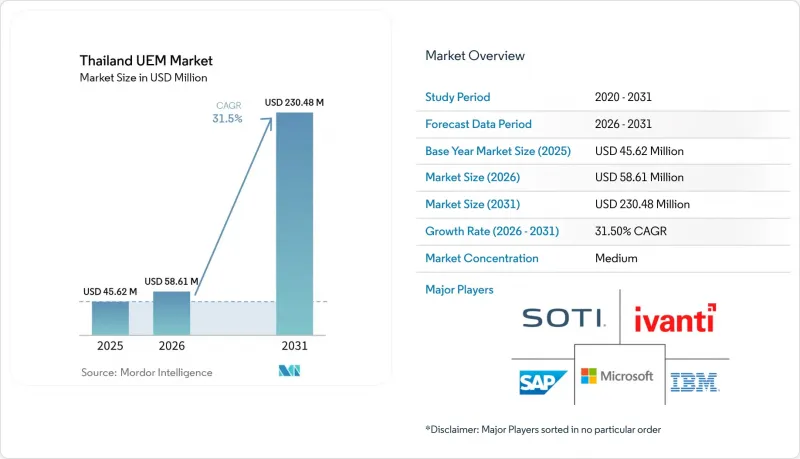
Mordor Intelligence에 의하면, 태국의 UEM 시장 규모는 2025년에 4,562만 달러로 평가되었습니다. 2026년 5,861만 달러에서 2031년까지 2억 3,048만 달러에 이를 것으로 예상되며, 예측 기간(2026-2031년) CAGR은 31.50%를 나타낼 전망입니다.
본 보고서는 구성 요소(솔루션 및 서비스), 도입 형태(클라우드 기반, On-Premise형, 하이브리드형), 조직 규모(대기업 및 중소기업), 최종 사용자 산업(IT 및 통신, 은행, 금융서비스 및 보험(BFSI), 정부·국방, 헬스케어 및 생명과학, 제조, 소매 및 전자상거래 등)별로 분류되어 있습니다. 시장 예측은 금액(달러) 기준으로 제시되어 있습니다.
태국의 UEM 시장 동향 및 인사이트
태국 조직 전반에 걸친 엔터프라이즈 모빌리티 요구 사항 증가
태국에서는 모바일 액세스, 원격 워크플로우, 멀티 디바이스 운영이 은행, 통신, 의료, 제조, 공공 서비스와 같은 분야의 핵심 사업 제공과 직접적으로 연결되어 있기 때문에 엔터프라이즈 모빌리티는 더 이상 부수적인 노력으로 취급되지 않습니다. 과거에는 스마트폰과 노트북을 별도의 도구로 관리하던 조직들이, 현재는 모바일 기기, PC, 공유 엔드포인트, 연결된 자산을 일관되게 관리하기 위한 단일 정책 계층을 필요로 하고 있어, 태국의 UEM 시장은 이러한 변화의 혜택을 누리고 있습니다. EEC(동부 경제 회랑)의 디지털 인프라 전략은 이러한 요구를 더욱 강화하고 있습니다. 스마트 시티 시스템, 산업용 연결성, 디지털 서비스 플랫폼은 모두 공통된 관리 체제 하에서 프로비저닝, 모니터링, 보안 조치가 이루어져야 하는 방대한 수의 연결 엔드포인트에 의존하고 있기 때문입니다. 이와 유사한 추세는 태국의 디지털 데이터 인프라 로드맵을 통해서도 뒷받침되고 있습니다. 이 로드맵은 데이터 거버넌스, 역량 개발, 그리고 보다 광범위한 디지털 대응 능력을 지역을 아우르는 국가 현대화 노력의 중심에 두고 있습니다. 이러한 조합을 통해 기업들은 파편화된 모바일 기기 관리 스택에서 벗어나, 보다 광범위한 플랫폼 통합으로 나아가고 있습니다. 기기군이 여러 거점, 운영 체제, 운영 팀에 걸쳐 있을 경우, 단일 도구만으로는 정책상의 공백이 발생하기 때문입니다. 그 결과, 모빌리티의 성장에 따라 일회성 소프트웨어 구매가 아닌 통합된 정책 적용에 대한 지속적인 수요가 발생하고 있어, 태국의 UEM 시장은 더욱 견고한 구조적 기반을 구축해 가고 있습니다.
규제 산업에서 엔드포인트 보안의 중요성 증가
규제 대상 산업에서 보안의 우선순위가 높아짐에 따라, 엔드포인트 제어가 구매 요건으로서 최전선으로 부상하고 있습니다. 특히 은행, 의료, 정부 관련 환경에서는 기기의 부정 사용이 업무 혼란, 감사상의 지적, 평판 저하를 초래할 우려가 있기 때문입니다. 과거 모빌리티 도입 시기와 비교했을 때, 현재 엔드포인트 거버넌스가 ID 관리, 액세스 관리, 데이터 보호와 밀접하게 연계되어 있어 태국의 UEM 시장은 이러한 추세로부터 혜택을 보고 있습니다. 크룬실리 은행이 Kyndryl과 공동으로 진행한 Microsoft 365 E3 도입 사례는 태국의 금융 기관들이 기기 관리 및 업무 환경 보안을 규제 당국의 기대와 전 직원을 대상으로 한 관리 체제에 부합하는 보다 공식적인 엔터프라이즈 거버넌스 모델로 전환하고 있음을 보여줍니다. 의료 업계도 비슷한 방향으로 나아가고 있습니다. 이는 디지털 헬스 프로그램의 확대에 따라 중앙 콘솔에서 설정, 업데이트 및 제한을 수행해야 하는 임상용 및 관리용 기기의 수가 증가하고 있기 때문입니다. 이러한 환경에서는 규정 준수 기준, 원격 정책 업데이트, 철저한 암호화, 감사 가시성 등 최신 UEM 플랫폼의 핵심 기능을 구성하는 요소들의 중요성이 부각되고 있습니다. 또한 이는 태국의 UEM 시장에서 벤더 선정이 편의성보다는 감독이 더욱 엄격해지고 있는 분야에서 기기 관련 관리상의 격차를 줄일 수 있는 능력에 따라 좌우되고 있음을 의미합니다.
레거시 엔터프라이즈 시스템과의 통합 복잡성
태국의 UEM 시장의 도입을 가장 크게 저해하는 요인은 최신 클라우드 네이티브형 엔드포인트 플랫폼을 On-Premise 시스템이나 개별 운영 사일로 중심으로 구축된 기존 엔터프라이즈 환경에 통합하는 데 따르는 어려움입니다. 태국의 많은 주요 조직은 여전히 레거시 디렉터리, 구형 ERP 시스템, 독자적인 사양의 네트워크 제어, 그리고 정책 기반 엔드포인트 오케스트레이션과 쉽게 통합되지 않는 맞춤형 내부 워크플로우에 의존하고 있습니다. 그 결과, UEM 프로젝트는 더욱 어려워집니다. 정책 자동화를 확실하게 작동시키려면, 기기 관리가 ID 서비스, SIEM 도구, 티켓 발행 시스템, 액세스 제어와 연동되어야 하는 경우가 많기 때문입니다. 또한, Ivanti EPMM의 중대한 취약점에 관한 ThaiCERT의 2025년 권고문은 On-Premise 엔드포인트 관리 환경에서의 보안 조치 및 패치 적용에 대한 추가적인 부담을 부각시키고 있으며, 이는 이미 복잡한 마이그레이션 의사 결정에 더 큰 위험을 가중시킬 수 있습니다. 따라서 기업들은 두 가지 과제에 직면해 있습니다. 바로 아키텍처 현대화와 기존 시스템 내의 활성 위험 관리를, 기기 운영을 중단하지 않고 수행하는 것입니다. 이로 인해 태국의 UEM 시장의 계약 체결이 지연되고, 도입 일정이 장기화되며, 소프트웨어 비용에 그치지 않는 총 소유 비용(TCO) 증가로 이어지고 있습니다.
부문 분석
2025년 태국의 UEM 시장에서 솔루션 부문은 67.81%의 점유율을 차지했으며, 해당 부문은 2026년부터 2031년까지 연평균 성장률(CAGR) 32.69%를 나타낼 것으로 예측됩니다. 이러한 선두 위상은 초기 도입 주기에서 기업들이 플랫폼 소프트웨어를 명확히 우선시하고 있음을 반영합니다. 이는 구매자들이 우선적으로 기기 등록, 정책 설정, 액세스 보호, 그리고 다양한 엔드포인트 환경 전반에 걸친 가시성을 유지할 수 있는 제어 계층을 필요로 하기 때문입니다. 조직들이 스마트폰, 노트북, 태블릿, 키오스크, 공유 기기에 대한 무선(OTA) 설정, 원격 초기화, 정책 적용, 수명 주기 관리를 우선시함에 따라 기기 관리는 솔루션 내에서 여전히 가장 큰 하위 부문으로 남아 있습니다. 규제 대상 조직에서는 사용자, 앱, 기기 상태를 아우르며 엔드포인트 정책이 적용 및 감사 가능하다는 증거를 점점 더 필요로 하고 있기 때문에 보안 및 규정 준수 관리가 매출 구성에서 더 큰 비중을 차지하게 되었습니다. 용도 관리 또한 직접적인 운영상의 역할을 수행하고 있습니다. 태국의 IT 팀은 지점, 진료소, 창고 또는 현장 팀에 흩어져 있는 기기에 대한 물리적 접근에 의존하지 않고도 업무용 용도의 배포, 업데이트 및 폐기를 수행해야 하기 때문입니다.
컨텐츠 관리 및 분석 기능은 수익 측면에서는 여전히 규모가 작지만, 기업이 엔드포인트 플랫폼에 정책 인텔리전스, 워크플로우 자동화, 수작업 최소화를 지원하는 기능을 요구함에 따라 그 전략적 중요성이 높아지고 있습니다. IBM이 2025년에 발표한 MaaS360용 AI 기반 정책 추천 기능은 벤더들이 기본적인 제어를 넘어, 규정 준수 위험을 가시화하고 수작업을 최소화하면서 더 강력한 구성을 추천할 수 있는 시스템으로 전환하고 있음을 보여줍니다. 나머지 수익 구성 요소는 서비스가 차지하고 있으며, 도입, 정책 조정, 통합 작업 및 관리형 서비스는 많은 사내 팀이 여전히 단독으로 대응하기 어렵기 때문에 서비스 분야는 계속 확대되고 있습니다. 이는 태국의 UEM 업계에서 성장하고 있는 분야 중 하나입니다. 기기 환경이 더욱 분산되고 규제가 강화됨에 따라 소프트웨어에 대한 수요가 자연스럽게 컨설팅, 도입 및 관리형 지원을 견인하기 때문입니다. 하지만 기업이 운영을 외주화하거나 워크플로우를 일관되게 최적화하기 위해서는 일반적으로 견고한 소프트웨어 기반이 필요하기 때문에 플랫폼에 대한 지출이 계속해서 시장을 주도할 것으로 보입니다.
2025년에는 클라우드 기반 도입이 매출의 63.58%를 차지했으며, 태국의 UEM 시장의 클라우드 기반 도입은 2031년까지 연평균 성장률(CAGR) 32.27%로 성장할 것으로 전망됩니다. 이러한 주도적 위상은 태국에서 클라우드 서비스가 제공하는 실질적인 이점을 반영한 것입니다. 태국 기업들은 더 신속한 도입, 인프라 오버헤드 절감, 지사 및 모바일 근로자에 대한 기기 정책의 손쉬운 배포를 원하고 있기 때문입니다. 마이크로소프트의 태국 내 인프라에 대한 노력은 클라우드에 대한 신뢰를 폭넓게 높이고, 기업의 구매 결정 과정에서 Microsoft 365, Azure, Intune 간의 연동을 강화함으로써 이러한 전환 경로를 뒷받침하고 있습니다. 또한, 클라우드 도입을 통해 조직은 자체 서버 스택을 구축하거나 업데이트할 필요 없이 UEM을 원활하게 확장할 수 있게 됩니다. 이는 제어 기능을 원하지만 새로운 인프라의 복잡성을 원치 않는 많은 구매자가 존재하는 시장에서 중요한 요소입니다. 태국의 UEM 시장에서 이는 클라우드가 가장 주요한 도입 모델일 뿐만 아니라, 태국의 광범위한 디지털 인프라 주기와 가장 밀접하게 부합하는 모델임을 의미합니다.
On-Premise 배포는 관리가 엄격한 환경, 특히 레거시 인증 시스템이나 내부 호스팅 정책, 혹은 더 엄격한 운영상 분리가 여전히 유지되고 있는 환경에서는 여전히 중요한 역할을 수행하고 있습니다. 이 모델은 정부 기관이나 국방 분야, 그리고 일부 오래된 대규모 기업 환경에서는 계속해서 중요하게 여겨지겠지만, 하드웨어 유지보수, 업그레이드 지연, 그리고 더 무거운 패치 적용 의무와 같은 과제에 직면해 있습니다. ThaiCERT가 2025년에 발표한 Ivanti EPMM의 심각한 취약점에 대한 경고는 패치 적용이나 설정 관리가 소홀해질 경우 On-Premise 엔드포인트 관리 환경이 독자적인 보안 부담을 짊어지게 될 것임을 보여줌으로써 이러한 우려를 더욱 강화했습니다. 따라서 전환 중인 기업들 사이에서 하이브리드 배포가 주목받고 있습니다. 이는 구형 기기나 디렉터리를 지원하면서도 클라우드 정책을 새로운 엔드포인트로 확장할 수 있는 방법을 제공하기 때문입니다. 태국의 UEM 시장이 ‘클라우드 퍼스트’ 운영 패턴으로 계속 전환되는 가운데, 이 중간 모델은 모든 기업이 한 번에 모든 기기 거버넌스를 이전하도록 강요하지 않으면서도 계속해서 유용할 것으로 보입니다.
기타 혜택 :
- 엑셀 형식 시장 예측(ME) 시트
- 3개월간의 애널리스트 지원
자주 묻는 질문
목차
제1장 서론
제2장 조사 방법
제3장 주요 요약
제4장 시장 구도
제5장 시장 규모 및 성장 예측
제6장 경쟁 구도
제7장 시장 기회 및 향후 전망
KTH 26.08.05According to Mordor Intelligence, the Thailand UEM market size was valued at USD 45.62 million in 2025 and estimated to grow from USD 58.61 million in 2026 to reach USD 230.48 million by 2031, at a CAGR of 31.50% during the forecast period (2026-2031).
This report is Segmented by Component (Solutions, and Services), Deployment Mode (Cloud-Based, On-Premise, and Hybrid), Organization Size (Large Enterprises, and Small and Medium Enterprises), and End-User Industry (IT and Telecommunications, BFSI, Government and Defense, Healthcare and Life Sciences, Manufacturing, Retail and E-Commerce, and More). The Market Forecasts are Provided in Terms of Value (USD).
Thailand UEM Market Trends and Insights
Increasing Enterprise Mobility Requirements Across Thai Organizations
Enterprise mobility is no longer treated as a side initiative in Thailand, as mobile access, remote workflows, and multi-device operations are now directly tied to core business delivery across banking, telecom, healthcare, manufacturing, and public services. The Thailand UEM market is benefiting from this shift because organizations that once managed smartphones and laptops with separate tools now need a single policy layer to manage mobile devices, PCs, shared endpoints, and connected assets consistently. The EEC digital infrastructure agenda is reinforcing that need, because smart city systems, industrial connectivity, and digital service platforms all depend on large volumes of connected endpoints that must be provisioned, monitored, and secured under common controls. The same pattern is supported by Thailand's digital data infrastructure roadmap, which places data governance, capacity development, and broader digital readiness at the center of national modernization efforts across regions. That combination is pushing enterprises away from fragmented mobile device management stacks and toward broader platform consolidation, because point tools create policy gaps once device fleets spread across sites, operating systems, and operating teams. The result is a stronger structural base for the Thailand UEM market, as mobility growth creates ongoing demand for centralized policy enforcement rather than one-time software purchases.
Growing Endpoint Security Priorities in Regulated Industries
Security priorities in regulated sectors are driving endpoint control to the forefront as a buying requirement, especially in banking, healthcare, and government-linked environments, where device misuse can trigger operational disruptions, audit findings, and reputational damage. The Thailand UEM market is gaining from this pressure because endpoint governance now sits much closer to identity control, access management, and data protection than it did in earlier mobility rollouts. Krungsri's Microsoft 365 E3 deployment with Kyndryl demonstrates how Thai financial institutions are moving device management and workplace security into a more formal enterprise governance model aligned with regulatory expectations and workforce-wide controls. Healthcare is moving in the same direction because broader digital health programs are increasing the number of clinical and administrative devices that must be configured, updated, and restricted from a central console. This environment underscores the value of compliance baselines, remote policy updates, encryption enforcement, and audit visibility, capabilities that are central to modern UEM platforms. It also means that vendor selection in the Thailand UEM market is being shaped less by convenience and more by the ability to reduce device-related control gaps in sectors where oversight has become more active.
Integration Complexity with Legacy Enterprise Systems
The largest brake on adoption in the Thailand UEM market is the difficulty of integrating modern cloud-native endpoint platforms into older enterprise environments built around on-prem systems and separate operational silos. Many large Thai organizations still rely on legacy directories, older ERP systems, proprietary network controls, and customized internal workflows that do not easily align with policy-based endpoint orchestration. That makes UEM projects more demanding, because device management often has to connect to identity services, SIEM tools, ticketing systems, and access controls before policy automation can operate reliably. ThaiCERT's 2025 advisory on critical Ivanti EPMM vulnerabilities also underscored the additional security and patching burden on on-premises endpoint management environments, which can add risk to already complex migration decisions. Enterprises therefore face a two-part problem: modernizing architecture and managing active risk in inherited systems while keeping device operations uninterrupted. This slows deal conversion in the Thailand UEM market, stretches implementation timelines, and raises total ownership cost beyond the software fee alone.
Other drivers and restraints analyzed in the detailed report include:
- Expansion of Cloud-Managed IT Operations in Thailand
- Rising BYOD and COPE Adoption in Large Enterprises
- Budget Constraints Among Small and Medium Enterprises
For complete list of drivers and restraints, kindly check the Table Of Contents.
Segment Analysis
Solutions held 67.81% of the Thailand UEM market share in 2025, and the same segment is projected to grow at a 32.69% CAGR from 2026 to 2031. That lead reflects a clear enterprise preference for platform software during initial rollout cycles, because buyers first need a control layer that can enroll devices, set policies, secure access, and maintain visibility across mixed endpoint estates. Device management remained the largest sub-segment inside solutions, as organizations prioritized over-the-air configuration, remote wipe, policy enforcement, and lifecycle control for smartphones, laptops, tablets, kiosks, and shared devices. Security and compliance management is becoming more influential within the revenue mix, because regulated organizations increasingly need proof that endpoint policies can be enforced and audited across users, apps, and device states. Application management also has a direct operating role, since Thai IT teams need to push, update, and retire business apps without depending on physical access to devices scattered across branches, clinics, warehouses, or field teams.
Content management and analytics functions remain smaller in revenue terms, but they are becoming more strategic as enterprises ask endpoint platforms to support policy intelligence, workflow automation, and lower-touch administration. IBM's 2025 release of AI-powered policy recommendations for MaaS360 showed how vendors are moving beyond basic control toward systems that can surface compliance risks and recommend stronger configurations with less manual effort. Services accounted for the remaining component revenue and continue to expand because implementation, policy tuning, integration work, and managed administration are still difficult for many internal teams to handle alone. This is one place where the Thailand UEM industry is widening, because software demand naturally pulls consulting, deployment, and managed support around it once device estates become more distributed and more regulated. Even so, platform spending should continue to set the tone, because enterprises usually need a strong software base before they can outsource operations or optimize workflows in a consistent way.
Cloud-based deployment accounted for 63.58% of revenue in 2025, and the Thailand UEM market for cloud-based deployment is projected to grow at a 32.27% CAGR through 2031. This lead reflects the practical advantages of cloud delivery in Thailand, where enterprises want faster implementation, lower infrastructure overhead, and easier device policy distribution across branches and mobile workforces. Microsoft's infrastructure commitment in Thailand is reinforcing that migration path by bolstering broader cloud confidence and tighter alignment among Microsoft 365, Azure, and Intune in enterprise buying decisions. Cloud deployment also gives organizations a cleaner route to scale UEM without building or refreshing their own server stack, which matters in a market where many buyers want control capabilities but do not want new infrastructure complexity. For the Thailand UEM market, that means cloud is not only the largest deployment model, it is also the model most closely matched to the country's broader digital infrastructure cycle.
On-premises deployment still has a meaningful role in highly controlled environments, especially where legacy authentication systems, internal hosting policies, or stricter operational isolation remain in place. That model is likely to stay relevant in parts of government, defense, and older large-enterprise estates, but it faces more friction from hardware upkeep, slower upgrades, and heavier patching obligations. ThaiCERT's 2025 alert on critical Ivanti EPMM vulnerabilities sharpened that concern by showing how on-premise endpoint management environments can carry their own security burden when patching and configuration discipline slip. Hybrid deployment is therefore gaining attention among enterprises in transition, because it gives them a way to support older devices and directories while extending cloud policies to new endpoints. That intermediate model should remain useful as the Thailand UEM market continues shifting toward cloud-first operating patterns without forcing every enterprise to move all device governance in a single step.
Complete Report Scope:
- By Component
- Solutions
- Device Management
- Application Management
- Content Management
- Security and Compliance Management
- Analytics and Automation
- Services
- Solutions
- By Deployment Mode
- Cloud-Based
- On-Premise
- Hybrid
- By Organization Size
- Large Enterprises
- Small and Medium Enterprises
- By End-User Industry
- IT and Telecommunications
- BFSI
- Government and Defense
- Healthcare and Life Sciences
- Manufacturing
- Retail and E-Commerce
- Education
- Transportation and Logistics
- Energy and Utilities
- Other End-User Industries
List of Companies Covered in this Report:
- Microsoft Corporation
- IBM Corporation
- Ivanti, Inc.
- SOTI Inc.
- BlackBerry Limited
- SAP SE
- JAMF Holding Corp.
- Broadcom Inc.
- Cisco Systems, Inc.
- Google LLC
- Samsung Electronics Co., Ltd.
- Citrix Systems, Inc.
- Matrix42 AG
- Quest Software Inc.
- Dell Technologies Inc.
- HCLTech Limited
- Fujitsu Limited
- Kaspersky Lab
- Sophos Limited
Additional Benefits:
- The market estimate (ME) sheet in Excel format
- 3 months of analyst support
TABLE OF CONTENTS
1 INTRODUCTION
- 1.1 Study Assumptions and Market Definition
- 1.2 Scope of the Study
2 RESEARCH METHODOLOGY
3 EXECUTIVE SUMMARY
4 MARKET LANDSCAPE
- 4.1 Market Overview
- 4.2 Market Drivers
- 4.2.1 Increasing Enterprise Mobility Requirements Across Thai Organizations
- 4.2.2 Rising BYOD and COPE Adoption In Large Enterprises
- 4.2.3 Growing Endpoint Security Priorities in Regulated Industries
- 4.2.4 Expansion of Cloud-Managed IT Operations In Thailand
- 4.2.5 Accelerating Demand for Centralized Device Lifecycle Control
- 4.2.6 Rising Need for Secure Remote Workforce Enablement
- 4.3 Market Restraints
- 4.3.1 Integration Complexity With Legacy Enterprise Systems
- 4.3.2 Budget Constraints Among Small and Medium Enterprises
- 4.3.3 Limited Internal UEM Skill Availability
- 4.3.4 Data Privacy and Compliance Concerns Around Device Monitoring
- 4.4 Industry Value Chain Analysis
- 4.5 Regulatory Landscape
- 4.6 Technological Outlook
- 4.7 Impact of Macroeconomic Factors on the Market
- 4.8 Porter's Five Forces Analysis
- 4.8.1 Threat of New Entrants
- 4.8.2 Bargaining Power of Buyers
- 4.8.3 Bargaining Power of Suppliers
- 4.8.4 Threat of Substitutes
- 4.8.5 Industry Rivalry
5 MARKET SIZE AND GROWTH FORECASTS (VALUE)
- 5.1 By Component
- 5.1.1 Solutions
- 5.1.1.1 Device Management
- 5.1.1.2 Application Management
- 5.1.1.3 Content Management
- 5.1.1.4 Security and Compliance Management
- 5.1.1.5 Analytics and Automation
- 5.1.2 Services
- 5.1.1 Solutions
- 5.2 By Deployment Mode
- 5.2.1 Cloud-Based
- 5.2.2 On-Premise
- 5.2.3 Hybrid
- 5.3 By Organization Size
- 5.3.1 Large Enterprises
- 5.3.2 Small and Medium Enterprises
- 5.4 By End-User Industry
- 5.4.1 IT and Telecommunications
- 5.4.2 BFSI
- 5.4.3 Government and Defense
- 5.4.4 Healthcare and Life Sciences
- 5.4.5 Manufacturing
- 5.4.6 Retail and E-Commerce
- 5.4.7 Education
- 5.4.8 Transportation and Logistics
- 5.4.9 Energy and Utilities
- 5.4.10 Other End-User Industries
6 COMPETITIVE LANDSCAPE
- 6.1 Market Concentration
- 6.2 Strategic Moves
- 6.3 Market Share Analysis
- 6.4 Company Profiles (includes Global Level Overview, Market Level Overview, Core Segments, Financials as available, Strategic Information, Market Rank/Share, Products and Services, Recent Developments)
- 6.4.1 Microsoft Corporation
- 6.4.2 IBM Corporation
- 6.4.3 Ivanti, Inc.
- 6.4.4 SOTI Inc.
- 6.4.5 BlackBerry Limited
- 6.4.6 SAP SE
- 6.4.7 JAMF Holding Corp.
- 6.4.8 Broadcom Inc.
- 6.4.9 Cisco Systems, Inc.
- 6.4.10 Google LLC
- 6.4.11 Samsung Electronics Co., Ltd.
- 6.4.12 Citrix Systems, Inc.
- 6.4.13 Matrix42 AG
- 6.4.14 Quest Software Inc.
- 6.4.15 Dell Technologies Inc.
- 6.4.16 HCLTech Limited
- 6.4.17 Fujitsu Limited
- 6.4.18 Kaspersky Lab
- 6.4.19 Sophos Limited
7 MARKET OPPORTUNITIES AND FUTURE OUTLOOK
- 7.1 White-Space and Unmet-Need Assessment


