

|
시장보고서
상품코드
2100275
통합 엔드포인트 관리 시장 : 시장 점유율 분석, 업계 동향 및 통계, 성장 예측(2026-2031년)Unified Endpoint Management - Market Share Analysis, Industry Trends & Statistics, Growth Forecasts (2026 - 2031) |
||||||
 Mordor Intelligence
Mordor Intelligence에 의하면, 통합 엔드포인트 관리 시장 규모는 2025년에 70억 7,000만 달러로 평가되었고, 2026년 87억 2,000만 달러에서 2031년까지 270억 3,000만 달러에 이를 것으로 예측되며, 예측 기간(2026-2031년) CAGR은 25.38%를 나타낼 전망입니다.
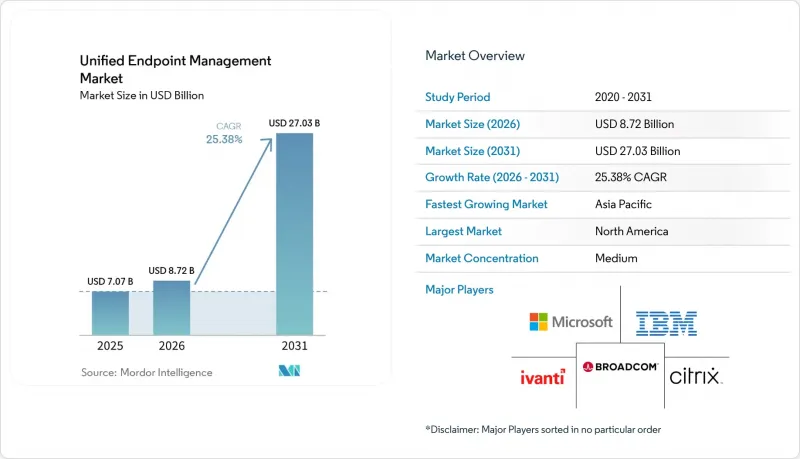
본 보고서는 컴포넌트별(솔루션 및 서비스), 도입 형태별(클라우드 기반, 온프레미스형 등), 조직 규모별(대기업 및 중소기업), 최종 사용자 산업별(IT 및 통신, 은행, 금융서비스 및 보험(BFSI), 정부·국방, 헬스케어 및 생명과학, 소매 및 전자상거래 등), 그리고 국가별로 분류되어 있습니다. 시장 전망은 금액(달러) 기준으로 제시되어 있습니다.
세계의 통합 엔드포인트 관리 시장 동향 및 인사이트
특권, 기밀 및 규제 대상 워크로드에 대한 '보안 우선' 디지털화
보안은 단순히 기기 제어에 부가된 2차적인 기능이 아니라, 통합 엔드포인트 관리 시장에서 주요 구매 동인이 되고 있습니다. 법률 사무소, 금융 기관, 의료 서비스 제공업체는 특권적, 기밀 및 규제 대상 데이터를 취급하고 있기 때문에 엔드포인트 침해는 소송, 개인정보 문제 또는 감사상의 위험으로 즉시 이어질 수 있습니다. 미국변호사협회(ABA)의 공식 의견 제512호에 따라, 벤더의 데이터 처리에 대한 검토가 변호사의 직업적 의무로 규정됨에 따라 엔드포인트 및 AI 도구에 대한 거버넌스의 중요성이 높아졌습니다. 또한, 많은 구매자가 UEM과 ID 및 액세스 관리를 결합하여 정책, 접근, 감사에 대한 통제를 연계하고 있어, 이러한 압박으로 인해 계약 규모도 증가하고 있습니다. HCL BigFix는 2025년 7월 NIAP 인증을 획득하여, 보안 검증이 특히 중시되는 규제 대상 환경 및 연방 정부 기관에서의 입지를 강화했습니다.
고객 및 내부 워크플로우의 ‘클라우드 우선’ 방식에 따른 현대화
2025년, 클라우드 도입이 통합 엔드포인트 관리 시장을 주도하며, 도입 가속화 및 원격 환경 대응 간소화라는 구매 추세를 지속적으로 뒷받침하고 있습니다. 클라우드 에이전트는 표준 프로토콜을 통해 분산된 디바이스에 액세스하므로, 일반적으로 온프레미스 도입을 지연시키는 인프라 부담을 경감시킵니다. 디바이스 관리가 클라우드로 전환됨에 따라, 많은 조직에서는 동일한 스택 상에서 협업, VDI, 인트라넷 및 워크플로우 도구도 재검토하고 있습니다. 이를 통해 통합 엔드포인트 관리 시장에서 확고한 플랫폼 포트폴리오를 보유한 벤더에게는 더 광범위한 시장 점유율 확대 기회가 생깁니다. 마이크로소프트가 2026년에 Microsoft 365 E3 및 E5 번들에 Intune의 고급 기능을 확장한 것은 벤더들이 클라우드 UEM을 활용하여 단순한 엔드포인트 제어를 넘어서는 플랫폼의 채택 확대를 도모하고 있음을 보여줍니다.
레거시 문서 관리, 청구 관리, 프로젝트 관리 시스템과의 통합에서 발생하는 큰 마찰
통합 과정에서 발생하는 마찰은 법무 및 전문 서비스 분야의 통합 엔드포인트 관리(UEM) 시장을 가로막는 가장 큰 걸림돌로 남아 있습니다. 많은 기업은 클라우드 네이티브 아키텍처가 표준화되기 이전에 구축된 문서 관리, 청구, 사건 관리 시스템에 여전히 의존하고 있습니다. 이러한 시스템을 최신 UEM 플랫폼에 연결하려면 대부분의 경우 맞춤형 미들웨어, 장기 서비스 계약, 그리고 도입 후 지속적인 유지 관리가 필요합니다. 그 결과, 엔드포인트 위험이 가장 높은 조직일수록 통합 엔드포인트 관리 시장에서 완전한 커버리지를 달성하는 데 가장 오랜 시간이 걸리는 경향이 있습니다. 중규모 로펌은 더 강력한 거버넌스가 필요하지만, 사내에 대규모 통합 팀을 갖추지 못한 경우가 많아 특히 위험에 노출되어 있습니다.
부문 분석
솔루션은 2025년 통합 엔드포인트 관리 시장의 66.78% 점유율을 차지했으며, 2031년까지 연평균 성장률(CAGR) 26.14%로 확대될 것으로 예측됩니다. 기업들은 콘솔 수를 줄이고, 정책 적용을 더욱 명확히 하며, 기기 유형에 관계없이 보다 일관된 커버리지를 실현하고자 하기 때문에 통합 플랫폼 라이선스를 선호합니다. 솔루션 분야에서는 통합 엔드포인트 관리와 엔터프라이즈 모빌리티 관리가 여전히 가장 확고한 수요 분야로 자리 잡고 있습니다. 커뮤니케이션, 협업, 직원 경험, 인트라넷 도구, 워크플로우 자동화, 지식 관리와 같은 인접 분야는 여전히 통합 과정에 있으며, 이로 인해 통합 엔드포인트 관리 시장에서 인수합병 및 제휴의 여지가 남아 있습니다.
대규모 도입에는 여전히 설정, 통합 및 관리형 지원이 필요하기 때문에 서비스는 UEM 업계에 깊이 뿌리내리고 있습니다. 이는 환경이 여러 운영 체제, 지역, 규정 준수 규칙에 걸쳐 있는 경우에 특히 해당됩니다. IBM은 2025년에 MaaS360에 WatsonX 기반의 정책 권장 기능을 추가했습니다. 이를 통해 팀은 STIG 및 HIPAA를 준수하는 설정에서 벗어난 부분을 감지하고 시정 조치를 제안할 수 있게 되었습니다. 자동화가 진전되더라도 규제 대상인 구매 기업에는 여전히 변경 관리, 통합 작업, 지속적인 거버넌스가 필요하기 때문에 통합 엔드포인트 관리 시장의 서비스 수요는 견조한 추세를 보이고 있습니다.
2025년 기준, UEM 시장 규모의 60.42%를 클라우드가 차지했으며, 2031년까지 연평균 성장률(CAGR) 26.45%를 나타낼 것으로 예측됩니다. 이러한 추세는 주요 도입 모델이 성숙기에 접어들기는커녕 여전히 성장세를 이어가고 있음을 보여줍니다. 클라우드 에이전트는 많은 온프레미스 환경에 수반되는 막중한 인프라 요구 사항을 피할 수 있으므로, IT 팀이 원격 환경의 단말기들을 보다 신속하게 관리할 수 있게 해줍니다. 또한, 클라우드 제공을 통해 구축되는 공유 데이터 레이어는 통합 엔드포인트 관리 시장에서 보다 지속적인 정책 적용과 신속한 시정 조치를 지원합니다.
온프레미스 배포는 로컬 제어 및 엄격한 데이터 관리가 여전히 최우선 과제인 기밀성이 높은 환경에서 여전히 중요한 역할을 수행하고 있습니다. 또한 하이브리드 모델도 지지를 얻고 있습니다. 이는 기업이 기밀성이 높은 워크로드를 사내에 가까운 곳에 유지하면서, 표준 엔드포인트를 클라우드 서비스를 통해 관리할 수 있기 때문입니다. 마이크로소프트는 2026년에도 Intune의 고급 기능을 지속적으로 확충하여, 이를 통해 보다 광범위한 관리 계층을 마이크로소프트 스택에 연결한 채로 클라우드 관리 환경으로의 전환을 촉진했습니다. 클라우드의 확장성과 로컬 제어 간의 이러한 균형 덕분에, 통합 엔드포인트 관리 업계 전반에서 몇 가지 도입 경로가 여전히 유효한 것으로 나타났습니다.
지역별 분석
2025년, 북미는 통합 엔드포인트 관리(UEM) 시장 점유율의 39.78%를 차지하며 최대 지역 블록이 되었습니다. 조기 클라우드 도입과 사이버 보안에 대한 투자 문화가 뿌리 깊게 자리 잡고 있는 것이 이 지역 전체 수요를 지속적으로 뒷받침하고 있습니다. 또한, 의료, 법률 서비스, 금융 등 규제 대상 산업에서도 완벽한 감사 추적 기록과 더욱 엄격한 엔드포인트 관리의 중요성이 더욱 높아지고 있습니다. 미국 주요 도시에 위치한 대형 로펌 및 엔터프라이즈 서비스 네트워크는 고객의 기밀 유지 및 전자 증거 개시(e-discovery) 대응이 업무상 핵심 요건이기 때문에 계속해서 매력적인 고객층으로 남아 있습니다. Kyndryl이 2026년 3월에 수주한 텍사스주 DIR 계약은 공공 부문의 현대화가 엔드포인트 보안, 클라우드 및 AI 관련 서비스에 대한 수요를 더욱 높이고 있음을 보여줍니다.
유럽은 GDPR(EU 개인정보보호규정), 제로 트러스트의 우선순위, 하이브리드 근무의 확산이 모두 구매 결정에 영향을 미치고 있기 때문에 통합 엔드포인트 관리(UEM) 시장에서 여전히 중요한 지역으로 남아 있습니다. 독일 및 인근 시장의 구매자들은 클라우드의 유연성과 현지 관리, 엄격한 데이터 처리 요건 간의 균형을 계속해서 모색하고 있습니다. Kyndryl이 2026년 4월 스페인에서 체결한 SANDETEL 계약은 지방 자치 단체가 클라우드 도입, 프로세스 자동화, 규정 준수를 보다 광범위한 현대화 프로그램에 통합하고 있는 실태를 보여줍니다. 남미에서는 도입이 아직 초기 단계에 있으며, 지역 사무소 간 일관된 엔드포인트 기준을 요구하는 다국적 기업을 중심으로 활동이 전개되고 있습니다.
아시아태평양은 2031년까지 연평균 성장률(CAGR) 26.68%를 나타낼 것으로 예측되며, 통합 엔드포인트 관리 시장에서 지역별 가장 빠른 성장 속도를 보일 전망입니다. 이 지역은 모바일 인력 증가, 디지털 전환(DX) 프로그램, 그리고 일부 도입 환경에서 레거시 인프라의 부담 경감과 같은 혜택을 누리고 있습니다. 중국, 일본, 인도, 한국은 여전히 최대 수요 거점이며, 의료 IT 및 제조업 거버넌스 분야에서 이용 사례의 기반이 확대되고 있습니다. 중동 및 아프리카는 현재 규모는 작지만, 사우디아라비아와 UAE의 스마트 시티 및 공공 부문 디지털화 노력에 힘입어 해당 지역에서 서비스를 제공할 수 있는 벤더들에게 중기적인 비즈니스 기회가 창출되고 있습니다.
기타 혜택 :
- 엑셀 형식 시장 예측(ME) 시트
- 3개월간의 애널리스트 지원
자주 묻는 질문
목차
제1장 서론
제2장 조사 방법
제3장 주요 요약
제4장 시장 구도
제5장 시장 규모 및 성장 예측
제6장 경쟁 구도
제7장 시장 기회 및 향후 전망
AJY 26.08.07According to Mordor Intelligence, the unified endpoint management market size was valued at USD 7.07 billion in 2025 and estimated to grow from USD 8.72 billion in 2026 to reach USD 27.03 billion by 2031, at a CAGR of 25.38% during the forecast period (2026-2031).
This report is Segmented by Component (Solutions and Services), Deployment Mode (Cloud-Based, On-Premise, and More), Organization Size (Large Enterprises and Small and Medium Enterprises), End-User Industry (IT and Telecommunications, BFSI, Government and Defense, Healthcare and Life Sciences, Retail and E-Commerce, and More), and Country. The Market Forecasts are Provided in Terms of Value (USD).
Global Unified Endpoint Management Market Trends and Insights
Security-First Digitization for Privileged, Confidential, and Regulated Workloads
Security has become the main buying trigger in the unified endpoint management market, rather than a secondary feature layered onto device control. Legal firms, financial institutions, and healthcare providers handle privileged, confidential, and regulated data, so endpoint compromise can quickly turn into litigation, privacy, or audit exposure. The American Bar Association's Formal Opinion 512 made vendor data handling review a professional obligation for lawyers, which raised the importance of governance around endpoint and AI tools. That pressure is also lifting contract values because many buyers pair UEM with identity and access management so that policy, access, and audit controls are tied together. HCL BigFix received NIAP certification in July 2025, which strengthened its position in regulated and federal settings where security validation carries unusual weight.
Cloud-First Modernization of Client-Facing and Internal Workflows
Cloud deployments led the unified endpoint management market in 2025 and continue to push buying patterns toward faster rollouts and simpler remote coverage. Cloud agents reach distributed devices over standard protocols, which reduces the infrastructure burden that usually slows on-premises deployments. Once device management moves to the cloud, many organizations also review collaboration, VDI, intranet, and workflow tools on the same stack. That creates broader wallet-share opportunities for vendors with established platform portfolios inside the unified endpoint management market. Microsoft's 2026 expansion of advanced Intune capabilities into Microsoft 365 E3 and E5 bundles shows how vendors are using cloud UEM to widen platform adoption beyond endpoint control alone.
High Integration Friction with Legacy Document, Billing, and Case Management Systems
Integration friction remains the clearest brake on the unified endpoint management market in legal and professional services. Many firms still rely on document, billing, and case systems that were built before cloud-native architectures became standard. Connecting those estates to modern UEM platforms often requires custom middleware, long service engagements, and continuous maintenance after rollout. The result is that the organizations with the greatest endpoint risk often face the slowest path to full coverage in the unified endpoint management market. Mid-sized firms are especially exposed because they need stronger governance but often do not have large in-house integration teams.
Other drivers and restraints analyzed in the detailed report include:
- Continuing Hybrid Work in Law Firms and Professional Services
- Rising Demand for AI-Assisted Knowledge Retrieval and Matter Workflow Automation
- Elevated Confidentiality, E-Discovery, and Data Residency Compliance Burden
For complete list of drivers and restraints, kindly check the Table Of Contents.
Segment Analysis
Solutions held 66.78% of unified endpoint management market share in 2025 and are projected to expand at a 26.14% CAGR through 2031. Enterprises favor consolidated platform licenses because they want fewer consoles, clearer policy enforcement, and more consistent coverage across device types. Within solutions, unified endpoint management and enterprise mobility management remain the most established areas of demand. Adjacent areas such as communication and collaboration, employee experience, intranet tools, workflow automation, and knowledge management are still moving through consolidation, which leaves room for acquisition and partnership activity in the unified endpoint management market.
Services remain embedded in the UEM industry because large deployments still need configuration, integration, and managed support. This is especially true when estates span multiple operating systems, geographies, and compliance rules. IBM added WatsonX-based policy recommendations to MaaS360 in 2025, which helps teams detect drift from STIG or HIPAA-aligned settings and suggests corrective steps. Even with stronger automation, services demand stays resilient in the unified endpoint management market because regulated buyers still need change management, integration work, and ongoing governance.
Cloud accounted for 60.42% of the UEM market size in 2025 and is forecast to grow at a 26.45% CAGR through 2031. That pattern shows the leading deployment model is still gaining ground instead of settling into maturity. Cloud agents let IT teams cover remote fleets faster because they avoid the heavier infrastructure prerequisites tied to many on-premises environments. The shared data layer created by cloud delivery also supports more continuous policy enforcement and faster remediation in the unified endpoint management market.
On-premises deployments still matter in sensitive environments where local control and strict data handling remain top priorities. Hybrid models are also gaining traction because they let firms keep sensitive workloads closer to home while managing standard endpoints through cloud services. Microsoft continued to widen Intune's advanced capabilities in 2026, which reinforced the pull toward cloud-managed environments while keeping the broader management layer tied to the Microsoft stack. This balance between cloud scale and local control is keeping several deployment paths relevant across the unified endpoint management industry.
Complete Report Scope:
- By Component
- Solutions
- Device Management
- Application Management
- Content Management
- Security and Compliance Management
- Analytics and Automation
- Services
- Solutions
- By Deployment Mode
- Cloud-Based
- On-Premise
- Hybrid
- By Organization Size
- Large Enterprises
- Small and Medium Enterprises
- By End-User Industry
- IT and Telecommunications
- BFSI
- Government and Defense
- Healthcare and Life Sciences
- Manufacturing
- Retail and E-Commerce
- Education
- Transportation and Logistics
- Energy and Utilities
- Other end-user industries
- By Geography
- North America
- United States
- Canada
- Mexico
- South America
- Brazil
- Argentina
- Chile
- Rest of South America
- Europe
- Germany
- United Kingdom
- France
- Italy
- Spain
- Netherlands
- Russia
- Rest of Europe
- Asia-Pacific
- China
- Japan
- India
- South Korea
- Australia and New Zealand
- Southeast Asia
- Rest of Asia-Pacific
- Middle East
- Saudi Arabia
- United Arab Emirates
- Turkey
- Rest of Middle East
- Africa
- South Africa
- Egypt
- Nigeria
- Rest of Africa
- North America
Geography Analysis
North America accounted for 39.78% of unified endpoint management (UEM) market share in 2025, making it the largest regional block. Early cloud adoption and a stronger cybersecurity spending culture continue to support demand across the region. Regulated sectors such as healthcare, legal services, and finance also raise the value of complete audit trails and tighter endpoint control. Large law firms and enterprise service networks in major US cities remain attractive customers because client confidentiality and e-discovery readiness are central operating requirements. Kyndryl's March 2026 Texas DIR contract shows how public sector modernization is adding another layer of demand for endpoint security, cloud, and AI-linked services.
Europe remains a key geography in the unified endpoint management (UEM) market because GDPR, zero-trust priorities, and hybrid work are all shaping buying decisions. Buyers in Germany and nearby markets continue to weigh cloud flexibility against local control and strict data handling requirements. Kyndryl's April 2026 SANDETEL contract in Spain shows how regional governments are tying cloud adoption, process automation, and compliance into wider modernization programs. South America is still earlier in adoption, with activity centered on multinational firms that want consistent endpoint standards across regional offices.
Asia-Pacific is projected to grow at a 26.68% CAGR through 2031, the fastest pace among regions in the unified endpoint management market. The region benefits from mobile workforce growth, digital transformation programs, and lower legacy infrastructure burdens in several deployment settings. China, Japan, India, and South Korea remain the largest national demand centers, while healthcare IT and manufacturing governance are widening the use case base. Middle East and Africa are smaller today, but smart city and public digitalization efforts in Saudi Arabia and the UAE are building a medium-term opening for vendors with regional delivery capacity.
- Jamf Holding Corp.
- Ivanti Software, Inc.
- SOTI Inc.
- Mitsogo Inc.
- 42Gears Mobility Systems Pvt. Ltd.
- Matrix42 GmbH
- Omnissa, LLC
- NinjaOne, LLC
- Tanium Inc.
- Automox, Inc.
- JumpCloud Inc.
- Kandji, Inc.
- Addigy, Inc.
- Mosyle Corporation
- ProMobi Technologies Pvt. Ltd.
- Syxsense Inc.
- Action1 Corporation
- Absolute Software Corporation
- Atera Networks Ltd.
- baramundi software GmbH
- Aagon GmbH
- Adaptiva Corporation
- Miradore Oy
- Codeproof Technologies Inc.
- SimpleMDM, Inc.
- FileWave AG
Additional Benefits:
- The market estimate (ME) sheet in Excel format
- 3 months of analyst support
TABLE OF CONTENTS
1 INTRODUCTION
- 1.1 Study Assumptions and Market Definition
- 1.2 Scope of the Study
2 RESEARCH METHODOLOGY
3 EXECUTIVE SUMMARY
4 MARKET LANDSCAPE
- 4.1 Market Overview
- 4.2 Impact of Macroeconomic Factors on the Market
- 4.3 Market Drivers
- 4.3.1 Hybrid Work and BYOD Governance Expansion
- 4.3.2 Zero-Trust and Endpoint Security Convergence
- 4.3.3 Cloud-First UEM Adoption Across Distributed Fleets
- 4.3.4 Expansion of Frontline and Rugged Device Programs
- 4.3.5 Windows 10 End-of-Support Device Modernization Cycle
- 4.3.6 NIS2 and DORA Compliance Readiness Spending
- 4.4 Market Restraints
- 4.4.1 Legacy Toolchain Migration and Integration Complexity
- 4.4.2 Data Sovereignty and Regional Hosting Constraints
- 4.4.3 Procurement Hesitation After the VMware-to-Omnissa Transition
- 4.4.4 Endpoint Agent Fatigue and Performance Trade-Offs
- 4.5 Industry Value Chain Analysis
- 4.6 Regulatory Landscape
- 4.7 Technological Outlook
- 4.8 Porter's Five Forces Analysis
- 4.8.1 Threat of New Entrants
- 4.8.2 Bargaining Power of Suppliers
- 4.8.3 Bargaining Power of Buyers
- 4.8.4 Threat of Substitutes
- 4.8.5 Intensity of Rivalry
- 4.9 Stakeholder Analysis
- 4.10 Use-Case Analysis
5 MARKET SIZE AND GROWTH FORECASTS (VALUE)
- 5.1 By Component
- 5.1.1 Solutions
- 5.1.1.1 Device Management
- 5.1.1.2 Application Management
- 5.1.1.3 Content Management
- 5.1.1.4 Security and Compliance Management
- 5.1.1.5 Analytics and Automation
- 5.1.2 Services
- 5.1.1 Solutions
- 5.2 By Deployment Mode
- 5.2.1 Cloud-Based
- 5.2.2 On-Premise
- 5.2.3 Hybrid
- 5.3 By Organization Size
- 5.3.1 Large Enterprises
- 5.3.2 Small and Medium Enterprises
- 5.4 By End-User Industry
- 5.4.1 IT and Telecommunications
- 5.4.2 BFSI
- 5.4.3 Government and Defense
- 5.4.4 Healthcare and Life Sciences
- 5.4.5 Manufacturing
- 5.4.6 Retail and E-Commerce
- 5.4.7 Education
- 5.4.8 Transportation and Logistics
- 5.4.9 Energy and Utilities
- 5.4.10 Other end-user industries
- 5.5 By Geography
- 5.5.1 North America
- 5.5.1.1 United States
- 5.5.1.2 Canada
- 5.5.1.3 Mexico
- 5.5.2 South America
- 5.5.2.1 Brazil
- 5.5.2.2 Argentina
- 5.5.2.3 Chile
- 5.5.2.4 Rest of South America
- 5.5.3 Europe
- 5.5.3.1 Germany
- 5.5.3.2 United Kingdom
- 5.5.3.3 France
- 5.5.3.4 Italy
- 5.5.3.5 Spain
- 5.5.3.6 Netherlands
- 5.5.3.7 Russia
- 5.5.3.8 Rest of Europe
- 5.5.4 Asia-Pacific
- 5.5.4.1 China
- 5.5.4.2 Japan
- 5.5.4.3 India
- 5.5.4.4 South Korea
- 5.5.4.5 Australia and New Zealand
- 5.5.4.6 Southeast Asia
- 5.5.4.7 Rest of Asia-Pacific
- 5.5.5 Middle East
- 5.5.5.1 Saudi Arabia
- 5.5.5.2 United Arab Emirates
- 5.5.5.3 Turkey
- 5.5.5.4 Rest of Middle East
- 5.5.6 Africa
- 5.5.6.1 South Africa
- 5.5.6.2 Egypt
- 5.5.6.3 Nigeria
- 5.5.6.4 Rest of Africa
- 5.5.1 North America
6 COMPETITIVE LANDSCAPE
- 6.1 Market Concentration
- 6.2 Strategic Moves
- 6.3 Market Share Analysis
- 6.4 Company Profiles (includes Global Level Overview, Market Level Overview, Core Segments, Financials as available, Strategic Information, Market Rank/Share, Products and Services, Recent Developments)
- 6.4.1 Jamf Holding Corp.
- 6.4.2 Ivanti Software, Inc.
- 6.4.3 SOTI Inc.
- 6.4.4 Mitsogo Inc.
- 6.4.5 42Gears Mobility Systems Pvt. Ltd.
- 6.4.6 Matrix42 GmbH
- 6.4.7 Omnissa, LLC
- 6.4.8 NinjaOne, LLC
- 6.4.9 Tanium Inc.
- 6.4.10 Automox, Inc.
- 6.4.11 JumpCloud Inc.
- 6.4.12 Kandji, Inc.
- 6.4.13 Addigy, Inc.
- 6.4.14 Mosyle Corporation
- 6.4.15 ProMobi Technologies Pvt. Ltd.
- 6.4.16 Syxsense Inc.
- 6.4.17 Action1 Corporation
- 6.4.18 Absolute Software Corporation
- 6.4.19 Atera Networks Ltd.
- 6.4.20 baramundi software GmbH
- 6.4.21 Aagon GmbH
- 6.4.22 Adaptiva Corporation
- 6.4.23 Miradore Oy
- 6.4.24 Codeproof Technologies Inc.
- 6.4.25 SimpleMDM, Inc.
- 6.4.26 FileWave AG
7 MARKET OPPORTUNITIES AND FUTURE OUTLOOK
- 7.1 White-Space and Unmet-Need Assessment


