

|
시장보고서
상품코드
2098460
남미의 통합 엔드포인트 관리(UEM) 시장 : 시장 점유율 분석, 업계 동향 및 통계, 성장 예측(2026-2031년)South America UEM - Market Share Analysis, Industry Trends & Statistics, Growth Forecasts (2026 - 2031) |
||||||
 Mordor Intelligence
Mordor Intelligence에 의하면, 남미의 통합 엔드포인트 관리(UEM) 시장 규모는 2025년에 3억 6,000만 달러로 평가되었고, 2026-2031년 CAGR 27.08%로 확대될 전망이며, 2031년에는 14억 8,000만 달러에 이를 것으로 예측됩니다.
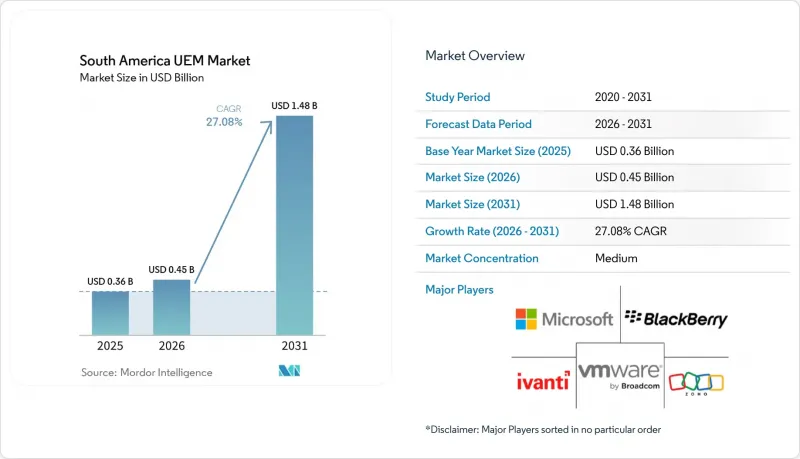
본 보고서는 컴포넌트별(솔루션 및 서비스), 배포 방식별(클라우드 기반, 온프레미스형 등), 조직 규모별(대기업 및 중소기업), 최종 사용자 산업별(IT 및 통신, 정부 및 국방, 의료 및 생명과학, 제조, 소매 및 전자상거래 등), 그리고 국가별로 분류되어 있습니다. 시장 전망은 금액(달러)으로 표시되어 있습니다.
남미의 통합 엔드포인트 관리(UEM) 시장 동향 및 인사이트
BYOD 증가와 하이브리드 근무로 인한 기기 증가
남미의 통합 엔드포인트 관리(UEM) 시장은 기업 환경 내 개인용 기기 및 원격 근무용 기기의 보급에 힘입어 성장하고 있습니다. 이러한 추세는 엔드포인트의 수 자체보다는 현재 단일 기업 ID 및 액세스 구조 하에 통합된 iOS, Android, Windows 기기의 혼재에서 기인합니다. 하이브리드 근무의 확산으로 인해 직원들이 동일한 근무 주기 내에서 사무실 네트워크, 자택 연결 환경, 공공 액세스 포인트 사이를 이동하게 되면서 이 과제는 더욱 복잡해지고 있습니다. 이에 따라 개인정보 보호를 고려한 정책 적용이 더욱 중요해지고 있습니다. IT 팀은 개인 사용에 과도하게 간섭하지 않으면서도 개인 단말기상의 업무 데이터를 보호해야 하기 때문입니다. 남미의 통합 엔드포인트 관리(UEM) 시장에서는 이러한 변화로 인해 구매자들의 관심이 단일 기능의 모바일 단말기 관리 도구에서 단일 콘솔로 등록, 패치 적용, 규정 준수 관리를 통합할 수 있는 플랫폼으로 이동하고 있습니다. 그 결과, 다양한 단말기 군에 걸친 정책 불일치를 해소하면서도 지역 IT 팀이 관리하기에 현실적인 범위로 유지되는 소프트웨어에 대한 수요가 꾸준히 증가하고 있습니다.
엔드포인트를 중심으로 한 사이버 공격 빈도의 급증
남미의 통합 엔드포인트 관리 시장은 엔드포인트를 표적으로 한 사이버 위험의 급증에 힘입어 성장하고 있습니다. 포티넷(Fortinet)의 보고서에 따르면, 2025년에 브라질 조직을 대상으로 7,538억 건의 사이버 공격 시도가 있었으며, 10월 한 달 동안만 1,980억 건의 공격이 기록되었습니다. 특히 정부, 교육, 에너지 분야가 가장 큰 위협에 노출되어 있습니다. 또한 아크로니스(Acronis)는 2025년 상반기 브라질을 전 세계에서 두 번째로 멀웨어 공격이 많은 국가로 지목했으며, LockBit, Play, 8Base와 같은 랜섬웨어 그룹은 제조업 및 IT 관련 표적을 대상으로 지속적인 공격을 전개했습니다. 소포스(Sophos)의 조사에 따르면, 2025년 브라질에서 발생한 랜섬웨어 사고의 54%가 데이터 암호화로 이어졌으며, 이는 세계 평균인 50%를 상회하는 수치입니다. 이는 엔드포인트가 실제로 얼마나 취약해졌는지를 보여줍니다. 남미의 통합 엔드포인트 관리(UEM) 시장에서는 개별 도구만으로는 침해된 기기 간의 횡방향 이동을 감지하기 어렵기 때문에 구매자들이 통합 텔레메트리를 보안 요건으로 간주하는 경향이 강해지고 있습니다. 이에 따라 엔드포인트 관리는 단순한 관리 기능에서 더 광범위한 보안 운영을 뒷받침하는 제어 지점으로 변화하고 있습니다.
중견 기업의 예산 고려 사항
예산 측면의 압박은 남미의 통합 엔드포인트 관리(UEM) 시장에 여전히 큰 걸림돌이 되고 있으며, 특히 기기별 소프트웨어 비용과 기타 시급한 IT 요구 사항 간의 균형을 고려해야 하는 중견 기업에서 두드러집니다. 이는 아르헨티나에서 특히 두드러지는데, 통화 불안정으로 인해 일부 조직은 광범위한 플랫폼 통합을 연기하거나 대신 경량형 모빌리티 도구를 선택하고 있습니다. 또한, 이러한 기업의 대부분은 전담 엔드포인트 전문가를 보유하고 있지 않기 때문에 총 비용은 라이선스 비용뿐만 아니라 외부 업체를 통한 도입 및 지원 비용에도 좌우됩니다. 통신 사업자가 제공하는 번들형 기기 관리 옵션은 어느 정도 대안이 될 수 있지만, 규제 대상 구매자의 경우 정책의 세부 사항이나 규정 준수 보고 측면에서 불충분한 경우가 적지 않습니다. 남미의 통합 엔드포인트 관리(UEM) 시장에서 이는 미개척 잠재력이 가장 큰 부문임에도 불구하고, 기기 증가 속도가 시사하는 만큼 도입이 진행되지 않고 있음을 의미합니다. 500대 미만의 기기를 관리하는 조직의 경우, 클라우드 가격 책정이 유지되기 쉬워질 때까지는 이러한 제약이 계속해서 두드러질 것으로 보입니다.
부문 분석
2025년에는 ‘솔루션’ 부문이 시장의 63.66%를 차지한 것으로 평가되었으며, 남미의 통합 엔드포인트 관리 시장에서도 해당 부문은 2031년까지 연평균 성장률(CAGR) 28.22%로 성장할 것으로 전망됩니다. 이러한 규모와 성장률의 조합은 구매자들이 여전히 서비스 전용 접근 방식보다 소프트웨어 주도형 통합을 선호하고 있음을 보여줍니다. 기업들은 기기 관리, 애플리케이션 제어, 규정 준수 관리, 컨텐츠 모니터링 및 분석 기능을 단일 환경으로 통합한 통합 제품군으로 전환하고 있습니다. 이러한 추세는 중복되는 도구를 추가하지 않으면서도 보다 광범위한 제어가 필요한 IT 팀에서 특히 두드러집니다. 또한 모바일 기기, 노트북, 데스크톱 PC 및 현장 엔드포인트에 걸친 관리를 단일 정책 구조 하에 통합해야 할 필요성도 반영하고 있습니다.
솔루션에 포함된 소프트웨어의 구성은 보안 및 규정 준수 기능으로 전환되고 있습니다. 이는 남미의 통합 엔드포인트 관리(UEM) 시장에서 이러한 분야에 대한 운영상의 압박이 가장 크기 때문입니다. 구매자들은 보안 워크플로우에 활용할 수 있는 엔드포인트 텔레메트리를 점점 더 요구하고 있으며, 그 결과 기본적인 기기 관리만 제공하는 경우에 비해 특정 목적을 위해 설계된 소프트웨어가 지출 결정에서 더 중요한 위치를 차지하게 되었습니다. 또한, 특히 티켓 건수를 줄이기 위해 예측적 패치 적용 및 자가 복구 조치를 요구하는 대규모 고객의 경우, 분석 기능과 자동화의 중요성도 높아지고 있습니다. 브라질의 마테르 데이(Mater Dei)에서 ManageEngine의 ‘Endpoint Central’을 도입한 사례는 단일 플랫폼이 IT 팀이 대규모 엔드포인트 환경의 업데이트, 애플리케이션 관리, 그리고 통합 콘솔을 통한 안전한 원격 지원을 제공하는 데 어떻게 도움이 될 수 있는지 보여주었습니다. 특히, 정책 설계나 라이프사이클 실행에 있어 외부 지원이 필요한 중규모 조직의 경우, 서비스는 여전히 중요하지만 구매 결정권은 여전히 플랫폼 자체에 기반을 두고 있습니다.
2025년에는 클라우드 기반 도입이 56.78%의 점유율을 차지한 것으로 평가되었으며, 이러한 방식을 통한 남미의 통합 엔드포인트 관리(UEM) 시장 규모는 2031년까지 연평균 성장률(CAGR) 28.67%로 확대될 것으로 전망됩니다. 이러한 성장은 실질적인 도입상의 이점과 해당 지역에서 호스팅형 기업 소프트웨어가 널리 수용되고 있는 점을 모두 반영합니다. 클라우드 기반 제공은 도입 기간을 단축하고, 대규모 인프라 요구 사항을 제거하며, 기기 수에 따른 가격 책정을 용이하게 합니다. 또한, 보안 정책과 엔드포인트의 동작이 급변하는 이 분야에서 중요한 신기능에 대한 신속한 접근도 고객에게 제공합니다. 남미의 통합 엔드포인트 관리 시장에서는 설정 부담을 줄이고 정기적인 기능 업데이트를 원하는 구매자들에게 클라우드 아키텍처가 표준적인 선택지로 자리 잡고 있습니다.
인프라 환경도 개선되었습니다. 마이크로소프트가 브라질의 클라우드 및 AI 인프라에 147억 레알(29억 달러)을 투자하겠다고 약속한 것과 AWS가 상파울루에서 사업을 확장함에 따라, 과거 기밀성이 높은 환경에서 도입을 지연시켰던 데이터 저장 위치에 대한 우려가 완화되었습니다. 또한 마이크로소프트는 2026년 Intune 로드맵을 통해 핫패치를 통한 보안 업데이트, 리눅스 로그인 지원 강화, 클라우드 테넌트를 위한 AI 지원 정책 설정 기능을 추가했습니다. 가용성 및 주권에 대한 우려가 여전히 큰 정부, 국방, BFSI(은행 및 금융 및 보험·증권), 제조업 분야에서는 온프레미스 구축이 여전히 중요한 위치를 차지하고 있습니다. 또한 하이브리드 모델의 활용도 확대되고 있습니다. 이는 구형 Windows 환경을 로컬 인프라에 유지하면서 BYOD 및 모바일 엔드포인트에 클라우드 정책을 적용할 수 있기 때문입니다. 이를 통해 벤더에게는 두 가지 기회가 생깁니다. 즉, 기존 온프레미스 고객을 유지하면서, 시간을 두고 해당 고객들을 클라우드 구독으로 유도하는 것입니다.
기타 혜택 :
- 엑셀 형식 시장 예측(ME) 시트
- 3개월간의 애널리스트 지원
자주 묻는 질문
목차
제1장 서론
제2장 조사 방법
제3장 주요 요약
제4장 시장 구도
제5장 시장 규모 및 성장 예측
제6장 경쟁 구도
제7장 시장 기회 및 향후 전망
AJY 26.08.07According to Mordor Intelligence, the South America UEM market size was valued at USD 0.36 billion in 2025 and is forecast to reach USD 1.48 billion by 2031 at a CAGR of 27.08% during 2026-2031.
This report is Segmented by Component (Solutions and Services), Deployment Mode (Cloud-Based, On-Premise, and More), Organization Size (Large Enterprises and Small and Medium Enterprises), End-User Industry (IT and Telecommunications, Government and Defense, Healthcare and Life Sciences, Manufacturing, Retail and E-Commerce, and More), and Country. The Market Forecasts are Provided in Terms of Value (USD).
South America UEM Market Trends and Insights
Rising BYOD and Hybrid Work Device Sprawl
The South America UEM market is gaining support from the spread of personal and remote-work devices across enterprise environments. The pressure comes less from the number of endpoints alone and more from the mix of iOS, Android, and Windows devices that now sit under one corporate identity and access structure. Hybrid work has made that challenge harder, because employees move between office networks, home connections, and public access points during the same work cycle. This has made privacy-aware policy enforcement more important, since IT teams must secure business data on personal devices without overreaching into personal use. In the South America UEM market, this shift is moving buyers away from narrow mobile device tools and toward platforms that can manage enrollment, patching, and compliance from one console. The result is steady demand for software that can reduce policy gaps across mixed fleets while keeping administration practical for regional IT teams.
Escalating Endpoint-Centric Cyberattack Frequency
The South America unified endpoint management market is also being pushed by a sharp increase in endpoint-focused cyber risk. Fortinet reported 753.8 billion attempted cyberattacks against Brazilian organizations in 2025, and October alone absorbed 198 billion attempts, with government, education, and energy among the most exposed sectors. Acronis also identified Brazil as the second most malware-attacked country globally in H1 2025, while ransomware groups such as LockBit, Play, and 8Base sustained campaigns against manufacturing and IT targets. Sophos found that 54% of ransomware incidents in Brazil resulted in data encryption in 2025, above the global average of 50%, which shows how exposed endpoints have become in practical terms. In the South America UEM market, buyers increasingly treat unified telemetry as a security requirement because separate tools make lateral movement harder to detect across compromised devices. This is turning endpoint management from an administrative function into a control point that feeds broader security operations.
Budget Sensitivity Among Mid-Market Buyers
Budget pressure remains a real brake on the South America UEM market, especially in mid-market organizations that must weigh per-device software costs against other immediate IT needs. This is especially visible in Argentina, where currency instability has pushed some organizations to delay broader platform consolidation or choose lighter mobility tools instead. Many of these companies also lack dedicated endpoint specialists, so total cost depends not just on licensing but also on outside implementation and support. Telco-bundled device management options offer a partial alternative, but they often fall short on policy depth and compliance reporting for regulated buyers. In the South America UEM market, this means the segment with the widest untapped potential still adopts more slowly than its device growth would suggest. Until cloud pricing becomes easier to sustain for organizations managing fewer than 500 devices, this restraint is likely to remain visible.
Other drivers and restraints analyzed in the detailed report include:
- Cloud Delivery Preference for Faster Rollout and Lower Upfront Cost
- Need for Centralized Policy Enforcement Across Multi-OS Fleets
- Legacy Endpoint Tool Fragmentation and Migration Complexity
For complete list of drivers and restraints, kindly check the Table Of Contents.
Segment Analysis
Solutions held 63.66% of the market in 2025, and within the South America unified endpoint management market, the same segment is projected to grow at a 28.22% CAGR through 2031. This combination of scale and growth shows that buyers still prefer software-led consolidation over a services-only approach. Companies are moving toward integrated suites that combine device management, application control, compliance management, content oversight, and analytics in one environment. That preference is strongest where IT teams need broader control without adding more overlapping tools. It also reflects the need to unify administration across mobile devices, laptops, desktops, and frontline endpoints under one policy structure.
The software mix inside solutions is shifting toward security and compliance functions because that is where operational pressure is highest in the South America UEM market. Buyers increasingly want endpoint telemetry to feed security workflows, and that makes purpose-built software more central to spending decisions than basic device administration alone. Analytics and automation are also gaining weight, especially in larger accounts that want predictive patching and self-healing actions to reduce ticket volumes. ManageEngine's Endpoint Central deployment at Mater Dei in Brazil showed how one platform could help IT teams update large endpoint estates, control applications, and provide secure remote support from a unified console. Services still matter, especially for mid-sized organizations that need outside help with policy design and lifecycle execution, but the buying center remains anchored in the platform itself.
Cloud-based deployment held 56.78% share in 2025, and the South America UEM market size for this mode is projected to expand at a 28.67% CAGR through 2031. That performance reflects both practical deployment advantages and broader acceptance of hosted enterprise software in the region. Cloud delivery shortens rollout time, removes heavy infrastructure requirements, and makes pricing easier to match to device counts. It also gives customers faster access to new features, which matters in a category where security policy and endpoint behavior change quickly. In the South America unified endpoint management market, cloud architecture is becoming the default path for buyers that want lower setup friction and regular feature updates.
The infrastructure backdrop has also improved. Microsoft's BRL 14.7 billion (USD 2.9 billion), commitment to Brazilian cloud and AI infrastructure and AWS expansion in Sao Paulo helped reduce the data-location concern that once slowed adoption in sensitive environments. Microsoft also used its 2026 Intune roadmap to add hotpatch security updates, stronger Linux sign-on support, and AI-assisted policy configuration for cloud tenants. On-premises deployments still hold relevance in government, defense, BFSI, and manufacturing where continuity and sovereignty concerns remain stronger. Hybrid models are also gaining use because they let organizations apply cloud policy to BYOD and mobile endpoints while keeping older Windows environments on local infrastructure. This leaves vendors with a two-track opportunity, defending installed on-premises accounts while pulling those customers toward cloud subscriptions over time.
Complete Report Scope:
- By Component
- Solutions
- Device Management
- Application Management
- Content Management
- Security and Compliance Management
- Analytics and Automation
- Services
- Solutions
- By Deployment Mode
- Cloud-Based
- On-Premise
- Hybrid
- By Organization Size
- Large Enterprises
- Small and Medium Enterprises
- By End-User Industry
- IT and Telecommunications
- BFSI
- Government and Defense
- Healthcare and Life Sciences
- Manufacturing
- Retail and E-Commerce
- Education
- Transportation and Logistics
- Energy and Utilities
- Other End-User Industries
- By Country
- Brazil
- Argentina
- Chile
- Rest of South America
List of Companies Covered in this Report:
- Microsoft Corporation
- VMware, Inc. (Broadcom Inc.)
- Ivanti, Inc.
- BlackBerry Limited
- IBM Corporation
- Citrix Systems, Inc. (Cloud Software Group, Inc.)
- Zoho Corporation Pvt. Ltd.
- SOTI Inc.
- Sophos Limited
- HCL Technologies Limited
- ManageEngine (Zoho Corporation Pvt. Ltd.)
- Jamf Holding Corp.
- Kandji, Inc.
- CrowdStrike Holdings, Inc.
- Google LLC
- Samsung Electronics Co., Ltd.
- Motorola Solutions, Inc.
- Lenovo Group Limited
- Dell Technologies Inc.
- HP Inc.
- Baramundi Software GmbH
Additional Benefits:
- The market estimate (ME) sheet in Excel format
- 3 months of analyst support
TABLE OF CONTENTS
1 INTRODUCTION
- 1.1 Study Assumptions and Market Definition
- 1.2 Scope of the Study
2 RESEARCH METHODOLOGY
3 EXECUTIVE SUMMARY
4 MARKET LANDSCAPE
- 4.1 Market Overview
- 4.2 Market Drivers
- 4.2.1 Rising BYOD and Hybrid Work Device Sprawl
- 4.2.2 Escalating Endpoint-Centric Cyberattack Frequency
- 4.2.3 Cloud Delivery Preference for Faster Rollout and Lower Upfront Cost
- 4.2.4 Need for Centralized Policy Enforcement Across Multi-OS Fleets
- 4.2.5 Data Residency Pressure on Telemetry and Device Compliance Logs
- 4.2.6 Retail, Logistics, and Field Workforce Mobility Expanding Managed Endpoint Demand
- 4.3 Market Restraints
- 4.3.1 Budget Sensitivity Among Mid-Market Buyers
- 4.3.2 Legacy Endpoint Tool Fragmentation and Migration Complexity
- 4.3.3 Limited Internal Skill Availability for Policy Orchestration and Automation
- 4.3.4 Concerns Over Cloud Control Plane Latency and Sovereignty
- 4.4 Industry Value Chain Analysis
- 4.5 Impact of Macroeconomic Factors on the Market
- 4.6 Regulatory Landscape
- 4.7 Technological Outlook
- 4.8 Porter's Five Forces Analysis
- 4.8.1 Threat of New Entrants
- 4.8.2 Bargaining Power of Suppliers
- 4.8.3 Bargaining Power of Buyers
- 4.8.4 Threat of Substitutes
- 4.8.5 Intensity of Competitive Rivalry
5 MARKET SIZE AND GROWTH FORECASTS
- 5.1 By Component
- 5.1.1 Solutions
- 5.1.1.1 Device Management
- 5.1.1.2 Application Management
- 5.1.1.3 Content Management
- 5.1.1.4 Security and Compliance Management
- 5.1.1.5 Analytics and Automation
- 5.1.2 Services
- 5.1.1 Solutions
- 5.2 By Deployment Mode
- 5.2.1 Cloud-Based
- 5.2.2 On-Premise
- 5.2.3 Hybrid
- 5.3 By Organization Size
- 5.3.1 Large Enterprises
- 5.3.2 Small and Medium Enterprises
- 5.4 By End-User Industry
- 5.4.1 IT and Telecommunications
- 5.4.2 BFSI
- 5.4.3 Government and Defense
- 5.4.4 Healthcare and Life Sciences
- 5.4.5 Manufacturing
- 5.4.6 Retail and E-Commerce
- 5.4.7 Education
- 5.4.8 Transportation and Logistics
- 5.4.9 Energy and Utilities
- 5.4.10 Other End-User Industries
- 5.5 By Country
- 5.5.1 Brazil
- 5.5.2 Argentina
- 5.5.3 Chile
- 5.5.4 Rest of South America
6 COMPETITIVE LANDSCAPE
- 6.1 Market Concentration
- 6.2 Strategic Moves
- 6.3 Market Share Analysis
- 6.4 Company Profiles (includes Global Level Overview, Market Level Overview, Core Segments, Financials as available, Strategic Information, Market Rank/Share, Products and Services, Recent Developments)
- 6.4.1 Microsoft Corporation
- 6.4.2 VMware, Inc. (Broadcom Inc.)
- 6.4.3 Ivanti, Inc.
- 6.4.4 BlackBerry Limited
- 6.4.5 IBM Corporation
- 6.4.6 Citrix Systems, Inc. (Cloud Software Group, Inc.)
- 6.4.7 Zoho Corporation Pvt. Ltd.
- 6.4.8 SOTI Inc.
- 6.4.9 Sophos Limited
- 6.4.10 HCL Technologies Limited
- 6.4.11 ManageEngine (Zoho Corporation Pvt. Ltd.)
- 6.4.12 Jamf Holding Corp.
- 6.4.13 Kandji, Inc.
- 6.4.14 CrowdStrike Holdings, Inc.
- 6.4.15 Google LLC
- 6.4.16 Samsung Electronics Co., Ltd.
- 6.4.17 Motorola Solutions, Inc.
- 6.4.18 Lenovo Group Limited
- 6.4.19 Dell Technologies Inc.
- 6.4.20 HP Inc.
- 6.4.21 Baramundi Software GmbH
7 MARKET OPPORTUNITIES AND FUTURE OUTLOOK
- 7.1 White-Space and Unmet-Need Assessment


