

|
시장보고서
상품코드
2098462
유럽의 통합 엔드포인트 관리(UEM) 시장 : 시장 점유율 분석, 업계 동향 및 통계, 성장 예측(2026-2031년)Europe UEM - Market Share Analysis, Industry Trends & Statistics, Growth Forecasts (2026 - 2031) |
||||||
 Mordor Intelligence
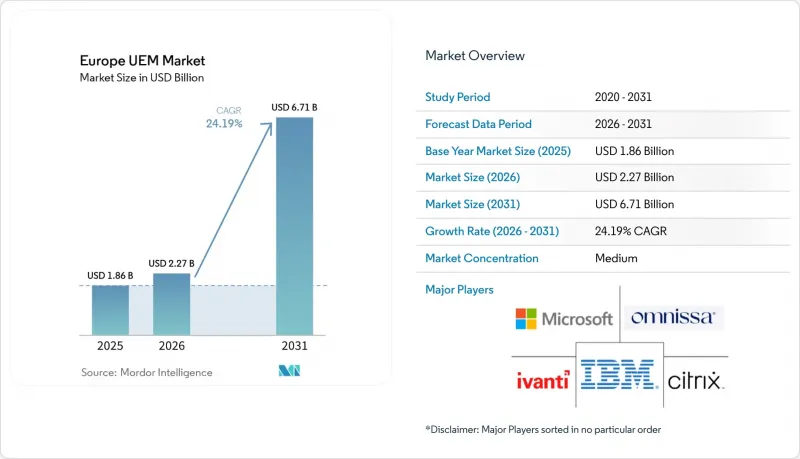
Mordor Intelligence에 의하면, 유럽의 통합 엔드포인트 관리(UEM) 시장 규모는 2025년에 18억 6,000만 달러로 평가되었고, 2026년 22억 7,000만 달러에서 2031년까지 67억 1,000만 달러에 이를 것으로 예측되며, 2026-2031년 CAGR 24.19%로 성장할 전망입니다.
본 보고서는 컴포넌트별(솔루션 및 서비스), 배포 방식별(클라우드 기반, 온프레미스형 등), 조직 규모별(대기업 및 중소기업), 최종 사용자 산업별(IT 및 통신, 은행, 금융서비스 및 보험(BFSI), 정부 및 국방, 헬스케어 및 생명과학, 제조, 소매 및 전자상거래 등) 및 국가별로 분류되어 있습니다. 시장 전망은 금액(달러) 기준으로 제시되어 있습니다.
유럽의 통합 엔드포인트 관리(UEM) 시장 동향 및 인사이트
규제 대상 기업에서의 하이브리드 근무 및 BYOD 확대
하이브리드 근무는 현재 많은 유럽 조직에서 정착된 운영 모델이 되었으며, 그 결과 엔드포인트 관리는 유럽의 통합 엔드포인트 관리(UEM) 시장 전체에서 단순한 IT 부서의 업무에서 더 광범위한 거버넌스 요구 사항으로 전환되고 있습니다. 원격으로 사용되는 노트북, 스마트폰, 태블릿이 1대씩 늘어날 때마다 정책 담당 팀이 관리해야 할 기기의 범위가 넓어지며, 기기 유형별로 개별 도구를 사용하는 대신 단일 운영 프레임워크를 통해 관리할 필요가 대두되고 있습니다. 규제 대상 부문의 BYOD 정책에서는 기업 데이터와 개인 데이터의 명확한 분리 외에도, 공유 기기에 대한 더욱 강력한 인증 및 접근 제어가 요구됩니다. NIS2는 데스크톱, 모바일 및 액세스 정책이 서로 연동되지 않은 시스템에 분산되어 있을 경우, 일관되게 시행하기 어려운 위험 관리 및 보안 조치를 의무화함으로써 이러한 변화를 더욱 가속화했습니다. 따라서 기업들은 워크플로우를 중복시키지 않으면서 Windows, macOS, iOS, Android, ChromeOS 및 관련 엔드포인트 유형에 단일 제어 모델을 적용할 수 있는 플랫폼을 선호하게 되었습니다. 따라서 기성 규정 준수 템플릿과 중앙 집중식 보고 기능을 제공하는 벤더는 하이브리드 근무에 대한 수요를 유럽의 통합 엔드포인트 관리(UEM) 시장 전반에 걸친 신속한 도입으로 연결하는 데 있어 더 유리한 입장에 있습니다.
분산형 엔드포인트 환경에서의 제로 트러스트 도입
유럽에서는 기기 식별, 액세스 제어, 지속적인 검증이 공식적인 사이버 보안 의무와 점점 더 밀접하게 연관됨에 따라 제로 트러스트 도입의 중요성이 커지고 있습니다. 실제로, 기업 애플리케이션이나 네트워크 리소스에 대한 액세스를 요청하는 모든 엔드포인트는 최신 상태, 알려진 식별 정보, 그리고 규정 준수 상태를 제시해야 합니다. 이러한 요구 사항으로 인해 통합된 제어 계층의 가치가 높아지고 있습니다. 단일 플랫폼에서 등록, 정책, 텔레메트리, 적용을 통합적으로 연계할 수 있기 때문입니다. Horizon 프로그램의 자금 지원을 받고 있는 MEDIATE 프로젝트에서는 클라우드, 엣지, IoT 환경을 아우르는 연합형 제로 트러스트 모델에 동적으로 업데이트 및 재구성 가능한 보안 제어가 필요하다는 점도 밝혀졌습니다. 이에 따라 구매자들의 관심은 정적인 규칙 세트에서 엔드포인트 상황이 실시간으로 변화함에 따라 정책 변경을 자동화할 수 있는 플랫폼으로 이동하고 있습니다. 그 결과, 보안 예산이 엔드포인트 관리 비용에서 차지하는 비중이 증가하고 있으며, 이는 유럽의 통합 엔드포인트 관리(UEM) 시장 전체에서 더 높은 부가가치를 지닌 계약을 촉진하고 있습니다.
데이터 주권과 국경을 초월한 관리상의 제약
데이터 주권은 여전히 구매 속도를 현저히 저해하는 요인으로 작용하고 있습니다. 이는 유럽의 조직들이 클라우드의 편의성과 데이터 저장 위치, 접근, 전송에 관한 엄격한 의무 사이의 균형을 신중하게 고려해야 하기 때문입니다. '데이터법(Data Act)'은 공급자에게 EU 역외 정부의 불법적인 접근에 대비해 기술적 및 조직적 조치를 취할 것을 의무화하고 있으며, 한편 유럽의 데이터 전송에 관한 지침에서는 개인 데이터가 관할 구역을 넘어 어떻게 이동하는 지에 주목하고 있습니다. 따라서 조달을 진행하기 전에 법무팀이나 보안팀이 호스팅 모델, 암호화 제어, 키 관리 체계를 면밀히 검토하는 경우가 많습니다. 구매자가 이러한 문제에 대해 납득하지 못할 경우, 의사 결정을 미루거나 주권형 솔루션을 요구하거나, EU 관할 구역 내에서 체제가 더 견고한 공급자로 후보를 좁히게 됩니다. 그 결과, 공급업체는 운영상의 요구 사항과 공식적인 보증 요건을 모두 충족하는 지역 환경을 구축하고 유지하기 위해 추가 비용을 부담하게 됩니다. 그 결과, 유럽의 통합 엔드포인트 관리(UEM) 시장 전반에 걸쳐 판매 주기가 장기화되고, 도입 계획이 더욱 신중해지는 경향이 있습니다.
부문 분석
솔루션은 2025년에 시장 점유율의 68.33%를 차지한 것으로 평가되었으며, 2026-2031년 연평균 성장률(CAGR) 25.12%로 확대될 것으로 전망되어, 소프트웨어는 유럽 통합 엔드포인트 관리(UEM) 시장에서 상업적 가치 창출의 중심 역할을 계속할 것입니다. 기업은 일반적으로 등록, 정책 적용, 패치 가시화 및 보고 작성부터 시작하기 때문에 디바이스 관리, 보안 관리, 규정 준수 관리가 계속해서 기반 계층을 형성하고 있습니다. 이어서 용도 관리 및 컨텐츠 관리는 관리 대상 엔드포인트 전반에 걸쳐 소프트웨어, 액세스, 분산 파일의 일관성을 유지해야 하는 두 번째 운영상의 요구 사항을 충족합니다. 기업 환경에서 온프레미스 도구, SaaS 워크로드, 모바일 우선 업무 패턴이 동일한 운영 기반 내에서 혼재됨에 따라 이러한 중요성은 더욱 커지고 있습니다. 또한 구매자들은 문제의 조기 감지 및 수동 수정 절차의 감소를 요구하고 있어, 솔루션 계층의 분석 및 자동화에도 관심이 집중되고 있습니다.
서비스 계층은 이러한 소프트웨어 도입에 발맞추어 확대되고 있습니다. 이는 엔드포인트의 규모가 여러 운영 체제와 거점에 걸쳐 확대됨에 따라, 구성, 정책 설계, 환경 튜닝에 대한 요구가 더욱 까다로워지기 때문입니다. 프로페셔널 서비스는 기업이 등록 계획, 정책 아키텍처, 통합 옵션 및 규제 대상 이용 사례에 부합하는 보고 프레임워크에 대한 지원이 필요한 주기의 초기 단계에서 중요합니다. 매니지드 서비스는 고객이 위험 관리 태도에 요구되는 일관성을 유지하면서도 엔터프라이즈급 엔드포인트 제어를 매일 운영할 내부 인력이 부족한 경우 그 중요성이 더욱 커집니다. 또한, BlackBerry가 2026년 6월에 실시한 선택적 AI 지원 운영 기능 강화는 벤더가 소프트웨어 계층의 실질적인 범위를 어떻게 확대하고 있는지를 보여주며, 그 결과 배포 및 최적화를 위한 부수적인 서비스 수요가 발생하고 있습니다. 이러한 의미에서 솔루션은 여전히 수익의 핵심을 이루는 한편, 서비스는 조직이 소프트웨어가 현재 약속하는 운영 기준에 따라 유럽의 통합 엔드포인트 관리 시장을 도입할 수 있도록 지원하는 역할을 하고 있습니다.
2025년에는 클라우드 기반 도입이 시장의 63.55%를 차지한 것으로 평가되었으며, 2031년까지 연평균 성장률(CAGR) 25.23%로 성장할 전망입니다. 이는 호스팅형 관리가 유럽 통합 엔드포인트 관리(UEM) 시장의 많은 신규 프로젝트에서 표준적인 방향으로 자리 잡고 있음을 뒷받침합니다. 기업들은 제로 터치 프로비저닝, 원격 정책 업데이트, 중앙 집중식 텔레메트리 기능에 매력을 느끼고 있습니다. 이러한 기능들은 특정 거점에 묶인 관리 모델보다 분산된 직원 체제에 더 적합하기 때문입니다. 온프레미스 배포는 호스팅 및 데이터 처리에 대한 직접적인 관리가 계약상 또는 정치적 우선순위로 남아 있는 정부, 국방, 중요 인프라 분야에서 여전히 중요한 위치를 차지하고 있습니다. 또한 일부 조직에서는 일반 직원용 단말기 군에는 클라우드의 편의성을 추구하면서도, 특정 워크로드나 기밀성이 높은 자산에 대해서는 관리된 환경을 유지하고자 하기 때문에 하이브리드 모델의 중요성도 커지고 있습니다. 이로 인해, 특히 규제가 엄격한 분야에서는 도입 전략이 언뜻 보기만큼 단순한 양자택일이 아니게 되었습니다.
바로 ‘주권’이라는 층위가 현재의 클라우드 전환에 유럽 특유의 양상을 부여하고 있는 것입니다. Ivanti사는 2026년 4월, BSI 인증을 획득한 인프라 위에서 ‘Neurons for MDM-Sovereign Edition-EU’를 출시했습니다. 이 회사는 이 제품을 EU의 데이터 주권, 규정 준수, 그리고 단일 콘솔을 통한 다중 OS 지원을 핵심으로 자리매김하고 있습니다. Omnissa와 GEMA 역시 2025년 10월, 독일 및 오스트리아를 대상으로 '주권형 Workspace ONE' 서비스를 출시하며, SaaS 방식의 제공과 로컬 인프라 제어를 결합하는 것을 목표로 했습니다. 이러한 제품 출시들은 클라우드의 성장이 단순히 호스팅 확대를 넘어 관할권의 명확화로 나아가고 있음을 보여주며, 이러한 변화가 유럽의 통합 엔드포인트 관리 시장에서 프리미엄 분야를 창출하고 있습니다. 따라서 클라우드 기반 부문이 규모 면에서 선두를 달리고 있는 반면, 주권형 클라우드의 변형은 유럽 내 ‘고품질 성장’의 기준을 높이고 있습니다.
기타 혜택 :
- 엑셀 형식 시장 예측(ME) 시트
- 3개월간의 애널리스트 지원
자주 묻는 질문
목차
제1장 서론
제2장 조사 방법
제3장 주요 요약
제4장 시장 구도
제5장 시장 규모 및 성장 예측
제6장 경쟁 구도
제7장 시장 기회 및 향후 전망
AJY 26.08.07According to Mordor Intelligence, the Europe UEM market size is projected to be USD 1.86 billion in 2025, USD 2.27 billion in 2026, and reach USD 6.71 billion by 2031, growing at a CAGR of 24.19% from 2026 to 2031.
This report is Segmented by Component (Solutions and Services), Deployment Mode (Cloud-Based, On-Premise, and More), Organization Size (Large Enterprises and Small and Medium Enterprises), End-User Industry (IT and Telecommunications, BFSI, Government and Defense, Healthcare and Life Sciences, Manufacturing, Retail and E-Commerce, and More), and Country. The Market Forecasts are Provided in Terms of Value (USD).
Europe UEM Market Trends and Insights
Hybrid Work and BYOD Expansion Across Regulated Enterprises
Hybrid work is now a durable operating model in many European organizations, so endpoint control has moved from a narrow IT task to a wider governance need across the Europe UEM market. Each additional remote laptop, phone, and tablet widens the device surface that policy teams must manage through one operating framework instead of separate tools for separate device classes. BYOD policies in regulated sectors also require clear separation between corporate and personal data, along with stronger authentication and access control on shared devices. NIS2 reinforced this shift by requiring risk management and security measures that are harder to enforce consistently when desktop, mobile, and access policies sit in disconnected systems. That is why enterprises are favoring platforms that can apply one control model across Windows, macOS, iOS, Android, ChromeOS, and adjacent endpoint types without duplicating workflows. Vendors that ship ready-made compliance templates and centralized reporting are therefore better placed to turn hybrid-work demand into faster deployments across the Europe unified endpoint management (UEM) market.
Zero-Trust Rollouts Across Distributed Endpoint Environments
Zero-trust adoption is gaining more weight in Europe because device identity, access control, and continuous verification now sit closer to formal cybersecurity obligations. In practice, every endpoint that requests access to a corporate application or network resource must present a current state, a known identity, and a compliant posture. That requirement increases the value of a unified control layer because the same platform can tie enrollment, policy, telemetry, and enforcement together in one place. The MEDIATE project under Horizon funding also showed that federated zero-trust models across cloud, edge, and IoT settings need security controls that can be updated and reconfigured dynamically. This shifts buyer attention away from static rule sets and toward platforms that can automate policy changes as endpoint conditions change in real time. As a result, security budgets are absorbing a larger share of endpoint management spending, which supports higher-value contracts across the Europe UEM market.
Data Sovereignty and Cross-Border Control Constraints
Data sovereignty remains a real brake on buying speed because European organizations must weigh cloud convenience against strict obligations around data location, access, and transfer. The Data Act requires providers to take technical and organizational measures against unlawful non-EU government access, while European data-transfer guidance keeps attention on how personal data moves across jurisdictions. This means legal and security teams often review hosting models, encryption control, and key-management arrangements before procurement can move forward. When buyers cannot get comfortable with those issues, they either delay decisions, ask for sovereign variants, or narrow the vendor list to providers with stronger EU-jurisdiction positioning. Vendors then face extra cost to build and maintain regional environments that satisfy both operational needs and formal assurance expectations. The result is longer sales cycles and more cautious deployment planning across the Europe UEM market.
Other drivers and restraints analyzed in the detailed report include:
- Endpoint Consolidation Across Identity, Access, and Device Control
- Cloud Migration of Endpoint Operations and Policy Orchestration
- Broadcom-VMware Transition Friction in Installed Base Procurement
For complete list of drivers and restraints, kindly check the Table Of Contents.
Segment Analysis
Solutions held 68.33% of the market in 2025 and are projected to expand at a 25.12% CAGR from 2026 to 2031, which keeps software at the center of commercial value creation in the Europe UEM market. Device management and security and compliance management continue to form the base layer because enterprises usually start with enrollment, policy enforcement, patch visibility, and reporting. Application management and content management then address a second operational need, which is keeping software, access, and distributed files consistent across managed endpoints. This becomes more important as enterprise environments mix on-premises tools, SaaS workloads, and mobile-first work patterns in the same operating estate. Analytics and automation inside the solutions layer are also attracting more attention because buyers want earlier issue detection and fewer manual remediation steps.
The services layer is growing in step with those software deployments because configuration, policy design, and environment tuning become more demanding as fleets expand across multiple operating systems and locations. Professional services matter early in the cycle when enterprises need help with enrollment planning, policy architecture, integration choices, and reporting frameworks that align with regulated use cases. Managed services become more relevant when customers lack internal staff to run enterprise-grade endpoint control day after day with the consistency their risk posture requires. BlackBerry's June 2026 enhancement of optional AI-assisted operations also shows how vendors are widening the practical scope of the software layer, which in turn creates follow-on service demand for rollout and optimization. In that sense, solutions remain the core revenue driver, while services help organizations adopt the Europe unified endpoint management market at the operational standard the software now promises.
Cloud-based deployment accounted for 63.55% of the market in 2025 and is projected to expand at a 25.23% CAGR through 2031, which confirms that hosted management has become the default direction for many new projects in the Europe UEM market. Enterprises are drawn to zero-touch provisioning, remote policy updates, and centralized telemetry because these features fit distributed workforces better than site-bound administration models. On-premises deployments still matter in government, defense, and critical infrastructure settings where direct control over hosting and data handling remains a contractual or political priority. Hybrid models are also gaining relevance because some organizations want cloud convenience for standard employee fleets while keeping selected workloads or sensitive estates in controlled environments. This leaves deployment strategy less binary than it first appears, especially in regulated sectors.
The sovereignty layer is what gives the current cloud shift its distinctly European shape. Ivanti launched Neurons for MDM - Sovereign Edition - EU in April 2026 on BSI-certified infrastructure, and the company positioned it around EU data sovereignty, compliance, and multi-OS coverage through one console. Omnissa and GEMA made a similar move in October 2025 with a sovereign Workspace ONE service for Germany and Austria that aimed to combine SaaS-style delivery with local infrastructure control. These launches show that cloud growth is not simply moving toward more hosting, but toward more jurisdictional clarity, and that shift is creating a premium track within the Europe unified endpoint management market. The cloud-based segment therefore leads on scale, while sovereign cloud variants are raising the bar on what qualified growth looks like in Europe.
Complete Report Scope:
- By Component
- Solutions
- Device Management
- Application Management
- Content Management
- Security and Compliance Management
- Analytics and Automation
- Services
- Professional Services
- Managed Services
- Solutions
- By Deployment Mode
- Cloud-Based
- On-Premise
- Hybrid
- By Organization Size
- Large Enterprises
- Small and Medium Enterprises
- By End-User Industry
- IT and Telecommunications
- BFSI
- Government and Defense
- Healthcare and Life Sciences
- Manufacturing
- Retail and E-Commerce
- Education
- Transportation and Logistics
- Energy and Utilities
- Other End-User Industries
- By Country
- Germany
- United Kingdom
- France
- Italy
- Spain
- Netherlands
- Russia
- Rest of Europe
List of Companies Covered in this Report:
- Microsoft Corporation
- Ivanti, Inc.
- Omnissa, LLC
- IBM Corporation
- Citrix Systems, Inc.
- BlackBerry Limited
- Sophos Ltd.
- SOTI Inc.
- Matrix42 AG
- baramundi software USA, Inc.
- 42Gears Mobility Systems Pvt Ltd.
- ManageEngine (Zoho Corporation Pvt. Ltd.)
- Jamf Holding Corp.
- Kandji, Inc.
- HCL Technologies Limited
- Microland Limited
- STEFANINI
- TANGOE
- SCALEFUSION (Promobi Technologies Pvt Ltd)
- Mitsogo Inc.
Additional Benefits:
- The market estimate (ME) sheet in Excel format
- 3 months of analyst support
TABLE OF CONTENTS
1 INTRODUCTION
- 1.1 Study Assumptions and Market Definition
- 1.2 Scope of the Study
2 RESEARCH METHODOLOGY
3 EXECUTIVE SUMMARY
4 MARKET LANDSCAPE
- 4.1 Market Overview
- 4.2 Market Drivers
- 4.2.1 Hybrid Work and BYOD Expansion Across Regulated Enterprises
- 4.2.2 Zero-Trust Rollouts Across Distributed Endpoint Environments
- 4.2.3 Endpoint Consolidation Across Identity, Access, and Device Control
- 4.2.4 Cloud Migration of Endpoint Operations and Policy Orchestration
- 4.2.5 EU Cyber Resilience and Data-Protection Compliance Spend
- 4.2.6 AI-Enabled Endpoint Automation and Digital Employee Experience Optimization
- 4.3 Market Restraints
- 4.3.1 Data Sovereignty and Cross-Border Control Constraints
- 4.3.2 Broadcom-VMware Transition Friction in Installed Base Procurement
- 4.3.3 Integration Complexity Across Legacy Windows, Mobile, and Specialized Devices
- 4.3.4 Security Tool Overlap and Budget Scrutiny in Midmarket Buyers
- 4.4 Industry Value Chain Analysis
- 4.5 Regulatory Landscape
- 4.6 Technological Outlook
- 4.7 Impact of Macroeconomic Factors on the Market
- 4.8 Porter's Five Forces Analysis
- 4.8.1 Bargaining Power of Suppliers
- 4.8.2 Bargaining Power of Buyers
- 4.8.3 Threat of New Entrants
- 4.8.4 Threat of Substitutes
- 4.8.5 Competitive Rivalry
5 MARKET SIZE AND GROWTH FORECAST (VALUE)
- 5.1 By Component
- 5.1.1 Solutions
- 5.1.1.1 Device Management
- 5.1.1.2 Application Management
- 5.1.1.3 Content Management
- 5.1.1.4 Security and Compliance Management
- 5.1.1.5 Analytics and Automation
- 5.1.2 Services
- 5.1.2.1 Professional Services
- 5.1.2.2 Managed Services
- 5.1.1 Solutions
- 5.2 By Deployment Mode
- 5.2.1 Cloud-Based
- 5.2.2 On-Premise
- 5.2.3 Hybrid
- 5.3 By Organization Size
- 5.3.1 Large Enterprises
- 5.3.2 Small and Medium Enterprises
- 5.4 By End-User Industry
- 5.4.1 IT and Telecommunications
- 5.4.2 BFSI
- 5.4.3 Government and Defense
- 5.4.4 Healthcare and Life Sciences
- 5.4.5 Manufacturing
- 5.4.6 Retail and E-Commerce
- 5.4.7 Education
- 5.4.8 Transportation and Logistics
- 5.4.9 Energy and Utilities
- 5.4.10 Other End-User Industries
- 5.5 By Country
- 5.5.1 Germany
- 5.5.2 United Kingdom
- 5.5.3 France
- 5.5.4 Italy
- 5.5.5 Spain
- 5.5.6 Netherlands
- 5.5.7 Russia
- 5.5.8 Rest of Europe
6 COMPETITIVE LANDSCAPE
- 6.1 Market Concentration
- 6.2 Strategic Moves
- 6.3 Market Share Analysis
- 6.4 Company Profiles (includes Global Level Overview, Market Level Overview, Core Segments, Financials as available, Strategic Information, Market Rank/Share, Products and Services, Recent Developments)
- 6.4.1 Microsoft Corporation
- 6.4.2 Ivanti, Inc.
- 6.4.3 Omnissa, LLC
- 6.4.4 IBM Corporation
- 6.4.5 Citrix Systems, Inc.
- 6.4.6 BlackBerry Limited
- 6.4.7 Sophos Ltd.
- 6.4.8 SOTI Inc.
- 6.4.9 Matrix42 AG
- 6.4.10 baramundi software USA, Inc.
- 6.4.11 42Gears Mobility Systems Pvt Ltd.
- 6.4.12 ManageEngine (Zoho Corporation Pvt. Ltd.)
- 6.4.13 Jamf Holding Corp.
- 6.4.14 Kandji, Inc.
- 6.4.15 HCL Technologies Limited
- 6.4.16 Microland Limited
- 6.4.17 STEFANINI
- 6.4.18 TANGOE
- 6.4.19 SCALEFUSION (Promobi Technologies Pvt Ltd)
- 6.4.20 Mitsogo Inc.
7 MARKET OPPORTUNITIES AND FUTURE OUTLOOK
- 7.1 White-Space and Unmet-Need Assessment


