

|
시장보고서
상품코드
2098512
중동 및 아프리카의 통합 엔드포인트 관리(UEM) 시장 : 시장 점유율 분석, 업계 동향 및 통계, 성장 예측(2026-2031년)Middle East and Africa UEM - Market Share Analysis, Industry Trends & Statistics, Growth Forecasts (2026 - 2031) |
||||||
 Mordor Intelligence
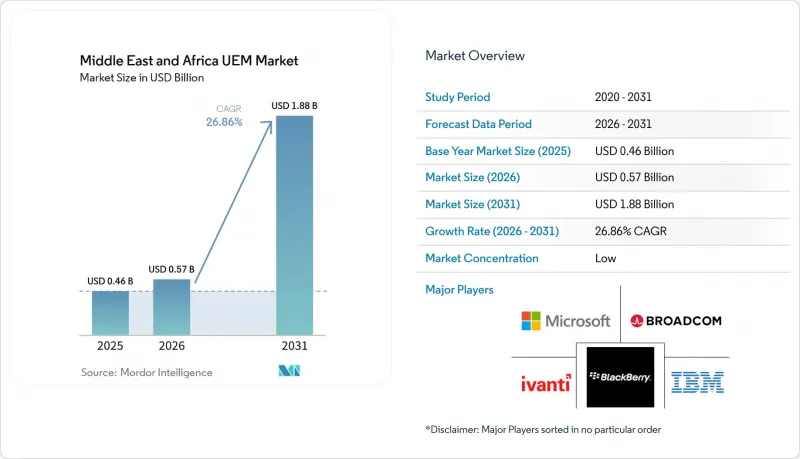
Mordor Intelligence에 의하면, 중동 및 아프리카의 통합 엔드포인트 관리(UEM) 시장 규모는 2025년 4억 6,000만 달러로 평가되었고, 2026년 5억 7,000만 달러에서 2031년까지 18억 8,000만 달러로 확대될 것으로 예측되며, 2026-2031년 연평균 복합 성장률(CAGR)은 26.86%를 나타낼 전망입니다.
본 보고서는 컴포넌트별(솔루션 및 서비스), 배포 방식별(클라우드 기반, 온프레미스형, 하이브리드형), 조직 규모별(대기업 및 중소기업), 최종 사용자 산업별(IT 및 통신, 정부 및 국방, 의료 및 생명과학, 소매 및 전자상거래 등) 및 지역별로 분류되어 있습니다. 시장 전망은 금액(달러) 기준으로 제시되어 있습니다.
중동 및 아프리카의 UEM 시장 동향 및 인사이트
BYOD 및 기업 모빌리티 도입 확대
현재 이 지역의 주요 기업에서 개인 소유 기기는 일상 업무에 없어서는 안 될 요소가 되었으며, 중동 및 아프리카의 UEM 시장에서 기기 다양성은 더 이상 일시적인 IT 과제가 아닙니다. 이러한 변화로 인해, 공식 등록이나 정책 적용 범위를 벗어난 스마트폰이나 태블릿을 통해 직원이 업무용 용도에 액세스할 때 보안 위험에 노출되는 범위가 확대되고 있습니다. Zylo는 2026년에 기업용 용도의 87%가 IT 부서 외부를 통해 구매되었다고 보고했는데, 이는 중앙 관리 팀이 완전히 통제할 수 없는 엔드포인트에서 관리 대상 외의 액세스 패턴이 얼마나 빠르게 확산되고 있는지를 보여줍니다. 따라서 구매 담당자들은 업무 데이터와 개인 데이터를 명확히 분리하면서도 BYOD(개인 소유 기기)를 등록할 수 있는 UEM 도구를 더욱 중요하게 여기고 있습니다. 이러한 추세에 따라 각 벤더들은 기업 소유 기기와 직원 소유 기기가 혼재된 환경에서 간편한 등록 프로세스, 일관된 용도 접근 제어, 그리고 도입 시 부담 경감을 중시하고 있습니다.
통합된 기기 및 애플리케이션 거버넌스에 대한 수요 증가
중동 및 아프리카의 UEM 시장에서는 앱, ID, 기기를 개별적으로 관리하는 도구로는 보안 팀이나 IT 팀이 쉽게 해소할 수 없는 격차가 발생하기 때문에 통합 관리에 대한 수요가 높아지고 있습니다. 용도 사용 권한과 기기의 규정 준수가 별도로 관리되는 경우, 어떤 시스템에서는 규정을 준수하는 것처럼 보여도 다른 시스템에서는 위험이 있는 것처럼 보이는 액세스 경로가 발생하는 경우가 종종 있습니다. 따라서 특히 콘솔의 난립을 해소하고, 분산된 기기군 전체에 대한 보고서 작성을 간소화할 수 있는 통합 플랫폼에 대한 예산 지원이 늘어나고 있습니다. 마이크로소프트는 2026년 3월, MSP용 Intune의 새로운 인증 파트너 3곳을 발표했습니다. 이를 통해 서비스 주도형 제공 모델에 대한 멀티테넌트형 엔드포인트 관리 지원이 확대되었으며, 일원화된 관리로의 움직임이 더욱 강화되었습니다. 그 결과, 중동 및 아프리카의 UEM 시장에서는 디바이스 정책, 용도 모니터링, 서비스 제공을 단일 운영 계층 아래에서 통합하는 플랫폼이 높이 평가받고 있습니다.
분산된 레거시 IT와 엔드포인트 툴 스택
중동 및 아프리카의 UEM 시장에서는 여전히 수많은 레거시 시스템이 존재하는 환경이 도입의 걸림돌이 되고 있습니다. 그 이유는 많은 조직이 깨끗하고 검증된 자산 대장 기준선에서 시작하지 않기 때문입니다. 혼재된 운영 체제, 중복된 보안 에이전트, 스프레드시트에 의존하는 자산 기록은 초기 배포를 더욱 복잡하게 만들고, 도입 일정을 지연시키는 경우가 많습니다. 또한 이러한 복잡성으로 인해 초기 도입이 비용이 많이 들고 어렵게 느껴질 위험이 높아지며, 초기 계약이 체결된 후에도 후속 확장이 억제될 가능성이 있습니다. Tanium은 2026년 상반기 플랫폼 업데이트를 통해 실시간 인텔리전스와 시정 조치를 운영 기술(OT) 환경 및 모바일 기기까지 확장했습니다. 이는 각 벤더들이 기존의 사무실 환경보다 더 광범위하고 분산된 환경에 대응하려고 시도하고 있음을 보여줍니다. 도입 초기부터 기존 도구를 전면적으로 교체하도록 강요하지 않고, 단계적으로 고객을 온보딩할 수 있는 벤더는 레거시 시스템의 복잡성이 여전히 높은 시장에서 수요를 확실하게 확보할 수 있는 입장에 있습니다.
부문 분석
솔루션은 2025년에 65.46%의 점유율을 차지한 것으로 평가되었으며, 2031년까지 연평균 성장률(CAGR) 27.06%로 성장할 전망입니다. 이 카테고리는 중동 및 아프리카의 UEM 시장 지출에서 계속해서 중심을 차지할 것으로 보입니다. 구매자들은 디바이스, 용도, 규정 준수 및 시정 조치 전반에 걸친 정책의 일관성을 요구하고 있으므로, 제한적인 모바일 디바이스 관리 단일 기능 도구보다는 보다 종합적인 거버넌스 스택을 분명히 선호하고 있습니다. 기기 관리는 여전히 판매량의 기반을 이루고 있습니다. 이는 모든 도입이 엔드포인트 환경의 가시화, 등록 및 기본적인 제어에서 시작되기 때문입니다. 동시에 단순한 설정 보고서가 아닌 증거에 기반한 정책 적용을 요구하는 고객이 늘어남에 따라 보안 및 규정 준수 관리에 대한 관심이 높아지고 있습니다. 또한, 분석 및 자동화도 제품 평가의 핵심 요소로 부상하고 있습니다. 이는 구매자들이 수동 검토를 기다리지 않고 정책 위반을 감지하며, 위험 패턴을 식별하고, 시정 조치를 자동으로 실행할 수 있는 플랫폼을 중요시하게 되었기 때문입니다.
서비스 분야는 여전히 규모는 작지만, 사내 IT 자원이 제한적이고 관리형 서비스가 도입을 위한 현실적인 경로가 되는 경우에는 여전히 중요한 위치를 차지하고 있습니다. 이러한 경우, 플랫폼이 복잡해짐에 따라 서비스에 대한 수요가 높아집니다. 이는 고객이 도입 후 정책 설계, 마이그레이션, 라이프사이클 관리에 대한 지원을 필요로 하는 경우가 많기 때문입니다. 따라서 중동 및 아프리카의 통합 엔드포인트 관리(UEM) 시장에서는 서비스를 단순한 부가 요소로 취급하지 않고, 인력이 제한된 환경에서도 플랫폼의 보다 광범위한 도입을 가능하게 하는 수단으로 활용하고 있습니다. 자동화 기능이 향상됨에 따라 서비스 제공업체들도 수동 관리에서 예외 기반 관리로 전환하는 경향을 보이고 있으며, 이를 통해 각 고객별로 동일한 인적 부담을 늘리지 않으면서도 서비스 품질을 향상시킬 수 있게 됩니다.
2025년 시점에서 중동 및 아프리카의 통합 엔드포인트 관리(UEM) 시장 규모의 58.27%를 클라우드 기반 도입이 차지했으며, 2031년까지 연평균 성장률(CAGR) 27.19%로 확대될 것으로 예측됩니다. 그 매력은 기능 제공 속도에 있으며, 클라우드 관리형 플랫폼은 사내 업그레이드 주기에 의존하는 환경에 비해 빈번한 업데이트, 광범위한 기기 지원, 그리고 보다 신속한 기능 제공이 실현되기 때문입니다. 이는 정책 요건이 급속히 변화하고, 구매자가 도입 지연을 초래하지 않으면서 새로운 제어 기능을 원하는 시장에서 중요한 요소가 됩니다. 또한, 마이크로소프트가 2026년 초부터 UAE 국내에서 데이터 처리를 약속하고 있는 점도 클라우드로의 전환을 뒷받침하고 있습니다. 이는 현지 인프라가 주권을 중시하는 고객에게 있어 가장 큰 우려 사항 중 하나를 해소할 수 있음을 보여주기 때문입니다. 그렇다고 해서 클라우드가 주도적인 입장에 있다고 해서 아키텍처에 관한 논의가 사라지는 것은 아닙니다. 중동 및 아프리카의 UEM 시장에서의 도입 결정은 여전히 데이터 관리, 계약 조건, 그리고 각 구매자의 규제 환경에 따라 좌우되기 때문입니다.
온프레미스 배포는 독자적인 관리 모델 하에서 엔드포인트 텔레메트리 데이터를 공용 네트워크를 통해 전송할 수 없는 국방 기관, 엄격한 규제를 받는 사업자 사이에서 여전히 큰 수요를 유지하고 있습니다. 하이브리드 배포는 일부 자산을 사내에 남겨두면서 특정 사용자나 디바이스 범주를 클라우드 관리로 전환하는 조직에게 있어 전환 경로로서 그 중요성이 커지고 있습니다. 이러한 분할은 전환을 원활하게 하는 한편, 팀이 서로 다른 엔드포인트 그룹별로 별도의 제어 플레인을 관리하게 되므로 정책 불일치나 운영상의 복잡성을 초래할 가능성도 있습니다. 로컬 제어 옵션을 유지하면서 하이브리드 환경에서 보다 통합된 관리 체제로의 신뢰할 수 있는 전환 경로를 제공할 수 있는 벤더는 예측 기간 동안 이러한 전환에 따른 지출에서 더 큰 점유율을 확보할 가능성이 높을 것으로 보입니다.
기타 혜택 :
- 엑셀 형식 시장 예측(ME) 시트
- 3개월간의 애널리스트 지원
자주 묻는 질문
목차
제1장 서론
제2장 조사 방법
제3장 주요 요약
제4장 시장 구도
제5장 시장 규모 및 성장 예측
제6장 경쟁 구도
제7장 시장 기회 및 향후 전망
AJY 26.08.07According to Mordor Intelligence, the Middle East and Africa UEM market size is projected to expand from USD 0.46 billion in 2025 and USD 0.57 billion in 2026 to USD 1.88 billion by 2031, registering a CAGR of 26.86% between 2026 to 2031.
This report is Segmented by Component (Solutions, and Services), Deployment Mode (Cloud-Based, On-Premise, and Hybrid), Organization Size (Large Enterprises, and Small and Medium Enterprises), End-User Industry (IT and Telecommunications, Government and Defense, Healthcare and Life Sciences, Retail and E-Commerce, and More), and Geography. The Market Forecasts are Provided in Terms of Value (USD).
Middle East and Africa UEM Market Trends and Insights
Increasing BYOD and Corporate Mobility Adoption
Personal devices are now a permanent part of daily work across large employers in the region, which means device diversity in the Middle East and Africa UEM market is no longer a temporary IT issue. That shift widens exposure when staff access business applications through phones and tablets that sit outside formal enrollment and policy coverage. Zylo stated in 2026 that 87% of enterprise applications were purchased outside IT, which shows how quickly unmanaged access patterns can spread across endpoints that central teams do not fully control. Buyers are therefore placing more weight on UEM tools that can enroll bring-your-own devices with clear separation between work data and personal data. This preference is pushing vendors to emphasize light-touch enrollment, consistent app access controls, and lower-friction onboarding for mixed corporate and employee-owned fleets.
Rising Need for Centralized Device and Application Governance
The Middle East and Africa UEM market is seeing stronger demand for centralized control because separate tools for apps, identities, and devices leave gaps that security and IT teams cannot easily reconcile. When application entitlement and device compliance are managed on different tracks, organizations often end up with access paths that appear compliant in one system and risky in another. That is why integrated platforms are gaining budget support, especially when they reduce console sprawl and simplify reporting across distributed fleets. Microsoft announced 3 new validated partners for Intune for MSPs in March 2026, which widened multi-tenant endpoint management support for service-led delivery models and reinforced the push toward centralized administration. As a result, the Middle East and Africa UEM market is rewarding platforms that combine device policy, application oversight, and service delivery under one operating layer.
Fragmented Legacy IT and Endpoint Tool Stacks
Legacy-heavy environments still slow deployment in the Middle East and Africa UEM market because many organizations do not begin with a clean, validated inventory baseline. Mixed operating systems, overlapping security agents, and spreadsheet-led asset records make early rollout more complex and often stretch implementation timelines. That complexity also raises the risk that first deployments feel costly and difficult, which can reduce later expansion even after initial contracts are signed. Tanium extended real-time intelligence and remediation into operational technology environments and mobile devices in its 2026H1 platform update, which shows how vendors are trying to address estates that are broader and more fragmented than traditional office. Vendors that can onboard customers in stages, rather than forcing a full replacement of existing tools at the start, are in a better position to convert demand where legacy complexity remains high.
Other drivers and restraints analyzed in the detailed report include:
- Growing Endpoint Security Requirements in Regulated Industries
- Expansion of Hybrid Workflows in Distributed Enterprises
- Data Residency and Sovereignty Constraints
For complete list of drivers and restraints, kindly check the Table Of Contents.
Segment Analysis
Solutions held 65.46% share in 2025 and are projected to expand at 27.06% CAGR through 2031, which keeps this category at the center of spending in the Middle East and Africa UEM market. Buyers are clearly favoring fuller governance stacks over narrow mobile device management point tools because they want policy consistency across devices, applications, compliance, and remediation. Device management still anchors volume because every deployment begins with visibility, enrollment, and basic control over the endpoint estate. At the same time, security and compliance management is taking a larger share of attention as more customers need evidence-backed enforcement instead of simple configuration reporting. Analytics and automation are also moving into the center of product evaluation because buyers now value platforms that can detect drift, identify risk patterns, and trigger corrective action without waiting for manual review.
The Services segment remains smaller, but it is still important where internal IT resources are limited and managed delivery is the practical path to adoption. In these cases, service demand rises alongside platform complexity because customers often need help with policy design, migration, and lifecycle administration after deployment. The Middle East and Africa Unified Endpoint Management (UEM) market is therefore not treating services as a separate afterthought, it is using them to make broader platform adoption possible in thinner-staffed environments. As automation features improve, service providers are also likely to shift from manual administration toward exception-based management, which can lift service quality without adding the same staffing burden at each account.
Cloud-based deployments accounted for 58.27% of the Middle East and Africa Unified Endpoint Management market size in 2025 and are projected to expand at 27.19% CAGR through 2031. Their appeal is tied to capability velocity because cloud-managed platforms receive frequent updates, broader device support, and faster feature delivery than environments that rely on internal upgrade cycles. This matters in a market where policy needs are changing quickly and buyers want new controls without long implementation delays. Microsoft's UAE in-country processing commitment from early 2026 also supports the cloud path by showing that local infrastructure can narrow one of the biggest objections for sovereign-sensitive customers. Even so, cloud leadership does not remove the architecture debate, because deployment decisions in the Middle East and Africa UEM market are still shaped by data control, contract conditions, and the regulatory profile of each buyer.
On-premise deployments continue to hold meaningful demand among defense organizations and highly restricted operators that cannot route endpoint telemetry through public networks under their own control models. Hybrid deployment is gaining ground as a transition path for organizations that keep some estates in-house while moving selected users or device classes to cloud management. That split can ease migration, but it also creates policy inconsistency and operating complexity when teams manage separate control planes for different endpoint groups. Vendors that can offer a credible path from hybrid to more unified administration, while preserving local control options, are likely to capture more of this transitional spending across the forecast period.
Complete Report Scope:
- By Component
- Solutions
- Device Management
- Application Management
- Content Management
- Security and Compliance Management
- Analytics and Automation
- Services
- Solutions
- By Deployment Mode
- Cloud-Based
- On-Premise
- Hybrid
- By Organization Size
- Large Enterprises
- Small and Medium Enterprises
- By End-User Industry
- IT and Telecommunications
- BFSI
- Government and Defense
- Healthcare and Life Sciences
- Manufacturing
- Retail and E-Commerce
- Education
- Transportation and Logistics
- Energy and Utilities
- Other End-User Industries
- By Geography
- Middle East
- Saudi Arabia
- United Arab Emirates
- Qatar
- Kuwait
- Rest of Middle East
- Africa
- South Africa
- Egypt
- Rest of Africa
- Middle East
List of Companies Covered in this Report:
- Microsoft Corporation
- Broadcom Inc.
- Ivanti, Inc.
- BlackBerry Limited
- IBM Corporation
- Sophos Group plc
- ManageEngine, A Division Of Zoho Corporation Private Limited
- SOTI Inc.
- Jamf Holding Corp.
- Cisco Systems, Inc.
- Samsung Electronics Co., Ltd.
- Google LLC
- Oracle Corporation
- Citrix Systems, Inc.
- Baramundi Software GmbH
- Matrix42 AG
- HCL Technologies Limited
- Accenture plc
- Fortinet, Inc.
- Tanium Inc.
Additional Benefits:
- The market estimate (ME) sheet in Excel format
- 3 months of analyst support
TABLE OF CONTENTS
1 INTRODUCTION
- 1.1 Study Assumptions and Market Definition
- 1.2 Scope of the Study
2 RESEARCH METHODOLOGY
3 EXECUTIVE SUMMARY
4 MARKET LANDSCAPE
- 4.1 Market Overview
- 4.2 Market Drivers
- 4.2.1 Increasing BYOD and Corporate Mobility Adoption
- 4.2.2 Rising Need for Centralized Device And Application Governance
- 4.2.3 Growing Endpoint Security Requirements in Regulated Industries
- 4.2.4 Expansion of Hybrid Workflows in Distributed Enterprises
- 4.2.5 Under-Managed SaaS and Mobile App Sprawl Across Mid-Market Firms
- 4.2.6 Rising Demand for Automation-Driven Policy Enforcement and Remediation
- 4.3 Market Restraints
- 4.3.1 Fragmented Legacy IT and Endpoint Tool Stacks
- 4.3.2 Data Residency and Sovereignty Constraints
- 4.3.3 Integration Complexity with Legacy Identity and Security Systems
- 4.3.4 Skills Shortage for UEM Policy Design and Lifecycle Operations
- 4.4 Industry Value Chain Analysis
- 4.5 Impact of Macroeconomic Factors on the Market
- 4.6 Regulatory Landscape
- 4.7 Technological Outlook
- 4.8 Porter's Five Forces Analysis
- 4.8.1 Bargaining Power of Buyers
- 4.8.2 Bargaining Power of Suppliers
- 4.8.3 Threat of New Entrants
- 4.8.4 Threat of Substitutes
- 4.8.5 Competitive Rivalry
5 MARKET SIZE AND GROWTH FORECASTS (VALUE)
- 5.1 By Component
- 5.1.1 Solutions
- 5.1.1.1 Device Management
- 5.1.1.2 Application Management
- 5.1.1.3 Content Management
- 5.1.1.4 Security and Compliance Management
- 5.1.1.5 Analytics and Automation
- 5.1.2 Services
- 5.1.1 Solutions
- 5.2 By Deployment Mode
- 5.2.1 Cloud-Based
- 5.2.2 On-Premise
- 5.2.3 Hybrid
- 5.3 By Organization Size
- 5.3.1 Large Enterprises
- 5.3.2 Small and Medium Enterprises
- 5.4 By End-User Industry
- 5.4.1 IT and Telecommunications
- 5.4.2 BFSI
- 5.4.3 Government and Defense
- 5.4.4 Healthcare and Life Sciences
- 5.4.5 Manufacturing
- 5.4.6 Retail and E-Commerce
- 5.4.7 Education
- 5.4.8 Transportation and Logistics
- 5.4.9 Energy and Utilities
- 5.4.10 Other End-User Industries
- 5.5 By Geography
- 5.5.1 Middle East
- 5.5.1.1 Saudi Arabia
- 5.5.1.2 United Arab Emirates
- 5.5.1.3 Qatar
- 5.5.1.4 Kuwait
- 5.5.1.5 Rest of Middle East
- 5.5.2 Africa
- 5.5.2.1 South Africa
- 5.5.2.2 Egypt
- 5.5.2.3 Rest of Africa
- 5.5.1 Middle East
6 COMPETITIVE LANDSCAPE
- 6.1 Market Concentration
- 6.2 Strategic Moves
- 6.3 Market Share Analysis
- 6.4 Company Profiles (includes Global Level Overview, Market Level Overview, Core Segments, Financials as available, Strategic Information, Market Rank/Share, Products and Services, Recent Developments)
- 6.4.1 Microsoft Corporation
- 6.4.2 Broadcom Inc.
- 6.4.3 Ivanti, Inc.
- 6.4.4 BlackBerry Limited
- 6.4.5 IBM Corporation
- 6.4.6 Sophos Group plc
- 6.4.7 ManageEngine, A Division Of Zoho Corporation Private Limited
- 6.4.8 SOTI Inc.
- 6.4.9 Jamf Holding Corp.
- 6.4.10 Cisco Systems, Inc.
- 6.4.11 Samsung Electronics Co., Ltd.
- 6.4.12 Google LLC
- 6.4.13 Oracle Corporation
- 6.4.14 Citrix Systems, Inc.
- 6.4.15 Baramundi Software GmbH
- 6.4.16 Matrix42 AG
- 6.4.17 HCL Technologies Limited
- 6.4.18 Accenture plc
- 6.4.19 Fortinet, Inc.
- 6.4.20 Tanium Inc.
7 MARKET OPPORTUNITIES AND FUTURE OUTLOOK
- 7.1 White-Space and Unmet-Need Assessment


