

|
시장보고서
상품코드
2098453
BFSI용 통합 엔드포인트 관리(UEM) 시장 : 시장 점유율 분석, 업계 동향 및 통계, 성장 예측(2026-2031년)UEM In BFSI - Market Share Analysis, Industry Trends & Statistics, Growth Forecasts (2026 - 2031) |
||||||
 Mordor Intelligence
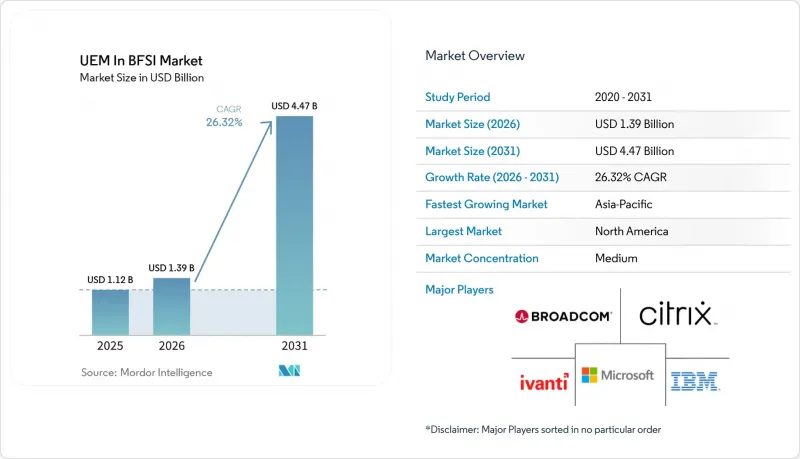
Mordor Intelligence에 의하면, BFSI용 통합 엔드포인트 관리(UEM) 시장 규모는 2025년에 11억 2,000만 달러로 평가되었고, 2026년 13억 9,000만 달러에서 2031년까지 44억 7,000만 달러에 이를 것으로 예측되며, 예측 기간(2026-2031년) CAGR은 26.32%를 나타낼 전망입니다.
본 보고서는 컴포넌트별(솔루션(기기 관리, 용도 관리, 컨텐츠 관리, 보안 및 규정 준수 관리 등) 및 서비스), 배포 모드별(클라우드 기반, 온프레미스형, 하이브리드형), 조직 규모별(대기업, 중소기업), 지역별(북미, 남미 등)로 분류되어 있습니다. 시장 예측은 금액(달러) 기준으로 제시되어 있습니다.
세계의 BFSI용 통합 엔드포인트 관리(UEM) 동향 및 인사이트
은행 업무에서의 하이브리드 근무 및 BYOD 확대
BFSI용 통합 엔드포인트 관리(UEM)에 대한 수요가 증가하고 있는 배경에는 하이브리드 근무의 보급으로 인해 개인 소유 기기의 거버넌스가 은행 및 보험사에게 핵심적인 보안 과제로 대두되고 있기 때문입니다. 뱅크 오브 아메리카의 2024년 가이드라인에 따르면, 금융 기관은 기밀성이 높은 금융 데이터를 보호하기 위해 BYOD 프로그램에 참여할 수 있는 기기에 대한 명확한 규칙은 물론, 엔드포인트 보안, VPN 제어, 다단계 인증을 구축해야 한다고 밝혔습니다. 이 운영 모델에서는 관리 대상 노드의 수가 증가합니다. 코어 뱅킹 시스템에 연결되는 승인된 노트북 및 모바일 기기 모두에 대해 정책 적용, 라이프사이클 관리, 그리고 안전한 액세스 관리가 필요하기 때문입니다. 또한, 공유 및 분산된 지점 기기 역시 유사한 업무 부하를 증가시킵니다. 이는 현장 직원에게 배포할 때에도 공통 엔드포인트 전반에 걸쳐 안전한 사용자 분리 및 통제된 로그인 절차가 여전히 필요하기 때문입니다. 소규모 금융 은행이 2만 5,000대의 기기에 ‘ManageEngine Mobile Device Manager Plus’를 도입한 사례는 대형 금융 기관이 이미 통합된 정책 프레임워크를 통해 원격 지점, 공유 기기 및 BYOD 엔드포인트를 관리하고 있는 실태를 보여줍니다. 실제로, 이로 인해 엔드포인트 상태 관리가 일상적인 은행 업무에서 상시 관리 항목이 되었으며, 이것이 BFSI 분야에서 UEM(통합 엔드포인트 관리)이 보안 및 규정 준수 예산의 주류로 점점 더 가까워지고 있는 이유입니다.
금융 기관에서의 제로 트러스트 도입
BFSI용 통합 엔드포인트 관리(UEM)은 기기 인증을 ID, 네트워크, 애플리케이션 및 데이터 관리와 동등한 수준으로 취급하는 제로 트러스트 프로그램의 이점도 누리고 있습니다. 유럽연합 집행위원회의 DORA 기술 기준은 보다 광범위한 ICT 위험 프레임워크 내에서 휴대용 및 비휴대용 엔드포인트 기기의 안전한 관리를 요구하며, 규제 대상 기관에 엔드포인트 관리를 강화하기 위한 직접적인 정책적 근거를 제공합니다. 『World Journal of Advanced Engineering Technology and Sciences』지에 게재된 연구에 따르면, 엔드포인트 보호, 기기 인증 및 모바일 기기 관리가 금융 기관을 위한 제로 트러스트 환경에서 핵심적인 구현 도구라고 설명하고 있습니다. 유럽은행감독청(EBA)의 DORA 준비 작업 또한 금융 기관이 업무 복원력과 제3자 ICT 감독을 강화할 필요성을 강조하고 있으며, 이는 결제 및 거래 환경 전반에 걸친 보다 엄격한 기기 거버넌스를 뒷받침합니다. 그 결과, BFSI용 통합 엔드포인트 관리(UEM)은 규제 대상인 제로 트러스트 프로그램 하에서 정책의 심도, 실시간 포지션 모니터링, 신속한 대응 조치를 결합한 도구로 전환되고 있습니다.
데이터 주권 및 개인정보 보호 규정 준수 제약
BFSI용 통합 엔드포인트 관리(UEM)은 데이터 주권 측면에서 가장 명확한 제약 사항 중 하나에 직면해 있습니다. 이는 엔드포인트 플랫폼이 현재 데이터 저장 위치, 암호화 처리 및 데이터 반출 계획에 관한 공식적인 요건의 적용을 받고 있기 때문입니다. IAPP의 2025년 GDPR(EU 개인정보보호규정) 및 DORA 통합에 관한 검토 보고서에 따르면, 금융 기관은 ICT 계약을 단순한 일상적인 공급업체와의 서류 절차가 아닌 규정 준수 수단으로 취급해야 하며, 이로 인해 클라우드 도입의 선택지가 좁아지고 있습니다. Ivanti가 2026년 4월, BSI 인증을 받은 유럽 인프라에서 호스팅되며 EU 클라우드 주권 프레임워크를 준수하는 MDM용 ‘Neurons’의 EU 주권 에디션을 출시한 것은 공급업체가 이러한 압박에 얼마나 직접적으로 대응하고 있는지를 보여줍니다. 또한 프랑스에서는 ACPR이 2025년 5월 20일부터 발효되는 EBA/GL/2025/02 ICT 리스크 관리 지침을 승인함에 따라 규정 준수 부담이 더욱 커졌습니다. 이로 인해 관리된 ICT 거버넌스에 대한 현지 기대치가 한층 더 강화되었습니다. 실질적인 영향으로, BFSI용 통합 엔드포인트 관리(UEM) 벤더 선정은 단순한 제품 결정에 그치지 않게 되었습니다. 도입 장소, 데이터 처리, 계약 구조가 플랫폼 승인 여부에 영향을 미치게 되었기 때문입니다. 이와 유사한 추세는 유럽 이외의 지역으로도 확산되고 있으며, 조달 심사의 핵심에는 주권적 도입 및 고객 관리 하의 데이터 분리가 계속해서 자리 잡고 있습니다.
부문 분석
2025년에는 솔루션이 매출의 68.43%를 차지했으며, 기준 연도에도 BFSI용 통합 엔드포인트 관리(UEM) 시장에서 소프트웨어 플랫폼이 중심적인 위치를 계속 차지했습니다. 은행과 보험사는 보안 및 규정 준수 관리, 기기 관리, 분석 도구가 단일 정책 구조 내에 통합되어 있을 때 관리가 용이하기 때문에 보다 광범위한 제품군을 선호했습니다. 이러한 추세는 DORA 및 관련 재무 관리 하에서 강화된 문서화 요건과 밀접한 관련이 있으며, 금융 기관은 엔드포인트 환경 전반에 걸쳐 기기의 위험이 어떻게 식별, 모니터링, 처리되고 있는지 입증해야 합니다. 또한 BYOD 프로그램의 도입으로 인해 은행은 감독 체계를 약화시키지 않으면서 업무 데이터와 개인용 컨텐츠를 분리해야 할 필요성이 대두됨에 따라, 용도 관리 및 컨텐츠 관리의 중요성도 높아졌습니다.
BFSI용 통합 엔드포인트 관리(UEM) 서비스 부문은 여전히 소규모였으나, 도입 설계, IAM 통합 및 지속적인 규정 준수 검증에 대해 외부 지원을 요청하는 금융 기관이 증가함에 따라 그 중요성이 높아졌습니다. 또한, DORA 관련 계약에서는 서비스 연속성과 문서화된 관리 책임이 중시되므로, 매니지드 서비스는 제3자의 책임을 명확히 하려는 해당 부문의 요구에도 부응하고 있습니다. Ivanti사의 2025년 DEX 보고서에 따르면, 광범위한 UEM(통합 엔드포인트 관리) 스택 내에서 고도로 통합된 DEX 솔루션을 도입하고 있다고 보고한 IT 팀은 불과 24%에 그쳤으며, 이는 경험 모니터링 및 도구 통합 분야에서 서비스 제공 기회가 있음을 시사합니다. 향후 BFSI용 통합 엔드포인트 관리(UEM)은 플랫폼이 확장을 주도하고, 서비스가 통합, 정책 매핑, 감사 대응과 같은 더 까다로운 작업을 지원하는 구조로 발전할 것입니다.
지역별 분석
2025년, 북미는 매출의 36.14%를 차지했으며, 기준 연도 기준 BFSI용 통합 엔드포인트 관리(UEM) 시장 점유율에서 1위를 기록했습니다. 이 지역의 우위는 성숙한 사이버 보안 벤더 기반, 기업 내 높은 클라우드 이용률, 그리고 은행에 대해 이미 보다 체계화된 기기 거버넌스를 추진하고 있는 규제 환경에 힘입은 것입니다. 미국의 금융 기관들은 엔드포인트의 규정 준수 현황을 개별 감사 기록으로 보관하는 대신, 실시간으로 접근 결정에 반영하는 ‘조건부 접근’ 프로그램을 조기에 도입했습니다. 캐나다와 멕시코에서는 디지털 뱅킹의 확대와 현지 감독 체제가 보다 엄격한 ICT 거버넌스 기대치에 가까워짐에 따라 수요가 점차 증가했습니다. 그러나 이 지역에는 여전히 실행 측면의 격차가 존재하며, Talenbrium이 2025년에 보고한 바와 같이, 미국 BFSI 업계 경영진의 55%가 최신 엔드포인트 플랫폼에 대한 기술 향상이 시급하다고 인식하고 있습니다.
유럽은 BFSI 분야에서 UEM(통합 엔드포인트 관리)에 두 번째로 큰 기여를 하는 지역으로 자리매김하고 있습니다. 이는 GDPR(EU 개인정보보호규정) 및 DORA에 따라 엔드포인트 감독이 보다 공식적인 이사회 수준의 규정 준수 논의로 자리매김했기 때문입니다. 독일과 프랑스는 금융 기관이 기술적 통제를 엄격한 문서화 및 감독 당국의 기대치와 일치시켜야 하는 까다로운 시장으로 두드러집니다. 2025년 5월, ACPR이 EBA/GL/2025/02 ‘ICT 위험 관리 지침’을 채택함에 따라 프랑스 금융 기관에 대한 거버넌스 규율이 더욱 강화되었습니다. 남미, 중동 및 아프리카는 여전히 초기 단계에 있는 지역이지만, 오픈 뱅킹의 성장, SAMA 주도의 사이버 보안 요건, 그리고 모바일 머니 및 분산형 에이전트 네트워크의 공식화로 인해 대상 기기의 기반은 꾸준히 확대되고 있습니다.
아시아태평양은 2026-2031년 연평균 성장률(CAGR) 27.32%를 나타낼 것으로 예측되며, 시장 내에서 가장 빠르게 성장하는 지역 블록이 될 것입니다. 인도는 주요 성장 동력이며, 디지털 뱅킹의 확대, 페이먼트 뱅크의 활동, 그리고 규제에 기반한 IT 리스크에 대한 기대감 고조로 인해 공식 금융 채널 전반에 걸쳐 관리 대상 엔드포인트의 수가 증가하고 있습니다. 중국은 광범위한 핀테크 통합과 엄격한 데이터 현지화 노력을 통해 시장 규모를 확대하고 있으며, 이로 인해 대규모 직원 네트워크 및 지점 네트워크 전반에 걸친 중앙 집중식 엔드포인트 거버넌스의 가치가 높아지고 있습니다. 일본과 한국은 주요 은행 및 보험사의 보다 체계적인 클라우드 및 보안 감독 체계를 통해 시장에 기여하고 있습니다. 동남아시아는 모바일 우선 금융 서비스 모델로 인해 보다 엄격한 정책 관리가 필요한 고객용 기기 및 직원 관리 기기의 수가 급증함에 따라 해당 지역에서의 입지를 강화하고 있습니다.
기타 혜택 :
- 엑셀 형식 시장 예측(ME) 시트
- 3개월간의 애널리스트 지원
자주 묻는 질문
목차
제1장 서론
제2장 조사 방법
제3장 주요 요약
제4장 시장 구도
제5장 시장 규모 및 성장 예측
제6장 경쟁 구도
제7장 시장 기회 및 향후 전망
AJY 26.08.07According to Mordor Intelligence, the UEM in BFSI market size was valued at USD 1.12 billion in 2025 and estimated to grow from USD 1.39 billion in 2026 to reach USD 4.47 billion by 2031, at a CAGR of 26.32% during the forecast period (2026-2031).
This report is Segmented by Component (Solutions [Device Management, Application Management, Content Management, Security and Compliance Management, and More], and Services), Deployment Mode (Cloud-Based, On-Premise, and Hybrid), Organization Size (Large Enterprises, and Small and Medium Enterprises), and Geography (North America, South America, and More). The Market Forecasts are Provided in Terms of Value (USD).
Global UEM In BFSI Market Trends and Insights
Hybrid Work and BYOD Expansion in Banking Operations
The UEM in BFSI market is seeing stronger demand because hybrid work has made personal-device governance a core security task for banks and insurers. Bank of America's 2024 guidance states that institutions need clear rules on which devices can enter BYOD programs, along with endpoint security, VPN controls, and multifactor authentication to protect sensitive financial data. That operating model increases the number of managed nodes because every approved laptop or mobile device that connects to core banking systems requires policy enforcement, lifecycle management, and secure access management. Shared and distributed branch devices add to the same workload because frontline worker deployments still require secure user separation and controlled sign-in behavior across common endpoints. Small Finance Bank's rollout of ManageEngine Mobile Device Manager Plus across 25,000 devices shows how large financial institutions are already managing remote branches, shared devices, and BYOD endpoints through centralized policy frameworks. In practice, this makes endpoint posture a standing control in day-to-day banking operations, which is why the UEM in BFSI market keeps moving closer to mainstream security and compliance budgets.
Zero Trust Rollouts Across Financial Institutions
The UEM in BFSI market is also benefiting from zero trust programs that place device verification alongside identity, network, application, and data controls. The European Commission's DORA technical standards require the secure management of portable and non-portable endpoint devices within the broader ICT risk framework, providing regulated institutions with a direct policy basis for stronger endpoint control. Research in the World Journal of Advanced Engineering Technology and Sciences describes endpoint protection, device attestation, and mobile device management as core enforcement tools within zero-trust environments for financial institutions. The EBA's DORA preparation work also reinforces the need for financial entities to strengthen operational resilience and third-party ICT oversight, which supports more disciplined device governance across payment and transaction environments. As a result, the UEM in BFSI market is moving toward tools that combine policy depth, live posture monitoring, and faster response actions under regulated zero trust programs.
Data Sovereignty and Privacy Compliance Constraints
The UEM in BFSI market faces one of its clearest limits in data sovereignty because endpoint platforms now sit inside formal requirements on data location, encryption handling, and exit planning. IAPP's 2025 review of GDPR and DORA integration shows that financial institutions must treat ICT contracts as compliance instruments, not as routine vendor paperwork, which narrows the field for cloud deployments. Ivanti's April 2026 launch of a sovereign EU edition for Neurons for MDM, hosted on BSI-certified European infrastructure and aligned with the EU Cloud Sovereignty Framework, shows how directly vendors are responding to this pressure. France also added to the compliance load when ACPR endorsed the EBA/GL/2025/02 ICT risk management guidelines, effective May 20, 2025, which reinforced local expectations around controlled ICT governance. The practical effect is that vendor selection in the UEM in BFSI market is not only a product decision, because deployment location, data handling, and contractual structure now influence whether a platform can be approved at all. Similar patterns are spreading beyond Europe, keeping sovereign deployment and customer-managed data separation near the center of procurement reviews.
Other drivers and restraints analyzed in the detailed report include:
- Convergence of UEM With Identity and Access Controls
- AI-Driven Digital Employee Experience Optimization
- High Migration and Integration Cost of Legacy Estates
For complete list of drivers and restraints, kindly check the Table Of Contents.
Segment Analysis
Solutions accounted for 68.43% of revenue in 2025, keeping software platforms at the center of the UEM in the BFSI market during the base year. Banks and insurers favored broader suites because security and compliance management, device management, and analytics tools are easier to manage when they sit within a single policy structure. That preference is tied to stronger documentation requirements under DORA and related financial controls, where institutions must demonstrate how device risk is identified, monitored, and addressed across the endpoint estate. Application management and content management also gained weight as BYOD programs required banks to separate business data from personal content without weakening oversight.
The services side of the UEM in BFSI market remained smaller, but it gained importance as institutions sought outside help with rollout design, IAM integration, and ongoing compliance validation. Managed services also meet the sector's need for clearer third-party accountability, as DORA-related contracting emphasizes service continuity and documented control responsibilities. Ivanti's 2025 DEX report found that only 24% of IT teams reported highly integrated DEX solutions within the broader UEM stack, suggesting a service opportunity in experience monitoring and tool integration. Over time, this leaves the UEM in BFSI industry with a component mix where platforms drive scale, while services support the harder work of integration, policy mapping, and audit readiness.
Complete Report Scope:
- By Component
- Solutions
- Device Management
- Application Management
- Content Management
- Security and Compliance Management
- Analytics and Automation
- Services
- Solutions
- By Deployment Mode
- Cloud-Based
- On-Premise
- Hybrid
- By Organization Size
- Large Enterprises
- Small and Medium Enterprises
- By Geography
- North America
- United States
- Canada
- Mexico
- South America
- Brazil
- Argentina
- Chile
- Colombia
- Rest of South America
- Europe
- Germany
- United Kingdom
- France
- Italy
- Spain
- Netherlands
- Nordics
- Russia
- Rest of Europe
- Asia-Pacific
- China
- Japan
- India
- South Korea
- Australia and New Zealand
- Southeast Asia
- Rest of Asia-Pacific
- Middle East
- Saudi Arabia
- United Arab Emirates
- Turkey
- Israel
- Rest of Middle East
- Africa
- South Africa
- Egypt
- Nigeria
- Kenya
- Rest of Africa
- North America
Geography Analysis
North America accounted for 36.14% of revenue in 2025, giving the region the largest position in the UEM BFSI market share during the base year. The region's lead rests on a mature cybersecurity vendor base, high enterprise cloud use, and a regulatory setting that already pushes banks toward more formalized device governance. United States institutions have moved early on conditional-access endpoint programs, in which real-time device compliance is linked to access decisions rather than recorded as a separate audit record. Canada and Mexico added incremental demand as digital banking expanded and local oversight moved closer to stronger ICT governance expectations. The region still faces an execution gap, as Talenbrium reported in 2025 that 55% of United States BFSI executives identified urgent upskilling needs in modern endpoint platforms.
Europe remained the second-largest contributor to the UEM in BFSI market because GDPR and DORA have pushed endpoint oversight into a more formal board-level compliance discussion. Germany and France stood out as demanding markets where institutions must align technical controls with strict documentation and supervisory expectations. ACPR's adoption of the EBA/GL/2025/02 ICT risk management guidelines from May 2025 added another layer of governance discipline for French institutions ACPR. South America, the Middle East, and Africa remained earlier-stage regions, but open banking growth, SAMA-led cybersecurity requirements, and formalization of mobile money and distributed agent networks were steadily broadening the addressable device base.
Asia-Pacific is projected to grow at a 27.32% CAGR from 2026 to 2031, which makes it the fastest-growing regional block in the UEM in BFSI market size outlook. India is a major growth engine because digital banking expansion, payment bank activity, and stronger regulated IT risk expectations are increasing the number of managed endpoints across formal financial channels. China adds scale through broad fintech integration and strict data localization practices, which raise the value of centralized endpoint governance across large employee and branch networks. Japan and South Korea contribute through more structured cloud and security oversight across major banks and insurers. Southeast Asia strengthens the regional profile because mobile-first financial services models create growing volumes of customer-facing and employee-managed devices that require tighter policy control.
- Microsoft Corporation
- Broadcom Inc.
- IBM Corporation
- Ivanti, Inc.
- Citrix Systems, Inc.
- BlackBerry Limited
- 42Gears Mobility Systems Private Limited
- Matrix42 AG
- SOTI Inc.
- Sophos Limited
- Zoho Corporation Pvt. Ltd.
- Cisco Systems, Inc.
- Jamf Holding Corp.
- Tanium Inc.
- Google LLC
- Kaseya Limited
- NinjaOne, LLC
- Automox, Inc.
- Open Text Corporation
- Quest Software Inc.
Additional Benefits:
- The market estimate (ME) sheet in Excel format
- 3 months of analyst support
TABLE OF CONTENTS
1 INTRODUCTION
- 1.1 Study Assumptions and Market Definition
- 1.2 Scope of the Study
2 RESEARCH METHODOLOGY
3 EXECUTIVE SUMMARY
4 MARKET LANDSCAPE
- 4.1 Market Overview
- 4.2 Market Drivers
- 4.2.1 Hybrid Work and BYOD Expansion in Banking Operations
- 4.2.2 Zero Trust Rollouts Across Financial Institutions
- 4.2.3 Convergence of UEM with Identity and Access Controls
- 4.2.4 AI-Driven Digital Employee Experience Optimization
- 4.2.5 Device-Level Carbon and Energy Reporting for ESG Commitments
- 4.2.6 Growth in Frontline and Specialized Endpoint Fleets
- 4.3 Market Restraints
- 4.3.1 Data Sovereignty and Privacy Compliance Constraints
- 4.3.2 High Migration and Integration Cost of Legacy Estates
- 4.3.3 Procurement Uncertainty Following Broadcom and VMware Ecosystem Changes
- 4.3.4 Shortage of UEM Automation and Scripting Skills
- 4.4 Industry Value Chain Analysis
- 4.5 Regulatory Landscape
- 4.6 Technological Outlook
- 4.7 Impact of Macroeconomic Factors on the Market
- 4.8 Porter's Five Forces Analysis
- 4.8.1 Threat of New Entrants
- 4.8.2 Bargaining Power of Buyers
- 4.8.3 Bargaining Power of Suppliers
- 4.8.4 Threat of Substitutes
- 4.8.5 Industry Rivalry
5 MARKET SIZE AND GROWTH FORECASTS (VALUE)
- 5.1 By Component
- 5.1.1 Solutions
- 5.1.1.1 Device Management
- 5.1.1.2 Application Management
- 5.1.1.3 Content Management
- 5.1.1.4 Security and Compliance Management
- 5.1.1.5 Analytics and Automation
- 5.1.2 Services
- 5.1.1 Solutions
- 5.2 By Deployment Mode
- 5.2.1 Cloud-Based
- 5.2.2 On-Premise
- 5.2.3 Hybrid
- 5.3 By Organization Size
- 5.3.1 Large Enterprises
- 5.3.2 Small and Medium Enterprises
- 5.4 By Geography
- 5.4.1 North America
- 5.4.1.1 United States
- 5.4.1.2 Canada
- 5.4.1.3 Mexico
- 5.4.2 South America
- 5.4.2.1 Brazil
- 5.4.2.2 Argentina
- 5.4.2.3 Chile
- 5.4.2.4 Colombia
- 5.4.2.5 Rest of South America
- 5.4.3 Europe
- 5.4.3.1 Germany
- 5.4.3.2 United Kingdom
- 5.4.3.3 France
- 5.4.3.4 Italy
- 5.4.3.5 Spain
- 5.4.3.6 Netherlands
- 5.4.3.7 Nordics
- 5.4.3.8 Russia
- 5.4.3.9 Rest of Europe
- 5.4.4 Asia-Pacific
- 5.4.4.1 China
- 5.4.4.2 Japan
- 5.4.4.3 India
- 5.4.4.4 South Korea
- 5.4.4.5 Australia and New Zealand
- 5.4.4.6 Southeast Asia
- 5.4.4.7 Rest of Asia-Pacific
- 5.4.5 Middle East
- 5.4.5.1 Saudi Arabia
- 5.4.5.2 United Arab Emirates
- 5.4.5.3 Turkey
- 5.4.5.4 Israel
- 5.4.5.5 Rest of Middle East
- 5.4.6 Africa
- 5.4.6.1 South Africa
- 5.4.6.2 Egypt
- 5.4.6.3 Nigeria
- 5.4.6.4 Kenya
- 5.4.6.5 Rest of Africa
- 5.4.1 North America
6 COMPETITIVE LANDSCAPE
- 6.1 Market Concentration
- 6.2 Strategic Moves
- 6.3 Market Share Analysis
- 6.4 Company Profiles (includes Global Level Overview, Market Level Overview, Core Segments, Financials as available, Strategic Information, Market Rank/Share, Products and Services, Recent Developments)
- 6.4.1 Microsoft Corporation
- 6.4.2 Broadcom Inc.
- 6.4.3 IBM Corporation
- 6.4.4 Ivanti, Inc.
- 6.4.5 Citrix Systems, Inc.
- 6.4.6 BlackBerry Limited
- 6.4.7 42Gears Mobility Systems Private Limited
- 6.4.8 Matrix42 AG
- 6.4.9 SOTI Inc.
- 6.4.10 Sophos Limited
- 6.4.11 Zoho Corporation Pvt. Ltd.
- 6.4.12 Cisco Systems, Inc.
- 6.4.13 Jamf Holding Corp.
- 6.4.14 Tanium Inc.
- 6.4.15 Google LLC
- 6.4.16 Kaseya Limited
- 6.4.17 NinjaOne, LLC
- 6.4.18 Automox, Inc.
- 6.4.19 Open Text Corporation
- 6.4.20 Quest Software Inc.
7 MARKET OPPORTUNITIES AND FUTURE OUTLOOK
- 7.1 White-Space and Unmet-Need Assessment


