

|
시장보고서
상품코드
2098463
ASEAN의 통합 엔드포인트 관리(UEM) 시장 : 시장 점유율 분석, 업계 동향 및 통계, 성장 예측(2026-2031년)ASEAN UEM - Market Share Analysis, Industry Trends & Statistics, Growth Forecasts (2026 - 2031) |
||||||
 Mordor Intelligence
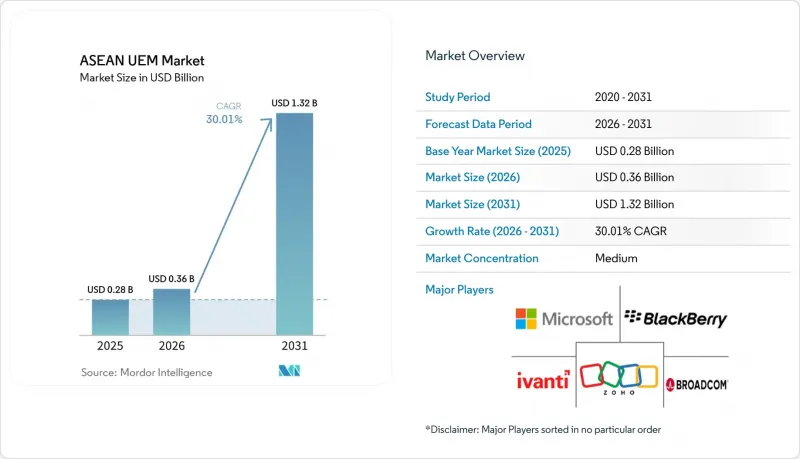
Mordor Intelligence에 의하면, ASEAN의 통합 엔드포인트 관리(UEM) 시장 규모는 2025년 2억 8,000만 달러로 평가되었고, 2026년에는 3억 6,000만 달러로 확대될 것으로 추정되고, 2026-2031년 CAGR 30.01%로 성장을 지속할 전망이며, 2031년에는 13억 2,000만 달러에 이를 것으로 예측됩니다.
본 보고서는 컴포넌트별(솔루션 및 서비스), 배포 방식별(클라우드 기반, 온프레미스형 등), 조직 규모별(대기업 및 중소기업), 최종 사용자 산업별(IT 및 통신, 은행, 금융서비스 및 보험(BFSI), 정부 및 국방, 헬스케어 및 생명과학, 제조, 소매 및 전자상거래 등) 및 국가별로 분류되어 있습니다. 시장 전망은 금액(달러) 기준으로 제시되어 있습니다.
아세안(ASEAN)의 UEM 시장 동향 및 인사이트
하이브리드 근무 및 BYOD(개인 소유 기기 지참)의 확대
하이브리드 근무는 많은 아세안 기업에서 일시적인 조치에서 표준적인 업무 형태로 전환되고 있으며, 이러한 변화에 따라 공식적인 관리가 필요한 기기의 수가 증가하고 있습니다. 개인 소유 기기가 몇년전과 비교해 훨씬 더 빈번하게 기업 용도, 고객 기록, 협업 도구 및 사내 네트워크에 접근하게 되면서, 통일된 정책 적용에 대한 기본적인 필요성이 높아지고 있습니다. 아세안(ASEAN)의 UEM 시장이 확대되고 있는 것은 고용주들이 일상 업무의 효율성을 저해하지 않으면서 회사 소유 및 직원 소유 기기 전체를 가시화하고 싶어하기 때문입니다. 2024년 싱가포르 개인 데이터 보호 위원회(PDPC)가 시행한 시정 조치는 접근 제어의 취약성과 인증 정보 거버넌스의 미비점이 기기 보안 위험을 대규모 고객 데이터 유출 사고로 발전시킬 수 있음을 여실히 드러냈습니다. 이로 인해 많은 기업이 엔드포인트 등록 관리 및 정책 적용 범위를 강화해야 하는 상황에 직면해 있습니다. 또한, 이사회나 리스크 위원회가 원격 기기가 사무실 내 자산과 동등한 기준으로 관리되고 있다는 명확한 증거를 요구하게 된 환경에서는 조달 주기 또한 단축되고 있습니다. 이에 따라 벤더는 안전한 온보딩, 원격 삭제, 정책 분리 및 감사 가능한 접근 제어를 단일 운영 모델로 지원할 수 있다면 경쟁 우위를 확보할 수 있습니다.
확대되는 사이버 위협의 공격 표면과 제로 트러스트 도입
사이버 보안 우선순위에 따라 엔드포인트 관리는 신원 및 접근 제어와 더욱 밀접하게 연계되고 있습니다. 특히 기업이 클라우드 사용을 확대하고 더욱 분산된 직원 체제를 지원함에 따라 이러한 경향은 두드러지고 있습니다. 제로 트러스트 프로그램에서는 디바이스 자체를 '능동적인 제어 지점'으로 취급해야 합니다. 즉, 접근 권한 결정은 인증 정보뿐만 아니라 디바이스 상태, 규정 준수 현황 및 정책 상태를 기반으로 이루어집니다. 아세안(ASEAN)의 UEM 시장은 이러한 변화의 혜택을 누리고 있습니다. 구매자들이 기기 상태 점검을 단순한 선택적 기기 관리가 아닌, 기본적인 보안 아키텍처의 일부로 인식하기 시작했기 때문입니다. 싱가포르 GovTech가 추진하는 SEED 프로그램은 대규모 엔지니어링 사용자 기반 전반에 걸쳐 엔드포인트 관리를 통합하는 동시에, CrowdStrike EDR을 통한 완벽한 커버리지와 강력한 운영 가시성을 유지함으로써 2025년의 이러한 방향성을 명확히 보여주었습니다. 싱가포르의 ‘정부 제로 트러스트 아키텍처’ 프레임워크 역시 엔드포인트의 건전성을 지속적인 접근 제어의 변수로 다루고 있으며, 그 설계 논리는 공공 시스템에서 민간 부문의 보안 프로그램으로 확대되고 있습니다. 점점 더 많은 조직이 기기의 신뢰성을 리소스 접근 권한과 연계하게 됨에 따라, 건전한 엔드포인트 상태를 광범위한 보안 워크플로우에 반영하지 못하는 플랫폼은 그 존재 가치를 잃을 가능성이 높습니다.
데이터 주권과 개인정보 보호 규정 준수의 장벽
디바이스의 텔레메트리, 정책 데이터, 사용자 ID, 애플리케이션 접근 기록이 반드시 단일 법적 프레임워크에 명확히 부합하는 것은 아니기 때문에 국경을 초월한 엔드포인트 거버넌스는 여전히 어려운 과제입니다. 다국간에 걸쳐 사업을 영위하는 기업들은 업무 효율화를 위해 단일 제어 모델을 필요로 하는 경우가 많은 반면, 아세안(ASEAN) 각 관할 구역에서는 데이터 저장, 전송, 접근 심사와 관련하여 각각 다른 요건에 직면하고 있습니다. 따라서 아세안(ASEAN)의 UEM 시장은 규정 준수상의 제약 속에서 확대되고 있으며, 신뢰할 수 있는 데이터 거주지의 일관성이 뒷받침되지 않는 한 기술적 역량만으로는 불충분합니다. 아세안의 국경을 초월한 클라우드 원칙 및 데이터 거버넌스 가이드에 관한 지역적 노력은 조화가 진행되고 있음을 보여주고 있지만, 그 속도는 여전히 기업의 조달 일정이나 실질적인 도입 요구를 따라가지 못하고 있습니다. 또한, 싱가포르 개인 데이터 보호 위원회는 2025년 1월에 3가지 지역 데이터 거버넌스 지침을 발표했습니다. 이를 통해 규정 준수를 위한 일부 경로는 명확해졌지만, 공유 장치 환경 전반에 걸친 각국 고유의 의무를 관리해야 하는 부담이 해소된 것은 아닙니다. 따라서 고객에게 서로 연동되지 않은 여러 콘솔의 사용을 강요하지 않으면서, 지역별 호스팅 옵션, 명확한 정책 경계, 그리고 더욱 강력한 감사 지원을 제공할 수 있는 벤더에게는 경쟁 우위가 생깁니다.
부문 분석
2025년 아세안(ASEAN) 통합 엔드포인트 관리 시장에서 솔루션은 시장 점유율의 65.66%를 차지했으며, 연평균 성장률(CAGR)은 31.23%를 기록했습니다. 이는 기업들이 여전히 주변 서비스 계층보다 핵심 제어 플랫폼에 지출의 대부분을 할당하고 있음을 보여줍니다. 구매자들은 팀이 서로 연동되지 않는 여러 도구를 관리해야 하는 부담을 주지 않으면서, 기기 등록, 용도 거버넌스, 규정 준수 정책, 컨텐츠 접근 및 워크플로우 자동화를 처리할 수 있는 단일 운영 환경을 원하고 있습니다. 이러한 경향은 보안 및 규정 준수 요구 사항이 높아지고 있는 분야에서 특히 두드러지는데, 이는 기업들이 기본적인 기기 제어와 고위험 거버넌스 기능 사이에 정책상의 격차가 발생하는 것을 원치 않기 때문입니다. 솔루션 스택 내에서 보안 및 규정 준수 관리, 분석, 자동화가 더욱 전략적인 중요성을 띠고 있습니다. 이는 구매자들이 현재 포지션 모니터링, 정책 검증 및 신속한 문제 해결을 표준 기능으로 기대하고 있기 때문입니다. 기기 관리는 여전히 필수적이지만, 다중 OS 지원 및 원격 정책 제어가 입찰의 최소 요건이 되었기 때문에 과거와 같이 경쟁상의 차별화 요소가 될 수는 없게 되었습니다. 이것이 바로 아세안(ASEAN)의 UEM 시장에서 단순한 자산 가시화에 그치지 않고, 엔드포인트의 전체 수명 주기에 걸쳐 측정 가능한 제어를 입증할 수 있는 벤더가 높이 평가받는 이유입니다.
서비스 계층이 확대되고 있는 것은 도입 프로젝트의 상당수가 여러 사업 부문이나 국가에 걸친 통합 작업, 정책 재설계, 역할 기반 접근 권한 조정, 그리고 사용자 교육을 수반하게 되었기 때문입니다. 많은 기업에게 플랫폼 구매 자체는 어렵지 않지만, 레거시 용도이나 규제된 워크플로우, IT 팀과 보안 팀 간의 책임 분담에 맞추어 운영을 확립하는 데 어려움을 겪고 있습니다. 따라서 아세안 UEM 업계에서는 서비스 수요가 단순한 부수적 활동이 아니라, 도입 및 업데이트를 성공시키기 위한 실질적인 조건으로 부상하고 있습니다. 관리형 UEM 지원은 특히 중견 기업 시장에서 그 중요성이 커지고 있습니다. 이 시장의 구매자들은 중앙 집중식 엔드포인트 거버넌스의 이점을 원하지만, 반드시 사내에 고도의 자동화 노하우를 보유하고 있는 것은 아닙니다. Ivanti가 2025년 10월, PT Berca Hardayaperkasa를 통해 인도네시아에서 ‘Secure Unified Endpoint Management’ 솔루션을 출시한 것은 이러한 채널 주도형 서비스 기회를 반영한 것이며, 벤더가 플랫폼 판매를 중심으로 현지 제공 체계를 어떻게 구축하고 있는지를 보여줍니다. 아세안(ASEAN) 기업들이 관리 대상 기기의 범위를 확대하고 관리 기준을 강화함에 따라, 서비스는 플랫폼의 기능을 일상적인 운영에 활용할 수 있는 형태로 전환하는 중요한 계층이 되고 있습니다.
2025년에는 클라우드 기반 도입이 시장의 59.34%를 차지한 것으로 평가되었으며, 이러한 선두 위상은 기업들이 분산된 기기 전체에 걸쳐 더 신속한 프로비저닝, 인프라 소유 부담 경감, 원격 정책 관리의 용이성을 선호하는 경향을 반영합니다. 또한, 클라우드 기반 제공은 2031년까지 연평균 성장률(CAGR) 31.23%로 확대될 것으로 예측되며, 현재 수요 구조에서 가장 빠르게 성장하고 있는 도입 모델입니다. 실용적인 관점에서 볼 때, 클라우드 기반 UEM은 온보딩, 패치 배포, 원격 문제 해결, 제로 터치 설정과 같은 운영상의 마찰을 줄여줍니다. 이는 직원들이 사무실, 자택, 창고, 진료소, 현장 환경 등 다양한 장소에 분산됨에 따라 점점 더 중요해지고 있습니다. 아세안(ASEAN)의 클라우드 기반 UEM 시장 규모가 확대되고 있는 것은 특히 기기 수가 급격히 변동하거나 사업 부문이 새로운 국가로 확장될 경우 구매자들이 유연성과 표준화를 동시에 요구하기 때문입니다. 2026년 1월에 발표된 ‘아세안 국경을 초월한 클라우드 컴퓨팅 원칙에 관한 프레임워크’는 지역 전체의 사업 거점에서 더욱 사용하기 편리한 상호 운용 가능한 클라우드 아키텍처를 권장함으로써 이러한 방향성을 뒷받침하고 있습니다. 이러한 정책적 신호가 주권과 관련된 모든 문제를 해결해 주는 것은 아니지만, 지역 기업들의 계획에서 클라우드 도입의 기반을 더욱 공고히 하고 있습니다.
정부, 국방 및 엄격한 규제가 적용되는 기관의 경우, 관리 트래픽, 정책 로그 또는 장치 기록을 현지에서 직접 관리해야 하므로 온프레미스 배포는 여전히 중요합니다. 이 시장 부문의 규모는 작지만, 주권 환경이나 고신뢰성 환경에서 벤더의 신뢰도를 형성한다는 점에서 전략적 가치를 지닙니다. 블랙베리가 2026년 6월에 실시한 UEM 플랫폼 업데이트에서는 클라우드에 의존하지 않고 단일 온프레미스 콘솔에서 Apple, Windows, Android 기기의 주권 관리 기능을 확장함으로써 이러한 요구를 더욱 강화했습니다. 하이브리드 배포는 이 두 모델의 중간에 위치하며, 디지털 프론트엔드와 규제 대상 백오피스 시스템을 병행하여 운영하는 복잡한 조직에서 여전히 확고한 입지를 유지하고 있습니다. 아세안 지역의 UEM 업계는 앞으로도 하이브리드형에 대한 수요를 지속적으로 뒷받침할 전망입니다. 이는 많은 지역 대기업들이 모든 워크로드를 단일 인프라 경로로 강제하지 않으면서도 공통된 정책 로직을 필요로 하기 때문입니다. 따라서 하이브리드 모델은 단순한 타협안이라기보다는 규모, 관리, 국가 차원의 규정 준수를 균형 있게 조율해야 하는 대기업에게 의도적인 운영 설계로 기능하고 있습니다.
기타 혜택 :
- 엑셀 형식 시장 예측(ME) 시트
- 3개월간의 애널리스트 지원
자주 묻는 질문
목차
제1장 서론
제2장 조사 방법
제3장 주요 요약
제4장 시장 구도
제5장 시장 규모 및 성장 예측
제6장 경쟁 구도
제7장 시장 기회 및 향후 전망
AJY 26.08.07According to Mordor Intelligence, the ASEAN UEM market size is expected to grow from USD 0.28 billion in 2025 to USD 0.36 billion in 2026, and is forecast to reach USD 1.32 billion by 2031 at a 30.01% CAGR over 2026-2031.
This report is Segmented by Component (Solutions and Services), Deployment Mode (Cloud-Based, On-Premise, and More), Organization Size (Large Enterprises and Small and Medium Enterprises), End-User Industry (IT and Telecommunications, BFSI, Government and Defense, Healthcare and Life Sciences, Manufacturing, Retail and E-Commerce, and More), and Country. The Market Forecasts are Provided in Terms of Value (USD).
ASEAN UEM Market Trends and Insights
Hybrid Work and Bring Your Own Device Expansion
Hybrid work has moved from a temporary arrangement to a standard operating pattern across many ASEAN enterprises, and that shift is widening the number of devices that need formal control. Personal devices now touch enterprise applications, customer records, collaboration tools, and internal networks far more often than they did a few years ago, which raises the baseline need for unified policy enforcement. The ASEAN UEM market is benefiting because employers want visibility across company-owned and employee-owned devices without slowing daily work. Enforcement action by Singapore's Personal Data Protection Commission in 2024 reinforced how weak access controls and poor credential governance can turn device exposure into large customer-data incidents, which has pushed many enterprises to tighten endpoint enrollment and policy coverage. Procurement cycles have also shortened in environments where boards and risk committees now expect clearer proof that remote devices are governed to the same standard as office-based assets. This gives vendors an advantage when they can support secure onboarding, remote wipe, policy separation, and auditable access control in one operating model.
Escalating Cyber Threat Surface and Zero Trust Rollouts
Cybersecurity priorities are pulling endpoint management closer to identity and access control, especially as enterprises extend cloud usage and support more distributed workforces. Zero trust programs require the device itself to be treated as a live control point, which means access decisions depend on posture, compliance state, and policy status rather than on credentials alone. The ASEAN UEM market is gaining from this shift because buyers increasingly treat device health checks as part of basic security architecture rather than as optional device administration. Singapore GovTech's SEED program showed this direction clearly in 2025 by centralizing endpoint management across a large engineering user base while maintaining full CrowdStrike EDR coverage and strong operational visibility. The Government Zero Trust Architecture framework in Singapore also treats endpoint health as a continuous access-control variable, and that design logic is moving from public systems into private-sector security programs. As more organizations map device trust to resource access, platforms that cannot feed clean endpoint posture into broader security workflows are likely to lose relevance.
Data Sovereignty and Privacy Compliance Hurdles
Cross-border endpoint governance remains difficult because device telemetry, policy data, user identity, and application access records do not always fit neatly within one legal framework. Multi-country operators often need one control model for business efficiency, but they face separate expectations for data storage, transfer, and access review across ASEAN jurisdictions. The ASEAN UEM market therefore expands under a compliance constraint, where technical capability alone is not enough unless it is paired with credible data-residency alignment. ASEAN's regional work on cross-border cloud principles and data governance guides shows that harmonization is moving forward, but the pace still trails enterprise procurement timelines and practical deployment needs. Singapore's Personal Data Protection Commission also published 3 regional data governance guides in January 2025, which helped clarify some compliance pathways but did not eliminate the burden of managing country-specific obligations across a shared device estate. This leaves an advantage for vendors that can show regional hosting options, clear policy boundaries, and stronger audit support without forcing customers into multiple disconnected consoles.
Other drivers and restraints analyzed in the detailed report include:
- Platform Convergence of Endpoint, Identity, and Access Management
- AI-Based Digital Employee Experience Optimization
- High Migration and Integration Cost of Legacy Estates
For complete list of drivers and restraints, kindly check the Table Of Contents.
Segment Analysis
Solutions accounted for 65.66% of the ASEAN unified endpoint management market share in 2025, with a growth rate of 31.23% CAGR, which shows that enterprises still direct most spending toward the core control platform rather than toward surrounding service layers. Buyers want one operating environment that can handle device enrollment, application governance, compliance policy, content access, and workflow automation without forcing teams to manage several disconnected tools. That preference is strongest where security and compliance requirements are rising because enterprises do not want policy gaps between basic device control and higher-risk governance functions. Within the solutions stack, security and compliance management, analytics, and automation are carrying more strategic weight because buyers now expect posture monitoring, policy validation, and faster issue resolution as standard capabilities. Device management remains essential, but it no longer defines competitive differentiation in the same way because multi-OS support and remote policy control have become baseline tender requirements. This is why the ASEAN UEM market is rewarding vendors that can move beyond inventory visibility and show measurable control across the full endpoint lifecycle.
The services layer is scaling because a larger share of deployments now involve integration work, policy redesign, role-based access tuning, and user training across several business units or countries. Many enterprises do not struggle to buy the platform, they struggle to operationalize it in a way that fits legacy applications, regulated workflows, and shared accountability between IT and security teams. The ASEAN UEM industry is therefore seeing service demand rise not as a side activity, but as a practical condition for successful rollout and renewal. Managed UEM support is especially relevant in the mid-market, where buyers want the benefits of centralized endpoint governance but do not always have in-house automation depth. Ivanti's October 2025 launch of its Secure Unified Endpoint Management offering in Indonesia through PT Berca Hardayaperkasa reflected that channel-led services opportunity and showed how vendors are building local delivery capacity around the platform sale. As ASEAN organizations widen device coverage and tighten control standards, services become the layer that turns platform capability into usable daily operations.
Cloud-based deployment held 59.34% of the market in 2025, and that lead reflects how enterprises prefer faster provisioning, lighter infrastructure ownership, and easier remote policy administration across distributed device fleets. Cloud delivery is also projected to advance at a 31.23% CAGR through 2031, which makes it the fastest-moving deployment model in the current structure of demand. In practical terms, cloud UEM reduces the operational friction of onboarding, patch distribution, remote troubleshooting, and zero-touch setup, which matters more as workforces stretch across offices, homes, warehouses, clinics, and field environments. The ASEAN UEM market size for cloud-based deployment is growing because buyers want elasticity and standardization at the same time, especially when device counts change quickly or business units expand into new countries. The ASEAN Framework on Cross-Border Cloud Computing Principles, published in January 2026, supports this direction by encouraging interoperable cloud architectures that are easier to use across regional operating footprints. That policy signal does not remove every sovereignty issue, but it gives cloud deployment a firmer foundation in regional enterprise planning.
On-premises deployment still matters in government, defense, and tightly regulated institutions where management traffic, policy logs, or device records must remain under direct local control. This part of the market is smaller, but it carries strategic value because it shapes vendor credibility in sovereign and high-assurance environments. BlackBerry's June 2026 update to its UEM platform reinforced this need by expanding sovereign management capabilities for Apple, Windows, and Android devices from a single on-premises console without cloud dependency. Hybrid deployment sits between those 2 models and retains a strong hold in complex organizations that operate digital front ends alongside regulated back-office systems. The ASEAN UEM industry is likely to keep supporting hybrid demand because many regional conglomerates need shared policy logic without forcing every workload into one infrastructure path. Hybrid therefore works less as a compromise and more as a deliberate operating design for large enterprises balancing scale, control, and country-level compliance.
Complete Report Scope:
- By Component
- Solutions
- Device Management
- Application Management
- Content Management
- Security and Compliance Management
- Analytics and Automation
- Services
- Solutions
- By Deployment Mode
- Cloud-Based
- On-Premise
- Hybrid
- By Organization Size
- Large Enterprises
- Small and Medium Enterprises
- By End-User Industry
- IT and Telecommunications
- BFSI
- Government and Defense
- Healthcare and Life Sciences
- Manufacturing
- Retail and E-Commerce
- Education
- Transportation and Logistics
- Energy and Utilities
- Other End-User Industries
- By Country
- Indonesia
- Philippines
- Malaysia
- Singapore
- Vietnam
- Rest of ASEAN
List of Companies Covered in this Report:
- Microsoft Corporation
- Ivanti, Inc.
- BlackBerry Limited
- IBM Corporation
- Broadcom Inc.
- Citrix Systems, Inc.
- Jamf Holding Corp.
- SOTI Inc.
- Sophos Limited
- HCL Technologies Limited
- Zoho Corporation Private Limited
- 42Gears Mobility Systems Pvt. Ltd.
- Absolute Software Corporation
- Tanium Inc.
- JumpCloud, Inc.
- Atera Networks Ltd.
- Open Text Corporation
- Matrix42 AG
- Miradore Ltd.
- Micro Focus International plc
- ManageEngine, a division of Zoho Corporation
Additional Benefits:
- The market estimate (ME) sheet in Excel format
- 3 months of analyst support
TABLE OF CONTENTS
1 INTRODUCTION
- 1.1 Study Assumptions and Market Definition
- 1.2 Scope of the Study
2 RESEARCH METHODOLOGY
3 EXECUTIVE SUMMARY
4 MARKET LANDSCAPE
- 4.1 Market Overview
- 4.2 Market Drivers
- 4.2.1 Hybrid Work and Bring Your Own Device Expansion
- 4.2.2 Escalating Cyber Threat Surface and Zero Trust Rollouts
- 4.2.3 Platform Convergence of Endpoint, Identity, and Access Management
- 4.2.4 AI-Based Digital Employee Experience Optimization
- 4.2.5 Frontline and Internet of Things Device Growth in Warehousing and Field Operations
- 4.2.6 ESG-Led Demand for Device-Level Carbon Analytics
- 4.3 Market Restraints
- 4.3.1 Data Sovereignty and Privacy Compliance Hurdles
- 4.3.2 High Migration and Integration Cost of Legacy Estates
- 4.3.3 Procurement Uncertainty in Post-VMware Transition Environments
- 4.3.4 Talent Gap in Low-Code Automation and Scripting for UEM
- 4.4 Industry Value Chain Analysis
- 4.5 Industry Supply Chain Analysis
- 4.6 Regulatory Landscape
- 4.7 Technological Outlook
- 4.8 Impact of Macroeconomic Factors on the Market
- 4.9 Porter's Five Forces Analysis
- 4.9.1 Bargaining Power of Buyers
- 4.9.2 Bargaining Power of Suppliers
- 4.9.3 Threat of New Entrants
- 4.9.4 Threat of Substitutes
- 4.9.5 Competitive Rivalry
5 MARKET SIZE AND GROWTH FORECASTS (VALUE)
- 5.1 By Component
- 5.1.1 Solutions
- 5.1.1.1 Device Management
- 5.1.1.2 Application Management
- 5.1.1.3 Content Management
- 5.1.1.4 Security and Compliance Management
- 5.1.1.5 Analytics and Automation
- 5.1.2 Services
- 5.1.1 Solutions
- 5.2 By Deployment Mode
- 5.2.1 Cloud-Based
- 5.2.2 On-Premise
- 5.2.3 Hybrid
- 5.3 By Organization Size
- 5.3.1 Large Enterprises
- 5.3.2 Small and Medium Enterprises
- 5.4 By End-User Industry
- 5.4.1 IT and Telecommunications
- 5.4.2 BFSI
- 5.4.3 Government and Defense
- 5.4.4 Healthcare and Life Sciences
- 5.4.5 Manufacturing
- 5.4.6 Retail and E-Commerce
- 5.4.7 Education
- 5.4.8 Transportation and Logistics
- 5.4.9 Energy and Utilities
- 5.4.10 Other End-User Industries
- 5.5 By Country
- 5.5.1 Indonesia
- 5.5.2 Philippines
- 5.5.3 Malaysia
- 5.5.4 Singapore
- 5.5.5 Vietnam
- 5.5.6 Rest of ASEAN
6 COMPETITIVE LANDSCAPE
- 6.1 Market Concentration
- 6.2 Strategic Moves
- 6.3 Market Share Analysis
- 6.4 Company Profiles (includes Global Level Overview, Market Level Overview, Core Segments, Financials as available, Strategic Information, Market Rank/Share, Products and Services, Recent Developments)
- 6.4.1 Microsoft Corporation
- 6.4.2 Ivanti, Inc.
- 6.4.3 BlackBerry Limited
- 6.4.4 IBM Corporation
- 6.4.5 Broadcom Inc.
- 6.4.6 Citrix Systems, Inc.
- 6.4.7 Jamf Holding Corp.
- 6.4.8 SOTI Inc.
- 6.4.9 Sophos Limited
- 6.4.10 HCL Technologies Limited
- 6.4.11 Zoho Corporation Private Limited
- 6.4.12 42Gears Mobility Systems Pvt. Ltd.
- 6.4.13 Absolute Software Corporation
- 6.4.14 Tanium Inc.
- 6.4.15 JumpCloud, Inc.
- 6.4.16 Atera Networks Ltd.
- 6.4.17 Open Text Corporation
- 6.4.18 Matrix42 AG
- 6.4.19 Miradore Ltd.
- 6.4.20 Micro Focus International plc
- 6.4.21 ManageEngine, a division of Zoho Corporation
7 MARKET OPPORTUNITIES AND FUTURE OUTLOOK
- 7.1 White-Space and Unmet-Need Assessment


