

|
시장보고서
상품코드
2098461
아시아태평양의 UEM : 시장 점유율 분석, 업계 동향과 통계, 성장 예측(2026-2031년)Asia-Pacific UEM - Market Share Analysis, Industry Trends & Statistics, Growth Forecasts (2026 - 2031) |
||||||
 Mordor Intelligence
Mordor Intelligence에 의하면, 아시아태평양의 UEM 시장 규모는 2025년에 17억 6,000만 달러로 평가되었고, 2026-2031년 CAGR 28.14%로 확대되어 2031년에는 76억 7,000만 달러에 이를 것으로 예측됩니다.
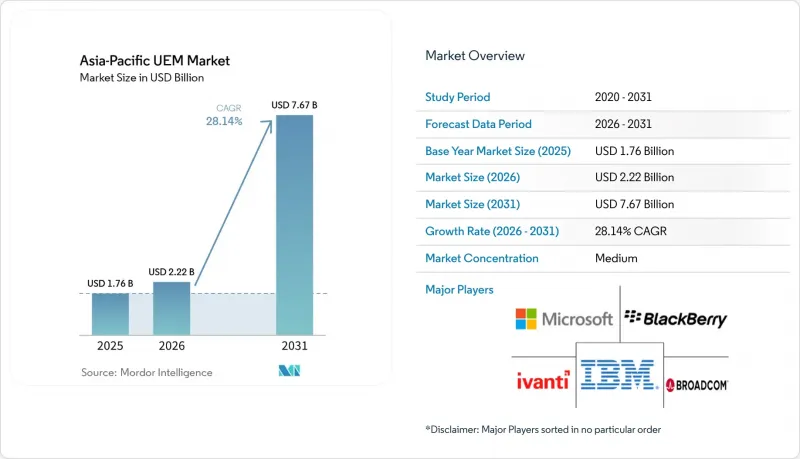
본 보고서는 구성 요소(솔루션 및 서비스), 도입 형태(클라우드 기반, On-Premise형 등), 조직 규모(대기업 및 중소기업), 최종 사용자 산업(IT 및 통신, 정부·국방, 의료 및 생명과학, 제조, 소매 및 전자상거래 등), 그리고 국가별로 분류되어 있습니다. 시장 전망은 금액(달러)으로 표시되어 있습니다.
아시아태평양의 UEM 시장 동향 및 인사이트
하이브리드 근무 및 BYOD의 가속화
아시아태평양의 UEM 시장은 근무 패턴의 광범위한 변화로 인해 혜택을 받고 있습니다. 이는 개인 소유 기기, 여러 운영 체제의 혼용, 그리고 분산된 사용자가 현재 기업 환경 전반에서 일반화되었기 때문입니다. 실제로 이러한 추세로 인해 구매자들은 업무 데이터와 개인 데이터를 분리하고, 지역, 사용자 역할, 기기 유형에 따라 서로 다른 제어 기능을 적용할 수 있는 플랫폼을 요구하고 있습니다. 또한, 아시아태평양의 UEM 시장은 많은 조직이 현재 Android의 업무용 프로파일, Apple의 사용자 등록, 그리고 Windows의 개인용 시나리오를 동시에 관리하기 위한 단일 콘솔을 필요로 하고 있다는 사실에서도 혜택을 받고 있습니다. 이러한 요구 사항은 메시징 앱이나 다중 기기 액세스로 인해 기존의 데스크톱 중심 환경보다 더 많은 규정 준수 접점이 발생하는 ‘모바일 우선’ 비즈니스 환경에서 특히 중요합니다. 그 결과, 개별 도구가 아닌 통합 플랫폼 내에 내장된 컨테이너화, 모바일 애플리케이션 관리 및 정책 세분화 기능에 대한 수요가 증가하고 있습니다. 기업들이 더 이상 재고 관리나 기본적인 모바일 기기 관리만을 목적으로 제품을 구매하는 것이 아니라 이러한 기능을 요구하게 됨에 따라, 이 요인으로 인해 아시아태평양의 통합 엔드포인트 관리 시장은 더욱 소프트웨어 주도적인 시장으로 변화하고 있습니다.
확대되는 사이버 위협의 공격 표면과 제로 트러스트 도입
아시아태평양의 UEM 시장이 확대되고 있는 또 다른 이유는 엔드포인트가 더 이상 단순한 관리 대상 자산이 아니라, ID, 액세스 및 보안 정책의 제어 지점으로서 기능하게 되었기 때문입니다. 제로 트러스트 프로그램이 클라우드 애플리케이션과 내부 네트워크 전반으로 확대됨에 따라, 구매자들은 지속적인 보안 상태 확인, 조건부 액세스 지원, 그리고 보다 신속한 액세스 권한 만료 워크플로를 요구하고 있습니다. Ivanti는 2026년 1분기 릴리스에서 'Autonomous Endpoint Management'를 도입하여, 시정 조치를 정기적인 유지 관리 주기에서 보다 지속적인 모델로 전환했습니다. 이번 릴리스에서는 테크니컬 프리뷰로 ‘Workspace AI Diagnostics’도 추가되어, 벤더가 디바이스 신호와 자동화된 문제 해결을 동일한 플랫폼에 통합하고 있음을 엿볼 수 있습니다.
데이터 주권 및 개인정보 보호 규정 준수의 장벽
아시아태평양의 UEM 시장은 각국의 관할권에 따라 정책 규정이 크게 다르기 때문에 여전히 과제에 직면해 있습니다. 아시아태평양의 여러 국가에서 기기를 관리하는 기업은 텔레메트리, 모니터링, 감사 기록 보관 및 사고 대응에 있어 단일한 표준 클라우드 설계에 의존할 수 없는 경우가 많습니다. 이로 인해 예산이나 제품 적합성이 이미 확보된 경우에도 도입 시기가 지연되고 설계 작업이 증가하게 됩니다. 아시아태평양의 통합 엔드포인트 관리(UEM) 시장은 엔드포인트 플랫폼이 사용자 데이터, 기기 작동, 사고 기록과 밀접하게 연관되어 있기 때문에 특히 이 문제의 영향을 받기 쉬운 상황에 놓여 있습니다. 따라서 법적 해석, 호스팅 아키텍처, 워크플로 설계는 단순한 백오피스 업무가 아닌 구매 프로세스의 핵심 요소로 자리 잡고 있습니다. 그 결과, 수요가 줄어들지는 않지만 규제 대상 환경에서 도입 속도가 느려지고, 보다 맞춤화된 구현이 필요하게 됩니다.
부문 분석
솔루션은 2025년 시장 점유율의 67.62%를 차지할 것으로 예상되며, 2031년까지 연평균 성장률(CAGR) 29.11%를 기록할 것으로 전망됩니다. 이는 아시아태평양의 UEM 시장의 상업적 중심이 도입 지원이 아닌 여전히 소프트웨어에 있음을 보여줍니다. 구매자들은 정책 간의 중복이나 도구의 난립을 줄일 수 있기 때문에 단일 콘솔 내에서 기기 관리, 용도 관리, 컨텐츠 관리, 보안 및 규정 준수 관리, 그리고 분석과 자동화를 계속해서 우선시하고 있습니다. 디바이스 상태가 액세스 결정 및 더 광범위한 보안 워크플로우에 점점 더 큰 영향을 미치게 됨에 따라, 디바이스 관리, 보안, 규정 준수 관리는 여전히 주요 구매 대상입니다. 이에 따라 번들 구매 추세는 계속해서 강세를 보이고 있으며, 기업이 엔드포인트 팀과 보안 팀 간의 업무 이관을 최소화하고자 할 경우 통합 플랫폼은 분명한 우위를 차지합니다. 따라서 아시아태평양의 통합 엔드포인트 관리 시장에서는 클라이언트에 별도의 관리 스택을 강요하지 않으면서 제어, 적용, 보고 기능을 결합할 수 있는 솔루션이 높이 평가받고 있습니다.
컨텐츠 관리는 솔루션 구성에서 비교적 눈에 띄지 않는 부분이지만, 여전히 중요한 비중을 차지하고 있습니다. 이는 현장용 태블릿, 키오스크, 공유 기기에서 앱 및 기기 제어와 동일한 워크플로우 내에서 안전한 문서 배포와 오프라인 거버넌스가 요구되기 때문입니다. 분석 및 자동화는 여전히 솔루션 하위 부문 중규모가 가장 작지만, 조직이 서비스 티켓 감소와 운영 효율성 향상을 추구함에 따라 솔루션 계층 내에서 가장 빠르게 확장되고 있습니다. Ivanti의 2026년 1분기 릴리스에서는 ‘Autonomous Endpoint Management’가 제품 라인에 추가되었으며, 이는 각 벤더들이 정적 모니터링에서 예측형 및 자동화된 시정 조치로 전환하고 있음을 시사합니다. 또한, 플랫폼 도입과 측정 가능한 운영 성과 창출은 별개의 문제라는 점을 많은 조직이 이해하고 있기 때문에 서비스 부문도 지속적으로 성장하고 있습니다. 아시아태평양의 UEM 업계 전반에서 이러한 양극화로 인해 표준화된 도입을 위한 시장과, 보다 복잡한 멀티 벤더 통합 지원을 위한 시장이라는 두 가지 시장이 형성되고 있습니다.
클라우드 기반 도입은 2025년 전체 시장의 61.45%를 차지하며, 2026년부터 2031년까지 연평균 성장률(CAGR) 29.54%로 확대되고 있어, 아시아태평양의 UEM 시장 규모 논의에서 가장 뚜렷한 선두를 달리고 있습니다. 이러한 선도적 위상은 단순히 호스팅형 소프트웨어가 선호되기 때문이 아니라, 분산된 사용자 및 기기 간에 정책을 실시간으로 동기화해야 할 필요성에서 기인합니다. 많은 기업, 특히 여러 부처, 주 또는 국내 시장에서 사업을 전개하는 기업에게 클라우드 기반 제공은 기존의 On-Premise 모델보다 신속한 업데이트와 일관된 거버넌스를 실현합니다. 이러한 실용적인 이점은 하나의 정책 구조 하에서 노트북, 스마트폰, 태블릿 및 현장 엔드포인트가 디바이스 그룹에 포함될 경우 더욱 중요해집니다. 따라서 아시아태평양의 UEM 시장은 기존의 포인트형 인프라보다 이 지역의 규모와 지리적 범위에 더 적합한 운영 모델인 클라우드로 전환되고 있습니다.
On-Premise 배포는 주권적 호스팅이나 에어갭 요건이 여전히 필수적인 정부 기관, 국방 기관 및 엄격하게 관리되는 특정 환경에서 여전히 확고한 입지를 유지하고 있습니다. 또한, 하이브리드 모델은 분석 및 보고서 작성에는 퍼블릭 클라우드를 활용하면서도 정책 관리는 로컬에서 수행하고자 하는 고객에게 중간적인 선택지가 되어 지지를 넓혀가고 있습니다. Omnissa가 v2410을 마지막 영구 라이선스형 On-Premise 릴리스로 삼고 SaaS 전업으로의 전환을 추진하고 있는 것은 고객으로 하여금 장기적인 아키텍처 선택을 재검토하도록 촉구하고 있습니다. 또한, Ivanti도 2026년 6월에 ‘Sovereign Edition’을 출시한 바 있으며, 이를 통해 각 벤더들은 더욱 엄격한 데이터 경계 관리 하에서도 클라우드의 편의성에 대한 수요가 지속될 것으로 전망하고 있음을 알 수 있습니다. 아시아태평양의 UEM 업계 전반에서 이는 방향성 측면에서는 클라우드가 우세하지만, 정책이나 호스팅 규제로 인해 완전한 퍼블릭 클라우드 설계가 여전히 제한되는 곳에서는 하이브리드 방식이 중요한 위치를 계속 차지할 것임을 의미합니다.
기타 혜택:
- 엑셀 형식 시장 예측(ME) 시트
- 3개월간의 애널리스트 지원
자주 묻는 질문
목차
제1장 서론
제2장 조사 방법
제3장 주요 요약
제4장 시장 구도
제5장 시장 규모와 성장 예측
제6장 경쟁 구도
제7장 시장 기회와 향후 전망
KTH 26.08.06According to Mordor Intelligence, the Asia-Pacific UEM market size was valued at USD 1.76 billion in 2025 and is forecast to reach USD 7.67 billion by 2031 at a CAGR of 28.14% from 2026 to 2031.
This report is Segmented by Component (Solutions and Services), Deployment Mode (Cloud-Based, On-Premise, and More), Organization Size (Large Enterprises and Small and Medium Enterprises), End-User Industry (IT and Telecommunications, Government and Defense, Healthcare and Life Sciences, Manufacturing, Retail and E-Commerce, and More), and Country. The Market Forecasts are Provided in Terms of Value (USD).
Asia-Pacific UEM Market Trends and Insights
Hybrid Work and BYOD Acceleration
The Asia-Pacific UEM market is benefiting from a broader shift in work patterns, because personal devices, mixed operating systems, and distributed users are now common across enterprise estates. In practice, this is pushing buyers toward platforms that can separate work data from personal data and apply different controls by geography, user role, and device type. The Asia-Pacific UEM market is also gaining from the fact that many organizations now need one console to govern Android work profiles, Apple user enrollment, and Windows personal-use scenarios at the same time. That requirement is especially important in mobile-first business settings, where messaging apps and multi-device access create more compliance touchpoints than older desktop-heavy environments. The result is stronger demand for containerization, mobile application management, and policy segmentation features that sit inside unified platforms rather than as separate tools. This driver is making the Asia-Pacific unified endpoint management market more software-led, because enterprises are no longer buying only for inventory control and basic mobile device management.
Escalating Cyber Threat Surface and Zero-Trust Rollouts
The Asia-Pacific UEM market is also moving higher because the endpoint now acts as a control point for identity, access, and security policy rather than as a simple managed asset. Buyers are asking for continuous posture checks, conditional access support, and faster revocation workflows as zero-trust programs spread across cloud applications and internal networks. Ivanti introduced Autonomous Endpoint Management in its Q1 2026 release, shifting remediation closer to a continuous model instead of periodic maintenance cycles. The same release also added Workspace AI Diagnostics in technical preview, which shows how vendors are tying device signals and automated problem resolution into the same platform.
Data Sovereignty and Privacy Compliance Hurdles
The Asia-Pacific UEM market still faces friction because policy rules differ sharply across national jurisdictions. Enterprises that manage devices in several Asia-Pacific countries often cannot rely on one standard cloud design for telemetry, monitoring, audit retention, and breach response. This slows rollout timing and adds design work even when budget and product fit are already in place. The Asia-Pacific unified endpoint management market is especially exposed to this issue because endpoint platforms sit close to user data, device behavior, and incident records. That makes legal interpretation, hosting architecture, and workflow design part of the buying process rather than back-office tasks. The result is not weaker demand, but slower deployment and more customized implementation across regulated environments.
Other drivers and restraints analyzed in the detailed report include:
- Platform Convergence of Endpoint, Identity, and Access Management
- AI-Based Digital Employee Experience Optimization
- High Migration and Integration Cost of Legacy Estates
For complete list of drivers and restraints, kindly check the Table Of Contents.
Segment Analysis
Solutions held 67.62% of the 2025 market, growing at 29.11% CAGR through 2031, which shows that the commercial core of the Asia-Pacific UEM market still sits in software rather than delivery support. Buyers continue to prioritize device management, application management, content management, security and compliance management, and analytics and automation inside a single console because that reduces policy overlap and tool sprawl. Device management, security, and compliance management remain central purchases because device posture increasingly feeds access decisions and broader security workflows. This keeps bundled buying behavior strong and gives integrated platforms a clear edge when enterprises want fewer handoffs between endpoint and security teams. The Asia-Pacific unified endpoint management market is therefore rewarding solutions that can combine control, enforcement, and reporting without forcing clients into separate management stacks.
Content management remains a quieter but still important part of the solutions mix, because field tablets, kiosks, and shared devices need secure document distribution and offline governance in the same workflow as app and device control. Analytics and automation is still the smallest solutions sub-segment, but it is expanding fastest inside the solutions layer as organizations look for fewer service tickets and better operational efficiency. Ivanti's Q1 2026 release, which brought Autonomous Endpoint Management into the product line, reflects how vendors are moving from static monitoring toward predictive and automated remediation. The services segment also continues to grow because many organizations understand that installing a platform and producing measurable operating gains are not the same task. Across the Asia-Pacific UEM industry, this split is creating one market for standardized deployments and another for more complex, multi-vendor integration support.
Cloud-based deployment accounted for 61.45% of the 2025 market and is advancing at a 29.54% CAGR from 2026 to 2031, giving it the clearest lead within the Asia-Pacific UEM market size discussion. Its lead comes from the need to synchronize policy across distributed users and devices in real time rather than from a simple preference for hosted software. For many enterprises, especially those operating across several provinces, states, or national markets, cloud delivery supports faster updates and more consistent governance than older on-site models. That practical advantage becomes more important when device fleets include laptops, smartphones, tablets, and frontline endpoints under one policy structure. The Asia-Pacific UEM market is therefore moving toward cloud because the operating model fits the region's scale and geographic spread better than legacy point infrastructure.
On-premises deployment still holds a defensible position in government, defense, and certain tightly controlled environments where sovereign hosting and air-gapped requirements remain essential. The hybrid model is also gaining ground because it offers a middle path for clients that want local policy control while using public cloud for analytics and reporting. Omnissa's move toward a SaaS-only direction, with v2410 as the final perpetual on-premises release, is pushing customers to revisit long-term architecture choices. Ivanti also launched a Sovereign Edition in June 2026, showing that vendors see continued demand for cloud convenience shaped by stricter data boundary controls. Across the Asia-Pacific UEM industry, that means cloud wins on direction, while hybrid remains important wherever policy and hosting rules still limit a full public cloud design.
Complete Report Scope:
- By Component
- Solutions
- Device Management
- Application Management
- Content Management
- Security and Compliance Management
- Analytics and Automation
- Services
- Solutions
- By Deployment Mode
- Cloud-Based
- On-Premise
- Hybrid
- By Organization Size
- Large Enterprises
- Small and Medium Enterprises
- By End-User Industry
- IT and Telecommunications
- BFSI
- Government and Defense
- Healthcare and Life Sciences
- Manufacturing
- Retail and E-Commerce
- Education
- Transportation and Logistics
- Energy and Utilities
- Other End-User Industries
- By Country
- China
- Japan
- India
- South Korea
- Australia and New Zealand
- Southeast Asia
- Rest of Asia-Pacific
List of Companies Covered in this Report:
- Microsoft Corporation
- Broadcom Inc.
- International Business Machines Corporation
- Citrix Systems, Inc.
- Ivanti, Inc.
- BlackBerry Limited
- 42Gears Mobility Systems Pvt Ltd.
- Matrix42 AG
- SOTI Inc.
- Sophos Ltd.
- Zoho Corporation Pvt. Ltd.
- Cisco Systems, Inc.
- Jamf Software, LLC
- Google LLC
- Tanium Inc.
- Kaseya Limited
- NinjaOne, LLC
- Automox, Inc.
- Quest Software Inc.
- Open Text Corporation
Additional Benefits:
- The market estimate (ME) sheet in Excel format
- 3 months of analyst support
TABLE OF CONTENTS
1 INTRODUCTION
- 1.1 Study Assumptions and Market Definition
- 1.2 Scope of the Study
2 RESEARCH METHODOLOGY
3 EXECUTIVE SUMMARY
4 MARKET LANDSCAPE
- 4.1 Market Overview
- 4.2 Market Drivers
- 4.2.1 Hybrid Work and BYOD Acceleration
- 4.2.2 Escalating Cyber Threat Surface and Zero-Trust Rollouts
- 4.2.3 Platform Convergence of Endpoint, Identity, and Access Management
- 4.2.4 AI-Based Digital Employee Experience Optimization
- 4.2.5 Frontline and IoT Device Expansion in Warehousing and Field Operations
- 4.2.6 Data Sovereignty-Driven Shift Toward Policy-Aware Cloud Management
- 4.3 Market Restraints
- 4.3.1 Data Sovereignty and Privacy Compliance Hurdles
- 4.3.2 High Migration and Integration Cost of Legacy Estates
- 4.3.3 Procurement Uncertainty in Post-Broadcom VMware Environments
- 4.3.4 Talent Gap in Low-Code Automation and Scripting for UEM
- 4.4 Industry Value Chain Analysis
- 4.5 Supply Chain Analysis
- 4.6 Regulatory Landscape
- 4.7 Technological Outlook
- 4.8 Impact of Macroeconomic Factors on the Market
- 4.9 Porter's Five Forces Analysis
- 4.9.1 Bargaining Power of Suppliers
- 4.9.2 Bargaining Power of Buyers
- 4.9.3 Threat of New Entrants
- 4.9.4 Threat of Substitutes
- 4.9.5 Intensity of Competitive Rivalry
5 MARKET SIZE AND GROWTH FORECASTS (VALUE)
- 5.1 By Component
- 5.1.1 Solutions
- 5.1.1.1 Device Management
- 5.1.1.2 Application Management
- 5.1.1.3 Content Management
- 5.1.1.4 Security and Compliance Management
- 5.1.1.5 Analytics and Automation
- 5.1.2 Services
- 5.1.1 Solutions
- 5.2 By Deployment Mode
- 5.2.1 Cloud-Based
- 5.2.2 On-Premise
- 5.2.3 Hybrid
- 5.3 By Organization Size
- 5.3.1 Large Enterprises
- 5.3.2 Small and Medium Enterprises
- 5.4 By End-User Industry
- 5.4.1 IT and Telecommunications
- 5.4.2 BFSI
- 5.4.3 Government and Defense
- 5.4.4 Healthcare and Life Sciences
- 5.4.5 Manufacturing
- 5.4.6 Retail and E-Commerce
- 5.4.7 Education
- 5.4.8 Transportation and Logistics
- 5.4.9 Energy and Utilities
- 5.4.10 Other End-User Industries
- 5.5 By Country
- 5.5.1 China
- 5.5.2 Japan
- 5.5.3 India
- 5.5.4 South Korea
- 5.5.5 Australia and New Zealand
- 5.5.6 Southeast Asia
- 5.5.7 Rest of Asia-Pacific
6 COMPETITIVE LANDSCAPE
- 6.1 Market Concentration
- 6.2 Strategic Moves
- 6.3 Market Share Analysis
- 6.4 Company Profiles (includes Global Level Overview, Market Level Overview, Core Segments, Financials as available, Strategic Information, Market Rank/Share, Products and Services, Recent Developments)
- 6.4.1 Microsoft Corporation
- 6.4.2 Broadcom Inc.
- 6.4.3 International Business Machines Corporation
- 6.4.4 Citrix Systems, Inc.
- 6.4.5 Ivanti, Inc.
- 6.4.6 BlackBerry Limited
- 6.4.7 42Gears Mobility Systems Pvt Ltd.
- 6.4.8 Matrix42 AG
- 6.4.9 SOTI Inc.
- 6.4.10 Sophos Ltd.
- 6.4.11 Zoho Corporation Pvt. Ltd.
- 6.4.12 Cisco Systems, Inc.
- 6.4.13 Jamf Software, LLC
- 6.4.14 Google LLC
- 6.4.15 Tanium Inc.
- 6.4.16 Kaseya Limited
- 6.4.17 NinjaOne, LLC
- 6.4.18 Automox, Inc.
- 6.4.19 Quest Software Inc.
- 6.4.20 Open Text Corporation
7 MARKET OPPORTUNITIES AND FUTURE OUTLOOK
- 7.1 White-Space and Unmet-Need Assessment


