

|
시장보고서
상품코드
2097455
베트남의 통합 엔드포인트 관리(UEM) 시장 : 시장 점유율 분석, 업계 동향 및 통계, 성장 예측(2026-2031년)Vietnam UEM - Market Share Analysis, Industry Trends & Statistics, Growth Forecasts (2026 - 2031) |
||||||
 Mordor Intelligence
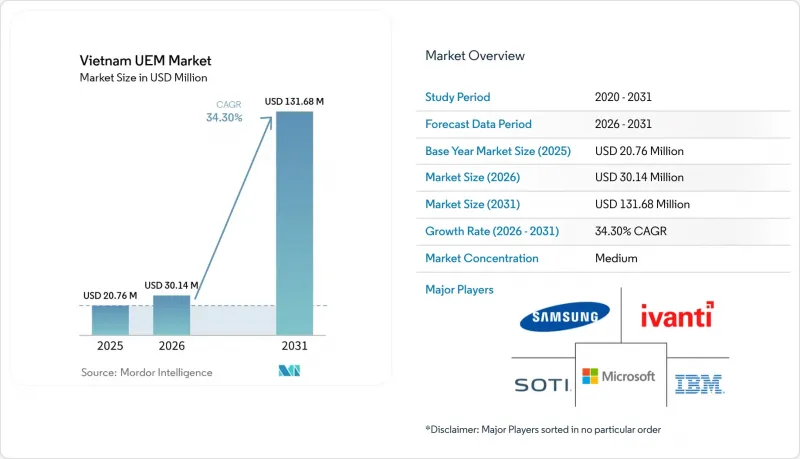
Mordor Intelligence에 의하면, 베트남의 통합 엔드포인트 관리(UEM) 시장 규모는 2025년에 2,076만 달러로 평가되었고, 2026년 3,014만 달러에서 2031년까지 1억 3,168만 달러에 이를 것으로 예측되며, 2026-2031년 예측 기간 CAGR은 34.30%를 나타낼 전망입니다.
본 보고서는 컴포넌트별(솔루션 및 서비스), 배포 방식별(클라우드 기반, 온프레미스형, 하이브리드형), 조직 규모별(대기업 및 중소기업), 최종 사용자 산업별(IT 및 통신, 은행, 금융서비스 및 보험(BFSI), 정부 및 국방, 헬스케어 및 생명과학, 제조, 소매 및 전자상거래 등)로 분류되어 있습니다. 시장 전망은 금액(달러) 기준으로 제시되어 있습니다.
베트남의 통합 엔드포인트 관리(UEM) 시장 동향 및 인사이트
베트남 기업 모빌리티의 부상
현재 많은 조직이 기존의 사무용 노트북 이외의 기기도 관리하게 되면서, 기업 모빌리티의 확대가 베트남 통합 엔드포인트 관리(UEM) 시장의 잠재 시장을 확대시키고 있습니다. 모바일 엔드포인트는 영업, 서비스, 물류, 의료, 행정 등 일상 업무의 일부가 되어가고 있으며, 여러 운영 체제와 이용 모델을 아우르는 단일 정책 계층의 필요성이 강조되고 있습니다. 이러한 변화가 중요한 이유는 많은 조직에서 기기 증가 속도가 내부 정책의 표준화 속도를 앞지르고 있어, 디지털화가 순조롭게 진행되는 것처럼 보여도 거버넌스 격차가 확대될 가능성이 있기 때문입니다. 이러한 요구 사항은 직원의 스마트폰에 그치지 않고 태블릿, 내충격성 핸드헬드 단말기, 공유 기기, 현장 단말기에 대해서도 프로비저닝, 액세스 제어, 패치 적용, 원격 지원이 필요해집니다. 등록, 규정 준수 점검, 시정 조치를 자동화할 수 있는 벤더는 특히 IT 팀이 기기 수 증가와 같은 속도로 인력을 확충할 수 없는 경우, 이러한 수요를 확보하는 데 유리한 입장에 있습니다. 주요 벤더들의 최근 플랫폼 업데이트를 통해 이 분야가 수동 관리에서 ‘저터치 관리’로 전환되고 있음을 알 수 있으며, 이를 통해 베트남의 통합 엔드포인트 관리(UEM) 시장 전반의 확산이 더욱 가속화될 것입니다.
지식 근로자 계층에서의 BYOD 및 COPE의 급속한 확산
베트남의 통합 엔드포인트 관리(UEM) 시장은 지식 근로자 계층에서의 BYOD 및 COPE 모델의 확산으로부터도 혜택을 받고 있습니다. 이러한 방식은 하드웨어 비용을 절감하는 한편, 관리 요구 사항을 높이고 있기 때문입니다. 개인용 또는 혼합 용도 기기가 기업용 앱에 연결되면, 통합된 제어 계층 없이는 데이터 분리, 액세스 정책, 앱 배포, 기기 상태 관리가 어려워집니다. 이로 인해 통합 엔드포인트 관리(UEM) 플랫폼에 실질적인 기회가 생깁니다. 단일 도구로는 엔드포인트 환경의 일부를 보호할 수는 있어도, 등록, 정책 관리, 규정 준수, 지원과 같은 전체 워크플로를 포괄하지 못하는 경우가 많기 때문입니다. 이러한 수요 패턴은 규제 대상 데이터나 기밀 데이터를 다루는 산업에서 특히 중요하며, 이러한 산업에서는 직원의 유연성과 고용주의 관리 사이에서 실질적인 균형을 유지해야 합니다. 또한, 공유 기기나 혼합 기기 환경에서는 사용자, 앱, 기기의 역할이 변화함에 따라 수동 정책 할당이 어려워지므로, 보다 엄격한 자동화가 요구됩니다. 2026년 각 벤더의 신제품 출시에서는 규정 준수 자동화 강화 및 Android 및 Apple 기기군의 관리 간소화를 통해 이러한 변화가 반영되고 있으며, 이를 통해 베트남의 통합 엔드포인트 관리(UEM) 시장 전반에 걸쳐 보다 자연스러운 도입이 촉진되고 있습니다.
중소기업의 예산 고려
예산에 대한 고려는 베트남 통합 엔드포인트 관리(UEM) 시장의 단기적 확장을 가로막는 가장 뚜렷한 제약 요소 중 하나로 남아 있습니다. 이는 많은 중소기업이 여전히 엔드포인트 관리에서 비용 관리를 최우선으로 하고, 거버넌스는 뒷전으로 미루고 있기 때문입니다. 이 과제는 구조적인 문제입니다. 수익 기반이 작고 IT 인력도 제한적인 기업에게 연간 5,000만 VND(1,970달러)에서 2억 VND(7,880달러)에 달하는 소프트웨어 지출은 부담스러울 수 있기 때문입니다. 규정 준수 압박은 존재하지만, 구매력이나 도입 능력이 반드시 같은 속도로 향상되는 것은 아니기 때문에 이 점은 중요합니다. 중소규모 조직은 많은 경우 기본적인 엔드포인트 보호를 선택하거나, 보다 광범위한 관리 도구의 도입을 미루는 방식으로 대응하고 있습니다. 그 결과, 통합 관리의 필요성이 실제로 존재함에도 불구하고 수익 창출이 지연되고 있습니다. 또한, BYOD(개인 소유 단말기의 업무용 사용)는 하드웨어 비용을 절감하는 한편, 기업이 더 강력한 관리 도구를 도입할 때까지 정책 및 데이터 관련 위험이 해결되지 않은 채 남아 있기 때문에 이러한 격차를 더욱 심화시킬 가능성이 있습니다. 그 결과, 베트남의 통합 엔드포인트 관리(UEM) 시장에서 중소기업을 대상으로 한 비즈니스 기회는 크고 빠르게 성장하고 있지만, 즉시 대규모 시장 규모를 가져오기보다는 여전히 낮은 수준에서 점차 확대될 가능성이 높다고 볼 수 있습니다.
부문 분석
2025년 베트남 통합 엔드포인트 관리(UEM) 시장에서 솔루션이 66.37%의 점유율을 차지했으며, 구매자들은 여전히 단독 외부 지원보다 소프트웨어 제어 계층을 더 중요하게 여기고 있는 것으로 나타났습니다. 이러한 추세는 디바이스, 애플리케이션, 컨텐츠, 보안, 규정 준수, 분석, 자동화를 연계하여 관리할 수 있는 단일 플랫폼에 대한 수요를 반영하고 있습니다. 이러한 구성에서 디바이스 관리와 보안 기능은 여전히 중심적인 위치를 차지하고 있습니다. 이는 조직이 지속적으로 확대되는 엔드포인트 인프라 전반에 걸쳐 등록, 액세스, 패치 적용 및 정책 적용을 관리해야 하기 때문입니다. 또한, 이 분야는 기본적인 제어를 넘어 자동화로 전환되고 있습니다. 그 예로, Ivanti가 2026년 2분기에 발표한 'Neurons' 업데이트에서는 AI 기반 워크플로우 기능과 자율적인 엔드포인트 관리 기능이 추가되었습니다.
베트남의 통합 엔드포인트 관리(UEM) 시장에서는 매출 점유율 측면에서 솔루션에 이어 두 번째로 큰 비중을 차지하며, 서비스는 여전히 중요한 위치를 차지하고 있습니다. 이는 많은 도입 사례에서 구현 지원, 관리자 교육 및 도입 후 관리형 지원이 필요하기 때문입니다. 특히 조직 내 엔드포인트에 대한 전문 지식이 제한적이거나, 새로운 통합 엔드포인트 관리(UEM) 계층을 기존 용도 환경에 연결해야 하는 경우에는 이러한 경향이 두드러집니다. 따라서 베트남의 통합 엔드포인트 관리(UEM) 업계에서는 플랫폼 판매와 서비스 주도형 도입이 실질적으로 중첩되어 있으며, 현지 파트너가 제품 기능과 일상적인 운영 실행 사이의 가교 역할을 수행하는 경우가 많습니다. 분석, 자동화, 그리고 AI 주도형 시정 조치로의 전환을 통해 매니지드 서비스의 가치는 더욱 높아질 가능성이 있습니다. 일부 구매자는 완전한 사내 관리보다 성과와 지속적인 지원을 우선시하기 때문입니다. 이러한 동향은 현재 매출액 기준으로는 솔루션이 주류를 이루고 있는 반면, 더 광범위한 베트남의 통합 엔드포인트 관리(UEM) 시장 전체로 확대되는 데 있어 서비스가 여전히 중요한 이유를 설명하는 요인 중 하나입니다.
2025년에는 클라우드 기반 도입이 매출의 64.35%를 차지했으며, 현재 도입 구성에서 베트남 통합 엔드포인트 관리(UEM) 시장 점유율의 중심에 위치할 것으로 전망됩니다. 클라우드 플랫폼이 선호되는 이유는 도입 속도 향상, 지속적인 기능 제공, 초기 인프라 요구 사항 감소, 그리고 분산형 기기 지원의 용이성을 뒷받침하기 때문입니다. 2026년 6월 Samsung Electronics가 출시한 'Knox Cloud Services'에서는 단말기 그룹의 등록 및 관리 기능이 더욱 직접적으로 추가되어, 대규모 안드로이드 환경에서 클라우드 기반 관리가 얼마나 쉽게 확장될 수 있는지를 보여주고 있습니다. 이러한 기능들은 조직이 여러 거점에 걸쳐 있는 모바일 엔드포인트, 원격 팀, 공유 기기를 관리하는 베트남의 통합 엔드포인트 관리(UEM) 시장에서 큰 가치를 제공합니다.
베트남의 통합 엔드포인트 관리(UEM) 시장에서는 정부 기관이나 BFSI(은행 및 금융 및 보험) 부문의 구매자들이 워크로드 및 데이터 처리에 대해 더 신중할 가능성이 있기 때문에 온프레미스 배포는 여전히 전략적 중요성을 유지하고 있습니다. 따라서 기밀성이 낮은 엔드포인트는 클라우드 관리 하에 두고, 규제 대상 워크로드는 보다 엄격한 로컬 관리 하에 둘 수 있는 하이브리드 환경이 현실적인 중간 방안으로 부상하고 있습니다. 고객에게 양자택일을 강요하지 않고, 두 환경에 걸쳐 단일한 관리 뷰를 제공할 수 있는 벤더가 가장 유력해질 것입니다. 2026년 6월 Ivanti가 발표한 ‘소버린 클라우드(Sovereign Cloud)’는 중앙 집중식 엔드포인트 관리의 핵심적인 이점을 포기하지 않으면서도 관할권 및 규정 준수 관련 우려 사항에 대응하고 있는 이 범주에서 유용한 제품 사례라고 할 수 있습니다. 이러한 유연성과 제어력의 균형 덕분에 베트남의 통합 엔드포인트 관리(UEM) 시장에서는 클라우드가 주도적인 위치를 유지하면서도, 하이브리드 모델과 온프레미스 모델도 확고한 입지를 계속 지켜나갈 것입니다.
기타 혜택 :
- 엑셀 형식 시장 예측(ME) 시트
- 3개월간의 애널리스트 지원
자주 묻는 질문
목차
제1장 서론
제2장 조사 방법
제3장 주요 요약
제4장 시장 구도
제5장 시장 규모 및 성장 예측
제6장 경쟁 구도
제7장 시장 기회 및 향후 전망
AJY 26.08.07According to Mordor Intelligence, the Vietnam UEM market size was valued at USD 20.76 million in 2025 and estimated to grow from USD 30.14 million in 2026 to reach USD 131.68 million by 2031, at a CAGR of 34.30% during the forecast period 2026-2031.
This report is Segmented by Component (Solutions, and Services), Deployment Mode (Cloud-Based, On-Premise, and Hybrid), Organization Size (Large Enterprises, and Small and Medium Enterprises), and End-User Industry (IT and Telecommunications, BFSI, Government and Defense, Healthcare and Life Sciences, Manufacturing, Retail and E-Commerce, and More). The Market Forecasts are Provided in Terms of Value (USD).
Vietnam UEM Market Trends and Insights
Rising Enterprise Mobility in Vietnam
Enterprise mobility is expanding the addressable market for the Vietnam UEM market, as more organizations now manage devices beyond traditional office laptops. Mobile endpoints are becoming part of daily operations across sales, service, logistics, healthcare, and public administration, underscoring the need for a single policy layer across multiple operating systems and usage models. This shift matters because device growth is outpacing internal policy standardization in many organizations, so governance gaps can widen even when digital adoption appears positive. The need is not limited to employee smartphones, as tablets, rugged handhelds, shared devices, and field terminals also require provisioning, access control, patching, and remote support. Vendors that can automate enrollment, compliance checks, and remediation are better placed to capture this demand, especially where IT teams cannot scale headcount at the same pace as device fleets. Recent platform updates from leading vendors show that the category is moving toward lower-touch management rather than manual administration, which supports broader deployment across the Vietnam UEM market.
Rapid BYOD and COPE Adoption Across Knowledge Workforces
The Vietnam UEM market is also benefiting from the spread of BYOD and COPE models across knowledge workforces, as these arrangements reduce hardware costs but increase control requirements. Once personal or mixed-use devices connect to enterprise apps, data separation, access policy, app distribution, and device posture become harder to manage without a unified control plane. This creates a practical opening for UEM platforms, as point tools can protect parts of the endpoint environment but often do not cover the full workflow of enrollment, policy management, compliance, and support. The demand pattern is especially relevant in sectors that handle regulated or sensitive data, where organizations need a workable balance between employee flexibility and employer control. Shared- and mixed-device environments also require tighter automation, as manual policy assignment becomes more difficult as users, apps, and device roles change. Vendor releases in 2026 reflected this shift through stronger compliance automation and simpler management of Android and Apple fleets, which supports more organic adoption across the Vietnam UEM market.
Budget Sensitivity Among Small and Medium Enterprises
Budget sensitivity remains one of the clearest limits on near-term expansion in the Vietnam UEM market because most smaller firms still approach endpoint management through cost control first and governance second. The challenge is structural, since annual software spending of VND 50 million (USD 1,970) to VND 200 million (USD 7,880) can be difficult for firms with modest revenue bases and limited IT staff. This matters because compliance pressure may exist, but purchasing power and implementation capacity do not always move at the same speed. Smaller organizations often respond by choosing basic endpoint protection or delaying broader management tools, which slows revenue conversion even when the need for unified control is real. BYOD can also deepen this gap by reducing hardware costs while leaving policy and data risks unresolved until a company adopts stronger management tools. As a result, the SME opportunity in the Vietnam UEM market is large and fast growing, but it is still likely to build from a low base rather than deliver immediate scale.
Other drivers and restraints analyzed in the detailed report include:
- Accelerating Cybersecurity and Data Protection Requirements
- Expansion of Public Sector Digitization and Endpoint Standardization
- Complex Integration with Legacy Windows and Industry-Specific Applications
For complete list of drivers and restraints, kindly check the Table Of Contents.
Segment Analysis
Solutions held a 66.37% share of the Vietnam UEM market in 2025, indicating that buyers still place greater value on the software control layer than on standalone external support. That preference reflects demand for one platform that can manage devices, applications, content, security, compliance, analytics, and automation in a coordinated way. Within this mix, device management and security functions remain central because organizations need to control enrollment, access, patching, and policy enforcement across a widening endpoint base. The category is also moving beyond basic control into automation, as shown by Ivanti's Q2 2026 Neurons update that added AI-driven workflow features and autonomous endpoint management capabilities.
Services still matter in the Vietnam UEM market, even though they trail solutions in revenue share, because many deployments require implementation support, administrator training, and managed support after rollout. This is particularly true when organizations have limited internal endpoint expertise or when they must connect a new UEM layer to older application environments. The Vietnam UEM industry is therefore seeing a practical overlap between platform sales and service-led adoption, with local partners often acting as the bridge between product capability and day-to-day execution. The shift toward analytics, automation, and AI-led remediation may raise the value of managed services further, since some buyers will prefer outcomes and ongoing support over full in-house administration. That dynamic helps explain why solutions dominate current revenue while services remain important to expansion across the broader Vietnam UEM market.
Cloud-based deployment accounted for 64.35% of revenue in 2025, putting it at the center of Vietnam's UEM market share in the current adoption mix. Cloud platforms appeal because they support faster implementation, continuous feature delivery, lower upfront infrastructure needs, and easier support for distributed devices. Samsung's June 2026 Knox Cloud Services release, which added more direct fleet enrollment and management functions, illustrates how cloud-based administration is getting easier to scale in high-volume Android environments. Those features are valuable in the Vietnam UEM market when organizations manage mobile endpoints, remote teams, and shared devices across multiple sites.
On-premises deployment still holds strategic relevance in the Vietnam UEM market, as government and BFSI buyers may be more sensitive to workloads and data handling. That is why hybrid environments are emerging as a practical middle path, allowing less sensitive endpoints to stay under cloud administration while regulated workloads remain under tighter local control. The strongest vendors are likely to be those that present one administrative view across both settings rather than forcing customers into a binary choice. Ivanti's sovereign cloud launch in June 2026 provides a useful product example of how the category is adapting to jurisdiction and compliance concerns without abandoning the core benefits of centralized endpoint management. This balance between flexibility and control should keep cloud in the lead while preserving a durable place for hybrid and on-premise models in the Vietnam UEM market.
Complete Report Scope:
- By Component
- Solutions
- Device Management
- Application Management
- Content Management
- Security and Compliance Management
- Analytics and Automation
- Services
- Solutions
- By Deployment Mode
- Cloud-Based
- On-Premise
- Hybrid
- By Organization Size
- Large Enterprises
- Small and Medium Enterprises
- By End-User Industry
- IT and Telecommunications
- BFSI
- Government and Defense
- Healthcare and Life Sciences
- Manufacturing
- Retail and E-Commerce
- Education
- Transportation and Logistics
- Energy and Utilities
- Other End-User Industries
List of Companies Covered in this Report:
- Microsoft Corporation
- Ivanti, Inc.
- Samsung Electronics Co., Ltd.
- BlackBerry Limited
- SOTI Inc.
- IBM Corporation
- Citrix Systems, Inc.
- Jamf Holding Corp.
- Zoho Corporation Private Limited
- Google LLC
- Hexnode
- OpenText Corporation
- Cisco Systems, Inc.
- Hewlett Packard Enterprise Company
- Dell Technologies Inc.
Additional Benefits:
- The market estimate (ME) sheet in Excel format
- 3 months of analyst support
TABLE OF CONTENTS
1 INTRODUCTION
- 1.1 Study Assumptions and Market Definition
- 1.2 Scope of the Study
2 RESEARCH METHODOLOGY
3 EXECUTIVE SUMMARY
4 MARKET LANDSCAPE
- 4.1 Market Overview
- 4.2 Market Drivers
- 4.2.1 Rising Enterprise Mobility in Vietnam
- 4.2.2 Rapid BYOD and COPE Adoption Across Knowledge Workforces
- 4.2.3 Accelerating Cybersecurity and Data Protection Requirements
- 4.2.4 Expansion of Public Sector Digitization and Endpoint Standardization
- 4.2.5 Android Enterprise and Kiosk Device Growth in Retail and Logistics
- 4.2.6 Fragmented Device Estates Increasing Need for Unified Policy Control
- 4.3 Market Restraints
- 4.3.1 Budget Sensitivity Among Small and Medium Enterprises
- 4.3.2 Complex Integration With Legacy Windows and Industry-Specific Applications
- 4.3.3 Cloud Sovereignty Concerns for Sensitive Government and BFSI Workloads
- 4.3.4 Limited Endpoint Security and UEM Administration Skills in Mid-Market Firms
- 4.4 Industry Value Chain Analysis
- 4.5 Regulatory Landscape
- 4.6 Technological Outlook
- 4.7 Impact of Macroeconomic Factors on the Market
- 4.8 Porter's Five Forces Analysis
- 4.8.1 Threat of New Entrants
- 4.8.2 Bargaining Power of Buyers
- 4.8.3 Bargaining Power of Suppliers
- 4.8.4 Threat of Substitutes
- 4.8.5 Industry Rivalry
5 MARKET SIZE AND GROWTH FORECASTS (VALUE)
- 5.1 By Component
- 5.1.1 Solutions
- 5.1.1.1 Device Management
- 5.1.1.2 Application Management
- 5.1.1.3 Content Management
- 5.1.1.4 Security and Compliance Management
- 5.1.1.5 Analytics and Automation
- 5.1.2 Services
- 5.1.1 Solutions
- 5.2 By Deployment Mode
- 5.2.1 Cloud-Based
- 5.2.2 On-Premise
- 5.2.3 Hybrid
- 5.3 By Organization Size
- 5.3.1 Large Enterprises
- 5.3.2 Small and Medium Enterprises
- 5.4 By End-User Industry
- 5.4.1 IT and Telecommunications
- 5.4.2 BFSI
- 5.4.3 Government and Defense
- 5.4.4 Healthcare and Life Sciences
- 5.4.5 Manufacturing
- 5.4.6 Retail and E-Commerce
- 5.4.7 Education
- 5.4.8 Transportation and Logistics
- 5.4.9 Energy and Utilities
- 5.4.10 Other End-User Industries
6 COMPETITIVE LANDSCAPE
- 6.1 Market Concentration
- 6.2 Strategic Moves
- 6.3 Market Share Analysis
- 6.4 Company Profiles (includes Global Level Overview, Market Level Overview, Core Segments, Financials as available, Strategic Information, Market Rank/Share, Products and Services, Recent Developments)
- 6.4.1 Microsoft Corporation
- 6.4.2 Ivanti, Inc.
- 6.4.3 Samsung Electronics Co., Ltd.
- 6.4.4 BlackBerry Limited
- 6.4.5 SOTI Inc.
- 6.4.6 IBM Corporation
- 6.4.7 Citrix Systems, Inc.
- 6.4.8 Jamf Holding Corp.
- 6.4.9 Zoho Corporation Private Limited
- 6.4.10 Google LLC
- 6.4.11 Hexnode
- 6.4.12 OpenText Corporation
- 6.4.13 Cisco Systems, Inc.
- 6.4.14 Hewlett Packard Enterprise Company
- 6.4.15 Dell Technologies Inc.
7 MARKET OPPORTUNITIES AND FUTURE OUTLOOK
- 7.1 White-Space and Unmet-Need Assessment


