
|
시장보고서
상품코드
2098482
워크스테이션 GPU : 시장 점유율 분석, 업계 동향과 통계, 성장 예측(2026-2031년)Workstation GPU - Market Share Analysis, Industry Trends & Statistics, Growth Forecasts (2026 - 2031) |
||||||
 Mordor Intelligence
Mordor Intelligence에 의하면, 워크스테이션용 GPU 시장 규모는 2025년에 44억 9,000만 달러로 평가되었고, 2031년까지 121억 5,000만 달러에 이를 것으로 예측되며, 2026-2031년 CAGR 18.45%를 기록할 전망입니다.
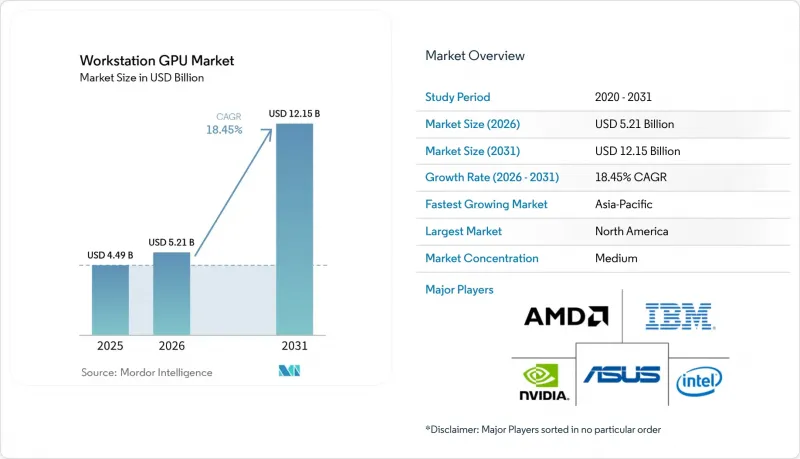
본 보고서는 제품 유형(데스크톱 워크스테이션용 GPU, 모바일 워크스테이션용 GPU), 용도(CAD, CAM, CAE, 3D 렌더링 및 시각화, 미디어 제작 및 컨텐츠 제작 등), 기업 규모(중소기업, 대기업), 산업 분야(미디어 및 엔터테인먼트 등), 그리고 지역별로 분류되어 있습니다. 시장 전망은 금액(달러) 기준으로 제시되어 있습니다.
세계 워크스테이션 GPU 시장 동향 및 인사이트
워크스테이션에서의 AI 추론 및 로컬 모델 워크플로우의 부상
워크스테이션 GPU 시장은 클라우드 처리에 대한 승인이나 도입 정당화가 어려운 환경에서 로컬 AI 추론에 대한 기업 수요를 배경으로 성장세를 보이고 있습니다. NVIDIA는 2025년 3월 'RTX PRO Blackwell' 제품군을 발표했으며, 이 제품군의 플래그십 워크스테이션용 모델은 최대 4,000 AI TOPS 및 96GB의 GDDR7 ECC 메모리를 탑재하여 로컬 모델 실행 성능을 획기적으로 향상시켰습니다. 이번 발표로 AI 개발, 모델 추론, 시각화, 컨텐츠 제작 워크플로가 단일 프로페셔널 플랫폼으로 통합되어 워크스테이션 GPU 시장의 폭이 넓어졌습니다. AMD도 2025년 7월, 워크스테이션 시스템용으로 설계되고 ROCm 6.3을 지원하는 32GB 프로페셔널용 그래픽 카드 ‘Radeon AI PRO R9700’을 출시하며 이 워크스테이션 GPU 시장에 진출했습니다. 이러한 추세가 중요한 이유는 기업들이 더 이상 렌더링 속도만을 추구하는 것이 아니라, 사용자 가까이에서 독자적인 AI 작업을 유지하기 위해 충분한 로컬 메모리와 검증된 성능을 요구하고 있기 때문입니다. 이러한 요구 사항이 확산됨에 따라 워크스테이션 GPU 시장은 과거 CAD나 렌더링에만 의존하던 상태에서 벗어나고 있습니다.
엔지니어링 팀의 CAD, 시뮬레이션, 디지털 트윈 워크로드 증가
워크스테이션 GPU 시장은 전문용 하드웨어에서 시뮬레이션 및 디지털 트윈 실행이 그 어느 때보다 빨라질 것으로 기대하는 엔지니어링 팀에 의해서도 주도되고 있습니다. NVIDIA에 따르면, Ansys, Altair, Cadence, Siemens, Synopsys 등 주요 CAE 벤더들은 특정 워크로드에서 Blackwell을 통해 최대 50배의 속도 향상을 달성했으며, 이로 인해 워크스테이션 기반 시뮬레이션의 경제성이 변화했다고 합니다. 해당 보도자료에서는 BMW와 볼보 카스가 Blackwell을 통해 가속화된 디지털 트윈을 채택하고 있다는 점도 지적하고 있으며, 워크스테이션 GPU 시장이 단순한 시각적 출력뿐만 아니라 제품 개발 속도와 설계 검증과도 밀접하게 연결되어 있음을 보여주고 있습니다. 또한 Springer Nature사는 스마트 제조 환경 내 설계, 시뮬레이션, 검증, 최적화 각 분야에서 디지털 트윈의 도입이 확산되고 있다고 보고하고 있으며, 이는 이러한 시스템에 대한 장기적인 수요 기반을 뒷받침하는 것입니다. 이러한 변화로 인해 엔지니어링 팀이 프로페셔널 GPU에 요구하는 최소 사양이 높아지고 있습니다. 이는 동일한 워크플로우 내에서 시뮬레이션, 시각화, 협업의 모든 단계에서 안정적인 성능이 필요하기 때문입니다. 그 결과, 워크스테이션 GPU 시장은 독립형 그래픽 가속화보다 엔지니어링 소프트웨어 스택에서 더 많은 가치를 이끌어내고 있습니다.
프로페셔널 GPU 워크스테이션의 높은 총 소유 비용
워크스테이션 GPU 시장은 본격적인 프로페셔널 시스템의 도입 및 유지에 여전히 막대한 비용이 소요되기 때문에 여전히 큰 도입 장벽에 직면해 있습니다. NVIDIA RTX PRO 6000 Blackwell Workstation Edition의 2025년 기준 소매 가격은 8,500달러에 육박하며, 조사 데이터에 따르면 AI 및 시뮬레이션용 풀 사양의 하이엔드 워크스테이션은 1대당 2만 달러를 초과하는 경우가 많다는 사실이 밝혀졌습니다. Lenovo Press의 보고서에 따르면, On-Premise형 생성형 AI의 경제성은 이용률에 크게 좌우되며, 워크로드가 불안정한 중소기업일수록 투자 회수 기간이 길어지는 것으로 나타났습니다. 이러한 비용 문제는 GPU 본체에만 국한되지 않고, 기업에는 이를 뒷받침하는 CPU 성능, 메모리, 스토리지, 냉각, 전력, 보안 도구, 관리 시간 등도 필요하기 때문입니다. 이러한 요인들이 복합적으로 작용하여, 기술적 필요성이 명확하더라도 워크스테이션 GPU 시장의 하위 모델 도입이 주춤하고 있습니다. 또한, 대기업이 여전히 매출의 대부분을 차지하는 반면, 중소기업은 보다 선택적으로 도입을 진행하고 있는 이유도 여기서 설명됩니다.
부문 분석
2025년 시점에서 데스크톱 워크스테이션용 GPU는 워크스테이션 GPU 시장 규모의 57.68%를 차지했으나, 모바일 워크스테이션용 GPU는 2031년까지 연평균 성장률(CAGR) 19.63%를 나타낼 것으로 예측됩니다. 워크스테이션 GPU 시장의 데스크톱 부문이 여전히 큰 점유율을 차지하는 이유는 타워형 시스템이 더 큰 방열 여유, 더 높은 확장성, 그리고 고대역폭 PCIe Gen 5 데이터 경로에 대한 뛰어난 지원을 지속적으로 제공하기 때문입니다. 이는 멀티 GPU 스케일링이나 초대용량 메모리에 의존하는 시뮬레이션, 디지털 트윈, 그리고 고급 시각화를 활용하는 사용자에게 중요한 요소입니다. 또한, 기존 도입 기반은 피크 시의 그래픽 성능과 마찬가지로, 데스크톱 인증 및 플리트 표준화가 중요시되는 장기간 운영되는 엔지니어링 환경과 여전히 밀접하게 연결되어 있습니다.
엔지니어링 및 AI 팀의 분산이 진행됨에 따라 모바일 워크스테이션용 GPU의 성장률은 가속화되고 있지만, 그럼에도 불구하고 인증된 용도과 로컬 추론을 지원하는 전문가급 하드웨어는 여전히 필요합니다. NVIDIA에 따르면, 자사의 RTX PRO Blackwell 노트북용 GPU 시리즈는 GDDR7 메모리를 최대 24GB까지 확장하고 Blackwell Max-Q의 효율화 기능을 추가함으로써, 많은 전문적인 워크플로우에서 모바일과 데스크톱 간의 실질적인 성능 격차를 줄였습니다. 또한 이 보고서에서는 몇 가지 추론 및 시각화 작업에서 모바일 성능이 데스크톱 성능의 80%에서 90% 수준에 근접하고 있으며, 이로 인해 기업이 현장에서 허용할 수 있는 성능을 정의하는 방식이 변화하고 있다고 지적하고 있습니다. 레노버의 2026년 워크스테이션 전략은 이러한 변화를 더욱 가속화하고 있습니다. 이는 각 OEM 업체들이 모바일성과 워크스테이션급 성능을 동일한 제품 계획 주기의 일부로 간주하고 있기 때문입니다. 그 결과, 예측 기간 동안 워크스테이션 GPU 시장에서 데스크톱 시스템과 모바일 시스템 간의 점유율 격차가 줄어들 것으로 전망됩니다.
2025년 시점에서 CAD, CAM, CAE는 워크스테이션 GPU 시장 규모의 28.14%를 차지했으나, AI 개발 및 데이터 사이언스는 2031년까지 연평균 성장률(CAGR) 19.51%로 확대될 것으로 예측됩니다. 설계, 구조 분석 및 엔지니어링 검증은 이미 기업의 워크플로우에 통합되어 있기 때문에 CAD, CAM, CAE는 계속해서 워크스테이션 GPU 시장의 핵심 용도으로서의 지위를 유지하고 있습니다. 이 분석에서는 이러한 주도적 지위가 주요 상용 소프트웨어 플랫폼 내에 통합된 솔버의 고속화, 메쉬의 정밀화, 그리고 실시간 물리 시뮬레이션 기능과 밀접하게 연관되어 있다고 지적하고 있습니다. 또한 NVIDIA는 Ansys, Siemens, Synopsys와 같은 소프트웨어 제공업체들이 워크스테이션급 하드웨어를 위해 CUDA-X를 통해 가속화된 버전을 제공하고 있다고 밝혔으며, 이는 해당 용도이 현재 수요를 지속적으로 견인하고 있는 이유를 뒷받침합니다.
AI 개발과 데이터 사이언스의 성장이 가속화되고 있는 것은 기업들이 공유 클라우드 클러스터에 전적으로 의존하지 않고 모델 미세 조정, 추론 최적화 및 검색 확장 워크플로우를 위한 전용 시스템을 요구하고 있기 때문입니다. 이러한 변화로 인해 워크스테이션 GPU 시장은 사내 AI 개발 분야로 확대되고 있으며, 이 분야에서는 메모리 용량, 보안이 보장된 로컬 스토리지, 그리고 소프트웨어 호환성이 워크스테이션 수준에서 중요하게 여겨지고 있습니다. 기타 용도에서도 여전히 의미 있는 수요가 있으며, 특히 3D 렌더링·시각화 및 미디어 제작·컨텐츠 제작 분야에서는 클라이언트 대상 업무에서 레이 트레이싱과 실시간 출력이 여전히 필수적입니다. 과학 계산 및 시뮬레이션 분야도 연구 기관, 제약 기업, 공공 연구 환경에서 수요로 인해 안정적인 추세를 보이고 있는 반면, 의료 영상 및 헬스케어 시각화 분야에서는 On-Premise 영상 진단·치료 계획 도구와 관련된 보다 전문적인 수요층이 추가되고 있습니다. 이러한 상황의 결과로, 워크스테이션 GPU 시장은 현재 작업마다 별도의 시스템을 마련하는 대신, 동일한 작업 세션 내에서 AI와 시각화를 하나의 플랫폼으로 구현하고자 하는 많은 구매자를 지원하게 되었습니다.
지역별 분석
2025년 시점에서 북미는 워크스테이션 GPU 시장 점유율의 36.53%를 차지하고 있는 반면, 아시아태평양은 2031년까지 연평균 성장률(CAGR) 20.35%를 나타낼 것으로 예측됩니다. 북미가 워크스테이션 GPU 시장을 주도하고 있는 이유는 막대한 기술 예산에 더해, 방위 관련 기업, 생명과학 기관, 미디어 제작 스튜디오 수요가 집중되어 있기 때문입니다. 또한, 이 지역의 구매자들은 인증된 플랫폼, 안전한 로컬 컴퓨팅 환경, 안정적인 엔터프라이즈 지원을 높이 평가했습니다. HPE와 NVIDIA는 2025년, 공공 부문 및 규제 대상 환경에서 안전한 AI 도입을 목표로 하는 ‘AI Factory for Government’ 설계를 통해 이러한 환경을 강화했습니다. 캐나다와 멕시코도 미국의 워크스테이션 표준을 밀접하게 준수하는 자동차 엔지니어링 센터 및 공급망 설계 팀을 통해 시장에 기여하고 있습니다.
유럽은 워크스테이션 및 GPU 시장 규모에서 계속해서 2위를 차지하고 있으며, 독일, 영국, 프랑스가 주요 수요 거점입니다. 독일이 중심적인 위치를 계속 차지하고 있는 이유는 자동차, 항공우주, 산업기계 분야의 기업들이 전문가용 GPU의 성능이 필요한 시뮬레이션, 디지털 트윈, 정밀 설계 워크플로우에 지속적으로 의존하고 있기 때문입니다. NVIDIA는 지멘스 및 기타 CAE 파트너와의 협력을 통해, 생산 환경에 더 빠른 엔지니어링 계산을 도입함으로써 이러한 체제를 지원하고 있습니다. 영국과 프랑스는 시각 효과, 미디어 제작, 과학 연구, 계산 모델링을 통해 안정적인 수요를 창출하고 있습니다. 이탈리아 및 기타 유럽 국가들은 제품 설계, 건축, 경공업 제조를 통해 기여하고 있으며, 이를 통해 유럽 시장은 특정 최종 시장에 집중되지 않고 폭넓은 기반을 유지하고 있습니다.
아시아태평양은 중국, 인도, 일본, 한국이 각각 다른 출발점에서 수요를 확대하고 있어 워크스테이션 GPU 시장에서 가장 빠르게 성장하고 있는 지역입니다. 이러한 동향은 수출 규제 압력 하에서 국내 GPU 대체 움직임과 중국의 성장세가 결합된 결과이며, OECD는 보다 탄탄한 반도체 밸류체인을 구축하기 위한 정부의 광범위한 노력을 지적하고 있습니다. 인도는 확대되는 AI 개발 서비스 기반과 GPU 도입을 위한 인프라 구축을 통해 새로운 성장층을 형성하고 있으며, 이는 현지 전문가용 컴퓨팅에 대한 부수적인 수요를 뒷받침하고 있습니다. 일본과 한국은 반도체 EDA, 로봇 설계, 자동차 엔지니어링 분야에서 계속해서 워크스테이션급 시스템에 의존하고 있습니다. 동남아시아는 전자기기 수탁 제조 서비스(EMS)와 설계 역량의 성장을 통해 부상하고 있는 반면, 남미, 중동 및 아프리카는 규모는 작지만 에너지 분야의 디지털 트윈 이니셔티브와 기술 서비스 확장에 힘입어 발전 중인 시장입니다.
기타 혜택:
- 엑셀 형식 시장 예측(ME) 시트
- 3개월간의 애널리스트 지원
자주 묻는 질문
목차
제1장 서론
제2장 조사 방법
제3장 주요 요약
제4장 시장 구도
제5장 시장 규모와 성장 예측
제6장 경쟁 구도
제7장 시장 기회와 향후 전망
KTH 26.08.06According to Mordor Intelligence, the workstation GPU market size was valued at USD 4.49 billion in 2025 and is projected to reach USD 12.15 billion by 2031, growing at a CAGR of 18.45% from 2026 to 2031.
This report is Segmented by Product Type (Desktop Workstation GPU, and Mobile Workstation GPU), Application (CAD, CAM and CAE, 3D Rendering and Visualization, Media Production and Content Creation, and More), Organization Size (Small and Medium Enterprises, and Large Enterprises), Industry Vertical (Media and Entertainment, and More), and Geography. The Market Forecasts are Provided in Terms of Value (USD).
Global Workstation GPU Market Trends and Insights
Rising AI Inference and Local Model Workflows on Workstations
The workstation GPU market is gaining momentum from enterprise demand for local AI inference in settings where cloud processing is difficult to approve or justify. NVIDIA introduced the RTX PRO Blackwell family in March 2025, and the flagship workstation edition delivered up to 4,000 AI TOPS and 96 GB of GDDR7 ECC memory, elevating local model execution to a much higher performance class. The same launch broadened the workstation GPU market by integrating AI development, model inference, visualization, and content workflows into a single professional platform. AMD also entered this part of the workstation GPU market in July 2025 with the Radeon AI PRO R9700, a 32 GB professional card built for workstation systems and ROCm 6.3 compatibility. This pattern matters because enterprises are no longer buying only rendering speed; they are buying enough local memory and certified performance to keep proprietary AI work close to the user. As that requirement spreads, the workstation GPU market is moving beyond its older dependence on CAD and rendering alone.
Rising CAD, Simulation, and Digital Twin Workloads in Engineering Teams
The workstation GPU market is also being pushed by engineering teams that now expect much faster simulation and digital twin execution on professional hardware. NVIDIA said leading CAE vendors, including Ansys, Altair, Cadence, Siemens, and Synopsys, achieved up to 50x acceleration with Blackwell in selected workloads, thereby changing the economics of workstation-side simulation. The same release noted that BMW and Volvo Cars were using Blackwell-accelerated digital twins, which shows how the workstation GPU market is now tied to product development speed and design validation, not only to visual output. Springer Nature also documented broader digital twin adoption across design, simulation, validation, and optimization in smart manufacturing environments, which supports the longer-term demand base for these systems. That shift raises the minimum specification that engineering teams expect from a professional GPU, because they now need stable performance across simulation, visualization, and collaboration within the same workflow. As a result, the workstation GPU market is pulling more value from engineering software stacks and less from stand-alone graphics acceleration.
High Total Cost of Ownership for Professional GPU Workstations
The workstation GPU market still faces a meaningful adoption barrier because full professional systems remain expensive to acquire and maintain. The NVIDIA RTX PRO 6000 Blackwell Workstation Edition had a retail price near USD 8,500 in 2025, and the input indicated that a fully configured high-end workstation for AI or simulation often exceeded USD 20,000 per seat. Lenovo Press also showed that the financial case for on-premises generative AI depends heavily on utilization, meaning smaller firms with uneven workloads have a longer payback window. This cost issue extends beyond the GPU itself, as enterprises also need supporting CPU power, memory, storage, cooling, energy, security tools, and management time. That combination slows adoption in the lower end of the workstation GPU market, even when the technical need is clear. It also explains why large enterprises still dominate revenue while smaller firms are adopting more selectively.
Other drivers and restraints analyzed in the detailed report include:
- Enterprise Demand for Secure On-Premise AI Development Environments
- Refresh Cycle for Professional Visualization and Content Creation PCs
- Supply Tightness in Advanced Memory and Substrate Components
For complete list of drivers and restraints, kindly check the Table Of Contents.
Segment Analysis
Desktop workstation GPUs accounted for 57.68% of the workstation GPU market size in 2025, while mobile workstation GPUs are projected to grow at a 19.63% CAGR through 2031. The desktop side of the workstation GPU market remained larger because tower systems still offer more thermal headroom, more expansion capacity, and better support for high-bandwidth PCIe Gen 5 data paths. That matters for simulation, digital twin, and advanced visualization users who depend on multi-GPU scaling or very high memory footprints. The installed base also remains tied to long-running engineering environments where desktop certification and fleet standardization matter as much as peak graphics speed.
Mobile workstation GPUs are growing faster as engineering and AI teams are increasingly distributed, yet they still need professional-grade hardware that supports certified applications and local inference. NVIDIA said its RTX PRO Blackwell laptop GPU range scaled up to 24 GB of GDDR7 and added Blackwell Max-Q efficiency features, which reduced the practical gap between mobile and desktop use in many professional workflows. The input also noted that mobile performance is moving toward 80% to 90% of desktop equivalents for several inference and visualization tasks, which is changing how enterprises define acceptable field performance. Lenovo's 2026 workstation push further supports that shift because OEMs are treating mobility and workstation-class output as part of the same product planning cycle. As a result, the workstation GPU market is likely to see a narrower share gap between desktop and mobile systems over the forecast period.
CAD, CAM and CAE held 28.14% of the workstation GPU market size in 2025, while AI Development and Data Science are projected to expand at a 19.51% CAGR through 2031. CAD, CAM and CAE remained the anchor application in the workstation GPU market because design, structural analysis, and engineering validation are already embedded in enterprise workflows. The input tied this leadership to solver acceleration, mesh refinement, and real-time physics simulation features inside major commercial software platforms. NVIDIA also said that Ansys, Siemens, and Synopsys were among the software providers bringing CUDA-X-accelerated releases to workstation-class hardware, which reinforces why this application continues to drive current demand.
AI Development and data science are growing faster because enterprises want dedicated systems for model fine-tuning, inference optimization, and retrieval-augmented workflows without relying fully on shared cloud clusters. That change is broadening the workstation GPU market into private AI development, where memory capacity, secure local storage, and software compatibility all matter at the workstation level. Other applications still carry meaningful demand, especially 3D Rendering and Visualization and Media Production and Content Creation, where ray tracing and real-time output remain essential for client work. Scientific Computing and Simulation also stays stable through demand from research labs, pharmaceutical firms, and public research environments, while Medical Imaging and Healthcare Visualization adds a more specialized layer of demand around on-premise imaging and planning tools. The broader result is that the workstation GPU market now supports many buyers who want one platform for AI and visualization in the same work session, rather than separate systems for each task.
Complete Report Scope:
- By Product Type
- Desktop Workstation GPU
- Mobile Workstation GPU
- By Application
- CAD, CAM and CAE
- 3D Rendering and Visualization
- Media Production and Content Creation
- Scientific Computing and Simulation
- Medical Imaging and Healthcare Visualization
- AI Development and Data Science
- Other Applications
- By Organization Size
- Small and Medium Enterprises
- Large Enterprises
- By Industry Vertical
- Architecture, Engineering and Construction
- Manufacturing and Industrial Design
- Media and Entertainment
- Automotive and Transportation
- Other Industry Verticals
- By Geography
- North America
- United States
- Canada
- Mexico
- Europe
- Germany
- United Kingdom
- France
- Italy
- Rest of Europe
- Asia-Pacific
- China
- Japan
- South Korea
- India
- Southeast Asia
- Rest of Asia-Pacific
- South America
- Middle East and Africa
- North America
Geography Analysis
North America held 36.53% of the workstation GPU market share in 2025, while Asia-Pacific is forecast to grow at a 20.35% CAGR through 2031. North America led the workstation GPU market because it combines large technology budgets with dense demand from defense contractors, life sciences organizations, and media production studios. Buyers in the region also place high value on certified platforms, secure local compute, and stable enterprise support. HPE and NVIDIA reinforced that environment in 2025 with an AI Factory for Government design aimed at secure AI deployment in the public sector and regulated settings. Canada and Mexico also contribute through automotive engineering centers and supply chain design teams that align closely with U.S. workstation standards.
Europe remained the second-largest regional market for workstations and GPUs, with Germany, the United Kingdom, and France as the main demand centers. Germany remained central because automotive, aerospace, and industrial machinery companies continue to depend on simulation, digital twins, and precision design workflows that require professional GPU capabilities. NVIDIA's work with Siemens and other CAE partners supports that setup by bringing faster engineering computation into production environments. The United Kingdom and France add steady demand through visual effects, media work, scientific research, and computational modeling. Italy and the rest of the region contribute through product design, architecture, and light industrial manufacturing, which keeps Europe broad-based rather than concentrated in one end market.
Asia-Pacific is the fastest-growing part of the workstation GPU market because China, India, Japan, and South Korea are all adding demand from different starting points. The input linked China's momentum to domestic GPU substitution under export control pressure, while the OECD noted wider government efforts to build more resilient semiconductor value chains. India is adding another layer through its expanding AI development services base and infrastructure push around GPU deployment, which supports adjacent demand for local professional compute. Japan and South Korea continue to rely on workstation-class systems for semiconductor EDA, robotics design, and automotive engineering. Southeast Asia is emerging through electronics manufacturing services and design capability growth, while South America and the Middle East and Africa remain smaller but developing markets supported by digital twin work in energy and expanding technology services.
- NVIDIA Corporation
- Advanced Micro Devices, Inc.
- Intel Corporation
- ASUSTeK Computer Inc.
- Micro-Star International Co., Ltd.
- GIGA-BYTE Technology Co., Ltd.
- PNY Technologies, Inc.
- Leadtek Research Inc.
- ZOTAC International (MCO) Limited
- Sapphire Technology Limited
- Matrox Graphics Inc.
- BOXX Technologies, Inc.
- Exxact Corporation
- Colfax International
- Koi Computers, Inc.
- Super Micro Computer, Inc.
- ELSA Japan Inc.
- GUNNIR Technology Co., Ltd.
Additional Benefits:
- The market estimate (ME) sheet in Excel format
- 3 months of analyst support
TABLE OF CONTENTS
1 INTRODUCTION
- 1.1 Study Assumptions and Market Definition
- 1.2 Scope of the Study
2 RESEARCH METHODOLOGY
3 EXECUTIVE SUMMARY
4 MARKET LANDSCAPE
- 4.1 Market Overview
- 4.2 Market Drivers
- 4.2.1 Rising AI Inference and Local Model Workflows on Workstations
- 4.2.2 Refresh Cycle for Professional Visualization and Content Creation PCs
- 4.2.3 Chiplet and Advanced Packaging Road Maps Improving Pro GPU Performance Density
- 4.2.4 Export Controls and Supply Chain Localization Supporting Regional GPU Substitution
- 4.2.5 Enterprise Demand for Secure On-Premise AI Development Environments
- 4.2.6 Rising CAD, Simulation, and Digital Twin Workloads in Engineering Teams
- 4.3 Market Restraints
- 4.3.1 High Total Cost of Ownership for Professional GPU Workstations
- 4.3.2 Driver Certification and Application Compatibility Complexity
- 4.3.3 Power, Thermal, and Form Factor Constraints in Desktop and Mobile Systems
- 4.3.4 Supply Tightness in Advanced Memory and Substrate Components
- 4.4 Industry Value Chain Analysis
- 4.5 Regulatory Landscape
- 4.6 Technological Outlook
- 4.7 Impact of Macroeconomic Factors on the Market
- 4.8 Porter's Five Forces Analysis
- 4.8.1 Bargaining Power of Suppliers
- 4.8.2 Bargaining Power of Buyers
- 4.8.3 Threat of New Entrants
- 4.8.4 Threat of Substitutes
- 4.8.5 Competitive Rivalry
5 MARKET SIZE AND GROWTH FORECASTS (VALUE)
- 5.1 By Product Type
- 5.1.1 Desktop Workstation GPU
- 5.1.2 Mobile Workstation GPU
- 5.2 By Application
- 5.2.1 CAD, CAM and CAE
- 5.2.2 3D Rendering and Visualization
- 5.2.3 Media Production and Content Creation
- 5.2.4 Scientific Computing and Simulation
- 5.2.5 Medical Imaging and Healthcare Visualization
- 5.2.6 AI Development and Data Science
- 5.2.7 Other Applications
- 5.3 By Organization Size
- 5.3.1 Small and Medium Enterprises
- 5.3.2 Large Enterprises
- 5.4 By Industry Vertical
- 5.4.1 Architecture, Engineering and Construction
- 5.4.2 Manufacturing and Industrial Design
- 5.4.3 Media and Entertainment
- 5.4.4 Automotive and Transportation
- 5.4.5 Other Industry Verticals
- 5.5 By Geography
- 5.5.1 North America
- 5.5.1.1 United States
- 5.5.1.2 Canada
- 5.5.1.3 Mexico
- 5.5.2 Europe
- 5.5.2.1 Germany
- 5.5.2.2 United Kingdom
- 5.5.2.3 France
- 5.5.2.4 Italy
- 5.5.2.5 Rest of Europe
- 5.5.3 Asia-Pacific
- 5.5.3.1 China
- 5.5.3.2 Japan
- 5.5.3.3 South Korea
- 5.5.3.4 India
- 5.5.3.5 Southeast Asia
- 5.5.3.6 Rest of Asia-Pacific
- 5.5.4 South America
- 5.5.5 Middle East and Africa
- 5.5.1 North America
6 COMPETITIVE LANDSCAPE
- 6.1 Market Concentration
- 6.2 Strategic Moves
- 6.3 Vendor Positioning Analysis
- 6.4 Company Profiles (includes Global Level Overview, Market Level Overview, Core Segments, Financials as available, Strategic Information, Market Rank/Share, Products and Services, Recent Developments)
- 6.4.1 NVIDIA Corporation
- 6.4.2 Advanced Micro Devices, Inc.
- 6.4.3 Intel Corporation
- 6.4.4 ASUSTeK Computer Inc.
- 6.4.5 Micro-Star International Co., Ltd.
- 6.4.6 GIGA-BYTE Technology Co., Ltd.
- 6.4.7 PNY Technologies, Inc.
- 6.4.8 Leadtek Research Inc.
- 6.4.9 ZOTAC International (MCO) Limited
- 6.4.10 Sapphire Technology Limited
- 6.4.11 Matrox Graphics Inc.
- 6.4.12 BOXX Technologies, Inc.
- 6.4.13 Exxact Corporation
- 6.4.14 Colfax International
- 6.4.15 Koi Computers, Inc.
- 6.4.16 Super Micro Computer, Inc.
- 6.4.17 ELSA Japan Inc.
- 6.4.18 GUNNIR Technology Co., Ltd.
7 MARKET OPPORTUNITIES AND FUTURE OUTLOOK
- 7.1 White-Space and Unmet-Need Assessment