
|
시장보고서
상품코드
2098492
인도의 그린 IT 소프트웨어 시장 : 점유율 분석, 업계 동향 및 통계, 성장 예측(2026-2031년)India Green IT Software - Market Share Analysis, Industry Trends & Statistics, Growth Forecasts (2026 - 2031) |
||||||
 Mordor Intelligence
Mordor Intelligence에 의하면, 인도 그린 IT 소프트웨어 시장 규모는 2025년 5억 8,000만 달러에서 2026년에는 7억 1,000만 달러로 확대되어 2031년까지 22억 2,000만 달러에 이를 것으로 예상되고 있어 2026년부터 2031년까지 CAGR 25.59%로 성장할 전망입니다.
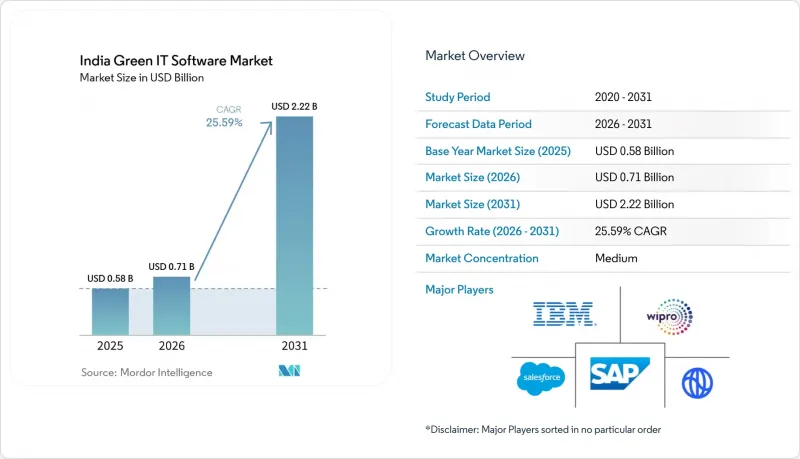
본 보고서는 제공 방식(소프트웨어 및 서비스), 배포 방식(클라우드, On-Premise, 하이브리드), 조직 규모(대기업 및 중소기업), 최종 사용 산업(IT 및 통신, 은행, 금융서비스 및 보험(BFSI), 제조, 에너지·유틸리티, 소매 및 전자상거래 등), 솔루션 유형(탄소 관리·산정 소프트웨어 등)별로 분류되어 있습니다. 시장 전망은 금액(달러) 기준으로 제시되어 있습니다.
인도 그린 IT 소프트웨어 시장 동향 및 인사이트
증가하는 기업의 넷제로 노력
인도 내 기업의 넷제로 목표 설정 건수는 2024년부터 2025년까지 29개사에서 34개사로 증가했으며, 대기업 간 거버넌스 체제가 강화되고 있음을 보여줍니다. 각 목표에는 배출량 측정, 내부 통제, 그리고 재현 가능한 정보 공개를 위한 보다 공식적인 프로세스가 요구되므로, 이는 인도의 그린 IT 소프트웨어 시장에 중요한 의미를 지닙니다. 목표 설정에서 보증된 보고로 전환하는 기업들은 버전 관리, 감사 추적, 그리고 공급업체 데이터의 적절한 처리가 요구되므로, 스프레드시트 중심의 프로세스에 오랫동안 의존할 수 없습니다. 또한, 공식적인 약속을 표명한 인도 기업에 대해 이해관계자들이 비교 가능하고 신뢰할 수 있는 기후 데이터 제공을 점점 더 기대하고 있기 때문에 구매 결정도 자발적인 차원에서 벗어나고 있습니다. 그 결과, 인도의 그린 IT 소프트웨어 시장은 현재 재무, 규정 준수, 조달 및 이사회 차원의 감독과 더욱 긴밀하게 연계된 지속가능성 프로그램의 혜택을 누리고 있습니다.
데이터센터 에너지 비용의 급등
인도의 하이퍼스케일 데이터센터 건설 계획으로 인해 전력 관리는 단순한 시설 운영상의 부차적인 문제가 아니라 운영상의 핵심 과제가 되었습니다. AirTrunk사는 2030년까지 인도에 5GW 규모의 데이터센터용량을 구축하기 위해 300억 달러를 투자하겠다고 밝혔으며, 이는 전력 사용량과 효율성이 이제 인프라의 경제성을 좌우하는 수준에 이르렀음을 여실히 보여줍니다. 구글이 계획 중인 비사카파트남 시설에서 전력 관리를 직접 수행하겠다는 방침을 밝힌 것은 에너지 조달 및 사용 현황 모니터링이 인도 사업자들에게 전략적 역량이 되어가고 있음을 보여줍니다. 이는 인도의 그린 IT 소프트웨어 시장을 직접적으로 뒷받침하는 요소입니다. 구매자에게는 에너지 집약도를 추적하고, 시설의 성능을 비교하며, 사용 데이터를 보고 의무와 연계할 수 있는 도구가 필요하기 때문입니다. 대규모 컴퓨팅 용량이 더욱 가동됨에 따라, 소프트웨어 수요는 기존의 기업 사용자에 그치지 않고 하이퍼스케일러, 코로케이션 제공업체, 그리고 디지털 인프라와 관련된 대규모 부동산 운영 사업자로 확대되고 있습니다.
레거시 엔터프라이즈 시스템과의 통합 복잡성
많은 인도 기업에서는 여전히 사이트 수준의 운영 데이터로부터 탄소 회계 결과를 산출하도록 설계되지 않은 ERP 환경이 운영되고 있습니다. 이로 인해 인도의 그린 IT 소프트웨어 시장 성장이 둔화되고 있습니다. 소프트웨어 도입 시 보고서가 안정화되기까지 미들웨어 작업, 맞춤형 API, 마스터 데이터 정리가 필요한 경우가 많기 때문입니다. 이 문제는 운영 체제, 유틸리티 데이터, 공급업체 기록이 서로 연동되지 않은 여러 플랫폼에 분산되어 있는 제조, 에너지, BFSI(은행 및 금융 및 보험) 분야에서 특히 두드러집니다. 이 분야의 구매 기업들은 지속가능성 보고가 광범위한 데이터 아키텍처 문제와 분리될 수 없기 때문에 도입 주기가 장기화되는 경향이 있습니다. 각 벤더사는 주요 엔터프라이즈 시스템을 위한 커넥터를 제공하여 대응하고 있지만, 배출량 파악에 플랜트 수준이나 시설 수준의 세부 정보가 필요한 경우 도입에는 여전히 시간이 소요됩니다. 그 결과, 판매 주기가 길어지고, 핵심 시스템 현대화 프로젝트에도 자금을 투자하고 있는 구매 기업에게는 총 소유 비용(TCO)이 증가하게 됩니다.
부문 분석
2025년에는 소프트웨어가 시장의 81.43%를 차지하고, 이는 도입 초기 단계에서 구매자들이 프로젝트 주도형 지원보다 확장 가능한 플랫폼을 얼마나 강력하게 선호했는지를 보여줍니다. 인도 그린 IT 소프트웨어 시장이 이처럼 발전한 것은 상장 기업들이 여러 보고 주기에 걸쳐 감사, 갱신, 재사용이 가능한 시스템을 필요로 했기 때문입니다. 또한 대규모 조직 전체에 걸친 통합된 워크플로우, 권한 제어, 그리고 배출량 측정을 위한 일관된 방법론에 대한 수요도 소프트웨어 수요를 뒷받침했습니다. 규제가 엄격하거나 정보 공개 부담이 큰 환경에 있는 구매자들은 일반적으로 일회성 자문 서비스보다, 보다 지속 가능한 운영 기반을 구축할 수 있는 구독형 도구를 선호했습니다. 이를 통해 기업이 도입 단계에서 계속해서 외부 전문가에 의존하더라도, 소프트웨어가 도입의 기반이 되는 카테고리로 남을 수 있게 되었습니다.
서비스 분야는 여전히 급속히 성장세를 보이고 있으며, 2031년까지 연평균 성장률(CAGR) 29.74%로 확대될 것으로 예측됩니다. 이는 설정, 통합 및 관리형 보고서 작성 지원에 대한 수요가 확산되고 있음을 반영합니다. 많은 중견 기업들이 사내에 지속가능성 기술 팀을 갖추지 않은 채 인도의 그린 IT 소프트웨어 업계에 진입하고 있기 때문에 도입 기간을 단축하기 위해 구현 파트너에게 의뢰하고 있습니다. 이로 인해 매니지드 서비스의 가치가 높아지고 있습니다. 구매자들은 플랫폼 가동 후 공급업체로부터 데이터 요청에 대한 대응, 워크플로우 설정, 정기적인 보고서 작성 지원을 요구하고 있기 때문입니다. 인도의 IT 서비스 기업들은 이미 많은 대기업의 ERP, 클라우드, 규정 준수 환경을 관리하고 있어 이 분야에서 유리한 입지를 점하고 있습니다. 이러한 서비스 기회는 소규모 소프트웨어 벤더에게도 유익합니다. 대규모 직접 서비스 팀을 구축하는 대신, 파트너 주도형 제공 모델을 통해 엔터프라이즈 고객에게 접근할 수 있기 때문입니다. 향후에는 소프트웨어 및 서비스의 균형이 더욱 상호 보완적인 형태로 발전할 것이며, 플랫폼 수익이 고객 기반을 공고히 하고, 서비스 수익이 도입의 심화와 갱신의 안정성을 촉진할 것으로 전망됩니다.
2025년에는 클라우드 도입이 73.86%를 차지할 것으로 예상되며, 이는 구매자의 대다수가 설정 부담을 줄이고 업데이트된 보고서 로직에 신속하게 접근하기를 원했음을 뒷받침합니다. ‘클라우드 퍼스트’ 도입은 인도의 그린 IT 소프트웨어 시장에 적합했습니다. 기업들은 대규모 On-Premise 인프라 구축을 피하고 정기적인 제품 업데이트에 의존할 수 있었기 때문입니다. 또한 이러한 움직임은 인도 기업 전반에 걸쳐 SaaS 비즈니스 시스템으로의 전환이 진행되고 있는 광범위한 추세와도 부합했습니다. 특히 지속가능성 팀이 소규모이고 공유 IT 지원에 의존하는 기업에서 두드러졌습니다. 일원화된 접근성과 손쉬운 업그레이드 덕분에, 다수의 내부 이해관계자에 걸친 정기적인 공시 주기를 관리해야 하는 기업들에게 클라우드 시스템은 매력적인 선택지가 되었습니다. 이로 인해 구매자가 백그라운드에서 여전히 일부 구형 운영 체제에 의존하고 있는 경우에도 클라우드는 주도적인 위치를 유지했습니다.
하이브리드 배포는 가장 빠르게 성장하는 도입 형태로, 2031년까지 연평균 성장률(CAGR) 31.28%로 확대될 것으로 예측됩니다. 이는 많은 대기업이 On-Premise 운영 데이터를 클라우드 기반 컴퓨팅 및 보고 생성 엔진과 연동해야 하기 때문입니다. 이러한 상황에서 하이브리드 배포는 데이터 기밀성을 확보하면서도 최신 분석 및 워크플로우 오케스트레이션을 가능하게 한다는 점에서 인도 그린 IT 소프트웨어 시장에 있어 가장 실용적인 타협점이 되었습니다. 제조업, 금융 서비스업 및 복잡한 다중 사이트 운영을 수행하는 대기업의 경우, 모든 데이터 세트를 동일한 속도로 순수 클라우드 환경으로 이전할 수 없는 경우가 많습니다. 따라서 하이브리드 모델을 채택함으로써 배출량 계산 로직, 대시보드, 공시 자료 작성에는 클라우드를 활용하면서도 특정 기록이나 소스 시스템은 On-Premise에서 유지할 수 있게 됩니다. 현지화를 매우 중시하는 환경에서는 On-Premise 배포가 여전히 일정한 존재감을 유지하고 있지만, 클라우드 보안 및 국내 호스팅 옵션이 개선됨에 따라 그 상대적인 역할은 점차 축소되고 있습니다. 현재 진정한 제품적 우위를 점하고 있는 것은 구매자가 엔터프라이즈 스택의 다른 부분을 재설계할 필요 없이 혼합 아키텍처를 지원할 수 있는 벤더입니다.
기타 혜택:
- 엑셀 형식 시장 예측(ME) 시트
- 3개월간의 애널리스트 지원
자주 묻는 질문
목차
제1장 서론
제2장 조사 방법
제3장 주요 요약
제4장 시장 구도
제5장 시장 규모와 성장 예측
제6장 경쟁 구도
제7장 시장 기회와 향후 전망
JHS 26.08.07According to Mordor Intelligence, the India green IT software market size is expected to increase from USD 0.58 billion in 2025 to USD 0.71 billion in 2026 and reach USD 2.22 billion by 2031, growing at a CAGR of 25.59% over 2026-2031.
This report is Segmented by Offering (Software, and Services), Deployment Mode (Cloud, On-Premises, and Hybrid), Organization Size (Large Enterprises, and SMEs), End-User Industry (IT and Telecom, BFSI, Manufacturing, Energy and Utilities, Retail and E-Commerce, and More), and Solution Type (Carbon Management and Accounting Software, and More). The Market Forecasts are Provided in Terms of Value (USD).
India Green IT Software Market Trends and Insights
Rising Corporate Net-Zero Commitments
India's corporate net-zero target base increased from 29 to 34 companies between 2024 and 2025, showing a stronger governance posture among large enterprises. This matters for the India green IT software market because each target requires a more formal process for emissions measurement, internal controls, and repeatable disclosure. Companies that move from target setting to assured reporting cannot rely on spreadsheet-led processes for long because they need version control, audit trails, and better supplier data handling. The buying decision is also becoming less voluntary because external stakeholders increasingly expect comparable and credible climate data from Indian companies with public commitments. As a result, the India green IT software market is benefiting from sustainability programs that now sit closer to finance, compliance, procurement, and board-level oversight.
Escalating Data Center Energy Costs
India's hyperscale data center pipeline is making electricity management a central operating issue rather than a secondary facility concern. AirTrunk committed USD 30 billion to build 5 GW of data center capacity in India by 2030, which highlights the scale at which power use and efficiency now shape infrastructure economics. Google's direct electricity management move for its planned Visakhapatnam facility showed that energy procurement and usage monitoring are becoming strategic capabilities for operators in the country. This directly supports the India green IT software market because buyers need tools that can track energy intensity, compare facility performance, and connect usage data with reporting obligations. As more large computing capacity comes online, software demand extends beyond traditional enterprise users to hyperscalers, colocation providers, and large property operators linked to digital infrastructure.
High Integration Complexity with Legacy Enterprise Systems
Many Indian enterprises still run on ERP landscapes that were not designed to produce carbon accounting outputs from site-level operating data. This slows the India green IT software market because software deployment often needs middleware work, custom APIs, and master data cleanup before reporting can stabilize. The problem is most visible in manufacturing, energy, and BFSI environments where operating systems, utility data, and supplier records sit across several disconnected platforms. Buyers in these sectors often face longer implementation cycles because sustainability reporting cannot be separated from broader data architecture issues. Vendors are responding with connectors for major enterprise systems, but deployments still stretch when emissions capture needs plant-level or facility-level granularity. That keeps sales cycles longer and raises the total cost of ownership for buyers who are also funding core modernization projects.
Other drivers and restraints analyzed in the detailed report include:
- Regulatory Push for Emissions Disclosure
- Expansion of Hyperscale and Colocation Data Centers in India
- Limited Availability of Skilled Green IT and Carbon Accounting Talent
For complete list of drivers and restraints, kindly check the Table Of Contents.
Segment Analysis
Software commanded 81.43% of the market in 2025, which shows how strongly buyers favored scalable platforms over project-led support in the early phase of adoption. The India green IT software market developed this way because listed enterprises needed systems that could be audited, updated, and reused across multiple reporting cycles. Software demand was also supported by the need for centralized workflows, permission controls, and consistent methods for emissions measurement across large organizations. Buyers in regulated or disclosure-heavy settings usually preferred subscription tools because they created a more durable operating layer than one-time advisory work. This helped software remain the base category for adoption even as companies continued to rely on outside experts during implementation.
Services are still gaining ground quickly and are projected to expand at a 29.74% CAGR through 2031, which reflects a wider need for configuration, integration, and managed reporting support. Many mid-sized companies are entering the India green IT software industry without internal sustainability technology teams, so they are turning to implementation partners to shorten deployment time. That raises the value of managed services because buyers want help with supplier data requests, workflow setup, and recurring report preparation after the platform goes live. Indian IT service firms are well-positioned in this layer because they already manage ERP, cloud, and compliance environments for many large enterprises. The services opportunity also helps smaller software vendors because they can reach enterprise customers through partner-led delivery models instead of building large direct service teams. Over time, the balance between software and services is likely to become more complementary, with platform revenue anchoring the account and service revenue driving adoption depth and renewal stability.
Cloud deployment accounted for 73.86% in 2025, which confirms that most buyers wanted lower setup friction and faster access to updated reporting logic. Cloud-first adoption suited the India green IT software market because companies could avoid heavy local infrastructure builds and rely on regular product updates. IT also matched the broader shift toward SaaS business systems across Indian enterprises, especially where sustainability teams are lean and depend on shared IT support. Centralized access and easier upgrades made cloud systems attractive for companies handling recurring disclosure cycles across many internal stakeholders. This kept cloud in the lead even where buyers still depended on several older operating systems in the background.
Hybrid deployment is the fastest-growing mode and is projected to advance at a 31.28% CAGR through 2031 because many large enterprises need to connect on-premises operational data with cloud-based calculation and reporting engines. In that context, hybrid captured the most practical middle ground for the India green IT software market because it respects data sensitivity while still allowing modern analytics and workflow orchestration. Large companies in manufacturing, financial services, and complex multi-site operations often cannot shift every dataset into a pure cloud setup at the same pace. Hybrid models, therefore, allow them to keep certain records and source systems local while using the cloud for emissions logic, dashboards, and disclosure preparation. On-premises deployments still retain some presence in environments with stronger localization preferences, but their relative role is narrowing as cloud security and domestic hosting choices improve. The real product advantage now sits with vendors that can support mixed architectures without making buyers redesign the rest of their enterprise stack.
Complete Report Scope:
- By Offering
- Software
- Services
- By Deployment Mode
- Cloud
- On-Premises
- Hybrid
- By Organization Size
- Large Enterprises
- SMEs
- By End-User Industry
- IT and Telecom
- BFSI
- Manufacturing
- Energy and Utilities
- Retail and E-Commerce
- Government
- Healthcare
- Construction and Infrastructure
- Other End-User Industries
- By Solution Type
- Carbon Management and Accounting Software
- ESG Reporting and Compliance Software
- Sustainability Data Management Platforms
- Decarbonization Planning Software
- Energy and Resource Optimization Software
List of Companies Covered in this Report:
- Persefoni AI, Inc.
- Watershed Technology Inc.
- IBM Corporation
- SAP SE
- Wipro Limited
- Tata Consultancy Services Limited
- Infosys Limited
- HCL Technologies Limited
- Cognizant Technology Solutions Corporation
- Capgemini SE
- Microsoft Corporation
- Schneider Electric SE
- Accenture PLC
- Sweep SAS
- Greenly SAS
- Normative AB
- Plan A Earth GmbH
- Emitwise Ltd.
- Climatiq GmbH
- SINAI Technologies, Inc.
- Cority Software Inc.
- Enablon SA
- Sphera Solutions, Inc.
Additional Benefits:
- The market estimate (ME) sheet in Excel format
- 3 months of analyst support
TABLE OF CONTENTS
1 INTRODUCTION
- 1.1 Study Assumptions and Market Definition
- 1.2 Scope of the Study
2 RESEARCH METHODOLOGY
3 EXECUTIVE SUMMARY
4 MARKET LANDSCAPE
- 4.1 Market Overview
- 4.2 Market Drivers
- 4.2.1 Rising Corporate Net-Zero Commitments
- 4.2.2 Escalating Data Center Energy Costs
- 4.2.3 Regulatory Push for Emissions Disclosure
- 4.2.4 Expansion of Hyperscale and Colocation Data Centers in India
- 4.2.5 AI-Based Energy Optimization in IT Workloads
- 4.2.6 Green Software Procurement by Large Indian Enterprises
- 4.3 Market Restraints
- 4.3.1 High Integration Complexity With Legacy Enterprise Systems
- 4.3.2 Limited Availability of Skilled Green IT and Carbon Accounting Talent
- 4.3.3 Data Quality Gaps in Scope 3 and Embedded Emissions Tracking
- 4.3.4 Buyer Hesitation Around Near-Term ROI in Mid-Market Firms
- 4.4 Industry Value Chain Analysis
- 4.5 Impact of Macroeconomic Factors on the Market
- 4.6 Regulatory Landscape
- 4.7 Technological Outlook
- 4.8 Porter's Five Forces Analysis
- 4.8.1 Threat of New Entrants
- 4.8.2 Bargaining Power of Suppliers
- 4.8.3 Bargaining Power of Buyers
- 4.8.4 Threat of Substitutes
- 4.8.5 Intensity of Competitive Rivalry
5 MARKET SIZE AND GROWTH FORECASTS (VALUE)
- 5.1 By Offering
- 5.1.1 Software
- 5.1.2 Services
- 5.2 By Deployment Mode
- 5.2.1 Cloud
- 5.2.2 On-Premises
- 5.2.3 Hybrid
- 5.3 By Organization Size
- 5.3.1 Large Enterprises
- 5.3.2 SMEs
- 5.4 By End-User Industry
- 5.4.1 IT and Telecom
- 5.4.2 BFSI
- 5.4.3 Manufacturing
- 5.4.4 Energy and Utilities
- 5.4.5 Retail and E-Commerce
- 5.4.6 Government
- 5.4.7 Healthcare
- 5.4.8 Construction and Infrastructure
- 5.4.9 Other End-User Industries
- 5.5 By Solution Type
- 5.5.1 Carbon Management and Accounting Software
- 5.5.2 ESG Reporting and Compliance Software
- 5.5.3 Sustainability Data Management Platforms
- 5.5.4 Decarbonization Planning Software
- 5.5.5 Energy and Resource Optimization Software
6 COMPETITIVE LANDSCAPE
- 6.1 Market Concentration
- 6.2 Strategic Moves
- 6.3 Market Share Analysis
- 6.4 Company Profiles (includes Global Level Overview, Market Level Overview, Core Segments, Financials as available, Strategic Information, Market Rank/Share, Products and Services, Recent Developments)
- 6.4.1 Persefoni AI, Inc.
- 6.4.2 Watershed Technology Inc.
- 6.4.3 IBM Corporation
- 6.4.4 SAP SE
- 6.4.5 Wipro Limited
- 6.4.6 Tata Consultancy Services Limited
- 6.4.7 Infosys Limited
- 6.4.8 HCL Technologies Limited
- 6.4.9 Cognizant Technology Solutions Corporation
- 6.4.10 Capgemini SE
- 6.4.11 Microsoft Corporation
- 6.4.12 Schneider Electric SE
- 6.4.13 Accenture PLC
- 6.4.14 Sweep SAS
- 6.4.15 Greenly SAS
- 6.4.16 Normative AB
- 6.4.17 Plan A Earth GmbH
- 6.4.18 Emitwise Ltd.
- 6.4.19 Climatiq GmbH
- 6.4.20 SINAI Technologies, Inc.
- 6.4.21 Cority Software Inc.
- 6.4.22 Enablon SA
- 6.4.23 Sphera Solutions, Inc.
7 MARKET OPPORTUNITIES AND FUTURE OUTLOOK
- 7.1 White-Space and Unmet-Need Assessment