
|
시장보고서
상품코드
2098498
산업용 GPU : 시장 점유율 분석, 업계 동향과 통계, 성장 예측(2026-2031년)Industrial GPU - Market Share Analysis, Industry Trends & Statistics, Growth Forecasts (2026 - 2031) |
||||||
 Mordor Intelligence
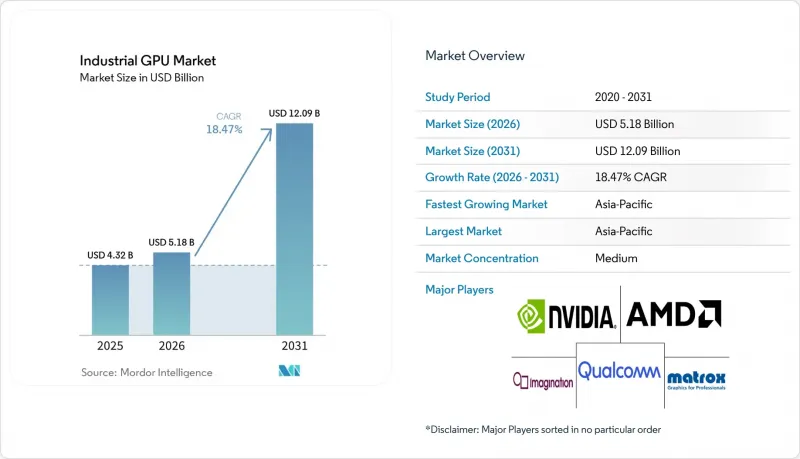
Mordor Intelligence에 의하면, 산업용 GPU 시장 규모는 2025년 43억 2,000만 달러에서 2026년에는 51억 8,000만 달러로 확대되고, 2031년까지 120억 9,000만 달러에 이를 것으로 예측되며, 2026-2031년 CAGR 18.47%를 기록할 전망입니다.
본 보고서는 GPU 아키텍처(디스크리트 GPU 가속기 등), 하드웨어 폼 팩터(PCIe 애드인 카드 등), 용도(머신 비전 및 품질 검사, 로봇 공학 및 자율형 자재관리 등), 최종 사용자 산업(제조, 물류 및 창고, 헬스케어 및 생명과학 등), 지역별로 분류되어 있습니다. 시장 전망은 금액(달러) 기준으로 제시되어 있습니다.
전 세계 산업용 GPU 시장 동향과 인사이트
산업 자동화 분야에서 증가하는 엣지 AI 추론 수요
산업용 GPU 시장은 AI 추론이 중앙 집중식 컴퓨팅 환경에서 생산 라인, 검사 스테이션, 자율 주행 시스템으로 이동하는 추세에 따라 재편되고 있습니다. 물리 AI 워크로드는 현재 시각적 추론, 센서 퓨전, 기계 간 협업을 결합하는 형태로 발전하고 있으며, 이에 따라 병렬 처리가 산업용 컴퓨팅 설계의 핵심으로 자리 잡고 있습니다. NVIDIA는 실시간 물리적 AI 기능을 갖춘 IGX Thor를 산업용 및 의료용 엣지 배포용으로 포지셔닝함으로써, 산업용 GPU 시장이 데이터센터용 하드웨어를 전용한 것이 아닌, 전용으로 설계된 엣지 플랫폼으로 전환되고 있음을 보여주었습니다. 코그넥스(Cognex)는 2026년 4월, 엣지 AI 검사 워크로드를 위해 NVIDIA Jetson 기술을 탑재한 ‘In-Sight 6900 비전 컨트롤러’를 출시하며 이러한 방향성을 더욱 공고히 했습니다. 도입이 생산 라인에 가까워짐에 따라 구매자들은 GPU 기반 엣지 시스템을 일시적인 시험 운용 도구가 아닌 핵심 산업용 인프라로 인식하게 되었으며, 이는 산업용 GPU 시장 전체에서 보다 장기적이고 치밀한 조달 주기를 뒷받침하고 있습니다.
고처리량 산업용 워크로드에서 디스크리트 GPU 채택 확대
디스크리트 가속기는 인증된 서버나 산업용 PC 플랫폼을 교체하지 않고도 운영자가 연산 능력을 추가할 수 있게 해주기 때문에 산업용 GPU 시장의 핵심적인 위치를 계속 유지하고 있습니다. 이러한 모듈식 접근 방식은 시스템 변경 시마다 발생하는 비용, 가동 중단 시간, 규정 준수 문제를 피하고자 하는 플랜트 팀의 개조 작업에 있어 중요합니다. 어드밴텍은 2026년 1월, MIC-780 모듈형 산업용 컴퓨터용 MIC-78 시리즈 확장 모듈을 발표하며 이 모델을 지원했습니다. 여기에는 최대 250W의 엣지 AI 추론 및 머신 비전을 위한 PCIe Gen 5GPU 모듈이 포함되어 있습니다. 이 회사는 2026년 3월, 콤팩트하고 실시간 처리가 가능한 AI 집약형 산업용 시스템을 위해 NVIDIA RTX PRO Blackwell 임베디드 GPU를 기반으로 한 'SKY-MXM' 시리즈의 양산을 시작하며, 이러한 노력을 더욱 확대했습니다. 이러한 제품 발표는 산업용 GPU 시장에서 업그레이드 유연성, 기존 시스템과의 호환성, 그리고 높은 처리량을 요구하는 검사 및 시뮬레이션 작업에 대한 대응 능력을 겸비한 폼 팩터가 여전히 높이 평가받고 있음을 보여줍니다.
가혹한 산업 환경에서의 엄격한 열·전력 제약
많은 산업 환경은 데이터센터급 가속기 사양을 가정하여 설계되지 않았기 때문에 열 및 전력 제한이 여전히 산업용 GPU 시장의 일부를 저해하고 있습니다. Premio사는 산업용 시스템이 종종 넓은 온도 범위에서 밀폐된 케이스 내부에서 게다가 먼지와 진동에 노출된 상태로 가동되는 경우가 많으며, 이 모든 요인이 고성능 GPU 하드웨어의 활용 여지를 좁히고 있다고 지적했습니다. 이 정보원은 또한 먼지로 인한 냉각 효율 저하가 시간이 지남에 따라 열 성능을 저하시켜, 가혹한 설치 환경에서 스로틀링 위험을 높이고 부품 수명을 단축시킬 가능성이 있다고 지적했습니다. 이로 인해 첨단 AI 가속기의 전력 소비량과 많은 견고한 플랫폼이 유지할 수 있는 낮은 열 설계 한계 사이에 설계상의 격차가 발생하고 있습니다. 따라서 산업용 GPU 시장은 공조 관리 시설 이외의 장소에 도입할 경우, 여전히 전용 임베디드 시스템, 팬리스 설계, 그리고 신중한 워크로드 균형 조정에 의존하고 있습니다.
부문 분석
2025년, 디스크리트 GPU 가속기는 산업용 GPU 시장에서 43.84%의 점유율을 차지하며, 라인사이드 AI 서버 및 랙 마운트형 엣지 시스템의 주요 아키텍처로 자리매김했습니다. 이러한 위상은 모듈식 업그레이드, 폭넓은 PCIe 호환성, 그리고 전면적인 재설계가 필요 없이 기존 산업용 컴퓨팅 환경에 통합할 수 있다는 실용적인 이점을 반영합니다. 많은 기존 플랜트에서 이러한 유연성 덕분에 업무 차질이 줄어들고, 시각 검사, 시뮬레이션, AI 제어 능력을 단계적으로 확장하기가 쉬워집니다. 많은 사업자가 플랫폼의 전면적인 교체보다는 단계적인 성능 향상을 선호하기 때문에 산업용 GPU 시장에서는 여전히 이러한 접근 방식이 높이 평가되고 있습니다. 하지만 구매자들이 전력 소비, 수명 주기 지원, 소프트웨어 통합을 동시에 평가하는 경향이 강해지고 있어, 이 부문은 더 이상 단순한 가속기 카드만으로 정의될 수 없습니다.
GPU가 탑재된 이종 에지 SoC는 2031년까지 연평균 성장률(CAGR) 19.42%로 확대될 것으로 예측되며, 이는 에지 분야에서 소형 통합으로의 전환이 가속화되고 있음을 보여줍니다. 이러한 디바이스는 GPU, NPU, 이미지 처리 및 안전 지원 기능을 단일 패키지에 통합하여, 대형 디스크리트 시스템보다 저전력인 산업용 섀시에 쉽게 장착할 수 있습니다. AMD는 2026년 1월, 이러한 방향으로 나아가기 위해 ‘Ryzen AI Embedded P100 시리즈’를 발표했습니다. 이 시리즈는 Zen 5 CPU 코어, 50-TOPS의 XDNA 2 NPU 및 통합형 Radeon 그래픽을 결합한 것으로, 머신 비전용 IPC, 자율 주행 로봇 및 3D 의료용 이미지 처리를 위해 설계되었습니다. 통합형 GPU 프로세서나 APU는 자본 예산 및 열 설계상의 제약이 엄격한 모니터링용 시각화, HMI, 그리고 부하가 가벼운 추론 작업에서 여전히 중요한 역할을 하고 있습니다. 산업용 GPU 시장 전체를 살펴보면, 이러한 구성으로 인해 고성능이 요구되는 이용 사례에서는 여전히 디스크리트 시스템이 주류를 이루는 반면, 도입 밀도, 전력 제어 및 인증 프로세스의 간소화가 더 중요시되는 분야에서는 소형 SoC 설계가 빠르게 보급되고 있음을 알 수 있습니다.
2025년에는 PCIe 애드인 카드가 시장 점유율의 36.42%를 차지하며, 산업용 GPU 시장에서 가장 큰 하드웨어 폼 팩터가 되었습니다. 그 강점은 기존 산업용 서버와의 호환성, 그리고 랙 수준의 머신 비전, AI 분석, 시뮬레이션 작업을 위한 간단한 업그레이드 경로에 있습니다. 이는 주변 시스템 아키텍처를 변경하지 않고 연산 밀도를 높이고자 하는 현장에서 특히 가치가 있습니다. 어드밴텍이 2026년 1월에 발표한 ‘MIC-78’ GPU 확장 모듈과 같은 해 3월에 발표한 ‘SKY-MXM’은 모두 산업용 컴퓨팅을 위한 모듈형 가속기에 대한 지속적인 투자를 보여줍니다. 이러한 추세는 산업용 GPU 시장이 여전히 표준 규격에 기반한 카드에 크게 의존하고 있으며, 유지보수성과 기존 도입 인프라와의 호환성이 계속해서 최우선 과제임을 시사합니다.
SoM 및 CoM은 2031년까지 연평균 성장률(CAGR) 19.64%를 나타낼 것으로 예측되며, 산업용 GPU 시장에서 가장 빠르게 성장하는 폼 팩터로 자리매김하고 있습니다. 각 OEM 업체들은 개발 주기를 단축하고, 완전한 맞춤형 보드에 비해 재설계 부담을 줄이면서 하드웨어 업데이트를 가능하게 하기 위해 표준화된 모듈로의 전환을 추진하고 있습니다. 어드밴텍이 2026년 3월, 소형 산업용 시스템을 위해 GPU를 풍부하게 탑재한 임베디드 모듈을 출시한 것은 더 좁은 공간 내에서 고밀도화를 도모하려는 이러한 추세를 반영한 것입니다. MXM 및 메자닌 그래픽 모듈은 납땜된 상호 연결의 안정성이 중요한 견고한 용도나 운송 관련 용도에서 계속해서 활용되고 있습니다. 한편, 싱글 보드 컴퓨터 및 캐리어 보드 솔루션은 카메라, 게이트웨이, 저전력 엣지 노드에서 여전히 중요한 역할을 수행하고 있습니다. 납땜된 GPU 및 SoC 설계는 현장 교체성보다 부품표(BOM) 관리나 콤팩트한 패키징이 중시되는 대량 생산 제품에서도 그 역할을 수행하고 있으며, 산업용 GPU 시장의 폼 팩터 다양화를 촉진하고 있습니다.
지역별 분석
아시아태평양은 2025년 산업용 GPU 시장 규모에서 46.63%의 점유율을 차지하고 있으며, 2031년까지 연평균 성장률(CAGR) 19.38%로 확대될 것으로 예측됩니다. 이 지역은 전자기기 제조의 높은 집적도, 자동차 생산, 반도체 생산 능력, 그리고 적극적인 공장 현대화 프로그램이 맞물려 여전히 가장 큰 도입 기반을 형성하고 있습니다. 2026년 2월, SmartVision사가 차세대 엣지 AI 로보틱스를 위해 NVIDIA Jetson Thor를 탑재한 ‘EAC-7000 시리즈’를 발표하면서 일본도 이러한 기세를 더욱 가속화했습니다. 또한, 히타치는 2026년 4월, 자사의 엣지 AI 반도체 개발이 제조, 검사, 로봇 공학, 물류용 하드웨어에 탑재되는 단계로 접어들었습니다고 발표했습니다. 이를 통해 범용 GPU 처리와 비교해 10배 이상의 에너지 효율 향상이 실현되었습니다. 이러한 움직임은 새로운 공장 건설 계획과 임베디드 하드웨어 개발이 서로를 지속적으로 보완하고 있는 아시아태평양에서 산업용 GPU 시장이 여전히 가장 견조한 이유를 보여줍니다.
북미와 유럽은 산업용 GPU 시장의 다음 두 가지 주요 지역 클러스터이지만, 그 수요 추세는 아시아태평양과는 다릅니다. 북미는 가속 컴퓨팅, 로봇 공학 소프트웨어, 그리고 다양한 산업용 사례에서 검증 가능한 시뮬레이션 플랫폼을 둘러싼 탄탄한 생태계의 혜택을 누리고 있습니다. 반면 유럽에서는 특히 협동 로봇, 기계 제어, 그리고 더 엄격한 규정 준수가 요구되는 규제 대상 산업 환경에서 안전성을 중시한 조달에 중점을 두고 있습니다. NVIDIA가 2025년 6월에 발표한 유럽 제조업용 산업용 AI 클라우드 이니셔티브에서는 해당 지역의 대규모 제조 네트워크 전반에 걸쳐 디지털 트윈 도구가 어떻게 도입되고 있는지가 강조되었습니다. 따라서 이 두 지역의 산업용 GPU 시장은 단순한 판매 대수보다는 인증된 도입 모델, 심층적인 소프트웨어 통합, 그리고 전체 수명 주기에 걸친 플랫폼 지원에 의해 형성되고 있습니다.
남미, 중동 및 아프리카는 산업용 그래픽 처리 장치(GPU) 시장에서 여전히 비교적 작은 비중을 차지하고 있지만, 주요 지역과는 이용 사례가 다르기 때문에 중요한 시장으로 부상하고 있습니다. 남미에서는 광업, 공정 산업 및 분산된 제조 거점에서 예측 유지보수, 머신 비전, 원격 지원을 가능하게 하는 엣지 시스템에 대한 수요가 발생하고 있습니다. 중동 및 아프리카에서는 스마트 인프라, 건설, 물류, 에너지 프로젝트가 GPU를 활용한 산업용 자동화의 초기 시장 기회를 창출하고 있습니다. 이러한 시장은 아직 발전 단계에 있지만, 공조 관리되는 공장 환경의 범위를 넘어 산업용 GPU 시장을 확대하고 있으며, 견고하고 전력 효율을 고려하며 도입 환경에 특화된 하드웨어 설계에 대한 수요를 높이고 있습니다.
기타 혜택:
- 엑셀 형식 시장 예측(ME) 시트
- 3개월간의 애널리스트 지원
자주 묻는 질문
목차
제1장 서론
제2장 조사 방법
제3장 주요 요약
제4장 시장 구도
제5장 시장 규모와 성장 예측
제6장 경쟁 구도
제7장 시장 기회와 향후 전망
KTH 26.08.06According to Mordor Intelligence, the industrial GPU market size is expected to increase from USD 4.32 billion in 2025 to USD 5.18 billion in 2026 and reach USD 12.09 billion by 2031, growing at a CAGR of 18.47% over 2026-2031.
This report is Segmented by GPU Architecture (Discrete GPU Accelerators, and More), Hardware Form Factor (PCIe Add-In Cards, and More), Application (Machine Vision and Quality Vision, Robotics and Autonomous Material Handling, and More), End-User Industry (Manufacturing, Logistics and Warehousing, Healthcare and Life Sciences, and More), and Geography. The Market Forecasts are Provided in Terms of Value (USD).
Global Industrial GPU Market Trends and Insights
Rising Edge AI Inference Demand in Industrial Automation
The industrial GPU market is being reshaped by the movement of AI inference from centralized computing environments to production lines, inspection stations, and autonomous mobile systems. Physical AI workloads now combine visual reasoning, sensor fusion, and machine coordination, which places parallel processing at the center of industrial compute design. NVIDIA positioned IGX Thor for industrial and medical edge deployments with real-time physical AI capabilities, showing how the industrial GPU market is shifting toward purpose-built edge platforms rather than adapted data center hardware. Cognex reinforced this direction in April 2026, when it launched the In-Sight 6900 Vision Controller powered by NVIDIA Jetson technology for edge AI inspection workloads. As deployments move closer to the line, buyers are treating GPU-based edge systems as core industrial infrastructure, not as temporary pilot tools, which supports longer, deeper procurement cycles across the industrial GPU market.
Increasing Adoption of Discrete GPUs in High-Throughput Industrial Workloads
Discrete accelerators remain central to the industrial GPU market because they let operators add compute capacity without replacing qualified server and industrial PC platforms. This modular path matters in retrofits, where every system change can trigger cost, downtime, and compliance work that plant teams try to avoid. Advantech supported this model in January 2026 with MIC-78 Series expansion modules for the MIC-780 modular industrial computer, including a PCIe Gen 5 GPU module for edge AI inference and machine vision up to 250W. The company extended that push in March 2026 with mass production of the SKY-MXM series based on NVIDIA RTX PRO Blackwell Embedded GPUs for compact, real-time, AI-intensive industrial systems. These launches show that the industrial GPU market is still rewarding form factors that combine upgrade flexibility, installed-base compatibility, and support for high-throughput inspection and simulation tasks.
High Thermal and Power Constraints in Rugged Industrial Environments
Thermal and power limits continue to hold back part of the industrial GPU market because many industrial environments were not built for data center-class accelerator profiles. Premio noted that industrial systems often operate over wide temperature ranges, in sealed enclosures, and under dust and vibration, all of which reduce usable headroom for high-performance GPU hardware. The same source also pointed to dust-related cooling losses that can degrade thermal performance over time, increasing the risk of throttling and shorter component lifespans in harsh deployments. This creates a design gap between the power draw of advanced AI accelerators and the lower thermal envelope that many rugged platforms can sustain. The industrial GPU market, therefore, continues to depend on specialized embedded systems, fanless designs, and careful workload balancing when deployments move beyond climate-controlled facilities.
Other drivers and restraints analyzed in the detailed report include:
- Growing Deployment of Digital Twins and Simulation in Smart Factories
- Expanding Use of Functional-Safety-Ready GPU Platforms in Robotics
- Long Validation Cycles For Safety-Critical Industrial Deployments
For complete list of drivers and restraints, kindly check the Table Of Contents.
Segment Analysis
Discrete GPU accelerators held a 43.84% share of the industrial GPU market in 2025, making them the leading architecture for line-side AI servers and rack-mounted edge systems. Their position reflects the practical advantage of modular upgrades, broad PCIe compatibility, and the ability to fit into existing industrial compute environments without a full redesign. In many brownfield plants, that flexibility reduces disruption and makes it easier to expand visual inspection, simulation, and AI control capacity in stages. The industrial GPU market still rewards that approach because many operators prefer incremental performance additions over full platform replacement. Even so, the segment is no longer defined solely by raw accelerator cards, as buyers increasingly evaluate power envelope, lifecycle support, and software integration simultaneously.
GPU-enabled heterogeneous edge SoCs are projected to expand at a 19.42% CAGR through 2031, indicating a faster shift toward compact integration at the edge. These devices combine a GPU, an NPU, image processing, and safety support into a single package that fits more easily into low-power industrial enclosures than larger discrete systems. AMD moved into this direction in January 2026 with the Ryzen AI Embedded P100 Series, which combined Zen 5 CPU cores, a 50-TOPS XDNA 2 NPU, and integrated Radeon graphics for machine vision IPCs, autonomous mobile robots, and 3D medical imaging. Integrated GPU processors and APUs remain important for supervisory visualization, HMI, and lighter inference tasks where capital budgets and thermal limits are tighter. Across the industrial GPU market, this mix shows that discrete systems still anchor performance-heavy use cases, while compact SoC designs are accelerating wherever deployment density, power control, and simplified qualification matter more.
PCIe add-in cards accounted for 36.42% of the market share in 2025, making them the largest hardware form factor in the industrial GPU market. Their strength lies in compatibility with existing industrial servers and the straightforward upgrade path they offer for rack-level machine vision, AI analytics, and simulation tasks. This is especially valuable in sites that want to raise compute density without changing the surrounding system architecture. Advantech's January 2026 MIC-78 GPU expansion module and its March 2026 SKY-MXM launch both showed continued investment in modular accelerator paths for industrial computing. That pattern suggests the industrial GPU market still depends heavily on standards-based cards where serviceability and installed-base fit remain high priorities.
SoMs and CoMs are projected to grow at a 19.64% CAGR through 2031, which makes them the fastest-growing form factor in the industrial GPU market. OEMs are moving toward standardized modules because they shorten development cycles and allow hardware refresh with less redesign effort than fully custom boards. Advantech's March 2026 rollout of GPU-rich embedded modules for compact industrial systems reflected that move toward higher density within tighter space envelopes. MXM and mezzanine graphics modules continue to serve rugged and transit-oriented applications where soldered-down interconnect stability matters, while single-board computers and carrier-board solutions stay relevant for cameras, gateways, and low-power edge nodes. Soldered-down GPU and SoC designs also have a place in high-volume products where bill-of-materials control and compact packaging matter more than field replaceability, broadening the form-factor spread across the industrial GPU market.
Complete Report Scope:
- By GPU Architecture
- Discrete GPU Accelerators
- Integrated GPU Processors and APUs
- GPU-Enabled Heterogeneous Edge SoCs
- By Hardware Form Factor
- PCIe Add-In Cards
- MXM and Mezzanine Graphics Modules
- System-on-Modules and Computer-on-Modules
- Single-Board Computers and Embedded GPU Carrier Boards
- Soldered-Down GPU/SoC Solutions
- By Application
- Machine Vision and Quality Inspection
- Robotics and Autonomous Material Handling
- Digital Twin and Industrial Simulation
- Industrial HMI and Visualization
- Edge AI Analytics and Predictive Maintenance
- Medical and Critical Imaging
- By End-User Industry
- Manufacturing
- Logistics and Warehousing
- Healthcare and Life Sciences
- Energy and Utilities
- Aerospace and Defense
- Other End-User Industries
- By Geography
- North America
- United States
- Canada
- Mexico
- Europe
- Germany
- United Kingdom
- France
- Italy
- Rest of Europe
- Asia-Pacific
- China
- Japan
- South Korea
- India
- Southeast Asia
- Rest of Asia-Pacific
- South America
- Middle East and Africa
- North America
Geography Analysis
Asia-Pacific held 46.63% share of the industrial GPU market size in 2025 and is projected to expand at a 19.38% CAGR through 2031. The region remains the largest deployment base because it combines dense electronics manufacturing, automotive production, semiconductor capacity, and aggressive factory modernization programs. Japan added to that momentum in February 2026, when SmartVision introduced the EAC-7000 Series, powered by NVIDIA Jetson Thor, for next-generation edge AI robotics. Hitachi also stated in April 2026 that its edge AI semiconductor work had moved into implementation for manufacturing, inspection, robotics, and logistics hardware, with energy efficiency gains of more than 10 times compared with general-purpose GPU processing. These moves show why the industrial GPU market remains strongest in Asia-Pacific, where new factory programs and embedded hardware development continue to reinforce each other.
North America and Europe are the next two major regional clusters in the industrial GPU market, but their demand profiles differ from those in Asia-Pacific. North America benefits from a deep ecosystem around accelerated computing, robotics software, and simulation platforms that can be qualified across multiple industrial use cases. Europe places greater emphasis on safety-led procurement, especially in collaborative robotics, machine control, and regulated industrial environments, where stronger compliance pathways are required. NVIDIA's June 2025 industrial AI cloud initiative for European manufacturing highlighted how digital twin tools are being deployed across large manufacturing networks in the region. The industrial GPU market in both regions is therefore shaped less by sheer unit volume and more by certified deployment models, deep software integration, and long lifecycle platform support.
South America, the Middle East, and Africa remain smaller parts of the industrial graphics processing unit (GPU) market, but they matter because their use cases differ from the leading regions. In South America, mining, process industries, and distributed manufacturing sites create demand for predictive maintenance, machine vision, and edge systems that support remote support. In the Middle East and Africa, smart infrastructure, construction, logistics, and energy projects are creating early openings for GPU-enabled industrial automation. These markets are still developing, but they expand the industrial GPU market beyond climate-controlled factory settings and increase the need for rugged, power-aware, and deployment-specific hardware designs.
- NVIDIA Corporation
- Advanced Micro Devices, Inc.
- Imagination Technologies Limited
- Moore Threads Intelligent Technology (Beijing) Co., Ltd.
- Biren Technology Co., Ltd.
- VeriSilicon Microelectronics (Shanghai) Co., Ltd.
- Zhaoxin Semiconductor Co., Ltd.
- VIA Technologies, Inc.
- UNISOC Technologies Co., Ltd.
- Rockchip Electronics Co., Ltd.
- Loongson Technology Corporation Limited
- Matrox Electronic Systems Ltd.
- ASPEED Technology Inc.
- Qualcomm Incorporated
- Huawei Technologies Co., Ltd.
- Apple Inc.
- Samsung Electronics Co., Ltd.
- MediaTek Inc.
- Renesas Electronics Corporation
- NXP Semiconductors N.V.
Additional Benefits:
- The market estimate (ME) sheet in Excel format
- 3 months of analyst support
TABLE OF CONTENTS
1 INTRODUCTION
- 1.1 Study Assumptions and Market Definition
- 1.2 Scope of the Study
2 RESEARCH METHODOLOGY
3 EXECUTIVE SUMMARY
4 MARKET LANDSCAPE
- 4.1 Market Overview
- 4.2 Impact of Macroeconomic Factors on the Market
- 4.3 Market Drivers
- 4.3.1 Rising Edge AI Inference Demand in Industrial Automation
- 4.3.2 Increasing Adoption of Discrete GPUs in High-Throughput Industrial Workloads
- 4.3.3 Growing Deployment of Digital Twins and Simulation in Smart Factories
- 4.3.4 Expanding Use of Functional-Safety-Ready GPU Platforms in Robotics
- 4.3.5 Rising Visualization Intensity in Machine Vision and Quality Inspection
- 4.3.6 Increasing Software-Defined Industrial Compute Architectures
- 4.4 Market Restraints
- 4.4.1 High Thermal and Power Constraints in Rugged Industrial Environments
- 4.4.2 Long Validation Cycles for Safety-Critical Industrial Deployments
- 4.4.3 Fragmented Software Portability Across GPU Ecosystems
- 4.4.4 Supply Chain Volatility in Advanced Semiconductor Packaging
- 4.5 Industry Value Chain Analysis
- 4.6 Regulatory Landscape
- 4.7 Technological Outlook
- 4.8 Porter's Five Forces Analysis
- 4.8.1 Bargaining Power of Suppliers
- 4.8.2 Bargaining Power of Buyers
- 4.8.3 Threat of New Entrants
- 4.8.4 Threat of Substitutes
- 4.8.5 Intensity of Competitive Rivalry
5 MARKET SIZE AND GROWTH FORECASTS (VALUE)
- 5.1 By GPU Architecture
- 5.1.1 Discrete GPU Accelerators
- 5.1.2 Integrated GPU Processors and APUs
- 5.1.3 GPU-Enabled Heterogeneous Edge SoCs
- 5.2 By Hardware Form Factor
- 5.2.1 PCIe Add-In Cards
- 5.2.2 MXM and Mezzanine Graphics Modules
- 5.2.3 System-on-Modules and Computer-on-Modules
- 5.2.4 Single-Board Computers and Embedded GPU Carrier Boards
- 5.2.5 Soldered-Down GPU/SoC Solutions
- 5.3 By Application
- 5.3.1 Machine Vision and Quality Inspection
- 5.3.2 Robotics and Autonomous Material Handling
- 5.3.3 Digital Twin and Industrial Simulation
- 5.3.4 Industrial HMI and Visualization
- 5.3.5 Edge AI Analytics and Predictive Maintenance
- 5.3.6 Medical and Critical Imaging
- 5.4 By End-User Industry
- 5.4.1 Manufacturing
- 5.4.2 Logistics and Warehousing
- 5.4.3 Healthcare and Life Sciences
- 5.4.4 Energy and Utilities
- 5.4.5 Aerospace and Defense
- 5.4.6 Other End-User Industries
- 5.5 By Geography
- 5.5.1 North America
- 5.5.1.1 United States
- 5.5.1.2 Canada
- 5.5.1.3 Mexico
- 5.5.2 Europe
- 5.5.2.1 Germany
- 5.5.2.2 United Kingdom
- 5.5.2.3 France
- 5.5.2.4 Italy
- 5.5.2.5 Rest of Europe
- 5.5.3 Asia-Pacific
- 5.5.3.1 China
- 5.5.3.2 Japan
- 5.5.3.3 South Korea
- 5.5.3.4 India
- 5.5.3.5 Southeast Asia
- 5.5.3.6 Rest of Asia-Pacific
- 5.5.4 South America
- 5.5.5 Middle East and Africa
- 5.5.1 North America
6 COMPETITIVE LANDSCAPE
- 6.1 Market Concentration
- 6.2 Strategic Moves
- 6.3 Market Positioning Analysis
- 6.4 Company Profiles (includes Global Level Overview, Market Level Overview, Core Segments, Financials as available, Strategic Information, Market Rank/Share, Products and Services, Recent Developments)
- 6.4.1 NVIDIA Corporation
- 6.4.2 Advanced Micro Devices, Inc.
- 6.4.3 Imagination Technologies Limited
- 6.4.4 Moore Threads Intelligent Technology (Beijing) Co., Ltd.
- 6.4.5 Biren Technology Co., Ltd.
- 6.4.6 VeriSilicon Microelectronics (Shanghai) Co., Ltd.
- 6.4.7 Zhaoxin Semiconductor Co., Ltd.
- 6.4.8 VIA Technologies, Inc.
- 6.4.9 UNISOC Technologies Co., Ltd.
- 6.4.10 Rockchip Electronics Co., Ltd.
- 6.4.11 Loongson Technology Corporation Limited
- 6.4.12 Matrox Electronic Systems Ltd.
- 6.4.13 ASPEED Technology Inc.
- 6.4.14 Qualcomm Incorporated
- 6.4.15 Huawei Technologies Co., Ltd.
- 6.4.16 Apple Inc.
- 6.4.17 Samsung Electronics Co., Ltd.
- 6.4.18 MediaTek Inc.
- 6.4.19 Renesas Electronics Corporation
- 6.4.20 NXP Semiconductors N.V.
7 Market Opportunities and Future Outlook
- 7.1 White-Space and Unmet-Need Assessment