
|
시장보고서
상품코드
2098555
GPU 반도체 시장 : 점유율 분석, 업계 동향 및 통계, 성장 예측(2026-2031년)GPU Semiconductor - Market Share Analysis, Industry Trends & Statistics, Growth Forecasts (2026 - 2031) |
||||||
 Mordor Intelligence
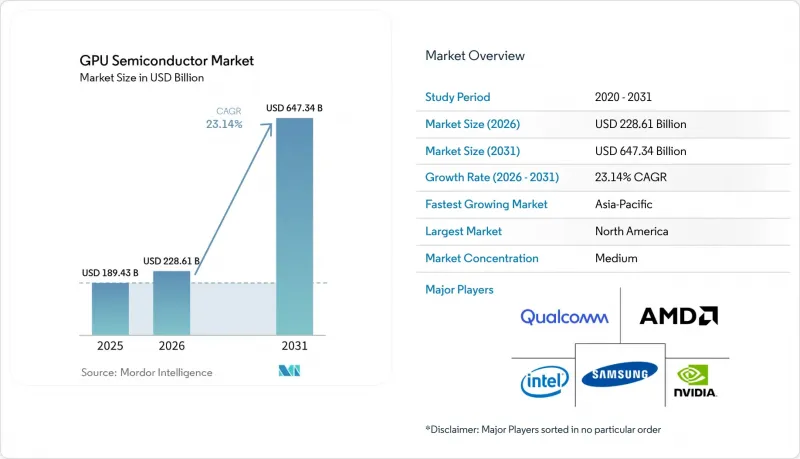
Mordor Intelligence에 의하면, GPU 반도체 시장 규모는 2025년 1,894억 3,000만 달러에서 2026년에는 2,286억 1,000만 달러로 확대되어 2031년까지 6,473억 4,000만 달러에 이를 것으로 예상되고 있어 2026년부터 2031년까지 CAGR 23.14%로 성장할 전망입니다.
본 보고서는 통합형(통합형 GPU 및 디스크리트 GPU), 기기 용도(모바일 기기 및 태블릿, PC 및 워크스테이션, 데이터센터 및 서버 가속기, 게임기 및 핸드헬드 기기 등), 최종 사용자(소비자용 전자기기 및 게임 등), 메모리 유형(GDDR 탑재 GPU 등), 지역별로 분류되어 있습니다. 시장 전망은 금액(달러) 기준으로 제시되어 있습니다.
세계 GPU 반도체 시장 동향 및 인사이트
하이퍼스케일 AI 훈련 및 추론 클러스터의 확대
GPU 반도체 시장은 주요 클라우드 사업자들이 GPU 용량을 기반 인프라로 자리매김하기로 한 결정에 힘입어 성장을 가속화하고 있습니다. 아마존, 알파벳, 메타, 마이크로소프트, Oracle의 총 설비 투자액은 2026년에 6,000억 달러에 육박했으며, 그 대부분이 AI 인프라 확충에 투입되었습니다. 엔비디아(NVIDIA)는 2026년 5월, 2027 회계연도 1분기 데이터센터 매출이 752억 달러(전년 동기 대비 92% 증가)였다고 보고했으며, 이는 이러한 조달 사이클이 얼마나 신속하게 공급업체의 매출로 이어졌는지를 보여줍니다. 반도체산업협회(SIA) 역시 2026년 AI 데이터센터용 반도체 매출이 6,700억 달러에 달했다고 밝혔으며, 이는 AI 인프라가 반도체 업계 전체에서 가장 큰 수요 원천이 되고 있음을 뒷받침합니다. 동 정보원에 따르면, 추론 워크로드는 훈련 워크로드보다 빠르게 성장할 것으로 예상되며, 대규모 모델용 훈련 클러스터의 첫 물결이 성숙한 후에도 GPU 반도체 시장은 견조한 성장세를 유지할 것으로 전망됩니다. 최첨단 AI 랙 1대당 시스템 비용이 매우 높기 때문에 하이퍼스케일 용량이 소폭 확대되는 것만으로도 GPU 반도체 시장 전체의 GPU 출하량, 제품 구성, 가격 책정에 지대한 영향을 미칩니다.
엔터프라이즈 AI 팩토리 및 주권형 컴퓨팅 조달
GPU 반도체 시장은 단기적인 수익성 기준이 아닌, 정책 목표에 따라 운영되는 엔터프라이즈 AI 팩토리 및 주권 컴퓨팅 프로그램으로부터도 뒷받침을 받고 있습니다. 이러한 수요는 데이터 주권, 국가 산업 계획, 그리고 기밀성이 높은 모델 개발을 국내 관리 하에 둘 필요성과 밀접하게 연관되어 있습니다. NVIDIA는 초안에 인용된 주권 AI 지수의 맥락에서 자사 플랫폼이 추적 대상인 주권 인프라 프로젝트의 대부분을 차지하고 있다고 밝혔으며, 이는 국가 플랫폼이 선정된 후 조달 주기가 장기화될 가능성을 시사합니다. 이러한 추세가 중요한 이유는 민간 구매자의 의사 결정이 둔화되는 상황에서도 정부 및 규제 대상 기관이 종종 하이엔드 시스템을 구매하기 때문에 GPU 반도체 시장의 가격 하한선을 유지하는 데 기여하고 있기 때문입니다. 그 결과, 하이퍼스케일러의 발주 물결 시기에 대한 의존도가 낮은 보다 광범위한 수요 기반이 형성됩니다. 또한 주요 벤더에게는 하드웨어, 소프트웨어 스택, 지속적인 지원을 중심으로 한 견고한 관계를 구축할 기회가 되며, 이는 GPU 반도체 시장 전체의 향후 교체 주기를 확실하게 확보하는 데 기여합니다.
수출 규제와 관세 변동
GPU 반도체 시장은 가격 책정, 규정 준수, 거래 시기에 영향을 미치는 수출 규제 변경 및 관세 조치로 인해 명백한 제약에 직면해 있습니다. 미국 산업안보국(BIS)은 2026년 1월, 중국으로 수출되는 첨단 반도체에 대한 라이선스 심사 방침을 개정하여, 특정 심사를 최종 사용자의 인증 및 검증을 조건으로 하는 사례별 심사 절차로 전환했습니다. 그 후, BIS는 2026년 5월, 물리적 소재지와 관계없이 국가 그룹 D:5에 본거지를 둔 사업체에 대해서는 첨단 컴퓨팅 제품에 관한 라이선스 요건이 계속 적용된다는 점을 명확히 했습니다. 이로 인해 하이엔드 공급업체가 일부 해외 수요층에 얼마나 자유롭게 접근할 수 있는지에 대해 구조적인 제약이 남게 됩니다. 또한, 본 초안에서는 관세가 국경을 넘는 AI 칩 거래에 직접적인 비용을 추가하여 유통업체나 클라우드 사업자의 조달 계획을 복잡하게 만들고 있다는 점도 지적되고 있습니다. 이러한 조치들이 복합적으로 작용하여 의사 결정이 지연되고, 서류 작성 부담이 증가하며, GPU 반도체 시장 전체의 수익 전환을 예측하기 어렵게 만들고 있습니다.
부문 분석
2025년 GPU 반도체 시장에서 디스크리트 GPU가 매출의 84.31%를 차지하고 있으며, 이는 AI 컴퓨팅 수요가 현재 시장 전체의 구성을 어떻게 형성하고 있는지를 여실히 보여줍니다. 이러한 점유율은 통합형 그래픽스가 여전히 대규모 모델의 훈련 및 추론에 필요한 메모리 대역폭, 전용 VRAM 용량, 부동소수점 연산 처리량을 제공하지 못한다는 단순한 사실을 반영하고 있습니다. 반도체산업협회(SIA)의 보고서에 따르면, AI 서버 랙 내 반도체 가치의 상당 부분을 AI 가속기가 차지하고 있으며, 이것이 디스크리트 설계가 GPU 반도체 시장에서 이처럼 큰 점유율을 차지하는 이유 중 하나입니다. NVIDIA와 AMD의 제품 출시는 구매자가 기존의 소프트웨어 환경과 도입 논리를 거의 유지한 채 새로운 하드웨어를 채택할 수 있게 함으로써, 그들의 입지를 더욱 공고히 했습니다. GPU 반도체 업계에서 이러한 연속성은 중요한 의미를 지닙니다. 왜냐하면 현재 교체 결정은 순수한 성능 향상과 마찬가지로 생태계의 안정성에도 크게 좌우되기 때문입니다.
Computex 2026에서 인텔이 Crescent Island를 발표한 것은 서버 컴퓨팅 분야의 실적과 패키징 역량을 갖춘 주요 진출기업들을 끌어모을 만큼, 디스크리트 데이터센터 분야에는 여전히 충분한 여지가 있음을 보여주었습니다. 동시에, 통합형 GPU는 모바일 기기, 노트북, 디스플레이 중심의 자동차 시스템, 그리고 피크 처리량보다 전력 효율이 중시되는 경량 엣지 추론 작업에서 전략적으로 여전히 중요한 위치를 차지하고 있습니다. 또한, 이 초안에서는 특히 AMD의 Instinct 로드맵에서 칩렛 기반 아키텍처의 역할도 강조되고 있습니다. 이는 대규모 연산 설계에서 수율 경제성을 향상시키고, 공급업체가 단일 모노리식 다이에 의존하지 않고도 제품을 확장할 수 있도록 하기 위함입니다. 이 아키텍처는 하나의 설계 기반을 AI, 게임, 전문용 사례 등 다양한 이용 사례에 맞춘 서로 다른 메모리 접근 방식과 결합할 수 있으므로, 보다 광범위한 제품 계획을 가능하게 합니다. 그 결과, GPU 반도체 시장에서는 디스크리트 GPU가 고부가가치 AI 워크로드를 계속 지배하는 한편, 통합형 설계는 대량 생산되는 클라이언트용 및 임베디드 용도에서 중요한 역할을 유지하게 될 것입니다.
2025년 시점에서 데이터센터 및 서버용 가속기는 GPU 반도체 시장의 73.52% 점유율을 차지하고 있으며, 2031년까지 연평균 성장률(CAGR) 24.35%로 확대될 것으로 예측됩니다. 반도체산업협회(SIA) 보고서에 따르면, 2026년 AI 데이터센터용 반도체 매출액은 6,700억 달러에 달할 것으로 예상되며, 이 용도가 GPU 반도체 시장 전체에서 중심적인 위치를 차지하고 있음을 여실히 보여주고 있습니다. 동 보고서에 따르면, AI 가속기는 AI 서버 랙 내 반도체 컨텐츠 가치의 대부분을 차지하고 있어, 이에 따라 용도별 구성 비율은 현재 소비자용 제품 출하량보다 인프라 투자 동향에 더 크게 좌우되고 있습니다. 또 다른 중요한 변화로, 추론 수요가 학습 수요보다 빠르게 증가할 것으로 예상되며, 이를 통해 신규 도입을 지원하면서도 이미 도입된 플랫폼의 생산성을 더 오랫동안 유지할 수 있을 것으로 전망됩니다. 이러한 균형은 랙당 가격이 시간이 지남에 따라 경쟁력을 잃더라도 지속적인 수량 수요를 뒷받침한다는 점에서 유익합니다.
기타 디바이스 용도도 여전히 중요하며, 이는 GPU 수요를 다양한 이용 모델과 교체 주기로 분산시키고 있기 때문입니다. PC와 워크스테이션은 로컬 AI 추론 수요의 혜택을 받고 있으며, 마이크로소프트가 2026년부터 디스크리트 RTX 시스템에 대한 소프트웨어 지원을 확대함에 따라 기존 사용자의 교체 주기가 연장되었습니다. 자동차 및 ADAS는 더 높은 연산 능력이 더 대형 차량 부문으로 이동함에 따라, 데이터센터 외 용도 중 가장 빠르게 성장하는 분야로 자리 잡고 있습니다. 임베디드 디바이스와 엣지 디바이스 역시 GPU IP 라이선싱 및 모듈형 플랫폼 설계를 통해 칩 제조업체가 처음부터 완전한 맞춤형 스택을 구축하지 않고도 그래픽 및 AI 기능을 통합할 수 있게 해주기 때문에 중요한 수요층을 형성하고 있습니다. 이로 인해 GPU 반도체 시장은 데이터센터를 명확한 중심축으로 삼고 있으면서도 단일 용도로의 일극 집중 현상은 나타나지 않고 있습니다.
지역별 분석
2025년, 북미는 GPU 반도체 시장에서 49.51%의 점유율을 차지했으며, 2026년에 들어서도 해당 지역이 선두를 유지하고 있습니다. 그 주된 이유는 최대 규모의 하이퍼스케일러 구매 기업들이 미국에 본사를 두고 있으며, 이들 기업의 AI 인프라 예산이 반도체 시장 내 GPU 수요를 지속적으로 견인하고 있기 때문입니다. 아마존, 마이크로소프트, 알파벳, 메타, Oracle 각사는 2026년에 AI 인프라에 6,000억 달러 이상을 지출할 전망이며, 이는 데이터센터 확장이 지리적으로 분산되어 있었음에도 불구하고 지역적 수요가 계속 집중된 이유를 설명해 줍니다. 엔비디아(NVIDIA)의 2026 회계연도 매출과 AMD의 2026년 1분기 데이터센터 관련 실적은 모두 이러한 지출 패턴을 반영하고 있습니다. 이는 하이엔드 제품 조달 및 제품 인증 과정에서 북미 구매자들이 여전히 중심적인 역할을 하고 있기 때문입니다. 또한, 캐나다는 정책 지원을 통해 AI 컴퓨팅에 대한 투자를 더욱 유치하고 있는 반면, 멕시코는 니어쇼어링 및 지역 분산화와 관련하여 제2의 데이터센터 입지로서 중요성이 높아지고 있습니다. 이러한 요인들이 복합적으로 작용하여, GPU 반도체 시장 수요, 플랫폼 테스트 및 초기 도입 활동의 중심으로서 북미가 계속해서 중요한 위치를 차지하고 있습니다.
아시아태평양은 2031년까지 연평균 성장률(CAGR) 24.57%로 확대될 것으로 예측되며, GPU 반도체 시장에서 가장 빠르게 성장하는 지역이 될 전망입니다. 이 지역은 최종 수요, 메모리 공급, 패키징 역량, 설비 투자 및 국가 주도의 컴퓨팅 프로그램이 하나의 광범위한 생태계로 통합되어 있어 다양한 요인의 조합에 힘입어 성장하고 있습니다. 한국은 Samsung Electronics(Samsung Electronics)와 SK하이닉스(SK Hynix)가 HBM 생산의 핵심을 담당하고 있어 특히 중요한 위치를 차지하고 있으며, 최종 시스템 수요가 다른 지역에 있더라도 이 지역은 프리미엄 AI 공급망의 중심이 되고 있습니다. 일본도 GPU 반도체 시장의 업스트림 부문을 뒷받침하고 있으며, 일본 반도체 제조 장비 협회는 일본의 반도체 및 FPD 제조 장비 시장이 2026 회계연도에 5조 5,004억 엔(367억 달러)에 달할 것으로 예측했습니다. 이러한 증가는 첨단 로직 및 메모리 생산 능력에 대한 AI 관련 투자를 반영하며, GPU 수요가 장비, 소재, 생산 인프라로 파급되고 있음을 의미합니다.
GPU 반도체 시장에서 유럽의 역할은 규정 준수, 데이터 거주 요건, 그리고 규제 대상 이용 사례에서 현지 운영형 AI 컴퓨팅에 대한 선호에 의해 뒷받침되고 있습니다. 독일, 영국, 프랑스는 여전히 이 지역 최대 수요원이며, 국내 클라우드 사업자들은 기업의 요구 사항에 맞추어 현지 GPU 용량을 확대되고 있습니다. 이 지역 수요 동향은 소비자의 교체 주기와는 비교적 약한 연관성을 보이며, 금융, 의료, 공공 부문의 워크로드에서 요구되는 높은 신뢰성의 도입 조건과 더 강한 연관성을 보이고 있습니다. 유럽 이외의 지역에서는 남미, 중동 및 아프리카의 점유율이 여전히 작지만 전략적으로 중요한 위치를 차지하고 있습니다. 이는 에너지 공급 상황, 디지털 인프라 확대, 그리고 국가 차원의 기술 우선순위에 따라 고품질 AI 컴퓨팅 수요의 새로운 거점이 생겨나고 있기 때문입니다. 그 결과, GPU 반도체 시장은 북미가 현재 수요를 주도하고, 아시아태평양이 공급 및 도입 확대를 통해 가장 빠르게 성장하며, 기타 지역에서는 규제, 인프라 또는 국가 주도 프로그램이 명확한 구매 동인이 되어 시장이 확대되는 지역적 구조를 보이고 있습니다.
기타 혜택:
- 엑셀 형식 시장 예측(ME) 시트
- 3개월간의 애널리스트 지원
자주 묻는 질문
목차
제1장 서론
제2장 조사 방법
제3장 주요 요약
제4장 시장 구도
제5장 시장 규모와 성장 예측
제6장 경쟁 구도
제7장 시장 기회와 향후 전망
JHSAccording to Mordor Intelligence, the GPU semiconductor market size is expected to increase from USD 189.43 billion in 2025 to USD 228.61 billion in 2026 and reach USD 647.34 billion by 2031, growing at a CAGR of 23.14% over 2026-2031.
This report is Segmented by Integration Type (Integrated GPUs and Discrete GPUs), Device Application (Mobile Devices and Tablets, Pcs and Workstations, Data Center and Server Accelerators, Gaming Consoles and Handheld Devices, and More), End User (Consumer Electronics and Gaming, and More), Memory Type (GDDR-Based GPUs, and More), and Geography. The Market Forecasts are Provided in Terms of Value (USD).
Global GPU Semiconductor Market Trends and Insights
Hyperscale AI Training and Inference Cluster Expansion
The GPU semiconductor market is being pushed higher by the decision of the largest cloud operators to treat GPU capacity as foundational infrastructure. The combined capital expenditure of Amazon, Alphabet, Meta, Microsoft, and Oracle approached USD 600 billion in 2026, with a large share directed toward AI infrastructure build-outs. NVIDIA reported Q1 FY2027 data center revenue of USD 75.2 billion in May 2026, up 92% year over year, which shows how quickly this procurement cycle translated into supplier revenue. The Semiconductor Industry Association also showed that AI data center semiconductor revenue reached USD 670 billion in 2026, confirming that AI infrastructure has become the largest demand engine in the broader chip stack. The same source indicated that inference workloads are expected to grow faster than training workloads, suggesting the GPU semiconductor market should remain robust even after the first wave of large-model training clusters matures. Each leading-edge AI rack carries a very high system cost, so even a modest expansion in hyperscale capacity has an outsized effect on GPU volumes, mix, and pricing across the GPU semiconductor market.
Enterprise AI Factory and Sovereign Compute Procurement
The GPU semiconductor market is also gaining support from enterprise AI factories and sovereign compute programs that follow policy goals rather than short-cycle return thresholds. The source text shows that this demand is tied to data sovereignty, national industrial planning, and the need to keep sensitive model development under domestic control. NVIDIA stated, in the context of the Sovereign AI Index cited in the draft, that its platforms account for a large share of tracked sovereign infrastructure projects, suggesting long procurement cycles once a national platform is selected. That pattern matters because governments and regulated institutions often buy premium systems even as commercial buyers slow down decision-making, helping keep a pricing floor in the GPU semiconductor market. The result is a broader demand base that is less dependent on the timing of hyperscaler ordering waves. It also gives leading vendors a chance to build durable relationships around hardware, software stacks, and ongoing support, which can lock in future replacement cycles across the GPU semiconductor market.
Export Controls and Tariff Volatility
The GPU semiconductor market faces a clear restraint from export control changes and tariff actions that affect pricing, compliance, and deal timing. The US Bureau of Industry and Security revised its license review policy for advanced semiconductors exported to China in January 2026, moving certain reviews to a case-by-case process subject to end-user certification and verification. BIS then clarified in May 2026 that license requirements for advanced computing items still apply to entities headquartered in Country Group D:5, regardless of their physical location. That keeps a structural limit on how freely high-end suppliers can address some overseas demand pools. The draft also notes that tariffs added a direct cost to cross-border AI chip transactions, complicating procurement planning for distributors and cloud operators. Together, these measures slow decisions, raise documentation burdens, and make revenue conversion less predictable across the GPU semiconductor market.
Other drivers and restraints analyzed in the detailed report include:
- Edge AI Upgrade Cycle in PCs and Mobile Devices
- Rising ADAS and In-Cabin Compute Content per Vehicle
- Elevated GPU And Memory ASPs Slowing Mainstream Adoption
For complete list of drivers and restraints, kindly check the Table Of Contents.
Segment Analysis
Discrete GPUs accounted for 84.31% of revenue in the GPU semiconductor market in 2025, underscoring how AI computing needs now shape the overall mix. That share reflects the simple fact that integrated graphics still cannot provide the memory bandwidth, dedicated VRAM capacity, and floating-point throughput needed for large-scale model training and inference. The Semiconductor Industry Association reported that AI accelerators account for most of the semiconductor value in AI server racks, which helps explain why discrete designs hold such a large share of the GPU semiconductor market. Product launches across NVIDIA and AMD have reinforced that position because buyers can adopt new hardware while keeping much of the same software environment and deployment logic. That continuity matters in the GPU semiconductor industry because replacement decisions now depend as much on ecosystem stability as on raw performance gains.
Intel's Crescent Island launch at Computex 2026 showed that the discrete data center segment remains open enough to attract major entrants with server compute relationships and packaging capabilities. At the same time, integrated GPUs remain strategically relevant in mobile devices, notebooks, display-centric automotive systems, and lighter edge inference tasks where power efficiency matters more than peak throughput. The draft also highlights the role of chiplet-based architecture, especially in AMD's Instinct roadmap, because it improves yield economics for large compute designs and allows suppliers to scale products without relying on a single monolithic die. That architecture supports broader product planning because one design base can be paired with different memory approaches for AI, gaming, and professional use cases. The result is a GPU semiconductor market where discrete GPUs keep control of high-value AI workloads, while integrated designs retain an important role in high-volume client and embedded deployments.
Data center and server accelerators held a 73.52% share of the GPU semiconductor market in 2025 and are projected to expand at a 24.35% CAGR through 2031. The Semiconductor Industry Association reported that AI data center semiconductor revenue reached USD 670 billion in 2026, underscoring the centrality of this application to the broader GPU semiconductor market. The same report also shows that AI accelerators capture the majority of semiconductor content value in AI server racks, so application mix now follows infrastructure investment more than consumer unit shipments. Another important shift is that inference demand is expected to grow faster than training demand, which should keep installed platforms productive for longer while still supporting new deployments. That balance is useful because it supports continuing volume demand even if per-rack pricing becomes less aggressive over time.
Other device applications still matter because they spread GPU demand across several usage models and replacement cycles. PCs and workstations are benefiting from local AI inference needs, and Microsoft's 2026 software support expansion for discrete RTX systems widened the refresh path for installed users. Automotive and ADAS remains the fastest-moving non-data-center application in the draft because higher compute content is moving into larger vehicle segments. Embedded and edge devices also provide a meaningful layer of demand because GPU IP licensing and modular platform design let chipmakers integrate graphics and AI capability without building full custom stacks from scratch. This leaves the GPU semiconductor market with a clear center of gravity in data centers, but not a single-point dependence on one application alone.
Complete Report Scope:
- By Integration Type
- Integrated GPUs
- Discrete GPUs
- By Device Application
- Mobile Devices and Tablets
- PCs and Workstations
- Data Center and Server Accelerators
- Gaming Consoles and Handheld Devices
- Automotive and ADAS
- Embedded and Edge Devices
- By End User
- Consumer Electronics and Gaming
- Cloud, Data Center, and Enterprise IT
- Telecom
- Automotive
- Industrial and Robotics
- Other End Users
- By Memory Type
- GDDR-Based GPUs
- HBM-Based GPUs
- Shared DDR/LPDDR Memory GPUs
- Other Memory Types
- By Geography
- North America
- United States
- Canada
- Mexico
- Europe
- Germany
- United Kingdom
- France
- Italy
- Rest of Europe
- Asia-Pacific
- China
- Japan
- South Korea
- India
- Southeast Asia
- Rest of Asia-Pacific
- South America
- Middle East and Africa
- North America
Geography Analysis
North America held a 49.51% share of the GPU semiconductor market in 2025, keeping the region in the lead entering 2026. The main reason is that the largest hyperscaler buyers are headquartered in the United States, and their AI infrastructure budgets continue to drive demand for GPUs in the semiconductor market. The draft states that Amazon, Microsoft, Alphabet, Meta, and Oracle were on track to spend more than USD 600 billion on AI infrastructure in 2026, which helps explain why regional demand remained concentrated even when data center build-outs were geographically distributed. NVIDIA's FY2026 revenue and AMD's Q1 2026 data center performance both reflect that spending pattern, since North American buyers remain central to high-end procurement and product qualification. Canada is also drawing more AI compute investment through policy support, while Mexico is gaining relevance as a secondary data center location tied to nearshoring and regional diversification. Together, these factors keep North America at the core of demand, platform testing, and early deployment activity in the GPU semiconductor market.
Asia-Pacific is projected to expand at a 24.57% CAGR through 2031, making it the fastest-growing regional layer in the GPU semiconductor market. The region is growing through a different mix of drivers, since it combines end demand, memory supply, packaging capacity, equipment investment, and sovereign compute programs in one broad ecosystem. South Korea remains especially important because Samsung Electronics and SK Hynix anchor HBM production, which makes the region central to the premium AI supply chain even when final system demand is located elsewhere. Japan also supports the GPU semiconductor market upstream, and the Semiconductor Equipment Association of Japan forecast that the country's semiconductor and FPD manufacturing equipment market would reach JPY 5,500.4 billion (USD 36.7 billion) in FY2026. That rise reflects AI-linked investment in advanced logic and memory capacity, which means GPU demand is spreading back through tools, materials, and production infrastructure.
Europe's role in the GPU semiconductor market is being supported by compliance, data residency, and the preference for locally operated AI compute in regulated use cases. Germany, the United Kingdom, and France remain the largest demand pools in the region, and domestic cloud operators are scaling local GPU capacity in response to enterprise requirements. The region's demand profile is less tied to consumer replacement cycles and more tied to trusted deployment conditions for finance, healthcare, and public sector workloads. Outside Europe, South America and the Middle East and Africa remain smaller in share but important in strategic terms because energy availability, digital infrastructure expansion, and sovereign technology priorities are creating new pockets of premium AI compute demand. This leaves the GPU semiconductor market with a regional structure where North America leads in current demand, Asia-Pacific grows fastest through supply and deployment depth, and other regions expand where regulation, infrastructure, or state-backed programs create clear buying triggers.
- NVIDIA Corporation
- Advanced Micro Devices, Inc.
- Intel Corporation
- Qualcomm Incorporated
- Samsung Electronics Co., Ltd.
- MediaTek Inc.
- Imagination Technologies Group Ltd.
- Huawei Technologies Co., Ltd.
- Moore Threads Intelligent Technology (Beijing) Co., Ltd.
- Biren Technology Co., Ltd.
- VeriSilicon Microelectronics (Shanghai) Co., Ltd.
- Zhaoxin Semiconductor Co., Ltd.
- UNISOC Technologies Co., Ltd.
- Rockchip Electronics Co., Ltd.
- Bolt Graphics, Inc.
Additional Benefits:
- The market estimate (ME) sheet in Excel format
- 3 months of analyst support
TABLE OF CONTENTS
1 INTRODUCTION
- 1.1 Study Assumptions and Market Definition
- 1.2 Scope of the Study
2 RESEARCH METHODOLOGY
3 EXECUTIVE SUMMARY
4 MARKET LANDSCAPE
- 4.1 Market Overview
- 4.2 Market Drivers
- 4.2.1 Hyperscale AI Training and Inference Cluster Expansion
- 4.2.2 Enterprise AI Factory and Sovereign Compute Procurement
- 4.2.3 Edge AI Upgrade Cycle in PCs and Mobile Devices
- 4.2.4 Rising ADAS and In-Cabin Compute Content per Vehicle
- 4.2.5 Chiplet-Based GPU Roadmaps Improving Yield and Product Scaling
- 4.2.6 GPU-as-a-Service Broadening Access Beyond Hyperscalers
- 4.3 Market Restraints
- 4.3.1 Export Controls and Tariff Volatility
- 4.3.2 Elevated GPU and Memory ASPs Slowing Mainstream Adoption
- 4.3.3 HBM and CoWoS Allocation Bias Toward AI Racks
- 4.3.4 Grid Interconnection Delays for High-Density GPU Campuses
- 4.4 Industry Value Chain Analysis
- 4.5 Regulatory Landscape
- 4.6 Technological Outlook
- 4.7 Porter's Five Forces Analysis
- 4.7.1 Bargaining Power of Suppliers
- 4.7.2 Bargaining Power of Buyers
- 4.7.3 Threat of New Entrants
- 4.7.4 Threat of Substitutes
- 4.7.5 Competitive Rivalry
5 MARKET SIZE AND GROWTH FORECASTS (VALUE)
- 5.1 By Integration Type
- 5.1.1 Integrated GPUs
- 5.1.2 Discrete GPUs
- 5.2 By Device Application
- 5.2.1 Mobile Devices and Tablets
- 5.2.2 PCs and Workstations
- 5.2.3 Data Center and Server Accelerators
- 5.2.4 Gaming Consoles and Handheld Devices
- 5.2.5 Automotive and ADAS
- 5.2.6 Embedded and Edge Devices
- 5.3 By End User
- 5.3.1 Consumer Electronics and Gaming
- 5.3.2 Cloud, Data Center, and Enterprise IT
- 5.3.3 Telecom
- 5.3.4 Automotive
- 5.3.5 Industrial and Robotics
- 5.3.6 Other End Users
- 5.4 By Memory Type
- 5.4.1 GDDR-Based GPUs
- 5.4.2 HBM-Based GPUs
- 5.4.3 Shared DDR/LPDDR Memory GPUs
- 5.4.4 Other Memory Types
- 5.5 By Geography
- 5.5.1 North America
- 5.5.1.1 United States
- 5.5.1.2 Canada
- 5.5.1.3 Mexico
- 5.5.2 Europe
- 5.5.2.1 Germany
- 5.5.2.2 United Kingdom
- 5.5.2.3 France
- 5.5.2.4 Italy
- 5.5.2.5 Rest of Europe
- 5.5.3 Asia-Pacific
- 5.5.3.1 China
- 5.5.3.2 Japan
- 5.5.3.3 South Korea
- 5.5.3.4 India
- 5.5.3.5 Southeast Asia
- 5.5.3.6 Rest of Asia-Pacific
- 5.5.4 South America
- 5.5.5 Middle East and Africa
- 5.5.1 North America
6 COMPETITIVE LANDSCAPE
- 6.1 Market Concentration
- 6.2 Strategic Moves
- 6.3 Vendor Positioning Analysis
- 6.4 Company Profiles (includes Global Level Overview, Market Level Overview, Core Segments, Financials as available, Strategic Information, Market Rank/Share, Products and Services, Recent Developments)
- 6.4.1 NVIDIA Corporation
- 6.4.2 Advanced Micro Devices, Inc.
- 6.4.3 Intel Corporation
- 6.4.4 Qualcomm Incorporated
- 6.4.5 Samsung Electronics Co., Ltd.
- 6.4.6 MediaTek Inc.
- 6.4.7 Imagination Technologies Group Ltd.
- 6.4.8 Huawei Technologies Co., Ltd.
- 6.4.9 Moore Threads Intelligent Technology (Beijing) Co., Ltd.
- 6.4.10 Biren Technology Co., Ltd.
- 6.4.11 VeriSilicon Microelectronics (Shanghai) Co., Ltd.
- 6.4.12 Zhaoxin Semiconductor Co., Ltd.
- 6.4.13 UNISOC Technologies Co., Ltd.
- 6.4.14 Rockchip Electronics Co., Ltd.
- 6.4.15 Bolt Graphics, Inc.
7 MARKET OPPORTUNITIES AND FUTURE OUTLOOK
- 7.1 White-Space and Unmet-Need Assessment