
|
시장보고서
상품코드
2099057
CAD 및 CAM용 GPU 시장 : 점유율 분석, 업계 동향 및 통계, 성장 예측(2026-2031년)CAD/CAM GPU - Market Share Analysis, Industry Trends & Statistics, Growth Forecasts (2026 - 2031) |
||||||
 Mordor Intelligence
Mordor Intelligence에 의하면, CAD 및 CAM용 GPU 시장 규모는 2025년에 29억 1,000만 달러, 2026년에 34억 8,000만 달러가 되고, 2031년까지 80억 2,000만 달러에 이를 것으로 예측되며, 2026년부터 2031년까지 CAGR 18.17%로 성장할 전망입니다.
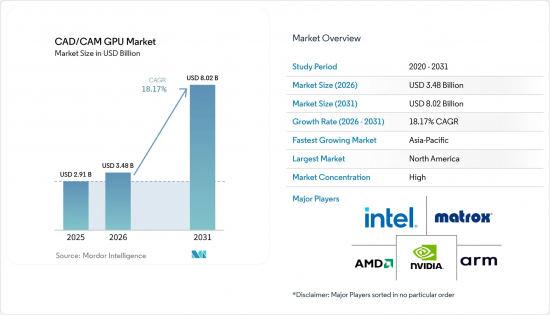
본 보고서는 GPU 제품 유형(데스크톱용 전문가/워크스테이션용 디스크리트 GPU, 모바일용 전문가/워크스테이션용 디스크리트 GPU 등), GPU 플랫폼/아키텍처(NVIDIA GPU 플랫폼 등), 용도(컴퓨터 지원 설계 및 3D 모델링, 컴퓨터 지원 제조 등), 최종 사용자(자동차 산업 등), 그리고 지역별로 분류되어 있습니다. 시장 전망은 금액(달러) 기준으로 제시되어 있습니다.
전 세계 CAD 및 CAM용 GPU 시장 동향 및 인사이트
실시간 CAD 및 CAM 워크플로우에 대한 수요 증가
CAD 및 CAM용 GPU 시장은 전문가용 설계·제조 소프트웨어에서 실시간 응답성에 대한 수요가 증가함에 따라 성장하고 있습니다. 대규모 어셈블리, 멀티 뷰포트 작업, 시뮬레이션 연동형 설계 검토로 인해 현재는 CPU 속도뿐만 아니라 GPU의 메모리 및 병렬 연산 능력에 대한 부하가 증가하고 있습니다. NVIDIA는 2025년 3월 'RTX PRO Blackwell' 워크스테이션 라인업을 출시했습니다. 여기에는 96GB의 GDDR7 메모리를 탑재한 'RTX PRO 6000 Workstation Edition'이 포함되어 있어, 벤더의 로드맵이 더 높은 부하를 요구하는 전문가용 워크로드를 목표로 하고 있음을 알 수 있습니다. 이는 CAD 및 CAM용 GPU 시장에 중요한 의미를 지닙니다. 설계 팀은 동일한 워크스테이션 세션 내에서 복잡한 모델, 시뮬레이션 결과물, 검토 작업을 원활하게 처리할 수 있기를 점점 더 기대하고 있기 때문입니다. 또한, 새로운 워크플로우의 요구로 인해 일반적인 교체 주기가 끝나기도 전에 메모리나 처리량의 한계가 드러나게 되어, 구형 하드웨어의 실용 수명이 단축되는 결과로 이어집니다. 그 결과, 각 워크스테이션 벤더들은 그래픽을 부차적인 시스템 구성 요소로 취급하지 않고, 전문가용 GPU 업그레이드에 맞추어 제품 출시 시기를 조정하고 있습니다.
AI를 활용한 생성형 설계 및 렌더링의 확대
CAD 및 CAM용 GPU 시장은 엔지니어링 워크플로우 전반에 걸친 AI 지원 설계 및 렌더링 도구의 보급에 의해서도 뒷받침되고 있습니다. 새로운 전문가용 그래픽 카드는 콤팩트 시스템이나 풀사이즈 시스템 내에서 모델링, 렌더링, 설계의 반복 작업을 향상시키는 형태로 AI에 특화된 가속 기능을 추가하고 있습니다. NVIDIA는 2025년 8월 'RTX PRO 2000 Blackwell'을 발표하며, 이전 세대에 비해 CAD 성능이 최대 1.4배, 3D 모델링이 1.6배 빨라졌다고 보고했습니다. 이는 AI를 통한 성능 향상이 메인스트림 워크스테이션 계층으로 확산되고 있음을 보여줍니다. 또한 AMD도 2025년 7월, 32GB GDDR6와 128개의 AI 가속기를 탑재한 ‘Radeon AI PRO R9700’을 워크스테이션용으로 출시하여, AI 지원 그래픽 하드웨어를 찾는 엔지니어링 스튜디오의 선택 폭을 넓혔습니다. 이러한 변화는 CAD 및 CAM용 GPU 시장에 중요한 의미를 지닙니다. 과거에는 오프로드 처리가 필요했던 렌더링이나 설계 작업이 단일 워크스테이션에서 더 빠르게 완료될 수 있게 되었기 때문입니다. 또한, 전문가용 시스템의 메모리 대역폭 및 로컬 AI 처리 기준을 높여, 기존 엔지니어링 팀 전체의 시스템 교체 수요를 촉진하는 결과로 이어질 것입니다.
프로페셔널용 GPU의 높은 총 소유 비용
CAD 및 CAM용 GPU 시장은 프로페셔널 시스템과 관련된 총 소유 비용(TCO) 측면에서 여전히 뚜렷한 도입 장벽에 직면해 있습니다. 이 비용은 그래픽 카드에만 국한되지 않습니다. 구매자는 인증된 드라이버, 워크스테이션 검증, 전원 공급, 냉각 지원, 그리고 경우에 따라 더 광범위한 인프라 변경까지 필요로 하기 때문입니다. NVIDIA는 96GB 프레임 버퍼와 워크스테이션급 성능을 갖춘 'RTX PRO 6000 Blackwell Workstation Edition'을 라인업의 최상위 모델로 자리매김했습니다. 이는 통합 비용을 산입하기 전부터 프리미엄 도입 환경이 왜 고가가 될 수 있는지를 여실히 보여줍니다. 또한 AMD도 2025년 8월, 저전력 엔트리 모델로 ‘Radeon PRO W7400’을 출시했습니다. 이는 공급업체들이 소형 프로페셔널 시스템 분야에서 비용을 절감한 대체 제품의 필요성을 인식하고 있음을 보여줍니다. 하지만 성능 측면에서의 타협으로 인해, 생산에 필수적인 엔지니어링 업무에서 저비용 옵션의 매력은 제한적일 수 있습니다. 그 결과, CAD 및 CAM용 GPU 시장에서는 수요 패턴이 양극화되어, 대기업은 고가 시스템의 비용을 감당할 수 있는 반면, 중소기업은 교체 주기를 연장하거나 사양을 낮출 수밖에 없는 상황에 처해 있습니다.
부문 분석
2025년, 데스크톱용 전문가용 및 워크스테이션용 디스크리트 GPU는 매출의 56.77%를 차지하며, CAD 및 CAM용 GPU 시장에서 가장 큰 제품군으로서의 지위를 유지했습니다. 이러한 우위는 대규모 어셈블리 CAD, 멀티피직스 시뮬레이션 및 고충실도 렌더링 분야의 견조한 수요에 기인하며, 이러한 분야에서는 대용량 VRAM과 안정적인 인증이 여전히 필수적입니다. 이러한 시스템은 고밀도 모델, 여러 개의 활성 뷰, 그리고 시뮬레이션을 많이 사용하는 프로젝트 검토를 관리하는 최상위 엔지니어링 환경에서 여전히 기본 선택지로 자리 잡고 있습니다. 또한, 초기 비용보다 가동 시간, 용도 안정성, 예측 가능한 인증된 동작이 중시되는 CAD 및 CAM용 GPU 업계에서도 여전히 중심적인 위치를 차지하고 있습니다. 모바일용 전문가 및 워크스테이션용 디스크리트 GPU는 여전히 인증된 그래픽 성능이 필요한 현장 엔지니어링, 고객사 현장 작업 및 분산형 프로젝트 팀을 지원하기 위해 수요의 다음 계층을 형성하고 있습니다.
통합형 및 통합 메모리 GPU는 2026년부터 2031년까지 연평균 성장률(CAGR) 18.66%를 나타낼 것으로 예측되며, CAD 및 CAM용 GPU 시장에서 가장 빠르게 확대될 제품 유형이 될 전망입니다. 이러한 성장은 주류 2D 제도 및 부하가 낮은 3D 작업에서의 성능 향상을 반영하며, 더 이상 모든 전문 환경에서 독립형 디스크리트 카드가 필수적이지 않음을 보여줍니다. 따라서 제품 구성은 복잡한 시뮬레이션을 위한 프리미엄 디스크리트 시스템과, 소규모 기업, 교육 기관 사용자, 그리고 엔트리 레벨 전문 워크플로우를 위한 보다 효율적인 통합 플랫폼으로 양극화되고 있습니다. 컴팩트한 워크스테이션 환경을 위해 55W로 출시된 AMD의 ‘Radeon PRO W7400’ 역시, 각 벤더들이 전문가 분야에서 완전히 철수하지 않으면서도 제약이 있는 폼 팩터에 대응하려 하고 있음을 보여줍니다. 가상화 환경이나 서버 연동 환경을 포함한 기타 전문가용 GPU 구성은 시장 점유율이 여전히 작지만, CAD 및 CAM용 GPU 시장 전체에서 클라우드 기반 워크스테이션 모델이 보급됨에 따라 그 중요성이 높아지고 있습니다.
2025년, NVIDIA 플랫폼은 매출의 77.33%를 차지하며 플랫폼 차원의 CAD 및 CAM용 GPU 시장 점유율에서 선두를 유지했습니다. 이러한 위상은 하드웨어의 우위뿐만 아니라, CUDA 기반 워크플로우의 규모, Omniverse와의 연동, 그리고 널리 사용되는 엔지니어링 소프트웨어 전반에 걸친 광범위한 인증 지원도 반영하고 있습니다. 실용적인 관점에서 볼 때, 이 플랫폼은 많은 대기업의 조달 기준에 깊이 뿌리내리고 있어 성능 격차가 좁혀지더라도 전환 비용이 높게 발생합니다. 이로 인해 NVIDIA는 CAD 및 CAM용 GPU 시장, 특히 장기적인 소프트웨어 지원을 중시하는 설계 환경에서 가장 견고한 도입 기반을 유지하고 있습니다. 또한 이러한 입지를 바탕으로 NVIDIA는 하드웨어 출시 및 생태계 확장을 통해 업그레이드 시기에 영향을 미칠 수도 있습니다.
인텔의 GPU 플랫폼은 2026년부터 2031년까지 19.21%라는 가장 높은 연평균 성장률(CAGR)을 보일 것으로 예측되며, 이는 가성비 중심 시장 및 주류 전문가 시장에서 점차 시장이 개방되고 있음을 시사합니다. 인텔의 부상은 해당 기업의 전문가용 그래픽스 스택에 대한 신뢰도 상승과, 비용 효율성을 중시하는 워크스테이션 이용 사례를 우선적으로 타겟으로 삼는 전략과 관련이 있습니다. AMD는 최고 가격대의 프리미엄을 수용하지 않으면서도 강력한 시각화 성능을 추구하는 구매자들에게 여전히 유력한 선택지이며, 2025년에 출시된 ‘Radeon AI PRO R9700’은 이러한 선택지 중 AI 지원 기능을 갖춘 명확한 옵션을 추가했습니다. 따라서 플랫폼 주도권은 여전히 NVIDIA가 확고하게 장악하고 있지만, CAD 및 CAM용 GPU 업계에서는 최상위권 이외의 부문에서 경쟁이 격화되고 있습니다. 전문용 CAD 및 CAM 용도에서 다른 플랫폼의 선택지는 여전히 제한적이지만, 소프트웨어 스택의 진화가 더 빠를 가능성이 있는 가상 워크스테이션이나 AI를 활용한 설계 환경에서는 이러한 동향이 주목받고 있습니다.
지역별 분석
2025년, 북미는 매출의 35.16%를 차지하며 지역별 CAD 및 CAM용 GPU 시장 점유율에서 1위를 차지하고 있습니다. 이 지역은 미국, 캐나다, 멕시코 전역에 항공우주 관련 계약업체, 자동차 설계 부서, 반도체 시설, 방위 공학 프로그램이 밀집해 있다는 이점이 있습니다. 이러한 요인들이 복합적으로 작용하여, 특히 원격 또는 공유 컴퓨팅 환경에 전적으로 의존할 수 없는 분야에서 인증된 워크스테이션 시스템에 대한 안정적인 수요를 뒷받침하고 있습니다. 또한, 북미의 CAD 및 CAM용 GPU 시장은 소프트웨어의 조기 도입, 기업 IT 예산의 규모가 크다는 점, 그리고 AI를 활용한 엔지니어링 도구를 대규모로 도입하려는 조직의 기반이 탄탄하다는 점도 호재로 작용하고 있습니다.
2025년, 유럽은 CAD 및 CAM용 GPU 시장에서 여전히 중요한 위치를 유지하고 있으며, 독일, 영국, 프랑스, 이탈리아가 지역 수요의 주요 중심지가 되고 있습니다. 독일은 제조업의 두터운 기반, 확립된 엔지니어링 소프트웨어 인프라, 그리고 CAD를 많이 사용하는 산업 워크플로우에 의존하는 기업들이 집중되어 있어 특히 중요한 위치를 계속 차지하고 있습니다. NVIDIA는 2025년 6월, 독일에 1만 개의 GPU를 갖춘 산업용 AI 클라우드를 구축하고, BMW 그룹, Cadence, Siemens가 초기 단계부터 참여한다고 발표했습니다. 이는 해당 지역이 산업의 디지털 전환에서 수행하는 역할을 여실히 보여줍니다. 기타 유럽은 특히 북유럽 국가, 베네룩스 국가, 중동부 유럽에서 인더스트리 4.0의 투자 주기를 따르는 2차 수요층을 형성하고 있습니다.
아시아태평양은 2026년부터 2031년까지 연평균 성장률(CAGR) 19.04%를 나타낼 것으로 예측되며, CAD 및 CAM용 GPU 시장 규모 측면에서 가장 두드러진 성장을 보이는 지역 부문이 될 것입니다. 이 지역은 한국의 반도체 산업 기반, 일본의 정밀 제조 역량, 인도의 엔지니어링 서비스 확대, 중국의 산업 디자인 규모, 그리고 동남아시아의 첨단 조립 분야에서의 역할 확대와 같은 요인들에 힘입고 있습니다. 일본 국내의 워크스테이션 생태계는 여전히 활발하며, TSUKUMO는 2026년 5월, 시뮬레이션 및 AI를 많이 사용하는 전문가용 워크로드에 대응하기 위해 Intel Xeon 600 시리즈를 탑재한 워크스테이션 모델을 출시했습니다. 이번 출시는 여전히 국내 하드웨어 판매 채널에 의존하고 있는 국내 엔지니어링 사용자들로부터 전문용 시스템에 대한 지속적인 수요를 반영하고 있습니다. 남미, 중동 및 아프리카는 여전히 소규모 시장이지만, 인프라, 건설, 설계 서비스 분야의 프로젝트 주도형 수요가 서서히 새로운 조달 주기를 만들어내고 있습니다. 앞으로 이 지역들의 CAD 및 CAM용 GPU 시장은 인증된 시각화, BIM 및 시뮬레이션 워크플로가 표준 엔지니어링 업무의 일부로 자리 잡음에 따라 더욱 확대될 것으로 보입니다.
기타 혜택:
- 엑셀 형식 시장 예측(ME) 시트
- 3개월간의 애널리스트 지원
자주 묻는 질문
목차
제1장 서론
제2장 조사 방법
제3장 주요 요약
제4장 시장 구도
제5장 시장 규모와 성장 예측
제6장 경쟁 구도
제7장 시장 기회와 향후 전망
JHSAccording to Mordor Intelligence, the CAD/CAM GPU market size is projected to be USD 2.91 billion in 2025, USD 3.48 billion in 2026, and reach USD 8.02 billion by 2031, growing at a CAGR of 18.17% from 2026 to 2031.
This report is Segmented by GPU Product Type (Desktop Professional/Workstation Discrete GPUs, Mobile Professional/Workstation Discrete GPUs, and More), GPU Platform / Architecture (NVIDIA GPU Platform, and More), Application (Computer-Aided Design and 3D Modeling, Computer-Aided Manufacturing, and More), End User (Automotive, and More), and Geography. The Market Forecasts are Provided in Terms of Value (USD).
Global CAD/CAM GPU Market Trends and Insights
Rising Demand For Real-Time CAD And CAM Workflows
The CAD/CAM GPU market is being lifted by the growing need for real-time responsiveness in professional design and manufacturing software. Large assemblies, multi-viewport work, and simulation-linked design reviews now place more pressure on GPU memory and parallel compute than on CPU speed alone. NVIDIA launched the RTX PRO Blackwell workstation lineup in March 2025, including the RTX PRO 6000 Workstation Edition with 96GB of GDDR7 memory, which shows how vendor roadmaps are targeting heavier professional workloads. This matters for the CAD/CAM GPU market because design teams increasingly expect smooth handling of complex models, simulation output, and review tasks inside the same workstation session. It also shortens the practical life of older hardware, because new workflow demands can expose memory and throughput limits before normal replacement cycles end. As a result, workstation vendors are aligning product launches with professional GPU upgrades rather than treating graphics as a secondary system component.
Expansion Of AI-Assisted Generative Design And Rendering
The CAD/CAM GPU market is also being supported by the spread of AI-assisted design and rendering tools across engineering workflows. New professional cards are adding AI-focused acceleration in a way that improves modeling, rendering, and design iteration inside compact and full-size systems. NVIDIA introduced the RTX PRO 2000 Blackwell in August 2025 and reported up to 1.4x faster CAD performance and 1.6x faster 3D modeling than its prior generation, which shows how AI-enabled gains are moving into mainstream workstation tiers. AMD also positioned the Radeon AI PRO R9700 with 32GB of GDDR6 and 128 AI accelerators for workstation deployments in July 2025, which widened the set of options for engineering studios seeking AI-ready graphics hardware. This shift is important for the CAD/CAM GPU market because rendering and design tasks that once required offloading can now be completed faster on a single workstation. It also raises the baseline for memory bandwidth and local AI processing in professional systems, which strengthens replacement demand across established engineering teams.
High Total Cost Of Ownership Of Professional-Grade GPUs
The CAD/CAM GPU market still faces a clear adoption limit in the total cost of ownership tied to professional systems. The cost is not limited to the graphics card, because buyers also need certified drivers, workstation validation, power delivery, cooling support, and, in some cases, broader infrastructure changes. NVIDIA positioned the RTX PRO 6000 Blackwell Workstation Edition at the top end of the stack with a 96GB frame buffer and workstation-class performance, which highlights why premium deployments can become expensive even before integration costs are counted. AMD also launched the Radeon PRO W7400 in August 2025 as a lower-power entry option, which shows that suppliers recognize the need for cost-controlled alternatives in compact professional systems. Even so, performance trade-offs can limit the appeal of lower-cost options in production-critical engineering work. This leaves the CAD/CAM GPU market with a split demand pattern, where large enterprises can absorb premium system costs while smaller firms stretch refresh cycles or reduce configuration levels.
Other drivers and restraints analyzed in the detailed report include:
- Growth In Digital Twin And Simulation-Heavy Engineering Programs
- Wider Adoption Of Hybrid On-Premises And Cloud-Based Design Environments
- Driver Certification And Software Compatibility Constraints
For complete list of drivers and restraints, kindly check the Table Of Contents.
Segment Analysis
Desktop professional and workstation discrete GPUs held 56.77% of revenue in 2025, which kept them as the largest product group in the CAD/CAM GPU market. That lead came from strong demand in large-assembly CAD, multi-physics simulation, and high-fidelity rendering, where higher VRAM capacity and stable certification remain essential. These systems are still the default choice in tier-one engineering environments that manage dense models, multiple active views, and simulation-heavy project reviews. They also remain central in the CAD/CAM GPU industry, where uptime, application stability, and predictable certified behavior matter more than entry cost. Mobile professional and workstation discrete GPUs form the next layer of demand, because they support field engineering, client-site work, and distributed project teams that still need certified graphics performance.
Integrated and unified-memory GPUs are projected to grow at an 18.66% CAGR from 2026 to 2031, making them the fastest-expanding product type in the CAD/CAM GPU market. Their growth reflects improving capability in mainstream 2D drafting and lighter 3D work, where a separate, discrete card is no longer required in every professional setup. The product mix is therefore splitting into premium discrete systems for complex simulation and more efficient integrated platforms for smaller firms, education users, and entry-level professional workflows. AMD's Radeon PRO W7400, introduced for compact workstation environments at 55W, also shows how vendors are trying to serve constrained form factors without leaving the professional segment entirely. Other professional GPU configurations, including virtualized and server-linked setups, remain smaller in share but are growing in importance as cloud-delivered workstation models become more common across the CAD/CAM GPU market.
The NVIDIA platform held 77.33% of revenue in 2025, which gave it the leading position in the CAD/CAM GPU market share at the platform level. That position reflects not only hardware strength, but also the scale of CUDA-based workflows, Omniverse alignment, and broad certification coverage across widely used engineering software. In practical terms, the platform remains deeply embedded in procurement standards for many large enterprises, which raises switching costs even when performance gaps narrow. This has helped NVIDIA keep the strongest installed base in the CAD/CAM GPU market, especially in design environments that place high value on long-term software support. The same position also allows NVIDIA to influence upgrade timing through both hardware launches and ecosystem expansion.
The Intel GPU platform is projected to record the fastest 19.21% CAGR from 2026 to 2031, which points to a gradual opening at the value and mainstream professional tiers. Intel's rise is linked to growing confidence in its professional graphics stack and a strategy that targets cost-sensitive workstation use cases first. AMD remains a credible alternative where buyers want strong visualization capability without accepting the highest premium, and its Radeon AI PRO R9700 added a clearer AI-ready option to that discussion in 2025. The CAD/CAM GPU industry is therefore becoming more competitive below the top tier, even if platform leadership still sits firmly with NVIDIA. Other platform options remain limited in professional CAD and CAM use, but they are being watched in virtual workstation and AI-in-design environments where software stacks may evolve faster.
Complete Report Scope:
- By GPU Product Type
- Desktop Professional/Workstation Discrete GPUs
- Mobile Professional/Workstation Discrete GPUs
- Integrated/Unified-Memory GPUs
- Other Professional GPU Configurations
- By GPU Platform / Architecture
- NVIDIA GPU Platform
- AMD GPU Platform
- Intel GPU Platform
- Other GPU Platforms
- By Application
- Computer-Aided Design and 3D Modeling
- Computer-Aided Manufacturing
- Computer-Aided Engineering and Simulation
- Rendering, Visualization, and Digital Twins
- Other Advanced Design Workloads
- By End User
- Automotive
- Aerospace and Defense
- Industrial Machinery and Heavy Equipment
- Electronics and Semiconductor
- Architecture, Engineering, and Construction
- Other End Users (Education, Academia, and Research Institutions; Healthcare, Medical Devices, and Dental)
- By Geography
- North America
- United States
- Canada
- Mexico
- Europe
- Germany
- United Kingdom
- France
- Italy
- Rest of Europe
- Asia-Pacific
- China
- Japan
- South Korea
- India
- Southeast Asia
- Rest of Asia-Pacific
- South America
- Middle East and Africa
- North America
Geography Analysis
North America held 35.16% of revenue in 2025, which gave it the leading position in the CAD/CAM GPU market share by geography. The region benefits from the close concentration of aerospace contractors, automotive design operations, semiconductor facilities, and defense engineering programs across the United States, Canada, and Mexico. That combination supports steady demand for certified workstation systems, especially in sectors that cannot rely fully on remote or shared compute environments. The CAD/CAM GPU market in North America also gains from early software adoption, larger enterprise IT budgets, and a stronger base of organizations willing to deploy AI-assisted engineering tools at scale.
Europe maintained a meaningful position in the CAD/CAM GPU market in 2025, with Germany, the United Kingdom, France, and Italy acting as the main centers of regional demand. Germany remains especially important because of its manufacturing depth, established engineering software base, and concentration of companies that rely on CAD-intensive industrial workflows. NVIDIA announced in June 2025 that it would build an industrial AI cloud in Germany with 10,000 GPUs and early participation from BMW Group, Cadence, and Siemens, which highlights the region's role in industrial digital transformation. The rest of Europe forms a secondary tier of demand that follows Industry 4.0 investment cycles, especially in the Nordics, Benelux, and Central and Eastern Europe.
Asia-Pacific is projected to grow at a 19.04% CAGR from 2026 to 2031, which makes it the fastest-growing regional segment in the CAD/CAM GPU market size. The region draws support from South Korea's semiconductor base, Japan's precision manufacturing strength, India's engineering services expansion, China's industrial design scale, and Southeast Asia's rising role in advanced assembly. Japan's local workstation ecosystem remains active, and TSUKUMO launched Intel Xeon 600-based workstation models in May 2026 for simulation-heavy and AI-intensive professional workloads. That release reflects continuing demand for professional systems from domestic engineering users who still depend on local hardware channels. South America and the Middle East and Africa remain smaller markets, but project-led demand in infrastructure, construction, and design services is gradually creating new procurement cycles. Over time, the CAD/CAM GPU market in these regions is likely to deepen where certified visualization, BIM, and simulation workflows become part of standard engineering delivery.
- NVIDIA Corporation
- Advanced Micro Devices, Inc.
- Intel Corporation
- Matrox Electronic Systems Ltd.
- HP Inc.
- BOXX Technologies, Inc.
- Dell Technologies Inc.
- ASUSTeK Computer Inc.
- Micro-Star International Co., Ltd.
- GIGA-BYTE Technology Co., Ltd.
- ZOTAC Technology Limited
- PNY Technologies, Inc.
- Leadtek Research Inc.
- Palit Microsystems Ltd.
- Gainward Co., Ltd.
- Colorful Technology Company Limited
- Manli Technology Group Limited
- ASRock Incorporation
- InnoVISION Multimedia Limited
- Sapphire Technology Limited
Additional Benefits:
- The market estimate (ME) sheet in Excel format
- 3 months of analyst support
TABLE OF CONTENTS
1 INTRODUCTION
- 1.1 Study Assumptions and Market Definition
- 1.2 Scope of the Study
2 RESEARCH METHODOLOGY
3 EXECUTIVE SUMMARY
4 MARKET LANDSCAPE
- 4.1 Market Overview
- 4.2 Market Drivers
- 4.2.1 Rising Demand for Real-Time CAD and CAM Workflows on GPU-Accelerated Workstations
- 4.2.2 Expansion of AI-Assisted Generative Design and Rendering
- 4.2.3 Growth in Digital Twin and Simulation-Heavy Engineering Programs
- 4.2.4 Wider Adoption of Hybrid On-Premises and Cloud-Based Design Environments
- 4.2.5 Increasing GPU Use in High-Mix, Low-Volume Manufacturing Workflows
- 4.2.6 Rising Need for Remote Collaborative Visualization and Review
- 4.3 Market Restraints
- 4.3.1 High Total Cost of Ownership of Professional-Grade GPUs
- 4.3.2 Driver Certification and Software Compatibility Constraints
- 4.3.3 Supply Chain Volatility in Advanced Nodes, Memory, and Interconnects
- 4.3.4 Power, Thermal, and Form-Factor Limits in Dense Workstations
- 4.4 Industry Value Chain Analysis
- 4.5 Impact of Macroeconomic Factors on the Market
- 4.6 Regulatory Landscape
- 4.7 Technological Outlook
- 4.8 Porter's Five Forces Analysis
- 4.8.1 Bargaining Power of Suppliers
- 4.8.2 Bargaining Power of Buyers
- 4.8.3 Threat of New Entrants
- 4.8.4 Threat of Substitutes
- 4.8.5 Industry Rivalry
5 MARKET SIZE AND GROWTH FORECASTS (VALUE)
- 5.1 By GPU Product Type
- 5.1.1 Desktop Professional/Workstation Discrete GPUs
- 5.1.2 Mobile Professional/Workstation Discrete GPUs
- 5.1.3 Integrated/Unified-Memory GPUs
- 5.1.4 Other Professional GPU Configurations
- 5.2 By GPU Platform / Architecture
- 5.2.1 NVIDIA GPU Platform
- 5.2.2 AMD GPU Platform
- 5.2.3 Intel GPU Platform
- 5.2.4 Other GPU Platforms
- 5.3 By Application
- 5.3.1 Computer-Aided Design and 3D Modeling
- 5.3.2 Computer-Aided Manufacturing
- 5.3.3 Computer-Aided Engineering and Simulation
- 5.3.4 Rendering, Visualization, and Digital Twins
- 5.3.5 Other Advanced Design Workloads
- 5.4 By End User
- 5.4.1 Automotive
- 5.4.2 Aerospace and Defense
- 5.4.3 Industrial Machinery and Heavy Equipment
- 5.4.4 Electronics and Semiconductor
- 5.4.5 Architecture, Engineering, and Construction
- 5.4.6 Other End Users (Education, Academia, and Research Institutions; Healthcare, Medical Devices, and Dental)
- 5.5 By Geography
- 5.5.1 North America
- 5.5.1.1 United States
- 5.5.1.2 Canada
- 5.5.1.3 Mexico
- 5.5.2 Europe
- 5.5.2.1 Germany
- 5.5.2.2 United Kingdom
- 5.5.2.3 France
- 5.5.2.4 Italy
- 5.5.2.5 Rest of Europe
- 5.5.3 Asia-Pacific
- 5.5.3.1 China
- 5.5.3.2 Japan
- 5.5.3.3 South Korea
- 5.5.3.4 India
- 5.5.3.5 Southeast Asia
- 5.5.3.6 Rest of Asia-Pacific
- 5.5.4 South America
- 5.5.5 Middle East and Africa
- 5.5.1 North America
6 COMPETITIVE LANDSCAPE
- 6.1 Market Concentration
- 6.2 Strategic Moves
- 6.3 Market Positioning Analysis
- 6.4 Company Profiles (includes Global Level Overview, Market Level Overview, Core Segments, Financials as available, Strategic Information, Market Rank/Share, Products and Services, Recent Developments)
- 6.4.1 NVIDIA Corporation
- 6.4.2 Advanced Micro Devices, Inc.
- 6.4.3 Intel Corporation
- 6.4.4 Matrox Electronic Systems Ltd.
- 6.4.5 HP Inc.
- 6.4.6 BOXX Technologies, Inc.
- 6.4.7 Dell Technologies Inc.
- 6.4.8 ASUSTeK Computer Inc.
- 6.4.9 Micro-Star International Co., Ltd.
- 6.4.10 GIGA-BYTE Technology Co., Ltd.
- 6.4.11 ZOTAC Technology Limited
- 6.4.12 PNY Technologies, Inc.
- 6.4.13 Leadtek Research Inc.
- 6.4.14 Palit Microsystems Ltd.
- 6.4.15 Gainward Co., Ltd.
- 6.4.16 Colorful Technology Company Limited
- 6.4.17 Manli Technology Group Limited
- 6.4.18 ASRock Incorporation
- 6.4.19 InnoVISION Multimedia Limited
- 6.4.20 Sapphire Technology Limited
7 MARKET OPPORTUNITIES AND FUTURE OUTLOOK
- 7.1 White-Space and Unmet-Need Assessment