

|
시장보고서
상품코드
2099531
AI 기반 골다공증 스크리닝 툴 시장 : 점유율 분석, 업계 동향 및 통계, 성장 예측(2026-2031년)AI Osteoporosis Screening Tools - Market Share Analysis, Industry Trends & Statistics, Growth Forecasts (2026 - 2031) |
||||||
 Mordor Intelligence
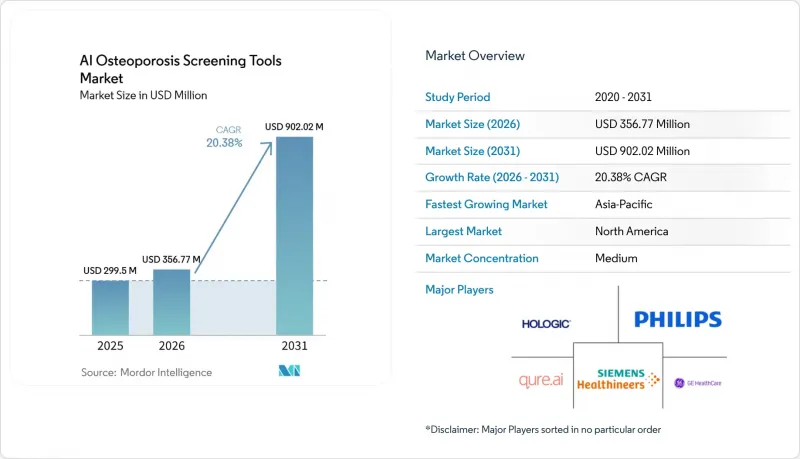
Mordor Intelligence에 의하면, AI 골다공증 스크리닝 툴 시장 규모는 2025년에 2억 9,950만 달러로 평가되었고 2026년 3억 5,677만 달러에서 2031년까지 9억 202만 달러에 이를 것으로 예측되며, 2026년부터 2031년까지 연평균 복합 성장률(CAGR)은 20.38%를 나타낼 전망입니다.
본 보고서는 기술별(DXA 분석, CT/X선 AI, 초음파 AI, 기타 도구), 배포 방식별(클라우드, 하이브리드, On-Premise), 최종 사용자별(병원, 전문 클리닉, 영상진단센터, 1차 진료기관, 학술 기관), 수익화 모델(구독, 영구 라이선스, 스캔 단위 과금), 지역(북미, 유럽, 아시아태평양, 중동 및 아프리카, 남미)별로 분류되어 있습니다.
전 세계 AI 골다공증 스크리닝 툴 시장 동향 및 인사이트
골다공증 유병률 증가 및 미진단 환자 수
AI 골다공증 스크리닝 툴 시장은 선진국 및 신흥국의 의료 시스템을 불문하고, 치료받지 못한 골질환의 규모로 인해 꾸준한 지지를 얻고 있습니다. 국제 골다공증 재단은 2025년 전 세계적으로 5억 명 이상이 골다공증을 앓고 있으며, 많은 고소득 국가에서 골절 환자 5명 중 1명만이 진단이나 적절한 치료를 받고 있다고 발표했습니다. 이러한 부족 현상은 여성에게만 국한된 것이 아닙니다. Rho사의 실세계 데이터에 따르면, AI를 활용한 DXA 검사 도입은 기존 방식에 비해 고령 남성의 실제 골밀도 저하 검출률이 더 높은 것으로 나타났으며, 이는 AI 골다공증 스크리닝 툴 시장에서 간과된 사례가 숨어 있음을 시사합니다. 이는 중요한 점입니다. 왜냐하면 임상의가 사전에 전용 골밀도 검사를 지시하지 않아도 작동하는 소프트웨어는 수년간 지속되어 온 검진 사각지대를 일반적인 영상 진단 과정 내의 정기적인 선별 검사 기회로 전환할 수 있기 때문입니다. 장기적인 부담 전망도 여전히 심각하며, 『Osteoporosis International』지의 예측에 따르면, 2050년까지 폐경 후 여성에서 골밀도 저하와 관련된 골절로 인해 39만 7,537명의 사망과 14,350,582 장애 조정 생명년(DALY)이 발생할 것으로 전망됩니다. 이는 예방 지향적 도구에 대한 수요가 장기적으로 지속될 것임을 뒷받침합니다.
기존 영상 데이터를 활용한 기회적 선별 검사 확대
AI 골다공증 스크리닝 툴 시장은 새로운 예약을 추가하지 않고 기존 영상 검사 데이터를 재사용하여 골량 감소를 감지하는 ‘기회적 선별 검사’로의 명확한 전환으로 인한 혜택도 누리고 있습니다. 2025년에 수행된 다기관 공동 코호트 연구에 따르면, 흉부 저선량 CT 및 요추 CT에 딥러닝 모델을 적용함으로써 여러 제조업체의 스캐너를 아우르는 높은 골다공증 진단 정확도를 얻었다는 보고가 있으며, 이로 인해 구매자는 서로 다른 기종이 혼재된 영상 진단 장비군 전체에 걸쳐 광범위하게 도입하는 데 신뢰를 갖기 쉬워졌습니다. 또한, 기회적 선별검사는 이미 일상 진료의 일부가 된 영상 진단 데이터를 활용하기 때문에 의료기관에게도 실용적인 이점이 있습니다. 이를 통해 환자의 부담이 경감되고, 별도의 검사로 인한 추가적인 방사선 피폭을 피할 수 있으며, 전용 선별 검사 시간을 확보할 필요도 없어집니다. 경제적 연구 결과도 이러한 주장을 뒷받침하고 있습니다. 독일, 미국, 일본에서 수행된 각 연구는 AI를 활용한 기회적 선별 검사가 각 환경에서 비용 대비 효과가 높다고 결론지었습니다. 그 결과, AI 골다공증 스크리닝 툴 시장은 좁은 범위의 영상의학용 소프트웨어라는 틀을 넘어, 지역 주민의 건강 상태 파악 및 골절 예방 워크플로우에서 보다 광범위한 역할을 담당하는 방향으로 전환되고 있습니다.
AI를 활용한 선별 검사의 보험 급여 전망 불투명성
AI 골다공증 스크리닝 툴 시장에서 보험 급여는 여전히 가장 뿌리 깊은 상업적 장벽으로 남아 있습니다. 그 이유는 많은 의료 기관이 여전히 임상적 가치와 예측 가능한 지불 경로를 연결하지 못하고 있기 때문입니다. 대부분공급업체는 여전히 의료 기관과의 청구 계약이나 보험사 간에 표준화되지 않은 판독 건당 보수 체계에 의존하고 있으며, 이로 인해 이러한 도구를 대규모로 도입하고자 하는 의료 제공업체에게는 수익 계획 수립이 어려워지고 있습니다. 골 건강 및 골다공증 재단은 2024년 CMS(미국 의료보험서비스센터)에 제출한 문서에서 2025년 의사 보수 일정을 통해 도입된 변경 사항을 포함한 기존 코드 세트에서는 골절 예방 및 연계 치료 프로그램의 조정 비용이 적절히 반영되지 않았다고 밝혔습니다. 유럽도 유사한 과제에 직면해 있습니다. 국제 골다공증 재단(IOF)과 메디맵스(Medimaps)가 2025년에 지적했듯이, 유럽연합(EU) 전역에서 골절 환자 5명 중 1명만이 진단이나 치료를 받고 있다는 사실은 임상적 필요성이 높은 경우에도 보상 제도나 치료 연계가 불충분하여 선별 검사 수검률을 제한할 수 있음을 보여줍니다. 보험사가 예방적 선별 검사와 후속 관리를 공식적인 치료 경로로 인정하기 전까지는 AI 골다공증 스크리닝 툴 시장이 그 기술적 역량이 시사하는 만큼 널리 보급되지 않는 상황이 지속될 것입니다.
부문 분석
2025년, AI를 활용한 DXA 영상 분석은 AI 골다공증 스크리닝 툴 시장 점유율의 47.1%를 차지하며 최대 기술 부문으로서의 지위를 유지했습니다. 이는 DXA가 임상 현장에서 골밀도 측정을 위한 확립된 표준 워크플로우로 계속 자리 잡고 있기 때문입니다. Medimaps사는 2025년 1월, TBS Osteo Advanced가 임상 현장에서 골 미세구조 평가를 위해 승인된 유일한 의료기기 소프트웨어이며, 연간 400만 건 이상의 검사에 사용되고 30개 이상의 국제 임상 지침에서 인용되고 있다고 발표했습니다. 이는 DXA 연동 소프트웨어가 여전히 AI 골다공증 스크리닝 툴 시장에서 상업적 수익의 기반이 되고 있는 이유를 보여줍니다. 이 부문은 특히 북미에서 DXA를 둘러싼 기존 보험 환급 제도의 혜택을 받고 있으며, 이로 인해 새로운 기회주의적 도구에 비해 구매 정당화를 더 쉽게 할 수 있습니다. 또한, 익숙한 방사선 진단 및 대사성 골질환 워크플로우에 원활하게 통합될 수 있으므로, 병원은 기존의 주요 골 검사를 수행하는 방식을 재설계하지 않고도 부가가치를 제공할 수 있습니다.
'기회적 CT 및 X선 AI 선별 검사'는 의료 시스템이 이미 보유하고 있는 영상 진단 역량을 수익화할 수 있기 때문에 2031년까지 연평균 성장률(CAGR) 21.4%를 기록하며 AI 골다공증 스크리닝 툴 시장에서 가장 빠르게 성장하는 분야가 될 것으로 예측됩니다. 2024년 4월 FDA가 Rho에 대해 De Novo 승인을 내림으로써, 표준 X선 영상을 이용한 기회적 저골밀도 평가에 관한 명확한 규제상 선례가 확립되었습니다. 이를 통해 AI 골다공증 스크리닝 툴 업계의 이 분야에서 도입의 가장 큰 장벽 중 하나가 해소되었습니다. 2026년 대만의 선별 대상 집단을 대상으로 한 연구에서는 흉부 X선 영상을 통해 골밀도 이상을 판정하는 AI 모델의 AUC가 0.95였던 것으로 보고되었으며, 지역별 검증이 완료되면 더 광범위한 집단에 대한 도입이 임상적으로 정당화될 수 있음을 시사하고 있습니다. 초음파를 이용한 AI 선별 검사는 휴대용 기기나 자원이 제한된 환경에서 여전히 유용하지만, 골·근육 허약증을 결합한 접근법이나 AI를 활용한 골절 위험 계산 도구와 같은 다른 기법들은 아직 초기 단계의 기여에 그치고 있습니다. 중국 농촌 지역에서는 선별 검사에 대한 접근성을 확대하기 위해 휴대용 DXA 프로그램이 이미 활용되고 있으며, 전문 인프라가 제한된 지역에서의 분석을 확대하기 위해 AI 기반 영상 분석 기능이 추가되고 있습니다.
클라우드 기반 도입은 2025년에 매출 점유율의 56.3%를 차지하고, 2031년까지 연평균 성장률(CAGR) 22.3%라는 가장 높은 성장률을 나타낼 것으로 전망되어, AI 골다공증 스크리닝 툴 시장에서 상업적으로 가장 선호되는 도입 모델로 자리매김하고 있습니다. 이러한 우위는 AI 소프트웨어에 대한 실질적인 요구를 반영한 것입니다. 벤더는 각 병원에 개별 소프트웨어 스택을 유지하도록 요구하지 않으면서도, 업데이트 관리, 다중 거점 지원, 그리고 분석 결과를 임상 시스템과 연동해야 하기 때문입니다. Rho사는 FHIR 표준 통합 기능을 활용하여 전자건강기록(EHR)에서 관련 데이터를 추출하고, 소견을 워크플로우에 반영하고 있습니다. 이는 AI 골다공증 스크리닝 툴 시장을 독립된 용도이 아닌 일상적인 진료의 일환으로 운영하고 싶어 하는 의료 기관에게, 클라우드 제공이 중심적인 역할을 수행하고 있는 이유를 여실히 보여줍니다. 또한, Medimaps사도 2025년에 여러 거점에 걸친 플릿 관리 기능을 갖춘 ‘TBS Osteo Advanced’를 출시하여 클라우드 기반 중앙 관리의 이점을 더욱 확대했습니다. 이는 대규모 의료 시스템에서 네트워크 수준의 표준화가 얼마나 중요한지를 보여줍니다.
클라우드 분야가 혜택을 보고 있는 또 다른 이유는 이것이 현재 기업 구매자들이 소프트웨어를 평가하는 방식과 부합한다는 점에 있습니다. 그곳에서는 지속적인 모델 개선과 공유 거버넌스가 초기 도입만큼이나 중요하게 여겨지고 있습니다. 여러 거점을 보유한 영상 진단 그룹의 경우, 일원화된 관리를 통해 각 거점별 버전 관리 부담이 경감되고, 거점 간 품질의 일관성을 유지할 수 있습니다. 이는 AI 골다공증 스크리닝 툴 시장에서 중요한 요소입니다. 왜냐하면 감지 정확도, 워크플로우의 타이밍, 그리고 임상의의 수용성은 알고리즘의 성능뿐만 아니라 신뢰할 수 있는 도입 환경에 좌우되기 때문입니다. 따라서 클라우드를 통한 제공은 파일럿 프로젝트에서 전체 시스템을 대상으로 한 계약으로의 전환을 촉진하고 있습니다.
지역별 분석
2025년, 북미는 AI 골다공증 스크리닝 툴 시장의 45.1% 점유율을 차지하며, 지역별로는 가장 큰 기여를 한 지역이 되었습니다. 이는 북미가 다른 대부분의 지역보다 고밀도의 DXA 인프라, 성숙한 FDA 소프트웨어 승인 절차, 그리고 견고한 보험 환급 체계를 모두 갖추고 있기 때문입니다. 미국에서는 현재 TEAM을 통해 수요 유발 요인이 더욱 명확해지고 있습니다. 에피소드 기반 책임 체제의 대상이 되는 병원들은 고액의 합병증이 발생하기 전에 골 건강 상태의 검출 정확도를 향상시켜야 할 명확한 이유가 있기 때문입니다. 또한, 이 지역은 활발한 규제 관련 파이프라인의 혜택도 받고 있으며, 이미 여러 벤더가 더 광범위한 의료 제공업체 네트워크에 접근하는 과정에서 FDA 승인을 신뢰성의 증거로 활용하고 있습니다. 캐나다에서는 일상 진료에 Rho를 도입하여 5만 명 이상의 환자를 처리했으며, AI를 활용한 의뢰 경로를 통해 선별 검사가 불충분한 고위험군을 식별할 수 있음이 입증되어, 의미 있는 실제 현장 검증 결과를 얻었습니다.
유럽은 질병 부담이 크기 때문에 AI 골다공증 스크리닝 툴 시장에서 여전히 중요한 시장이지만, 보험 급여 및 의료 연계에 대한 구조적 제약으로 인해 상용화에는 여전히 진전에 어려움이 있습니다. 국제 골다공증 재단의 추산에 따르면, 50세 이상의 유럽인 3,200만 명이 골다공증을 앓고 있으며, 유럽연합(EU), 스위스, 영국에서의 연간 골다공증성 골절 건수는 2034년까지 534만 건에 달할 것으로 예측됩니다. 독일의 경우, 현지 조사 결과 AI를 활용한 흉부 X선 선별 검사가 비용 대비 효과가 뛰어난 것으로 밝혀져, 해당 지역에서는 더 광범위한 기회를 포착한 도입을 위한 실용적인 경제적 근거를 확보하게 되었습니다. 한편, 유럽에서의 전개는 여전히 MDR(의료기기 규정) 준수에 크게 의존하고 있으며, Medimaps사가 채택한 미국과 EU 양쪽에서 승인을 획득하는 이중 전략은 두 지역에서 제품을 판매하고자 하는 공급업체에게 중요한 지침이 되고 있습니다.
아시아태평양은 대규모 고령 인구, 많은 국가에서 DXA 검사에 대한 접근 제한, 그리고 실용적인 선별 수단으로서 AI의 수용 확대에 힘입어, 2031년까지 연평균 성장률(CAGR) 22.1%를 기록하며 AI 골다공증 스크리닝 툴 시장 규모에서 가장 빠른 성장을 보일 전망입니다. 2025년 APCO-IOF 지역 조사에 따르면, 조사 대상인 아시아태평양 국가 중 골다공증을 국가적 보건 우선 과제로 삼고 있는 곳은 불과 6개국에 그쳐, 이 지역 전체에 여전히 많은 미충족 수요가 남아 있음을 여실히 보여주고 있습니다. 일본의 경우, 선별 검사율은 여전히 낮은 수준이지만, 국내 조사에 따르면 고령 여성의 골절 예방에 있어 AI를 활용한 흉부 X선 선별 검사가 비용 대비 효과가 뛰어나다는 점이 밝혀져 두드러진 존재감을 보이고 있습니다. 중국 역시 접근성 측면에서 큰 기회를 내포하고 있습니다. 농촌 지역에서 휴대용 DXA 프로그램이 선별검사의 적용 범위를 넓히고 있을 뿐만 아니라, 전문의 부족을 보완해 줄 AI 기반 영상 분석 도구에 대한 수요가 발생하고 있기 때문입니다. 중동 및 아프리카 및 남미는 여전히 초기 단계 시장이며, 인프라 격차와 보험 급여 제한이 도입을 저해하고 있지만, 향후 예정된 디지털 헬스 분야에 대한 투자를 통해 AI 골다공증 스크리닝 툴 시장에 선택적인 진입 기회가 생길 것으로 전망됩니다.
기타 혜택:
- 엑셀 형식 시장 예측(ME) 시트
- 3개월간의 애널리스트 지원
자주 묻는 질문
목차
제1장 서론
제2장 조사 방법
제3장 주요 요약
제4장 시장 구도
제5장 시장 규모와 성장 예측
제6장 경쟁 구도
제7장 시장 기회와 향후 전망
JHS 26.08.11According to Mordor Intelligence, the AI osteoporosis screening tools market size was valued at USD 299.5 million in 2025 and is estimated to grow from USD 356.77 million in 2026 to reach USD 902.02 million by 2031, at a CAGR of 20.38% during the forecast period (2026-2031).
This report is Segmented by Technology (DXA Analysis, CT/X-Ray AI, Ultrasound AI, Other Tools), Deployment Mode (Cloud, Hybrid, On Premises), End User (Hospitals, Specialty Clinics, Imaging Centers, Primary Care, Academic Institutions), Monetization Model (Subscription, Perpetual License, Per-Scan), and Geography (North America, Europe, Asia-Pacific, MEA, South America).
Global AI Osteoporosis Screening Tools Market Trends and Insights
Rising Osteoporosis Prevalence and Undiagnosed Burden
The AI osteoporosis screening tools market draws steady support from the scale of untreated bone disease across both developed and emerging care systems. The International Osteoporosis Foundation stated in 2025 that more than 500 million people live with osteoporosis worldwide, and only 1 in 5 fracture patients receives a diagnosis or appropriate therapy in many high-income settings. The shortfall is not limited to women, because real-world evidence from Rho showed that AI-prompted DXA referrals identified higher rates of true low bone mineral density in older men than conventional referral practice did, which points to a hidden pool of missed cases in the AI osteoporosis screening tools market. This matters because software that works without a clinician first ordering a dedicated bone exam can convert long-standing referral blind spots into routine screening opportunities inside ordinary imaging pathways. Long-range burden projections also remain severe, with Osteoporosis International projecting 397,537 deaths and 14,350,582 disability-adjusted life years among post-menopausal women from low bone mineral density-related fractures by 2050, which supports a long tail of need for prevention-oriented tools.
Expansion of Opportunistic Screening from Existing Imaging Data
The AI osteoporosis screening tools market is also benefiting from a clear shift toward opportunistic screening, where existing scans are reused to detect bone loss without adding new appointments. A 2025 multicenter cohort study reported that deep learning models applied to chest low-dose CT and lumbar CT delivered high diagnostic accuracy for osteoporosis across scanners from multiple manufacturers, which helps buyers trust wider deployment across mixed imaging fleets. Health systems also gain a practical advantage because opportunistic screening uses imaging that is already part of routine care, which lowers patient friction, avoids added radiation from separate exams, and cuts the need for dedicated screening slots. Economic findings strengthen the case, because studies in Germany, the United States, and Japan each concluded that AI-assisted opportunistic screening can be cost-effective in their respective settings. As a result, the AI osteoporosis screening tools market is moving beyond a narrow radiology software category and toward a broader role in population health detection and fracture prevention workflows.
Limited Reimbursement Visibility for AI-Assisted Screening
Reimbursement remains the most persistent commercial barrier in the AI osteoporosis screening tools market because many facilities still cannot match clinical value with a predictable payment path. Most vendors still rely on facility billing arrangements or per-read economics that are not standardized across payers, which makes revenue planning difficult for providers that want to deploy these tools at scale. The Bone Health and Osteoporosis Foundation stated in its 2024 CMS submission that existing code sets, including changes introduced through the 2025 Physician Fee Schedule, do not capture the coordination costs of fracture prevention and collaborative care programs. Europe faces a similar challenge, because the International Osteoporosis Foundation and Medimaps noted in 2025 that only 1 in 5 fracture patients across the European Union receives diagnosis or therapy, which shows how weak reimbursement and care coordination can limit screening uptake even when clinical need is high. Until payers treat preventive screening and follow-up as a recognized care pathway, the AI osteoporosis screening tools market will continue to face slower rollouts than its technical capabilities might suggest.
Other drivers and restraints analyzed in the detailed report include:
- AI Automation Reduces Radiologist and Technologist Workload
- Value-Based Care Incentives for Earlier Risk Stratification
- Clinician Trust, Explainability, and Liability Concerns
For complete list of drivers and restraints, kindly check the Table Of Contents.
Segment Analysis
AI-Enabled DXA Image Analysis held 47.1% of AI osteoporosis screening tools market share in 2025, which kept it as the largest technology segment because DXA remains the established reference workflow for bone mineral density measurement in clinical practice. Medimaps stated in January 2025 that TBS Osteo Advanced is the only approved medical device software for bone microarchitecture evaluation in clinical settings, is used in more than 4 million procedures each year, and is referenced by more than 30 international clinical guidelines, which shows why DXA-linked software still anchors commercial revenue in the AI osteoporosis screening tools market. This segment benefits from an existing reimbursement structure around DXA, especially in North America, which makes buyer justification more straightforward than it is for newer opportunistic tools. It also fits cleanly into familiar radiology and metabolic bone disease workflows, so hospitals can add value without redesigning how core bone testing is already performed.
Opportunistic CT and X-Ray AI Screening is projected to be the fastest-expanding part of the AI osteoporosis screening tools market size at a 21.4% CAGR through 2031, because it can monetize imaging capacity that health systems already own. The April 2024 FDA De Novo authorization for Rho created a clear regulatory precedent for opportunistic low bone mineral density assessment from standard X-rays, which reduced one of the biggest adoption barriers for this branch of the AI osteoporosis screening tools industry FDA. A 2026 study in a Taiwanese screening population reported an AUC of 0.95 for an AI model reading chest X-rays for abnormal bone mineral density, which supports the clinical case for wider population deployment when local validation is in place. Ultrasound-based AI screening remains relevant in portable and resource-limited settings, while other tools such as combined bone-muscle frailty approaches and AI-assisted fracture risk calculators are still earlier-stage contributors. In rural China, portable DXA programs are already being used to widen screening access, and AI interpretation layers are being added to help scale analysis where specialist infrastructure is limited.
Cloud-based deployment held 56.3% revenue share in 2025 and is also expected to post the fastest growth at 22.3% CAGR through 2031, which makes it the most commercially favored deployment model in the AI osteoporosis screening tools market. This lead reflects the practical needs of AI software, because vendors must manage updates, support multiple sites, and connect outputs back into clinical systems without asking each hospital to maintain a separate software stack. Rho uses FHIR-standard integration to pull relevant data from electronic health records and return findings into workflow, which illustrates why cloud delivery is becoming central for facilities that want the AI osteoporosis screening tools market to operate as part of routine care rather than as a stand-alone application. Medimaps also expanded the case for cloud-style central management in 2025 when it launched TBS Osteo Advanced with multi-site fleet management capabilities, showing how network-level standardization matters in larger health systems.
The cloud segment is also benefiting because it fits the way enterprise buyers now assess software, where ongoing model refinement and shared governance matter as much as the first installation. For multi-location imaging groups, centralized administration reduces the burden of local version control and keeps quality more consistent across sites. That matters in the AI osteoporosis screening tools market because detection accuracy, workflow timing, and clinician acceptance all depend on dependable deployment rather than on algorithm performance alone. Cloud delivery therefore supports the shift from pilot projects toward system-wide contracts.
Complete Report Scope:
- By Technology
- AI-Enabled DXA Image Analysis
- Opportunistic CT and X-Ray AI Screening
- Ultrasound-Based AI Screening
- Other AI Screening Tools
- By Deployment Mode
- Cloud Based
- Hybrid
- On Premises
- By End User
- Hospitals and Diagnostic Centers
- Specialty Orthopedic and Endocrine Clinics
- Imaging Centers
- Primary Care Networks
- Research and Academic Institutions
- By Monetization Model (Value)
- By Monetization Model (Value)
- Subscription
- Perpetual License
- Per-Scan and Usage Based
- By Geography
- North America
- United States
- Canada
- Mexico
- Europe
- Germany
- United Kingdom
- France
- Italy
- Spain
- North America
- United States
- Canada
- Mexico
- Europe
- Germany
- United Kingdom
- France
- Italy
- Spain
- Rest of Europe
- Asia-Pacific
- China
- India
- Japan
- South Korea
- Australia
- Rest of Asia-Pacific
- Middle East & Africa
- GCC
- South Africa
- Rest of Middle East and Africa
- South America
- Brazil
- Argentina
- Rest of South America
- North America
Geography Analysis
North America held 45.1% of AI osteoporosis screening tools market share in 2025, which made it the largest regional contributor because it combines dense DXA infrastructure, a mature FDA software pathway, and stronger reimbursement foundations than most other regions. The U.S. now adds a sharper demand trigger through TEAM, because hospitals covered under episode-based accountability have a clearer reason to improve bone health detection before costly complications occur. The region also benefits from an active regulatory pipeline, with several vendors already using FDA clearance as a credibility signal when approaching broader provider networks. Canada adds meaningful real-world validation, because routine-care Rho deployments there processed more than 50,000 patients and showed that AI-supported referral pathways can surface under-screened high-risk groups.
Europe remains important for the AI osteoporosis screening tools market because disease burden is large, but commercialization still moves through structural limits in reimbursement and care coordination. The International Osteoporosis Foundation estimated that 32 million Europeans aged 50 and over have osteoporosis, and annual osteoporotic fractures across the European Union, Switzerland, and the UK are projected to reach 5.34 million by 2034. Germany stands out because local research found AI chest radiograph screening to be cost-effective, which gives the region a more practical economic case for broader opportunistic deployment. At the same time, the European route still depends heavily on MDR compliance, and Medimaps' dual U.S. and EU clearance path has become an important reference point for suppliers that want to sell across both regions.
Asia Pacific is set to post the fastest growth in the AI osteoporosis screening tools market size at 22.1% CAGR through 2031, driven by a large aging population, limited DXA access in many countries, and growing acceptance of AI as a practical screening extension. The 2025 APCO-IOFregional audit found that osteoporosis is a national health priority in only 6 audited Asia Pacific countries, which underscores how much unmet need remains across the region. Japan stands out because local research found AI-assisted opportunistic chest radiograph screening to be cost-effective for fracture prevention in older women, even though screening rates remain low. China also represents a strong access-driven opportunity, because portable DXA programs in rural areas are widening screening coverage and creating demand for AI interpretation layers that can compensate for limited specialist capacity. The Middle East and Africa and South America remain early-stage markets, where infrastructure gaps and limited reimbursement still slow adoption, even though later-period digital health investment should create selective openings for the AI osteoporosis screening tools market.
- Hologic
- GE Healthcare
- Siemens Healthineers
- Koninklijke Philips
- FUJIFILM
- Canon
- Mindray
- Esaote S.p.A.
- Carestream Health
- Agfa-Gevaert
- Naitive Technologies, Inc.
- 16 Bit Inc.
- Qure.AI Technologies Pvt. Ltd.
- Zebra Medical Vision Ltd.
- Nanox.AI
- Gleamer
- Shukun Technology Co., Ltd.
- INFERVISION TECHNOLOGY CO., LTD.
- Medimaps Group SA
- OSTEOSYS Co., Ltd.
Additional Benefits:
- The market estimate (ME) sheet in Excel format
- 3 months of analyst support
TABLE OF CONTENTS
1 Introduction
- 1.1 Study Assumptions & Market Definition
- 1.2 Scope of the Study
2 Research Methodology
3 Executive Summary
4 Market Landscape
- 4.1 Market Overview
- 4.2 Market Drivers
- 4.2.1 Rising Osteoporosis Prevalence and Undiagnosed Fracture Risk
- 4.2.2 Expansion of Opportunistic Screening from Routine Imaging Workflows
- 4.2.3 AI Automation Reduces Radiologist and Technologist Workload
- 4.2.4 Value-Based Care Incentives for Earlier Risk Stratification
- 4.2.5 Cloud and EHR Integrated Deployment Improves Scale-Up Speed
- 4.2.6 Under-Screened Primary Care Populations Create New Catchment Areas
- 4.3 Market Restraints
- 4.3.1 Regulatory Clearance Burden for Clinical AI in Imaging
- 4.3.2 Interoperability and Data Governance Constraints
- 4.3.3 Limited Reimbursement Visibility for AI-Assisted Screening
- 4.3.4 Clinician Trust, Explainability, and Liability Concerns
- 4.4 Value / Supply-Chain Analysis
- 4.5 Regulatory Landscape
- 4.6 Technological Outlook
- 4.7 Porters Five Forces
5 Market Size & Growth Forecasts
- 5.1 By Technology
- 5.1.1 AI-Enabled DXA Image Analysis
- 5.1.2 Opportunistic CT and X-Ray AI Screening
- 5.1.3 Ultrasound-Based AI Screening
- 5.1.4 Other AI Screening Tools
- 5.2 By Deployment Mode
- 5.2.1 Cloud Based
- 5.2.2 Hybrid
- 5.2.3 On Premises
- 5.3 By End User
- 5.3.1 Hospitals and Diagnostic Centers
- 5.3.2 Specialty Orthopedic and Endocrine Clinics
- 5.3.3 Imaging Centers
- 5.3.4 Primary Care Networks
- 5.3.5 Research and Academic Institutions
- 5.4 By Monetization Model (Value)
- 5.4.1 Subscription
- 5.4.2 Perpetual License
- 5.4.3 Per-Scan and Usage Based
- 5.5 By Geography
- 5.5.1 North America
- 5.5.1.1 United States
- 5.5.1.2 Canada
- 5.5.1.3 Mexico
- 5.5.2 Europe
- 5.5.2.1 Germany
- 5.5.2.2 United Kingdom
- 5.5.2.3 France
- 5.5.2.4 Italy
- 5.5.2.5 Spain
- 5.5.4.6 Rest of Europe
- 5.5.5 Asia-Pacific
- 5.5.5.1 China
- 5.5.5.2 India
- 5.5.5.3 Japan
- 5.5.5.4 South Korea
- 5.5.5.5 Australia
- 5.5.5.6 Rest of Asia-Pacific
- 5.5.6 Middle East & Africa
- 5.5.6.1 GCC
- 5.5.6.2 South Africa
- 5.5.6.3 Rest of Middle East and Africa
- 5.5.7 South America
- 5.5.7.1 Brazil
- 5.5.7.2 Argentina
- 5.5.7.3 Rest of South America
- 5.5.1 North America
6 Competitive Landscape
- 6.1 Market Concentration
- 6.2 Market Share Analysis
- 6.3 Company Profiles
- 6.3.1 Hologic, Inc.
- 6.3.2 GE HealthCare
- 6.3.3 Siemens Healthineers AG
- 6.3.4 Koninklijke Philips N.V.
- 6.3.5 Fujifilm Holdings Corporation
- 6.3.6 Canon Medical Systems Corporation
- 6.3.7 Mindray Medical International Limited
- 6.3.8 Esaote S.p.A.
- 6.3.9 Carestream Health, Inc.
- 6.3.10 Agfa-Gevaert N.V.
- 6.3.11 Naitive Technologies, Inc.
- 6.3.12 16 Bit Inc.
- 6.3.13 Qure.ai Technologies Pvt. Ltd.
- 6.3.14 Zebra Medical Vision Ltd.
- 6.3.15 Nanox.AI
- 6.3.16 Gleamer
- 6.3.17 Shukun Technology Co., Ltd.
- 6.3.18 INFERVISION TECHNOLOGY CO., LTD.
- 6.3.19 Medimaps Group SA
- 6.3.20 OSTEOSYS Co., Ltd.
7 Market Opportunities & Future Outlook
- 7.1 White Space and Unmet Need Assessment


