

|
시장보고서
상품코드
2118213
의료 소프트웨어용 컴퓨터 비전 시장 : 시장 점유율 분석, 업계 동향 및 통계, 성장 예측(2026-2031년)Computer Vision In Medical Software - Market Share Analysis, Industry Trends & Statistics, Growth Forecasts (2026 - 2031) |
||||||
 Mordor Intelligence
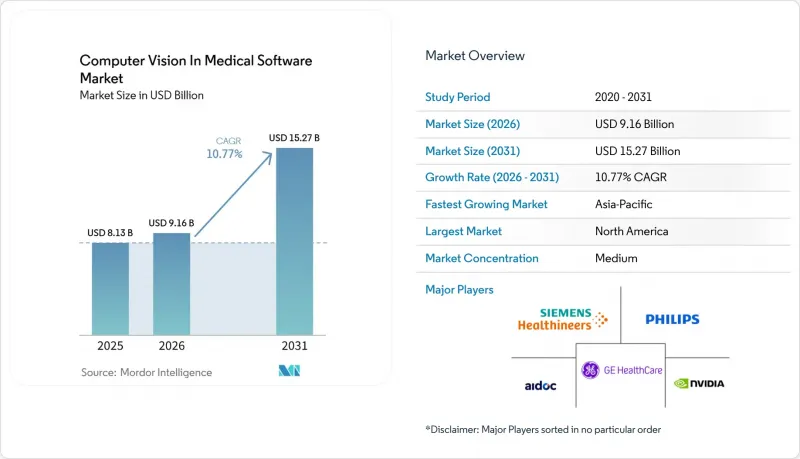
Mordor Intelligence에 의하면, 의료 소프트웨어용 컴퓨터 비전 시장 규모는 2025년 81억 3,000만 달러로 평가되었고, 2026년에는 91억 6,000만 달러로 추정되고, 2031년까지 152억 7,000만 달러에 이를 것으로 예상되며, 2026-2031년 CAGR 10.77%로 성장할 전망입니다.
본 보고서는 구성 요소별(소프트웨어, 서비스), 용도별(6개 부문), 영상 진단법별(9개 부문), 기술별(7개 부문), 배포 방식별(3개 부문), 최종 사용자별(6개 부문), 의료 전문 분야별(6개 부문), 지역별(북미, 유럽, 아시아태평양, 중동, 남미)로 분류되어 있습니다.
세계의 의료 소프트웨어용 컴퓨터 비전 시장 동향 및 인사이트
만성 질환의 영상 진단 건수가 기존 인프라 용량을 초과함에 따라
만성 심혈관 질환, 당뇨병 합병증 및 암으로 인해 의료 제공업체가 의뢰하고 판독해야 하는 스캔 건수는 계속 증가하고 있습니다. 미국에서는 매년 9억 건 이상의 의료 영상 검사가 수행되고 있어 스캐너의 처리 능력과 방사선과 팀에 부담이 가중되고 있습니다. 한 조사에 따르면, 영상 검사의 과다 사용률은 중앙값 기준으로 11.2%에서 20%에 달하며, 일부 환경에서는 50%에 이르고, 이로 인해 스캔을 의뢰하기 전과 촬영 후 의사 결정 지원의 필요성이 대두되고 있습니다. 이 때문에 의료 소프트웨어 분야의 컴퓨터 비전 시장은 영상 진단뿐만 아니라 수용 능력 관리 측면에서도 중요성이 커지고 있습니다. 특히 병원이 임상의에게 제한된 판독 시간을 임상적 우선순위가 높은 검사에 집중할 것을 요구할 경우, 그 중요성은 더욱 커집니다. 병원이 불필요한 검사를 줄이고 적절한 증례 처리를 신속하게 처리할 수 있는 도구를 요구할 때, 의료 소프트웨어 분야의 컴퓨터 비전 시장은 그 혜택을 누리게 될 것입니다. 따라서 검사 의뢰, 분류, 보고를 연계하는 플랫폼은 단독의 검출 도구보다 더 높은 가치를 제공할 가능성이 높다고 볼 수 있습니다.
방사선과 전문의 부족이 구조적인 상업적 호재를 낳고 있습니다.
방사선과 전문의 부족은 의료 시스템이 워크플로우 자동화를 고려하게 하는 직접적인 이유가 되고 있습니다. 미국에는 3만 4,000명의 현역 방사선과 전문의가 있으며, 그중 16%는 파트타임으로 근무하고, 32%는 55세 이상이었습니다. 미국 방사선학회(ACR)의 구인 게시판에는 1,930건에 가까운 구인 공고가 게시되어 있는 반면, 매년 방사선과에 매칭되는 전공의는 1,400명 미만에 그치고 있습니다. 영국 왕립방사선학회(RRS)에 따르면, 2025년에는 영국에서 2,300명의 임상 방사선과 전문의가 부족할 것으로 전망됩니다. 2026년에 실시된 유방촬영술 시험에서는 AI를 활용한 선별 검사 전략으로 인해 방사선과 의사의 업무 부담이 63.6% 경감되고, 암 검출률이 15.2% 향상된 것으로 밝혀졌습니다. 이러한 결과를 통해 의료 소프트웨어 분야의 컴퓨터 비전 기술은 도구가 업무 부담과 진단 성능 모두를 해결하면서도, 최종 판단과 현장 워크플로우 설계는 임상 팀이 주도할 수 있는 단계에 이르러 시범 평가 단계를 넘어서는 중입니다.
높은 도입 비용과 임상적 근거의 불균일성이 시스템 차원의 도입을 지연시키고 있습니다.
자본 예산이 제한적인 지역 병원이나 안전망 의료기관에게 있어 도입 비용은 여전히 큰 과제로 남아 있습니다. 비용은 라이선스 비용에 그치지 않고, PACS와의 통합, 현지 검증, 임상의 교육, 기술 지원, 주석 작업, 그리고 지속적인 모델 모니터링까지 미칩니다. 워크플로우에 통합된 도구는 검출률 향상과 보고서 작성 시간 단축에 기여하지만, 그로 인한 환자에게의 이점에 대한 근거는 전체 치료 경로를 통틀어 일관되지 않습니다. 따라서 조달 담당자들은 워크플로우 성능 향상이 조직 내 실제 병목 현상을 해소할 수 있는지 의문을 제기하고 있습니다. 2021년부터 2023년까지의 시범 운영 기간 동안 개별 도구를 도입했던 구매자들은 이제 보다 광범위한 엔터프라이즈 플랫폼으로의 통합을 추진하고 있습니다. 이로 인해 다양한 환자 집단에 걸쳐 임상적 유용성을 입증하지 못하는 단일 적응증에 특화된 공급업체의 생존 여지는 좁아지고 있습니다.
부문 분석
2025년에는 소프트웨어가 부문 매출의 78.23%를 차지하며, 의료 소프트웨어 분야 컴퓨터 비전 시장 규모에서 가장 큰 점유율을 기록했습니다. 구독 및 SaaS(Software-as-a-Service) 모델은 지속적인 매출을 뒷받침할 뿐만 아니라 임상 알고리즘의 빈번한 개선을 가능하게 합니다. 영상 진단용 하드웨어는 8-12년의 교체 주기를 따르지만, 소프트웨어는 규제 당국의 관리 하에 있는 프로세스를 통해 보다 정기적으로 업데이트할 수 있습니다. 이러한 차이로 인해, 기존 영상 진단 자산을 개선하려는 병원의 노력에서 소프트웨어 계층이 중심적인 역할을 하고 있습니다. 또한, 의료 시스템이 여러 부서와 임상 용도를 아우르는 엔터프라이즈 계약을 선호하는 경우, 소프트웨어 공급업체도 혜택을 받게 됩니다.
도입, 현장 타당성 확인, 모니터링, 시판 후 조사에 대한 지원을 요청하는 구매자가 늘어남에 따라, 서비스 시장은 2031년까지 연평균 성장률(CAGR) 11.5%로 확대될 것으로 예측됩니다. 매니지드 서비스 계약을 통해 기술 지원과 수년에 걸친 모델 성능 평가를 결합할 수 있습니다. 이러한 계약 형태는 개발 단계에서의 성능이 현장 도입 후의 성능과 일치하지 않을 수 있다는 광범위한 우려를 반영한 것입니다. Aidoc사는 2026년 1월, 단일 워크플로우로 11가지 복부 CT 적응증을 포괄하는 다중 적응증 기반 모델에 대해 FDA 승인을 획득했습니다. 이러한 제품은 소프트웨어 제공업체들이 제한적인 알고리즘에서 보다 광범위한 임상 플랫폼으로 전환하고 있는 이유를 보여줍니다. 따라서 의료 소프트웨어의 컴퓨터 비전 분야에서는 소프트웨어 도입에 따라 서비스 요구 사항도 확대되고 있습니다.
2025년에는 흉부, 복부, 신경계 및 유방 영상 진단 분야에서 방사선 의학의 활용 사례가 빈번해진 것을 배경으로, 의료 영상 진단 분야가 매출의 41.56%를 차지했습니다. 검출 및 분류 도구는 이러한 분야에서 많은 새로운 용도보다 더 오랜 임상 실적을 보유하고 있습니다. 그 가치는 일관된 우선순위 지정과 보고가 필요한 사례 수가 매우 많기 때문입니다. 또한 병원 측도 소요 시간이나 업무 부담 등 진단 도구를 평가하는 데 사용되는 워크플로우 지표를 잘 이해하고 있습니다. 이로 인해 의료 소프트웨어의 컴퓨터 비전 분야에서 영상 진단 용도는 확고한 입지를 다지고 있습니다. 이는 의료 제공업체들이 그 가치를 업무 부담, 우선순위 지정, 보고서의 품질, 검사 건수 등 일상적으로 친숙한 지표와 연결 지을 수 있기 때문입니다.
임상시험, 의약품 개발 및 연구 개발 분야는 2031년까지 연평균 성장률(CAGR) 11.2%를 나타낼 것으로 예측됩니다. 제약 기업 후원사들은 바이오마커 적격성 평가, 디지털 병리학의 평가 지표, 그리고 시험 실시 기관 간 일관된 영상 검토를 위해 영상 AI를 활용하고 있습니다. 영상 유도 수술 및 수술용 로봇 기술도 실시간 안내가 업무상 명확한 의미를 갖기 때문에 투자를 유치하고 있습니다. 메드트로닉(Medtronic)은 2026년 7월, 수술실 시술 중 실시간 AI를 활용하기 위한 컴퓨팅 플랫폼으로 ‘Touch Surgery Aide’를 발표했습니다. 환자 모니터링, 자산 인텔리전스, 병리 검사 자동화 역시 업무상의 이점을 정량화하기 쉬워 주목을 받고 있습니다. 이러한 이용 사례를 통해 수요는 기존의 방사선 판독실의 범위를 넘어 확장되고 있습니다.
2025년, X선 및 디지털 방사선 촬영은 검사 건수가 많고, 트리아지 및 검출 용도의 확립된 기반에 힘입어 모달리티 수익의 24.22%를 차지했습니다. 흉부 X선 도구는 임상의가 시의적절한 지원이 필요한 응급 의료 및 지역 의료 현장에서 특히 중요한 역할을 하고 있습니다. 2026년 전향적 연구에 따르면, 흉부 X선용 시각·언어 AI 시스템은 자원이 제한된 응급실에서 진단 정확도와 워크플로우 효율을 향상시킨 것으로 보고되었습니다. 이는 학술 기관 이외의 의료 소프트웨어에서 컴퓨터 비전 활용이 확대되고 있음을 뒷받침합니다. 응급실이나 지역 병원에서는 기존의 X선 촬영 건수나 제한된 전문의 체제에 맞추어 작동하는 도구가 요구되고 있습니다. X선은 의료 소프트웨어에서 컴퓨터 비전을 평가하는 의료 제공업체들에게 여전히 실용적인 도입 수단으로 자리 잡고 있습니다.
디지털 병리학 및 전체 슬라이드 이미징은 2031년까지 연평균 성장률(CAGR) 11.3%를 나타낼 것으로 예측됩니다. 파운데이션 모델, 멀티모달 시스템, 언어 모델 코파일럿이 진단 지원, 예후 예측, 워크플로우 효율화, 신약 개발에 응용되고 있습니다. 디지털 병리학 도입이 확대됨에 따라, DICOM-WSI 표준은 스캐너와 알고리즘 간의 상호 운용성을 향상시킬 수 있습니다. CT 및 MRI는 복잡한 감지, 재구성, 분할, 치료 계획과 같은 작업을 지원하기 때문에 여전히 주요 영상 모달리티입니다. GE 헬스케어는 2026년 4월, 몇 가지 영상 진단 적응증에 대해 ‘True Definition DL CT’ 재구성 기술에 대한 FDA 승인을 획득했습니다. PET 및 SPECT, 망막 영상 진단, 내시경 검사, 수술 중 영상 진단은 여전히 규모는 작지만, 모달리티 간 통합 모델의 가능성을 지닌 분야입니다.
지역별 분석
2025년, 북미는 전 세계 매출의 39.11%를 차지하며 의료 소프트웨어 분야의 컴퓨터 비전 시장에서 가장 규모가 큰 지역 점유율을 확보했습니다. 이 지역은 FDA 승인을 받은 기기의 높은 집중도와 성숙한 EHR 및 PACS 인프라를 모두 갖추고 있습니다. 2026년, 미국 내 신규 AI 기기 신청의 30%에서 사전에 정해진 변경 관리 계획(Change Control Plan)이 채택되어, 변경 사항마다 개별 신청을 하지 않고도 합의된 모델 업데이트가 가능해졌습니다. 또한, FDA의 ADVOCATE 프로그램은 의료 분야에서의 능동형 AI를 위한 위험 기반 프레임워크에 대한 노력이 지속되고 있음을 보여줍니다. 캐나다와 멕시코에서는 미국에서 승인된 솔루션이 채택되고 있지만, 캐나다의 주별 데이터 요건으로 인해 플랫폼의 광범위한 배포가 복잡해질 가능성이 있습니다.
유럽에서는 독일, 영국, 프랑스, 이탈리아, 스페인 등 각국의 조달 시스템이 서로 다르기 때문에 시장 기회는 크지만 분산된 상황입니다. EU AI법은 2024년 8월 이후 고위험 의료용 AI에 대해 적합성 평가, 문서화 및 시판 후 감시 요건을 부과하고 있습니다. 이러한 요건은 의료 소프트웨어 분야의 컴퓨터 비전 시장 진입 비용을 높일 가능성이 있습니다. 특히 문서화, 모니터링, 감사 준비 및 현지 규제 당국과의 협력을 담당할 전담 팀을 갖추지 못한 EU 역외의 소규모 공급업체에게는 그 영향이 클 것입니다. 영국 의약품 및 의료제품 규제청(MHRA)은 2026년에 ‘AI 에어록’을 시작하여 실용화에 가까운 조건에서 의료용 AI 시험을 진행하고 있습니다. 독일에서는 2025년 ‘DigiG’법에 따른 전자 환자 기록 도입으로, 향후 병원 차원의 맞춤형 의료를 위한 데이터베이스가 강화될 가능성이 있습니다. 유럽의 진전은 꾸준하지만, 규정 준수 의무로 인해 빠르게 성장하는 아시아 시장에 비해 도입 속도가 둔화될 수 있습니다.
아시아태평양은 2031년까지 연평균 성장률(CAGR) 12.66%를 나타낼 것으로 예측되며, 의료 소프트웨어 분야의 컴퓨터 비전 시장에서 가장 두드러진 성장을 보일 것으로 전망됩니다. 중국은 국내 영상 진단 AI 역량을 구축하고 있으며, 상하이 유나이티드 이미징 헬스케어는 CT, MRI, PET-CT에 걸쳐 영상 진단 하드웨어와 내장형 AI를 통합하고 있습니다. 한국은 2026년 6월 루닛(Lunit)이 엔비디아(NVIDIA)의 AI 생태계 원탁 회의에 참여한 것에서도 알 수 있듯이, 전국의 암 검진 데이터를 의료용 AI 기반 모델에 활용하고자 하고 있습니다. 2026년 초 시점에서 일본에는 PMDA의 승인을 받은 AI 의료기기가 약 80건인 반면, 미국에는 FDA의 승인을 받은 기기가 800건 이상 있었습니다. 도쿄대학과 이화학연구소(RIKEN)는 2026년 3월, 병원 내 On-Premise 사용을 목적으로 한 142억 파라미터 규모의 일본어 의료용 멀티모달 모델을 공개했습니다. 후지필름은 2026년 7월, MRA 영상용 동시 판독형 뇌동맥류 감지 도구 ‘SYNAPSE SAI’에 대해 PMDA의 승인을 획득했습니다. 인도와 한국도 AI 진단을 도입한 암 검진 프로그램을 확대되고 있습니다. 중동 및 아프리카 수요는 GCC(걸프협력회의) 국가들의 디지털 헬스 투자에 힘입어 증가하고 있습니다. 한편, 남미에서는 브라질과 아르헨티나가 중심이 되고 있으며, 인프라 제약이 있는 상황에서도 선별 검사의 활용 사례가 도입을 뒷받침하고 있습니다.
기타 혜택 :
- 엑셀 형식 시장 예측(ME) 시트
- 3개월간의 애널리스트 지원
자주 묻는 질문
목차
제1장 서론
제2장 조사 방법
제3장 주요 요약
제4장 시장 구도
제5장 시장 규모 및 성장 예측
제6장 경쟁 구도
제7장 시장 기회 및 향후 전망
AJY 26.09.03According to Mordor Intelligence, the computer vision in medical software market size is expected to increase from USD 8.13 billion in 2025 to USD 9.16 billion in 2026 and reach USD 15.27 billion by 2031, growing at a CAGR of 10.77% over 2026-2031.
This report is Segmented by Component (Software, Services), Application (6 Segments), Imaging Modality (9 Segments), Technology (7 Segments), Deployment Mode (3 Segments), End User (6 Segments), Medical Specialty (6 Segments), and Geography (North America, Europe, Asia-Pacific, Middle East, South America)
Global Computer Vision In Medical Software Market Trends and Insights
Chronic Disease Imaging Volumes Outpace Existing Infrastructure Capacity
Chronic cardiovascular disease, diabetes complications, and cancer continue to increase the volume of scans that providers must order and interpret. The United States performs more than 900 million medical imaging procedures each year, placing pressure on scanner capacity and radiology teams. A review reported imaging overuse rates from a median of 11.2% to 20% to 50% in some settings, which creates a role for decision support before a scan is ordered and after it is acquired. This makes the Computer vision in medical software market relevant to capacity management as well as image interpretation, especially when hospitals need clinicians to focus scarce reading time on scans with the highest clinical priority. The Computer vision in medical software market benefits when hospitals seek tools that reduce unnecessary examinations and accelerate appropriate cases. Platforms that connect ordering, triage, and reporting are therefore likely to carry more value than isolated detection tools.
Radiologist Shortfall Creates a Structural Commercial Tailwind
The shortage of radiologists gives health systems a direct reason to consider workflow automation. The United States had 34,000 practicing radiologists, 16% of whom worked part-time, while 32% were aged 55 or older. The American College of Radiology job board carried nearly 1,930 openings, while fewer than 1,400 residents matched into radiology each year. The United Kingdom was short of 2,300 clinical radiologists in 2025, according to the Royal College of Radiologists. A 2026 mammography trial found that an AI screening strategy reduced radiologist workload by 63.6% and improved cancer detection by 15.2%. These results are moving computer vision in the medical software market beyond pilot evaluations when a tool can address workload and diagnostic performance together, while still leaving clinical teams in control of final decisions and local workflow design.
High Deployment Costs and Uneven Clinical Evidence Slow System-Level Commitment
Implementation costs remain difficult for community hospitals and safety-net providers with constrained capital budgets. Costs extend beyond licenses to PACS integration, local validation, clinician training, technical support, annotation work, and ongoing model monitoring. Workflow-integrated tools can improve detection and report turnaround, but evidence of downstream patient benefits has not been consistent across care pathways. Procurement teams therefore ask whether a gain in workflow performance resolves the actual bottleneck in their organization. Buyers that acquired separate tools during the 2021 to 2023 pilot period are consolidating toward broader enterprise platforms. This reduces room for single-indication suppliers that cannot show clinical utility across varied patient populations.
Other drivers and restraints analyzed in the detailed report include:
- Regulatory and Reimbursement Momentum Converts Policy Progress Into Market Pull
- Cloud Interoperability Unlocks Enterprise-Scale Clinical AI Deployment
- Cross-Border Data Restrictions and Cybersecurity Exposure Fragment Global Deployment
For complete list of drivers and restraints, kindly check the Table Of Contents.
Segment Analysis
Software held 78.23% of segment revenue in 2025, giving it the largest share of the Computer vision in medical software market size. Subscription and software-as-a-service models support recurring revenue and allow frequent improvements to clinical algorithms. Imaging hardware follows replacement cycles of 8 to 12 years, while software can be updated more regularly under controlled regulatory processes. This difference makes the software layer central to hospital efforts to improve existing imaging assets. Software suppliers also benefit when health systems prefer enterprise contracts that cover several departments or clinical uses.
Services are forecast to expand at 11.5% CAGR through 2031 as buyers seek help with implementation, local validation, monitoring, and post-market surveillance. Managed service agreements can combine technical support with model performance review over several years. These arrangements reflect a wider concern that performance at the development site may not match performance after local deployment. Aidoc received FDA clearance in January 2026 for a multi-indication foundation model covering 11 abdominal CT indications in 1 workflow. Such products show why software providers are moving from narrow algorithms toward broader clinical platforms. The Computer vision in medical software industry is therefore seeing service requirements grow alongside software adoption.
Medical imaging and diagnostics held 41.56% of revenue in 2025, supported by frequent radiology use cases in chest, abdominal, neurological, and breast imaging. Detection and triage tools have a longer clinical record in these settings than many newer applications. Their value is tied to the high number of cases that need consistent prioritization and reporting. Hospitals also understand the workflow measures used to assess diagnostic tools, such as turnaround time and workload. This gives imaging applications a durable position in the Computer vision in medical software market, since providers can connect their value to familiar daily measures of workload, prioritization, report quality, and examination volume.
Clinical trials, drug development, and research is forecast to grow at 11.2% CAGR through 2031. Pharmaceutical sponsors use imaging AI for biomarker qualification, digital pathology endpoints, and consistent image review across trial sites. Image-guided surgery and surgical robotics are also drawing investment because real-time guidance has clear operational relevance. Medtronic introduced Touch Surgery Aide in July 2026 as a computing platform for real-time AI during operating room procedures. Patient monitoring, asset intelligence, and pathology automation can also appeal where operational gains are easier to quantify. These use cases broaden demand beyond the conventional radiology reading room.
X-ray and digital radiography held 24.22% of modality revenue in 2025, supported by large procedure volumes and an established base of triage and detection applications. Chest X-ray tools are especially relevant in emergency and community settings where clinicians need timely support. A 2026 prospective study reported that a vision-language AI system for chest X-rays improved diagnostic accuracy and workflow efficiency in resource-limited emergency department settings. This supports wider Computer vision in the medical software market use beyond academic centers, where emergency departments and community hospitals need tools that work with existing X-ray volumes and limited specialist availability. X-ray remains a practical entry modality for providers evaluating the Computer vision in medical software market.
Digital pathology and whole-slide imaging is forecast to grow at 11.3% CAGR through 2031. Foundation models, multimodal systems, and language model copilots are being applied to diagnostic support, prognosis, workflow efficiency, and drug discovery. DICOM-WSI standards can improve interoperability between scanners and algorithms as digital pathology deployments scale. CT and MRI remain major modalities because they support complex detection, reconstruction, segmentation, and treatment planning tasks. GE HealthCare received FDA clearance for True Definition DL CT reconstruction in April 2026 for several imaging indications. PET and SPECT, retinal imaging, endoscopy, and intraoperative imaging remain smaller areas with potential for cross-modality models.
Complete Report Scope:
- By Component
- Software
- Services
- By Application
- Medical Imaging and Diagnostics
- Image-Guided Surgery and Surgical Robotics
- Patient Monitoring and Safety
- Pathology and Laboratory Automation
- Clinical Trials, Drug Development, and Research
- Hospital Operations and Asset Intelligence
- By Imaging Modality
- X-Ray and Digital Radiography
- Computed Tomography
- Magnetic Resonance Imaging
- Ultrasound
- Mammography and Digital Breast Tomosynthesis
- Positron Emission Tomography and Single-Photon Emission Computed Tomography
- Optical Coherence Tomography and Retinal Imaging
- Digital Pathology and Whole-Slide Imaging
- Endoscopy, Surgical Video, and Intraoperative Imaging
- By Technology
- Deep Learning
- Computer Vision and Image Processing
- Natural Language Processing for Multimodal Reporting
- Generative AI and Vision-Language Models
- Machine Learning and Predictive Analytics
- Three-Dimensional Visualization and Extended Reality
- Edge AI and Federated Learning
- By Deployment Mode
- On-Premise
- Cloud-Based
- Hybrid and Edge
- By End User
- Hospitals and Specialty Clinics
- Diagnostic Imaging Centers
- Academic and Research Institutes
- Pharmaceutical and Biotechnology Companies
- Contract Research Organizations
- Ambulatory Surgical Centers
- By Medical Specialty
- Radiology
- Oncology
- Cardiology
- Neurology
- Orthopedics
- Other Specialties (Pathology, Ophthalmology, and Others)
- By Geography
- North America
- United States
- Canada
- Mexico
- Europe
- Germany
- United Kingdom
- France
- Italy
- Spain
- Rest of Europe
- Asia-Pacific
- China
- Japan
- India
- Australia
- South Korea
- Rest of Asia-Pacific
- Middle East
- GCC
- South Africa
- Rest of Middle East and Africa
- South America
- Brazil
- Argentina
- South America
- North America
Geography Analysis
North America held 39.11% of global revenue in 2025, giving it the largest regional position in the Computer vision in medical software market. The region combines a high concentration of FDA-cleared devices with mature EHR and PACS infrastructure. Predetermined Change Control Plans were used in 30% of new U.S. AI device submissions in 2026, allowing agreed model updates without a separate filing for each change. The FDA's ADVOCATE program also signals continuing work on a risk-based framework for agentic AI in healthcare. Canada and Mexico are adopting U.S.-cleared solutions, although Canadian provincial data requirements can complicate broader platform deployment.
Europe has a substantial but fragmented opportunity because national procurement systems differ across Germany, the United Kingdom, France, Italy, and Spain. The EU AI Act has imposed conformity assessment, documentation, and post-market monitoring requirements for high-risk healthcare AI since August 2024. These requirements can raise entry costs in the Computer vision in medical software market, especially for smaller non-EU vendors that lack dedicated teams for documentation, surveillance, audit preparation, and local regulatory engagement. The UK Medicines and Healthcare products Regulatory Agency launched its AI Airlock in 2026 to test medical AI in near-commercial conditions. Germany's electronic patient record rollout under the 2025 DigiG legislation can strengthen the data base for hospital-level personalization over time. Europe's pace is steady, but compliance obligations can slow adoption relative to faster-growing Asian markets.
Asia Pacific is forecast to grow at 12.66% CAGR through 2031, making it the fastest-growing regional part of the Computer vision in medical software market. China is building domestic imaging AI capacity, with Shanghai United Imaging Healthcare combining imaging hardware and embedded AI across CT, MRI, and PET-CT. South Korea is seeking to use national cancer screening data for medical AI foundation models, as shown by Lunit's participation in an NVIDIA AI Ecosystem Roundtable in June 2026. Japan had around 80 PMDA-approved AI medical devices in early 2026, compared with more than 800 FDA-cleared devices in the United States. The University of Tokyo and RIKEN released a 14.2 billion parameter Japanese medical multimodal model in March 2026 for on-premise hospital use. Fujifilm received PMDA approval in July 2026 for SYNAPSE SAI, a concurrent-read brain aneurysm detection tool for MRA images. India and South Korea are also scaling cancer screening programs that incorporate AI diagnostics. Middle East and Africa demand is supported by GCC digital health investment, while South America is centered on Brazil and Argentina, where screening use cases can support adoption despite infrastructure limits.
- Aidoc Medical Ltd.
- Alphabet Inc.
- Annalise.ai Pty Ltd.
- Arterys Inc.
- Butterfly Network, Inc.
- Canon
- Caption Health
- Cleerly, Inc.
- Enlitic
- FUJIFILM
- GE HealthCare Technologies Inc.
- HeartFlow, Inc.
- iCAD, Inc.
- Koninklijke Philips
- Lunit
- Microsoft
- NVIDIA
- Qure.ai Technologies Pvt. Ltd.
- Rad AI, Inc.
- Siemens Healthineers
- Tempus AI, Inc.
- Viz.ai Inc.
- VUNO, Inc.
- Shanghai United Imaging Healthcare Co., Ltd.
Additional Benefits:
- The market estimate (ME) sheet in Excel format
- 3 months of analyst support
TABLE OF CONTENTS
1 INTRODUCTION
- 1.1 Study Assumptions and Market Definition
- 1.2 Scope of the Study
2 RESEARCH METHODOLOGY
3 EXECUTIVE SUMMARY
4 MARKET LANDSCAPE
- 4.1 Market Overview
- 4.2 Market Drivers
- 4.2.1 Exploding Chronic-Disease Imaging Demand
- 4.2.2 Radiologist Shortage and Workflow Automation Needs
- 4.2.3 Regulatory and Reimbursement Momentum for AI-Assisted Diagnosis
- 4.2.4 Cloud and Enterprise Imaging Interoperability Adoption
- 4.2.5 Edge-AI Latency Requirements in Operating Rooms and Point-of-Care Imaging
- 4.2.6 Procedure-Volume and Bed-Capacity KPIs Driving Computer Vision Deployment
- 4.3 Market Restraints
- 4.3.1 High Implementation Cost and Uncertain Clinical ROI
- 4.3.2 Data Privacy, Cybersecurity, and Cross-Border Data Restrictions
- 4.3.3 Annotation Scarcity and Site-Specific Model Drift in Long-Tail Diseases
- 4.3.4 Liability Allocation for Human-in-the-Loop and Autonomous Clinical Decisions
- 4.4 Value and Supply-Chain Analysis
- 4.5 Regulatory Landscape
- 4.6 Technological Outlook
- 4.7 Porters Five Forces Analysis
- 4.7.1 Threat of New Entrants
- 4.7.2 Bargaining Power of Suppliers
- 4.7.3 Bargaining Power of Buyers
- 4.7.4 Threat of Substitutes
- 4.7.5 Competitive Rivalry
5 MARKET SIZE AND GROWTH FORECASTS
- 5.1 By Component
- 5.1.1 Software
- 5.1.2 Services
- 5.2 By Application
- 5.2.1 Medical Imaging and Diagnostics
- 5.2.2 Image-Guided Surgery and Surgical Robotics
- 5.2.3 Patient Monitoring and Safety
- 5.2.4 Pathology and Laboratory Automation
- 5.2.5 Clinical Trials, Drug Development, and Research
- 5.2.6 Hospital Operations and Asset Intelligence
- 5.3 By Imaging Modality
- 5.3.1 X-Ray and Digital Radiography
- 5.3.2 Computed Tomography
- 5.3.3 Magnetic Resonance Imaging
- 5.3.4 Ultrasound
- 5.3.5 Mammography and Digital Breast Tomosynthesis
- 5.3.6 Positron Emission Tomography and Single-Photon Emission Computed Tomography
- 5.3.7 Optical Coherence Tomography and Retinal Imaging
- 5.3.8 Digital Pathology and Whole-Slide Imaging
- 5.3.9 Endoscopy, Surgical Video, and Intraoperative Imaging
- 5.4 By Technology
- 5.4.1 Deep Learning
- 5.4.2 Computer Vision and Image Processing
- 5.4.3 Natural Language Processing for Multimodal Reporting
- 5.4.4 Generative AI and Vision-Language Models
- 5.4.5 Machine Learning and Predictive Analytics
- 5.4.6 Three-Dimensional Visualization and Extended Reality
- 5.4.7 Edge AI and Federated Learning
- 5.5 By Deployment Mode
- 5.5.1 On-Premise
- 5.5.2 Cloud-Based
- 5.5.3 Hybrid and Edge
- 5.6 By End User
- 5.6.1 Hospitals and Specialty Clinics
- 5.6.2 Diagnostic Imaging Centers
- 5.6.3 Academic and Research Institutes
- 5.6.4 Pharmaceutical and Biotechnology Companies
- 5.6.5 Contract Research Organizations
- 5.6.6 Ambulatory Surgical Centers
- 5.7 By Medical Specialty
- 5.7.1 Radiology
- 5.7.2 Oncology
- 5.7.3 Cardiology
- 5.7.4 Neurology
- 5.7.5 Orthopedics
- 5.7.6 Other Specialties (Pathology, Ophthalmology, and Others)
- 5.8 By Geography
- 5.8.1 North America
- 5.8.1.1 United States
- 5.8.1.2 Canada
- 5.8.1.3 Mexico
- 5.8.2 Europe
- 5.8.2.1 Germany
- 5.8.2.2 United Kingdom
- 5.8.2.3 France
- 5.8.2.4 Italy
- 5.8.2.5 Spain
- 5.8.2.6 Rest of Europe
- 5.8.3 Asia-Pacific
- 5.8.3.1 China
- 5.8.3.2 Japan
- 5.8.3.3 India
- 5.8.3.4 Australia
- 5.8.3.5 South Korea
- 5.8.3.6 Rest of Asia-Pacific
- 5.8.4 Middle East
- 5.8.4.1 GCC
- 5.8.4.2 South Africa
- 5.8.4.3 Rest of Middle East and Africa
- 5.8.5 South America
- 5.8.5.1 Brazil
- 5.8.5.2 Argentina
- 5.8.5.3 South America
- 5.8.1 North America
6 COMPETITIVE LANDSCAPE
- 6.1 Market Concentration
- 6.2 Market Share Analysis
- 6.3 Company Profiles (includes Global Level Overview, Market Level Overview, Core Segments, Financials as available, Strategic Information, Market Rank/Share, Products and Services, Recent Developments)
- 6.3.1 Aidoc Medical Ltd.
- 6.3.2 Alphabet Inc.
- 6.3.3 Annalise.ai Pty Ltd.
- 6.3.4 Arterys Inc.
- 6.3.5 Butterfly Network, Inc.
- 6.3.6 Canon Medical Systems Corporation
- 6.3.7 Caption Health
- 6.3.8 Cleerly, Inc.
- 6.3.9 Enlitic, Inc.
- 6.3.10 Fujifilm Holdings Corporation
- 6.3.11 GE HealthCare Technologies Inc.
- 6.3.12 HeartFlow, Inc.
- 6.3.13 iCAD, Inc.
- 6.3.14 Koninklijke Philips N.V.
- 6.3.15 Lunit Inc.
- 6.3.16 Microsoft Corporation
- 6.3.17 NVIDIA Corporation
- 6.3.18 Qure.ai Technologies Pvt. Ltd.
- 6.3.19 Rad AI, Inc.
- 6.3.20 Siemens Healthineers AG
- 6.3.21 Tempus AI, Inc.
- 6.3.22 Viz.ai Inc.
- 6.3.23 VUNO, Inc.
- 6.3.24 Shanghai United Imaging Healthcare Co., Ltd.
7 MARKET OPPORTUNITIES AND FUTURE OUTLOOK
- 7.1 White-Space and Unmet-Need Assessment
- 7.2 Future Outlook


