

|
시장보고서
상품코드
2118177
엣지 AI 의료용 소프트웨어 시장 : 시장 점유율 분석, 업계 동향 및 통계, 성장 예측(2026-2031년)Edge AI Medical Software - Market Share Analysis, Industry Trends & Statistics, Growth Forecasts (2026 - 2031) |
||||||
 Mordor Intelligence
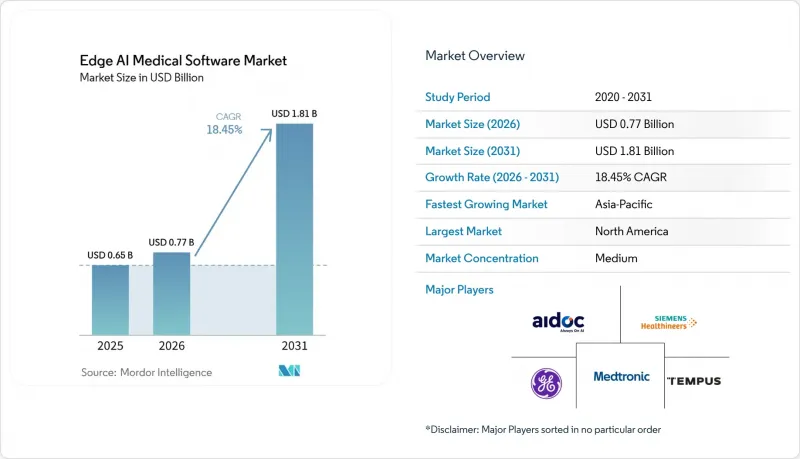
Mordor Intelligence에 의하면, 엣지 AI 의료용 소프트웨어 시장 규모는 2025년에 6억 5,000만 달러로 평가되었고, 2026년 7억 7,000만 달러로 추정되며, 2031년까지 18억 1,000만 달러에 이를 것으로 예측됩니다.
예측 기간(2026-2031년) 동안 연평균 성장률(CAGR)은 18.45%를 나타낼 전망입니다.
본 보고서는 구성 요소별(하드웨어 통합형, 플랫폼, 서비스), 소프트웨어 유형별(영상 진단, 의사 결정 지원, 기타), 기술별(컴퓨터 비전,ML/DL, 기타), 임상 용도별(방사선과, 순환기과, 신경과, 기타), 최종 사용자(병원, 영상진단센터, 기타), 배포 방식별(온디바이스, 엣지 서버, 하이브리드), 지역별(북미, 유럽, 기타)로 분류되어 있습니다. 시장 규모는 달러로 표시되어 있습니다.
세계의 엣지 AI 의료용 소프트웨어 시장 동향 및 인사이트
실시간 임상 의사 결정 및 저지연 추론
엣지 AI 의료용 소프트웨어 시장은 특히 응급 의료, 외래 수술 및 기타 시간적 제약이 엄격한 의료 현장에서 임상 데이터를 수집 지점 근처에서 처리할 수 있다는 장점이 있습니다. 2026년 『Scientific Reports』지에 게재된 연구에 따르면, 엣지 환경에서의 추론 지연 시간 중앙값은 118밀리초였던 반면, 클라우드 전용 기준선은 246밀리초였으며, 정확도는 94.7% 대 83.1%였습니다. 이 연구에서는 INT8 양자화를 통해 모델 크기를 최대 74% 줄이면서도 정확도 저하를 0.4퍼센트 포인트로 억제할 수 있었던 사실도 밝혀졌습니다. 이러한 결과로 인해 대규모 GPU 서버 도입 예산이 제한된 지역 병원에서도 로컬 추론의 실현 가능성이 높아졌으며, 벤더는 엔터프라이즈용 PACS 통합형 AI를 도입하지 않았던 임상 현장에 서비스를 제공할 수 있게 되었습니다.
AI 탑재 의료기기 및 영상 진단 워크플로우의 확대
AI 탑재 의료기기의 라인업이 확대됨에 따라, 현지 임상 워크플로우 내에서 안전하게 작동할 수 있는 소프트웨어에 대한 수요가 높아졌습니다. 영상 진단 시스템, 현장 진료(Point-of-Care) 기기 및 시술용 플랫폼에는 하드웨어 및 규제 요건에 부합하는 모델 관리 및 추론 환경이 요구됩니다. 2026년 4월, 애보트(Abbott)는 실시간 시술 안내와 자동 혈류 평가를 결합한 AI 기반 관상동맥 영상 진단 플랫폼 ‘Ultreon 3.0’에 대해 FDA 승인과 CE 마크를 획득했습니다. 이러한 제품 개발을 통해 영상 데이터, 기기 제어, 워크플로 통합에 걸친 엣지 소프트웨어 수요가 확대되었으며, 이는 순환기학, 신경학, 종양학 및 기타 임상 분야 시장 성장을 뒷받침했습니다.
도입, 검증 및 수명 주기 관리에 드는 막대한 비용
의료기관에 도입하려면 알고리즘이나 엣지 기기를 구매하는 것 이상의 조치가 필요합니다. 의료기관은 임상 성능 검증, 기존 시스템과의 소프트웨어 통합, 직원 교육, 그리고 운영 개시 후 모델 유지 관리를 수행해야 합니다. 이러한 요건으로 인해, 비록 현지 처리 능력이 의료 환경에 부합하더라도 지역 병원의 경우 도입이 어려울 수 있습니다. 지속적인 워크플로우 변경 및 안전성·성능 검토는 비용 증가로 이어지므로, 관리형 서비스, 모니터링, 규제 대응 지원을 제공하는 벤더가 유리합니다. 한편, 조기 도입은 확립된 임상정보학 자원을 보유한 대규모 3차 의료기관에 집중된 상태로 남아 있을 가능성이 있습니다.
부문 분석
2025년, 엣지 AI 하드웨어 통합형 소프트웨어는 매출의 33.22%를 차지했으며, 엣지 AI 의료용 소프트웨어 시장에서 가장 큰 구성 요소 그룹이 되었습니다. 이 범주에는 영상 진단 시스템, 수술용 플랫폼 및 포인트 오브 케어(Point-of-Care) 의료기기에 내장된 소프트웨어가 포함됩니다. 이 카테고리가 주도적인 위치를 차지하고 있는 것은 임상 데이터가 생성되는 기기 근처에서 추론을 수행하는 것의 가치를 반영합니다. OEM(주문자 상표 제조업체)이 스캐너나 초음파 진단 기기에 소프트웨어 계층을 통합하면, 업데이트, 검증, 재학습이 해당 생태계에 묶이게 되어 전환 비용이 높아질 가능성이 있습니다.
엣지 AI 소프트웨어 플랫폼은 개별 모델을 보다 광범위한 임상 워크플로우와 연결합니다. 이는 서로 다른 공급업체의 기기 간 모델 오케스트레이션, 워크플로우 통합 및 관리를 지원합니다. 병원이 알고리즘별로 개별 프로세스를 구축하지 않고 여러 알고리즘을 실행하게 됨에 따라, 그 역할은 점점 더 중요해지고 있습니다. 엣지 AI 전문 서비스 및 관리형 서비스는 거버넌스, 모니터링, 검증, 감사 프로세스를 수행할 전담 팀을 보유하지 않은 의료 시스템 수요에 힘입어 2031년까지 연평균 성장률(CAGR) 20.93%를 나타낼 것으로 예측됩니다.
2025년 기준, 의료 영상 분석 소프트웨어는 엣지 AI 의료용 소프트웨어 시장 점유율의 36.23%를 차지했습니다. 이 카테고리는 영상 진단 처리량이 방대하고, 방사선과 자원이 제한적일 때 검사의 우선순위를 정해야 한다는 점에서 이점을 얻고 있습니다. 또한, 감지 기능에 그치지 않고 보고서 작성 분야로 확대되면서 영상 진단 워크플로우에서의 역할을 강화하고 있습니다. Lunit사는 2025년 12월, 자사의 멀티모달 기반 모델이 SimonMed Imaging사의 175개 이상의 거점에서 흉부 X선 보고서 작성을 지원할 것이라고 발표했습니다.
환자 모니터링 및 원격 진료용 소프트웨어는 2031년까지 연평균 성장률(CAGR) 19.67%를 나타낼 것으로 예측되며, 이는 소프트웨어 유형 중 가장 높은 성장률입니다. 재택치료 프로그램과 지속적인 환자 데이터 스트림을 생성하는 모니터링 기기가 이러한 성장을 뒷받침하고 있습니다. 네트워크 가용성이나 데이터 거버넌스 제약으로 인해 ‘클라우드 우선’ 접근 방식이 제한될 경우, 로컬 소프트웨어는 이러한 데이터 스트림을 더 빠르게 처리할 수 있습니다. 또한, 의료 데이터 관리, 상호 운용성 소프트웨어, 임상 문서 작성 및 앰비언트 인텔리전스 도구도 전자의무기록 및 임상 워크플로우 환경에서 점차 보급되고 있습니다.
지역별 분석
북미는 2025년, 확립된 의료 IT 투자, 대규모 병원 네트워크, 그리고 견고한 임상 AI 플랫폼 기반에 힘입어 엣지 AI 의료용 소프트웨어 시장 점유율의 42.76%를 차지했습니다. 미국은 규제 및 지불 환경이 제품 개발과 의료 서비스 제공업체의 구매 결정에 영향을 미쳤기 때문에 지역적 성장의 중심지 역할을 계속했습니다. 2026년 4월 애보트(Abbott)가 ‘Ultreon 3.0’의 승인을 획득한 것은 관상동맥 영상 분야에서 AI 제품의 활발한 움직임이 지속되고 있음을 여실히 보여주었습니다. 캐나다의 가상 병동 프로그램과 멕시코의 디지털 헬스 관련 이니셔티브는 지역 사회 내 현지 데이터 처리 기회를 확대했으며, 한편 지역 벤더들은 임상용 소프트웨어와 인프라, 도입 지원을 결합했습니다.
유럽은 엣지 AI 의료용 소프트웨어 시장에서 매출 기준 2위를 차지하고 있습니다. 독일은 ‘병원 미래법’을 통해 임상 AI 인프라를 지원했으며, 28개 병원에 걸친 아스클레피오스(Asklepios)의 도입 사례는 자금 조달과 도입 준비가 어떻게 더 대규모 확장을 뒷받침했는지를 보여주었습니다. 영국 또한 가상 병동 관리에 AI를 활용한 원격 모니터링을 도입했습니다. 유럽의 의료 제공업체들은 데이터 처리, 거버넌스 및 기존 임상 프로세스에 부합하는 시스템을 우선시하며, 환자 정보를 의료 제공업체 환경 내에 보관하는 엣지 아키텍처를 지원했습니다. 프랑스, 이탈리아, 스페인 역시 유럽 헬스 데이터 스페이스(European Health Data Space)와 연계된 디지털 헬스 프레임워크를 구축하고 있으며, 규정 준수 및 통합이 중요한 구매 요인으로 작용했습니다.
아시아태평양은 2031년까지 연평균 성장률(CAGR) 19.56%를 나타낼 것으로 예측되며, 이는 지역별로는 가장 높은 성장률입니다. 방대한 환자 수, 확대되는 병원 네트워크, 그리고 디지털 헬스에 대한 정책적 관심이 높아지고 있는 점이 현지에서 도입 가능한 임상 AI에 대한 수요를 뒷받침하고 있습니다. NVIDIA, Foxconn 및 대만의 의료 센터는 2026년 6월, 유방암 검진, 심전도 분석, 안저 영상 진단, 관상동맥 분석 등의 병원 워크플로우에 에이전트형 및 물리적 AI를 도입하기 위한 제휴를 발표했습니다. 또한 인도에서는 통신 환경이 제한적인 현장에서의 포인트 오브 케어(PoC) 용도에 대한 수요가 지속적으로 증가했습니다. 중동 및 아프리카 및 남미는 도입 초기 단계에 머물러 있지만, 걸프협력회의(GCC) 회원국과 브라질이 디지털 헬스 활동 확대에 기여하고 있습니다.
기타 혜택 :
- 엑셀 형식 시장 예측(ME) 시트
- 3개월간의 애널리스트 지원
자주 묻는 질문
목차
제1장 서론
제2장 조사 방법
제3장 주요 요약
제4장 시장 구도
제5장 시장 규모 및 성장 예측
제6장 경쟁 구도
제7장 시장 기회 및 향후 전망
AJY 26.09.03According to Mordor Intelligence, the edge AI medical software market size was valued at USD 0.65 billion in 2025 and is estimated to grow from USD 0.77 billion in 2026 to reach USD 1.81 billion by 2031, at a CAGR of 18.45% during the forecast period (2026-2031).
This report is Segmented by Component (Hardware-Integrated, Platforms, Services), Software Type (Imaging, Decision Support, Others), Technology (Computer Vision, ML/DL, and More), Clinical Application (Radiology, Cardiology, Neurology, Others), End User (Hospitals, Imaging Centers, Others), Deployment (On-Device, Edge Server, Hybrid), and Geography (North America, Europe, and More). In Value (USD).
Global Edge AI Medical Software Market Trends and Insights
Real-Time Clinical Decision-Making and Low-Latency Inference
The edge AI medical software market benefits from processing clinical data close to the point of collection, especially in emergency medicine, ambulatory surgery, and other time-sensitive care settings. A 2026 Scientific Reports study reported median inference latency of 118 ms in an edge setup, compared with 246 ms for a cloud-only baseline, with accuracy of 94.7% versus 83.1%. The same study found that INT8 quantization reduced model size by up to 74% while limiting accuracy loss to 0.4 percentage points. These results made local inference more viable for community hospitals with limited budgets for large GPU-server installations and helped vendors serve clinical sites that had not adopted enterprise PACS-integrated AI.
Expansion of AI-Enabled Medical Devices and Imaging Workflows
The growing range of AI-enabled medical devices increased the need for software that can operate safely within local clinical workflows. Imaging systems, point-of-care devices, and procedural platforms require model management and inference environments aligned with hardware and regulatory requirements. In April 2026, Abbott received FDA clearance and CE Mark for Ultreon 3.0, an AI-powered coronary imaging platform that combines real-time planning guidance with automated blood-flow assessment. Such product development expanded the need for edge software across imaging data, device controls, and workflow integration, supporting market growth across cardiology, neurology, oncology, and other clinical areas.
High Deployment, Validation, and Lifecycle-Management Costs
Institutional deployment requires more than purchasing an algorithm or an edge device. Health systems must validate clinical performance, integrate software with existing systems, train staff, and maintain models after go-live. These requirements can make implementation difficult for community hospitals, even when local processing supports their care settings. Ongoing workflow changes and safety and performance reviews can add costs, favoring vendors that offer managed services, monitoring, and regulatory support, while early adoption may remain concentrated in larger tertiary centers with established clinical informatics resources.
Other drivers and restraints analyzed in the detailed report include:
- Growth of Remote Patient Monitoring and Hospital-at-Home Care
- Data Residency, Privacy, and Cybersecurity Requirements
- Limited Reimbursement Alignment for Medical AI Software
For complete list of drivers and restraints, kindly check the Table Of Contents.
Segment Analysis
Edge AI hardware-integrated software held 33.22% of revenue in 2025, making it the largest component group in the edge AI medical software market. This category includes software embedded in imaging systems, surgical platforms, and point-of-care medical devices. Its leadership reflects the value of running inference close to the device where clinical data originates. Once an original equipment manufacturer integrates a software layer into a scanner or ultrasound system, switching costs can rise as updates, validation, and retraining remain tied to that ecosystem.
Edge AI software platforms connect individual models with broader clinical workflows. They support model orchestration, workflow integration, and management across devices from different suppliers. Their role is becoming more important as hospitals run several algorithms without creating separate processes for each one. Edge AI professional and managed services is forecast to grow at a CAGR of 20.93% through 2031, driven by demand from health systems that lack dedicated teams for governance, monitoring, validation, and audit processes.
Medical imaging analysis software accounted for 36.23% of the edge AI medical software market share in 2025. The category benefits from high imaging volumes and the need to prioritize studies when radiology resources are constrained. It is expanding beyond detection into report generation, strengthening its role in imaging workflows. Lunit announced in December 2025 that its multimodal foundation models would support chest X-ray report generation across SimonMed Imaging's more than 175 locations.
Patient monitoring and remote care software is forecast to grow at a CAGR of 19.67% through 2031, the highest rate among software types. Hospital-at-home programs and monitoring devices that generate continuous patient data streams support this growth. Local software can process these streams faster when network availability or data governance limits a cloud-first approach. Medical data management, interoperability software, clinical documentation, and ambient intelligence tools are also gaining traction across electronic health record and clinical workflow environments.
Complete Report Scope:
- By Component
- Edge AI Hardware-Integrated Software
- Edge AI Software Platforms
- Edge AI Professional and Managed Services
- By Software Type
- Clinical Decision Support Software
- Medical Imaging Analysis Software
- Patient Monitoring and Remote Care Software
- Surgical and Procedural Guidance Software
- Medical Data Management and Interoperability Software
- Clinical Documentation and Ambient Intelligence Software
- By Technology
- Machine Learning and Deep Learning
- Computer Vision
- Natural Language Processing
- Generative AI
- By Clinical Application
- Radiology and Medical Imaging
- Cardiology
- Neurology and Stroke Care
- Oncology and Digital Pathology
- Ophthalmology
- Gastroenterology
- Obstetrics and Women's Health
- Critical Care and Emergency Medicine
- Remote Patient Monitoring and Chronic Disease Management
- Others
- By End User
- Hospitals and Health Systems
- Diagnostic and Imaging Centers
- Ambulatory Surgical Centers
- Long-Term and Home-Care Providers
- Physician Offices and Primary-Care Clinics
- Emergency Medical Services
- Pharmaceutical and Biotechnology Companies
- Academic and Research Institutions
- By Deployment
- On-Device
- On-Premises Edge Server
- Private Edge Cloud
- Public Cloud and Edge-Cloud Hybrid
- By Geography
- North America
- United States
- Canada
- Mexico
- Europe
- Germany
- United Kingdom
- France
- Italy
- Spain
- Rest of Europe
- Asia-Pacific
- China
- India
- Japan
- Australia
- South Korea
- Rest of Asia-Pacific
- Middle East and Africa
- GCC
- South Africa
- Rest of Middle East and Africa
- South America
- Brazil
- Argentina
- Rest of South America
- North America
Geography Analysis
North America held 42.76% of the edge AI medical software market share in 2025, supported by established health IT investments, large hospital networks, and a strong base of clinical AI platforms. The United States remained central to regional growth, as its regulatory and payment environment shaped product development and provider purchasing decisions. Abbott's April 2026 clearance for Ultreon 3.0 highlighted continued AI product activity in coronary imaging. Canada's virtual ward programs and Mexico's digital health activity added opportunities for local data processing in community settings, while regional vendors combined clinical software with infrastructure and deployment support.
Europe is the second-largest regional revenue contributor in the edge AI medical software market. Germany supported clinical AI infrastructure through the Hospital Future Act, and the Asklepios rollout across 28 hospitals showed how funding and implementation readiness supported larger deployments. The United Kingdom also used AI-supported remote monitoring in virtual ward care. European providers prioritized data handling, governance, and systems aligned with existing clinical processes, supporting edge architectures that retained patient information within the provider environment. France, Italy, and Spain also developed digital health frameworks linked to the European Health Data Space, making compliance and integration key purchasing factors.
Asia-Pacific is forecast to grow at a CAGR of 19.56% through 2031, the fastest regional growth rate. Large patient populations, expanding hospital networks, and policy interest in digital health supported demand for locally deployable clinical AI. NVIDIA, Foxconn, and Taiwan medical centers announced a June 2026 collaboration to deploy agentic and physical AI in hospital workflows, including breast cancer screening, ECG analysis, fundus imaging, and coronary artery analysis. India also remained relevant for point-of-care applications in settings with constrained connectivity. The Middle East and Africa and South America remained at earlier stages of adoption, with Gulf Cooperation Council countries and Brazil contributing to broader digital health activity.
- Aidoc Medical Ltd.
- Amazon Web Services, Inc.
- Butterfly Network, Inc.
- Canon
- Clarius Mobile Health Corp.
- Digital Diagnostics
- GE Medical Systems, LLC
- Google LLC
- Heartflow
- IBM
- Lunit, Inc.
- Medtronic Navigation, Inc.
- Microsoft
- NVIDIA
- Philips Medical Systems Nederland B.V.
- Qure.ai Technologies Pvt. Ltd.
- RapidAI, Inc.
- Siemens Medical Solutions USA, Inc.
- Tempus AI, Inc.
- Viz.ai, Inc.
Additional Benefits:
- The market estimate (ME) sheet in Excel format
- 3 months of analyst support
TABLE OF CONTENTS
1 INTRODUCTION
- 1.1 Study Assumptions and Market Definition
- 1.2 Scope of the Study
2 RESEARCH METHODOLOGY
3 EXECUTIVE SUMMARY
4 MARKET LANDSCAPE
- 4.1 Market Overview
- 4.2 Market Drivers
- 4.2.1 Real-Time Clinical Decision-Making and Low-Latency Inference
- 4.2.2 Expansion of AI-Enabled Medical Devices and Imaging Workflows
- 4.2.3 Growth of Remote Patient Monitoring and Hospital-at-Home Care
- 4.2.4 Data-Residency, Privacy and Cybersecurity Requirements
- 4.2.5 Federated Learning for Multi-Institutional Clinical Intelligence
- 4.2.6 TinyML and Ultra-Low-Power Inference in Wearable Medical Devices
- 4.3 Market Restraints
- 4.3.1 High Deployment, Validation and Lifecycle-Management Costs
- 4.3.2 Limited Reimbursement Alignment for Medical AI Software
- 4.3.3 Model Drift Across Patient Populations and Clinical Workflows
- 4.3.4 Heterogeneous Edge Hardware, Connectivity and Legacy-System Integration
- 4.4 Value Chain Analysis
- 4.5 Regulatory Landscape
- 4.6 Technological Outlook
- 4.7 Porter's Five Forces Analysis
- 4.7.1 Bargaining Power of Buyers
- 4.7.2 Bargaining Power of Suppliers
- 4.7.3 Threat of New Entrants
- 4.7.4 Threat of Substitutes
- 4.7.5 Competitive Rivalry
5 MARKET SIZE AND GROWTH FORECASTS (VALUE, USD)
- 5.1 By Component
- 5.1.1 Edge AI Hardware-Integrated Software
- 5.1.2 Edge AI Software Platforms
- 5.1.3 Edge AI Professional and Managed Services
- 5.2 By Software Type
- 5.2.1 Clinical Decision Support Software
- 5.2.2 Medical Imaging Analysis Software
- 5.2.3 Patient Monitoring and Remote Care Software
- 5.2.4 Surgical and Procedural Guidance Software
- 5.2.5 Medical Data Management and Interoperability Software
- 5.2.6 Clinical Documentation and Ambient Intelligence Software
- 5.3 By Technology
- 5.3.1 Machine Learning and Deep Learning
- 5.3.2 Computer Vision
- 5.3.3 Natural Language Processing
- 5.3.4 Generative AI
- 5.4 By Clinical Application
- 5.4.1 Radiology and Medical Imaging
- 5.4.2 Cardiology
- 5.4.3 Neurology and Stroke Care
- 5.4.4 Oncology and Digital Pathology
- 5.4.5 Ophthalmology
- 5.4.6 Gastroenterology
- 5.4.7 Obstetrics and Women's Health
- 5.4.8 Critical Care and Emergency Medicine
- 5.4.9 Remote Patient Monitoring and Chronic Disease Management
- 5.4.10 Others
- 5.5 By End User
- 5.5.1 Hospitals and Health Systems
- 5.5.2 Diagnostic and Imaging Centers
- 5.5.3 Ambulatory Surgical Centers
- 5.5.4 Long-Term and Home-Care Providers
- 5.5.5 Physician Offices and Primary-Care Clinics
- 5.5.6 Emergency Medical Services
- 5.5.7 Pharmaceutical and Biotechnology Companies
- 5.5.8 Academic and Research Institutions
- 5.6 By Deployment
- 5.6.1 On-Device
- 5.6.2 On-Premises Edge Server
- 5.6.3 Private Edge Cloud
- 5.6.4 Public Cloud and Edge-Cloud Hybrid
- 5.7 By Geography
- 5.7.1 North America
- 5.7.1.1 United States
- 5.7.1.2 Canada
- 5.7.1.3 Mexico
- 5.7.2 Europe
- 5.7.2.1 Germany
- 5.7.2.2 United Kingdom
- 5.7.2.3 France
- 5.7.2.4 Italy
- 5.7.2.5 Spain
- 5.7.2.6 Rest of Europe
- 5.7.3 Asia-Pacific
- 5.7.3.1 China
- 5.7.3.2 India
- 5.7.3.3 Japan
- 5.7.3.4 Australia
- 5.7.3.5 South Korea
- 5.7.3.6 Rest of Asia-Pacific
- 5.7.4 Middle East and Africa
- 5.7.4.1 GCC
- 5.7.4.2 South Africa
- 5.7.4.3 Rest of Middle East and Africa
- 5.7.5 South America
- 5.7.5.1 Brazil
- 5.7.5.2 Argentina
- 5.7.5.3 Rest of South America
- 5.7.1 North America
6 COMPETITIVE LANDSCAPE
- 6.1 Market Concentration
- 6.2 Market Share Analysis
- 6.3 Company Profiles (includes Global Level Overview, Market Level Overview, Core Segments, Financials as available, Strategic Information, Market Rank/Share, Products and Services, Recent Developments)
- 6.3.1 Aidoc Medical Ltd.
- 6.3.2 Amazon Web Services, Inc.
- 6.3.3 Butterfly Network, Inc.
- 6.3.4 Canon Medical Systems Corporation
- 6.3.5 Clarius Mobile Health Corp.
- 6.3.6 Digital Diagnostics, Inc.
- 6.3.7 GE Medical Systems, LLC
- 6.3.8 Google LLC
- 6.3.9 Heartflow, Inc.
- 6.3.10 IBM Corporation
- 6.3.11 Lunit, Inc.
- 6.3.12 Medtronic Navigation, Inc.
- 6.3.13 Microsoft Corporation
- 6.3.14 NVIDIA Corporation
- 6.3.15 Philips Medical Systems Nederland B.V.
- 6.3.16 Qure.ai Technologies Pvt. Ltd.
- 6.3.17 RapidAI, Inc.
- 6.3.18 Siemens Medical Solutions USA, Inc.
- 6.3.19 Tempus AI, Inc.
- 6.3.20 Viz.ai, Inc.
7 MARKET OPPORTUNITIES AND FUTURE OUTLOOK
- 7.1 White-Space and Unmet-Need Assessment


