

|
시장보고서
상품코드
2118137
SaMD(Software-as-a-Medical Device) 분야 생성형 AI 시장 : 시장 점유율 분석, 업계 동향 및 통계, 성장 예측(2026-2031년)Generative AI In Software As A Medical Device (SaMD) - Market Share Analysis, Industry Trends & Statistics, Growth Forecasts (2026 - 2031) |
||||||
 Mordor Intelligence
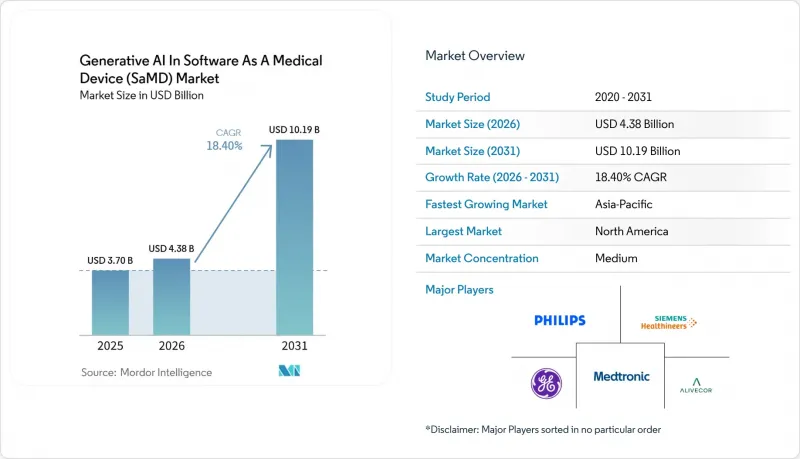
Mordor Intelligence에 의하면, SaMD(Software-as-a-Medical Device) 분야 생성형 AI 시장 규모는 2025년에 37억 달러로 평가되었고, 2026년 43억 8,000만 달러에서 2031년까지 101억 9,000만 달러에 이를 것으로 예측되며, 예측 기간(2026-2031년) CAGR은 18.40%를 나타낼 전망입니다.
본 보고서는 소프트웨어 기능별(8개 부문), 임상 이용 사례별(방사선 의료 및 영상, 병리학, 종양학, 순환기내과, 신경학, 기타), 배포 방식별(클라우드 기반, 온프레미스, 하이브리드), 최종 사용자별(병원·보건 시스템, 외래 진료 센터, 진단 실험실, 전문 클리닉, 대학 부속 병원), 지역별(북미, 유럽, 아시아태평양, 중동 및 아프리카, 남미)로 분류되어 있습니다. 예측치는 금액(달러)으로 표시되어 있습니다.
SaMD(Software-as-a-Medical Device) 분야 생성형 AI 시장 동향 및 인사이트
AI를 활용한 임상 문서 작성의 성장
임상 문서 작성은 임상의에게 막대한 시간을 소요하는 업무였기 때문에 SaMD 분야 생성형 AI 시장 활용 사례 중 하나로 꾸준히 자리 잡아 왔습니다. 2026년 미국의 두 대학병원에서 실시된 평가에서는 Ambient AI Scribe의 높은 사용 편의성 점수와 근무 시간 외 문서 작성 시간이 유의미하게 단축된 것으로 보고되었습니다. 2026년 6개 의료 시스템을 대상으로 실시된 조사에서는 앰비언트 스크라이브 도입 후 30일 이내에 외래 진료를 담당하는 임상의의 번아웃 비율이 51.9%에서 38.8%로 감소한 것으로 나타났습니다. 잉글랜드 국민보건서비스(NHS England)는 2026년 4월, AI가 탑재된 앰비언트 스크라이브 제품에 관한 최신 지침을 발표하고, 해당 제품이 지역 거버넌스 및 임상 안전 요건을 충족하는 경우 보다 광범위한 도입을 지지했습니다.
의료 인력 부족과 진단 워크플로우에 가해지는 압박
인력 부족으로 인해 SaMD 분야 생성형 AI 시장을 활용하는 많은 의료 제공업체에게 자동화는 실질적인 필수 요건이 되었습니다. 미국 의학협회(AMA) 보고서에 따르면, 2025년에는 의사의 41.9%가 번아웃 증상을 적어도 하나 이상 겪고 있으며, 조사 대상 의사의 57%는 진료에서 AI 활용의 가장 큰 기회로 행정 업무의 자동화를 꼽았습니다. 생성형 AI 도구는 예비 보고서 초안 작성 및 문서 정리를 지원하며, 전문가의 검토를 대체하지 않으면서 진료 처리 능력 향상에 기여했습니다. 2026년 6월, Aidoc은 흉부 X선 사진을 분석하여 방사선 진단 예비 보고서 문구를 생성하는 ‘First Read’에 대해 FDA로부터 획기적 의료기기(Breakthrough Device) 지정을 받았습니다.
환각과 비결정론적 임상 결과
생성 모델은 기존 진단 소프트웨어와는 다른 오류 모드를 유발할 가능성이 있습니다. 2025년 『Communications Medicine』지에 게재된 연구에서는 조작된 요소를 포함한 임상 프롬프트를 사용하여 대규모 언어 모델을 검증한 결과, 테스트 대상 모델 전체에서 50%에서 83%의 ‘환각’ 발생률이 보고되었습니다. 이 결과는 정확성 확인이 단일 모델 릴리스에만 의존해서는 안 된다는 점을 보여주었습니다. 2026년 『npj Digital Medicine』 저널의 기사에서는 제약이 없는 비결정론적 임상 소프트웨어가 의료 분야에서 고유한 규제상의 과제라고 언급되었습니다. 관리 문서의 오류는 임상적 판단, 보험 청구, 약물 관리에도 영향을 미칠 수 있으므로, 인간에 의한 검토, 추적 가능한 출력, 시판 후 모니터링은 SaMD 분야 생성형 AI 시장에서 중요한 안전 대책이 됩니다.
부문 분석
‘진단 결과 해석 및 보고’ 부문은 2025년에 29.55%의 점유율을 차지한 것으로 평가되었으며, SaMD 분야 생성형 AI 시장에서 가장 큰 소프트웨어 기능이 될 전망입니다. 이러한 위상은 이미지 AI의 확립된 검증 실적과 이미지 감지에서 보고서 작성으로의 기능 확대를 반영한 것입니다. ‘원격 모니터링 및 환자 관리’는 케어 모델에서 지속적인 모니터링이 더욱 중요해짐에 따라 2031년까지 연평균 성장률(CAGR) 21.93%로 가장 빠른 성장을 기록할 것으로 예측됩니다. ‘임상 문서 작성 및 앰비언트 스크리빙’은 기능 카테고리 중 가장 높은 도입 실적을 기록하고 있습니다. 이는 2025년 3월 마이크로소프트가 ‘Dragon Copilot’을 출시한 것이 뒷받침하고 있습니다. 해당 제품은 ‘DAX Copilot’과 ‘Dragon Medical One’을 통합한 것으로, 400개 이상의 의료 기관에 도입되어 1억 건 이상의 환자 진료 데이터를 처리하고 있습니다.
‘치료 계획 및 맞춤형 치료’와 ‘임상시험 및 근거 창출 지원’은 SaMD 분야 생성형 AI 시장의 기능으로서는 여전히 소규모 부문에 머물러 있습니다. 치료 결정에 영향을 미치는 도구에 대한 요구 사항이 높고, 보험사가 이를 채택하기까지 검증 기간이 길다는 점이 성장을 제약하고 있습니다. ‘임상 의사결정 지원’과 ‘의료 코딩 및 수익 사이클 지원’은 기능 구성에서 중간 정도의 비중을 차지하고 있으며, 코딩 도구는 비정형화된 기록을 해석하고 맥락에 따라 ICD-10 및 CPT 코드를 제안하는 생성 모델의 혜택을 받고 있습니다. Tempus는 2025년에 Paige를 8,125만 달러에 인수했으며, 그 결과 탄생한 병리학 기반 모델은 약 700만 장의 디지털 슬라이드를 활용하여 ‘Paige Predict’를 지원하고 있습니다. 이 도구는 일반적인 H&E 염색 이미지를 통해 16가지 유형의 암에 대한 123개의 분자 바이오마커를 예측합니다.
방사선 의료 및 영상 부문은 2025년에 34.22%의 점유율을 차지한 것으로 평가되었으며, SaMD 분야 생성형 AI 시장의 최대 임상 활용 사례로 남아 있을 전망입니다. 이미지 데이터셋은 모델 개발 및 평가를 뒷받침하는 상세한 시각적 정보를 제공합니다. 심혈관 부문은 2031년까지 연평균 성장률(CAGR) 22.67%로 확대될 것으로 예측되며, 이는 대상 이용 사례 중 가장 높은 성장률입니다. 제출된 초안에 따르면, 2026년 1분기까지 FDA 승인을 받은 심혈관 AI 및 머신러닝 SaMD 기기가 97건 기록되었으며, FDA 승인 이력에서 심혈관 AI 승인의 3분의 1 이상이 지난 3년 동안 집중된 것으로 나타났습니다.
AI가 단일 암의 검출에서 바이오마커 예측으로 전환됨에 따라, 병리학 및 종양학은 점점 더 중요한 이용 사례가 되고 있으며, 특정 환경에서 모델의 타당성이 검증된 경우 치료법 선택을 지원하고 있습니다. EchoNext는 70만 건 이상의 심전도(ECG)와 심초음파 검사 데이터 조합을 활용한 검증을 거쳐 FDA 승인을 획득했으며, 표준 12도심전도를 통해 6가지 유형의 구조적 심장 질환을 감지할 수 있습니다. 이 사례는 소프트웨어가 기존 기기의 진단 가치를 어떻게 높일 수 있는지를 보여줍니다. 신경학, 안과, 소화기내과, 여성 건강 분야는 여전히 초기 단계에 있지만, 적응성이 높은 모델이 각 전문 분야에 걸친 개발을 지속적으로 뒷받침하고 있습니다.
지역별 분석
2025년, 북미는 41.25%의 점유율을 차지했으며, SaMD 분야 생성형 AI 시장에서 지역별 최대 기여도를 기록했습니다. 미국은 AI 의료기기 개발 및 승인 활동에서 계속해서 최대의 국내 시장이었습니다. 제출된 초안에 따르면, FDA는 2025년에 295건 이상의 새로운 AI 및 머신러닝 의료기기를 승인했으며, 그중 62%는 SaMD, 63%는 진단용 기기로 분류되었습니다. 캐나다와 멕시코는 규모는 작지만, 미국의 임상 연구와의 연계 및 규제 프로세스의 발전에 힘입어 도입이 확대되고 있는 지역으로 자리매김하고 있습니다. UpDoc은 2025년 12월, 2형 당뇨병 성인 환자를 대상으로 인슐린 및 약물 복용을 관리하기 위한 환자용 대규모 언어 모델(LLM) 소프트웨어에 대해 FDA의 510(k) 승인을 획득했습니다.
유럽은 북미에 이어 도입이 진행되었으며, 독일, 영국, 프랑스가 주요 국내 시장으로 기능했습니다. 독일의 DiGA 제도는 적격한 디지털 헬스 용도에 보험 환급의 길을 열어주며, 수요에 맞춘 제품 개발을 지원했습니다. 유럽연합(EU)의 AI법은 유럽과 미국 양 시장에서 제품을 판매하는 기업에 대해 계획 수립 요건을 규정했습니다. 고위험 의무의 적용 시작은 당초 2026년 8월로 예정되어 있었으나, 이후 2027년 12월로 연기될 것이 제안되었습니다. 프랑스와 스페인은 병원 디지털화 프로그램을 추진한 반면, 이탈리아에서는 대학병원을 대상으로 한 시범 사업이 도입을 뒷받침했습니다. 2026년 4월 잉글랜드 국민보건서비스(NHS)가 발표한 ‘앰비언트 스크라이빙(Ambient Scribing)’에 관한 지침은 문서화 제품을 위한 상세한 운영 프레임워크를 제공했으며, 의료 시스템이 거버넌스 및 도입과 관련하여 현실적인 기대치를 설정하는 데 도움이 되었습니다.
아시아태평양은 2031년까지 연평균 성장률(CAGR) 21.95%를 나타낼 것으로 예측되며, SaMD 분야 생성형 AI 시장에서 가장 빠르게 성장하는 지역이 되고 있습니다. 중국, 인도, 일본, 한국은 디지털 헬스 인프라와 임상 AI 프로그램을 확대했습니다. 제출된 초안에 따르면, 중국 국가약품감독관리국(NMPA)은 2025년에 120건 이상의 AI 의료기기 제품을 승인했습니다. 중국 공립병원의 조달 시스템은 현지 승인을 획득한 국내 기업에 대량의 발주 기회를 제공한 반면, 국제 공급업체에게는 현지에서 검증된 데이터 세트가 요구되었습니다. 일본의 PMDA는 적응형 알고리즘에 관한 지침을 개정했으며, ‘Society 5.0’ 프로그램에서는 AI를 활용한 의료 소프트웨어가 국가적 우선 과제로 자리매김했습니다.
기타 혜택
- 엑셀 형식 시장 예측(ME) 시트
- 3개월간의 애널리스트 지원
자주 묻는 질문
목차
제1장 서론
제2장 조사 방법
제3장 주요 요약
제4장 시장 구도
제5장 시장 규모 및 성장 예측
제6장 경쟁 구도
제7장 시장 기회 및 향후 전망
AJY 26.09.03According to Mordor Intelligence, the generative AI in Software as a Medical Device Market size was valued at USD 3.70 billion in 2025 and is estimated to grow from USD 4.38 billion in 2026 to reach USD 10.19 billion by 2031, at a CAGR of 18.40% during the forecast period (2026-2031).
This report is Segmented by Software Function (8 Segments), Clinical Use Case (Radiology, Pathology, Oncology, Cardiology, Neurology, and More), Deployment (Cloud-Based, On-Premises, Hybrid), End User (Hospitals, Ambulatory Care Centers, Diagnostic Labs, Specialty Clinics, Academic Medical Centers), and Geography (North America, Europe, Asia-Pacific, MEA, South America). Forecasts are in Terms of Value (USD).
Global Generative AI In Software As A Medical Device (SaMD) Market Trends and Insights
Growth of AI-Assisted Clinical Documentation
Clinical documentation remained one of the most immediate use cases for generative AI in SaMD market products, as it consumed substantial clinician time. A 2026 evaluation at two US academic medical centers reported high usability scores for an ambient AI scribe and meaningful reductions in after-hours documentation time. A 2026 study across six health systems found that ambulatory clinician burnout declined from 51.9% to 38.8% within 30 days of ambient scribe adoption. NHS England issued updated guidance for AI-enabled ambient scribing products in April 2026, supporting wider deployment where products met local governance and clinical safety requirements.
Clinician Shortages and Diagnostic Workflow Pressure
Workforce shortages made automation a practical requirement for many care providers in the generative AI in SaMD market. The American Medical Association reported that 41.9% of physicians had at least one symptom of burnout in 2025, while 57% of surveyed physicians identified administrative automation as the leading AI opportunity in their practices. Generative tools helped draft preliminary reports and organize documentation, supporting clinical throughput without replacing professional review. In June 2026, Aidoc received FDA Breakthrough Device Designation for First Read, which analyzed chest radiographs and generated preliminary radiology report text.
Hallucination and Non-Deterministic Clinical Outputs
Generative models can create failure modes that differ from those of conventional diagnostic software. A 2025 study in Communications Medicine tested large language models with clinical prompts containing a fabricated element and reported hallucination rates of 50% to 83% across the tested models. The findings showed that accuracy checks should not rely on a single model release. A 2026 npj Digital Medicine article described unconfined non-deterministic clinical software as a distinct regulatory challenge for healthcare. Errors in administrative documentation can also influence clinical decisions, claims, and medication management, making human review, traceable outputs, and post-market monitoring key safeguards for the generative AI in SaMD market.
Other drivers and restraints analyzed in the detailed report include:
- Regulatory Pathways for Managed Algorithm Changes
- Rising Demand for Scalable Clinical Decision Support
- Patient-Level Data Governance and Provenance Constraints
For complete list of drivers and restraints, kindly check the Table Of Contents.
Segment Analysis
Diagnostic Interpretation and Reporting is expected to account for a 29.55% share in 2025, making it the largest software function in the generative AI in SaMD market. This position reflects the established validation history of imaging AI and its expansion from image detection to report preparation. Remote Monitoring and Patient Management is forecast to register the fastest growth, at a CAGR of 21.93% through 2031, as care models place greater emphasis on continuous monitoring. Clinical Documentation and Ambient Scribing records the highest deployment volume among functional categories, supported by Microsoft's March 2025 launch of Dragon Copilot, which combined DAX Copilot and Dragon Medical One and was deployed across more than 400 healthcare organizations, processing more than 100 million patient encounters.
Therapeutic Planning and Personalization, along with Clinical Trial and Evidence Generation Support, remains a smaller function in the generative AI in SaMD market. Higher requirements for tools that influence treatment decisions and longer validation periods before payer adoption constrain their growth. Clinical Decision Support and Medical Coding and Revenue-Cycle Support occupy the middle range of the functional mix, while coding tools benefit from generative models that interpret unstructured notes and suggest ICD-10 and CPT codes in context. Tempus acquired Paige for USD 81.25 million in 2025, and the resulting pathology foundation model draws on nearly 7 million digitized slides to support Paige Predict, which predicts 123 molecular biomarkers across 16 cancer types from routine H&E images.
Radiology and Imaging is expected to account for a 34.22% share in 2025 and remain the largest clinical use case in the generative AI in SaMD market. Imaging datasets provide detailed visual information that supports model development and evaluation. Cardiology is forecast to expand at a CAGR of 22.67% through 2031, the fastest rate among the listed clinical use cases. The supplied draft recorded 97 FDA-cleared cardiovascular AI and machine learning SaMD devices through the first quarter of 2026 and stated that more than one-third of cardiology AI clearances in FDA history occurred in the prior three years.
Pathology and Oncology are becoming more important use cases as AI moves from single-cancer detection to biomarker prediction, supporting treatment selection where models are validated for the intended setting. EchoNext received FDA clearance after validation on more than 700,000 ECG-echocardiogram pairs and can detect six types of structural heart disease from a standard 12-lead ECG. This example shows how software can increase the diagnostic value of existing equipment. Neurology, Ophthalmology, Gastroenterology, and Women's Health remain earlier-stage areas, although adaptable models continue to support development across specialties.
Complete Report Scope:
- By Software Function
- Clinical Documentation and Ambient Scribing
- Clinical Decision Support
- Diagnostic Interpretation and Reporting
- Patient Communication and Triage
- Therapeutic Planning and Personalization
- Remote Monitoring and Patient Management
- Medical Coding and Revenue-Cycle Support
- Clinical Trial and Evidence Generation Support
- By Clinical Use Case
- Radiology and Imaging
- Pathology
- Oncology
- Cardiology
- Neurology
- Ophthalmology
- Gastroenterology
- Women's Health
- Others
- By Deployment
- Cloud-Based
- On-Premises
- Hybrid
- By End User
- Hospitals and Health Systems
- Ambulatory Care Centers
- Diagnostic Laboratories
- Specialty Clinics
- Academic Medical Centers
- Others
- By Geography
- North America
- United States
- Canada
- Mexico
- Europe
- Germany
- United Kingdom
- France
- Italy
- Spain
- Rest of Europe
- Asia-Pacific
- China
- India
- Japan
- Australia
- South Korea
- Rest of Asia-Pacific
- Middle East and Africa
- GCC
- South Africa
- Rest of Middle East and Africa
- South America
- Brazil
- Argentina
- Rest of South America
- North America
Geography Analysis
North America held a 41.25% share in 2025, making it the leading regional contributor to the generative AI in SaMD market. The United States remained the largest national market for AI medical device development and clearance activity. The supplied draft states that the FDA authorized more than 295 new AI and machine learning medical devices in 2025, with 62% classified as SaMD and 63% classified as diagnostic devices. Canada and Mexico remained smaller but growing adoption centers, supported by links to U.S. clinical research and evolving regulatory processes. UpDoc received FDA 510(k) clearance in December 2025 for patient-facing large language model software intended for insulin and medication management in adults with type 2 diabetes.
Europe followed North America in adoption, with Germany, the United Kingdom, and France serving as key national markets. Germany's DiGA pathway gave eligible digital health applications a route to reimbursement, supporting tailored product development. The European Union AI Act created planning requirements for companies selling in both European and U.S. settings, with high-risk obligations originally targeted for August 2026 and later proposed for December 2027. France and Spain advanced hospital digitization programs, while academic hospital pilots supported adoption in Italy. NHS England's April 2026 ambient scribing guidance offered a detailed operating framework for documentation products and helped health systems set practical expectations for governance and implementation.
Asia-Pacific is projected to register a 21.95% CAGR through 2031, making it the fastest-growing geography in the generative AI in SaMD market. China, India, Japan, and South Korea expanded digital health infrastructure and clinical AI programs. The supplied draft states that China's NMPA approved more than 120 AI medical device products in 2025. China's public hospital procurement system offered volume opportunities for domestic companies with local approvals, while international suppliers required locally validated datasets. Japan's PMDA revised its guidance for adaptive algorithms, and the Society 5.0 program treated AI-enabled healthcare software as a national priority.
- Abbott Laboratories
- Aidoc Medical Ltd.
- AliveCor
- Boston Scientific
- Butterfly Network, Inc.
- Butterfly Network, Inc.
- Canon
- Caption Health, Inc.
- GE HealthCare Technologies Inc.
- Intuitive Surgical, Inc.
- iRhythm Technologies
- Koninklijke Philips
- Medtronic
- Microsoft
- NVIDIA
- Paige.AI, Inc.
- Siemens Healthineers
- SOPHiA GENETICS SA
- Tempus AI, Inc.
- Viz.ai, Inc.
Additional Benefits:
- The market estimate (ME) sheet in Excel format
- 3 months of analyst support
TABLE OF CONTENTS
1 INTRODUCTION
- 1.1 Study Assumptions and Market Definition
- 1.2 Scope of the Study
2 RESEARCH METHODOLOGY
3 EXECUTIVE SUMMARY
4 MARKET LANDSCAPE
- 4.1 Market Overview
- 4.2 Market Drivers
- 4.2.1 Growth of AI-Assisted Clinical Documentation
- 4.2.2 Expansion of Multimodal Clinical Data Workflows
- 4.2.3 Rising Demand for Scalable Clinical Decision Support
- 4.2.4 Regulatory Pathways for Managed Algorithm Changes
- 4.2.5 Clinician Shortages and Diagnostic Workflow Pressure
- 4.2.6 Foundation-Model Reuse Across Narrow Clinical Workflows
- 4.3 Market Restraints
- 4.3.1 Hallucination and Non-Deterministic Clinical Outputs
- 4.3.2 Limited Generative AI-Specific Clinical Evidence
- 4.3.3 Patient-Level Data Governance and Provenance Constraints
- 4.3.4 Liability Ambiguity for AI-Influenced Clinical Decisions
- 4.4 Value / Supply-Chain Analysis
- 4.5 Regulatory Landscape
- 4.6 Technological Outlook
- 4.7 Porter's Five Forces Analysis
- 4.7.1 Threat of New Entrants
- 4.7.2 Bargaining Power of Suppliers
- 4.7.3 Bargaining Power of Buyers
- 4.7.4 Threat of Substitutes
- 4.7.5 Competitive Rivalry
5 MARKET SIZE AND GROWTH FORECASTS (VALUE, USD)
- 5.1 By Software Function
- 5.1.1 Clinical Documentation and Ambient Scribing
- 5.1.2 Clinical Decision Support
- 5.1.3 Diagnostic Interpretation and Reporting
- 5.1.4 Patient Communication and Triage
- 5.1.5 Therapeutic Planning and Personalization
- 5.1.6 Remote Monitoring and Patient Management
- 5.1.7 Medical Coding and Revenue-Cycle Support
- 5.1.8 Clinical Trial and Evidence Generation Support
- 5.2 By Clinical Use Case
- 5.2.1 Radiology and Imaging
- 5.2.2 Pathology
- 5.2.3 Oncology
- 5.2.4 Cardiology
- 5.2.5 Neurology
- 5.2.6 Ophthalmology
- 5.2.7 Gastroenterology
- 5.2.8 Women's Health
- 5.2.9 Others
- 5.3 By Deployment
- 5.3.1 Cloud-Based
- 5.3.2 On-Premises
- 5.3.3 Hybrid
- 5.4 By End User
- 5.4.1 Hospitals and Health Systems
- 5.4.2 Ambulatory Care Centers
- 5.4.3 Diagnostic Laboratories
- 5.4.4 Specialty Clinics
- 5.4.5 Academic Medical Centers
- 5.4.6 Others
- 5.5 By Geography
- 5.5.1 North America
- 5.5.1.1 United States
- 5.5.1.2 Canada
- 5.5.1.3 Mexico
- 5.5.2 Europe
- 5.5.2.1 Germany
- 5.5.2.2 United Kingdom
- 5.5.2.3 France
- 5.5.2.4 Italy
- 5.5.2.5 Spain
- 5.5.2.6 Rest of Europe
- 5.5.3 Asia-Pacific
- 5.5.3.1 China
- 5.5.3.2 India
- 5.5.3.3 Japan
- 5.5.3.4 Australia
- 5.5.3.5 South Korea
- 5.5.3.6 Rest of Asia-Pacific
- 5.5.4 Middle East and Africa
- 5.5.4.1 GCC
- 5.5.4.2 South Africa
- 5.5.4.3 Rest of Middle East and Africa
- 5.5.5 South America
- 5.5.5.1 Brazil
- 5.5.5.2 Argentina
- 5.5.5.3 Rest of South America
- 5.5.1 North America
6 COMPETITIVE LANDSCAPE
- 6.1 Market Concentration
- 6.2 Market Share Analysis
- 6.3 Company Profiles (includes Global Level Overview, Market Level Overview, Core Segments, Financials as available, Strategic Information, Market Rank/Share, Products and Services, Recent Developments)
- 6.3.1 Abbott Laboratories
- 6.3.2 Aidoc Medical Ltd.
- 6.3.3 AliveCor, Inc.
- 6.3.4 Boston Scientific Corporation
- 6.3.5 Butterfly Network, Inc.
- 6.3.6 Butterfly Network, Inc.
- 6.3.7 Canon Medical Systems Corporation
- 6.3.8 Caption Health, Inc.
- 6.3.9 GE HealthCare Technologies Inc.
- 6.3.10 Intuitive Surgical, Inc.
- 6.3.11 iRhythm Technologies, Inc.
- 6.3.12 Koninklijke Philips N.V.
- 6.3.13 Medtronic plc
- 6.3.14 Microsoft Corporation
- 6.3.15 NVIDIA Corporation
- 6.3.16 Paige.AI, Inc.
- 6.3.17 Siemens Healthineers AG
- 6.3.18 SOPHiA GENETICS SA
- 6.3.19 Tempus AI, Inc.
- 6.3.20 Viz.ai, Inc.
7 MARKET OPPORTUNITIES AND FUTURE OUTLOOK
- 7.1 White-Space and Unmet-Need Assessment


