

|
시장보고서
상품코드
2118077
고위험(IMDRF 카테고리 III-IV) SaMD(Software-as-a-Medical Device) 시장 : 시장 점유율 분석, 업계 동향 및 통계, 성장 예측(2026-2031년)High-Risk (IMDRF Category III-IV) Software As A Medical Device (SaMD) - Market Share Analysis, Industry Trends & Statistics, Growth Forecasts (2026 - 2031) |
||||||
 Mordor Intelligence
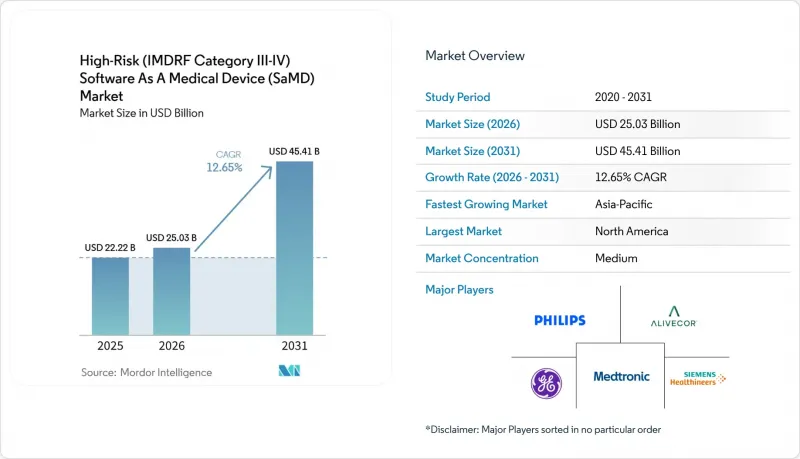
Mordor Intelligence에 의하면, 고위험(IMDRF 카테고리 III-IV) SaMD(Software-as-a-Medical Device) 시장 규모는 2025년에 222억 2,000만 달러로 평가되었고, 2026년에 250억 3,000만 달러로 추정되고, 2031년까지 454억 1,000만 달러에 이를 것으로 예측되며, 2026-2031년 CAGR 12.65%로 성장할 전망입니다.
본 보고서는 배포 방식별(클라우드 기반, 온프레미스형, 하이브리드형), 기능별(진단 지원, 기타), 임상 용도별(방사선과, 순환기과, 기타), 최종 사용자별(병원, 외래수술센터(ASC), 전문 클리닉, 영상 센터, 재택치료, 기타), IMDRF 위험 등급별(카테고리 III, 카테고리 IV), 지역별(북미, 유럽, 기타)로 분류되어 있습니다. 예측치는 금액(달러)으로 표시되어 있습니다.
고위험(IMDRF 카테고리 III-IV) SaMD(Software-as-a-Medical Device) 시장 동향 및 인사이트
임상적으로 검증된 AI 진단 도구에 대한 수요 증가
현재, 고위험(IMDRF 카테고리 III-IV) SaMD(Software-as-a-Medical Device) 시장의 조달에서는 단독의 성능 주장보다 임상적 검증에 더 중점을 두고 있습니다. 구매자들은 소프트웨어가 실제 환자 집단, 여러 의료 기관, 확립된 치료 경로에서 출시 후에도 확실하게 작동한다는 증거를 요구하고 있습니다. 이러한 변화로 인해 단일 승인 마일스톤에 의존하기보다는 지속적인 성과, 반복적인 활용, 지속적인 증거 유지를 입증할 수 있는 공급업체가 유리해지고 있습니다. HeartFlow의 지속적인 증거 확충과 보험사의 지지 확대는 검증된 플랫폼이 어떻게 전문적인 용도에서 더 광범위한 임상 도입으로 전환될 수 있는지를 보여주고 있습니다.
디지털 진단에 대한 보험 급여 지원 확대
고위험(IMDRF 카테고리 III-IV) SaMD(Software-as-a-Medical Device) 시장에서 보험 적용 지원은 점점 더 뚜렷한 성장 동력이 되고 있습니다. 보험 적용 결정은 임상적 관심을 재구매, 공식적인 예산 편성, 의료 기관에 대한 보다 광범위한 도입으로 전환시킵니다. HeartFlow의 플라크 분석은 2026년 1월 Aetna의 보험 플랜에서 적용이 승인되어, 일상 진료에서 AI를 활용한 심장 평가의 근거가 더욱 공고해졌습니다. 또한, AdvaMed는 2026년 2월 미국 정책 입안자들에게 SaMD를 위한 보다 명확한 결제 채널을 마련할 것을 요청했으며, 이는 환급 정책이 상업화 전략의 핵심임을 보여줍니다.
카테고리 III 및 IV 임상 검증에서의 증거 부담
증거 요건은 고위험(IMDRF 카테고리 III-IV) SaMD(Software-as-a-Medical Device) 시장에서 여전히 주요 진입 장벽으로 작용하고 있습니다. 카테고리 III 및 IV 소프트웨어는 저위험 디지털 도구보다 더 강력한 임상 검증이 요구됩니다. 특히, 그 결과가 중증 질환의 진단이나 치료 결정에 영향을 미치는 경우에는 더욱 그렇습니다. 2026년 5월, NeuroPace의 ‘ECoG Assistant’가 FDA 승인을 획득한 사례는 고도 임상용 소프트웨어가 소비자용 제품과 같은 출시 주기가 아니라 규제 대상인 치료 생태계와 밀접하게 연결되어 있음을 보여주었습니다. 이러한 요건은 개발 기간을 길게 만들고 연구 비용을 증가시키며, 확립된 임상시험 네트워크, 병원과의 제휴 관계, 품질 관리 시스템을 갖춘 기업에 유리하게 작용합니다. 그 결과, 신규 개발 기업의 경우 초기 승인을 획득한 후에도 지역 내 확산이 지연되고 비용도 많이 들게 됩니다.
부문 분석
도입 부문에서 클라우드 기반 SaMD는 2025년 매출의 52.56%를 차지했으며, 대규모 다중 의료 시스템 전반에 걸친 중앙 집중식 처리에 대한 기업의 강한 선호도를 반영하고 있습니다. 고위험(IMDRF 카테고리 III-IV) SaMD(Software-as-a-Medical Device) 시장에서 이러한 주도적 지위는 이미지 데이터 양, 감사 추적, 사용자 권한, 모델 성능을 단일하고 조정된 환경에서 관리해야 할 필요성에 의해 주도되었습니다. 대규모 병원 그룹은 공통의 임상 프로토콜을 사용하여 시설 간 원격 관리 및 일관된 감독을 수행하기 위해 클라우드 도입을 선호했습니다.
하이브리드형 SaMD는 2031년까지 연평균 성장률(CAGR) 14.93%로 확대될 것으로 예상되며, 의료 서비스 제공업체가 로컬 제어와 중앙 집중식 분석의 균형을 모색함에 따라 가장 빠르게 성장하는 배포 모델이 될 전망입니다. 온프레미스 배포는 데이터 상주 요건이 더 엄격하거나, 내부 보안 규정이 더 까다롭거나, 외부로의 데이터 마이그레이션에 대한 허용도가 낮은 의료 기관에서 여전히 중요성을 유지하고 있습니다. 따라서 고위험(IMDRF 카테고리 III-IV) SaMD(Software-as-a-Medical Device) 시장은 중앙 집중식 업데이트 및 규정 준수 기능을 유지하면서, 기밀성이 높은 추론 처리를 환자 근처에서 수행하는 연합 운영 모델로 전환되고 있습니다. RapidAI의 엔터프라이즈 플랫폼 접근 방식은 유연한 아키텍처를 지원하는 벤더가 지지를 얻은 이유를 보여주었습니다.
기능별로 보면, 2025년 고위험(IMDRF 카테고리 III-IV) SaMD(Software-as-a-Medical Device) 시장 규모의 38.23%를 진단 지원이 차지했습니다. 이는 방사선과, 순환기과, 의사결정 지원 워크플로우에 걸친 폭넓은 도입 실적이 뒷받침한 결과입니다. 의료 기관이 이 카테고리를 조기에 채택한 이유는 직접적인 치료 실행으로 즉시 전환하지 않으면서도 영상 분석과 우선순위 지정을 개선할 수 있었기 때문입니다. 이러한 조기 도입으로 인해 진단 지원은 조달 측면에서의 우위를 강화했으며, 성숙한 영상 활용 사례에서 경쟁이 치열해지는 상황 속에서도 리더십을 유지하는 데 기여했습니다.
‘치료 지침’은 2031년까지 연평균 성장률(CAGR) 14.67%로 확대될 것으로 예측되며, 고위험(IMDRF 카테고리 III-IV) SaMD(Software-as-a-Medical Device) 시장에서 가장 빠르게 성장하는 기능이 될 전망입니다. 성장이 가장 두드러졌던 부문은 규제 대상 임상 현장에서 소프트웨어가 시술 계획, 선량 선정, 기기 프로그래밍 또는 기타 치료 관련 활동에 영향을 미친 부문이었습니다. ‘모니터링 및 경보’는 안정적인 중간 수준을 유지한 반면, ‘트라이아지 및 우선순위 지정’은 보험 급여 상황의 불균형과 워크플로우 도입 현황의 편차를 겪었습니다. HeartFlow가 2026년 3월에 ‘PCI Navigator’를 출시한 것은 중재적 치료 분야에서 진단적 평가에서 시술 지침으로의 전환을 보여줍니다.
지역별 분석
북미는 2025년 매출의 39.88%를 차지했으며, 고위험(IMDRF 카테고리 III-IV) SaMD(Software-as-a-Medical Device) 시장에서 가장 규모가 큰 지역 점유율을 기록했습니다. 견고한 규제 인프라, 광범위한 의료 기관 네트워크, 지원적인 보험사 환경이 계속해서 도입을 뒷받침하고 있습니다. 미국은 여전히 주요 상용화 시장인 반면, 캐나다는 진입 장벽이 낮은 인접 시장으로 기능하고 있으며, 멕시코는 인증 기반 채널을 통한 선택적 진입의 장을 제공합니다.
유럽은 고위험(IMDRF 카테고리 III-IV) SaMD(Software-as-a-Medical Device) 시장에서 여전히 2위 지역 클러스터로 자리 잡고 있습니다. 독일, 프랑스, 영국, 네덜란드는 강력한 병원 조달 능력과 공식적인 환급 심사를 통해 도입을 주도하고 있습니다. 고위험 소프트웨어는 의료기기 규제에 따라 더 무거운 문서화 부담을 안고 있으며, AI 거버넌스에 대한 기대도 광범위하기 때문에 소규모 개발자의 경우 개발 기간이 장기화되고 있습니다. 영국은 보다 신속한 2차 시장 진입 경로를 제공할 수 있는 반면, 스페인과 이탈리아는 확고한 임상적 관심을 보이고 있으나 조달 조건은 편차가 있습니다.
아시아태평양은 2031년까지 연평균 성장률(CAGR) 17.56%를 나타낼 것으로 예측되며, 고위험(IMDRF 카테고리 III-IV) SaMD(Software-as-a-Medical Device) 시장에서 가장 빠르게 성장하는 지역이 될 전망입니다. 중국, 일본, 한국, 인도는 국내 제조 규모 확대, 규제 성숙도 향상, 병원 디지털화 진전을 통해 시장 확대를 주도하고 있습니다. 일본의 2026년 라이프사이클 프레임워크에서는 적응형 알고리즘에 대한 시판 후 요건이 더욱 엄격해질 것으로 시사된 반면, 중국에서는 계속해서 고위험 AI 제품에 대해 현지화된 운영 모델이 지지받고 있습니다. 중동 및 아프리카는 여전히 도입 초기 단계에 있으며, GCC(걸프협력회의) 국가들의 의료 시스템이 선도적으로 움직이고 있습니다. 한편, 남미 지역은 브라질과 아르헨티나를 중심으로 아직 발전 단계에 있지만, 심혈관 질환 및 종양학에 초점을 맞춘 의료 분야에서 중기적인 기회가 예상됩니다.
기타 혜택
- 엑셀 형식 시장 예측(ME) 시트
- 3개월간의 애널리스트 지원
자주 묻는 질문
목차
제1장 서론
제2장 조사 방법
제3장 주요 요약
제4장 시장 구도
제5장 시장 규모 및 성장 예측
제6장 경쟁 구도
제7장 시장 기회 및 향후 전망
AJY 26.09.03According to Mordor Intelligence, the high-Risk software as a medical device market size is projected to be USD 22.22 billion in 2025, USD 25.03 billion in 2026, and reach USD 45.41 billion by 2031, growing at a CAGR of 12.65% from 2026 to 2031.
This report is Segmented by Deployment (Cloud-Based, On-Premises, Hybrid), Functionality (Diagnosis Support, and More), Clinical Application (Radiology, Cardiology, and More), End User (Hospitals, Ascs, Specialty Clinics, Diagnostic Imaging Centers, Home Care, Others), IMDRF Risk Class (Category III, Category IV), and Geography (North America, Europe, and More). Forecasts are in Value (USD).
Global High-Risk (IMDRF Category III-IV) Software As A Medical Device (SaMD) Market Trends and Insights
Rising Demand for Clinically Validated AI Diagnostics
Clinical validation now carries more weight than standalone performance claims in procurement across the high-risk Software as a Medical Device (SaMD) market. Buyers require evidence that software performs across real patient populations, multiple sites, and established care pathways after launch. This shift favors vendors that can demonstrate durable outcomes, repeat use, and continuous evidence maintenance, rather than relying on a single authorization milestone. HeartFlow's continued evidence expansion and payer traction show how a validated platform can move from specialized use into broader clinical deployment.
Expanding Reimbursement Support for Digital Diagnostics
Reimbursement support is becoming a more visible growth lever in the high-risk Software as a Medical Device (SaMD) market. Coverage decisions convert clinical interest into repeat purchasing, formal budgeting, and wider provider rollout. HeartFlow Plaque Analysis gained coverage for Aetna plans in January 2026, strengthening the case for AI-supported cardiac assessment in routine care. AdvaMed also urged U.S. policymakers in February 2026 to create a clearer payment pathway for SaMD, showing that reimbursement policy is central to commercialization strategy.
Evidence Burden for Category III and IV Clinical Validation
Evidence requirements remain a key entry barrier in the high-risk Software as a Medical Device (SaMD) market. Category III and IV software requires stronger clinical validation than lower-risk digital tools, especially when outputs influence diagnosis or treatment decisions for serious conditions. NeuroPace's May 2026 FDA approval for ECoG Assistant showed how advanced clinical software remained closely linked to regulated therapeutic ecosystems rather than consumer-style release cycles. These requirements lengthen timelines, increase study costs, and favor companies with established trial networks, hospital relationships, and quality systems, making regional expansion slower and costlier for newer developers even after initial authorization.
Other drivers and restraints analyzed in the detailed report include:
- Shortage of Specialist Clinicians in Imaging and Monitoring Workflows
- Faster Regulatory Pathways for Predetermined Change Control Plans
- Cybersecurity and Software Update Liability Exposure
For complete list of drivers and restraints, kindly check the Table Of Contents.
Segment Analysis
Cloud-Based SaMD held 52.56% of 2025 revenue in the deployment segment, reflecting strong enterprise preference for centralized processing across large, multi-site health systems. In the high-risk Software as a Medical Device (SaMD) market, this leadership was driven by the need to manage imaging volumes, audit trails, user permissions, and model performance in one coordinated environment. Large hospital groups favored cloud deployment for remote administration and consistent oversight across facilities using common clinical protocols.
Hybrid SaMD is forecast to expand at 14.93% CAGR through 2031, making it the fastest-growing deployment model as providers balance local control with centralized analytics. On-premises deployment retained relevance in institutions with tighter data residency obligations, stricter internal security rules, or lower tolerance for external data movement. The high-risk Software as a Medical Device (SaMD) market is therefore moving toward federated operating models that keep sensitive inference closer to the patient while preserving centralized update and compliance functions. RapidAI's enterprise platform approach showed why vendors supporting flexible architectures gained traction.
Diagnosis Support accounted for 38.23% of the 2025 high-risk Software as a Medical Device (SaMD) market size by functionality, supported by its broad installed base across radiology, cardiology, and decision-support workflows. Providers adopted this category earlier because it improved interpretation and prioritization without immediately shifting into direct therapy execution. This early adoption gave diagnosis support a stronger procurement position and helped it retain leadership despite rising competition in mature imaging use cases.
Treatment Guidance is forecast to expand at 14.67% CAGR through 2031, making it the fastest-growing functionality in the high-risk Software as a Medical Device (SaMD) market. Growth was strongest where software influenced procedural planning, dose selection, device programming, or other therapy-linked actions in regulated clinical settings. Monitoring and Alerting remained a steady middle cohort, while Triage and Prioritization faced uneven reimbursement and variable workflow adoption. HeartFlow's March 2026 launch of PCI Navigator illustrated the shift from diagnostic assessment to procedural guidance in interventional care.
Complete Report Scope:
- By Deployment
- Cloud-Based SaMD
- On-Premises SaMD
- Hybrid SaMD
- By Functionality
- Diagnosis Support
- Monitoring and Alerting
- Treatment Guidance
- Triage and Prioritization
- By Clinical Application
- Radiology
- Cardiology
- Neurology
- Oncology
- Ophthalmology
- Gastroenterology
- Endocrinology
- Critical Care and Emergency Care
- Other Clinical Applications
- By End User
- Hospitals and Health Systems
- Ambulatory Surgical Centers
- Specialty Clinics
- Diagnostic Imaging Centers
- Home Care Settings
- Others
- By IMDRF Risk Class
- Category III
- Category IV
- By Geography
- North America
- United States
- Canada
- Mexico
- Europe
- Germany
- United Kingdom
- France
- Italy
- Spain
- Rest of Europe
- Asia-Pacific
- China
- India
- Japan
- Australia
- South Korea
- Rest of Asia-Pacific
- Middle East and Africa
- GCC
- South Africa
- Rest of Middle East and Africa
- South America
- Brazil
- Argentina
- Rest of South America
- North America
Geography Analysis
North America held 39.88% of 2025 revenue, giving it the largest regional position in the high-risk Software as a Medical Device (SaMD) market. Strong regulatory infrastructure, broad enterprise provider networks, and supportive payer conditions continue to drive adoption. The United States remains the main commercial launch market, while Canada offers a lower-friction adjacency and Mexico provides selective entry through recognition-based pathways.
Europe remained the second-largest regional cluster in the high-risk Software as a Medical Device (SaMD) market. Germany, France, the United Kingdom, and the Netherlands anchor adoption through strong hospital procurement capacity and formal reimbursement review. High-risk software faces a heavier documentation burden under medical device rules and broader AI governance expectations, extending timelines for smaller developers. The United Kingdom can offer a faster secondary launch route, while Spain and Italy show solid clinical interest but fragmented procurement conditions.
Asia-Pacific is forecast to grow at a CAGR of 17.56% through 2031, making it the fastest-growing region in the high-risk Software as a Medical Device (SaMD) market. China, Japan, South Korea, and India are driving expansion through domestic manufacturing scale, maturing regulation, and rising hospital digitization. Japan's 2026 lifecycle framework pointed to stricter post-market expectations for adaptive algorithms, while China continued to favor localized operating models for high-risk AI products. The Middle East and Africa remained at an earlier adoption stage, with GCC health systems moving first, while South America remained nascent, led by Brazil and Argentina, with medium-term opportunities in cardiovascular and oncology-focused care.
- Aidoc Medical Ltd.
- AliveCor
- Apple
- Butterfly Network, Inc.
- Carlsmed, Inc.
- CeriBell, Inc.
- Dexcom
- Digital Diagnostics
- GE HealthCare Technologies Inc.
- HeartFlow, Inc.
- Hologic
- Koninklijke Philips
- Lunit
- Medtronic
- NeuroPace
- Paige AI, Inc.
- Qure.ai Technologies Private Limited
- RapidAI, Inc.
- Siemens Healthineers
- Tempus AI, Inc.
- Viz.ai, Inc.
Additional Benefits:
- The market estimate (ME) sheet in Excel format
- 3 months of analyst support
TABLE OF CONTENTS
1 INTRODUCTION
- 1.1 Study Assumptions and Market Definition
- 1.2 Scope of the Study
2 RESEARCH METHODOLOGY
3 EXECUTIVE SUMMARY
4 MARKET LANDSCAPE
- 4.1 Market Overview
- 4.2 Market Drivers
- 4.2.1 Rising Demand for Clinically Validated AI Diagnostics
- 4.2.2 Expanding Reimbursement Support for Digital Diagnostics
- 4.2.3 Shortage of Specialist Clinicians in Imaging and Monitoring Workflows
- 4.2.4 Faster Regulatory Pathways for Predetermined Change Control Plans
- 4.2.5 Hospital Digital Transformation and EHR Integration Pressure
- 4.2.6 Cross-Border Scaling Through Platform-Based Evidence Reuse
- 4.3 Market Restraints
- 4.3.1 Evidence Burden for Category III and IV Clinical Validation
- 4.3.2 Cybersecurity and Software Update Liability Exposure
- 4.3.3 Data Access Fragmentation Across Health Systems
- 4.3.4 Low Interoperability With Legacy Clinical IT Infrastructure
- 4.4 Value/Supply Chain Analysis
- 4.5 Regulatory Landscape
- 4.6 Technological Outlook
- 4.7 Porter's Five Forces Analysis
- 4.7.1 Bargaining Power of Suppliers
- 4.7.2 Bargaining Power of Buyers
- 4.7.3 Threat of New Entrants
- 4.7.4 Threat of Substitutes
- 4.7.5 Industry Rivalry
5 MARKET SIZE AND GROWTH FORECASTS (VALUE, USD)
- 5.1 By Deployment
- 5.1.1 Cloud-Based SaMD
- 5.1.2 On-Premises SaMD
- 5.1.3 Hybrid SaMD
- 5.2 By Functionality
- 5.2.1 Diagnosis Support
- 5.2.2 Monitoring and Alerting
- 5.2.3 Treatment Guidance
- 5.2.4 Triage and Prioritization
- 5.3 By Clinical Application
- 5.3.1 Radiology
- 5.3.2 Cardiology
- 5.3.3 Neurology
- 5.3.4 Oncology
- 5.3.5 Ophthalmology
- 5.3.6 Gastroenterology
- 5.3.7 Endocrinology
- 5.3.8 Critical Care and Emergency Care
- 5.3.9 Other Clinical Applications
- 5.4 By End User
- 5.4.1 Hospitals and Health Systems
- 5.4.2 Ambulatory Surgical Centers
- 5.4.3 Specialty Clinics
- 5.4.4 Diagnostic Imaging Centers
- 5.4.5 Home Care Settings
- 5.4.6 Others
- 5.5 By IMDRF Risk Class
- 5.5.1 Category III
- 5.5.2 Category IV
- 5.6 By Geography
- 5.6.1 North America
- 5.6.1.1 United States
- 5.6.1.2 Canada
- 5.6.1.3 Mexico
- 5.6.2 Europe
- 5.6.2.1 Germany
- 5.6.2.2 United Kingdom
- 5.6.2.3 France
- 5.6.2.4 Italy
- 5.6.2.5 Spain
- 5.6.2.6 Rest of Europe
- 5.6.3 Asia-Pacific
- 5.6.3.1 China
- 5.6.3.2 India
- 5.6.3.3 Japan
- 5.6.3.4 Australia
- 5.6.3.5 South Korea
- 5.6.3.6 Rest of Asia-Pacific
- 5.6.4 Middle East and Africa
- 5.6.4.1 GCC
- 5.6.4.2 South Africa
- 5.6.4.3 Rest of Middle East and Africa
- 5.6.5 South America
- 5.6.5.1 Brazil
- 5.6.5.2 Argentina
- 5.6.5.3 Rest of South America
- 5.6.1 North America
6 COMPETITIVE LANDSCAPE
- 6.1 Market Concentration
- 6.2 Market Share Analysis
- 6.3 Company Profiles (includes Global Level Overview, Market Level Overview, Core Segments, Financials as available, Strategic Information, Market Rank/Share, Products and Services, Recent Developments)
- 6.3.1 Aidoc Medical Ltd.
- 6.3.2 AliveCor, Inc.
- 6.3.3 Apple Inc.
- 6.3.4 Butterfly Network, Inc.
- 6.3.5 Carlsmed, Inc.
- 6.3.6 CeriBell, Inc.
- 6.3.7 DexCom, Inc.
- 6.3.8 Digital Diagnostics Inc.
- 6.3.9 GE HealthCare Technologies Inc.
- 6.3.10 HeartFlow, Inc.
- 6.3.11 Hologic, Inc.
- 6.3.12 Koninklijke Philips N.V.
- 6.3.13 Lunit Inc.
- 6.3.14 Medtronic plc
- 6.3.15 NeuroPace, Inc.
- 6.3.16 Paige AI, Inc.
- 6.3.17 Qure.ai Technologies Private Limited
- 6.3.18 RapidAI, Inc.
- 6.3.19 Siemens Healthineers AG
- 6.3.20 Tempus AI, Inc.
- 6.3.21 Viz.ai, Inc.
7 MARKET OPPORTUNITIES AND FUTURE OUTLOOK
- 7.1 White-Space and Unmet-Need Assessment


