

|
시장보고서
상품코드
2118217
디지털 진단 소프트웨어 시장 : 시장 점유율 분석, 업계 동향 및 통계, 성장 예측(2026-2031년)Digital Diagnostics Software - Market Share Analysis, Industry Trends & Statistics, Growth Forecasts (2026 - 2031) |
||||||
 Mordor Intelligence
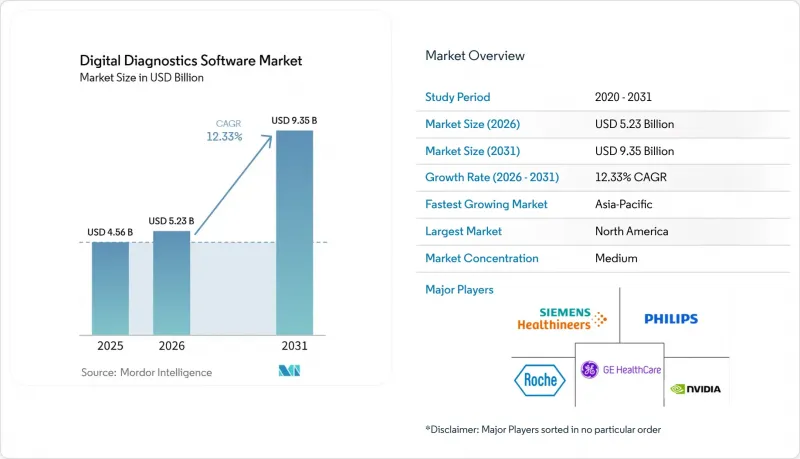
Mordor Intelligence에 의하면, 디지털 진단 소프트웨어 시장 규모는 2025년 45억 6,000만 달러로 평가되었고, 2026년에는 52억 3,000만 달러로 추정되고, 2031년까지 93억 5,000만 달러에 이를 것으로 전망되며, 2026-2031년 CAGR 12.33%를 나타낼 것으로 예측됩니다.
본 보고서는 제품 유형별(영상 진단, 임상 의사결정 지원, 기타), 도입 형태별(클라우드/SaaS, 온프레미스, 하이브리드), 진단 방식별(영상 기반, 신호 기반, IVD 및 분자진단, 기타), 용도별(순환기, 종양학, 기타), 최종 사용자별(병원, 검사실, 기타), 지역별(북미, 유럽, 아시아태평양, 중동, 남미)로 분류되어 있습니다.
세계의 디지털 진단 소프트웨어 시장 동향 및 인사이트
신속한 트리아지 및 질환 조기 발견에 대한 수요 증가
영상 진단 수요 증가와 의사 부족으로 인해 진단 서비스에 대한 부담이 커지는 가운데, 응급 의료팀과 1차 진료팀은 AI를 활용한 분류 도구의 도입을 추진하고 있습니다. 2026년 임상 연구에 따르면, 흉부 X선 사진 판독에 AI를 활용함으로써 신임 방사선과 의사의 보고서 수정 횟수가 감소하고, 상급 의사의 검토가 신속해져 진료 건수가 많은 의료 기관에서 검토 주기를 단축할 수 있는 것으로 밝혀졌습니다. 이 결과는 임상적 감독을 대체하는 것이 아니라, 임상의가 긴급성이 높은 증례를 우선적으로 처리할 수 있도록 지원하는 도구에 대한 수요를 뒷받침하는 것입니다. 소프트웨어가 1차 선별 검사 역할을 점점 더 많이 수행함에 따라, 의료 제공업체는 품질 보증 및 의료법적 심사 시 확인 및 설명이 가능한 출력 결과를 필요로 하고 있습니다. 이러한 요구에 따라, 기존 보고 프로세스에 부합하고 소프트웨어가 소견 도출을 어떻게 지원했는지를 명확히 기록할 수 있는 시스템이 중요시되고 있습니다. 따라서 디지털 진단 소프트웨어 시장에서 트리아지 신속화는 진단 성능뿐만 아니라 워크플로우 설계 및 설명 책임의 중요성을 높이고 있습니다.
AI를 활용한 방사선과 및 병리과 워크플로우의 확대
AI는 특정 증례에만 사용되는 독립적인 도구가 아니라, 방사선과 및 병리과의 일상 업무 워크플로우의 일부가 되어가고 있습니다. 예일 뉴헤이븐 헬스는 2026년 6월, 16개의 외래 영상진단센터와 5개의 병원 캠퍼스에 Rad AI를 도입하여 연간 70만 건 이상의 검사를 처리했습니다. 이번 도입을 통해 의료 시스템이 플랫폼이 각 거점 및 기존 시스템 간에 원활하게 작동하는지 여부를 매우 중요하게 여긴다는 사실이 밝혀졌습니다. 또한, PathAI와 메드스타 헬스도 2026년 4월, 40명 이상의 병리학자가 소속된 검사실 네트워크 전체에 ‘AISight Dx’ 디지털 병리 플랫폼을 도입하기 위해 수년에 걸친 제휴를 발표했습니다. 이러한 도입 사례에서는 의사의 업무 시간과 운영의 일관성이 중시되고 있으며, 이로 인해 구매 결정에 관여하는 병원 경영진의 범위가 확대되고 있습니다. 각 임상 용도별로 개별 기술 프로젝트가 필요하지 않고, 플랫폼을 부서 간에 확장할 수 있는 경우, 디지털 진단 소프트웨어 시장은 그 혜택을 누리게 될 것입니다.
알고리즘의 설명 가능성과 임상적 책임에 대한 우려
책임 문제는 AI 지원 진단 도구의 조달에 있어 직접적인 고려 사항이 되고 있습니다. 캘리포니아주의 AB-2575 법안은 임상 의사결정 지원 시스템을 다루며, 의료 AI 도입에 있어 명확한 거버넌스의 중요성을 강조하고 있습니다. 미국 의사협회(AMA)는 2025년, AI의 설명 가능성에 관한 지침이 임상 용도에서 여전히 중요한 과제라고 지적했습니다. 의료 제공업체는 출력 결과가 임상 워크플로우에 어떻게 반영되었는지, 누가 이를 확인했는지, 그리고 최종적인 책임이 누구에게 있는지 이해해야 합니다. 이로 인해 상세한 감사 기록, 보다 강력한 거버넌스 지원, 그리고 계약상 보증을 제공할 수 있는 벤더가 유리한 입장에 설 가능성이 있습니다. 따라서 디지털 진단 소프트웨어 시장에서 고객이 리스크 관리를 중시할 경우, 대형 벤더들이 혜택을 볼 것으로 보입니다.
부문 분석
제품 유형별 : 영상 분석이 영상 정보학의 역할을 확대
진단용 영상 소프트웨어는 2025년 매출의 30.2%를 차지했으며, 디지털 진단 소프트웨어 시장에서 가장 큰 제품 카테고리가 되고 있습니다. 이러한 위상은 일상적인 영상 판독, 보고서 작성, 저장 및 의료진 간의 소통을 위해 PACS 통합 시스템에 의존하고 있는 방사선과 분야의 광범위한 도입 실적을 반영합니다. 영상 분석 및 컴퓨터 비전 소프트웨어는 의료 기관이 병변 감지, 분할, 우선순위 지정, 체적 측정을 위한 도구를 도입함에 따라 2031년까지 연평균 성장률(CAGR) 13.3%를 나타낼 것으로 예측됩니다. 이러한 기능들은 이미지 처리량이 방대하고 보고서 작성 기한이 제한적인 상황에서 전문의가 많은 시간을 할애하게 되는 업무를 처리해 줍니다. 임상 의사결정 지원 소프트웨어는 1차 진료 분야에서 중요성이 커지고 있는 반면, 검사실 및 체외 진단용 소프트웨어는 검사실 자동화 및 기존 정보 시스템과의 연동 필요성에 따라 진화를 거듭하고 있습니다.
병리·디지털 현미경 소프트웨어는 디지털화된 전체 슬라이드 이미징의 도입에 따라 성장하고 있으며, 이를 통해 검사실은 통합적인 검토 및 소프트웨어 지원 분석을 수행할 수 있는 실용적인 기반을 확보하고 있습니다. 메이요 클리닉은 2025년, Techcyte Fusion Anatomic Pathology가 해당 병원의 디지털 병리학 전환을 지원했다고 보고하며, AI를 활용한 영상 관리가 기술을 일상 업무 워크플로우에서 분리하지 않고 대규모 검사실 환경 전반에 걸쳐 활용될 수 있음을 보여주었습니다. 후지필름은 규제 당국의 인증을 획득한 후, 2025년 7월 일본에서 AI 기반 간질성 폐질환 분석 소프트웨어 제품을 출시했습니다. 이는 제품 개발을 현지 임상 및 규제 요건과 연계한 결과입니다. 디지털 진단 소프트웨어 업계에서는 임상의가 별도의 판독 환경에서 작업하도록 요구하는 대신, 확립된 영상 워크플로우에 부합하는 제품으로 가치가 이동하고 있습니다. 이에 따라 영상 분석, 보고서 작성, 저장, 감사 기능 및 엔터프라이즈 워크플로우 도구를 임상적으로 일관된 솔루션으로 통합할 수 있는 공급업체가 유리한 입지를 점하고 있습니다.
2025년 매출액 중 클라우드 기반 및 SaaS(Software-as-a-Service) 방식의 도입이 55.8%를 차지했으며, 디지털 진단 소프트웨어 시장에서 가장 큰 점유율을 기록했습니다. 이러한 접근 방식을 통해 각 거점에서 별도의 하드웨어나 버전 관리 프로세스를 유지할 필요 없이 모델 업데이트, 여러 거점 간의 연계, 공유 소프트웨어 서비스에 대한 접근이 가능해집니다. 또한 의료 기관이 분산된 병원이나 영상 진단 네트워크 전체에 걸쳐 동일한 워크플로우 규칙, 사용자 접근 제어, 소프트웨어 버전을 적용하는 데에도 도움이 됩니다. 데이터 저장 위치 요건, 현지 거버넌스, 또는 기존 인프라가 병원의 선정 기준이 되는 경우, 온프레미스형 시스템은 여전히 중요한 위치를 차지하고 있습니다. 의료 서비스 제공업체가 기밀 데이터를 현지에 보관하면서 특정 컴퓨팅, 통합 및 워크플로우 업무에 클라우드 리소스를 활용하는 경우, 하이브리드 배포가 선택지로 떠오르고 있습니다.
클라우드 도입은 레거시 PACS 공급업체의 입지도 변화시키고 있습니다. 이러한 공급업체들은 진단 소프트웨어를 개별 기술 구매가 아닌, 보다 광범위한 관리형 서비스의 일부로 제공할 수 있게 되었습니다. Sectra는 2026년 2월, 게르프 종합병원에서 해당 병원이 이미 도입한 ‘Sectra One Cloud’ 플랫폼을 통해 디지털 병리 모듈을 가동했습니다. 이 이용 사례는 특정 영상 진단 분야에서 사용되고 있는 클라우드 플랫폼이, 익숙한 인프라와 확립된 사용자 관계를 활용하여 인접한 진단 모듈을 어떻게 지원할 수 있는지를 보여줍니다. 이를 통해 별도의 조달 프로젝트 필요성이 줄어들고, 도입이 간소화되며, 임상 팀이 추가적인 디지털 기능을 더 쉽게 도입할 수 있게 됩니다. 디지털 진단 소프트웨어 시장에서 이는 고객의 광범위한 정보 환경과의 상호 운용성을 유지하면서 플랫폼에 새로운 모듈을 추가할 수 있는 공급업체에게 판매상의 우위를 제공합니다.
지역별 분석
2025년, 북미는 디지털 진단 소프트웨어 시장의 39.1%를 차지했습니다. 이는 성숙한 의료 기록 인프라, 보험사의 적극적인 시범 운영, 그리고 진단 소프트웨어 공급업체의 고밀도 집적을 반영한 것입니다. 이 지역의 의료 시스템은 개별 AI 도구에서 영상 진단 시설, 외래 센터, 병원 각 진료과에 걸친 워크플로우를 관리하는 플랫폼으로 전환되고 있습니다. 예일 뉴헤이븐 헬스가 2026년에 5개 병원 캠퍼스와 16개 외래 센터에 ‘Rad AI’를 도입한 사례는 이러한 운영 모델의 규모를 여실히 보여줍니다. 캐나다에서도 2026년 2월 길프 종합병원에서 ‘Sectra Digital Pathology’가 가동을 시작한 것에서 알 수 있듯이, 주요 학술 의료 센터 이외의 곳으로도 도입이 확대되고 있습니다.
유럽에서는 유럽연합(EU)의 AI 법 및 의료기기 관련 요건에 의해 형성된 규정 준수 중심의 환경 속에서 진단용 AI가 도입되고 있습니다. 이러한 요건은 시장에 출시되는 도구의 품질 기준을 높이는 한편, 개발자에게는 시간과 비용 증가로 이어질 수 있습니다. 독일의 아스클레피오스 병원 그룹은 2025년에 병원 디지털화 자금을 활용해 25곳 이상의 진료 거점에 Aidoc사의 aiOS를 도입했습니다. 영국, 프랑스, 북유럽 국가에서는 디지털 병리학 및 영상 AI 도입이 진행되고 있지만, 스페인과 이탈리아는 도입 주기의 초기 단계에 머물러 있습니다.
아시아태평양은 2031년까지 연평균 성장률(CAGR) 12.6%를 나타낼 것으로 예측되며, 이는 디지털 진단 소프트웨어 시장에서 지역별 가장 높은 성장률입니다. 중국 현(縣) 수준의 원격 진단 영상 서비스는 2025년에 6,800만 건을 넘어설 것으로 예상되어, 원격 진단 능력에 대한 수요 규모를 보여주고 있습니다. 중국의 임상적 필요성과 대규모 의료 서비스 네트워크로 인해 원격 심사 및 AI를 활용한 트리아지가 특히 중요시되고 있습니다. 일본에서는 2025년에 AI Medical Service사가 위암 및 선종의 조기 발견을 목적으로 한 ‘gastroAI model-G2’를 출시하는 등, 규제 대상 소프트웨어의 파이프라인이 확대되고 있습니다. 중동 및 남미는 도입 초기 단계 시장이며, 도입은 3차 의료기관이나 정부 지원에 의한 원격의료 인프라에 집중되고 있습니다. 중동에서는 걸프협력회의(GCC) 회원국이 가장 활발하게 조달을 진행하고 있으며, 지역 전체로서의 기회는 임상 인프라 및 전문의 확보 상황에 좌우됩니다.
기타 혜택 :
- 엑셀 형식 시장 예측(ME) 시트
- 3개월간의 애널리스트 지원
자주 묻는 질문
목차
제1장 서론
제2장 조사 방법
제3장 개요
제4장 시장 구도
제5장 시장 규모 및 성장 예측
제6장 경쟁 구도
제7장 시장 기회 및 향후 전망
AJY 26.09.01According to Mordor Intelligence, the digital diagnostics software market size is expected to increase from USD 4.56 billion in 2025 to USD 5.23 billion in 2026 and reach USD 9.35 billion by 2031, growing at a CAGR of 12.33% over 2026-2031.
This report is Segmented by Product Type (Diagnostic Imaging, Clinical Decision Support, Others), Deployment Mode (Cloud/SaaS, On-Premises, Hybrid), Diagnostic Modality (Imaging-Based, Signal-Based, IVD and Molecular, and More), Application (Cardiology, Oncology, and More), End User (Hospitals, Labs, and More), and Geography (North America, Europe, APAC, Middle East, South America).
Global Digital Diagnostics Software Market Trends and Insights
Rising Demand for Faster Triage and Early Disease Detection
Emergency and primary care teams are adopting AI-assisted triage tools as imaging demand and physician shortages place more pressure on diagnostic services. A 2026 clinical study found that AI assistance in chest radiograph interpretation reduced junior radiologist report revisions and accelerated senior review, which can shorten the review cycle in high-volume institutions. The result supports demand for tools that help clinicians prioritize urgent cases without replacing clinical oversight. As software moves closer to first-line screening, providers need outputs that can be reviewed and explained during quality assurance and medicolegal review. This need favors systems that fit existing reporting processes and retain clear records of how the software supported a finding. In the digital diagnostics software market, faster triage therefore raises the value of workflow design and accountability alongside diagnostic performance.
Expansion of AI-Enabled Radiology and Pathology Workflows
AI is becoming part of the daily operating workflow in radiology and pathology rather than a separate tool used for selected cases. Yale New Haven Health deployed Rad AI across 16 outpatient imaging centers and 5 hospital campuses in June 2026, covering more than 700,000 annual examinations. The deployment showed that health systems place substantial weight on whether a platform can work across sites and existing systems. PathAI and MedStar Health also announced a multiyear partnership in April 2026 to deploy the AISight Dx digital pathology platform across a laboratory network of more than 40 pathologists. These deployments place emphasis on physician time and operational consistency, which broadens the group of hospital leaders involved in purchasing decisions. The digital diagnostics software market benefits when a platform can be extended across departments without requiring a separate technology project for each clinical use.
Algorithm Explainability and Clinical Liability Concerns
Liability has become a direct procurement consideration for AI-assisted diagnostic tools. California AB-2575 addresses clinical decision support systems and reinforces the importance of clear governance for healthcare AI deployment. The American Medical Association noted in 2025 that guidance on AI explainability remained an active issue for clinical use. Providers need to understand how an output entered the clinical workflow, who reviewed it, and where final responsibility rests. This can favor suppliers that can offer detailed audit records, stronger governance support, and contractual assurance. The digital diagnostics software market may therefore see larger vendors benefit where customers place a premium on risk management.
Other drivers and restraints analyzed in the detailed report include:
- Multi-Modal Clinical Data Convergence
- Provider Push Toward Workflow Automation
- High Integration and Validation Costs Across PACS, EHR, and LIS
For complete list of drivers and restraints, kindly check the Table Of Contents.
Segment Analysis
By Product Type: Image Analysis Expands the Role of Imaging Informatics
Diagnostic Imaging Software held 30.2% of 2025 revenue, making it the largest product category in the digital diagnostics software market. Its position reflects the extensive installed base of radiology departments that rely on PACS-integrated systems for routine image reading, reporting, storage, and communication between care teams. Image Analysis and Computer Vision Software is forecast to grow at a 13.3% CAGR through 2031 as providers introduce tools for lesion detection, segmentation, prioritization, and volumetric measurement. These functions address tasks that can consume substantial specialist time when imaging volumes are high and reporting windows are limited. Clinical Decision Support Software is gaining relevance in primary care, while Laboratory and In Vitro Diagnostics Software advances with laboratory automation and the need to work with existing information systems.
Pathology and Digital Microscopy Software is growing alongside the adoption of digitized whole-slide imaging, which gives laboratories a practical foundation for centralized review and software-supported analysis. Mayo Clinic reported in 2025 that Techcyte Fusion Anatomic Pathology supported its digital pathology transformation, showing that AI-enabled image management can be used across a large laboratory setting without separating the technology from routine workflows. Fujifilm launched an AI-based interstitial lung disease analysis software product in Japan in July 2025 after regulatory certification, linking product development with local clinical and regulatory requirements. The digital diagnostics software industry is seeing value shift toward products that fit established imaging workflows instead of requiring clinicians to work in separate reading environments. This favors suppliers that can combine image analysis, reporting, storage, audit functions, and enterprise workflow tools in a clinically coherent offering.
Cloud-Based and Software-as-a-Service deployment held 55.8% of 2025 revenue, the largest share of the digital diagnostics software market. The approach supports model updates, multisite coordination, and access to shared software services without maintaining separate hardware and version control processes at every location. It also helps providers apply the same workflow rules, user access controls, and software versions across distributed hospital and imaging networks. On-premises systems remain relevant where data residency requirements, local governance, or established infrastructure shape hospital preferences. Hybrid deployment is becoming an option when providers keep sensitive data locally while using cloud resources for selected computing, integration, and workflow tasks.
Cloud deployment also changes the position of legacy PACS vendors, which can offer diagnostic software as part of a broader managed service rather than as a separate technology purchase. Sectra activated its digital pathology module at Guelph General Hospital in February 2026 through the hospital's existing Sectra One Cloud platform. The case shows how a cloud platform used for one imaging area can support an adjacent diagnostic module, drawing on familiar infrastructure and established user relationships. This can reduce the need for a separate procurement project, simplify implementation, and make it easier for clinical teams to adopt additional digital functions. In the digital diagnostics software market, this creates a distribution advantage for suppliers whose platforms can add new modules while preserving interoperability with the customer's wider information environment.
Complete Report Scope:
- Market Size and Growth Forecast by Value
- Product and Offering
- Predictive Diagnostic Software Platforms
- Clinical Decision Support Modules
- Diagnostic Risk-Stratification Engines
- Predictive Monitoring and Early-Warning Applications
- Implementation, Integration, and Managed Services
- Maintenance, Validation, and Model-Governance Services
- Analytics Function
- Predictive Analytics
- Diagnostic Analytics
- Prescriptive Analytics
- Cognitive Analytics
- Risk Scoring and Stratification
- Anomaly Detection and Early Warning
- Deployment
- On-Premises
- Cloud-Based
- Hybrid
- Edge and Embedded Deployment
- Application
- Clinical Diagnostics
- Patient Deterioration and Sepsis Prediction
- Readmission, Length-of-Stay, and Mortality Prediction
- Preventive and Population Risk Management
- Treatment Response and Therapy Optimization
- Remote Patient Monitoring and Home-Based Care
- Clinical Trial and Real-World Evidence Analytics
- Diagnostic Utilization and Stewardship
- Segmentation by End User
- Hospitals and Health Systems
- Physician Groups and Clinics
- Diagnostic Laboratories and Pathology Networks
- Payers and Accountable Care Organizations
- Pharmaceutical and Biotechnology Companies
- Research Institutes and Academic Medical Centers
- Public Health Agencies
- Segmentation by Geography
- North America
- United States
- Canada
- Mexico
- Europe
- Germany
- United Kingdom
- France
- Italy
- Spain
- Rest of Europe
- Asia-Pacific
- China
- Japan
- India
- South Korea
- Australia
- Rest of Asia-Pacific
- Middle East and Africa
- GCC
- South Africa
- Rest of Middle East and Africa
- South America
- Brazil
- Argentina
- Rest of South America
- North America
Geography Analysis
North America held 39.1% of the digital diagnostics software market in 2025, reflecting mature health record infrastructure, active payer experimentation, and a high concentration of diagnostic software providers. Health systems in the region are moving from separate AI tools toward platforms that manage workflow across imaging sites, outpatient centers, and hospital departments. Yale New Haven Health's 2026 deployment of Rad AI across 5 hospital campuses and 16 outpatient centers shows the scale of this operating model. Canada is also extending adoption beyond major academic centers, as shown by the February 2026 activation of Sectra Digital Pathology at Guelph General Hospital.
Europe is adopting diagnostic AI within a compliance-focused environment shaped by the European Union's AI Act and medical device requirements. These requirements can raise the quality threshold for tools that reach the market while adding time and cost for developers. Germany's Asklepios hospital group deployed Aidoc's aiOS across more than 25 clinic sites in 2025 through hospital digitization funding. The United Kingdom, France, and Nordic countries are progressing with digital pathology and imaging AI procurement, while Spain and Italy remain earlier in the adoption cycle.
Asia Pacific is forecast to grow at a 12.6% CAGR through 2031, the fastest regional rate in the digital diagnostics software market. China's county-level remote diagnostic imaging services exceeded 68 million encounters in 2025, demonstrating the scale of demand for remote diagnostic capacity. China's clinical need and large health service network make remote review and AI-assisted triage especially relevant. Japan has an expanding pipeline of regulated software, including AI Medical Service's gastroAI model-G2 for early gastric cancer and adenoma detection in 2025. The Middle East and South America are earlier-stage markets where adoption is concentrated in tertiary referral centers and government-supported telemedicine infrastructure. Gulf Cooperation Council countries show the most active procurement in the Middle East, while the broader regional opportunity depends on clinical infrastructure and specialist availability.
- CitiusTech
- Cotiviti, Inc.
- Datavant
- Epic Systems
- GE HealthCare Technologies Inc.
- Health Catalyst, Inc.
- IBM
- Inovalon, Inc.
- IQVIA
- Komodo Health, Inc.
- Mckesson
- MedeAnalytics
- Merative
- Microsoft
- Optum
- Oracle
- Koninklijke Philips
- SAS Institute
- Siemens Healthineers
- Tempus AI, Inc.
- Veradigm
Additional Benefits:
- The market estimate (ME) sheet in Excel format
- 3 months of analyst support
TABLE OF CONTENTS
1 INTRODUCTION
- 1.1 Study Assumptions and Market Definition
- 1.2 Scope of the Study
2 RESEARCH METHODOLOGY
3 EXECUTIVE SUMMARY
4 MARKET LANDSCAPE
- 4.1 Market Overview
- 4.2 Market Drivers
- 4.2.1 Expanding Multimodal Clinical Data Availability
- 4.2.2 Shift Toward Proactive and Value-Based Care
- 4.2.3 Integration of Predictive Models Into EHR Workflows
- 4.2.4 Rising Demand for Earlier Detection of High-Cost Conditions
- 4.2.5 Cloud and AI Infrastructure Lowering Deployment Barriers
- 4.2.6 Underdiagnosed Disease Pathways Creating White Space for Risk Stratification
- 4.3 Market Restraints
- 4.3.1 Data Interoperability and Longitudinal Record Fragmentation
- 4.3.2 Clinical Liability and Trust in False Positives or False Negatives
- 4.3.3 Shortage of Clinical AI Validation and Implementation Skills
- 4.3.4 Model Drift, Bias, and Post-Deployment Monitoring Burden
- 4.4 Supply-Chain Analysis
- 4.5 Regulatory Landscape
- 4.6 Technological Outlook
- 4.7 Porters Five Forces Analysis
5 MARKET SIZE AND GROWTH FORECASTS
- 5.1 Market Size and Growth Forecast by Value
- 5.2 Product and Offering
- 5.2.1 Predictive Diagnostic Software Platforms
- 5.2.2 Clinical Decision Support Modules
- 5.2.3 Diagnostic Risk-Stratification Engines
- 5.2.4 Predictive Monitoring and Early-Warning Applications
- 5.2.5 Implementation, Integration, and Managed Services
- 5.2.6 Maintenance, Validation, and Model-Governance Services
- 5.3 Analytics Function
- 5.3.1 Predictive Analytics
- 5.3.2 Diagnostic Analytics
- 5.3.3 Prescriptive Analytics
- 5.3.4 Cognitive Analytics
- 5.3.5 Risk Scoring and Stratification
- 5.3.6 Anomaly Detection and Early Warning
- 5.4 Deployment
- 5.4.1 On-Premises
- 5.4.2 Cloud-Based
- 5.4.3 Hybrid
- 5.4.4 Edge and Embedded Deployment
- 5.5 Application
- 5.5.1 Clinical Diagnostics
- 5.5.2 Patient Deterioration and Sepsis Prediction
- 5.5.3 Readmission, Length-of-Stay, and Mortality Prediction
- 5.5.4 Preventive and Population Risk Management
- 5.5.5 Treatment Response and Therapy Optimization
- 5.5.6 Remote Patient Monitoring and Home-Based Care
- 5.5.7 Clinical Trial and Real-World Evidence Analytics
- 5.5.8 Diagnostic Utilization and Stewardship
- 5.6 Segmentation by End User
- 5.6.1 Hospitals and Health Systems
- 5.6.2 Physician Groups and Clinics
- 5.6.3 Diagnostic Laboratories and Pathology Networks
- 5.6.4 Payers and Accountable Care Organizations
- 5.6.5 Pharmaceutical and Biotechnology Companies
- 5.6.6 Research Institutes and Academic Medical Centers
- 5.6.7 Public Health Agencies
- 5.7 Segmentation by Geography
- 5.7.1 North America
- 5.7.1.1 United States
- 5.7.1.2 Canada
- 5.7.1.3 Mexico
- 5.7.2 Europe
- 5.7.2.1 Germany
- 5.7.2.2 United Kingdom
- 5.7.2.3 France
- 5.7.2.4 Italy
- 5.7.2.5 Spain
- 5.7.2.6 Rest of Europe
- 5.7.3 Asia-Pacific
- 5.7.3.1 China
- 5.7.3.2 Japan
- 5.7.3.3 India
- 5.7.3.4 South Korea
- 5.7.3.5 Australia
- 5.7.3.6 Rest of Asia-Pacific
- 5.7.4 Middle East and Africa
- 5.7.4.1 GCC
- 5.7.4.2 South Africa
- 5.7.4.3 Rest of Middle East and Africa
- 5.7.5 South America
- 5.7.5.1 Brazil
- 5.7.5.2 Argentina
- 5.7.5.3 Rest of South America
- 5.7.1 North America
6 COMPETITIVE LANDSCAPE
- 6.1 Market Concentration
- 6.2 Market Share Analysis
- 6.3 Company Profiles (includes Global Level Overview, Market Level Overview, Core Segments, Financials as available, Strategic Information, Market Rank/Share, Products and Services, Recent Developments)
- 6.3.1 CitiusTech Inc.
- 6.3.2 Cotiviti, Inc.
- 6.3.3 Datavant
- 6.3.4 Epic Systems Corporation
- 6.3.5 GE HealthCare Technologies Inc.
- 6.3.6 Health Catalyst, Inc.
- 6.3.7 International Business Machines Corporation (IBM)
- 6.3.8 Inovalon, Inc.
- 6.3.9 IQVIA Holdings Inc.
- 6.3.10 Komodo Health, Inc.
- 6.3.11 McKesson Corporation
- 6.3.12 MedeAnalytics, Inc.
- 6.3.13 Merative
- 6.3.14 Microsoft Corporation
- 6.3.15 Optum, Inc.
- 6.3.16 Oracle Corporation
- 6.3.17 Koninklijke Philips N.V.
- 6.3.18 SAS Institute Inc.
- 6.3.19 Siemens Healthineers AG
- 6.3.20 Tempus AI, Inc.
- 6.3.21 Veradigm LLC
7 MARKET OPPORTUNITIES AND FUTURE OUTLOOK
- 7.1 White-Space and Unmet-Need Assessment


