

|
시장보고서
상품코드
2119274
산전 진단 소프트웨어 : 시장 점유율 분석, 업계 동향 및 통계, 성장 예측(2026-2031년)Prenatal Diagnostic Software - Market Share Analysis, Industry Trends & Statistics, Growth Forecasts (2026 - 2031) |
||||||
 Mordor Intelligence
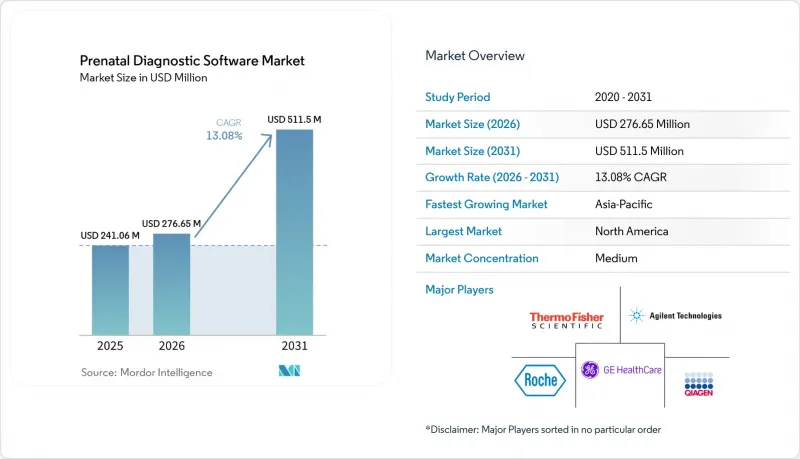
Mordor Intelligence에 의하면, 산전 진단 소프트웨어 시장 규모는 2025년 2억 4,106만 달러로 평가되었습니다. 2026년에는 2억 7,665만 달러로 확대되어 2026년부터 2031년에 걸쳐 CAGR 13.08%로 성장을 지속하여, 2031년에는 5억 1,150만 달러에 이를 것으로 예측됩니다.
본 보고서는 제품 유형(유전자 분석 등), 기술(NGS 바이오인포매틱스 등), 용도(염색체 이상 선별 검사 등), 도입 형태(클라우드 등), 워크플로우(검체 접수 등), 최종 사용자(병원·의료 시스템 등), 지역(북미 등)별로 분류되어 있습니다.
세계의 산전 진단 소프트웨어 시장 동향 및 인사이트
비침습적 산전 검사의 보급 확대
비침습적 산전 검사가 전문적인 검사가 아닌 일상적인 선택지가 됨에 따라 산전 진단 소프트웨어 시장은 그 혜택을 누리고 있습니다. 지침에 따른 지원과 보험사 측의 결정으로 인해 일부 선진국의 의료 제도에서 검사 수검률이 상승하고 있으며, 검사 기관이 처리해야 하는 검사 결과의 수도 증가하고 있습니다. 일본의 경우, 2023년 출생 수 중 35세 이상 여성의 비율이 30.4%에 달한 반면, 2003년에는 14%였습니다. 이러한 인구 통계학적 변화로 인해 선별 검사에 대한 수요가 높아지고, 검사 대상이 되는 환자층이 확대되고 있습니다. 검체 단위의 라이선싱 계약을 통해 검사 건수가 증가함에 따라 검사실은 지속적인 수익을 얻을 수 있습니다. 검사 대상이 평균 위험도의 임신으로 확대됨에 따라, 전문적인 고위험 사례에만 대응하는 것보다 대량의 검사를 효율적으로 관리하는 능력이 더욱 중요해지고 있습니다.
AI를 활용한 산전 초음파 진단의 확대
AI를 활용한 초음파 검사는 의료 현장마다 다른 태아 영상 촬영 방법과 해석의 편차를 해결하고 있습니다. 태아 초음파 검사에서 AI 기법에 관한 연구에 따르면, 자궁 내 발육 지연의 검출에서 통합 민감도가 0.84, 특이도가 0.87인 것으로 보고되었습니다. FetalCLIP은 21만 35쌍의 태아 초음파 이미지를 사용하여 학습되었으며, 재태 주수 추정, 선천성 심장병 감지 및 태아 구조 분할에서 테스트 대상이었던 기준 기법을 능가하는 성능을 보여주었습니다. 이러한 도구는 경험이 풍부한 산모-태아 의학 전문 인력이 제한적이고 전문성이 그리 높지 않은 산과 의료 현장을 지원할 수 있습니다. 따라서 산전 진단 소프트웨어 시장은 지금까지 복잡한 영상 진단을 위해 타 병원으로의 의뢰에 의존해 왔던 진료소나 지역 의료 현장에도 보급될 가능성이 있습니다. 의료 서비스 제공업체들은 이 도구를 치료 과정에 안전하게 통합할 수 있다는 증거를 필요로 하기 때문에 규제 당국의 승인 및 임상 검증은 도입에 있어 여전히 매우 중요합니다.
규제 분류 및 임상 검증의 복잡성
규제 요건은 특히 소규모 개발자의 경우, 산전 진단 소프트웨어 도입을 지연시킬 가능성이 있습니다. EU의 IVDR 규정 2017/746에 따르면, 많은 산전 진단 소프트웨어가 클래스 C 또는 D 요건에 해당하며, 여기에는 인증 기관의 평가가 요구됩니다. 기존의 산전 진단용 체외 진단 기기(IVD) 제조업체들은 클래스 III 의료기기의 경우 2027년 12월 31일, 클래스 IIb 의료기기의 경우 2028년 12월 31일이라는 최종 규정 준수 기한을 맞이하고 있습니다. 품질 관리, 검사실 인증, 임상 검증 및 시판 후 감시는 추가적인 비용과 시간을 소요합니다. BrightHeart사는 2025년 5월, 미리 정해진 변경 관리 계획에 대해 FDA의 승인을 획득했습니다. 이를 통해 향후 특정 모델 업데이트에 대해 별도의 신청 없이도 시행이 가능해집니다. 이러한 의무는 자금력이 풍부한 공급업체에 유리하게 작용하여, 지역을 초월해 경쟁할 수 있는 중소 공급업체의 수를 제한할 가능성이 있습니다.
부문별 분석
2025년 기준, 통합형 산전 진단 플랫폼은 산전 진단 소프트웨어 시장 점유율의 28.4%를 차지했습니다. 의료 기관은 이러한 플랫폼을 활용하여 시퀀싱 접수, 변이 판독, 위험도 평가 및 임상 보고서 작성을 하나의 환경으로 통합하고 있습니다. 통합형 시스템을 통해 공급업체는 정기적인 엔터프라이즈 라이선싱 수익 전망을 더욱 확실하게 확보할 수 있습니다. 또한, 검증된 파이프라인과 감사 추적이 검사실 업무에 통합되면 전환 비용도 발생합니다. 임상 보고서 작성 및 의사 결정 지원은 보다 광범위한 플랫폼 내의 모듈로 제공되는 경향이 강해지고 있습니다. 워크플로우 및 진료 조정 기능도 유사한 추세를 보이고 있습니다. 이에 따라 대규모 검사 기관에서 독립형 포인트 솔루션의 역할은 축소되고 있습니다. 그 결과, 산전 진단 소프트웨어 시장에서는 검사부터 보고서 작성까지의 전체 프로세스를 지원할 수 있는 벤더가 우위를 점하고 있습니다.
산전 초음파 분석 소프트웨어는 가장 빠르게 성장하는 제품 유형으로, 2031년까지의 예측 연평균 성장률(CAGR)은 13.8%를 나타낼 전망입니다. 증거와 규제 당국의 승인이 축적됨에 따라 AI 도구는 전문적인 연구 환경에서 일상적인 산부인과 진료로 점차 전환되고 있습니다. FetalCLIP은 여러 이미지 처리 작업을 위해 짝을 이룬 태아 초음파 이미지를 기반으로 구축된 모델을 통해 이러한 추세를 보여주고 있습니다. 검체 추적, 품질 관리 및 감사 기록을 위해서는 검사 정보 관리 소프트웨어가 여전히 필수적입니다. 산전 검사 전용 모듈에는 cfDNA 품질 점검 및 관리 이력(체인 오브 커스터디) 기능이 포함될 수 있습니다. 유전자 분석 소프트웨어는 원시 데이터인 시퀀싱 데이터를 임상적으로 유용한 변이 판정으로 변환한다는 점에서 다른 역할을 담당하고 있습니다. 기본적인 염색체 분석 파이프라인은 더욱 표준화되는 반면, 단일 유전자 워크플로는 분석의 복잡성이 높기 때문에 더 높은 가치를 유지할 가능성이 있습니다.
2025년, NGS 바이오인포매틱스는 매출의 24.9%를 차지하며 가장 큰 기술 카테고리가 되었습니다. 이는 cfDNA 기반의 비침습적 산전 검사를 대규모로 수행하기 위한 계산 기반을 제공합니다. 시퀀싱 대상 패널의 범위가 넓어짐에 따라 작업 부하와 임상적 복잡성 모두 증가하고 있습니다. 단일 유전자 질환, 복제수 변이 및 멀티오믹스 분석에는 표준 이수성 검사보다 더 정교한 분석이 요구됩니다. 산전 진단 소프트웨어 시장은 시퀀싱 결과를 검증된 임상 정보로 변환하기 위해 이러한 파이프라인에 의존하고 있습니다. 검사 기관은 또한 워크플로우에 대한 추적성을 확보한 버전 관리와 품질 관리가 필요합니다. 따라서 이 기술은 일상적인 대량 검사와 확장된 임상 패널 모두에서 중요해집니다. 진단의 범위가 넓어짐에 따라 그 역할은 여전히 핵심적입니다.
AI와 머신러닝은 가장 빠르게 성장하는 기술 분야로, 2031년까지의 예측 연평균 성장률(CAGR)은 13.6%를 나타낼 전망입니다. 주요 용도에는 구조적 이상 감지를 위한 컴퓨터 비전, 유전체 정보, 생체 인식 정보, 모체 정보를 결합한 위험 모델 등이 포함됩니다. AI를 활용한 초음파 검사에 대한 연구에서는 대조 시험 환경에서 태아 발육 지연을 감지하는 데 뛰어난 성능을 보였습니다. 규칙 기반의 임상 의사결정 지원 시스템은 여전히 규제 당국과 보험사가 기대하는 지침의 틀을 제공합니다. 컴퓨터 비전은 이미지 패턴 인식에 의존하는 작업에서 이러한 시스템을 보완할 수 있습니다. 마이크로어레이 및 세포유전학적 분석 소프트웨어는 확정 검사나 구조적 재조합 감지에서 여전히 중요한 역할을 수행하고 있습니다. 멀티오믹스 분석은 현재도 발전 단계에 있지만, 유전체, 트랜스크립톰, 에피유전체 데이터를 결합한 플랫폼에서는 향후 중요해질 가능성이 있습니다.
지역별 분석
2025년, 북미는 전 세계 매출의 40.11%를 차지하며, 지역별로는 산전 진단 소프트웨어 시장에서 가장 큰 점유율을 기록했습니다. NIPT(비침습적 산전 검사)의 높은 이용률, CLIA 인증을 받은 참조 검사 기관의 존재, 그리고 산전 AI 승인이 잇따르고 있는 것이 이 지역 수요를 뒷받침하고 있습니다. 또한, 대규모 검사 기관 네트워크는 AI 모델의 개발 및 검증에 사용되는 데이터 세트의 생성에도 기여하고 있습니다. 2025년 5월 BrightHeart사가 사전 승인받은 변경 관리 계획은 승인 후 모델 업데이트와 관련된 미국의 승인 절차에 대한 한 가지 사례로 꼽힙니다.
유럽은 두 번째로 큰 지역 부문이며, IVDR 의무화로 인해 공급업체에 대한 요건이 재정의됨에 따라 시장이 변화하고 있습니다. 클래스 C 및 D 산전 IVD 소프트웨어는 EU 프레임워크에 기반한 인증 기관의 평가를 받아야 합니다. 독일, 프랑스, 영국에서는 국가 선별 검사 프로그램, 민간 검사 기관, 공립 병원에서 수요가 발생하고 있습니다. 이탈리아와 스페인에서는 조달 업무가 각 지역의 보건 당국으로 분산되어 있어 움직임이 비교적 완만합니다.
아시아태평양은 가장 빠르게 성장하는 지역으로, 2031년까지의 예상 연평균 성장률(CAGR)은 14.1%를 나타낼 전망입니다. 중국은 산전 AI 기기의 국내 승인 및 비용 경쟁력 있는 시퀀싱 인프라를 통해 성장의 주요 원동력이 되고 있습니다. 2025년 3월, Kaili Medical은 중국 최초로 AI 산전 초음파 진단 기기의 승인을 획득했습니다. 항저우 SciDiagnostics는 2026년 5월 AI 염색체 카로티핑 분석 소프트웨어에 대한 3등급 등록을 획득했으며, 분석 시간이 34.42분에서 11.19분으로 단축되었다고 보고되었습니다. 일본에서는 2023년 출생아 중 35세 이상 여성이 차지하는 비율이 30.4%였으나, 침습적인 양수천자 시술 건수는 2014년 1만 6,454건에서 2023년 5,620건으로 감소했습니다. 인도, 한국, 호주에서는 민간 의료의 확대, 규제 대상인 체외진단용 의약품(IVD)에 대한 수요, 그리고 민간 보험에 의한 보상이 호재로 작용하고 있습니다.
기타 혜택 :
- 엑셀 형식 시장 예측(ME) 시트
- 3개월간의 애널리스트 지원
자주 묻는 질문
목차
제1장 서론
제2장 조사 방법
제3장 개요
제4장 시장 구도
제5장 시장 규모 및 성장 예측
제6장 경쟁 구도
제7장 시장 기회 및 향후 전망
KTH 26.09.02According to Mordor Intelligence, the prenatal diagnostic software market size is expected to grow from USD 241.06 million in 2025 to USD 276.65 million in 2026 and is forecast to reach USD 511.5 million by 2031 at 13.08% CAGR over 2026-2031.
This report is Segmented by Product Type (Genetic Analysis and More), Technology (NGS Bioinformatics and More), Application (Chromosomal Abnormality Screening and More), Deployment (Cloud, and More), Workflow (Sample Accessioning, and More), End User (Hospitals and Health Systems and More), and Geography (North America and More).
Global Prenatal Diagnostic Software Market Trends and Insights
Broader Adoption of Non-Invasive Prenatal Testing
The prenatal diagnostic software market benefits when non-invasive prenatal testing becomes a routine option rather than a specialist test. Guideline support and payer decisions have raised uptake in several developed health systems, increasing the number of test results that laboratories must process. Japan reported that women aged 35 years and older accounted for 30.4% of births in 2023, compared with 14% in 2003. This demographic shift increases demand for screening and creates a larger base of eligible patients. Per-sample software licensing can give laboratories recurring revenue as volumes rise. As testing reaches more average-risk pregnancies, the ability to manage high volumes efficiently becomes more important than serving only specialist high-risk cases.
Expansion of AI-Assisted Prenatal Ultrasound Interpretation
AI-assisted ultrasound is addressing variation in how fetal images are captured and interpreted across care settings. A studyof AI methods for fetal ultrasound reported a pooled sensitivity of 0.84 and a specificity of 0.87 for intrauterine growth restriction detection. FetalCLIP was trained on 210,035 paired fetal ultrasound images and outperformed the tested baselines for gestational age estimation, congenital heart defect detection, and fetal structure segmentation. These tools can support less specialized obstetric settings where experienced maternal-fetal medicine staff are limited. The prenatal diagnostic software market can therefore reach clinics and community settings that previously relied on referrals for complex interpretation. Regulatory clearances and clinical validation remain central to adoption because providers need evidence that the tool can be safely incorporated into care.
Regulatory Classification and Clinical-Validation Complexity
Regulatory requirements can slow the introduction of prenatal software, especially for smaller developers. Under EU IVDR Regulation 2017/746, much prenatal testing software falls within Class C or D requirements that require notified body assessment. Legacy prenatal IVD manufacturers face final compliance deadlines of December 31, 2027 for Class III devices and December 31, 2028 for Class IIb devices. Quality management, laboratory accreditation, clinical validation, and post-market monitoring add further cost and time. BrightHeart received FDA approval for a predetermined change control plan in May 2025, which allows certain future model updates without separate submissions. These obligations favor well-funded suppliers and can limit the number of smaller vendors able to compete across regions.
Other drivers and restraints analyzed in the detailed report include:
- Integration of Prenatal Diagnostics With EHR and Laboratory Workflows
- Rising Demand for Early Detection of Chromosomal and Genetic Disorders
- Privacy, Cybersecurity, and Cross-Border Genomic-Data Requirements
For complete list of drivers and restraints, kindly check the Table Of Contents.
Segment Analysis
Integrated prenatal diagnostic platforms held 28.4% of the prenatal diagnostic software market share in 2025. Health systems use these platforms to bring sequencing intake, variant calling, risk scoring, and clinical reporting into a single environment. Integrated systems can make recurring enterprise licensing more predictable for suppliers. They also create switching costs once validated pipelines and audit trails become part of laboratory operations. Clinical reporting and decision support are increasingly delivered as modules within broader platforms. Workflow and care coordination functions follow the same pattern. This reduces the role of standalone point solutions in larger laboratory accounts. The prenatal diagnostic software market is consequently rewarding suppliers that can support the whole testing and reporting process.
Prenatal ultrasound analysis software is the fastest-growing product type, with a forecast CAGR of 13.8% through 2031. AI tools are moving from specialist research settings into routine obstetric practice as evidence and regulatory approvals accumulate. FetalCLIP illustrates this direction through a model built on paired fetal ultrasound images for several imaging tasks. Laboratory information management software remains necessary for sample tracking, quality control, and audit records. Prenatal-specific modules can include cfDNA quality checks and chain-of-custody functions. Genetic analysis software has a different role because it converts raw sequencing data into clinically useful variant calls. Basic chromosomal pipelines face more standardization, while single-gene workflows can retain higher value because of their greater analytical complexity.
NGS bioinformatics held 24.9% of revenue in 2025, making it the largest technology category. It provides the computational foundation for cfDNA-based non-invasive prenatal testing at scale. The growing range of sequenced panels is increasing both workload and clinical complexity. Single-gene disorders, copy-number variants, and multi-omics features require more advanced analysis than standard aneuploidy testing. The prenatal diagnostic software market relies on these pipelines to turn sequencing output into validated clinical information. Laboratories also need traceable versions and quality controls for their workflows. This makes the technology important to both routine volume testing and expanded clinical panels. Its role remains central as diagnostic scope broadens.
AI and machine learning are the fastest-growing technology categories, with a forecast CAGR of 13.6% through 2031. Its main uses include computer vision for structural anomaly detection and risk models that combine genomic, biometric, and maternal information. Research on AI-supported ultrasound has shown strong performance for growth restriction detection in controlled study settings. Rule-based clinical decision support still provides the guideline structure that regulators and payers expect. Computer vision can complement those systems in tasks that depend on image pattern recognition. Microarray and cytogenetic analysis software remains relevant for confirmatory testing and structural rearrangements. Multi-omics analytics is still developing, although it may become important for platforms that combine genomic, transcriptomic, and epigenomic data.
Complete Report Scope:
- Market Size and Growth Forecasts, Value
- Segmentation by Product Type
- Prenatal Genetic Analysis Software
- Prenatal Ultrasound Analysis Software
- Laboratory Information Management Software
- Clinical Reporting and Decision Support Software
- Workflow and Care Coordination Software
- Integrated Prenatal Diagnostic Platforms
- Segmentation by Technology
- NGS Bioinformatics
- cfDNA Analysis
- Microarray and Cytogenetic Analysis
- AI and Machine Learning
- Computer Vision Ultrasound Analytics
- Rule-Based Clinical Decision Support
- Multi-Omics Analytics
- Segmentation by Application
- Chromosomal Abnormality Screening
- Genetic Disorder Screening
- Fetal Structural Anomaly Detection
- Maternal-Fetal Risk Assessment
- Pregnancy Monitoring and Dating
- Workflow and Clinical Management
- Carrier Screening
- Segmentation by Deployment
- Cloud-Based
- On-Premises
- Hybrid
- Edge/Offline-Enabled
- Segmentation by Workflow
- Sample Accessioning
- Laboratory Analysis
- Bioinformatics Interpretation
- Risk Assessment and Decision Support
- Reporting and Genetic Counselling
- Segmentation by End User
- Hospitals and Health Systems
- Diagnostic Laboratories
- Maternal-Fetal Medicine Centers
- Obstetrics and Gynecology Clinics
- Fertility and Reproductive Medicine Centers
- Academic and Research Institutions
- Public Health Programs
- Segmentation by Geography
- North America
- United States
- Canada
- Mexico
- Europe
- Germany
- United Kingdom
- France
- Italy
- Spain
- Rest of Europe
- Asia-Pacific
- China
- Japan
- India
- South Korea
- Australia
- Rest of Asia-Pacific
- Middle East and Africa
- GCC
- South Africa
- Rest of Middle East and Africa
- South America
- Brazil
- Argentina
- Rest of South America
- North America
Geography Analysis
North America held 40.11% of global revenue in 2025, representing the largest regional prenatal diagnostic software market share. High NIPT use, CLIA-certified reference laboratories, and a flow of prenatal AI clearances support regional demand. Large laboratory networks also generate datasets used to develop and validate AI models. BrightHeart's predetermined change control plan approval in May 2025 gives an example of a U.S. pathway for defined post-clearance model updates.
Europe is the second-largest regional segment and is changing as IVDR obligations reshape supplier requirements. Class C and D prenatal IVD software requires a notified body assessment under the EU framework. Germany, France, and the United Kingdom have demand from national screening programs, private laboratories, and public hospitals. Italy and Spain move more slowly because procurement is divided across regional health authorities.
Asia-Pacific is the fastest-growing region, with a forecast CAGR of 14.1% through 2031. China is a key source of momentum through domestic approvals for prenatal AI devices and cost-competitive sequencing infrastructure. Kaili Medical received China's first approval for an AI prenatal ultrasound device in March 2025. Hangzhou SciDiagnostics received a Class III registration for AI chromosome karyotype analysis software in May 2026, with analysis time reported to fall from 34.42 minutes to 11.19 minutes. In Japan, women aged 35 years and older accounted for 30.4% of live births in 2023, while invasive amniocentesis fell from 16,454 cases in 2014 to 5,620 in 2023. India, South Korea, and Australia have support from private healthcare expansion, regulated IVD demand, and private insurance coverage.
List of Companies Covered in this Report:
- Illumina
- Natera, Inc.
- Roche
- Thermo Fisher Scientific
- LabCorp
- Quest Diagnostics
- PerkinElmer
- Agilent Technologies
- BGI Genomics Co., Ltd.
- Eurofins
- Yourgene Health
- CENTOGENE N.V.
- Myriad Genetics
- The Cooper Companies
- GE HealthCare Technologies Inc.
- Koninklijke Philips
- Bio-Rad Laboratories
- Hologic
- Revvity, Inc.
- QIAGEN
- Sonio SAS
- Ultrasound AI
- Delft Imaging
Additional Benefits:
- The market estimate (ME) sheet in Excel format
- 3 months of analyst support
TABLE OF CONTENTS
1 INTRODUCTION
- 1.1 Study Assumptions and Market Definition
- 1.2 Scope of the Study
2 RESEARCH METHODOLOGY
3 EXECUTIVE SUMMARY
4 MARKET LANDSCAPE
- 4.1 Market Overview
- 4.2 Market Drivers
- 4.2.1 Broader Adoption of Non-Invasive Prenatal Testing
- 4.2.2 Integration of Prenatal Diagnostics With EHR and Laboratory Workflows
- 4.2.3 Expansion of AI-Assisted Prenatal Ultrasound Interpretation
- 4.2.4 Rising Demand for Early Detection of Chromosomal and Genetic Disorders
- 4.2.5 Increasing Need for Remote and Decentralized Maternal-Fetal Screening
- 4.2.6 Fetal-Fraction Optimization and Repeat-Test Reduction
- 4.3 Market Restraints
- 4.3.1 Regulatory Classification and Clinical-Validation Complexity
- 4.3.2 Privacy, Cybersecurity and Cross-Border Genomic-Data Requirements
- 4.3.3 Reimbursement Variation and Unequal Access to Advanced Screening
- 4.3.4 Clinical Interpretation Risks From False-Positive and Incidental Findings
- 4.4 Value and Supply-Chain Analysis
- 4.5 Regulatory Landscape
- 4.6 Technological Outlook
- 4.7 Porters Five Forces
- 4.7.1 Bargaining Power of Suppliers
- 4.7.2 Bargaining Power of Buyers
- 4.7.3 Threat of New Entrants
- 4.7.4 Threat of Substitutes
- 4.7.5 Competitive Rivalry
- 4.7.6 Analysis
5 MARKET SIZE AND GROWTH FORECASTS
- 5.1 Market Size and Growth Forecasts, Value
- 5.2 Segmentation by Product Type
- 5.2.1 Prenatal Genetic Analysis Software
- 5.2.2 Prenatal Ultrasound Analysis Software
- 5.2.3 Laboratory Information Management Software
- 5.2.4 Clinical Reporting and Decision Support Software
- 5.2.5 Workflow and Care Coordination Software
- 5.2.6 Integrated Prenatal Diagnostic Platforms
- 5.3 Segmentation by Technology
- 5.3.1 NGS Bioinformatics
- 5.3.2 cfDNA Analysis
- 5.3.3 Microarray and Cytogenetic Analysis
- 5.3.4 AI and Machine Learning
- 5.3.5 Computer Vision Ultrasound Analytics
- 5.3.6 Rule-Based Clinical Decision Support
- 5.3.7 Multi-Omics Analytics
- 5.4 Segmentation by Application
- 5.4.1 Chromosomal Abnormality Screening
- 5.4.2 Genetic Disorder Screening
- 5.4.3 Fetal Structural Anomaly Detection
- 5.4.4 Maternal-Fetal Risk Assessment
- 5.4.5 Pregnancy Monitoring and Dating
- 5.4.6 Workflow and Clinical Management
- 5.4.7 Carrier Screening
- 5.5 Segmentation by Deployment
- 5.5.1 Cloud-Based
- 5.5.2 On-Premises
- 5.5.3 Hybrid
- 5.5.4 Edge/Offline-Enabled
- 5.6 Segmentation by Workflow
- 5.6.1 Sample Accessioning
- 5.6.2 Laboratory Analysis
- 5.6.3 Bioinformatics Interpretation
- 5.6.4 Risk Assessment and Decision Support
- 5.6.5 Reporting and Genetic Counselling
- 5.7 Segmentation by End User
- 5.7.1 Hospitals and Health Systems
- 5.7.2 Diagnostic Laboratories
- 5.7.3 Maternal-Fetal Medicine Centers
- 5.7.4 Obstetrics and Gynecology Clinics
- 5.7.5 Fertility and Reproductive Medicine Centers
- 5.7.6 Academic and Research Institutions
- 5.7.7 Public Health Programs
- 5.8 Segmentation by Geography
- 5.8.1 North America
- 5.8.1.1 United States
- 5.8.1.2 Canada
- 5.8.1.3 Mexico
- 5.8.2 Europe
- 5.8.2.1 Germany
- 5.8.2.2 United Kingdom
- 5.8.2.3 France
- 5.8.2.4 Italy
- 5.8.2.5 Spain
- 5.8.2.6 Rest of Europe
- 5.8.3 Asia-Pacific
- 5.8.3.1 China
- 5.8.3.2 Japan
- 5.8.3.3 India
- 5.8.3.4 South Korea
- 5.8.3.5 Australia
- 5.8.3.6 Rest of Asia-Pacific
- 5.8.4 Middle East and Africa
- 5.8.4.1 GCC
- 5.8.4.2 South Africa
- 5.8.4.3 Rest of Middle East and Africa
- 5.8.5 South America
- 5.8.5.1 Brazil
- 5.8.5.2 Argentina
- 5.8.5.3 Rest of South America
- 5.8.1 North America
6 COMPETITIVE LANDSCAPE
- 6.1 Market Concentration
- 6.2 Market Share Analysis
- 6.3 Company Profiles (includes Global Level Overview, Market Level Overview, Core Segments, Financials as available, Strategic Information, Market Rank/Share, Products and Services, Recent Developments)
- 6.3.1 Illumina, Inc.
- 6.3.2 Natera, Inc.
- 6.3.3 F. Hoffmann-La Roche Ltd
- 6.3.4 Thermo Fisher Scientific Inc.
- 6.3.5 Laboratory Corporation of America Holdings
- 6.3.6 Quest Diagnostics Incorporated
- 6.3.7 PerkinElmer Inc.
- 6.3.8 Agilent Technologies, Inc.
- 6.3.9 BGI Genomics Co., Ltd.
- 6.3.10 Eurofins Scientific SE
- 6.3.11 Yourgene Health
- 6.3.12 CENTOGENE N.V.
- 6.3.13 Myriad Genetics, Inc.
- 6.3.14 CooperSurgical, Inc.
- 6.3.15 GE HealthCare Technologies Inc.
- 6.3.16 Koninklijke Philips N.V.
- 6.3.17 Bio-Rad Laboratories, Inc.
- 6.3.18 Hologic, Inc.
- 6.3.19 Revvity, Inc.
- 6.3.20 QIAGEN N.V.
- 6.3.21 Sonio SAS
- 6.3.22 Ultrasound AI
- 6.3.23 Delft Imaging
7 MARKET OPPORTUNITIES AND FUTURE OUTLOOK
- 7.1 White-Space and Unmet-Need Assessment


