

|
시장보고서
상품코드
2118263
디지털 동반진단 소프트웨어 시장 : 시장 점유율 분석, 업계 동향 및 통계, 성장 예측(2026-2031년)Digital Companion Diagnostics Software - Market Share Analysis, Industry Trends & Statistics, Growth Forecasts (2026 - 2031) |
||||||
 Mordor Intelligence
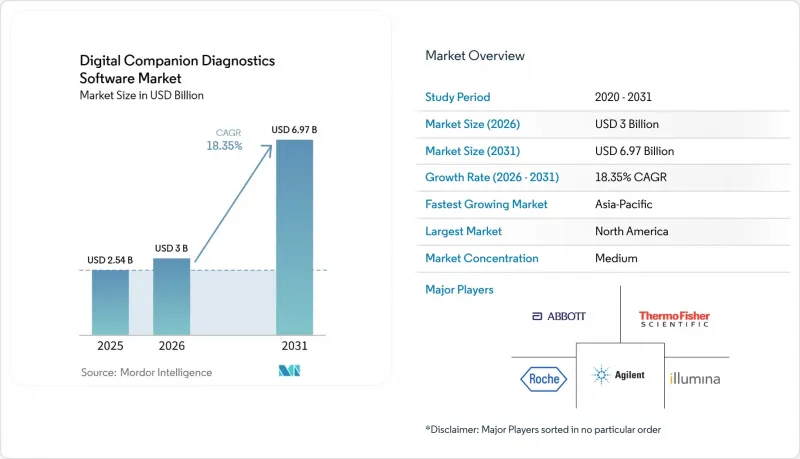
Mordor Intelligence에 의하면, 디지털 동반진단 소프트웨어 시장 규모는 2025년 25억 4,000만 달러로 평가되었고, 2026년 30억 달러에서 2031년까지 69억 7,000만 달러로 확대될 것으로 예측되며, 2026-2031년 예측 기간 CAGR은 18.35%를 기록할 전망입니다.
본 보고서는 제품 유형별(소프트웨어 플랫폼, 디지털 병리·영상 분석 소프트웨어, 기타), 도입 형태별(클라우드, 온프레미스, 하이브리드), 기술별(NGS, 디지털 PCR, 디지털 병리, 액체 생검, 기타), 용도별(종양학, 신경학, 기타), 최종 사용자별(제약 기업, 병원, CRO, 기타), 지역별(북미, 유럽, 아시아태평양, 중동 및 아프리카, 남미)로 분류되어 있습니다. 예측치는 금액(달러)으로 표시되어 있습니다.
세계의 디지털 동반진단 소프트웨어 시장 동향 및 인사이트
정밀 종양학 및 바이오마커 기반 치료의 확대
바이오마커를 통한 계층화가 필요한 새로운 종양학 적응증이 추가될 때마다, 공동 개발 및 환자 선별 워크플로우 전반에 걸쳐 지속적인 소프트웨어 수요가 발생할 가능성이 있습니다. 이러한 추세로 인해 동반진단 개발은 디지털 동반진단 소프트웨어 시장에서 지속적인 라이선스료 및 구독 수익의 중요한 원천이 되고 있습니다. Tempus는 2026년 5월, 자사의 xT CDx 플랫폼에 대해 종양 전용 적응증으로 FDA 승인을 획득하며, 종양 전용 및 종양·정상 조직에 대한 종합적인 유전체 프로파일링 모두에 대해 동반진단 승인을 받은 최초의 검사 기관이 되었습니다. Roche는 2026년 6월, PTEN 결손 전립선 선암을 위한 최초의 IHC 동반진단인 VENTANA PTEN 분석법에 대해 FDA 승인을 획득했습니다. 이 승인은 아스트라제네카(AstraZeneca)의 TRUQAP 대상 환자를 지원하기 위한 것으로, 전이성 호르몬 민감성 사례의 25%가 PTEN 결손을 보이는 환자 집단에 해당했습니다. 항체-약물 복합체(ADC) 및 다중 표적 치료법의 보급으로 인해 멀티 패널 소프트웨어에 대한 수요가 증가하고 있습니다. 이는 단일 유전자 PCR 검사만으로는 필요한 바이오마커 조합을 모두 포괄할 수 없기 때문입니다.
차세대 염기서열 분석(NGS)에 기반한 치료 선택의 확산
디지털 동반진단 소프트웨어 시장에서 NGS 기반 워크플로는 3차 암 센터를 넘어 지역 암 진료 현장으로 확대되고 있습니다. Thermo Fisher는 2025년 7월, 자사의 Ion Torrent Genexus Dx 통합 시퀀서용 Oncomine Dx Express Test에 대해 FDA 승인을 획득했습니다. 이 검사를 통해 분산형 검사 기관에서 EGFR 엑손 20 삽입 변이 결과를 최단 24시간 내에 제공할 수 있습니다. Illumina는 2025년 5월,혈액 WGS, 고형 종양 및 정상 조직의 WGS, 그리고 MRD 파이프라인을 위해 사전 구성된 용도를 갖춘 DRAGEN v4.4를 출시하고, 《Nature Biotechnology》지에 게재된 연구를 통해 검증된 생식세포 계통 구조 변이의 콜 정확도가 30% 향상되었다고 보고했습니다. SOPHiA GENETICS는 2025년 9월, TMB, MSI, HRD, CNV 검출을 포함한 DNA 및 RNA 바이오마커 분석을 하나의 모듈식 워크플로우로 통합한 MSK-IMPACT Flex를 도입했습니다. 검사량 증가는 구식 검사 정보 시스템에 부담을 줄 수 있어, 시퀀싱 결과를 임상 의사 결정 지원과 연결하는 미들웨어 및 해석 도구에 대한 수요가 증가하고 있습니다.
지속적으로 업데이트되는 진단 알고리즘을 둘러싼 규제상의 복잡성
디지털 동반진단 소프트웨어 시장의 머신러닝 소프트웨어는 지속적인 개선과 안정적이며 검증된 진단 결과 사이의 균형을 유지해야 합니다. 재학습된 모델로 인해 결과가 변경될 경우, 개발자는 수년에 걸쳐 수집한 임상 검체 세트를 사용하여 해당 모델을 재검증해야 할 수도 있습니다. 또한, 유럽의 플랫폼은 2027년 및 2028년에 EU IVDR에 기반한 클래스 C 및 D 재인증 요건에 직면하고 있으며, 지금까지 CE 마킹에 의존해 온 도구에 대해서도 전향적 임상 증거의 제출이 요구될 가능성이 있습니다. 이러한 업무 부담은 전담 규제 대응 팀을 보유한 기업에는 유리하게 작용하는 반면, 성능 향상을 위한 업데이트가 지연될 가능성이 있으며, 데이터 세트에 편향이 존재하는 경우 국제적인 적응증 확대 전에 추가적인 검증이 필요할 수 있습니다.
부문 분석
2025년, 소프트웨어 플랫폼은 제품 매출의 34.55%를 차지했습니다. 병원 네트워크와 제약 연구 기관은 이러한 라이선스 환경을 활용하여 바이오마커 분석, 차세대 염기서열 분석(NGS) 해석 및 규제 관련 문서의 통합을 수행했습니다. 멀티 용도 제품군은 각 추가 모듈이 의료 기관의 전환 복잡성을 증가시키는 한편, 디지털 동반진단 소프트웨어 시장을 강화했습니다. 해석 도구, 임상 의사 결정 지원, 환자 매칭 용도, 실세계 증거 분석 및 개발 소프트웨어는 검증된 바이오마커 결과와 자동화된 바이오인포매틱스 문서화를 요구하는 후원사 및 계약 연구 기관(CRO)을 지원했습니다.
디지털 병리 및 영상 분석 소프트웨어는 가장 빠르게 성장한 제품 유형으로, 2031년까지 연평균 성장률(CAGR) 18.93%를 기록했습니다. Proscia는 2026년 6월, 상위 20대 제약사 중 16곳이 이용하는 AI 네이티브 플랫폼으로서 Concentriq 5세대를 출시했습니다. 이 플랫폼은 관련 워크플로우 내에서 신약 개발, 임상 개발 및 진단 검토를 지원했습니다. 검증 및 규제 관련 서비스는 여전히 가장 규모가 작은 제품 카테고리였으나, 규제 대상 알고리즘에 있어 구조화된 증거, IEC 62304의 라이프사이클 규정 준수, 그리고 ISO 13485 품질 관리 표준 준수가 요구됨에 따라 수요가 증가했습니다.
2025년, 디지털 동반진단 소프트웨어 시장 규모의 63.56%를 클라우드 기반 도입이 차지했습니다. NGS 2차 분석, 전체 슬라이드 이미지 관리 및 다기관에 걸친 실세계 증거의 집약에는 고정된 로컬 하드웨어에 의존하지 않는 확장 가능한 계산 능력이 필요했습니다. SOPHiA GENETICS는 클라우드 네이티브 DDM 플랫폼을 통해 70개국 이상에 있는 800개 이상의 기관을 연결했습니다. 이 아키텍처는 고립된 온프레미스 환경보다 지리적으로 분산된 의약품 임상시험 네트워크를 더 효과적으로 지원했습니다.
하이브리드 배포는 2031년까지 연평균 성장률(CAGR) 19.67%를 나타낼 것으로 예측됩니다. 병원 보안 팀은 분석이나 보고서 작성에 클라우드 리소스를 사용하는 경우라 하더라도, 환자의 원시 유전체 데이터를 기관의 방화벽 내에 보관할 것을 요구할 수 있습니다. 컨테이너화된 배포를 제공하는 벤더는 병원 내 또는 클라우드 클러스터에서 공통 코드베이스를 실행할 수 있으므로, 기업 대상 입찰에서 경쟁력을 높일 수 있습니다. 데이터 주권 관련 요건으로 인해 국경을 넘는 환자 데이터 전송이 제한되는 유럽 및 중동 환경에서는 온프레미스형 시스템이 여전히 중요하게 여겨지고 있습니다.
지역별 분석
2025년, 북미는 디지털 동반진단 소프트웨어 시장 규모의 41.45%를 차지했습니다. 이 지역에는 FDA 승인을 받은 동반진단제의 적응증이 견고하게 존재하고, CMS(미국 의료보험서비스센터)에 의한 고도 진단 검사의 환급 메커니즘이 확립되어 있어 대규모 AI 진단 생태계가 형성되어 있었습니다. Guardant Health는 2025년, HER2 변이형 비소세포폐암에 대한 Guardant360 CDx에 대해 FDA 승인을 획득했으며, 이는 동사에게 25번째 동반진단 적응증이 되었습니다. 캐나다의 의료 기술 평가 절차와 멕시코의 분자진단에 대한 투자가 비교적 적은 점 등으로 인해, 이 지역의 수익은 미국에 집중되었습니다.
2025년, 유럽은 디지털 동반진단 소프트웨어 시장에서 2위 규모를 자랑하는 지역이 되었습니다. EU의 IVDR 클래스 C 및 D 요건으로 인해 디지털 병리 플랫폼의 규정 준수 기준이 강화되었으며, 연구용 도구보다 임상적으로 검증된 시스템이 우선시되게 되었습니다. Ibex는 2026년 7월, 유방암 IHC AI 알고리즘에 대한 CE-IVDR 인증을 획득했습니다. 한편, Tribun Health는 2026년 6월, 일상 진단 용도로 사용될 자사의 첫 번째 IVDR 인증 버전인 CaloPix 6를 발표했습니다. Tyrolpath는 오스트리아 최초의 모듈식 종합 유전체 프로파일링 검사실로, SOPHiA GENETICS의 MSK-IMPACT Flex를 도입했습니다. 또한, 영국 NHS에서의 Paige Prostate AI Suite 도입은 유럽 의료 시스템 전반의 조달 결정을 뒷받침하는 임상적 근거를 제공했습니다.
아시아태평양은 2031년까지 연평균 성장률(CAGR) 20.56%를 나타낼 것으로 예측되며, 이는 디지털 동반진단 소프트웨어 시장에서 지역별 가장 높은 성장률입니다. 중국의 ‘건강 중국 2030’ 프로그램,일본의 AI 통합형 IVD 기기에 대한 신속 승인 절차, 한국의 정밀의료 프로그램, 그리고 인도의 의약품 아웃소싱 거점이 수요를 뒷받침하고 있습니다. 한국 내 10개 병원에서 CancerVision을 도입한 실적은 보험 급여 지원이 이루어진다면 의료기관 차원의 도입이 급속히 진행될 것임을 보여주었습니다. 중동 및 아프리카 및 남미는 여전히 소규모 시장이지만, GCC 국가들의 국가 유전체 프로그램과 브라질의 SUS(공공 의료 제도)가 초기 수요를 창출하고 있는 반면, 상호 운용성 제약과 바이오정보학 인력 부족이 단기적인 도입을 제한하고 있습니다.
기타 혜택 :
- 엑셀 형식 시장 예측(ME) 시트
- 3개월간의 애널리스트 지원
자주 묻는 질문
목차
제1장 서론
제2장 조사 방법
제3장 주요 요약
제4장 시장 구도
제5장 시장 규모 및 성장 예측
제6장 경쟁 구도
제7장 시장 기회 및 향후 전망
AJY 26.09.03According to Mordor Intelligence, the digital companion diagnostics software market size is projected to grow from USD 2.54 billion in 2025 and USD 3.00 billion in 2026 to USD 6.97 billion by 2031, registering a CAGR of 18.35% during the forecast period 2026-2031.
This report is Segmented by Product Type (Software Platforms, Digital Pathology, Others), Deployment (Cloud-Based, On-Premise, Hybrid), Technology (NGS, Digital PCR, Digital Pathology, Liquid Biopsy, Others), Application (Oncology, Neurology, Others), End User (Pharma, Hospitals, Cros, Others), and Geography (North America, Europe, Asia-Pacific, MEA, South America). Forecasts in Value (USD).
Global Digital Companion Diagnostics Software Market Trends and Insights
Precision Oncology and Biomarker-Guided Therapy Expansion
Each new oncology label requiring biomarker stratification can create sustained software demand across co-development and patient-selection workflows. This trend makes companion diagnostic development a key source of recurring licenses and subscriptions for the digital companion diagnostics software market. Tempus received FDA approval in May 2026 for a tumor-only indication for its xT CDx platform, becoming the first laboratory with companion diagnostic approval for both tumor-only and tumor-normal comprehensive genomic profiling. Roche received FDA approval in June 2026 for the VENTANA PTEN assay, the first IHC companion diagnostic for PTEN-deficient prostate adenocarcinoma. The approval supported patients eligible for AstraZeneca's TRUQAP and addressed a population in which 25% of metastatic hormone-sensitive cases carried PTEN deficiency. Broader use of antibody-drug conjugates and multi-target therapies supports demand for multi-panel software, as single-gene PCR tests cannot manage the required biomarker combinations.
Rising Adoption of Next-Generation Sequencing-Based Therapy Selection
NGS-based workflows in the digital companion diagnostics software market are expanding beyond tertiary cancer centers into community oncology settings. Thermo Fisher received FDA approval in July 2025 for the Oncomine Dx Express Test on its Ion Torrent Genexus Dx Integrated Sequencer, which can deliver results for EGFR exon 20 insertion mutations in as few as 24 hours from decentralized laboratories. Illumina launched DRAGEN v4.4 in May 2025 with configured applications for heme WGS, solid WGS tumor-normal, and MRD pipelines, and reported a 30% improvement in germline structural variant calling accuracy, validated in a Nature Biotechnology study. SOPHiA GENETICS introduced MSK-IMPACT Flex in September 2025, combining DNA and RNA biomarker analysis, including TMB, MSI, HRD, and CNV detection, in one modular workflow. Higher testing volumes can strain older laboratory information systems, increasing demand for middleware and interpretation tools that connect sequencing output with clinical decision support.
Regulatory Complexity for Continuously Updated Diagnostic Algorithms
Machine-learning software in the digital companion diagnostics software market must balance continuous refinement with stable, validated diagnostic outputs. When a retrained model changes an output, developers may need to revalidate it against clinical specimen sets that took years to assemble. European platforms also face Class C and D re-certification requirements under the EU IVDR in 2027 and 2028, which may require prospective clinical evidence for tools that previously relied on CE marking. This workload favors companies with dedicated regulatory teams and may delay performance-enhancing updates, while dataset bias can require additional validation before international label expansion.
Other drivers and restraints analyzed in the detailed report include:
- Mainstreaming of AI-Assisted Digital Pathology
- Decentralized Companion Diagnostic Deployment and Trial Matching
- Uneven Reimbursement and System Interoperability
For complete list of drivers and restraints, kindly check the Table Of Contents.
Segment Analysis
Software platforms held 34.55% of product revenue in 2025. Hospital networks and pharmaceutical research organizations used these licensed environments to integrate biomarker analytics, NGS interpretation, and regulatory documentation. Multi-application suites strengthened the digital companion diagnostics software market, as each added module increased switching complexity for institutions. Interpretation tools, clinical decision support, patient-matching applications, real-world evidence analytics, and development software supported sponsors and contract research organizations seeking verified biomarker outputs and automated bioinformatics documentation.
Digital pathology and image-analysis software was the fastest-growing product type, registering an 18.93% CAGR through 2031. Proscia launched the fifth generation of Concentriq in June 2026 as an AI-native platform used by 16 of the top 20 pharmaceutical companies. The platform supported drug discovery, clinical development, and diagnostic review within related workflows. Validation and regulatory services remained the smallest product category, but demand increased as regulated algorithms required structured evidence, IEC 62304 lifecycle compliance, and ISO 13485 quality management alignment.
Cloud-based deployment accounted for 63.56% of the digital companion diagnostics software market size in 2025. NGS secondary analysis, whole-slide image management, and multi-site real-world evidence aggregation required scalable computing capacity without fixed local hardware. SOPHiA GENETICS connected more than 800 institutions across more than 70 countries through its cloud-native DDM platform. This architecture supported geographically dispersed pharmaceutical trial networks more effectively than isolated on-premise installations.
Hybrid deployment is forecast to register a 19.67% CAGR through 2031. Hospital security teams may require raw patient genomic data to remain behind institutional firewalls, even when analytics and reporting use cloud resources. Vendors offering containerized deployments can run a common codebase inside a hospital or on a cloud cluster, improving competitiveness in enterprise tenders. On-premise systems retained relevance in European and Middle Eastern settings where data-sovereignty requirements restricted cross-border patient data transfers.
Complete Report Scope:
- Product Type
- Software Platforms
- Interpretation and Decision-Support Software
- Clinical Trial and Patient-Matching Software
- Digital Pathology and Image-Analysis Software
- Real-World Evidence and Data-Analytics Software
- Companion Diagnostic Development Software
- Software-Related Validation and Regulatory Services
- By Deployment
- Cloud-Based
- On-Premise
- Hybrid
- By Technology
- Next-Generation Sequencing
- Polymerase Chain Reaction
- Digital Polymerase Chain Reaction
- Immunohistochemistry
- In-Situ Hybridization
- Digital Pathology
- Liquid Biopsy
- Circulating Tumor DNA
- Multi-Omics
- By Application
- Oncology
- Rare and Genetic Diseases
- Neurology
- Cardiovascular Diseases
- Infectious Diseases
- Immunology and Autoimmune Diseases
- By End User
- Pharmaceutical Companies
- Biotechnology Companies
- Contract Research Organizations
- Clinical Reference Laboratories
- Hospitals and Comprehensive Cancer Centers
- Academic and Research Institutes
- Payers and Health Technology Assessment Organizations
- By Geography
- North America
- United States
- Canada
- Mexico
- Europe
- Germany
- United Kingdom
- France
- Italy
- Spain
- Rest of Europe
- Asia-Pacific
- China
- India
- Japan
- Australia
- South Korea
- Rest of Asia-Pacific
- Middle East and Africa
- GCC
- South Africa
- Rest of Middle East and Africa
- South America
- Brazil
- Argentina
- Rest of South America
- North America
Geography Analysis
North America held 41.45% of the digital companion diagnostics software market size in 2025. The region had a strong base of FDA-approved companion diagnostic drug labels, an established CMS Advanced Diagnostic Laboratory Test reimbursement mechanism, and a large AI diagnostics ecosystem. Guardant Health received FDA approval in 2025 for Guardant360 CDx in HER2-mutant non-small cell lung cancer, its 25th companion diagnostic indication. Canada's health technology assessment process and Mexico's lower investment in molecular diagnostics concentrated regional revenue in the United States.
Europe was the second-largest geography in the digital companion diagnostics software market in 2025. EU IVDR Class C and D requirements raised compliance standards for digital pathology platforms and favored clinically validated systems over research tools. Ibex achieved CE-IVDR certification for breast IHC AI algorithms in July 2026, while Tribun Health announced CaloPix 6 as its first IVDR-certified version for routine diagnostic use in June 2026. Tyrolpath adopted SOPHiA GENETICS' MSK-IMPACT Flex as Austria's first modular comprehensive genomic profiling laboratory, and the UK NHS deployment of the Paige Prostate AI Suite provided clinical evidence for procurement decisions across European health systems.
Asia-Pacific is forecast to grow at a 20.56% CAGR through 2031, the fastest regional rate in the digital companion diagnostics software market. China's Healthy China 2030 program, Japan's expedited pathways for AI-integrated IVD devices, South Korea's precision medicine programs, and India's pharmaceutical outsourcing base support demand. CancerVision's deployment at 10 South Korean hospitals showed that institutional-scale adoption can advance quickly with reimbursement support. Middle East and Africa and South America remain smaller markets, although national genomics programs in GCC countries and Brazil's SUS health system are creating early demand, while interoperability constraints and limited bioinformatics workforces limit near-term adoption.
- Abbott Laboratories
- Agilent Technologies
- Amoy Diagnostics Co., Ltd.
- Arterys, Inc.
- Burning Rock Biotech Limited
- Caris Life Sciences, Inc.
- Danaher
- Exact Sciences
- Roche
- Foundation Medicine, Inc.
- Geneseeq Technology Inc.
- Genomenon, Inc.
- Guardant Health, Inc.
- Illumina
- LabCorp
- Myriad Genetics
- Natera, Inc.
- NeoGenomics, Inc.
- Paige.AI, Inc.
- PathAI, Inc.
- Personalis, Inc.
- Quest Diagnostics
- SOPHiA GENETICS SA
- Tempus AI, Inc.
- Thermo Fisher Scientific
Additional Benefits:
- The market estimate (ME) sheet in Excel format
- 3 months of analyst support
TABLE OF CONTENTS
1 INTRODUCTION
- 1.1 Study Assumptions and Market Definition
- 1.2 Scope of the Study
2 RESEARCH METHODOLOGY
3 EXECUTIVE SUMMARY
4 MARKET LANDSCAPE
- 4.1 Market Overview
- 4.2 Market Drivers
- 4.2.1 Precision Oncology and Biomarker-Guided Therapy Expansion
- 4.2.2 Rising Adoption of Next-Generation Sequencing-Based Therapy Selection
- 4.2.3 Mainstreaming of Artificial Intelligence-Assisted Digital Pathology
- 4.2.4 Decentralized Companion Diagnostic Deployment
- 4.2.5 Pharmaceutical Demand for Real-World Evidence and Biomarker-Defined Trial Matching
- 4.2.6 Companion Diagnostic Expansion Beyond Oncology
- 4.3 Market Restraints
- 4.3.1 Regulatory Complexity for Continuously Updated Diagnostic Algorithms
- 4.3.2 Uneven Reimbursement for Software-Enabled Interpretation
- 4.3.3 Interoperability Gaps Across Laboratory and Clinical Systems
- 4.3.4 Dataset Bias and Limited Representation of Under-Studied Populations
- 4.4 Value and Supply-Chain Analysis
- 4.5 Regulatory Landscape
- 4.6 Technological Outlook
- 4.7 Porter's Five Forces Analysis
- 4.7.1 Bargaining Power of Suppliers
- 4.7.2 Bargaining Power of Buyers
- 4.7.3 Threat of New Entrants
- 4.7.4 Threat of Substitutes
- 4.7.5 Competitive Rivalry
5 MARKET SIZE AND GROWTH FORECASTS (VALUE, USD)
- 5.1 Product Type
- 5.1.1 Software Platforms
- 5.1.2 Interpretation and Decision-Support Software
- 5.1.3 Clinical Trial and Patient-Matching Software
- 5.1.4 Digital Pathology and Image-Analysis Software
- 5.1.5 Real-World Evidence and Data-Analytics Software
- 5.1.6 Companion Diagnostic Development Software
- 5.1.7 Software-Related Validation and Regulatory Services
- 5.2 By Deployment
- 5.2.1 Cloud-Based
- 5.2.2 On-Premise
- 5.2.3 Hybrid
- 5.3 By Technology
- 5.3.1 Next-Generation Sequencing
- 5.3.2 Polymerase Chain Reaction
- 5.3.3 Digital Polymerase Chain Reaction
- 5.3.4 Immunohistochemistry
- 5.3.5 In-Situ Hybridization
- 5.3.6 Digital Pathology
- 5.3.7 Liquid Biopsy
- 5.3.8 Circulating Tumor DNA
- 5.3.9 Multi-Omics
- 5.4 By Application
- 5.4.1 Oncology
- 5.4.2 Rare and Genetic Diseases
- 5.4.3 Neurology
- 5.4.4 Cardiovascular Diseases
- 5.4.5 Infectious Diseases
- 5.4.6 Immunology and Autoimmune Diseases
- 5.5 By End User
- 5.5.1 Pharmaceutical Companies
- 5.5.2 Biotechnology Companies
- 5.5.3 Contract Research Organizations
- 5.5.4 Clinical Reference Laboratories
- 5.5.5 Hospitals and Comprehensive Cancer Centers
- 5.5.6 Academic and Research Institutes
- 5.5.7 Payers and Health Technology Assessment Organizations
- 5.6 By Geography
- 5.6.1 North America
- 5.6.1.1 United States
- 5.6.1.2 Canada
- 5.6.1.3 Mexico
- 5.6.2 Europe
- 5.6.2.1 Germany
- 5.6.2.2 United Kingdom
- 5.6.2.3 France
- 5.6.2.4 Italy
- 5.6.2.5 Spain
- 5.6.2.6 Rest of Europe
- 5.6.3 Asia-Pacific
- 5.6.3.1 China
- 5.6.3.2 India
- 5.6.3.3 Japan
- 5.6.3.4 Australia
- 5.6.3.5 South Korea
- 5.6.3.6 Rest of Asia-Pacific
- 5.6.4 Middle East and Africa
- 5.6.4.1 GCC
- 5.6.4.2 South Africa
- 5.6.4.3 Rest of Middle East and Africa
- 5.6.5 South America
- 5.6.5.1 Brazil
- 5.6.5.2 Argentina
- 5.6.5.3 Rest of South America
- 5.6.1 North America
6 Competitive Landscape
- 6.1 Market Concentration
- 6.2 Market Share Analysis
- 6.3 Company Profiles (includes Global Level Overview, Market Level Overview, Core Segments, Financials as available, Strategic Information, Market Rank/Share, Products and Services, Recent Developments)
- 6.3.1 Abbott Laboratories
- 6.3.2 Agilent Technologies, Inc.
- 6.3.3 Amoy Diagnostics Co., Ltd.
- 6.3.4 Arterys, Inc.
- 6.3.5 Burning Rock Biotech Limited
- 6.3.6 Caris Life Sciences, Inc.
- 6.3.7 Danaher Corporation
- 6.3.8 Exact Sciences Corporation
- 6.3.9 F. Hoffmann-La Roche Ltd
- 6.3.10 Foundation Medicine, Inc.
- 6.3.11 Geneseeq Technology Inc.
- 6.3.12 Genomenon, Inc.
- 6.3.13 Guardant Health, Inc.
- 6.3.14 Illumina, Inc.
- 6.3.15 Laboratory Corporation of America Holdings
- 6.3.16 Myriad Genetics, Inc.
- 6.3.17 Natera, Inc.
- 6.3.18 NeoGenomics, Inc.
- 6.3.19 Paige.AI, Inc.
- 6.3.20 PathAI, Inc.
- 6.3.21 Personalis, Inc.
- 6.3.22 Quest Diagnostics Incorporated
- 6.3.23 SOPHiA GENETICS SA
- 6.3.24 Tempus AI, Inc.
- 6.3.25 Thermo Fisher Scientific Inc.
7 Market Opportunities and Future Outlook
- 7.1 White-Space and Unmet-Need Assessment


