

|
시장보고서
상품코드
2099882
거래 VOD(TVOD) 시장 : 시장 점유율 분석, 업계 동향 및 통계, 성장 예측(2026-2031년)Transactional Video-on-Demand (TVOD) - Market Share Analysis, Industry Trends & Statistics, Growth Forecasts (2026 - 2031) |
||||||
 Mordor Intelligence
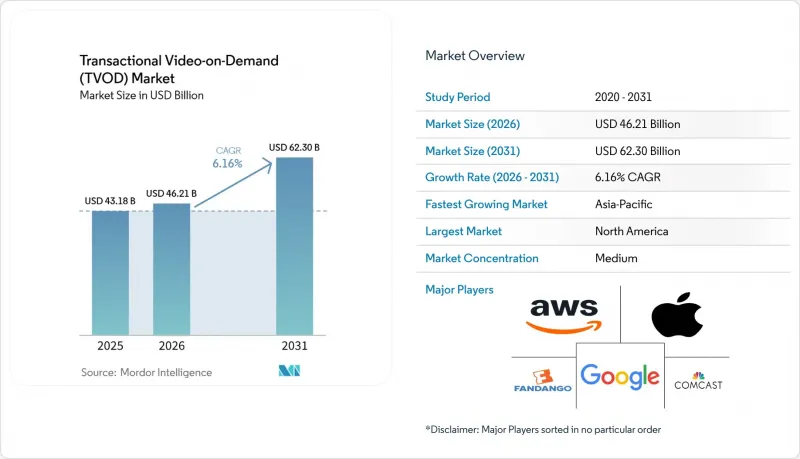
Mordor Intelligence에 의하면, 거래 VOD(TVOD) 시장 규모는 2025년에 431억 8,000만 달러로 평가되었고, 2026년 462억 1,000만 달러에서 2031년까지 623억 달러에 이를 것으로 추정되고 있어, 예측 기간(2026-2031년) CAGR은 6.16%를 나타낼 전망입니다.
본 보고서는 컨텐츠 유형별(영화, TV 프로그램, 다큐멘터리, 기타 컨텐츠), 수익 모델별(대여/DTR, 구매/EST, 페이퍼뷰, 기타 수익 모델), 기기 유형별(스마트폰·태블릿, 스마트 TV, 노트북·데스크톱 PC, 기타 기기) 및 지역별로 분류되어 있습니다. 시장 전망은 금액(달러) 기준으로 제시되어 있습니다.
세계의 거래 VOD(TVOD) 시장 동향 및 인사이트
신작에 대한 접근을 위해 소비자가 지불하려는 의지가 높아지고 있음
소비자의 지불 의향은 작품이 아직 극장 개봉의 화제성을 유지하고 있으며, 아카이브 작품이라기보다 ‘최신작’으로 느껴질 때 가장 높아집니다. 프리미엄 대여가 효과를 발휘하는 이유는 시청자들이 블록버스터 영화의 개봉을 일상적인 카탈로그 작품 선택이 아닌, 일회성 특별한 경험으로 인식하는 경우가 많기 때문입니다. 이로 인해 첫 번째 디지털 윈도우 시기에 수요가 집중되는 기간 동안, 트랜잭션형 비디오 온 디맨드 시장에서는 표준 라이브러리 대여보다 훨씬 높은 가격대가 형성되고 있습니다. 이 모델은 즉시 시청하고 싶지만, 이후의 구독형 스트리밍 서비스를 기다리고 싶지 않은 가구에게 특히 효과적입니다. 또한, 결제 과정을 신속하게 하고 작품 검색부터 결제까지의 절차를 간소화하는 플랫폼에도 유리하게 작용합니다. 그 결과, 트랜잭션형 VOD 시장은 구독 번들로 완전히 흡수할 수 없는 수익 창출의 입지를 계속 유지하고 있습니다.
각 스튜디오 및 지역별 프리미엄 윈도우 확대
프리미엄 윈도우는 2025-2026년 일시적인 대응 방식에서 보다 계획적인 스튜디오 전략으로 전환되었습니다. 일부 대형 스튜디오는 극장 개봉과 TVOD 서비스 개시 사이에 충분한 간격을 두었으며, 많은 인기 영화들은 최소 45일 동안 가정용 트랜잭션형 스트리밍 채널에서 이용할 수 없는 상태가 지속되었습니다. 디즈니 역시 주요 작품의 극장 개봉부터 디지털 스트리밍까지의 기간을 길게 유지하고 있으며, 일부 작품의 경우 2개월을 훨씬 초과했고, 한 작품은 TVOD 스트리밍 시작까지 102일이 소요되기도 했습니다. 파라마운트는 최소 45일간의 극장 개봉 기간을 공개적으로 약속했습니다. 이는 더 긴 프리미엄 기간이 단일 스튜디오에 국한되지 않고 지지를 얻고 있음을 시사하는 것이었습니다. 가정용 스트리밍 시작이 지연됨에 따라 수요가 디지털 스트리밍 공개 초기의 더 집중된 기간에 몰리는 경우가 많기 때문에 이는 거래 VOD(TVOD) 시장에 긍정적인 영향을 미칩니다. 관심이 식는 것이 아니라, 대기 시간이 길어짐으로써 비로소 유료로 접근하는 순간의 가치를 높일 수 있는 것입니다.
구독 번들화와 광고 지원형 서비스의 부상이 트랜잭션형 수요를 잠식하고 있습니다.
구독 번들 및 광고 지원 서비스는 구작의 단품 구매 필요성을 줄임으로써, 카탈로그 기반 트랜잭션에 지속적인 압박을 가하고 있습니다. 2025년 초, 프리미엄 SVOD 플랫폼 전체의 순 신규 가입자 대부분은 광고 포함 요금제에서 나왔습니다. 이는 저비용의 진입점이 신규 사용자의 상당 부분을 끌어들이고 있음을 보여줍니다. 타이틀이 널리 이용 가능하고 더 이상 프리미엄 공개 기간에 얽매이지 않는 경우, 무료 또는 저비용 스트리밍 옵션은 특히 큰 위협이 됩니다. 이로 인해, 특히 각 가구가 이미 여러 스트리밍 서비스를 이용하고 있는 성숙한 시장에서 기존 라이브러리 작품이나 시리즈에 대한 반복 대여 행태가 약화되고 있습니다. 거래 VOD(TVOD) 시장은 긴급성이나 독점성, 혹은 실시간 시청이 아닌 광범위한 카탈로그에 대한 접근성을 통해 경쟁하려 할 때 가장 큰 영향을 받습니다. 따라서 각 플랫폼은 광고 포함 서비스로 대체하기 어려운 신작 영화나 이벤트형 페이퍼뷰에 더 중점을 두고 있습니다.
부문 분석
2025년, 영화·영상 컨텐츠는 트랜잭션형 비디오 온 디맨드 시장 규모의 58.32%를 차지했습니다. 이러한 우위는 극장 개봉 후 트랜잭션형 스트리밍으로의 출시 패턴에 기인하며, 이로 인해 신작 영화는 여전히 유료 디지털 수요의 주요 원동력이 되고 있습니다. 프랜차이즈의 대히트작, 시상식 시즌 작품, 가족용 작품은 구독형 서비스가 시작되기 전에 1회당 거래 가격을 지탱하는 희소성을 창출하고 있습니다. 다큐멘터리는 규모는 작지만 독자적인 카테고리로서 존재감을 유지하고 있으며, 시청자들은 널리 스트리밍으로 제공되기 전에 고품질의 탐사 보도나 자연 다큐멘터리 작품에 기꺼이 대가를 지불하고 있습니다. '기타 컨텐츠' 부문에는 스포츠 이벤트, 음악 공연, 초기 인터랙티브 형식 등이 포함되어 있으며, 이는 거래형 VOD 업계에 영화만으로 구성된 카탈로그를 넘어서는 새로운 방향을 제시하고 있습니다.
TV 프로그램 및 에피소드형 컨텐츠는 2031년까지 연평균 성장률(CAGR) 6.72%로 확대될 것으로 예측되며, 가장 빠르게 성장하는 컨텐츠 부문이 될 전망입니다. 이러한 성장은 수요가 높은 새 시즌의 공개, K-드라마 작품, 그리고 지역별로 배급권이 분산되기 쉬운 애니메이션 시리즈에 대한 프리미엄 접근이 뒷받침하고 있습니다. Zee Entertainment의 ‘Z5’ 플랫폼은 2026년 FIFA 월드컵 개최 후 2주 이내에 주간 활성 사용자 수를 2배인 2,700만 명으로 늘렸습니다. 이 플랫폼에서는 3개월 기준 799루피(9.56달러)부터 시작하는 트랜잭셔널 패키지가 제공되고 있습니다. 인도의 아마존 ‘프라임 비디오(Prime Video)’와 ‘MX 기업(MX Player)’ 통합 플랫폼 역시 수요가 높은 타이틀이 구독형 스트리밍으로 전환되기 전의 조기 접근 수단으로 TVOD를 활용하고 있습니다. 이로 인해 에피소드 단위 시청이 하이브리드형 플랫폼 설계와 밀접하게 연계되어 가는 상황에서도, 트랜잭션형 비디오 온 디맨드 시장은 여전히 중요한 위치를 차지하고 있습니다.
지역별 분석
2025년, 북미는 트랜잭션형 비디오 온 디맨드 시장의 41.87%를 차지했습니다. 미국은 계속해서 가격 책정 및 이용량의 주요 벤치마크 역할을 하고 있으며, Amazon Prime Video, Apple TV, Google TV가 이 카테고리 전반의 일반적인 대여 및 구매 행태를 형성하고 있습니다. 캐나다도 유사한 추세를 보이고 있는데, 이는 작품의 공개 시기, 스토어프론트 접근성, 소비자 습관이 미국 시장과 밀접하게 일치하기 때문입니다. 멕시코에서는 OXXO의 현금 바우처나 SPEI 송금과 같은 하이브리드 결제 모델이 기존 신용카드 이용층을 넘어선 거래를 뒷받침함으로써 유료 시청자층이 지속적으로 확대되었습니다. 남미에서는 브라질의 VOD 플랫폼 수가 2024년 60개에서 2025년 106개로 증가하여, 생태계 전체에서 13만 8,000편 이상의 타이틀을 이용할 수 있게 되었습니다. 이는 가격에 대한 민감도가 여전히 과제로 남아 있음에도 불구하고, 플랫폼 인프라가 계속해서 확충되고 있음을 보여줍니다.
유럽에서는 거래 상황에 편차가 보였으며, 서유럽의 주요 플랫폼 중에서는 독일과 영국이 두드러졌습니다. 독일은 다른 많은 유럽 시장에 비해 예전부터 물리적 소유에서 디지털 구매로의 전환이 더욱 두드러졌습니다. 한편, 프랑스에서는 광고 수익형이나 무료 스트리밍 서비스로부터의 압박이 커지면서, 기존 작품의 반복 구매 여지가 줄어들었습니다. 이에 대응해 라쿠텐 TV는 통신 사업자 주도의 배포망을 확대했으며, 2026년 3월에는 Vodafone TV Spain과의 제휴를 통해 해당 사업자의 플랫폼에 약 6,000편의 대여 타이틀을 추가했습니다. 이탈리아의 CHILI는 TVOD, AVOD 및 B2B 서비스를 중심으로 리뉴얼을 추진한 반면, 사우디아라비아와 아랍에미리트는 중동 및 아프리카 전체에서 여전히 상업적으로 가장 선진적인 시장으로 남아 있었습니다.
아시아태평양은 2031년까지 연평균 성장률(CAGR) 7.67%로 확대될 것으로 예측되며, 거래 VOD(TVOD) 시장에서 가장 빠르게 성장하는 지역이 될 전망입니다. 일본, 인도, 한국은 고품질 현지 컨텐츠, 통신 사업자와의 번들 계약, 인기 시리즈 및 문화 컨텐츠의 조기 시청에 대한 강력한 수요를 통해 이러한 성장을 뒷받침하고 있습니다. 인도의 결제 인프라는 특히 중요하며, 2025년에는 UPI를 통해 수많은 디지털 사용자에게 원클릭 결제가 일상화되었습니다. 또한, 아마존이 인도에서 MX Player를 Prime Video에 통합함에 따라, 인도는 단일 서비스 내에서 SVOD, AVOD, TVOD 및 애드온형 구독을 시범적으로 도입하는 다중 모델 실험의 장이 되었습니다.
기타 혜택 :
- 엑셀 형식 시장 예측(ME) 시트
- 3개월간의 애널리스트 지원
자주 묻는 질문
목차
제1장 서론
제2장 조사 방법
제3장 주요 요약
제4장 시장 구도
제5장 시장 규모 및 성장 예측
제6장 경쟁 구도
제7장 시장 기회 및 향후 전망
AJY 26.08.11According to Mordor Intelligence, the transactional video-on-demand market size was valued at USD 43.18 billion in 2025 and is estimated to grow from USD 46.21 billion in 2026 to reach USD 62.30 billion by 2031, at a CAGR of 6.16% during the forecast period (2026-2031).
This report is Segmented by Content Type (Movies and Films, TV Shows, Documentaries, and Other Content Types), Revenue Model (Rental/DTR, Purchase/EST, Pay-Per-View, and Other Revenue Models), Device Type (Smartphones and Tablets, Smart TVs, Laptops and Desktops, and Other Devices), and Geography. The Market Forecasts are Provided in Terms of Value (USD).
Global Transactional Video-on-Demand (TVOD) Market Trends and Insights
Rising Consumer Willingness to Pay for New-Release Access
Consumer willingness to pay is strongest when a title still carries theatrical buzz, and the release feels current rather than archival. Premium rentals work because viewers often treat a major film launch as a one-off rather than a routine catalog choice. That supports a pricing lane in the transactional video-on-demand market that sits well above standard library rentals during periods of concentrated demand around the first digital window. The model is especially effective for households that want immediate access but do not want to wait for a later subscription release. It also favors platforms that make checkout fast and reduce the number of steps between discovery and payment. As a result, the transactional video-on-demand market continues to hold a monetization position that subscription bundles do not fully absorb.
Expansion of Premium Windowing Across Studios and Territories
Premium windowing moved from a temporary release response into a more deliberate studio strategy during 2025 and 2026. Several major studios maintained meaningful gaps between theatrical release and TVOD availability, and many top films remained unavailable on home transaction channels for at least 45 days. Disney also maintained longer theatrical-to-digital release windows for major releases, with some titles extending well beyond 2 months and one reaching 102 days before TVOD availability. Paramount publicly committed to a minimum 45-day theatrical window, which signaled that longer premium timing had support beyond a single studio. This helps the transactional video-on-demand market because the delayed home debut often concentrates demand into a more intense opening digital period. Instead of diluting interest, a longer wait can raise the value of the first paid access moment.
Subscription Bundling and Ad-Supported Alternatives Eroding Transactional Demand
Subscription bundles and ad-supported services continue to pressure catalog-based transactions by reducing the need for one-off purchases of older titles. Ad-supported tiers accounted for the majority of gross subscriber additions across premium SVOD platforms in early 2025, indicating that low-cost entry points were attracting a large share of new users. Free and low-cost streaming choices are especially disruptive when the title is widely available and no longer tied to a premium release window. This weakens repeat rental behavior for library films and series, particularly in mature markets where households already carry multiple streaming services. The transactional video-on-demand market is most exposed when it tries to compete on broad catalog access rather than on urgency, exclusivity, or live viewing. That is why platforms are leaning more heavily into new-release movies and event pay-per-view, where ad-supported substitutes are less direct.
Other drivers and restraints analyzed in the detailed report include:
- Growth of Hybrid OTT Ecosystems That Bundle Rental and Purchase Flows
- Smart TV and Connected Device Penetration
- Price Sensitivity for Repeat Viewers Limiting Purchase Frequency
For complete list of drivers and restraints, kindly check the Table Of Contents.
Segment Analysis
Movies and Films accounted for 58.32% share of the transactional video-on-demand market size in 2025. This lead stems from the theatrical-to-transactional release pattern, which still makes new-release films the main driver of paid digital demand. Franchise blockbusters, awards-season titles, and family releases create scarcity that supports per-transaction pricing before subscription availability begins. Documentaries remained a smaller but distinct category, with viewers willing to pay for premium investigative and nature titles ahead of broader streaming access. The Other content types segment included sports events, music performances, and early interactive formats, giving the transactional video-on-demand industry a path beyond a film-only catalog mix.
TV Shows and Episodic Content are projected to expand at a 6.72% CAGR through 2031, making it the fastest-growing content segment. Growth is being supported by premium access to high-demand season launches, K-drama titles, and anime series, where rights are often fragmented by region. Zee Entertainment's Z5 platform doubled its weekly active users to 27 million within 2 weeks of the FIFA World Cup 2026, with transactional packages starting at INR 799 (USD 9.56) for 3 months. Amazon's combined Prime Video and MX Player platform in India also uses TVOD as the early-access layer for high-demand titles before they move into subscription circulation. This keeps the transactional video-on-demand market relevant even as episodic viewing becomes more tied to hybrid platform design.
Complete Report Scope:
- By Content Type
- Movies and Films
- TV Shows and Episodic Content
- Documentaries
- Other Content Types
- By Revenue Model
- Rental / DTR (Download to Rent)
- Purchase / EST (Electronic Sell-Through)
- Pay-Per-View
- Other Revenue Models
- By Device Type
- Smartphones and Tablets
- Smart TVs
- Laptops and Desktops
- Other Devices
- By Geography
- North America
- United States
- Canada
- Mexico
- South America
- Brazil
- Argentina
- Chile
- Rest of South America
- Europe
- Germany
- United Kingdom
- France
- Italy
- Spain
- Rest of Europe
- Asia-Pacific
- China
- Japan
- India
- South Korea
- Australia
- Rest of Asia-Pacific
- Middle East
- Saudi Arabia
- United Arab Emirates
- Qatar
- Rest of Middle East
- Africa
- South Africa
- Egypt
- Nigeria
- Rest of Africa
- North America
Geography Analysis
North America held 41.87% of the transactional video-on-demand market share in 2025. The United States remained the main pricing and volume benchmark, with Amazon Prime Video, Apple TV, and Google TV shaping common rental and purchase behavior across the category. Canada followed a similar pattern because release timing, storefront access, and consumer habits closely align with those of the US market. Mexico continued to expand its paid audience as hybrid payment models, such as OXXO cash vouchers and SPEI transfers, helped support transactions beyond the traditional credit card base. In South America, Brazil's VOD platform count rose from 60 in 2024 to 106 in 2025, with more than 138,000 titles available across the ecosystem, indicating that platform infrastructure continued to deepen even as pricing sensitivity remained an issue.
Europe remained a split transactional landscape, with Germany and the UK standing out among the larger Western European storefronts. Germany has historically shown a stronger shift from physical ownership to digital purchase than many other European markets. France faced greater pressure from ad-supported and free streaming services, reducing the room for repeat catalog transactions. Rakuten TV responded by widening operator-led distribution, including a March 2026 partnership with Vodafone TV Spain that added around 6,000 rental titles to the operator environment. Italy's CHILI moved ahead with a relaunch built around TVOD, AVOD, and business-to-business services, while Saudi Arabia and the United Arab Emirates remained the most commercially advanced markets across the broader Middle East and Africa region.
Asia-Pacific is projected to expand at a 7.67% CAGR through 2031, making it the fastest-growing region in the transactional video-on-demand market. Japan, India, and South Korea support this expansion through premium local content, telecom bundle relationships, and strong demand for early access viewing around popular franchises and cultural exports. India's payment infrastructure is especially important because UPI made one-click transactions routine for a very large digital audience in 2025. Amazon's integration of MX Player into Prime Video in India also turned the country into a multi-model test bed for SVOD, AVOD, TVOD, and add-on subscriptions within a single service.
- Amazon.com, Inc.
- Apple Inc.
- Google LLC (Alphabet Inc.)
- Fandango Media, LLC
- Comcast Corporation
- Roku, Inc.
- Sony Group Corporation
- Rakuten Group, Inc.
- Lionsgate Plc
- Orange S.A.
- America Movil, S.A.B. de C.V.
- Fetch TV Pty Limited
- CHILI S.p.A.
- Pathe SAS
- SF Studios AB
- JioStar Media and Distribution Ltd.
- Zee Entertainment Enterprises Limited
- Preemz, LLC
- Plex, Inc.
- DIRECTV, LLC
Additional Benefits:
- The market estimate (ME) sheet in Excel format
- 3 months of analyst support
TABLE OF CONTENTS
1 INTRODUCTION
- 1.1 Study Assumptions and Market Definition
- 1.2 Scope of the Study
2 RESEARCH METHODOLOGY
3 EXECUTIVE SUMMARY
4 MARKET LANDSCAPE
- 4.1 Market Overview
- 4.2 Market Drivers
- 4.2.1 Rising Consumer Willingness to Pay for New Release Access
- 4.2.2 Expansion of Premium Windowing Across Studios and Territories
- 4.2.3 Growth of Hybrid OTT Ecosystems That Bundle Rental and Purchase Flows
- 4.2.4 Smart TV and Connected Device Penetration
- 4.2.5 Mobile Wallet and One-Click Checkout Adoption in Emerging Markets
- 4.2.6 CDN and Codec Optimization Lowering Per-Transaction Delivery Friction
- 4.3 Market Restraints
- 4.3.1 Subscription Bundling and Ad-Supported Alternatives Erode Transactional Demand
- 4.3.2 Price Sensitivity for Repeat Viewers Limits Purchase Frequency
- 4.3.3 Content Overlap Across Major Platforms Compresses Differentiation
- 4.3.4 Rights Fragmentation and Windowing Complexity Raise Operating Costs
- 4.4 Industry Value Chain Analysis
- 4.5 Regulatory Landscape
- 4.6 Technological Outlook
- 4.7 Impact of Macroeconomic Factors on the Market
- 4.8 Porter's Five Forces Analysis
- 4.8.1 Threat of New Entrants
- 4.8.2 Bargaining Power of Buyers
- 4.8.3 Bargaining Power of Suppliers
- 4.8.4 Threat of Substitutes
- 4.8.5 Intensity of Competitive Rivalry
5 MARKET SIZE AND GROWTH FORECASTS (VALUE)
- 5.1 By Content Type
- 5.1.1 Movies and Films
- 5.1.2 TV Shows and Episodic Content
- 5.1.3 Documentaries
- 5.1.4 Other Content Types
- 5.2 By Revenue Model
- 5.2.1 Rental / DTR (Download to Rent)
- 5.2.2 Purchase / EST (Electronic Sell-Through)
- 5.2.3 Pay-Per-View
- 5.2.4 Other Revenue Models
- 5.3 By Device Type
- 5.3.1 Smartphones and Tablets
- 5.3.2 Smart TVs
- 5.3.3 Laptops and Desktops
- 5.3.4 Other Devices
- 5.4 By Geography
- 5.4.1 North America
- 5.4.1.1 United States
- 5.4.1.2 Canada
- 5.4.1.3 Mexico
- 5.4.2 South America
- 5.4.2.1 Brazil
- 5.4.2.2 Argentina
- 5.4.2.3 Chile
- 5.4.2.4 Rest of South America
- 5.4.3 Europe
- 5.4.3.1 Germany
- 5.4.3.2 United Kingdom
- 5.4.3.3 France
- 5.4.3.4 Italy
- 5.4.3.5 Spain
- 5.4.3.6 Rest of Europe
- 5.4.4 Asia-Pacific
- 5.4.4.1 China
- 5.4.4.2 Japan
- 5.4.4.3 India
- 5.4.4.4 South Korea
- 5.4.4.5 Australia
- 5.4.4.6 Rest of Asia-Pacific
- 5.4.5 Middle East
- 5.4.5.1 Saudi Arabia
- 5.4.5.2 United Arab Emirates
- 5.4.5.3 Qatar
- 5.4.5.4 Rest of Middle East
- 5.4.6 Africa
- 5.4.6.1 South Africa
- 5.4.6.2 Egypt
- 5.4.6.3 Nigeria
- 5.4.6.4 Rest of Africa
- 5.4.1 North America
6 COMPETITIVE LANDSCAPE
- 6.1 Market Concentration
- 6.2 Strategic Moves
- 6.3 Vendor Positioning Analysis
- 6.4 Company Profiles (includes Global Level Overview, Market Level Overview, Core Segments, Financials as available, Strategic Information, Market Rank/Share, Products and Services, Recent Developments)
- 6.4.1 Amazon.com, Inc.
- 6.4.2 Apple Inc.
- 6.4.3 Google LLC (Alphabet Inc.)
- 6.4.4 Fandango Media, LLC
- 6.4.5 Comcast Corporation
- 6.4.6 Roku, Inc.
- 6.4.7 Sony Group Corporation
- 6.4.8 Rakuten Group, Inc.
- 6.4.9 Lionsgate Plc
- 6.4.10 Orange S.A.
- 6.4.11 America Movil, S.A.B. de C.V.
- 6.4.12 Fetch TV Pty Limited
- 6.4.13 CHILI S.p.A.
- 6.4.14 Pathe SAS
- 6.4.15 SF Studios AB
- 6.4.16 JioStar Media and Distribution Ltd.
- 6.4.17 Zee Entertainment Enterprises Limited
- 6.4.18 Preemz, LLC
- 6.4.19 Plex, Inc.
- 6.4.20 DIRECTV, LLC
7 MARKET OPPORTUNITIES AND FUTURE OUTLOOK
- 7.1 White-Space and Unmet-Need Assessment


