

|
시장보고서
상품코드
2119042
남미의 광고용 주문형 비디오 : 시장 점유율 분석, 산업 동향 및 통계 데이터, 성장 예측(2026-2031년)South America Advertising Video-on-Demand (AVOD) - Market Share Analysis, Industry Trends & Statistics, Growth Forecasts (2026 - 2031) |
||||||
 Mordor Intelligence
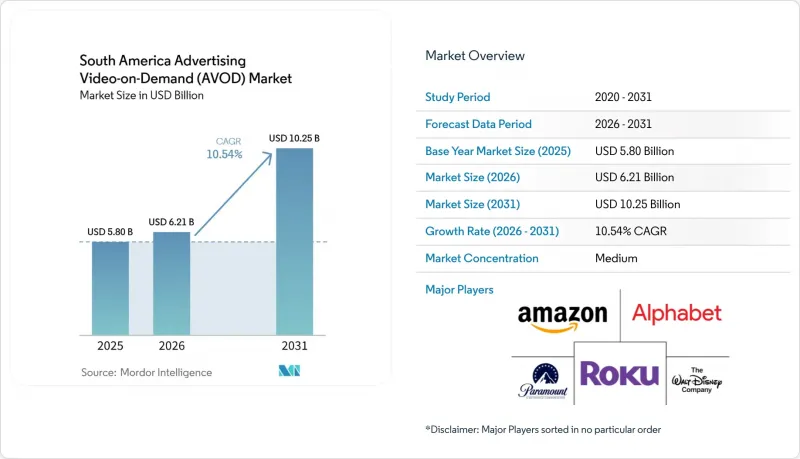
Mordor Intelligence에 의하면, 남미의 광고용 주문형 비디오 시장 규모는 2025년에 58억 달러로 평가되었습니다. 2026년 62억 1,000만 달러에서 성장하여 2031년까지 102억 5,000만 달러에 이를 것으로 추정되고 예측 기간(2026-2031년) CAGR 10.54%로 확대될 것으로 예측됩니다.
본 보고서는 컨텐츠 유형(영화, TV 프로그램·에피소드형 컨텐츠, 다큐멘터리, 기타 컨텐츠), 기기 유형(스마트폰 및 태블릿, 스마트 TV, 노트북 및 데스크톱 PC 등), 최종 사용자(미디어 및 엔터테인먼트 등), 광고 형식(프리롤, 미드롤, 포스트롤), 그리고 지역별로 분류되어 있습니다. 시장 예측은 금액(달러) 기준으로 제시되어 있습니다.
남미의 광고용 주문형 비디오 시장 동향 및 인사이트
저가형 광고 포함 스트리밍 요금제의 확대
저가 요금제의 등장으로 남미의 광고용 주문형 비디오 시장의 시청자층은 컨텐츠 지출에 의한 확대보다 더 빠르게 성장했습니다. 넷플릭스의 광고 포함 요금제는 2025년 3분기에 조사 대상 시장 전체 활성 계정의 40%에 달했습니다(2024년 4분기는 26%). 한편, 디즈니+의 광고 포함 요금제 이용률은 같은 기간 동안 35%에서 44%로 상승했습니다. 2026년에는 브라질의 주요 스트리밍 플랫폼 7곳 중 5곳이 저렴한 가격에 광고 수익 기반의 이용 요금제를 제공했습니다. 이러한 요금제의 역할이 확대되고 있다는 것은 광고주가 제한된 부차적 시청자층이 아닌, 더 새롭고 가격에 민감한 구독자에게 도달할 수 있게 되었음을 의미합니다. 또한 각 플랫폼은 프로그래매틱 광고 슬롯 외에도 스폰서십을 판매하고 있으며, 이는 광고 포함 요금제의 재고를 보다 전략적인 광고 상품으로 자리매김하는 데 기여하고 있습니다. 브라질에서 검토 중인 시청각 관련 규제 체계(CONDECINE의 부과금 도입안 및 현지 컨텐츠 10% 의무화 등)는 향후 현지 제작에 대한 지출을 늘리고 컨텐츠 카탈로그의 확충을 촉진할 가능성이 있습니다.
기존 TV 광고 예산에서 CTV 광고 슬롯으로의 전환
브랜드들이 선형 방송 외의 동영상 시청자를 모색함에 따라, 광고 예산은 커넥티드 TV로 이동하고 있습니다. 브라질의 커넥티드 TV 지출은 2026년에 1억 7,000만 달러에 달할 것으로 예상되며, 올해 브라질의 커넥티드 TV 광고비는 23.7% 증가할 것으로 전망됩니다. 커넥티드 TV는 시청자 수준의 타겟팅과 시청자 프로파일을 제공하는 반면, 기존 TV는 주로 광범위한 도달 지표에 의존하고 있습니다. 이러한 변화에 따라 남미의 광고용 주문형 비디오 시장 내 플랫폼들은 광고주에게 신뢰할 수 있고 일관된 측정 결과를 제공해야 할 필요가 있습니다. 또한 이러한 변화는 글로보(Globo)와 같은 방송사들이 방송권과 병행하여 커넥티드 TV 광고 슬롯을 확대하도록 촉진하고 있습니다. 남미의 온라인 동영상 시장 규모는 2026년에 340억 달러에 달할 것으로 예상되며, 이는 처음으로 기존 TV 수익을 넘어서는 수준이 될 것입니다. 광고주들이 동영상 캠페인에서 타겟팅과 검증을 점점 더 요구하고 있기 때문에 이러한 변화는 앞으로도 지속될 가능성이 높습니다.
낮은 광고 수익률과 환율 변동
남미의 광고 단가는 북미나 서유럽에 비해 낮아, 컨텐츠에 투자하는 플랫폼이 수익 모델을 구축하기 어렵게 만들고 있습니다. 특히 아르헨티나의 통화 약세는 계약이 현지 통화로 갱신될 때, 광고 계약의 미화 환산 가치를 떨어뜨릴 가능성이 있습니다. 이러한 격차는 단순한 가격 문제에 그치지 않고, 대규모 광고 시장에서 청구되는 단가를 지불할 수 있는 국내 광고주가 감소하고 있는 점도 원인입니다. 시청자 1시간당 수익이 낮아지면 컨텐츠 제작에 투입되는 자금이 제한되어, 플랫폼이 프리미엄 시청자를 유치하는 능력이 제한될 수밖에 없습니다. 일부 플랫폼은 광고 노출을 상거래 데이터 및 측정 가능한 성과와 연계하는 ‘리테일 미디어’ 파트너십을 통해 이 과제에 대응하고 있습니다. 이러한 접근 방식을 통해 시청자 수에만 의존하지 않고, 더 높은 가치를 지닌 광고 슬롯을 제공할 수 있게 될 가능성이 있습니다. 메르카도 리브레는 2026년 1분기 광고 수익이 달러 기준으로 전년 동기 대비 73% 증가했다고 보고했으며, 이는 이 지역에서 상거래 연계형 광고 도구의 매력을 보여줍니다.
부문별 분석
2025년, 영화는 남미의 광고용 주문형 비디오 시장 점유율의 39.41%를 차지하며, 이 지역에서 가장 큰 컨텐츠 장르가 되었습니다. 영화 라이브러리는 서비스가 시청 세션을 시작하고 시청 시간을 유지하는 데 도움이 됩니다. YouTube, Amazon, Tubi는 대규모 오리지널 제작 예산 없이도 시청자를 끌어들이기 위해 풍부한 영화 카탈로그를 활용하고 있습니다. Encripta S/A의 YouTube 무료 영화 배포 활동은 월간 순 사용자 수 7,720만 명에 달했으며, 2026년 7월까지 12개월 동안 2,000만 브라질 레알(380만 달러)의 수익을 창출했습니다. 동 기간 동안 이 회사의 기업 수익 중 30%는 광고 수익이 차지했습니다. 이 회사는 2026년 연간 3,000만 브라질 레알(570만 달러)을 목표로 하고 있으며, 세로형 동영상 포맷의 시범 운영을 진행해 왔습니다.
다큐멘터리는 2026년부터 2031년에 걸쳐 연평균 성장률(CAGR) 10.94%를 기록하며, 컨텐츠 유형 중 가장 빠른 성장세를 보일 것으로 예측됩니다. 브라질의 실화 범죄 다큐멘터리와 사회 문제 다큐멘터리는 현지에서 호응을 얻으며, 다른 시장으로도 확장 가능한 컨텐츠를 찾는 서비스에 유용한 포맷이 되고 있습니다. 넷플릭스는 2025년에 브라질 제작 타이틀 55편을 추가했으며, 지난 12개월 동안 해당 플랫폼에서 브라질 제작 컨텐츠의 시청 시간은 전 세계적으로 39% 증가했습니다. TV 프로그램이나 에피소드 형식의 컨텐츠는 점유율이 가장 높지는 않지만, 가장 긴 시청 세션을 만들어낼 수 있습니다. 시청 세션이 길어지면 시청자 1인당 광고 노출 횟수가 증가합니다. 또한, 미드롤 광고에 적합한 기회도 더 많이 생깁니다. 브라질 극장 개봉작의 라이선싱은 오리지널 컨텐츠 제작 의뢰에 비해 시청 시간당 비용을 낮게 유지할 수 있어, 컨텐츠 카탈로그를 풍부하게 하고 남미의 광고용 주문형 비디오 시장의 수익성을 뒷받침하고 있습니다.
2025년, 남미의 광고용 주문형 비디오 시장에서 스마트폰 및 태블릿이 31.73%를 차지했습니다. 이러한 상황은 해당 지역의 광범위한 지역에서 ‘모바일 우선’ 시청 습관이 정착되어 있음을 반영합니다. 브라질과 콜롬비아의 저렴한 데이터 통신 요금과 높은 스마트폰 보급률은 작은 화면에서의 동영상 시청을 뒷받침하고 있습니다. TV 프로그램, 스포츠, 숏폼 세로형 동영상은 특히 모바일 시청에 적합합니다. YouTube 및 관련 동영상 서비스는 수년에 걸친 모바일 중심 설계와 전송 체계의 혜택을 누리고 있습니다. 노트북, 데스크톱 PC, 기타 기기가 나머지 점유율을 차지하고 있지만, 모바일 및 스마트 TV 시청이 보편화됨에 따라 그 점유율은 감소 추세를 보이고 있습니다.
스마트 TV는 2026년부터 2031년까지 연평균 성장률(CAGR) 11.15%를 나타낼 것으로 예측되며, 이는 각종 기기 중 가장 높은 성장률입니다. 2025년 남미 6개 시장을 대상으로 실시된 콤스코어(Comscore) 조사에 따르면, 커넥티드 TV 시청자의 97%가 스마트 TV를 소유하고 있는 것으로 나타났습니다. 대형 화면 시청은 가족 단위의 시청이나 브랜드 지향 캠페인에 적합하기 때문에 모바일 광고 슬롯보다 높은 광고 단가를 가져올 가능성이 있습니다. 가구 단위 시청자 측정 기술의 발전으로 TV 광고 예산을 커넥티드 TV로 전환해야 할 근거가 더욱 강화되고 있습니다. MercadoLibre는 2025년 1분기, 삼성 티젠(Tizen), LG 웹OS(webOS), 안드로이드 TV(Android TV), 구글 TV(Google TV)를 탑재한 7,000만 대 이상의 스마트 TV에서 ‘Mercado Play’를 출시했습니다. 이 서비스는 월간 400만 명의 시청자를 확보하고, 1만 5,900시간 이상의 무료 광고 포함 컨텐츠를 제공했습니다.
기타 혜택 :
- 엑셀 형식 시장 예측(ME) 시트
- 3개월간의 애널리스트 지원
자주 묻는 질문
목차
제1장 서론
제2장 분석 방법
제3장 주요 요약
제4장 시장 구도
제5장 시장 규모 및 성장률 예측
제6장 경쟁 구도
제7장 시장 기회 및 향후 전망
KTH 26.09.04According to Mordor Intelligence, the South America advertising video-on-demand (AVOD) market size was valued at USD 5.80 billion in 2025 and estimated to grow from USD 6.21 billion in 2026 to reach USD 10.25 billion by 2031, at a CAGR of 10.54% during the forecast period (2026-2031).
This report is Segmented by Content Type (Movies and Films, TV Shows and Episodic Content, Documentaries, and Other Content Types), Device Type (Smartphones and Tablets, Smart TVs, Laptops and Desktops, and More), End User (Media and Entertainment, and More), Ad Format (Pre-Roll, Mid-Roll, and Post-Roll), and Geography. The Market Forecasts are Provided in Terms of Value (USD).
South America Advertising Video-on-Demand (AVOD) Market Trends and Insights
Expansion of Low-Cost Ad-Supported Streaming Tiers
Lower-priced plans have broadened the audience for the South America advertising video-on-demand (AVOD) market more quickly than content spending alone could have. Netflix's ad-supported plan reached 40% of active accounts across tracked markets in Q3 2025, compared with 26% in Q4 2024, while Disney+ ad-tier use rose from 35% to 44% over the same period. In 2026, 5 of Brazil's 7 major streaming platforms offered lower-cost, ad-funded access. The growing role of these plans means advertisers are reaching newer and more price-sensitive subscribers rather than a limited secondary audience. Platforms are also selling sponsorships alongside programmatic placements, helping position ad-supported inventory as a more deliberate advertising product. Brazil's pending audiovisual framework, including a proposed Condecine levy and a 10% local-content requirement, may increase local production spending and strengthen catalog depth over time
Migration of Linear Television Budgets to CTV Inventory
Advertising budgets are moving toward connected TV as brands seek video audiences beyond linear broadcast. Connected TV spending in Brazil reached USD 170 million in 2026, and the country's connected TV advertising spend is projected to grow by 23.7% this year. Connected TV offers audience-level targeting and viewer profiles, while linear television primarily relies on broader reach metrics. This change requires platforms in the South America advertising video-on-demand (AVOD) market to provide credible, consistent measurement for advertisers. It also encourages broadcasters such as Globo to expand connected TV inventory alongside their broadcast rights. Online video was projected to generate USD 34 billion in South America in 2026, surpassing traditional television revenue for the first time. The change is likely to remain durable because buyers increasingly expect targeting and verification in their video campaigns.
Low Advertising Yield and Currency Volatility
Advertising rates in South America are lower than in North America and Western Europe, creating a difficult revenue model for platforms investing in content. Currency depreciation, especially in Argentina, can reduce the USD value of advertising commitments when contracts are renewed in local currencies. The gap is not only a pricing issue, as fewer domestic advertisers can afford the rates charged in larger advertising economies. Lower revenue per viewer-hour can constrain the funds available for content, limiting a platform's ability to attract premium audiences. Some platforms are responding through retail-media partnerships that link advertising exposure to commerce data and measurable outcomes. This approach may support higher-value placements without relying solely on audience size. Mercado Libre reported that advertising revenue rose 73% year over year in USD terms in Q1 2026, showing the appeal of commerce-linked advertising tools in the region.
Other drivers and restraints analyzed in the detailed report include:
- Growth of Smart TV and Connected TV Reach
- Mobile-First Viewing and Affordable Data Packages
- Fragmented Measurement and Limited Cross-Platform Attribution
For complete list of drivers and restraints, kindly check the Table Of Contents.
Segment Analysis
Movies and films held 39.41% of the South America advertising video-on-demand (AVOD) market share in 2025, making them the largest content type in the region. Film libraries help services start viewing sessions and maintain viewing time. YouTube, Amazon, and Tubi use extensive film catalogs to attract audiences without requiring large original production budgets. Encripta S/A's free film distribution activity on YouTube reached 77.2 million unique monthly users and generated BRL 20 million (USD 3.8 million) in the 12 months ending July 2026. Advertising accounted for 30% of the company's revenue during that period. The company was targeting BRL 30 million (USD 5.7 million) for the full year of 2026 and was testing vertical video formats.
Documentaries are projected to record the fastest content-type growth at a 10.94% CAGR from 2026 to 2031. Brazilian true-crime and social documentaries have become useful formats for services seeking content that works locally and can travel to other markets. Netflix added 55 Brazilian titles in 2025, while viewing of national content on the platform increased 39% in hours watched globally during the preceding 12 months. Television shows and episodic content do not have the largest share, but they can create the longest viewing sessions. Longer sessions increase the number of available advertising impressions per viewer. They also create more suitable places for mid-roll advertising. Licensing Brazilian theatrical titles can cost less per viewing hour than commissioning original content, which supports catalog depth and the economics of the South America advertising video-on-demand (AVOD) market.
Smartphones and tablets accounted for 31.73% of the South America advertising video-on-demand (AVOD) market in 2025. This position reflects mobile-first viewing across large parts of the region. Affordable data and high smartphone use in Brazil and Colombia have supported video consumption on smaller screens. Television shows, sports, and short-form vertical video are particularly suited to mobile use. YouTube and related video services have benefited from their long-standing mobile design and distribution. Laptops, desktops, and other devices accounted for the remaining share, though their share is weakening as mobile and smart TV viewing become more common.
Smart TVs are expected to grow at an 11.15% CAGR from 2026 to 2031, the fastest rate among device types. A 2025 Comscore survey across 6 South American markets found that 97% of connected TV viewers owned a smart TV. Large-screen viewing can bring higher advertising rates than mobile placements because it supports household viewing and brand-oriented campaigns. Household-level audience measurement is improving the case for shifting television budgets to connected TV. MercadoLibre launched Mercado Play on more than 70 million smart TVs in Q1 2025 across Samsung Tizen, LG webOS, Android TV, and Google TV. The service reached 4 million monthly viewers and offered more than 15,900 hours of free ad-supported content.
Complete Report Scope:
- By Content Type
- Movies and Films
- TV Shows and Episodic Content
- Documentaries
- Other Content Types
- By Device Type
- Smartphones and Tablets
- Smart TVs
- Laptops and Desktops
- Other Device Types
- By End User
- Media and Entertainment
- Retail and E-Commerce
- BFSI
- Education
- Information Technology and Telecommunications
- Healthcare
- Other End Users
- By Ad Format
- Pre-Roll
- Mid-Roll
- Post-Roll
- By Geography
- Brazil
- Argentina
- Colombia
- Chile
- Peru
- Rest of South America
List of Companies Covered in this Report:
- Alphabet Inc.
- The Walt Disney Company
- Paramount, a Skydance Corporation
- Roku, Inc.
- Amazon.com, Inc.
- Netflix, Inc.
- Warner Bros. Discovery, Inc.
- Comcast Corporation
- MercadoLibre, Inc.
- Globo Comunicacao e Participacoes S.A.
- Telefonica, S.A.
- America Movil, S.A.B. de C.V.
- Samsung Electronics Co., Ltd.
- LG Electronics Inc.
- Tubi, Inc.
- Canela Media, Inc.
- TelevisaUnivision, Inc.
- Plex, Inc.
- Adsmovil, Inc.
- Entravision Communications Corporation
Additional Benefits:
- The market estimate (ME) sheet in Excel format
- 3 months of analyst support
TABLE OF CONTENTS
1 INTRODUCTION
- 1.1 Study Assumptions and Market Definition
- 1.2 Scope of the Study
2 RESEARCH METHODOLOGY
3 EXECUTIVE SUMMARY
4 MARKET LANDSCAPE
- 4.1 Market Overview
- 4.2 Impact of Macroeconomic Factors on the Market
- 4.3 Market Drivers
- 4.3.1 Expansion of Low-Cost Ad-Supported Streaming Tiers
- 4.3.2 Migration of Linear Television Budgets to CTV Inventory
- 4.3.3 Growth of Smart TV and Connected TV Reach
- 4.3.4 Mobile-First Viewing and Affordable Data Packages
- 4.3.5 Retail-Media and Streaming-Commerce Convergence
- 4.3.6 Local-Language and Regional Content Monetization
- 4.4 Market Restraints
- 4.4.1 Low Advertising Yield and Currency Volatility
- 4.4.2 Fragmented Measurement and Limited Cross-Platform Attribution
- 4.4.3 Ad-Load Fatigue and Viewer Churn
- 4.4.4 Piracy, Content Leakage, and Weak Copyright Enforcement
- 4.5 Industry Value Chain Analysis
- 4.6 Regulatory Landscape
- 4.7 Technological Outlook
- 4.8 Porter's Five Forces Analysis
- 4.8.1 Threat of New Entrants
- 4.8.2 Bargaining Power of Suppliers
- 4.8.3 Bargaining Power of Buyers
- 4.8.4 Threat of Substitutes
- 4.8.5 Competitive Rivalry
5 MARKET SIZE AND GROWTH FORECASTS (VALUE)
- 5.1 By Content Type
- 5.1.1 Movies and Films
- 5.1.2 TV Shows and Episodic Content
- 5.1.3 Documentaries
- 5.1.4 Other Content Types
- 5.2 By Device Type
- 5.2.1 Smartphones and Tablets
- 5.2.2 Smart TVs
- 5.2.3 Laptops and Desktops
- 5.2.4 Other Device Types
- 5.3 By End User
- 5.3.1 Media and Entertainment
- 5.3.2 Retail and E-Commerce
- 5.3.3 BFSI
- 5.3.4 Education
- 5.3.5 Information Technology and Telecommunications
- 5.3.6 Healthcare
- 5.3.7 Other End Users
- 5.4 By Ad Format
- 5.4.1 Pre-Roll
- 5.4.2 Mid-Roll
- 5.4.3 Post-Roll
- 5.5 By Geography
- 5.5.1 Brazil
- 5.5.2 Argentina
- 5.5.3 Colombia
- 5.5.4 Chile
- 5.5.5 Peru
- 5.5.6 Rest of South America
6 COMPETITIVE LANDSCAPE
- 6.1 Market Concentration
- 6.2 Strategic Moves
- 6.3 Market Share Analysis
- 6.4 Company Profiles (includes Global Level Overview, Market Level Overview, Core Segments, Financials as available, Strategic Information, Market Rank/Share, Products and Services, Recent Developments)
- 6.4.1 Alphabet Inc.
- 6.4.2 The Walt Disney Company
- 6.4.3 Paramount, a Skydance Corporation
- 6.4.4 Roku, Inc.
- 6.4.5 Amazon.com, Inc.
- 6.4.6 Netflix, Inc.
- 6.4.7 Warner Bros. Discovery, Inc.
- 6.4.8 Comcast Corporation
- 6.4.9 MercadoLibre, Inc.
- 6.4.10 Globo Comunicacao e Participacoes S.A.
- 6.4.11 Telefonica, S.A.
- 6.4.12 America Movil, S.A.B. de C.V.
- 6.4.13 Samsung Electronics Co., Ltd.
- 6.4.14 LG Electronics Inc.
- 6.4.15 Tubi, Inc.
- 6.4.16 Canela Media, Inc.
- 6.4.17 TelevisaUnivision, Inc.
- 6.4.18 Plex, Inc.
- 6.4.19 Adsmovil, Inc.
- 6.4.20 Entravision Communications Corporation
7 MARKET OPPORTUNITIES AND FUTURE OUTLOOK
- 7.1 White-space and Unmet-Need Assessment


