

|
시장보고서
상품코드
2100271
광고 기반 주문형 비디오(AVOD) 시장 : 시장 점유율 분석, 업계 동향 및 통계, 성장 예측(2026-2031년)Advertising Based Video On Demand (AVOD) - Market Share Analysis, Industry Trends & Statistics, Growth Forecasts (2026 - 2031) |
||||||
 Mordor Intelligence
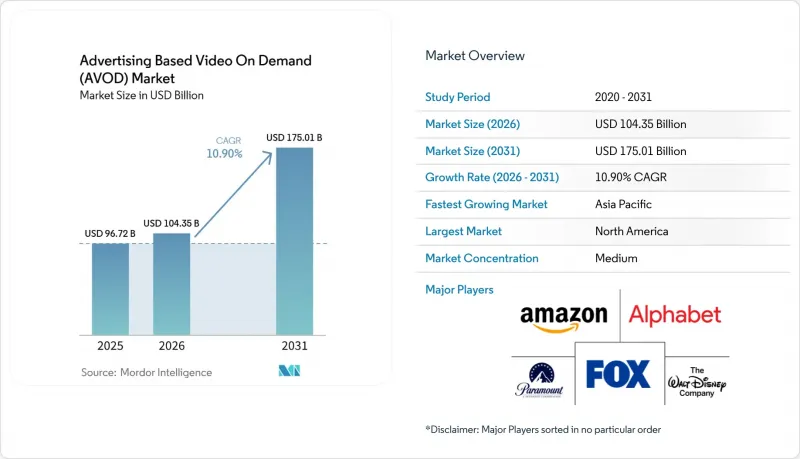
Mordor Intelligence에 의하면, 광고 기반 주문형 비디오(AVOD) 시장 규모는 2025년 967억 2,000만 달러로 평가되었고, 2026년에는 1,043억 5,000만 달러로 확대될 것으로 추정되고, 2026-2031년 CAGR 10.90%로 성장을 지속할 전망이며, 2031년에는 1,750억 1,000만 달러에 이를 것으로 예측됩니다.
본 보고서는 컨텐츠 유형별(영화, TV 프로그램·에피소드형 컨텐츠, 다큐멘터리, 기타), 기기 유형별(스마트폰·태블릿, 스마트 TV, 노트북·데스크톱 PC, 기타), 최종 사용자별(미디어 및 엔터테인먼트, 소매 및 전자상거래, 헬스케어, 기타), 광고 형태별(프리롤, 기타), 지역별로 분류되어 있습니다. 시장 전망은 금액(달러) 기준으로 제시되어 있습니다.
세계의 광고 기반 주문형 비디오(AVOD) 시장 동향 및 인사이트
커넥티드 TV로의 광고 지출 전환 확대
선형 TV에서 커넥티드 TV(CTV)로의 광고 지출 전환은 광고 기반 주문형 비디오(AVOD) 시장을 형성하는 가장 강력한 요인으로 계속 작용하고 있습니다. 이는 광고주들이 현재 스트리밍을 단순한 실험적 항목이 아닌 핵심 TV 채널로 인식하고 있기 때문입니다. 2026년 Premium과 Advertiser Perceptions의 조사에 따르면, 미국 광고주의 70%가 2026년에 CTV와 OTT에 대한 지출을 평균 17% 늘릴 계획이며, 그 증가분의 28%는 기존 방송 TV에서 재분배된 예산으로 직접 충당될 것으로 예측됩니다. 이러한 변화에 따라 광고주층도 확대되고 있습니다. IAB 보고서에 따르면, 연간 예산이 5,000만 달러 이하인 소규모 광고주 중 CTV에 투자하는 비율은 셀프 서비스 도구의 보급을 배경으로 2024년 60%에서 2026년에는 85%로 상승했습니다. 이러한 확대는 기존 TV 판매 모델로는 효율적으로 대응할 수 없었던 지속적인 수요의 ‘롱테일’을 창출한다는 점에서 중요합니다. 또한, 이 조사에서는 통합형 및 하이브리드형 구매 팀이 현재 CTV 예산의 55%를 관리하고 있는 것으로 밝혀졌습니다. 이는 기획 워크플로가 통합되어 가고 있으며, 강력한 프로그래매틱 인프라를 갖춘 플랫폼이 우위를 점하고 있음을 보여줍니다.
리테일 미디어와 쇼핑 지원 동영상의 융합
리테일 미디어의 통합으로 인해, 광고 기반 주문형 비디오(AVOD) 시장은 단순한 도달 채널에서 구매 기여도가 더 명확한 측정 가능한 유통 채널로 변화하고 있습니다. Criteo에 따르면, 2025년 4월에 출시된 ‘Onsite Video’(Albertsons Companies, Costco, Walmart Mexico에서 이용)는 초기 테스트에서 스폰서 상품 광고와 결합한 결과, 클릭률(CTR)이 280% 증가하고 매출이 460% 향상되었다고 합니다. Roku는 2026년 4월, 이러한 개념을 한층 더 발전시켜 ‘Roku Curate’를 도입했습니다. 이는 Roku의 오디언스 데이터와 Best Buy Ads, Instacart, Kroger Precision Marketing 및 기타 소매 파트너로부터 얻은 검증된 구매 신호를 일반적인 구매 워크플로우 내에서 통합하는 것입니다. 이 발전이 중요한 이유는 동영상 노출과 매출 측정 간의 격차를 줄여주기 때문입니다. 이 격차는 그동안 스트리밍 환경에서 성과형 광고 예산을 제한하는 요인이 되어 왔습니다. 또한, 이러한 움직임은 순수한 AVOD 사업자에 대한 압박을 강화할 것입니다. 왜냐하면 퍼스트 파티 상거래 신호를 보유하지 않은 플랫폼은 소매업체와 연계된 광고 슬롯의 가치 제안을 따라잡기 어려워지기 때문입니다.
과도한 광고로 인한 피로감과 시청자 이탈
광고 과다로 인한 피로감은 광고 기반 주문형 비디오(AVOD) 시장에 있어 여전히 가장 명백한 운영 위험 요소입니다. 단기적인 수익 증가는 광고 지원 모델이 의존하는 시청자의 안정성을 훼손할 가능성이 있기 때문입니다. Parks Associates는 2025년 보고서에서 스트리밍 시청자의 70%가 ‘반복되는 광고 노출’을 가장 큰 불만 사항으로 꼽았다고 보고했는데, 이는 광고 지원형 요금제의 확대에 따라 시청자의 수용 한계가 시험대에 올랐음을 보여줍니다. 또한 사용자 관련 초안에서는 삼성의 타이젠(Tizen) 생태계 내 전체 앱에서 이탈 사용자와 활성 사용자의 비율이 9 대 1이라고 지적하고 있으며, 이는 낮은 광고 품질이나 과도한 반복이 사용자 유지율을 저해할 수 있다는 견해를 뒷받침합니다. 이 문제는 중요합니다. 시청자 감소는 광고주가 지불하는 대가의 규모를 축소시키고, 시간이 지남에 따라 가격 결정력을 약화시키기 때문입니다. 광고 노출 빈도 관리, 크리에이티브 로테이션, 관련성 향상에 투자하는 플랫폼은 사용자 참여도와 수익화의 질을 모두 유지하는 데 유리한 입장에 있습니다.
부문 분석
2025년, TV 프로그램 및 에피소드 형식의 컨텐츠는 광고 기반 주문형 비디오(AVOD) 시장 점유율의 34.17%를 차지했으며, 이는 연속 시청이 동일한 세션 내에서 광고 노출 기회를 반복적으로 창출함을 반영합니다. 광고 기반 비디오 온디맨드 산업에서 이 형식은 ‘세션 스태킹’의 혜택을 받고 있습니다. 이는 시청자가 플랫폼을 떠나지 않고 한 에피소드에서 다음 에피소드로 이동하는 현상입니다. 이러한 패턴을 통해 컨텐츠 확보 및 배포 비용을 동등한 수준으로 증가시키지 않으면서도 광고 노출 밀도를 높일 수 있습니다. 영화나 장편 작품은 여전히 중요한 시청층을 차지하고 있지만, 일반적으로 1회 시청 세션당 미드롤 광고 횟수가 적기 때문에 에피소드 형식의 라이브러리에 비해 수익화 여지가 제한적입니다.
광고 기반 주문형 비디오(AVOD) 시장 규모 구성에서 기타 컨텐츠 유형은 크리에이터 주도형 동영상, 스포츠 클립, 뉴스 프로그램, 더 광범위한 FAST 채널 프로그램의 지원에 힘입어 2026-2031년 연평균 성장률(CAGR) 11.62%를 나타낼 것으로 예측됩니다. 이러한 변화가 중요한 이유는 과거에는 구조화되지 않은 것으로 간주되던 광고 슬롯 카테고리가 현재는 광고주에게 보다 체계적으로 판매되고 있기 때문입니다. 또한, 이 사용자용 초안에서는 iQIYI가 2026년에 ‘Nattopro’ 플랫폼을 통해 100편 이상의 단편 드라마를 공개할 계획이라고 지적하고 있으며, 단편 형식의 프로그램이 전용 수익화 카테고리로 자리 잡아가고 있음을 보여줍니다. 단편 형식은 1분당 광고와 컨텐츠의 비율을 높일 수 있어 시청자의 집중도가 높으며, 컨텐츠 비용이 엄격하게 관리되는 경우 수익성을 향상시킬 수 있습니다.
2025년에는 스마트 TV가 41.59%의 점유율을 차지했으며, 광고 기반 주문형 비디오(AVOD) 시장에서 거실이 프리미엄 가격 책정의 중심 역할을 계속했습니다. Roku는 2026년 1분기에 387억 시간의 스트리밍 이용 시간을 보고했으며, 이는 전년 동기 대비 8% 증가한 수치입니다. 이는 선진국 시장에서 대형 화면 인터페이스에 대한 높은 참여도가 지속되고 있음을 뒷받침합니다. 대형 화면 시청은 주목도가 높고 기억 유지율도 뛰어나며, 기존 TV와 유사한 시청 환경을 제공한다는 점에서 여전히 매력적입니다. 광고 전달 기능이 뛰어난 스마트 TV OS로의 시청 전환이 진행됨에 따라, 노트북 및 데스크톱 PC의 상대적 중요성은 계속해서 낮아지고 있습니다.
스마트폰 및 태블릿용 광고 기반 주문형 비디오(AVOD) 시장 규모는 아시아태평양 및 남미 지역의 ‘모바일 퍼스트’ 스트리밍 습관에 힘입어 2031년까지 연평균 성장률(CAGR) 11.76%로 확대될 것으로 예측됩니다. 이 사용자 보고서에서는 이러한 동향을 특히 인도와 연관지어 다루고 있으며, 인도에서는 2030년까지 온라인 동영상 증가분의 70% 이상을 광고 지원형 모델이 차지할 것으로 전망됩니다. 주요 과제는 한 가구에서 모바일 기기와 커넥티드 TV를 모두 사용하는 경우, 크로스 디바이스 ID의 일관성이 유지되지 않는다는 점입니다. 이로 인해 중복 집계나 빈도 관리의 미비점이 발생하고 있습니다. 인증된 가구 그래프나 기기 수준 ID 연동에 기반한 솔루션을 통해 상황은 점차 개선되고 있으나, 최대 규모의 플랫폼 생태계를 제외하면 도입 현황에 편차가 나타나고 있습니다.
지역별 분석
2025년, 북미는 광고 기반 주문형 비디오(AVOD) 시장 점유율의 39.54%를 차지했으며, 지역별 최대 수익원이 되었습니다. 이 지역은 성숙한 커넥티드 TV 인프라, 광고주 인지도, 미국 발 대형 스트리밍 플랫폼에 프리미엄 인벤토리가 집중되어 있다는 장점을 가지고 있습니다. Roku가 제출한 자료에서도 플랫폼에 대한 지속적인 참여와 수익화 지원 확대가 나타나고 있으며, 이는 광고 기반 비디오 온디맨드(AVOD) 시장에서 북미가 여전히 규모, 가격 책정, 프로그래매틱의 고도화 측면에서 상업적 기준을 확립하고 있는 이유를 뒷받침합니다. 캐나다와 멕시코는 미국에 비해 규모는 작지만, 국경을 초월한 플랫폼의 확대와 확립된 광고주 워크플로우로부터 계속해서 혜택을 받고 있습니다.
아시아태평양은 2026-2031년 연평균 성장률(CAGR) 11.93%로 확대될 것으로 예측되며, 광고 기반 주문형 비디오(AVOD) 시장 규모 측면에서 이 지역이 가장 빠른 성장을 이룰 것으로 보입니다. AVIA와 Media Partners Asia의 예측에 따르면, 아시아태평양의 프리미엄 AVOD 매출은 인도, 일본, 호주를 필두로 한국, 인도네시아가 뒤를 이어 2025년 80억 달러에서 2030년까지 120억 달러 이상으로 증가할 것으로 전망됩니다. 인도는 사용자 수가 많고 ARPU가 낮은 구조로 인해, 플랫폼이 구독 요금에 주로 의존하기보다는 광고 노출 수를 극대화할 수밖에 없는 상황이라, 여전히 특히 중요한 시장으로 남아 있습니다. 반면, 일본은 사용자 1인당 수익화가 더 높고, 고품질의 현지 컨텐츠 및 스포츠 컨텐츠를 중심으로 차별화를 꾀하고 있다는 점에서 다른 특징을 보이고 있습니다. 중국도 여전히 중요한 시장이지만, 사용자용 초안에서는 플랫폼이 컨텐츠의 경제성을 조정하는 과정에서 단기적으로는 광고 측면의 압박이 커지고, AI를 활용한 숏폼 프로그램으로의 적극적인 전환이 진행되고 있다고 지적되고 있습니다.
유럽은 광고 기반 주문형 비디오(AVOD) 시장에 있어 여전히 주요 지역 시장이며, 현지 진출기업들이 세계 플랫폼의 규모에 대응해 나감에 따라 방송사 간의 협력이 점점 더 중요해지고 있습니다. 또한 사용자용 초안에서는 남미가 브라질과 아르헨티나를 중심으로 부상하고 있는 기회라고 설명하고 있으며, 브라질에서 Roku의 광고 플랫폼 출시 소식은 수익화 준비가 완료되었음을 보여주는 강력한 자신감을 드러내고 있습니다. 아프리카는 여전히 초기 단계에 있지만, 남아프리카공화국, 나이지리아, 이집트 등 시장에서 나타나는 ‘모바일 우선’ 시청 패턴은 광고 지원형 스트리밍의 장기적인 잠재력을 뒷받침하고 있습니다. 이 지역 전반에 걸쳐 현지 컨텐츠, 비교적 낮은 가격 장벽, 유연한 광고 모델이 접근성을 대가로 광고를 시청하려는 소비자의 의지와 부합하는 곳에서 광고 기반 주문형 비디오(AVOD) 시장이 성장하고 있습니다.
기타 혜택
- 엑셀 형식 시장 예측(ME) 시트
- 3개월간의 애널리스트 지원
자주 묻는 질문
목차
제1장 서론
제2장 조사 방법
제3장 주요 요약
제4장 시장 구도
제5장 시장 규모 및 성장 예측
제6장 경쟁 구도
제7장 시장 기회 및 향후 전망
AJY 26.08.11According to Mordor Intelligence, the advertising based video on demand (AVOD) market size is expected to grow from USD 96.72 billion in 2025 to USD 104.35 billion in 2026 and is forecast to reach USD 175.01 billion by 2031 at 10.90% CAGR over 2026-2031.
This report is Segmented by Content Type (Movies and Films, TV Shows and Episodic Content, Documentaries, and More), Device Type (Smartphones and Tablets, Smart TVs, Laptops and Desktops, and More), End-User (Media and Entertainment, Retail and E-Commerce, Healthcare, and More), Ad Format (Pre-Roll, and More), and Geography. The Market Forecasts are Provided in Terms of Value (USD).
Global Advertising Based Video On Demand (AVOD) Market Trends and Insights
Rising Connected TV Ad Spend Migration
Advertising migration from linear television to connected TV remains the strongest force shaping the advertising based video on demand (AVOD) market, because buyers now see streaming as a core television channel rather than an experimental line item. The 2026 Premion and Advertiser Perceptions survey showed that 70% of U.S. advertisers planned to increase CTV and OTT spending by an average of 17% in 2026, with 28% of that increase expected to come directly from reallocation from broadcast linear. The same change is widening the buyer base, as the IAB reported that the share of small spenders with annual budgets below USD 50 million investing in CTV rose from 60% in 2024 to 85% in 2026, driven by self-serve tools. That broadening matters because it adds a long tail of recurring demand that older television sales models could not serve efficiently. The survey also found that integrated and hybrid buying teams now control 55% of CTV budgets, which shows that planning workflows are consolidating and favoring platforms with strong programmatic infrastructure.
Retail Media and Shoppable Video Convergence
Retail media integration is changing the advertising based video on demand (AVOD) market from a reach channel into a measurable sales channel with clearer purchase attribution. Criteo stated that its April 2025 rollout of Onsite Video, used by Albertsons Companies, Costco, and Walmart Mexico, produced a 280% increase in click-through rates and a 460% lift in sales when paired with sponsored product ads in early tests. Roku extended this logic in April 2026 through Roku Curate, which combined Roku audience data with verified purchase signals from Best Buy Ads, Instacart, Kroger Precision Marketing, and other retail partners inside ordinary buying workflows. This development matters because it lowers the gap between video exposure and sales measurement, which has historically limited performance budgets in streaming environments. It also increases pressure on pure-play AVOD operators, because platforms without first-party commerce signals will find it harder to match the value proposition of retail-linked inventory.
Ad-Load Fatigue and Viewer Churn
Ad-load fatigue remains the clearest operating risk for the advertising based video on demand (AVOD) market because short-term revenue gains can weaken the audience stability that ad-supported models depend on. Parks Associates reported in 2025 that 70% of streaming viewers identified repetitive ad exposure as their leading frustration, which shows that audience tolerance is being tested as ad-supported tiers expand. The user draft also noted a 9:1 churned-to-active user ratio across apps in the Samsung Tizen ecosystem, reinforcing the idea that weak ad quality and excessive repetition can damage retention. This issue is important because audience erosion reduces the scale that advertisers are paying for and weakens pricing leverage over time. Platforms that invest in frequency controls, creative rotation, and better relevance are better placed to defend both user engagement and monetization quality.
Other drivers and restraints analyzed in the detailed report include:
- First-Party Data Targeting Demand
- Streaming-Exclusive Live Sports Inventory Expansion
- Privacy-Led Targeting Constraints
For complete list of drivers and restraints, kindly check the Table Of Contents.
Segment Analysis
TV shows and episodic content held 34.17% of the advertising based video on demand (AVOD) market share in 2025, reflecting how serialized viewing creates repeated ad opportunities within the same session. In the advertising based video on demand industry, this format benefits from session stacking, where viewers move from one episode to the next without leaving the platform. That pattern raises ad impression density without requiring a matching increase in content acquisition or delivery costs. Movies and films still represent an important viewing pool, but they typically feature fewer mid-roll breaks per viewing session, which limits monetization compared to episodic libraries.
Other content types in the advertising based video on demand (AVOD) market size mix are projected to grow at an 11.62% CAGR from 2026 to 2031, supported by creator-led video, sports clips, news formats, and broader FAST channel programming. This shift matters because inventory categories that were once considered unstructured are now sold to advertisers more systematically. The user draft also pointed to iQIYI's plan to release more than 100 short-form dramas in 2026 through its Nattopro platform, showing that short-form programming is becoming a dedicated monetization category. Shorter formats can support a higher ad-to-content ratio per minute, which improves yield when audience attention is strong and content costs are tightly managed.
Smart TVs captured 41.59% share in 2025, which kept the living room at the center of premium pricing in the advertising based video on demand (AVOD) market. Roku reported 38.7 billion streaming hours in Q1 2026, up 8% year over year, which confirmed continued heavy engagement on large-screen interfaces in developed markets. Large-screen viewing remains attractive because it is associated with stronger attention, better recall, and a viewing setting that resembles traditional television. Laptops and desktops continue to lose relative importance as viewing shifts toward smart TV operating systems with stronger ad-serving capabilities.
The advertising based video on demand (AVOD) market size for smartphones and tablets is projected to expand at an 11.76% CAGR through 2031, driven by mobile-first streaming habits in Asia-Pacific and South America. The user draft linked that trend particularly to India, where ad-supported models are expected to account for more than 70% of incremental online video growth by 2030. The main challenge is that cross-device identity remains inconsistent when a household uses both mobile and connected TV devices, leading to duplication and poor frequency control. Solutions tied to authenticated household graphs and device-level identity partnerships are improving the situation, but adoption remains uneven outside the largest platform ecosystems.
Complete Report Scope:
- By Content Type
- Movies and Films
- TV Shows and Episodic Content
- Documentaries
- Other Content Types
- By Device Type
- Smartphones and Tablets
- Smart TVs
- Laptops and Desktops
- Other Device Types
- By End-User
- Media and Entertainment
- Retail and E-Commerce
- BFSI
- Education
- Information Technology and Telecommunications
- Healthcare
- Other End-Users
- By Ad Format
- Pre-Roll
- Mid-Roll
- Post-Roll
- By Geography
- North America
- United States
- Canada
- Mexico
- South America
- Brazil
- Argentina
- Chile
- Rest of South America
- Europe
- Germany
- United Kingdom
- France
- Italy
- Spain
- Rest of Europe
- Asia-Pacific
- China
- Japan
- India
- South Korea
- Australia
- Rest of Asia-Pacific
- Middle East
- Saudi Arabia
- United Arab Emirates
- Qatar
- Rest of Middle East
- Africa
- South Africa
- Egypt
- Nigeria
- Rest of Africa
- North America
Geography Analysis
North America accounted for 39.54% of the advertising based video on demand (AVOD) market share in 2025, which made it the leading regional revenue center. The region benefits from mature connected TV infrastructure, high advertiser familiarity, and a strong concentration of premium inventory across large U.S.-originated streaming platforms. Roku's filings also showed continued platform engagement and expanding monetization support, reinforcing why North America still sets the commercial standard for scale, pricing, and programmatic sophistication in the advertising based video on demand (AVOD) market. Canada and Mexico remain smaller than the U.S., but they continue to benefit from cross-border platform expansion and established advertiser workflows.
Asia-Pacific is projected to expand at an 11.93% CAGR from 2026 to 2031, giving the region the fastest growth in the advertising based video on demand (AVOD) market size. AVIA and Media Partners Asia projected that premium AVOD revenue in Asia-Pacific would increase from USD 8 billion in 2025 to more than USD 12 billion by 2030, led by India, Japan, and Australia, followed by South Korea and Indonesia. India remains especially important because a high-volume, low-ARPU structure pushes platforms to maximize ad impression output rather than rely mainly on subscription pricing. Japan adds a different profile, with stronger monetization per user, premium local content, and sports-led differentiation. China remains important, but the user draft pointed to near-term advertising pressure and an active pivot toward AI-supported short-form programming as platforms adjust content economics.
Europe remains a major regional pool for the advertising based video on demand (AVOD) market, and broadcaster coordination is becoming more important as local players respond to global platform scale. The user draft also described South America as a rising opportunity centered on Brazil and Argentina, with Roku's ad platform launch in Brazil showing stronger confidence in monetization readiness. Africa is still at an earlier stage, but mobile-first viewing patterns in markets such as South Africa, Nigeria, and Egypt support long-term potential for ad-supported streaming. Across these regions, the advertising based video on demand (AVOD) market is growing where local content, lighter pricing barriers, and flexible advertising models align with consumer willingness to watch ads in exchange for access.
- Alphabet Inc.
- Amazon.com, Inc.
- The Walt Disney Company
- Fox Corporation
- Paramount Skydance Corporation
- Roku, Inc.
- Comcast Corporation
- Warner Bros. Discovery, Inc.
- Netflix, Inc.
- Samsung Electronics Co., Ltd.
- LG Electronics Inc.
- ITV plc
- Rakuten Group, Inc.
- PCCW Limited
- iQIYI, Inc.
- Tencent Holdings Limited
- ProSiebenSat.1 Media SE
- Seven West Media Limited
- Channel Four Television Corporation
- Plex, Inc.
Additional Benefits:
- The market estimate (ME) sheet in Excel format
- 3 months of analyst support
TABLE OF CONTENTS
1 INTRODUCTION
- 1.1 Study Assumptions And Market Definition
- 1.2 Scope Of The Study
2 RESEARCH METHODOLOGY
3 EXECUTIVE SUMMARY
4 MARKET LANDSCAPE
- 4.1 Market Overview
- 4.2 Market Drivers
- 4.2.1 Rising Connected TV Ad Spend Migration
- 4.2.2 Retail Media and Shoppable Video Convergence
- 4.2.3 First-Party Data Targeting Demand
- 4.2.4 Streaming-Exclusive Live Sports Inventory Expansion
- 4.2.5 AI-Led Ad Personalization and Yield Optimization
- 4.2.6 FAST Channel Monetization Scale-Up
- 4.3 Market Restraints
- 4.3.1 Ad-Load Fatigue and Viewer Churn
- 4.3.2 Privacy-Led Targeting Constraints
- 4.3.3 Content Licensing Cost Inflation
- 4.3.4 Measurement Fragmentation Across Devices
- 4.4 Industry Value Chain Analysis
- 4.5 Regulatory Landscape
- 4.6 Technological Outlook
- 4.7 Porter's Five Forces Analysis
- 4.7.1 Bargaining Power of Buyers
- 4.7.2 Bargaining Power of Suppliers
- 4.7.3 Threat of New Entrants
- 4.7.4 Threat of Substitutes
- 4.7.5 Intensity of Competitive Rivalry
- 4.8 Impact of Macroeconomic Factors on the Market
5 MARKET SIZE AND GROWTH FORECASTS (VALUE)
- 5.1 By Content Type
- 5.1.1 Movies and Films
- 5.1.2 TV Shows and Episodic Content
- 5.1.3 Documentaries
- 5.1.4 Other Content Types
- 5.2 By Device Type
- 5.2.1 Smartphones and Tablets
- 5.2.2 Smart TVs
- 5.2.3 Laptops and Desktops
- 5.2.4 Other Device Types
- 5.3 By End-User
- 5.3.1 Media and Entertainment
- 5.3.2 Retail and E-Commerce
- 5.3.3 BFSI
- 5.3.4 Education
- 5.3.5 Information Technology and Telecommunications
- 5.3.6 Healthcare
- 5.3.7 Other End-Users
- 5.4 By Ad Format
- 5.4.1 Pre-Roll
- 5.4.2 Mid-Roll
- 5.4.3 Post-Roll
- 5.5 By Geography
- 5.5.1 North America
- 5.5.1.1 United States
- 5.5.1.2 Canada
- 5.5.1.3 Mexico
- 5.5.2 South America
- 5.5.2.1 Brazil
- 5.5.2.2 Argentina
- 5.5.2.3 Chile
- 5.5.2.4 Rest of South America
- 5.5.3 Europe
- 5.5.3.1 Germany
- 5.5.3.2 United Kingdom
- 5.5.3.3 France
- 5.5.3.4 Italy
- 5.5.3.5 Spain
- 5.5.3.6 Rest of Europe
- 5.5.4 Asia-Pacific
- 5.5.4.1 China
- 5.5.4.2 Japan
- 5.5.4.3 India
- 5.5.4.4 South Korea
- 5.5.4.5 Australia
- 5.5.4.6 Rest of Asia-Pacific
- 5.5.5 Middle East
- 5.5.5.1 Saudi Arabia
- 5.5.5.2 United Arab Emirates
- 5.5.5.3 Qatar
- 5.5.5.4 Rest of Middle East
- 5.5.6 Africa
- 5.5.6.1 South Africa
- 5.5.6.2 Egypt
- 5.5.6.3 Nigeria
- 5.5.6.4 Rest of Africa
- 5.5.1 North America
6 COMPETITIVE LANDSCAPE
- 6.1 Market Concentration
- 6.2 Strategic Moves
- 6.3 Vendor Positioning Analysis
- 6.4 Company Profiles (includes Global Level Overview, Market Level Overview, Core Segments, Financials as available, Strategic Information, Market Rank/Share, Products and Services, Recent Developments)
- 6.4.1 Alphabet Inc.
- 6.4.2 Amazon.com, Inc.
- 6.4.3 The Walt Disney Company
- 6.4.4 Fox Corporation
- 6.4.5 Paramount Skydance Corporation
- 6.4.6 Roku, Inc.
- 6.4.7 Comcast Corporation
- 6.4.8 Warner Bros. Discovery, Inc.
- 6.4.9 Netflix, Inc.
- 6.4.10 Samsung Electronics Co., Ltd.
- 6.4.11 LG Electronics Inc.
- 6.4.12 ITV plc
- 6.4.13 Rakuten Group, Inc.
- 6.4.14 PCCW Limited
- 6.4.15 iQIYI, Inc.
- 6.4.16 Tencent Holdings Limited
- 6.4.17 ProSiebenSat.1 Media SE
- 6.4.18 Seven West Media Limited
- 6.4.19 Channel Four Television Corporation
- 6.4.20 Plex, Inc.
7 MARKET OPPORTUNITIES AND FUTURE OUTLOOK
- 7.1 White-Space and Unmet-Need Assessment


